REVIEW 3 major objections 6 minor 56 references
Progressive Correspondence Regenerator for Robust 3D Registration
T0 review · 3 major / 6 minor · reviewed 2026-08-09 · deepseek-v4-flash
Pith's one-line read A new method, Regor, claims that robust 3D registration is better served by regenerating high-quality correspondences than by pruning outliers, and demonstrates roughly tenfold more correct matches with higher registration recall across…
desk verdict Genuinely new regeneration idea with broad empirical support, but the theoretical proof is circular and the few-inlier claim is conditional on a good seed. read the letter →
The pith
A machine-rendered reading of the paper's core claim, the machinery that carries it, and where it could break.
The reading
What carries the argument
The load-bearing mechanism is the progressive regeneration loop. In each iteration, prior-guided local grouping samples seed correspondences and pulls radius-neighborhood point sets around each seed in both scans; generalized mutual matching (GMM), a relaxed mutual nearest-neighbor rule, then creates new correspondences by combining nearest-neighbor and multi-nearest-neighbor agreement in both directions. These new correspondences are corrected by center-aware three-point consistency (CTC), which treats the seed as a reliable center and accepts a pair when either seed-relative distance consistency or a strict pairwise distance-consistency condition holds; local poses estimated from high-scoring matches then reassign targets in the target neighborhood. A global stage merges regions via a hash table and applies second-order consistency to fix region-level errors, and the radius shrinks each round so the loop first maximizes overlap probability and then tightens precision. The paper's Theorem 1 is the mathematical hinge: under the assumption that correct correspondences are mutually more consistent than incorrect ones (event $\Phi$ with probability near 1), a local region whose consistency score reaches 1 is guaranteed to have inlier proportion above the threshold $a$; Theorem 2 guarantees GMM generates at least as many correct correspondences as mutual matching.
What would settle it
Take a scan pair with 50 ground-truth-consistent initial matches among 5,000, but alter the initial matching so every one of those matches has a translation error larger than the first-stage radius; if Regor still generates dense inliers and high registration recall, the small-error seed premise is not load-bearing, and if recall collapses to near zero, the premise is confirmed as load-bearing.
Extended reading notes
Core claim
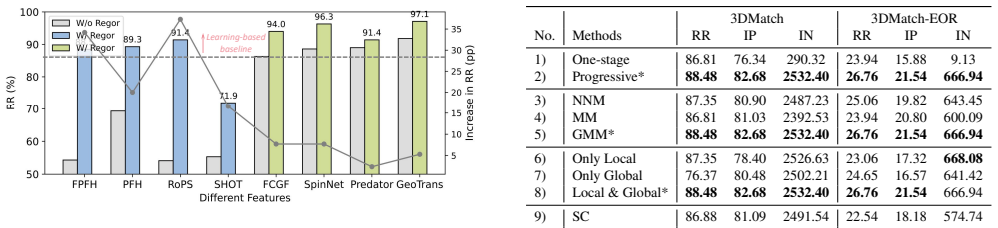
Regor's central discovery is that a correspondence set can be grown rather than merely filtered. Starting from the previous iteration's correspondences, the method samples seeds, defines radius-based local regions around each seed in both scans, re-matches within those regions, and then corrects the new matches using a center-aware three-point consistency test before merging and refining globally. Iterating this loop with progressively smaller radii accumulates inliers while improving precision. The paper claims this yields about ten times the number of correct correspondences of pruning methods, enables successful registration on 3DMatch-EOR with over 99% outlier ratios, and boosts weak descriptors such as PFH and RoPS above learning-based feature baselines. The same experiments also bound the claim: with fewer than 20 initial inliers, registration recall falls to 3.87%.
Load-bearing premise
The loop only works if at least one sampled seed correspondence has a positional error small enough that the radius neighborhoods around its two points still overlap the true corresponding surface region; if every seed is grossly wrong, local rematching has no correct geometry to latch onto and no new inliers can be generated.
Editorial extensions
If this is right
- If Regor's claims are right, state-of-the-art registration no longer requires a strong learned descriptor; traditional features such as FPFH and RoPS can reach or exceed the recall of learned-feature baselines.
- Because the loop ends with dense inliers, pose estimation can fall back to a plain SVD fit, reducing dependence on robust estimators like RANSAC in easy-to-moderate cases.
- The progressive shrinking-radius schedule becomes a reusable recipe: start wide to catch overlapping geometry, then narrow to lock in precision.
- The reported failure at fewer than 20 initial inliers sets a quantitative boundary for when regeneration can rescue a scan pair, useful for deciding when to acquire more views or denser sampling.
Reading between the lines
- Beyond the paper, the same regeneration principle could be applied to 2D image matching or multi-view feature tracking, where sparse seed matches also limit pose and structure estimation.
- The paper's own numbers imply a boundary condition it does not state in the conclusion: the final inlier count is capped by the overlapping surface area and sampling density, so on extremely sparse scans the 10x multiplier should shrink; a controlled experiment varying scan density would reveal this cap.
- A testable extension: replacing random seed sampling with a spatial-coverage strategy, such as farthest-point sampling over the correspondence set, could lower the minimum-inlier threshold below the observed 20 and stabilize the extreme-outlier regime.
- Beyond the paper's benchmarks, the center-aware three-point consistency could be reused as a generic local filter inside other outlier-removal pipelines, since it only requires a trustworthy seed pair.
Editorial analysis
A structured set of objections, weighed in public.
Referee Report
Summary. The manuscript proposes Regor, a progressive correspondence regeneration framework for 3D point cloud registration. Instead of pruning an initial match set, Regor iteratively groups correspondences into local regions, rematches inside those regions using a relaxed mutual nearest-neighbor rule, refines them with a center-aware three-point consistency and a global second-order consistency step, and merges the results, producing a much larger set of correspondences. The paper reports state-of-the-art registration recall on 3DMatch, 3DLoMatch, and KITTI, introduces a 3DMatch-EOR benchmark with >90% and >99% outlier ratios, and shows improvements across a range of hand-crafted and learned descriptors. It also states a theoretical guarantee (Theorem 1) for the local refinement step.
Significance. If the empirical claims hold, the method is a meaningful advance: it demonstrates that correspondence regeneration can substantially increase the number of usable inliers, with consistent gains across datasets and descriptors. The paper provides a broad experimental comparison, including ablations and a new extreme-outlier benchmark, and it intends to release the code. The main weaknesses are the invalid proof of Theorem 1, the conditional nature of the 'scarce inliers' claim, and the ambiguity introduced by SC2-PCR preprocessing before the first regeneration iteration.
major comments (3)
- [Appendix 6.1, Theorem 1] The proof of Theorem 1 is mathematically invalid and does not establish the stated claim. First, the statement 'if Score >= 1 then b >= a' is deterministic, but the proof derives a probability statement 'P(b/a >= 1) = 1', which is a different claim. Second, the proof assumes event Phi (that the consistency of correct correspondences exceeds that of incorrect ones) with P(Phi) ≈ 1; this is essentially the guarantee that the theorem is supposed to provide, so the argument is circular. Third, the proof replaces the L1-norm score of Eq. (7) with a max-row-sum expression without justification; these quantities are not equal. Fourth, the inequality in Eq. (11) and the step from Eq. (10) to Eq. (12) do not follow from the definitions: the sum over i of |S_il| is bounded by bN only for a column l of correct correspondences, and the product/independence step in Eq. (2) is not justified. Since Theorem 1 is cited in Sec. 3.4 as the theoretical guarantee for local correspondence correction, this is a load-bearing error.
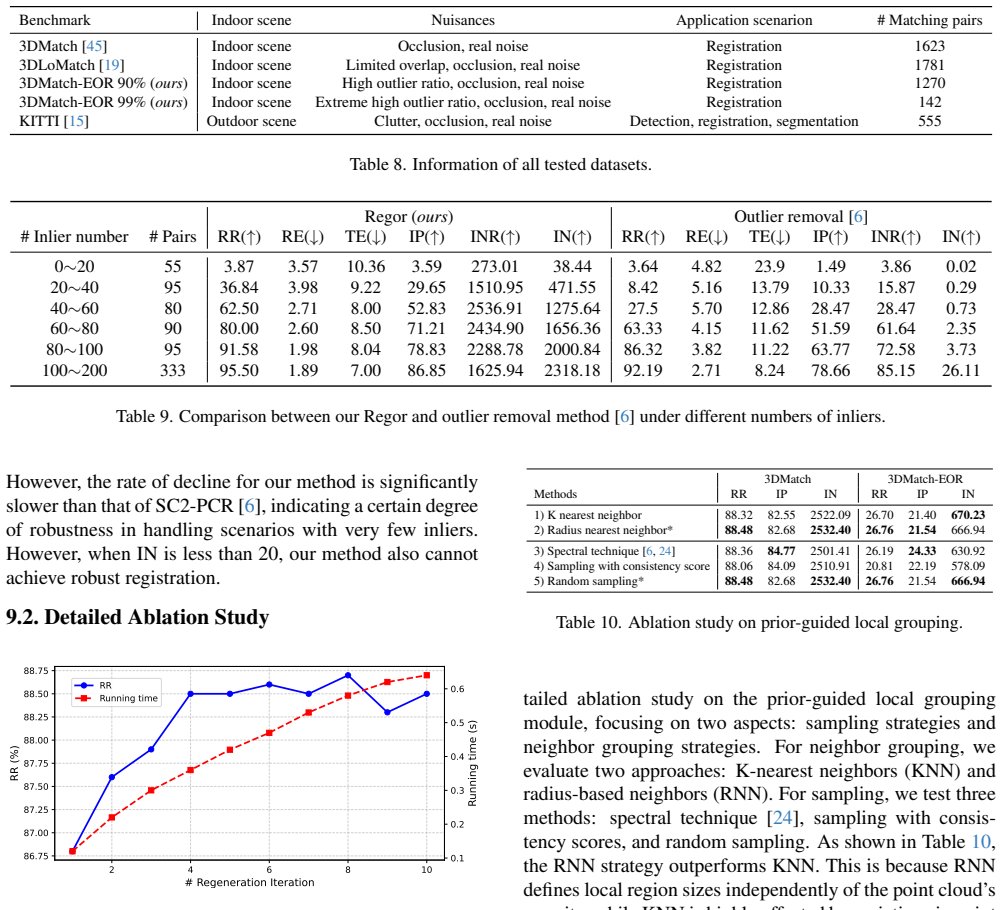
- [Section 6.3 and Table 9] The central claim of robustness to scarce initial inliers is conditional on the existence of at least one sampled seed correspondence whose positional error is smaller than the current local radius, so that the two local spheres overlap the same physical region. This is explicitly acknowledged in Sec. 6.3 ('outliers with small errors conduce to regenerate new correct correspondences by local matching') and is empirically confirmed by Table 9: when the initial match set contains 0–20 inliers, Regor achieves only 3.87% RR and 38.44 IN, and the text concedes 'when IN is less than 20, our method also cannot achieve robust registration.' The abstract and Sec. 4.1 therefore overstate the method's ability to 'address the challenge of scarce inliers'; the claim should be qualified and accompanied by an analysis of when the seed-overlap precondition is satisfied.
- [Section 7.2 and Eq. (18)] The description in Sec. 7.2 that SC2-PCR is applied before the first regeneration iteration means that the input to Regor is not the raw feature matching output but an already-filtered set of correspondences. This casts ambiguity on the definition of 'initial correspondences' in the INR metric (Eq. 18) and on the headline claim in Sec. 4.1 that Regor produces 'around 10 times the original amount' of correct correspondences: if the denominator is the SC2-PCR-filtered set, the ratio is inflated relative to methods that start from raw matches. The paper should clarify what set is used as the baseline for INR and the '10 times' claim, and should report the relevant numbers with respect to raw feature matches.
minor comments (6)
- [Abstract] Typo: 'whist' should be 'whilst' or 'while'.
- [Table 2] The method name 'PCRegen' in the table header should be 'Regor' for consistency with the rest of the paper.
- [Figure 12] The subfigure labels are inconsistent: '(c)' is used twice ('Pose result' and 'Correspondence result'); the second should be labeled '(d)'.
- [Eq. (17)] The expression should be argmax, not max, since the quantity is a maximization over R and t; also define sigma_d at first use.
- [Eq. (20)] The translation error formula contains a typo: 'ˆht' should read 't_hat_h'.
- [Sec. 8, Eq. (18)] The subscript in 'INRh' is typeset with a comma instead of a proper separator, and the definition should clarify the handling of INb = 0 in the denominator.
Circularity Check
Theorem 1's 'guarantee' assumes the very inlier-identification property it claims to establish; the empirical comparisons are otherwise externally benchmarked, so the circularity is partial.
-
self definitional
[Sec. 3.4 (Theorem 1); Supplementary Sec. 6.1 (Proof of Theorem 1)]
"Theorem 1. Assuming event Φ, where the consistency of correct correspondences is greater than the maximum consistency of incorrect correspondences, has a probability P (Φ) ≈ 1 (which means our method can correctly identify inliers), if the score of the local correspondences satisfies Score(Gt i ) ⩾ 1, then the proportion of correct correspondences b ⩾ a."
The assumption Φ is exactly the discriminative property the score is supposed to provide: that correctness can be read off the consistency matrix. The paper glosses Φ as 'our method can correctly identify inliers'. The score Score(G_t^i)=||S_t^i||_1/(a·N) is just an aggregate of that same consistency matrix. In the appendix proof, step (1) is justified 'based on our assumption that P(Φ)≈1', and the key bound 'sum_i |S_il| ≤ b·N' is asserted to hold 'when event Φ occurs'. From that bound the proof concludes b≥a. Thus Score≥1 ⇒ b≥a is not derived from properties of the actual CTC matrix; it is the assumption Φ restated in score language.
full rationale
Aside from Theorem 1, I find no significant circularity. Regor's headline results (88.48% RR on 3DMatch, 43.96% on 3DLoMatch, 99.82% on KITTI, and the large IN/INR gains) are measured against external baselines on public benchmarks; nothing is fitted and then re-predicted on the same quantity. The GMM argument (Theorem 2) is a set-inclusion bound (|G(A⊗B)|≥|G(A)|) and is not circular, though it counts all correspondences rather than only correct ones. The use of SC2-PCR as a pre-filter before the first iteration is disclosed in Sec. 7.2 and is an algorithmic component, not a fitted parameter masquerading as a prediction. The seed-overlap precondition (Sec. 6.3: 'outliers with small errors conduce to regenerate new correct correspondences') and the collapse at 0–20 initial inliers (Table 9) are important caveats about the scope of the central claim, but they are correctness/robustness limitations, not circular reductions. The one load-bearing circular step is Theorem 1, whose 'guarantee' is conditional on the discriminative event Φ that is essentially the desired property. Because the empirical contribution is independent of this theorem, the circularity is partial, not total.
Assumptions & free parameters
free parameters (9)
- local region initial radius r0 =
1 m (indoor), 10 m (outdoor)
- local region point count k0 =
20
- initial seed sampling count s0 =
500
- radius decay factor omega_r =
0.5
- GMM neighbor count k_GMM =
3
- inlier ratio threshold a =
0.5
- number of regeneration iterations =
4
- correspondence acceptance distance sigma_d =
not reported
- sampling and point-count decay factors omega_s, omega_k =
0.2 and 5
assumptions (4)
- ad hoc to paper Event Phi: with probability approximately 1, the consistency of correct correspondences exceeds the maximum consistency of incorrect correspondences.
- domain assumption At least one sampled seed correspondence has a small enough positional error that its local neighborhoods overlap the true corresponding region.
- domain assumption The underlying rigid transformation is consistent, so distance invariants such as ||pi-pj|| - ||qi-qj|| can identify inliers.
- domain assumption Feature descriptors retain some local discriminative signal even when global matching is poor.
Cite this review
Pith. "Pith review of Progressive Correspondence Regenerator for Robust 3D Registration." pith.science (2026). https://pith.science/paper/TKBZYNQE
@misc{pith2026250202163,
  author       = {Pith},
  title        = {Pith review of: Progressive Correspondence Regenerator for Robust 3D Registration},
  year         = {2026},
  howpublished = {\url{https://pith.science/paper/TKBZYNQE}},
  note         = {Machine review of arXiv:2502.02163}
}
read the original abstract
Obtaining enough high-quality correspondences is crucial for robust registration. Existing correspondence refinement methods mostly follow the paradigm of outlier removal, which either fails to correctly identify the accurate correspondences under extreme outlier ratios, or select too few correct correspondences to support robust registration. To address this challenge, we propose a novel approach named Regor, which is a progressive correspondence regenerator that generates higher-quality matches whist sufficiently robust for numerous outliers. In each iteration, we first apply prior-guided local grouping and generalized mutual matching to generate the local region correspondences. A powerful center-aware three-point consistency is then presented to achieve local correspondence correction, instead of removal. Further, we employ global correspondence refinement to obtain accurate correspondences from a global perspective. Through progressive iterations, this process yields a large number of high-quality correspondences. Extensive experiments on both indoor and outdoor datasets demonstrate that the proposed Regor significantly outperforms existing outlier removal techniques. More critically, our approach obtain 10 times more correct correspondences than outlier removal methods. As a result, our method is able to achieve robust registration even with weak features. The code will be released.
Figures


Figures from the paper (9 more)





Reference graph
Works this paper leans on
-
[1]
Spinnet: Learning a general surface descrip- tor for 3d point cloud registration
Sheng Ao, Qingyong Hu, Bo Yang, Andrew Markham, and Yulan Guo. Spinnet: Learning a general surface descrip- tor for 3d point cloud registration. In CVPR, pages 11753– 11762, 2021. 1, 2, 7, 8
work page 2021
-
[2]
Buffer: Balancing accuracy, efficiency, and general- izability in point cloud registration
Sheng Ao, Qingyong Hu, Hanyun Wang, Kai Xu, and Yulan Guo. Buffer: Balancing accuracy, efficiency, and general- izability in point cloud registration. In CVPR, pages 1255– 1264, 2023. 2
work page 2023
-
[3]
Pointdsc: Robust point cloud registration using deep spatial consistency
Xuyang Bai, Zixin Luo, Lei Zhou, Hongkai Chen, Lei Li, Zeyu Hu, Hongbo Fu, and Chiew-Lan Tai. Pointdsc: Robust point cloud registration using deep spatial consistency. In CVPR, pages 15859–15869, 2021. 1, 2, 6, 7, 3, 5
work page 2021
-
[4]
Daniel Barath and Ji ˇr´ı Matas. Graph-cut ransac. In CVPR, pages 6733–6741, 2018. 2
work page 2018
-
[5]
Daniel Barath and G ´abor Valasek. Space-partitioning ransac. In ECCV, pages 721–737, 2022. 2
work page 2022
-
[6]
Sc2- pcr: A second order spatial compatibility for efficient and ro- bust point cloud registration
Zhi Chen, Kun Sun, Fan Yang, and Wenbing Tao. Sc2- pcr: A second order spatial compatibility for efficient and ro- bust point cloud registration. In CVPR, pages 13221–13231,
-
[7]
Zhi Chen, Kun Sun, Fan Yang, Lin Guo, and Wenbing Tao. Sc2-pcr++: Rethinking the generation and selection for effi- cient and robust point cloud registration.IEEE TPAMI, 2023. 2, 7, 8
work page 2023
-
[8]
Fully convolutional geometric features
Christopher Choy, Jaesik Park, and Vladlen Koltun. Fully convolutional geometric features. In ICCV, pages 8957– 8965, 2019. 2, 6, 7, 8
work page 2019
Show all 56 references
-
[9]
Deep global registration
Christopher Choy, Wei Dong, and Vladlen Koltun. Deep global registration. In CVPR, pages 2514–2523, 2020. 6
2020
-
[10]
Point signatures: A new representation for 3d object recognition
Chin Seng Chua and Ray Jarvis. Point signatures: A new representation for 3d object recognition. IJCV, 25:63–85,
-
[11]
Optimal randomized ransac
Ond ˇrej Chum and Ji ˇr´ı Matas. Optimal randomized ransac. IEEE TPAMI, 30(8):1472–1482, 2008. 2
2008
-
[12]
Listing all maximal cliques in sparse graphs in near-optimal time
David Eppstein, Maarten L ¨offler, and Darren Strash. Listing all maximal cliques in sparse graphs in near-optimal time. In Algorithms and Computation: 21st International Sympo- sium, pages 403–414, 2010. 2
2010
-
[13]
Random sample consensus: a paradigm for model fitting with applications to image analysis and automated cartography
Martin A Fischler and Robert C Bolles. Random sample consensus: a paradigm for model fitting with applications to image analysis and automated cartography. Commun. ACM, 24(6):381–395, 1981. 1, 2, 6, 7, 5
1981
-
[14]
Isak Gath and Amir B. Geva. Unsupervised optimal fuzzy clustering. IEEE TPAMI, 11(7):773–780, 1989. 2
1989
-
[15]
Are we ready for autonomous driving? the kitti vision benchmark suite
Andreas Geiger, Philip Lenz, and Raquel Urtasun. Are we ready for autonomous driving? the kitti vision benchmark suite. In CVPR, pages 3354–3361, 2012. 2, 5, 3, 4
2012
-
[16]
Wegner, and Andreas Wieser
Zan Gojcic, Caifa Zhou, Jan D. Wegner, and Andreas Wieser. The perfect match: 3d point cloud matching with smoothed densities. In CVPR, pages 5540–5549, 2019. 2
2019
-
[17]
Rotational projection statistics for 3d local surface description and object recognition
Yulan Guo, Ferdous Sohel, Mohammed Bennamoun, Min Lu, and Jianwei Wan. Rotational projection statistics for 3d local surface description and object recognition. IJCV, 105: 63–86, 2013. 2, 7, 8
2013
-
[18]
Randla-net: Efficient semantic segmentation of large-scale point clouds
Qingyong Hu, Bo Yang, Linhai Xie, Stefano Rosa, Yulan Guo, Zhihua Wang, Niki Trigoni, and Andrew Markham. Randla-net: Efficient semantic segmentation of large-scale point clouds. In CVPR, pages 11108–11117, 2020. 4
2020
-
[19]
Predator: Registration of 3d point clouds with low overlap
Shengyu Huang, Zan Gojcic, Mikhail Usvyatsov, Andreas Wieser, and Konrad Schindler. Predator: Registration of 3d point clouds with low overlap. In CVPR, pages 4267–4276,
-
[20]
A comprehensive survey on point cloud registration
Xiaoshui Huang, Guofeng Mei, Jian Zhang, and Rana Ab- bas. A comprehensive survey on point cloud registration. arXiv preprint arXiv:2103.02690, 2021. 1
2021 arXiv
-
[21]
Robust outlier rejection for 3d reg- istration with variational bayes
Haobo Jiang, Zheng Dang, Zhen Wei, Jin Xie, Jian Yang, and Mathieu Salzmann. Robust outlier rejection for 3d reg- istration with variational bayes. In CVPR, pages 1148–1157,
-
[22]
Multiway point cloud mosaicking with diffusion and global optimization
Shengze Jin, Iro Armeni, Marc Pollefeys, and Daniel Barath. Multiway point cloud mosaicking with diffusion and global optimization. In CVPR, pages 20838–20849, 2024. 2
2024
-
[23]
Using spin im- ages for efficient object recognition in cluttered 3d scenes
Andrew E Johnson and Martial Hebert. Using spin im- ages for efficient object recognition in cluttered 3d scenes. TPAMI, 21(5):433–449, 1999. 4
1999
-
[24]
A spectral technique for correspondence problems using pairwise constraints
Marius Leordeanu and Martial Hebert. A spectral technique for correspondence problems using pairwise constraints. In ICCV, pages 1482–1489, 2005. 6, 4
2005
-
[25]
The 3d-3d registration problem revisited
Hongdong Li and Richard Hartley. The 3d-3d registration problem revisited. In ICCV, pages 1–8. IEEE, 2007. 4
2007
-
[26]
Hregnet: A hierarchical net- work for large-scale outdoor lidar point cloud registration
Fan Lu, Guang Chen, Yinlong Liu, Lijun Zhang, Sanqing Qu, Shu Liu, and Rongqi Gu. Hregnet: A hierarchical net- work for large-scale outdoor lidar point cloud registration. In ICCV, pages 16014–16023, 2021. 1
2021
-
[27]
Branch- and-bound methods for euclidean registration problems
Carl Olsson, Fredrik Kahl, and Magnus Oskarsson. Branch- and-bound methods for euclidean registration problems. IEEE TPAMI, 31(5):783–794, 2008. 1
2008
-
[28]
Dias Pais, Srikumar Ramalingam, Venu Madhav Govindu, Jacinto C
G. Dias Pais, Srikumar Ramalingam, Venu Madhav Govindu, Jacinto C. Nascimento, Rama Chellappa, and Pe- dro Miraldo. 3dregnet: A deep neural network for 3d point registration. In CVPR, pages 7191–7201, 2020. 2
2020
-
[29]
Geometric transformer for fast and ro- bust point cloud registration
Zheng Qin, Hao Yu, Changjian Wang, Yulan Guo, Yuxing Peng, and Kai Xu. Geometric transformer for fast and ro- bust point cloud registration. In CVPR, pages 11143–11152,
-
[30]
Aligning point cloud views using persistent feature histograms
Radu Bogdan Rusu, Nico Blodow, Zoltan Csaba Marton, and Michael Beetz. Aligning point cloud views using persistent feature histograms. In IROS, pages 3384–3391, 2008. 2, 7, 8
2008
-
[31]
Fast point feature histograms (fpfh) for 3d registration
Radu Bogdan Rusu, Nico Blodow, and Michael Beetz. Fast point feature histograms (fpfh) for 3d registration. In ICRA, pages 3212–3217, 2009. 2, 6, 7, 8, 5
2009
-
[32]
Shot: Unique signatures of histograms for surface and tex- ture description
Samuele Salti, Federico Tombari, and Luigi Di Stefano. Shot: Unique signatures of histograms for surface and tex- ture description. CVIU, 125:251–264, 2014. 2, 7, 8
2014
-
[33]
Ef- ficient ransac for point-cloud shape detection
Ruwen Schnabel, Roland Wahl, and Reinhard Klein. Ef- ficient ransac for point-cloud shape detection. In Comput. Graph Forum, pages 214–226, 2007. 2
2007
-
[34]
Speal: Skeletal prior embedded attention learning for cross-source point cloud registration
Kezheng Xiong, Maoji Zheng, Qingshan Xu, Chenglu Wen, Siqi Shen, and Cheng Wang. Speal: Skeletal prior embedded attention learning for cross-source point cloud registration. In AAAI, pages 6279–6287, 2024. 1
2024
-
[35]
One-inlier is first: Towards efficient position encoding for point cloud registration
Fan Yang, Lin Guo, Zhi Chen, and Wenbing Tao. One-inlier is first: Towards efficient position encoding for point cloud registration. NeurIPS, 35:6982–6995, 2022. 2
2022
-
[36]
Teaser: Fast and certifiable point cloud registration
Heng Yang, Jingnan Shi, and Luca Carlone. Teaser: Fast and certifiable point cloud registration. IEEE TRO, 37(2): 314–333, 2020. 2, 4, 6
2020
-
[37]
Mutual voting for ranking 3d correspon- dences
Jiaqi Yang, Xiyu Zhang, Shichao Fan, Chunlin Ren, and Yanning Zhang. Mutual voting for ranking 3d correspon- dences. IEEE TPAMI, 2023. 2
2023
-
[38]
Hunter: Exploring high-order consistency for point cloud registration with severe outliers
Runzhao Yao, Shaoyi Du, Wenting Cui, Aixue Ye, Feng Wen, Hongbo Zhang, Zhiqiang Tian, and Yue Gao. Hunter: Exploring high-order consistency for point cloud registration with severe outliers. IEEE TPAMI, 2023. 2, 6, 7
2023
-
[39]
Learning to find good correspondences
Kwang Moo Yi, Eduard Trulls, Yuki Ono, Vincent Lepetit, Mathieu Salzmann, and Pascal Fua. Learning to find good correspondences. In CVPR, pages 2666–2674, 2018. 2
2018
-
[40]
A survey on global lidar localization: Challenges, advances and open problems
Huan Yin, Xuecheng Xu, Sha Lu, Xieyuanli Chen, Rong Xiong, Shaojie Shen, Cyrill Stachniss, and Yue Wang. A survey on global lidar localization: Challenges, advances and open problems. IJCV, pages 1–33, 2024. 1
2024
-
[41]
Cofinet: Reliable coarse-to-fine correspondences for robust pointcloud registration
Hao Yu, Fu Li, Mahdi Saleh, Benjamin Busam, and Slobo- dan Ilic. Cofinet: Reliable coarse-to-fine correspondences for robust pointcloud registration. NeurIPS, 34:23872– 23884, 2021. 1, 2
2021
-
[42]
Rotation-invariant transformer for point cloud matching
Hao Yu, Zheng Qin, Ji Hou, Mahdi Saleh, Dongsheng Li, Benjamin Busam, and Slobodan Ilic. Rotation-invariant transformer for point cloud matching. InCVPR, pages 5384– 5393, 2023. 2
2023
-
[43]
Peal: Prior-embedded explicit attention learn- ing for low-overlap point cloud registration
Junle Yu, Luwei Ren, Yu Zhang, Wenhui Zhou, Lili Lin, and Guojun Dai. Peal: Prior-embedded explicit attention learn- ing for low-overlap point cloud registration. In CVPR, pages 17702–17711, 2023. 2
2023
-
[44]
Learning instance-aware correspondences for robust multi- instance point cloud registration in cluttered scenes
Zhiyuan Yu, Zheng Qin, Lintao Zheng, and Kai Xu. Learning instance-aware correspondences for robust multi- instance point cloud registration in cluttered scenes. arXiv preprint arXiv:2404.04557, 2024. 1
2024 arXiv
-
[45]
3dmatch: Learning local geometric descriptors from rgb-d reconstruc- tions
Andy Zeng, Shuran Song, Matthias Nießner, Matthew Fisher, Jianxiong Xiao, and Thomas Funkhouser. 3dmatch: Learning local geometric descriptors from rgb-d reconstruc- tions. In CVPR, pages 1802–1811, 2017. 2, 5, 6, 3, 4
2017
-
[46]
3d registration with maximal cliques
Xiyu Zhang, Jiaqi Yang, Shikun Zhang, and Yanning Zhang. 3d registration with maximal cliques. In CVPR, pages 17745–17754, 2023. 1, 2, 5, 6, 7
2023
-
[47]
Fastmac: Stochastic spectral sampling of correspondence graph
Yifei Zhang, Hao Zhao, Hongyang Li, and Siheng Chen. Fastmac: Stochastic spectral sampling of correspondence graph. In CVPR, pages 17857–17867, 2024. 6, 7
2024
-
[48]
Spherenet: Learning a noise-robust and general descriptor for point cloud registration
Guiyu Zhao, Zhentao Guo, Xin Wang, and Hongbin Ma. Spherenet: Learning a noise-robust and general descriptor for point cloud registration. IEEE TGRS, 62:1–16, 2024. 2 Progressive Correspondence Regenerator for Robust 3D Registration Supplementary Material
2024
-
[50]
Proof of Theorem 1 Theorem 1
Analysis and Proof 6.1. Proof of Theorem 1 Theorem 1. Assuming event Φ, where the consistency of correct correspondences is greater than the maximum consistency of incorrect correspondences, has a probability P (Φ) ≈ 1 (which means our method can correctly identify inliers), i...
-
[51]
Point-level Pose Refinement Pose refinement is crucial for achieving accurate pose esti- mation
Implementation details 7.1. Point-level Pose Refinement Pose refinement is crucial for achieving accurate pose esti- mation. In the final stage of correspondence regeneration, we perform pose refinement based on the established corre- spondences. Unlike correspondence-level po...
-
[52]
It represents the number of correct correspondences in the final correspondences, reflecting our ability to generate inliers
Detailed Metrics Inlier Number (IN). It represents the number of correct correspondences in the final correspondences, reflecting our ability to generate inliers. Inlier Number Ratio (INR). It is the ratio of inliers INa in the final correspondences to the inliers INb in the i...
-
[53]
Additional Experiments The information of all tested datasets is given in Table 8. 9.1. Results at different numbers of inliers In Sec. 4.1, we propose the 3DMatch-EOR Benchmark, which includes two baselines: one with an outlier ratio exceeding 99% and another exceeding 90%. F...
-
[54]
K nearest neighbor 88.32 82.55 2522.0926.70 21.40670.232) Radius nearest neighbor*88.4882.682532.4026.76 21.54666.94
-
[55]
Ablation study on prior-guided local grouping
Spectral technique [6, 24]88.3684.772501.4126.1924.33630.924) Sampling with consistency score88.06 84.09 2510.9120.81 22.19 578.095) Random sampling* 88.4882.682532.4026.7621.54666.94 Table 10. Ablation study on prior-guided local grouping. tailed ablation study on the prior-g...
1924
-
[56]
Similarly, Rows 4, 5, 6, and 7 indicated that r0 = 1 and ωr = 0.5 are the optimal radius hyperparameters. 9.3. Additional Qualitative Results As demonstrated in Sec. 4.1 and 4.2, our Regor achieves su- perior quantitative performance on the 3DMatch and KITTI datasets. In this ...
-
[2022]
1, 2, 5, 6, 7, 8, 3, 4
Reviewed August 9, 2026 · model on record in the stance chip above.
Discussion (0). Continue with ORCID to comment.