REVIEW 3 major objections 5 minor 55 references
Magnetic phases of the periodic Anderson model in two dimensions
T0 review · 3 major / 5 minor · reviewed 2026-08-10 · deepseek-v4-flash
Pith's one-line read At 1.5 electrons per site, the two-dimensional periodic Anderson model orders into a diagonal antiferromagnetic stripe, not the uniform ferromagnet predicted by earlier methods.
desk verdict Solid iPEPS study with a genuinely new diagonal AF stripe at n=1.5, but the ground-state assignment hinges on a small 2x2-supercell energy gap and needs larger-cell energies to close the case. read the letter →
The pith
A machine-rendered reading of the paper's core claim, the machinery that carries it, and where it could break.
The reading
What carries the argument
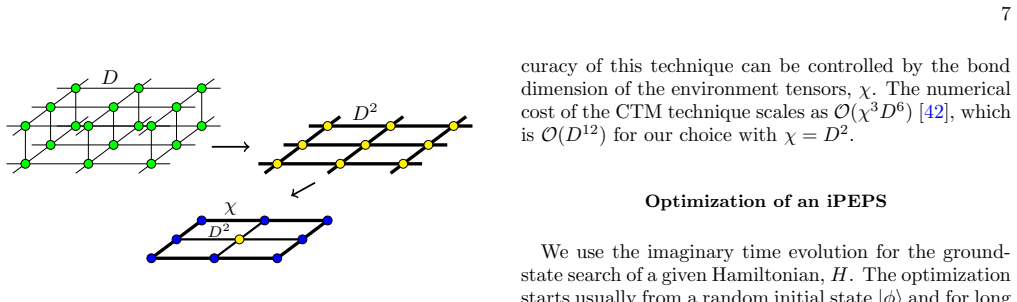
The central object is the infinite projected entangled-pair state (iPEPS), a tensor network that tiles the infinite square lattice with a small supercell of rank-5 tensors; the two orbitals per site are merged into a 16-dimensional supersite, and the tensors are optimized by imaginary-time evolution with the fast-full-update algorithm and gauge fixing. Accuracy is controlled by the bond dimension $D$ (up to 11 with U(1) spin and charge symmetry), and the infinite environment is contracted with the corner transfer matrix method at $\chi=D^2$. The decisive step for the ground-state claim is the extrapolation of the variational energy to the $D\to\infty$ limit using the normalized cost function $w$ of the time evolution rather than $1/D$, a procedure that makes the small energy difference between the diagonal AF and F stripes resolvable.
What would settle it
Run iPEPS (or another unbiased method) with $4\times4$ and larger supercells at $U_f=4$, $V=1$, $\varepsilon_f=-2$, $n=1.5$, and explicitly compare the extrapolated ($D\to\infty$) energies of the diagonal AF stripe, the diagonal F stripe, a vertical stripe, and any incommensurate state; if a non-diagonal state has lower energy, the central claim is refuted.
Extended reading notes
Core claim
At $n=1.5$ filling with $U_f=4$, $V=1$, and $\varepsilon_f=-2$, the paper identifies the ground state as a diagonal antiferromagnetic stripe of the localized $f$-electron moments: the moments order antiferromagnetically along the $[1\bar{1}]$ direction, while along the $[11]$ direction the magnetization is almost zero ($|m_f^i|\sim 0.09$ versus $0.4$) and the local correlation $C=|\langle \hat n_{j\uparrow}^f \hat n_{j\downarrow}^f\rangle - \langle \hat n_{j\uparrow}^f\rangle\langle \hat n_{j\downarrow}^f\rangle|$ is strongly enhanced, signaling that those sites stay nonmagnetic through local charge-spin fluctuations rather than through a uniform paramagnet. Extrapolating iPEPS energies to the error-free limit with a third-order polynomial in the cost function gives $E_{\rm AF}=-3.766(7)$ for this state and $E_{\rm F}=-3.751(4)$ for the symmetry-related diagonal ferromagnetic stripe, so the AF stripe is the ground state at this coupling; at $V\lesssim 0.8$ the extrapolated error bars overlap and the AF state is preferred only at the variational level. The same diagonal stripe pattern reappears in exploratory $2\times4$ and $4\times4$ supercells, and the total supercell spin flows to zero as the bond dimension grows.
Load-bearing premise
The argument assumes that a four-site repeating cell, with only exploratory checks of eight- and sixteen-site cells, contains the true magnetic pattern at $n=1.5$; if the true order repeats over a longer distance (for example as a vertical stripe), the diagonal-stripe conclusion collapses.
Editorial extensions
If this is right
- If the diagonal AF stripe is the true ground state at $n=1.5$, earlier mean-field and variational Monte Carlo predictions of a uniform ferromagnet at this filling miss the actual ordering and need larger unit cells or more general trial states.
- The near-degeneracy of the diagonal ferromagnetic stripe means small changes in hybridization or $f$-level energy could switch the ordering, so the model likely hosts an AF-to-F stripe transition inside the $n=1.5$ sector.
- The half-filling benchmark against quantum Monte Carlo establishes that iPEPS produces quantitatively reliable critical points and magnetizations for this two-band model, backing its use in sign-problem-affected parameter regions.
- Because the conduction electrons remain almost unpolarized ($m_c \sim 10^{-3}$) while the $f$-electron moments order, the magnetic stripe is carried by the localized band with the conduction band responding only through correlations.
- The absence of vertical stripes in iPEPS, despite mean-field favoring them, indicates that local suppression of double occupancy, not just magnetic order, is essential to the ground-state energy at this filling.
Reading between the lines
- Beyond the paper, the resonating spin-density-wave ground state seen in constrained-path quantum Monte Carlo on small clusters could be the finite-size precursor of this diagonal AF stripe; a large-scale unbiased simulation that can resolve long-range order would settle whether the two are the same phase.
- Beyond the paper, the diagonal-versus-vertical stripe competition mirrors the stripe physics of the two-dimensional Hubbard model near 1/8 doping, except that here the two competing stripe polarities (AF versus F) are being selected rather than two stripe orientations.
- Beyond the paper, a testable extension is to dope away from $n=1.5$ and check where the diagonal stripe gives way to a paramagnetic Kondo state; the paper's observation that magnetism dies near $n_f\sim0.5$ suggests the same depletion mechanism seen at half-filling.
- Beyond the paper, adding Hund's coupling through a Kanamori interaction could change the energy balance between the AF and F stripes, since Hund's coupling directly favors ferromagnetic alignment of the local moments; the paper lists this as an outlook.
Editorial analysis
A structured set of objections, weighed in public.
Referee Report
Summary. This paper presents infinite projected entangled-pair state (iPEPS) calculations for the periodic Anderson model on the square lattice. At half-filling and the symmetric point (εf = -Uf/2, Uf=4), the method reproduces the quantum Monte Carlo result for the critical hybridization Vc ≈ 1.2 (QMC: 1.1(1)) and the f-electron magnetization at V=1. The main new claim is that at n=1.5 electrons per site, for Uf=4, εf=-2, V=1, the ground state is a diagonal antiferromagnetic stripe phase, which is lower in energy than a competing diagonal ferromagnetic stripe state (E_AF=-3.766(7) vs E_F=-3.751(4) after extrapolation). The paper also reports that mean-field theory predicts a vertical stripe, not found in iPEPS, and that the diagonal stripe pattern persists in exploratory 2×4 and 4×4 unit-cell simulations.
Significance. If the n=1.5 ground-state claim holds, this is a genuinely new result: it identifies a stripe phase in a heavy-fermion model where previous mean-field, DMFT, and variational Monte Carlo studies predicted uniform ferromagnetism, and it provides a concrete target for future DMRG or large-cell tensor-network studies. The half-filling benchmark is a strong point: the iPEPS estimate of Vc is in excellent agreement with sign-problem-free QMC, and the magnetization at V=1 matches QMC within error bars. The paper also makes a clear falsifiable prediction (the diagonal stripe order) and provides data availability via Zenodo. However, the evidence for the central claim is currently marginal, resting on a 2×2 supercell energy extrapolation with a small energy difference and on qualitative rather than quantitative larger-supercell checks.
major comments (3)
- [Section III B, Fig. 4] The identification of the diagonal AF stripe as the ground state at n=1.5 rests on the extrapolated energies E_AF=-3.766(7) and E_F=-3.751(4) from a 2×2 supercell. The energy difference is only about 1.9σ given the reported errors, and the paper itself states that for V≲0.8 the error bars overlap. Thus the central claim is not robustly established for the parameter range as stated. Please provide a more detailed extrapolation analysis (e.g., alternative fit forms and error estimates) and state explicitly the parameter window in which the AF-F distinction is significant.
- [Section III B, paragraphs after Fig. 5] The larger-supercell (2×4 and 4×4) simulations are described only qualitatively ('the diagonal stripe pattern appeared'), and no energies are reported. Since iPEPS is variational and the 2×2 energy comparison is marginal, the possibility that a vertical stripe (predicted by the mean-field calculation) or a longer-period stripe has lower energy is not excluded. To support the central claim, please report the lowest variational energies found in these larger supercells (or provide them as supplementary material) and show that they are consistent with the 2×2 extrapolated value.
- [Section II and III B] The use of U(1) spin symmetry to target the Stot_z=0 and Stot_z=1 sectors of the 2×2 supercell restricts the search to collinear spin states with fixed total magnetization. The paper's statement that iPEPS provides 'unbiased' results (Introduction and Conclusions) is therefore too strong; the search is unbiased only within a limited manifold. Although the later charge-only simulations partially address this, no energies from those simulations are reported. Please either justify that non-collinear or incommensurate states are not relevant here, or present the corresponding energy data.
minor comments (5)
- [Section II] The definition of filling as 'the ratio of the total electron density per site (n = nc + nf ) to the maximum possible electron occupancy (nmax = 4)' is confusing because n is already a density. Suggest calling n the total electron density and noting that half filling corresponds to n=2.
- [Introduction] There is a typo in 'techniques that do no rely on rigid Ansätze' (should be 'do not rely'). Also, iPEPS is itself a variational ansatz, so 'no rigid Ansätze' is overstated; consider rephrasing to 'no a priori magnetic-ordering Ansatz.'
- [Fig. 4 caption] The caption says the energy is plotted 'as a function of the iPEPS cost function, w, ... and as a function of the inverse bond dimension,' which suggests two abscissas in one figure. Please clarify whether the figure contains two panels or an inset for the 1/D extrapolation.
- [Section III B] The sentence 'we begin our investigations with a 2 × 2 unit cell, allowing four independent tensors at each site to allow the appearance of more general magnetic structures' is awkward; it should read 'allowing four independent tensors, one at each site.'
- [Section III C] In the discussion of energetics, the phrase 'although mean-field theory is not a variational approach, even the raw iPEPS energies (without extrapolation) are significantly lower than the mean-field ones' is confusing; the point is that the iPEPS variational upper bound lies below the mean-field energy, which demonstrates the superiority of the iPEPS state. Please rephrase.
Circularity Check
No circularity: the n=1.5 diagonal-stripe claim is an unbiased variational result, not an input or a fitted prediction.
full rationale
The paper's derivation chain is numerical rather than definitional. The half-filled case is externally benchmarked against quantum Monte Carlo, with the text noting 'excellent agreement with the quantum Monte Carlo result, Vcrit ∼ 1.1(1)'; this validates the iPEPS method independently. At n=1.5, the central claim is the diagonal AF stripe state, obtained by optimizing iPEPS from random initial states in 2x2, 2x4, and 4x4 supercells, and the energy comparison is between two states that both emerge from the calculation: 'the AF state, with E_AF = -3.766(7), is the ground state, while the F state, with E_F = -3.751(4), also belongs to the low-energy manifold.' No physical parameter is fitted to force this ordering, and the competing ferromagnetic state is explicitly reported with overlapping error bars for V < 0.8. The author's self-citations ([11], [27], [47]) are methodological or comparative, with Ref. [47] used only to generalize a mean-field decoupling, not to assert the central result; no uniqueness theorem or ansatz is imported from prior author work. The paper's own limitations—larger-supercell runs described as 'exploratory' with no detailed energy comparison, and the admitted inability to definitively identify the lowest-energy state for V < 0.8—are robustness concerns, not circularity. The claim does not reduce to its inputs by construction.
Assumptions & free parameters
assumptions (5)
- domain assumption The true ground state is translationally invariant up to a finite supercell (2x2, 2x4, or 4x4).
- domain assumption iPEPS bond dimensions up to D=11, with extrapolation to D to infinity, accurately capture the ground-state energy and magnetization.
- domain assumption Third-order polynomial extrapolation of energies as a function of the iPEPS cost function w gives unbiased D-to-infinity limits.
- standard math Trotter-Suzuki decomposition and CTM environment contraction introduce controlled errors that vanish in the extrapolation.
- domain assumption Merging c and f orbitals into a d=16 supersite preserves the fermionic statistics of the model.
Cite this review
Pith. "Pith review of Magnetic phases of the periodic Anderson model in two dimensions." pith.science (2026). https://pith.science/paper/TLDW2KM5
@misc{pith2026250107541,
  author       = {Pith},
  title        = {Pith review of: Magnetic phases of the periodic Anderson model in two dimensions},
  year         = {2026},
  howpublished = {\url{https://pith.science/paper/TLDW2KM5}},
  note         = {Machine review of arXiv:2501.07541}
}
abstract
We investigate the ground-state properties of the periodic Anderson model on the square lattice across various band fillings. Employing the infinite projected entangled-pair states (iPEPS) technique, we can determine the magnetic ground states accurately and compare them to mean-field predictions to highlight the effects of quantum fluctuations. At half-filling, we analyze the transition between the antiferromagnetic and paramagnetic (Kondo singlet) phases as a function of hybridization and $f$-level energy, finding excellent agreement with existing quantum Monte Carlo studies in the case of hybridization. For $n = 1.5$ electrons per site, we identify a novel correlated antiferromagnetic diagonal stripe phase as the ground state, which competes with its ferromagnetic partner state.
Figures


Figures from the paper (2 more)

Reference graph
Works this paper leans on
-
[1]
A. C. Hewson, The Kondo Problem to Heavy Fermions, Cambridge Studies in Magnetism (Cambridge University Press, 1993)
1993
-
[2]
P. Fazekas, Lecture Notes on Electron Correla- tion and Magnetism (WORLD SCIENTIFIC, 1999) https://www.worldscientific.com/doi/pdf/10.1142/2945
doi:10.1142/2945 1999
-
[3]
G. R. Stewart, Heavy-fermion systems, Rev. Mod. Phys. 56, 755 (1984)
1984
-
[4]
Ott, Magnetism in heavy-electron metals, Acta Phys- ica Polonica A 85 (1994)
H. Ott, Magnetism in heavy-electron metals, Acta Phys- ica Polonica A 85 (1994)
work page 1994
-
[5]
A. V. Papavasileiou, M. Menelaou, K. J. Sarkar, Z. Sofer, L. Polavarapu, and S. Mourdikoudis, Ferromagnetic el- ements in two-dimensional materials: 2d magnets and beyond, Advanced Functional Materials 34, 2309046 (2024)
work page 2024
-
[6]
C. Noce, The periodic anderson model: Symmetry-based results and some exact solutions, Physics Reports 431, 173 (2006)
work page 2006
-
[7]
Z. Gul´ acsi and D. Vollhardt, Exact insulating and con- ducting ground states of a periodic anderson model in three dimensions, Phys. Rev. Lett. 91, 186401 (2003)
work page 2003
-
[8]
P. Gurin and Z. Gul´ acsi, Exact solutions for the peri- odic anderson model in two dimensions: A non-fermi- liquid state in the normal phase, Phys. Rev. B64, 045118 (2001)
work page 2001
Show all 55 references
-
[9]
Guerrero and R
M. Guerrero and R. M. Noack, Ferromagnetism and phase separation in one-dimensional d − p and periodic anderson models, Phys. Rev. B 63, 144423 (2001)
2001
-
[10]
P. R. Bertussi, M. B. S. Neto, T. G. Rappoport, A. L. Malvezzi, and R. R. dos Santos, Incommensurate spin- density-wave and metal-insulator transition in the one- dimensional periodic anderson model, Phys. Rev. B 84, 075156 (2011)
2011
-
[11]
Hagym´ asi, J
I. Hagym´ asi, J. S´ olyom, and O. Legeza, Interorbital inter- action in the one-dimensional periodic anderson model: Density matrix renormalization group study, Phys. Rev. B 90, 125137 (2014)
2014
-
[12]
Veki´ c, J
M. Veki´ c, J. W. Cannon, D. J. Scalapino, R. T. Scalettar, and R. L. Sugar, Competition between antiferromagnetic order and spin-liquid behavior in the two-dimensional pe- riodic anderson model at half filling, Phys. Rev. Lett. 74, 2367 (1995)
1995
-
[13]
Watanabe and M
H. Watanabe and M. Ogata, Fermi-surface reconstruc- tion in the periodic anderson model, Journal of the Phys- ical Society of Japan 78, 024715 (2009)
2009
-
[14]
Kubo, Lifshitz transitions in magnetic phases of the periodic anderson model, Journal of the Physical Society of Japan 84, 094702 (2015)
K. Kubo, Lifshitz transitions in magnetic phases of the periodic anderson model, Journal of the Physical Society of Japan 84, 094702 (2015)
2015
-
[15]
Sch¨ afer, A
T. Sch¨ afer, A. A. Katanin, M. Kitatani, A. Toschi, and K. Held, Quantum criticality in the two-dimensional pe- riodic anderson model, Phys. Rev. Lett. 122, 227201 (2019)
2019
-
[16]
and, on the Bethe and cubic lattices, with dynamical mean-field theory [17–20]. While dynamical mean-field theory (DMFT) yields exact results in infinite spatial di- mensions, it remains uncertain how quantum fluctuations in two dimensions modify these findings. The quantum Mo...
2025 arXiv
-
[17]
Doradzi´ nski and J
R. Doradzi´ nski and J. Spa lek, Mean-field magnetic phase diagram of the periodic anderson model with the kondo- compensated phases, Phys. Rev. B 58, 3293 (1998)
1998
-
[18]
Meyer and W
D. Meyer and W. Nolting, Dynamical mean-field study of ferromagnetism in the periodic anderson model, Phys. Rev. B 62, 5657 (2000)
2000
-
[19]
A. Koga, N. Kawakami, R. Peters, and T. Pruschke, Quantum phase transitions in the extended periodic an- derson model, Phys. Rev. B 77, 045120 (2008)
2008
-
[20]
De Leo, M
L. De Leo, M. Civelli, and G. Kotliar, t = 0 heavy- fermion quantum critical point as an orbital-selective mott transition, Phys. Rev. Lett. 101, 256404 (2008)
2008
-
[21]
Gleis, S.-S
A. Gleis, S.-S. B. Lee, G. Kotliar, and J. von Delft, Emer- gent properties of the periodic anderson model: A high- resolution, real-frequency study of heavy-fermion quan- tum criticality, Phys. Rev. X 14, 041036 (2024)
2024
-
[22]
Troyer and U.-J
M. Troyer and U.-J. Wiese, Computational complexity and fundamental limitations to fermionic quantum monte carlo simulations, Phys. Rev. Lett. 94, 170201 (2005)
2005
-
[23]
Bonˇ ca and J
J. Bonˇ ca and J. E. Gubernatis, Effects of doping on spin correlations in the periodic anderson model, Phys. Rev. B 58, 6992 (1998)
1998
-
[24]
C. D. Batista, J. Bonˇ ca, and J. E. Gubernatis, Ferromag- netism in the two-dimensional periodic anderson model, Phys. Rev. B 63, 184428 (2001)
2001
-
[25]
Fazekas and B
P. Fazekas and B. H. Brandow, Application of the gutzwiller method to the periodic anderson model, Phys- ica Scripta 36, 809 (1987)
1987
-
[26]
Gebhard, Equivalence of variational and slave-boson mean-field treatments of the periodic anderson model, Phys
F. Gebhard, Equivalence of variational and slave-boson mean-field treatments of the periodic anderson model, Phys. Rev. B 44, 992 (1991)
1991
-
[27]
Itai and P
K. Itai and P. Fazekas, Interaction effect in the kondo energy of the periodic anderson-hubbard model, Phys. Rev. B 54, R752 (1996)
1996
-
[28]
Hagym´ asi, K
I. Hagym´ asi, K. Itai, and J. S´ olyom, Periodic anderson model with correlated conduction electrons: Variational and exact diagonalization study, Phys. Rev. B85, 235116 (2012)
2012
-
[29]
Yang and Q.-N
J.-W. Yang and Q.-N. Chen, Phase diagram, correla- tions, and quantum critical point in the periodic anderson model*, Chinese Physics B 27, 037101 (2018)
2018
-
[30]
J. I. Cirac, D. P´ erez-Garc ´ ıa, N. Schuch, and F. Ver- straete, Matrix product states and projected entangled pair states: Concepts, symmetries, theorems, Rev. Mod. Phys. 93, 045003 (2021)
2021
-
[31]
Verstraete and J
F. Verstraete and J. I. Cirac, Renormalization al- gorithms for quantum-many body systems in two and higher dimensions (2004), arXiv:cond-mat/0407066 [cond-mat.str-el]
2004 arXiv
-
[32]
Nishio, N
Y. Nishio, N. Maeshima, A. Gendiar, and T. Nishino, Tensor product variational formulation for quantum sys- tems (2004), arXiv:cond-mat/0401115 [cond-mat.stat- mech]
2004 arXiv
-
[33]
Jordan, R
J. Jordan, R. Or´ us, G. Vidal, F. Verstraete, and J. I. Cirac, Classical simulation of infinite-size quantum lat- tice systems in two spatial dimensions, Phys. Rev. Lett. 101, 250602 (2008)
2008
-
[34]
Corboz, R
P. Corboz, R. Or´ us, B. Bauer, and G. Vidal, Simula- tion of strongly correlated fermions in two spatial di- mensions with fermionic projected entangled-pair states, Phys. Rev. B 81, 165104 (2010)
2010
-
[35]
Nishino, Y
T. Nishino, Y. Hieida, K. Okunishi, N. Maeshima, Y. Akutsu, and A. Gendiar, Two-dimensional tensor product variational formulation, Progress of Theoretical Physics 105, 409 (2001), https://academic.oup.com/ptp/article- pdf/105/3/409/5191613/105-3-409.pdf
2001
-
[36]
Peschke, B
M. Peschke, B. Ponsioen, and P. Corboz, Competing states in the two-dimensional frustrated kondo-necklace model, Phys. Rev. B 106, 205140 (2022). 9
2022
-
[37]
Corboz and F
P. Corboz and F. Mila, Crystals of bound states in the magnetization plateaus of the shastry-sutherland model, Phys. Rev. Lett. 112, 147203 (2014)
2014
-
[38]
H. J. Liao, Z. Y. Xie, J. Chen, Z. Y. Liu, H. D. Xie, R. Z. Huang, B. Normand, and T. Xiang, Gapless spin-liquid ground state in the s = 1 /2 kagome antiferromagnet, Phys. Rev. Lett. 118, 137202 (2017)
2017
-
[39]
Schmoll, A
P. Schmoll, A. Kshetrimayum, J. Naumann, J. Eisert, and Y. Iqbal, Tensor network study of the spin- 1 2 heisen- berg antiferromagnet on the shuriken lattice, Phys. Rev. B 107, 064406 (2023)
2023
-
[40]
Zheng, C.-M
B.-X. Zheng, C.-M. Chung, P. Corboz, G. Ehlers, M.-P. Qin, R. M. Noack, H. Shi, S. R. White, S. Zhang, and G. K.-L. Chan, Stripe order in the underdoped region of the two-dimensional hubbard model, Science 358, 1155 (2017), https://www.science.org/doi/pdf/10.1126/science.aam7127
2017 doi
-
[41]
Corboz, T
P. Corboz, T. M. Rice, and M. Troyer, Competing states in the t-j model: Uniform d-wave state versus stripe state, Phys. Rev. Lett. 113, 046402 (2014)
2014
-
[42]
H.-Y. Lee, R. Kaneko, L. E. Chern, T. Okubo, Y. Yamaji, N. Kawashima, and Y. B. Kim, Magnetic field induced quantum phases in a tensor network study of kitaev mag- nets, Nature Communications 11, 1639 (2020)
2020
-
[43]
Bruognolo, J.-W
B. Bruognolo, J.-W. Li, J. von Delft, and A. Weichsel- baum, A beginner’s guide to non-abelian iPEPS for cor- related fermions, SciPost Phys. Lect. Notes , 25 (2021)
2021
-
[44]
H. N. Phien, J. A. Bengua, H. D. Tuan, P. Corboz, and R. Or´ us, Infinite projected entangled pair states algo- rithm improved: Fast full update and gauge fixing, Phys. Rev. B 92, 035142 (2015)
2015
-
[45]
Nishino and K
T. Nishino and K. Okunishi, Corner transfer ma- trix renormalization group method, Journal of the Physical Society of Japan 65, 891 (1996), https://doi.org/10.1143/JPSJ.65.891
1996 doi
-
[46]
Or´ us and G
R. Or´ us and G. Vidal, Simulation of two-dimensional quantum systems on an infinite lattice revisited: Cor- ner transfer matrix for tensor contraction, Phys. Rev. B 80, 094403 (2009)
2009
-
[47]
Corboz, Improved energy extrapolation with infi- nite projected entangled-pair states applied to the two- dimensional hubbard model, Phys
P. Corboz, Improved energy extrapolation with infi- nite projected entangled-pair states applied to the two- dimensional hubbard model, Phys. Rev. B 93, 045116 (2016)
2016
-
[48]
Hagym´ asi, K
I. Hagym´ asi, K. Itai, and J. S´ olyom, Quantum critical- ity and first-order transitions in the extended periodic anderson model, Phys. Rev. B 87, 125146 (2013)
2013
-
[49]
F. F. Assaad, Quantum monte carlo simulations of the half-filled two-dimensional kondo lattice model, Phys. Rev. Lett. 83, 796 (1999)
1999
-
[50]
A. N. Tahvildar-Zadeh, M. Jarrell, and J. K. Freericks, Protracted screening in the periodic anderson model, Phys. Rev. B 55, R3332 (1997)
1997
-
[51]
J. P. F. LeBlanc, A. E. Antipov, F. Becca, I. W. Bulik, G. K.-L. Chan, C.-M. Chung, Y. Deng, M. Ferrero, T. M. Henderson, C. A. Jim´ enez-Hoyos, E. Kozik, X.-W. Liu, A. J. Millis, N. V. Prokof’ev, M. Qin, G. E. Scuseria, H. Shi, B. V. Svistunov, L. F. Tocchio, I. S. Tupitsyn, ...
2015
-
[52]
A. Koga, N. Kawakami, R. Peters, and T. Pruschke, Mag- netic properties of the extended periodic anderson model, Journal of the Physical Society of Japan 77, 033704 (2008), https://doi.org/10.1143/JPSJ.77.033704
2008 doi
-
[53]
Hubig, F
C. Hubig, F. Lachenmaier, N.-O. Linden, T. Reinhard, L. Stenzel, A. Swoboda, and M. Grundner, The SyTen toolkit
-
[54]
Hubig, Symmetry-Protected Tensor Networks, Ph.D
C. Hubig, Symmetry-Protected Tensor Networks, Ph.D. thesis, LMU M¨ unchen (2017)
2017
-
[55]
Hagymasi, Raw data for the manuscript ”magnetic phases of the periodic anderson model in two dimen- sions”, 10.5281/zenodo.15519541 (2025)
I. Hagymasi, Raw data for the manuscript ”magnetic phases of the periodic anderson model in two dimen- sions”, 10.5281/zenodo.15519541 (2025)
2025 doi
Reviewed August 10, 2026 · model on record in the stance chip above.
Discussion (0). Continue with ORCID to comment.