Measurement of solar pp neutrino flux with the new PandaX-4T data
Pith reviewed 2026-07-03 01:53 UTC · model grok-4.3
The pith
Combined PandaX-4T data yields a 2.2 sigma excess consistent with solar pp neutrinos below 165 keV recoil energy.
A machine-rendered reading of the paper's core claim, the machinery that carries it, and where it could break.
Core claim
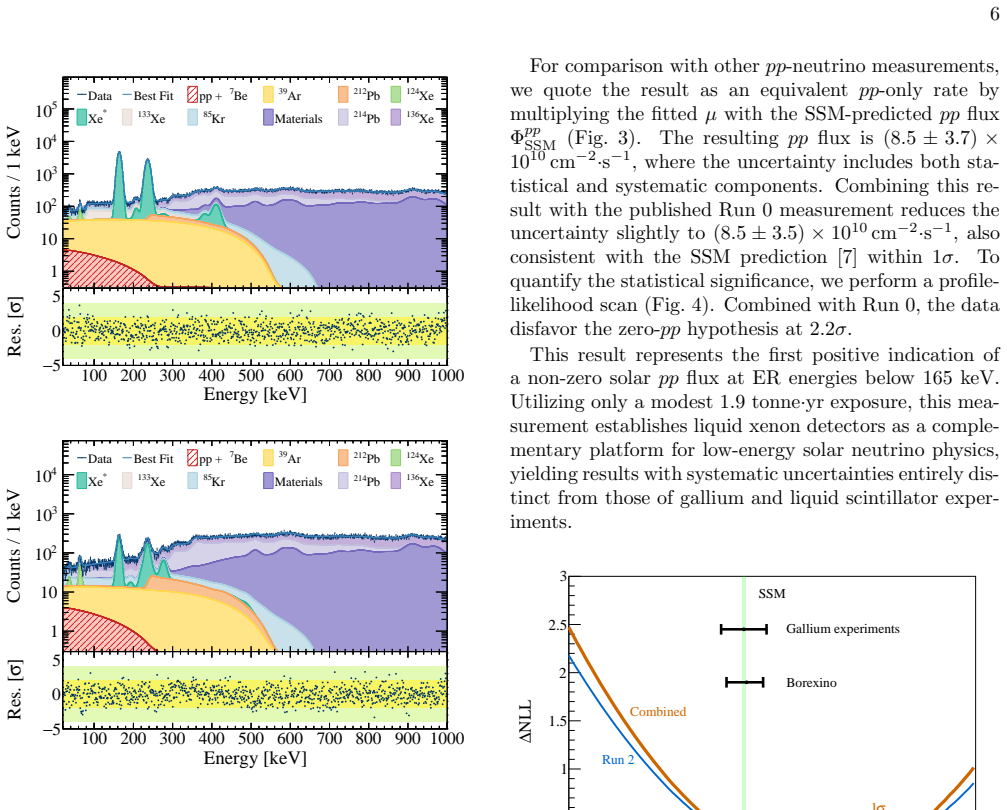
In combination with the Run 0 data, the fitted pp flux is (8.5 ± 3.5)×10^{10} cm^{-2}s^{-1}, consistent with the prediction of the Standard Solar Model. With a statistical significance of 2.2σ above background, this marks the first positive indication of solar pp neutrino–electron scattering below an electronic-recoil energy of 165 keV.
What carries the argument
Blind spectral fit to electronic-recoil events in the liquid xenon time projection chamber, after time-dependent impurity constraints and upgraded detector response modeling.
If this is right
- The measurement supplies an independent low-energy anchor for solar neutrino production rates.
- It shows that liquid xenon detectors can access the dominant pp neutrino component below current thresholds.
- Larger future exposures can raise the significance or begin to probe the pp spectrum shape.
- Consistency with the Standard Solar Model at this flux level supports the pp chain as the primary solar energy source.
Where Pith is reading between the lines
- If the excess holds, combining this pp flux with higher-energy solar neutrino measurements could tighten constraints on solar core temperature or composition.
- The same low-threshold analysis techniques may be applied to search for other rare low-energy processes such as coherent neutrino scattering in the same detector.
- A confirmed signal at this energy opens a path to test whether detector upgrades can eventually separate pp neutrinos from other solar fluxes or backgrounds.
Load-bearing premise
The post-upgrade background models and impurity constraints derived from the physics data are accurate enough that the observed 2.2 sigma excess arises from pp neutrinos rather than residual backgrounds.
What would settle it
An independent measurement or higher-exposure run that finds no excess in the 20-165 keV electronic recoil window after the same background subtraction would falsify the signal claim.
Figures
read the original abstract
We report a new measurement of the solar proton--proton ($pp$) neutrino flux via neutrino--electron elastic scattering using the PandaX-4T Run 2 data set collected between 2024 and 2026, corresponding to an exposure of 1.9 tonne$\cdot$yr. Before Run 2 data taking, the detector underwent a series of upgrades to improve its response and background conditions. Time variations of radioactive noble-gas impurities are constrained using the physics data themselves, complemented by measurements from the gas-assay system. The analysis introduced improvements in the data processing chain, detector response characterization, and background models. A blind spectral analysis was then performed on the electronic-recoil data across a wide energy range from 20 to 1000 keV. In combination with the Run 0 data published earlier, the fitted $pp$ flux is $(8.5 \pm 3.5)\times 10^{10}$ $\mathrm{cm^{-2}s^{-1}}$, consistent with the prediction of the Standard Solar Model. With a statistical significance of $2.2\sigma$ above background, this marks the first positive indication of solar $pp$ neutrino--electron scattering below an electronic-recoil energy of 165 keV.
Editorial analysis
A structured set of objections, weighed in public.
Referee Report
Summary. The manuscript reports a new measurement of the solar pp neutrino flux via neutrino-electron elastic scattering in the PandaX-4T detector using Run 2 data (2024-2026, 1.9 tonne·yr exposure) after detector upgrades. Time-dependent noble-gas impurity constraints are derived from the physics data and gas assay; improvements are made to data processing, detector response, and background models. A blind spectral analysis is performed on electronic-recoil events from 20 to 1000 keV. Combined with prior Run 0 data, the fitted pp flux is (8.5 ± 3.5)×10^{10} cm^{-2}s^{-1}, consistent with the Standard Solar Model, at 2.2σ significance above background—the first positive indication below 165 keV ER.
Significance. If robust, the result supplies the first positive low-energy pp neutrino signal in a direct-detection experiment, extending tests of the Standard Solar Model into a previously inaccessible regime. Strengths include the blind analysis protocol and data-driven impurity constraints, which reduce reliance on external assumptions. The modest 2.2σ significance, however, makes the claim sensitive to background modeling accuracy.
major comments (1)
- [Background model and spectral fit description] The central 2.2σ excess in the 20–165 keV ER window rests on the accuracy of the post-upgrade background model and time-dependent impurity constraints. The manuscript should provide quantitative validation (e.g., background-only fit residuals, pull distributions, or goodness-of-fit metrics) demonstrating that residual mismodeling is smaller than the observed excess; without this, the attribution to pp neutrinos remains vulnerable to systematic artifacts.
minor comments (2)
- Clarify in the abstract and text whether the quoted uncertainty is statistical only or includes systematics; a dedicated table summarizing all systematic contributions to the combined fit would improve transparency.
- The exposure is given as 'tonne·yr'; confirm consistent usage of this unit throughout the manuscript and figures.
Simulated Author's Rebuttal
We thank the referee for the positive assessment of the blind analysis and data-driven impurity constraints, and for the constructive feedback on background validation. We address the single major comment below and will incorporate the requested material in a revised manuscript.
read point-by-point responses
-
Referee: The central 2.2σ excess in the 20–165 keV ER window rests on the accuracy of the post-upgrade background model and time-dependent impurity constraints. The manuscript should provide quantitative validation (e.g., background-only fit residuals, pull distributions, or goodness-of-fit metrics) demonstrating that residual mismodeling is smaller than the observed excess; without this, the attribution to pp neutrinos remains vulnerable to systematic artifacts.
Authors: We agree that explicit quantitative validation strengthens the result. In the revision we will add: (i) residuals of the background-only fit in the 20–165 keV window, (ii) pull distributions for all floated background and impurity parameters, and (iii) a goodness-of-fit metric (χ²/ndf) for the background-only hypothesis. These will be shown to confirm that any residual mismodeling lies below the observed 2.2σ excess. The existing blind protocol already protects against analysis bias; the new figures will directly address the referee’s concern. revision: yes
Circularity Check
No significant circularity in experimental flux measurement
full rationale
This is a data-driven experimental paper that extracts the pp neutrino flux by performing a blind spectral fit to observed electronic-recoil events in the 20–1000 keV range after applying background models, impurity constraints, and detector response functions derived from the physics data and gas assays. The fitted value (8.5 ± 3.5)×10^{10} cm^{-2}s^{-1} is obtained directly from the data likelihood; the comparison to the Standard Solar Model is an external consistency check, not part of the derivation. Self-citation to the earlier Run 0 publication is used only to combine independent datasets and carries no load-bearing uniqueness theorem or ansatz. No step reduces by construction to its own inputs, and the analysis chain remains self-contained against external benchmarks.
Axiom & Free-Parameter Ledger
free parameters (2)
- noble-gas impurity time-variation parameters
- detector response model parameters
axioms (1)
- domain assumption Standard Solar Model prediction provides the reference flux value for consistency check
Reference graph
Works this paper leans on
-
[1]
Davis, Jr., D
R. Davis, Jr., D. S. Harmer, and K. C. Hoffman, Search for neutrinos from the sun, Phys. Rev. Lett.20, 1205 (1968)
1968
-
[2]
B. T. Cleveland, T. Daily, R. Davis, Jr., J. R. Distel, K. Lande, C. K. Lee, P. S. Wildenhain, and J. Ullman, Measurement of the solar electron neutrino flux with the Homestake chlorine detector, Astrophys. J.496, 505 (1998)
1998
-
[3]
Hampelet al.(GALLEX), GALLEX solar neutrino observations: Results for GALLEX IV, Phys
W. Hampelet al.(GALLEX), GALLEX solar neutrino observations: Results for GALLEX IV, Phys. Lett. B 447, 127 (1999)
1999
-
[4]
J. N. Abdurashitovet al.(SAGE), Measurement of the solar neutrino capture rate with gallium metal, Phys. Rev. C60, 055801 (1999), arXiv:astro-ph/9907113
work page internal anchor Pith review Pith/arXiv arXiv 1999
-
[5]
Evidence for oscillation of atmospheric neutrinos
Y. Fukudaet al.(Super-Kamiokande), Evidence for os- cillation of atmospheric neutrinos, Phys. Rev. Lett.81, 1562 (1998), arXiv:hep-ex/9807003
work page internal anchor Pith review Pith/arXiv arXiv 1998
-
[6]
Q. R. Ahmadet al.(SNO), Direct evidence for neutrino flavor transformation from neutral current interactions in the Sudbury Neutrino Observatory, Phys. Rev. Lett.89, 011301 (2002), arXiv:nucl-ex/0204008
work page internal anchor Pith review Pith/arXiv arXiv 2002
-
[7]
A new Generation of Standard Solar Models
N. Vinyoles, A. M. Serenelli, F. L. Villante, S. Basu, J. Bergstr¨ om, M. C. Gonzalez-Garcia, M. Maltoni, C. Pe˜ na-Garay, and N. Song, A new Generation of Standard Solar Models, Astrophys. J.835, 202 (2017), arXiv:1611.09867 [astro-ph.SR]
work page internal anchor Pith review Pith/arXiv arXiv 2017
-
[8]
Wolfenstein, Neutrino Oscillations in Matter, Phys
L. Wolfenstein, Neutrino Oscillations in Matter, Phys. Rev. D17, 2369 (1978)
1978
-
[9]
S. P. Mikheyev and A. Y. Smirnov, Resonance Amplifica- tion of Oscillations in Matter and Spectroscopy of Solar Neutrinos, Sov. J. Nucl. Phys.42, 913 (1985)
1985
-
[10]
Neutrino electromagnetic interactions: a window to new physics
C. Giunti and A. Studenikin, Neutrino electromagnetic interactions: a window to new physics, Rev. Mod. Phys. 87, 531 (2015), arXiv:1403.6344 [hep-ph]
work page internal anchor Pith review Pith/arXiv arXiv 2015
-
[11]
Status of non-standard neutrino interactions
T. Ohlsson, Status of non-standard neutrino interactions, Rept. Prog. Phys.76, 044201 (2013), arXiv:1209.2710 [hep-ph]
work page internal anchor Pith review Pith/arXiv arXiv 2013
-
[12]
Neutrino oscillations and Non-Standard Interactions
Y. Farzan and M. Tortola, Neutrino oscillations and Non-Standard Interactions, Front. in Phys.6, 10 (2018), arXiv:1710.09360 [hep-ph]
work page internal anchor Pith review Pith/arXiv arXiv 2018
-
[13]
K. N. Abazajianet al., Light Sterile Neutrinos: A White Paper (2012), arXiv:1204.5379 [hep-ph]
work page internal anchor Pith review Pith/arXiv arXiv 2012
-
[14]
Phenomenology of light sterile neutrinos: a brief review
A. Palazzo, Phenomenology of light sterile neutrinos: a brief review, Mod. Phys. Lett. A28, 1330004 (2013), arXiv:1302.1102 [hep-ph]
work page internal anchor Pith review Pith/arXiv arXiv 2013
-
[15]
Agostiniet al.(BOREXINO), Comprehensive mea- surement ofpp-chain solar neutrinos, Nature562, 505 (2018)
M. Agostiniet al.(BOREXINO), Comprehensive mea- surement ofpp-chain solar neutrinos, Nature562, 505 (2018)
2018
-
[16]
Liquid Xenon Detectors for Particle Physics and Astrophysics
E. Aprile and T. Doke, Liquid Xenon Detectors for Parti- cle Physics and Astrophysics, Rev. Mod. Phys.82, 2053 (2010), arXiv:0910.4956 [physics.ins-det]
work page internal anchor Pith review Pith/arXiv arXiv 2053
-
[17]
X. Luet al.(PandaX), Measurement of solar pp neu- trino flux using electron recoil data from PandaX-4T commissioning run*, Chin. Phys. C48, 091001 (2024), arXiv:2401.07045 [hep-ex]
-
[18]
The China Jinping Underground Laboratory and its Early Science
J.-P. Chenget al., The China Jinping Underground Lab- oratory and its Early Science, Ann. Rev. Nucl. Part. Sci. 67, 231 (2017), arXiv:1801.00587 [hep-ex]
work page internal anchor Pith review Pith/arXiv arXiv 2017
-
[19]
X. Yanet al.(PandaX), Searching for Two-Neutrino and Neutrinoless Double Beta Decay of Xe134 with the PandaX-4T Experiment, Phys. Rev. Lett.132, 152502 (2024), arXiv:2312.15632 [nucl-ex]
-
[20]
Z. Yuanet al.(PandaX), Precise 136Xe Double Beta De- cay Measurement in PandaX-4T with Implications on the Nuclear Matrix Elements and Majorons, Phys. Rev. Lett. 136, 162501 (2026), arXiv:2512.04849 [nucl-ex]
work page internal anchor Pith review Pith/arXiv arXiv 2026
-
[21]
C. He, J. Liu, X. Ren, X. Shang, X. Wei, M. Wang, J. Yang, J. Yang, Y. Yang, G. Zhang, and Q. Zheng, A 500 MS/s waveform digitizer for PandaX dark matter 8 experiments, JINST16(12), T12015
-
[22]
X. Cuiet al., Radon removal commissioning of the PandaX-4T cryogenic distillation system, JINST19(07), P07010, arXiv:2401.01638 [physics.ins-det]
-
[23]
Boet al.(PandaX), Dark Matter Search Results from 1.54 Tonne·Year Exposure of PandaX-4T, Phys
Z. Boet al.(PandaX), Dark Matter Search Results from 1.54 Tonne·Year Exposure of PandaX-4T, Phys. Rev. Lett.134, 011805 (2025), arXiv:2408.00664 [hep-ex]
-
[24]
Zenget al.(PandaX), Exploring New Physics with PandaX-4T Low Energy Electronic Recoil Data, Phys
X. Zenget al.(PandaX), Exploring New Physics with PandaX-4T Low Energy Electronic Recoil Data, Phys. Rev. Lett.134, 041001 (2025), arXiv:2408.07641 [hep- ex]
-
[25]
L. Luoet al., Improvement on the linearity response of PandaX-4T with new photomultiplier tube bases, JINST 19(05), P05021, arXiv:2401.00373 [physics.ins-det]
-
[26]
Z. Qianet al.(PandaX), Low radioactive material screen- ing and background control for the PandaX-4T experi- ment, JHEP06, 147, arXiv:2112.02892 [physics.ins-det]
-
[27]
L. Luoet al.(PandaX), Search for double beta decay of 136Xe to the 0 + 1 excited state of 136Ba with PandaX-4T, JHEP05, 089, arXiv:2502.03017 [nucl-ex]
-
[28]
D. S. Leonard, A. Dobi, C. Hall, L. J. Kaufman, T. Lang- ford, S. Slutsky, and Y. R. Yen, A simple high-sensitivity technique for purity analysis of xenon gas, Nucl. Instrum. Meth. A621, 678 (2001), arXiv:1002.2742 [physics.ins- det]
work page internal anchor Pith review Pith/arXiv arXiv 2001
-
[29]
Z. Boet al.(PandaX), Measurement of two-neutrino dou- ble electron capture half-life of 124Xe with PandaX-4T, JHEP05, 119, arXiv:2411.14355 [nucl-ex]
-
[30]
Low-energy electronic recoil in xenon detectors by solar neutrinos
J.-W. Chen, H.-C. Chi, C. P. Liu, and C.-P. Wu, Low- energy electronic recoil in xenon detectors by solar neu- trinos, Phys. Lett. B774, 656 (2017), arXiv:1610.04177 [hep-ex]
work page internal anchor Pith review Pith/arXiv arXiv 2017
-
[31]
Liet al.(PandaX), Search for MeV-Scale Axionlike Particles and Dark Photons with PandaX-4T, Phys
T. Liet al.(PandaX), Search for MeV-Scale Axionlike Particles and Dark Photons with PandaX-4T, Phys. Rev. Lett.134, 071004 (2025), arXiv:2409.00773 [hep-ex]
-
[32]
Grevesse and A
N. Grevesse and A. J. Sauval, Standard Solar Composi- tion, Space Sci. Rev.85, 161 (1998)
1998
-
[33]
The chemical composition of the Sun
M. Asplund, N. Grevesse, A. J. Sauval, and P. Scott, The chemical composition of the Sun, Ann. Rev. Astron. As- trophys.47, 481 (2009), arXiv:0909.0948 [astro-ph.SR]
work page internal anchor Pith review Pith/arXiv arXiv 2009
-
[34]
J. N. Abdurashitovet al.(SAGE), Measurement of the solar neutrino capture rate with gallium metal. III: Re- sults for the 2002–2007 data-taking period, Phys. Rev. C 80, 015807 (2009), arXiv:0901.2200 [nucl-ex]
work page internal anchor Pith review Pith/arXiv arXiv 2002
-
[35]
Abdukerimet al.(PandaX), PandaX-xT—A deep underground multi-ten-tonne liquid xenon observatory, Sci
A. Abdukerimet al.(PandaX), PandaX-xT—A deep underground multi-ten-tonne liquid xenon observatory, Sci. China Phys. Mech. Astron.68, 221011 (2025), arXiv:2402.03596 [hep-ex]
discussion (0)
Sign in with ORCID, Apple, or X to comment. Anyone can read and Pith papers without signing in.