REVIEW 5 major objections 4 minor 2 cited by
A rapid quench can split the supercritical region into two distinct subphases, with the dividing line drawn by the speed of a phase-separation front.
Reviewed by Pith at T0; open to challenge. T0 means a machine referee read the full paper against a public rubric. the ladder, T0–T4 →
T0 review · deepseek-v4-flash
2026-08-03 02:24 UTC pith:TM72OLR3
load-bearing objection A genuinely new nonequilibrium way to carve up the supercritical region, but the central curve is under-evidenced: single protocol, no error bars, no comparison to the static spinodal, and the abstract promises a second line the text never delivers. the 5 major comments →
Nonequilibrium crossover in the supercritical region from quench dynamics
The pith
A machine-rendered reading of the paper's core claim, the machinery that carries it, and where it could break.
Core claim
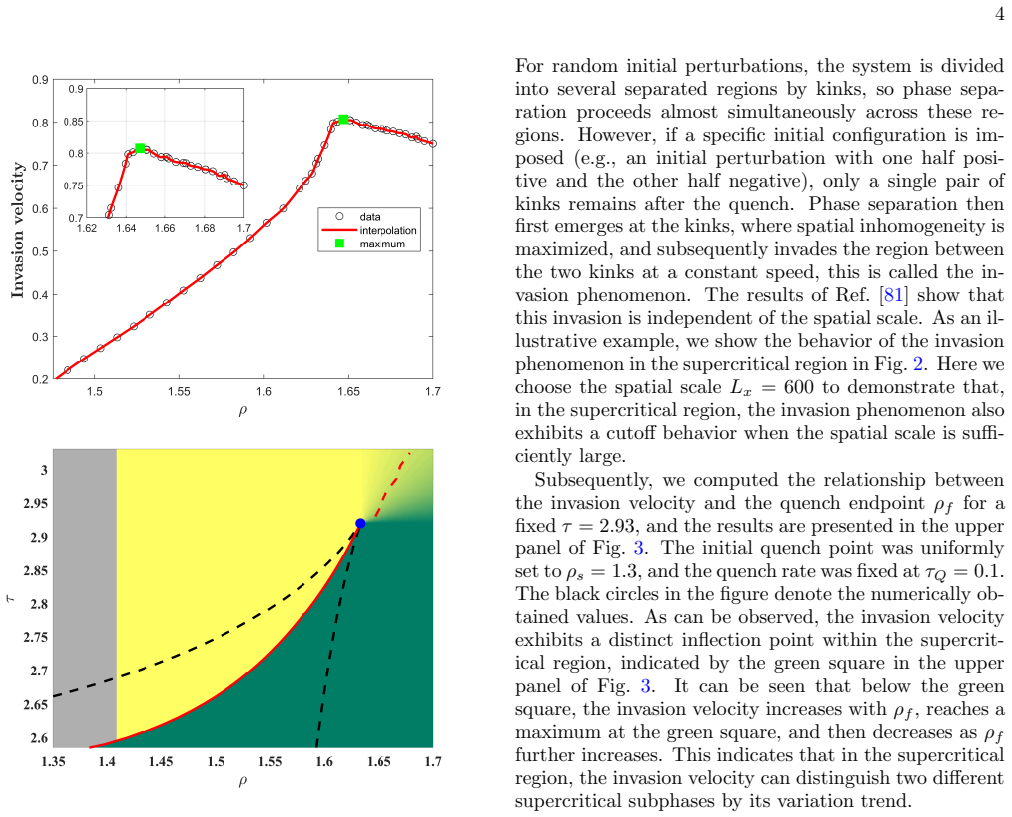
Within a holographic superfluid with two higher-order nonlinear terms, a rapid quench from the normal to the superfluid side of the phase diagram triggers spontaneous symmetry breaking. If the initial perturbation contains a single pair of kinks, a uniform phase-separation front invades the region between them at constant velocity — the invasion velocity. The authors find that this velocity is a non-monotonic function of the quench endpoint in the supercritical region: it increases, reaches a clear turning point, and then decreases. This turning point defines a new curve in parameter space, which they term the nonequilibrium supercritical crossover line. Because the curve emerges from time-d
What carries the argument
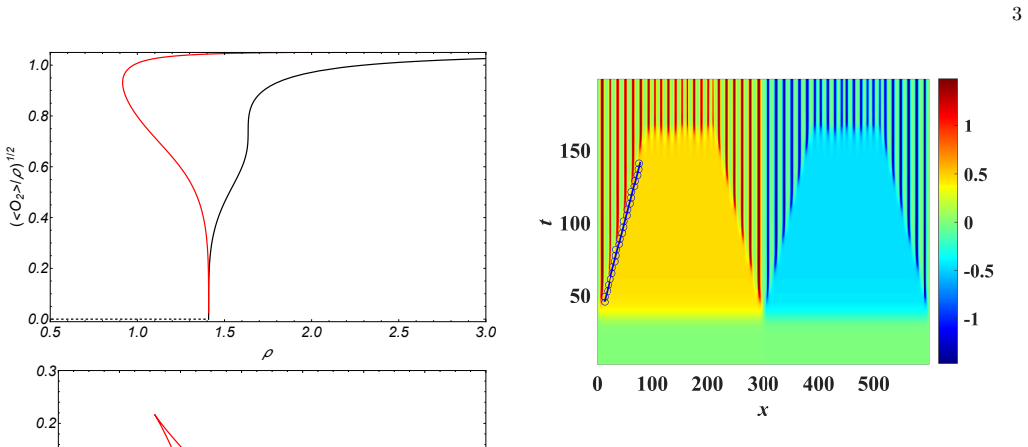
The central object is the invasion velocity, extracted as the reciprocal of the slope of a linear fit to the front position in the numerical quench simulations. The mechanism is the coupling between symmetry breaking and phase separation: topological-defect kinks act as nucleation sites, and a phase front sweeps inward at constant speed. The enabling step is the claim that during nonequilibrium evolution a globally charge-conserving system behaves like its local subsystems that exchange particles freely, so a locally unstable branch can produce inhomogeneous structures even in the supercritical region. The turning point of the invasion velocity with respect to the quench endpoint is the oper
Load-bearing premise
The load-bearing premise is that a globally charge-conserving system, during nonequilibrium evolution, behaves like its local subsystems that exchange particles freely, so that an unstable branch of those local subsystems creates inhomogeneous structures in the supercritical region; if that equivalence fails, no invasion front forms and the crossover line cannot be defined.
What would settle it
A simulation with strict global charge conservation imposed on the dynamical evolution, rather than allowing local particle exchange, would be decisive: if no phase-separation front appears in the supercritical region, the claimed turning point and crossover line are artifacts of the locality assumption.
If this is right
- The supercritical region is not dynamically featureless: two subphases can be distinguished by how fast a phase front invades after a fast quench.
- A crossover line defined by a turning point in invasion velocity can be drawn in parameter space, complementing classical static crossover lines with a purely nonequilibrium curve.
- Because the line encodes both thermodynamic and kinetic information, it may be more sensitive than static response functions to symmetry-breaking structure beyond the critical point.
- The mechanism is expected to be universal, so the same turning point should appear in any system with an energy barrier and a quench into an unstable region, including classical fluids, quantum gases, and black-hole systems.
Where Pith is reading between the lines
- A direct extension is to test whether the turning point shifts with quench rate; if it does, the crossover line is best understood as a kinetic locus rather than a material boundary, setting it even further apart from thermodynamic crossover lines.
- Because the front speed depends on how fast the symmetry-breaking order parameter relaxes, the turning point might be predicted from a reduced two-well free-energy model without holography, offering a simpler experimental handle.
- If the locality assumption is dropped — for example, by enforcing strict global charge conservation in the dynamics — the invasion front may fail to form and the entire crossover line would vanish; this is a targeted check that the paper's results invite.
Editorial analysis
A structured set of objections, weighed in public.
Referee Report
Summary. The paper studies the supercritical region of a holographic superfluid model (Einstein–Maxwell–scalar theory with Z2 symmetry and λ, τ, α couplings) by subjecting the system to a rapid quench across the critical point. The authors report that, after a quench from the normal phase to a supercritical endpoint, topological-defect-induced 'invasion' persists and the invasion velocity v_i, extracted from linear fits to the invasion front position, exhibits a maximum as a function of the quench endpoint ρ_f. This maximum is used to define a 'nonequilibrium supercritical crossover line' in the τ–ρ plane. The paper argues that this line encodes both thermodynamic and dynamical information, in contrast to Widom or Frenkel lines.
Significance. If the reported maximum in v_i(ρ_f) is robust and does not simply coincide with the static grand-canonical spinodal, the proposed crossover line would be a genuinely nonequilibrium probe of supercritical subphase structure, combining phase-separation and symmetry-breaking dynamics. The idea is interesting and potentially relevant beyond holography, as the authors relate it to Ginzburg–Landau mechanisms. However, the paper currently lacks several checks that are essential for establishing the claim: no protocol-sensitivity study, no comparison with the static stability boundary, no uncertainty or convergence analysis, and an unproved locality assumption in the theoretical justification. The abstract also promises two crossover lines while the body delivers only one.
major comments (5)
- [Abstract / Sections IV–V] The abstract states that the paper defines a supercritical crossover curve based on 'the time at which inhomogeneous structures appear most rapidly' and, in addition, a second crossover line from the invasion-velocity turning point. The main text never defines or analyzes the former quantity; Sections IV and V only discuss the invasion-velocity line. This discrepancy affects the paper's central claims and must be resolved: either remove the first line from the abstract or present the corresponding analysis.
- [Section IV, Fig. 3] The proposed crossover line is the red dashed curve in the lower panel, defined as the maximum of v_i as a function of ρ_f for fixed τ. The text itself notes in Section III that the grand-canonical ensemble retains an unstable branch in the supercritical region, and the lower panel shows a static spinodal region (black dashed line). The red dashed line is never compared with that static boundary. If the v_i maximum simply tracks the spinodal or the normal/superfluid boundary, the claimed novelty is substantially weakened. The authors should overlay the static spinodal and the v_i maxima for all τ values shown, and quantify their separation or coincidence.
- [Section IV, Fig. 3] All simulations use a single quench protocol: τ_Q=0.1, ρ_s=1.3, L_x=600, and a fixed step initial perturbation ±1e-5. In holographic quenches, front velocities and unstable-mode growth depend on quench rate, so v_i(ρ_f) and the location of its maximum could shift or smear with τ_Q. The paper must provide v_i(ρ_f) for at least a few quench rates (e.g., τ_Q = 0.05, 0.1, 0.2) and, ideally, for different initial perturbation amplitudes and system sizes, to show that the turning point is a robust dynamical feature rather than a protocol artifact.
- [Section IV, Fig. 3] The v_i values are extracted from linear fits (Fig. 2) but no error bars, fit residuals, or convergence tests are reported. The black circles in Fig. 3 therefore cannot be used to assess whether the maximum is statistically significant or whether the observed nonmonotonicity is within numerical uncertainty. The authors should report uncertainties from the fits and test sensitivity to time step, spatial resolution, and number of grid points.
- [Section III, last paragraph] The argument that the globally charge-conserving canonical system can be described by local grand-canonical subsystems, and that dynamical stability coincides with the stability of local subsystems, is asserted without proof. This assumption is load-bearing because it is what allows inhomogeneous structures and invasion to exist in the supercritical region. The authors should either provide a derivation or a quantitative numerical test (e.g., comparing canonical and grand-canonical response or directly computing local stability eigenvalues) to justify this step.
minor comments (4)
- [Section IV, Fig. 3 caption/text] The text says the invasion velocity exhibits a 'distinct inflection point' but describes a maximum (turning point). Please use consistent terminology.
- [Figure 2 caption] The quench rate is written as τ_Q = 0.1s, but the holographic model uses dimensionless boundary time; the unit 's' is either a typo or requires clarification of the conversion to physical units.
- [General] The paper relies heavily on the companion preprint Ref. [81] for the phase diagram and the invasion mechanism. The present manuscript should state more explicitly which results are new here and which are inherited from Ref. [81].
- [Section IV, paragraph 1] The description of the initial condition for the step perturbation could be clearer: it is introduced only in the caption of Fig. 2, and the main text should define it at first use.
Circularity Check
Main circularity: the supercritical-invasion premise is imported from overlapping-author preprint [81], while the v_i maximum itself is new data; the 'crossover line' is definitional rather than independently validated.
specific steps
-
self citation load bearing
[Sec. I (Introduction); Sec. III (static solutions/phase diagram); Sec. IV (quench dynamics); Refs. [81]]
"The full phase diagram in terms of the coefficients of the higher-order terms has been presented in previous work [81]. ... In Ref. [81], the authors demonstrated that when symmetry breaking is present and the quench endpoint resides within the unstable region of the first-order phase transition, topological defects can serve as nucleation sites for phase separation, thereby inducing a uniform invasion phenomenon."
The paper's central measurable, the invasion velocity v_i in the supercritical region, is justified by phenomena (topological-defect invasion, supercritical phase-separation mechanism, phase-diagram regime) attributed to Ref. [81], a companion preprint by the same authors (Zhao, Nie, Zhang, Zhang). No independent check of [81] is given. The new v_i(ρ_f) maximum is measured here, so the central claim has independent numerical content, but its physical premise is a load-bearing self-citation.
full rationale
The paper does not derive the new crossover line from first principles; it operationally defines it as the turning point of the invasion velocity v_i(ρ_f) measured in its own simulations. That is a stipulative definition, not a circular derivation: the line is, by construction, the locus of the maximum of v_i, and the paper says so explicitly ('This turning point defines a new curve in parameter space'). The absence of a comparison with the static grand-canonical spinodal, error bars, or τ_Q-variation is a validation/correctness gap, not a circularity. The unproved locality assumption in Sec. III ('the dynamical stability of the system coincides with that of the local subsystems') is likewise a missing proof rather than a self-reduction and is weighed as a correctness risk, not as circularity. The clearest circularity concern is the load-bearing reliance on Ref. [81], an overlapping-author preprint, for the invasion mechanism, the phase diagram, and scale-independence; this is what raises the score. Because the v_i turning-point data are new and self-contained, the paper retains independent content, consistent with a moderate circularity score of 4.
Axiom & Free-Parameter Ledger
free parameters (5)
- λ (quartic scalar coupling) =
-4
- τ (sextic scalar coupling) =
2.93 at critical point; varied to generate crossover line
- α (coupling in h(Ψ)=e^{αΨ²}) =
5
- m² (scalar mass squared) =
not stated in text
- Quench protocol parameters =
ρ_s=1.3, τ_Q=0.1, L_x=600, n_x=1800, δt=0.05, initial perturbation 10^-5
axioms (4)
- domain assumption AdS/CFT duality maps the boundary superfluid to a classical Einstein–Maxwell–scalar bulk theory.
- domain assumption The metric is taken in a fixed probe/fixed-background form f(z)=1-(z/z_h)^3 with no backreaction evolved.
- ad hoc to paper Dynamical stability of the globally charge-conserving system coincides with the grand-canonical stability of local subsystems.
- ad hoc to paper A genuine supercritical subphase boundary can be identified with the maximum of the invasion velocity v_i(ρ_f) at fixed quench protocol.
read the original abstract
Distinguishing different subphases in the supercritical region is an important issue in statistical physics and condensed matter physics. Traditional approaches rely mainly on static thermodynamic response functions or equilibrium correlation functions, which are essentially limited to quasistatic processes. In this paper, we investigate the evolution behavior of a system after a rapid quench from the perspective of nonequilibrium dynamics within a holographic model. We find that, using the time at which inhomogeneous structures appear most rapidly, we can define a supercritical crossover curve based on the pure phase separation process. In addition, the uniform invasion phenomenon induced by topological defects persists in the supercritical region, and the invasion velocity exhibits a clear turning point as a function of the quench endpoint. This turning point can define another new nonequilibrium supercritical crossover line that simultaneously incorporates the effects of both symmetry breaking and phase separation. Unlike the classical Widom line or Frenkel line, these two new crossover lines contain both thermodynamic information and dynamical information, reflecting the dynamical nature of the supercritical region under nonequilibrium conditions. This work provides a novel nonequilibrium dynamical approach for characterizing supercritical subphases.
Figures

Forward citations
Cited by 2 Pith papers
-
Phase separation seeded by Z2 and U(1) topological defects from holography
Holographic simulations demonstrate that Z2 and U(1) topological defects universally seed phase separation, with cores expanding into domains under a double-quench protocol.
-
Boson star-black hole binaries: initial data and head-on collisions
A one-body conformal-factor correction stabilizes boson star-black hole initial data, enabling gravitational-wave analysis that shows higher multipoles can discriminate mixed mergers from pure black-hole binaries.
Reference graph
Works this paper leans on
-
[1]
Burke, J
T. Burke, J. L. Lebowitz, and E. Lieb, Phys. Rev.149, 118 (1966)
1966
-
[2]
D. T. Son, M. Stephanov, and H.-U. Yee, J. Stat. Mech. 2101, 013105 (2021), arXiv:2006.01156 [cond-mat.quant- gas]
Pith/arXiv arXiv 2021
-
[3]
J. L. Jim´ enez, S. P. G. Crone, E. Fogh, M. E. Za- yed, R. Lortz, E. Pomjakushina, K. Conder, A. M. L¨ auchli, L. Weber, S. Wessel, A. Honecker, B. Normand, C. R¨ uegg, P. Corboz, H. M. Rønnow, and F. Mila, Na- ture592, 370–375 (2021)
2021
-
[4]
V. V. Brazhkin and K. Trachenko, Physics Today65, 68 (2012)
2012
-
[5]
D. Kubiznak and R. B. Mann, JHEP07, 033 (2012), arXiv:1205.0559 [hep-th]
Pith/arXiv arXiv 2012
-
[6]
D. Kubiznak, R. B. Mann, and M. Teo, Class. Quant. Grav.34, 063001 (2017), arXiv:1608.06147 [hep-th]
Pith/arXiv arXiv 2017
-
[7]
R.-G. Cai, L.-M. Cao, L. Li, and R.-Q. Yang, JHEP09, 005 (2013), arXiv:1306.6233 [gr-qc]
Pith/arXiv arXiv 2013
-
[8]
S.-W. Wei and Y.-X. Liu, Phys. Rev. D90, 044057 (2014), arXiv:1402.2837 [hep-th]
Pith/arXiv arXiv 2014
-
[9]
L. Xu, P. Kumar, S. V. Buldyrev, S.-H. Chen, P. H. Poole, F. Sciortino, and H. E. Stanley, Proceedings of the National Academy of Sciences102, 16558–16562 (2005)
2005
-
[10]
G. Ruppeiner, A. Sahay, T. Sarkar, and G. Sen- gupta, Physical Review E86(2012), 10.1103/phys- reve.86.052103
doi:10.1103/phys- 2012
-
[11]
J. Luo, L. Xu, E. Lascaris, H. E. Stanley, and S. V. Buldyrev, Phys. Rev. Lett.112, 135701 (2014)
2014
-
[12]
D. T. Banuti, M. Raju, and M. Ihme, Phys. Rev. E95, 052120 (2017)
2017
-
[13]
Gallo, D
P. Gallo, D. Corradini, and M. Rovere, Nature Commu- nications5, 5806 (2014)
2014
-
[14]
T. J. Yoon, M. Y. Ha, W. B. Lee, and Y.-W. Lee, The Journal of Physical Chemistry Letters9, 4550–4554 (2018). 6
2018
-
[15]
V. V. Brazhkin, Y. D. Fomin, A. G. Lyapin, V. N. Ryzhov, E. N. Tsiok, and K. Trachenko, Phys. Rev. Lett.111, 145901 (2013)
2013
-
[16]
Bolmatov, V
D. Bolmatov, V. V. Brazhkin, and K. Trachenko, Nature Communications4, 2331 (2013)
2013
-
[17]
C. Prescher, Y. D. Fomin, V. B. Prakapenka, J. Stefanski, K. Trachenko, and V. V. Brazhkin, Physical Review B 95(2017), 10.1103/physrevb.95.134114
-
[18]
D. Bolmatov, M. Zhernenkov, D. Zav’yalov, S. N. Tkachev, A. Cunsolo, and Y. Q. Cai, Scientific Reports 5(2015), 10.1038/srep15850
-
[19]
Y. D. Fomin, V. N. Ryzhov, E. N. Tsiok, J. E. Proc- tor, C. Prescher, V. B. Prakapenka, K. Trachenko, and V. V. Brazhkin, Journal of Physics: Condensed Matter 30, 134003 (2018)
2018
-
[20]
Y. D. Fomin, V. N. Ryzhov, E. N. Tsiok, and V. V. Brazhkin, Scientific Reports5, 14234 (2015)
2015
-
[21]
V. V. Brazhkin, Y. D. Fomin, A. G. Lyapin, V. N. Ryzhov, and K. Trachenko, Phys. Rev. E85, 031203 (2012)
2012
-
[22]
D. Huang, M. Baggioli, S. Lu, Z. Ma, and Y. Feng, Phys- ical Review Research5, 013149 (2023), arXiv:2301.08449 [physics.plasm-ph]
Pith/arXiv arXiv 2023
-
[23]
C. Jiang, Z. Zheng, Y. Chen, M. Baggioli, and J. Zhang, arXiv preprint arXiv:2403.08285 (2024)
Pith/arXiv arXiv 2024
-
[24]
Z.-Q. Zhao, Z.-Y. Nie, J.-F. Zhang, X. Zhang, and M. Baggioli, Eur. Phys. J. C85, 464 (2025), arXiv:2406.05345 [hep-th]
Pith/arXiv arXiv 2025
- [25]
-
[26]
Z.-Q. Zhao, Z.-Y. Nie, J.-F. Zhang, and X. Zhang, Chin. Phys. Lett.42, 101102 (2025), arXiv:2504.04995 [gr-qc]
arXiv 2025
-
[27]
S. Wang, X. Li, Y. Jin, and L. Li, (2025), arXiv:2506.10808 [gr-qc]
Pith/arXiv arXiv 2025
- [28]
- [29]
-
[30]
R. Li, K. Zhang, J. Yang, R. B. Mann, and J. Wang, Phys. Rev. D112, 064004 (2025), arXiv:2505.24148 [gr- qc]
Pith/arXiv arXiv 2025
-
[31]
J. M. Maldacena, Adv. Theor. Math. Phys.2, 231 (1998), arXiv:hep-th/9711200
Pith/arXiv arXiv 1998
-
[32]
S. A. Hartnoll, C. P. Herzog, and G. T. Horowitz, Phys. Rev. Lett.101, 031601 (2008), arXiv:0803.3295 [hep-th]
Pith/arXiv arXiv 2008
-
[33]
S. A. Hartnoll, C. P. Herzog, and G. T. Horowitz, JHEP 12, 015 (2008), arXiv:0810.1563 [hep-th]
Pith/arXiv arXiv 2008
-
[34]
C. P. Herzog, Phys. Rev. D81, 126009 (2010), arXiv:1003.3278 [hep-th]
Pith/arXiv arXiv 2010
-
[35]
Q. Chen, Y. Liu, Y. Tian, B. Wang, C.-Y. Zhang, and H. Zhang, JHEP01, 056 (2023), arXiv:2209.12789 [hep- th]
Pith/arXiv arXiv 2023
-
[36]
X. Li, Z.-Y. Nie, and Y. Tian, JHEP09, 063 (2020), arXiv:2003.12987 [hep-th]
Pith/arXiv arXiv 2020
-
[37]
Q. Chen, Y. Liu, Y. Tian, X. Wu, and H. Zhang, Phys. Rev. D108, 106017 (2023), arXiv:2211.11291 [hep-th]
Pith/arXiv arXiv 2023
-
[38]
C.-Y. Xia and H.-B. Zeng, Phys. Rev. D102, 126005 (2020), arXiv:2009.00435 [hep-th]
Pith/arXiv arXiv 2020
-
[39]
A. del Campo, F. J. G´ omez-Ruiz, Z.-H. Li, C.-Y. Xia, H.-B. Zeng, and H.-Q. Zhang, JHEP06, 061 (2021), arXiv:2101.02171 [cond-mat.stat-mech]
Pith/arXiv arXiv 2021
-
[40]
Z.-H. Li, H.-B. Zeng, and H.-Q. Zhang, JHEP04, 295 (2021), arXiv:2101.08405 [hep-th]
Pith/arXiv arXiv 2021
-
[41]
Z.-H. Li, C.-Y. Xia, H.-B. Zeng, and H.-Q. Zhang, JHEP 10, 124 (2021), arXiv:2103.01485 [hep-th]
Pith/arXiv arXiv 2021
-
[42]
C.-Y. Xia and H.-B. Zeng, (2021), arXiv:2110.07969 [cond-mat.stat-mech]
Pith/arXiv arXiv 2021
-
[43]
H.-B. Zeng, C.-Y. Xia, and A. del Campo, Phys. Rev. Lett.130, 060402 (2023), arXiv:2204.13529 [cond- mat.stat-mech]
Pith/arXiv arXiv 2023
-
[44]
P. Yang, C.-Y. Xia, S. Grieninger, H.-B. Zeng, and M. Baggioli, Phys. Rev. Lett.136, 051602 (2026), arXiv:2508.05964 [cond-mat.stat-mech]
arXiv 2026
-
[45]
C.-Y. Xia, A. Grabarits, H.-B. Zeng, and A. del Campo, (2026), arXiv:2601.14328 [hep-th]
arXiv 2026
-
[46]
C.-Y. Xia, H.-B. Zeng, C.-M. Chen, and A. del Campo, Phys. Rev. D108, 026017 (2023), arXiv:2302.11597 [hep- th]
Pith/arXiv arXiv 2023
-
[47]
J.-H. Su, C.-Y. Xia, W.-C. Yang, and H.-B. Zeng, Phys. Rev. D109, 046019 (2024), arXiv:2311.05856 [hep-th]
Pith/arXiv arXiv 2024
-
[48]
X. Zhao, Z.-Y. Nie, Z.-Q. Zhao, H.-B. Zeng, Y. Tian, and M. Baggioli, JHEP02, 184 (2024), arXiv:2311.08277 [hep-th]
Pith/arXiv arXiv 2024
-
[49]
Y.-P. An, L. Li, C.-Y. Xia, and H.-B. Zeng, Phys. Rev. D 109, 106022 (2024), arXiv:2401.09189 [cond-mat.quant- gas]
Pith/arXiv arXiv 2024
-
[50]
W.-C. Yang, C.-Y. Xia, Y. Tian, M. Tsubota, and H.-B. Zeng, (2024), arXiv:2402.17980 [hep-th]
Pith/arXiv arXiv 2024
-
[51]
C.-Y. Xia and H.-B. Zeng, Phys. Rev. D111, 026004 (2025), arXiv:2404.04274 [hep-th]
Pith/arXiv arXiv 2025
-
[52]
H.-B. Zeng, C.-Y. Xia, W.-C. Yang, Y. Tian, and M. Tsubota, Phys. Rev. Lett.134, 091603 (2025), arXiv:2408.13620 [hep-th]
Pith/arXiv arXiv 2025
-
[53]
S. A. Hartnoll, G. T. Horowitz, J. Kruthoff, and J. E. Santos, SciPost Phys.10, 009 (2021), arXiv:2008.12786 [hep-th]
Pith/arXiv arXiv 2021
-
[54]
R.-G. Cai, L. Li, and R.-Q. Yang, JHEP03, 263 (2021), arXiv:2009.05520 [gr-qc]
Pith/arXiv arXiv 2021
-
[55]
Y.-Q. Wang, Y. Song, Q. Xiang, S.-W. Wei, T. Zhu, and Y.-X. Liu, (2020), arXiv:2009.06277 [hep-th]
Pith/arXiv arXiv 2020
-
[56]
Y. Liu, H.-D. Lyu, and A. Raju, JHEP10, 140 (2021), arXiv:2108.04554 [hep-th]
Pith/arXiv arXiv 2021
-
[57]
Y.-S. An, L. Li, and F.-G. Yang, Phys. Rev. D104, 024040 (2021), arXiv:2106.01069 [gr-qc]
Pith/arXiv arXiv 2021
-
[58]
S. A. H. Mansoori, L. Li, M. Rafiee, and M. Baggioli, JHEP10, 098 (2021), arXiv:2108.01471 [hep-th]
Pith/arXiv arXiv 2021
-
[59]
R.-G. Cai, C. Ge, L. Li, and R.-Q. Yang, JHEP02, 139 (2022), arXiv:2112.04206 [gr-qc]
Pith/arXiv arXiv 2022
-
[60]
Y.-S. An, L. Li, F.-G. Yang, and R.-Q. Yang, JHEP08, 133 (2022), arXiv:2205.02442 [hep-th]
Pith/arXiv arXiv 2022
-
[61]
L. Sword and D. Vegh, JHEP12, 045 (2022), arXiv:2210.01046 [hep-th]
Pith/arXiv arXiv 2022
-
[62]
Y. Liu and H.-D. Lyu, JHEP09, 071 (2022), arXiv:2205.14803 [hep-th]
Pith/arXiv arXiv 2022
-
[63]
Z.-Q. Zhao, X.-K. Zhang, and Z.-Y. Nie, JHEP02, 023 (2023), arXiv:2211.14762 [hep-th]
Pith/arXiv arXiv 2023
-
[64]
Y. Xu, D. Wang, and Q. Pan, Phys. Rev. D110, 046003 (2024), arXiv:2311.13145 [hep-th]
Pith/arXiv arXiv 2024
-
[65]
L.-L. Gao, Y. Liu, and H.-D. Lyu, JHEP03, 034 (2023), arXiv:2301.01468 [hep-th]
Pith/arXiv arXiv 2023
-
[66]
L.-L. Gao, Y. Liu, and H.-D. Lyu, JHEP01, 063 (2024), arXiv:2310.15781 [hep-th]
Pith/arXiv arXiv 2024
-
[67]
X.-K. Zhang, X. Zhao, Z.-Y. Nie, Y.-P. Hu, and Y.-S. An, Phys. Lett. B868, 139684 (2025), arXiv:2411.07693 [hep-th]
Pith/arXiv arXiv 2025
- [68]
-
[69]
Y. Xu, L. Li, and W.-J. Li, (2025), arXiv:2511.00877 [hep-th]
arXiv 2025
-
[70]
L.-L. Gao, Y. Liu, and R.-L. Zhao, (2025), arXiv:2511.19079 [hep-th]
Pith/arXiv arXiv 2025
- [71]
-
[72]
Z.-Q. Zhao, Z.-Y. Nie, S.-W. Wei, J.-F. Zhang, and X. Zhang, (2026), arXiv:2604.01818 [gr-qc]
arXiv 2026
-
[73]
R. A. Janik, J. Jankowski, and H. Soltanpanahi, Phys. Rev. Lett.117, 091603 (2016), arXiv:1512.06871 [hep- th]
Pith/arXiv arXiv 2016
-
[74]
R. A. Janik, J. Jankowski, and H. Soltanpanahi, JHEP 06, 047 (2016), arXiv:1603.05950 [hep-th]
Pith/arXiv arXiv 2016
-
[75]
R. A. Janik, J. Jankowski, and H. Soltanpanahi, Phys. Rev. Lett.119, 261601 (2017), arXiv:1704.05387 [hep- th]
Pith/arXiv arXiv 2017
-
[76]
M. Attems, Y. Bea, J. Casalderrey-Solana, D. Mateos, M. Triana, and M. Zilhao, JHEP06, 129 (2017), arXiv:1703.02948 [hep-th]
Pith/arXiv arXiv 2017
-
[77]
M. Attems, Y. Bea, J. Casalderrey-Solana, D. Mateos, and M. Zilh˜ ao, JHEP01, 106 (2020), arXiv:1905.12544 [hep-th]
Pith/arXiv arXiv 2020
-
[78]
L. Bellantuono, R. A. Janik, J. Jankowski, and H. Soltanpanahi, JHEP10, 146 (2019), arXiv:1906.00061 [hep-th]
Pith/arXiv arXiv 2019
-
[79]
Attems, JHEP08, 155 (2021), arXiv:2012.15687 [hep- th]
M. Attems, JHEP08, 155 (2021), arXiv:2012.15687 [hep- th]
Pith/arXiv arXiv 2021
-
[80]
Z. Ning, Q. Chen, Y. Tian, X. Wu, and H. Zhang, Phys. Rev. D109, 064082 (2024), arXiv:2307.14156 [gr-qc]
Pith/arXiv arXiv 2024
discussion (0)
Sign in with ORCID, Apple, or X to comment. Anyone can read and Pith papers without signing in.