Recognition: unknown
Boson star-black hole binaries: initial data and head-on collisions
Pith reviewed 2026-05-10 10:08 UTC · model grok-4.3
The pith
A conformal-factor correction to initial data allows clean simulations showing that higher multipole gravitational waves distinguish boson star-black hole head-on collisions from pure black hole binaries.
A machine-rendered reading of the paper's core claim, the machinery that carries it, and where it could break.
Core claim
We demonstrate that a one-body conformal-factor correction applied to superposed boson star-black hole initial data suppresses constraint violations and radial oscillations. With this improved data, equal-mass collisions produce radiated energy that increases with boson star compactness and approaches the black hole-black hole value. Unequal-mass collisions keep the dominant (2,0) mode similar to black hole binaries, yet the subdominant (3,0) mode supplies clear differences when the black hole is the heavier companion, identifying higher multipoles as a discriminator.
What carries the argument
The one-body conformal-factor correction applied to the superposed metric and scalar-field initial data, which removes unphysical perturbations from the boson star core.
If this is right
- Radiated energy in equal-mass boson star-black hole collisions grows with boson star compactness and approaches the black hole-black hole limit.
- The dominant (2,0) gravitational-wave mode stays similar to black hole binaries in both equal- and unequal-mass runs.
- The subdominant (3,0) mode diverges from black hole expectations when the black hole is the heavier companion.
- Higher multipoles serve as an observable to separate mixed boson star-black hole mergers from pure black hole binaries.
Where Pith is reading between the lines
- Multipolar analysis of detected gravitational waves could be used to test for boson-star components in future events.
- The same initial-data correction might be tested on orbiting binaries to check whether the multipole distinction survives in more realistic inspiral-merger waveforms.
Load-bearing premise
The one-body conformal-factor correction produces initial data that remains physically realistic and does not alter the subsequent collision dynamics in unphysical ways.
What would settle it
Gravitational-wave signals from a head-on collision simulation that still shows large constraint violations or radial oscillations after the correction, or an observed merger whose (3,0) mode amplitude and phase match pure black hole predictions rather than the mixed case.
Figures



read the original abstract
We present a numerical-relativity study of comparable-mass boson star-black hole (BS-BH) head-on collisions, focusing on both initial-data construction and gravitational-wave (GW) phenomenology. We show that plain superposition can strongly perturb the BS core, leading to large constraint violations and unphysical radial oscillations. To remedy this problem, we introduce a one-body conformal-factor correction and find that it robustly suppresses these artifacts. Using the improved initial data, we analyze GW emission from equal- and unequal-mass BS-BH binaries and compare with matched BS-BS and BH-BH baselines. For equal masses, the BS-BH radiated energy increases with BS compactness and approaches the BH-BH limit for highly compact stars. For unequal masses, the dominant $(2,0)$ mode often remains close to the BH-BH morphology, whereas the subdominant $(3,0)$ mode provides clear discriminatory power when the BH is the heavier companion. Our results identify higher multipoles as a key observable for distinguishing mixed BS-BH mergers from pure BH binaries.
Editorial analysis
A structured set of objections, weighed in public.
Referee Report
Summary. The manuscript presents a numerical-relativity study of head-on collisions between comparable-mass boson stars and black holes. It shows that naive superposition of initial data produces large constraint violations and unphysical radial oscillations in the boson star, introduces a one-body conformal-factor correction to suppress these artifacts, and then compares the gravitational-wave emission from equal- and unequal-mass BS-BH systems against matched BS-BS and BH-BH baselines. The central result is that the dominant (2,0) mode often resembles the BH-BH case while the subdominant (3,0) mode provides clear discriminatory power, especially when the black hole is the heavier object; higher multipoles are therefore proposed as key observables for distinguishing mixed BS-BH mergers.
Significance. If the initial-data correction is shown to be free of spurious artifacts and the reported mode differences are robust, the work supplies a practical route to constructing viable BS-BH initial data and identifies a concrete gravitational-wave signature that could help distinguish boson-star components in future detections. The study is grounded in direct numerical evolution and baseline comparisons, which strengthens its relevance to ongoing efforts in numerical relativity and gravitational-wave astronomy.
major comments (2)
- [Initial data construction] Initial-data section: the one-body conformal-factor correction is introduced to remedy superposition artifacts, yet the manuscript provides no side-by-side comparison of the scalar-field profile, ADM mass, or radial-oscillation amplitude between the corrected data and an isolated, settled boson star evolved for the same coordinate time. Without this check it remains possible that the correction itself modifies the effective compactness or excites additional multipoles that are then misattributed to the BS-BH interaction when interpreting the (3,0) mode.
- [Gravitational wave analysis] Gravitational-wave results section: the claim that the (3,0) mode distinguishes BS-BH from BH-BH binaries rests on extracted multipole amplitudes, but no convergence tests, resolution studies, or quantitative error bars on the radiated energy or mode amplitudes are reported. This absence makes it difficult to judge whether the reported trends (e.g., increase of radiated energy with compactness) are numerically reliable or could be affected by residual constraint violations.
minor comments (2)
- [Abstract] The abstract states that results are obtained for “equal- and unequal-mass” cases but does not specify the exact mass ratios or compactness parameters explored; adding these values would improve clarity.
- [Figures] Figure captions for the waveform comparisons could explicitly note the extraction radius and the time window used for the (3,0) mode analysis to facilitate reproducibility.
Simulated Author's Rebuttal
We thank the referee for their careful reading of the manuscript and for the constructive comments, which have helped us strengthen the presentation of both the initial-data construction and the gravitational-wave analysis. We address each major comment below and have incorporated revisions to improve the robustness of the results.
read point-by-point responses
-
Referee: Initial-data section: the one-body conformal-factor correction is introduced to remedy superposition artifacts, yet the manuscript provides no side-by-side comparison of the scalar-field profile, ADM mass, or radial-oscillation amplitude between the corrected data and an isolated, settled boson star evolved for the same coordinate time. Without this check it remains possible that the correction itself modifies the effective compactness or excites additional multipoles that are then misattributed to the BS-BH interaction when interpreting the (3,0) mode.
Authors: We agree that an explicit validation against an isolated boson star is a valuable addition. The one-body correction is constructed to recover the isolated solution for the conformal factor while leaving the scalar field unchanged, but we acknowledge that a direct side-by-side comparison was not shown. In the revised manuscript we have added a new figure and accompanying text in the initial-data section that overlays the scalar-field radial profile and the central-density evolution (as a measure of radial oscillations) for the corrected BS-BH data against an isolated boson star evolved for the same coordinate time. We also tabulate the ADM mass for both configurations, confirming that the correction preserves the global mass to within 0.1 percent and does not introduce additional oscillations. These checks demonstrate that the reported (3,0)-mode differences originate from the binary interaction rather than from the initial-data procedure. revision: yes
-
Referee: Gravitational-wave results section: the claim that the (3,0) mode distinguishes BS-BH from BH-BH binaries rests on extracted multipole amplitudes, but no convergence tests, resolution studies, or quantitative error bars on the radiated energy or mode amplitudes are reported. This absence makes it difficult to judge whether the reported trends (e.g., increase of radiated energy with compactness) are numerically reliable or could be affected by residual constraint violations.
Authors: We concur that quantitative convergence information is necessary to substantiate the gravitational-wave claims. Although resolution studies were performed during the project, they were not reported in the original submission. In the revised manuscript we have inserted a new paragraph in the gravitational-wave analysis section that presents results from three resolutions (low, medium, and high). We demonstrate second-order convergence for both the (2,0) and (3,0) modes, provide error bars on the radiated energy and peak amplitudes obtained via Richardson extrapolation, and show that the residual constraint violations remain below the level that would affect the extracted waveforms at the reported precision. These additions confirm that the observed increase in radiated energy with compactness and the discriminatory power of the (3,0) mode are numerically robust. revision: yes
Circularity Check
No circularity: numerical evolutions and baseline comparisons are independent.
full rationale
The paper constructs initial data via a one-body conformal-factor correction to mitigate superposition artifacts, then performs numerical evolutions of BS-BH head-on collisions and extracts GW modes for direct comparison against separate BS-BS and BH-BH runs. No equations reduce the reported (3,0) mode distinctions or radiated energies to quantities fitted from the same data, self-defined, or imported via self-citation chains; the results rest on independent constraint-satisfying evolutions and external baseline simulations, rendering the derivation self-contained.
Axiom & Free-Parameter Ledger
Reference graph
Works this paper leans on
-
[1]
Initial constraint violations Since the plain superposition method can distort the volume element at the BS center and thereby inject spu- rious mass-energy, one expects the improved superpo- sition method to reduce the Hamiltonian-constraint vi- olation significantly. To demonstrate this, we plot the 8 RunqObject A Object Bv A x vB x d MInitial data BSBH...
-
[2]
The total mass of the binary is denoted byM=γ AMA +γ BMB
The initial velocities are chosen so that the total initial momentumP x =M AγAvA x +M BγBvB x vanishes, while the initial relative velocity is fixed at ∆v=v A x −v B x = 0.2 for all runs. The total mass of the binary is denoted byM=γ AMA +γ BMB. For the BS-BH binaries, we use the improved superposition method described in Sec. III D for all runs exceptBSB...
-
[3]
The model BS-170is a highly compact BS, lying below but close to the maximum-mass threshold and therefore close to the instability threshold
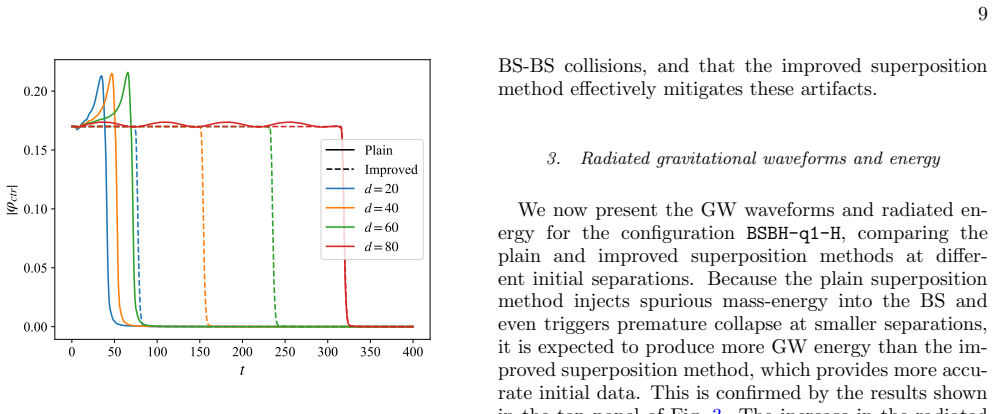
Evolution of the scalar field and premature collapse We now compare the time evolution of the scalar field for the configurationBSBH-q1-Hgenerated using the plain and improved superposition methods. The model BS-170is a highly compact BS, lying below but close to the maximum-mass threshold and therefore close to the instability threshold. Fig. 2 shows the...
-
[4]
BH mimicker
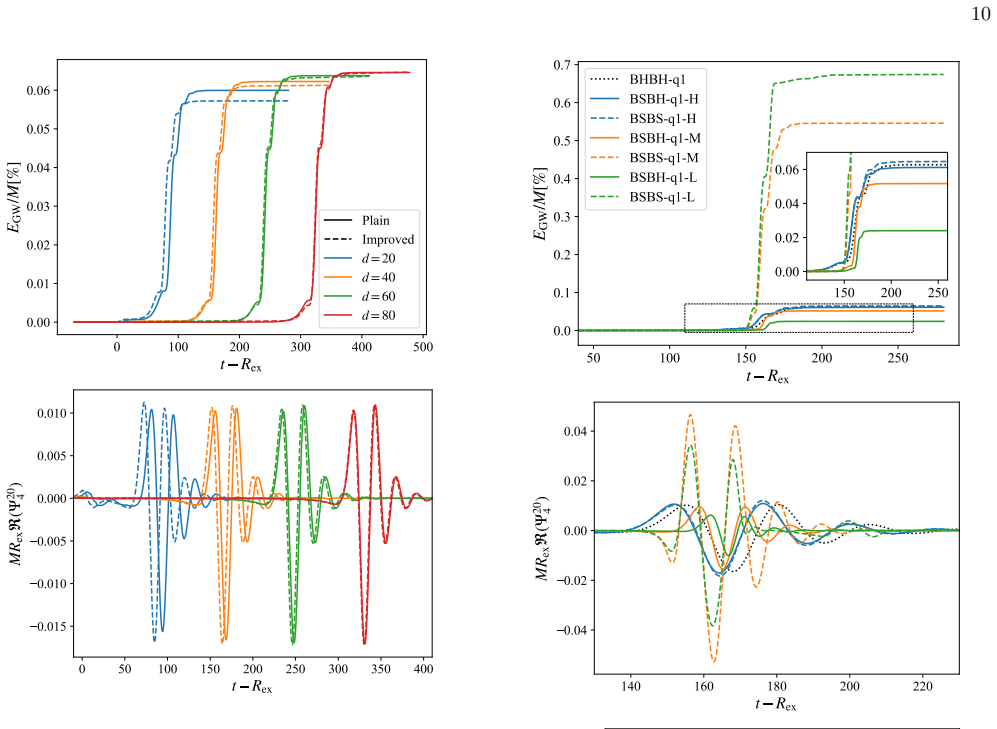
Radiated gravitational waveforms and energy We now present the GW waveforms and radiated en- ergy for the configurationBSBH-q1-H, comparing the plain and improved superposition methods at differ- ent initial separations. Because the plain superposition method injects spurious mass-energy into the BS and even triggers premature collapse at smaller separati...
2025
-
[5]
The Structure of cold dark matter ha- los,
Julio F. Navarro, Carlos S. Frenk, and Simon D. M. White, “The Structure of cold dark matter ha- los,” Astrophys. J.462, 563–575 (1996), arXiv:astro- ph/9508025
-
[6]
A direct empirical proof of the existence of dark matter
Douglas Clowe, Marusa Bradac, Anthony H. Gonzalez, Maxim Markevitch, Scott W. Randall, Christine Jones, and Dennis Zaritsky, “A direct empirical proof of the ex- istence of dark matter,” Astrophys. J. Lett.648, L109– L113 (2006), arXiv:astro-ph/0608407
work page Pith review arXiv 2006
-
[7]
Particle dark matter: Evidence, candidates and con- straints,
Gianfranco Bertone, Dan Hooper, and Joseph Silk, “Particle dark matter: Evidence, candidates and con- straints,” Phys. Rept.405, 279–390 (2005), arXiv:hep- ph/0404175
-
[8]
Feng,Dark Matter Candidates from Particle Physics and Methods of Detection,Ann
Jonathan L. Feng, “Dark Matter Candidates from Par- ticle Physics and Methods of Detection,” Ann. Rev. As- tron. Astrophys.48, 495–545 (2010), arXiv:1003.0904 [astro-ph.CO]
-
[9]
Indirect and direct search for dark matter,
Michael Klasen, Martin Pohl, and G¨ unter Sigl, “In- direct and direct search for dark matter,” Prog. Part. Nucl. Phys.85, 1–32 (2015), arXiv:1507.03800 [hep-ph]
-
[10]
Review of LHC Dark Matter Searches,
Felix Kahlhoefer, “Review of LHC Dark Matter Searches,” Int. J. Mod. Phys. A32, 1730006 (2017), arXiv:1702.02430 [hep-ph]
-
[11]
Review on dark matter searches,
Susana Cebri´ an, “Review on dark matter searches,” J. Phys. Conf. Ser.2502, 012004 (2023), arXiv:2205.06833 [physics.ins-det]
-
[12]
B. P. Abbottet al.(LIGO Scientific, Virgo), “GWTC- 1: A Gravitational-Wave Transient Catalog of Compact Binary Mergers Observed by LIGO and Virgo during the First and Second Observing Runs,” Phys. Rev. X9, 031040 (2019), arXiv:1811.12907 [astro-ph.HE]. /uni00000018/uni00000013 /uni00000013/uni00000018/uni00000013/uni00000014/uni00000013/uni00000013/uni000...
work page internal anchor Pith review arXiv 2019
-
[13]
R. Abbottet al.(KAGRA, VIRGO, LIGO Scientific), “GWTC-3: Compact Binary Coalescences Observed by LIGO and Virgo during the Second Part of the Third Observing Run,” Phys. Rev. X13, 041039 (2023), arXiv:2111.03606 [gr-qc]. 16 /uni00000013/uni00000018/uni00000013/uni00000014/uni00000013/uni00000013/uni00000014/uni00000018/uni00000013/uni00000015/uni00000013/...
work page internal anchor Pith review arXiv 2023
-
[14]
A. G. Abacet al.(LIGO Scientific, VIRGO, KAGRA), “GWTC-4.0: Updating the Gravitational-Wave Tran- sient Catalog with Observations from the First Part of the Fourth LIGO-Virgo-KAGRA Observing Run,” (2025), arXiv:2508.18082 [gr-qc]
work page internal anchor Pith review arXiv 2025
- [15]
-
[16]
Gravitational wave probes of dark matter: challenges and opportunities,
Gianfranco Bertoneet al., “Gravitational wave probes of dark matter: challenges and opportunities,” Sci- Post Phys. Core3, 007 (2020), arXiv:1907.10610 [astro- ph.CO]
-
[17]
Maxim Pospelov, Adam Ritz, and Mikhail B. Voloshin, “Secluded WIMP Dark Matter,” Phys. Lett. B662, 53– 61 (2008), arXiv:0711.4866 [hep-ph]
work page Pith review arXiv 2008
-
[18]
Giorgio Arcadi, Ma´ ıra Dutra, Pradipta Ghosh, Manfred Lindner, Yann Mambrini, Mathias Pierre, Stefano Pro- fumo, and Farinaldo S. Queiroz, “The waning of the WIMP? A review of models, searches, and constraints,” Eur. Phys. J. C78, 203 (2018), arXiv:1703.07364 [hep- ph]
-
[19]
WIMP dark matter candidates and searches - current status and future prospects
Leszek Roszkowski, Enrico Maria Sessolo, and Sebas- tian Trojanowski, “WIMP dark matter candidates and searches—current status and future prospects,” Rept. Prog. Phys.81, 066201 (2018), arXiv:1707.06277 [hep- ph]
work page Pith review arXiv 2018
-
[20]
Direct Detection of WIMP Dark Mat- ter: Concepts and Status,
Marc Schumann, “Direct Detection of WIMP Dark Matter: Concepts and Status,” J. Phys. G46, 103003 (2019), arXiv:1903.03026 [astro-ph.CO]
-
[21]
Sterile Neutrinos as Dark Matter
Scott Dodelson and Lawrence M. Widrow, “Sterile- neutrinos as dark matter,” Phys. Rev. Lett.72, 17–20 (1994), arXiv:hep-ph/9303287
work page Pith review arXiv 1994
-
[22]
A New dark matter candidate: Nonthermal sterile neutrinos,
Xiang-Dong Shi and George M. Fuller, “A New dark matter candidate: Nonthermal sterile neutrinos,” Phys. Rev. Lett.82, 2832–2835 (1999), arXiv:astro- ph/9810076
-
[23]
Light Sterile Neutrinos: A White Paper
K. N. Abazajianet al., “Light Sterile Neutrinos: A White Paper,” (2012), arXiv:1204.5379 [hep-ph]
work page Pith review arXiv 2012
-
[24]
Wayne Hu, Rennan Barkana, and Andrei Gruzinov, “Cold and fuzzy dark matter,” Phys. Rev. Lett.85, 1158–1161 (2000), arXiv:astro-ph/0003365
work page Pith review arXiv 2000
-
[25]
Ultralight scalars as cosmological dark matter
Lam Hui, Jeremiah P. Ostriker, Scott Tremaine, and Edward Witten, “Ultralight scalars as cosmolog- ical dark matter,” Phys. Rev. D95, 043541 (2017), arXiv:1610.08297 [astro-ph.CO]
work page Pith review arXiv 2017
-
[26]
Lam Hui, “Wave Dark Matter,” Ann. Rev. Astron. As- trophys.59, 247–289 (2021), arXiv:2101.11735 [astro- ph.CO]
-
[27]
Primordial Black Holes as Dark Matter
Bernard Carr, Florian Kuhnel, and Marit Sandstad, “Primordial Black Holes as Dark Matter,” Phys. Rev. D94, 083504 (2016), arXiv:1607.06077 [astro-ph.CO]
work page Pith review arXiv 2016
-
[28]
Primordial Black Holes as a dark matter candidate
Anne M. Green and Bradley J. Kavanagh, “Primordial Black Holes as a dark matter candidate,” J. Phys. G 48, 043001 (2021), arXiv:2007.10722 [astro-ph.CO]
work page internal anchor Pith review arXiv 2021
-
[29]
Sound waves from primordial black hole formations,
Zhuan Ning, Xiang-Xi Zeng, Zi-Yan Yuwen, Shao-Jiang Wang, Heling Deng, and Rong-Gen Cai, “Sound waves from primordial black hole formations,” Phys. Rev. D 113, 024020 (2026), arXiv:2504.12243 [gr-qc]
-
[30]
Relic gravitational waves from primordial gravitational collapses
Xiang-Xi Zeng, Zhuan Ning, Zi-Yan Yuwen, Shao-Jiang Wang, Heling Deng, and Rong-Gen Cai, “Relic gravi- tational waves from primordial gravitational collapses,” (2025), arXiv:2504.11275 [gr-qc]
work page internal anchor Pith review Pith/arXiv arXiv 2025
-
[31]
Acoustic gravita- tional waves from primordial curvature perturbations,
Zhuan Ning, Zi-Yan Yuwen, Xiang-Xi Zeng, Rong- Gen Cai, and Shao-Jiang Wang, “Acoustic gravita- tional waves from primordial curvature perturbations,” (2025), arXiv:2512.21151 [gr-qc]
-
[32]
Primordial black holes: constraints, potential evidence and prospects,
Bernard Carr, Antonio J. Iovino, Gabriele Perna, Ville Vaskonen, and Hardi Veerm¨ ae, “Primordial black holes: constraints, potential evidence and prospects,” (2026), 10.1007/s40766-026-00080-z, arXiv:2601.06024 [astro-ph.CO]
-
[33]
Numerical simulations of primordial black hole formation via delayed first-order phase transitions,
Zhuan Ning, Xiang-Xi Zeng, Rong-Gen Cai, and Shao- Jiang Wang, “Numerical simulations of primordial black hole formation via delayed first-order phase transi- tions,” (2026), arXiv:2601.21878 [gr-qc]
-
[34]
Baryogenesis from Exploding Primordial Black Holes,
Alexandra P. Klipfel, Miguel Vanvlasselaer, Sokratis Trifinopoulos, and David I. Kaiser, “Baryogenesis from Exploding Primordial Black Holes,” (2026), arXiv:2603.29024 [hep-ph]
-
[35]
Dark radi- ation from Kerr primordial black holes: the role of su- perradiance,
Nayun Jia, Chen Zhang, and Xin Zhang, “Dark radi- ation from Kerr primordial black holes: the role of su- perradiance,” (2026), arXiv:2603.29790 [astro-ph.CO]. 17
-
[36]
A Simple Solution to the Strong CP Problem with a Harm- less Axion,
Michael Dine, Willy Fischler, and Mark Srednicki, “A Simple Solution to the Strong CP Problem with a Harm- less Axion,” Phys. Lett. B104, 199–202 (1981)
1981
-
[37]
The Not So Harmless Axion,
Michael Dine and Willy Fischler, “The Not So Harmless Axion,” Phys. Lett. B120, 137–141 (1983)
1983
-
[38]
Cos- mology of the Invisible Axion,
John Preskill, Mark B. Wise, and Frank Wilczek, “Cos- mology of the Invisible Axion,” Phys. Lett. B120, 127– 132 (1983)
1983
-
[39]
David J. E. Marsh, “Axion Cosmology,” Phys. Rept. 643, 1–79 (2016), arXiv:1510.07633 [astro-ph.CO]
work page Pith review arXiv 2016
-
[40]
Peter Svrcek and Edward Witten, “Axions In String Theory,” JHEP06, 051 (2006), arXiv:hep-th/0605206
work page Pith review arXiv 2006
-
[41]
Asimina Arvanitaki, Savas Dimopoulos, Sergei Dubovsky, Nemanja Kaloper, and John March- Russell, “String Axiverse,” Phys. Rev. D81, 123530 (2010), arXiv:0905.4720 [hep-th]
work page internal anchor Pith review arXiv 2010
-
[42]
Klein-Gordon Geon,
David J. Kaup, “Klein-Gordon Geon,” Phys. Rev.172, 1331–1342 (1968)
1968
-
[43]
Systems of self- gravitating particles in general relativity and the con- cept of an equation of state,
Remo Ruffini and Silvano Bonazzola, “Systems of self- gravitating particles in general relativity and the con- cept of an equation of state,” Phys. Rev.187, 1767–1783 (1969)
1969
-
[44]
Oscillating soliton stars,
E. Seidel and W. M. Suen, “Oscillating soliton stars,” Phys. Rev. Lett.66, 1659–1662 (1991)
1991
-
[45]
General relativistic boson stars,
Franz E. Schunck and Eckehard W. Mielke, “General relativistic boson stars,” Class. Quant. Grav.20, R301– R356 (2003), arXiv:0801.0307 [astro-ph]
-
[46]
Steven L. Liebling and Carlos Palenzuela, “Dynam- ical boson stars,” Living Rev. Rel.26, 1 (2023), arXiv:1202.5809 [gr-qc]
-
[47]
Boson stars and oscillatons: A re- view,
Luca Visinelli, “Boson stars and oscillatons: A re- view,” Int. J. Mod. Phys. D30, 2130006 (2021), arXiv:2109.05481 [gr-qc]
-
[48]
Miguel Bezares and Nicolas Sanchis-Gual, “Exotic Com- pact Objects: A Recent Numerical-Relativity Perspec- tive,” (2025) arXiv:2406.04901 [gr-qc]
-
[49]
Gravitational instability of scalar fields and formation of primordial black holes,
M. Yu. Khlopov, B. A. Malomed, Ia. B. Zeldovich, and Ya. B. Zeldovich, “Gravitational instability of scalar fields and formation of primordial black holes,” Mon. Not. Roy. Astron. Soc.215, 575–589 (1985)
1985
-
[50]
Hirotada Okawa, Vitor Cardoso, and Paolo Pani, “Collapse of self-interacting fields in asymptotically flat spacetimes: do self-interactions render Minkowski spacetime unstable?” Phys. Rev. D89, 041502 (2014), arXiv:1311.1235 [gr-qc]
-
[51]
Pierre-Henri Chavanis, “Collapse of a self-gravitating Bose-Einstein condensate with attractive self- interaction,” Phys. Rev. D94, 083007 (2016), arXiv:1604.05904 [astro-ph.CO]
-
[52]
Formation of Relativistic Axion Stars,
James Y. Widdicombe, Thomas Helfer, David J. E. Marsh, and Eugene A. Lim, “Formation of Relativistic Axion Stars,” JCAP10, 005 (2018), arXiv:1806.09367 [astro-ph.CO]
-
[53]
Cosmic Structure as the Quantum Interference of a Coherent Dark Wave
Hsi-Yu Schive, Tzihong Chiueh, and Tom Broadhurst, “Cosmic Structure as the Quantum Interference of a Co- herent Dark Wave,” Nature Phys.10, 496–499 (2014), arXiv:1406.6586 [astro-ph.GA]
work page Pith review arXiv 2014
-
[54]
Formation and structure of ultralight bosonic dark matter halos,
Jan Veltmaat, Jens C. Niemeyer, and Bodo Schwabe, “Formation and structure of ultralight bosonic dark matter halos,” Phys. Rev. D98, 043509 (2018), arXiv:1804.09647 [astro-ph.CO]
-
[55]
Vitor Cardoso, Lu´ ıs C. B. Crispino, Caio F. B. Macedo, Hirotada Okawa, and Paolo Pani, “Light rings as observational evidence for event horizons: long-lived modes, ergoregions and nonlinear instabilities of ultra- compact objects,” Phys. Rev. D90, 044069 (2014), arXiv:1406.5510 [gr-qc]
work page Pith review arXiv 2014
-
[56]
Long-term stable nonlinear evolutions of ultracompact black-hole mim- ickers,
Gareth Arturo Marks, Seppe J. Staelens, Tamara Evstafyeva, and Ulrich Sperhake, “Long-Term Sta- ble Nonlinear Evolutions of Ultracompact Black-Hole Mimickers,” Phys. Rev. Lett.135, 131402 (2025), arXiv:2504.17775 [gr-qc]
-
[57]
Search for growing angular modes in ultracompact boson star evolutions
Seppe J. Staelens, “Search for growing angular modes in ultracompact boson star evolutions,” J. Phys. Conf. Ser.3177, 012046 (2026), arXiv:2508.19460 [gr-qc]
work page internal anchor Pith review Pith/arXiv arXiv 2026
-
[58]
Assessing the stability of ultracompact spinning boson stars with nonlinear evolutions,
Tamara Evstafyeva, Nils Siemonsen, and William E. East, “Assessing the stability of ultracompact spinning boson stars with nonlinear evolutions,” Phys. Rev. D 113, 044024 (2026), arXiv:2508.11527 [gr-qc]
-
[59]
Testing solitonic boson star interpretations of Sagittarius A* with near-infrared flare astrometry
Xiangyu Wang, Zhenyu Zhang, Hai-Qing Zhang, Miny- ong Guo, and Bin Chen, “Testing solitonic boson star interpretations of Sagittarius A* with near-infrared flare astrometry,” (2026), arXiv:2604.21883 [astro-ph.HE]
work page internal anchor Pith review Pith/arXiv arXiv 2026
-
[60]
Scalar Field Dark Matter: Head-on interaction between two structures,
Argelia Bernal and F. Siddhartha Guzman, “Scalar Field Dark Matter: Head-on interaction between two structures,” Phys. Rev. D74, 103002 (2006), arXiv:astro-ph/0610682
-
[61]
C. Palenzuela, I. Olabarrieta, L. Lehner, and Steven L. Liebling, “Head-on collisions of boson stars,” Phys. Rev. D75, 064005 (2007), arXiv:gr-qc/0612067
-
[62]
Ultra Relativistic Particle Collisions,
Matthew W. Choptuik and Frans Pretorius, “Ultra Relativistic Particle Collisions,” Phys. Rev. Lett.104, 111101 (2010), arXiv:0908.1780 [gr-qc]
-
[63]
Mundim,A Numerical Study of Boson Star Binaries, Ph.D
Bruno C. Mundim,A Numerical Study of Boson Star Binaries, Ph.D. thesis, British Columbia U. (2010), arXiv:1003.0239 [gr-qc]
-
[64]
Vitor Cardoso, Seth Hopper, Caio F. B. Macedo, Carlos Palenzuela, and Paolo Pani, “Gravitational-wave signa- tures of exotic compact objects and of quantum correc- tions at the horizon scale,” Phys. Rev. D94, 084031 (2016), arXiv:1608.08637 [gr-qc]
work page Pith review arXiv 2016
- [65]
-
[66]
Head-on col- lisions ofℓ-boson stars,
V´ ıctor Jaramillo, Nicolas Sanchis-Gual, Juan Barranco, Argelia Bernal, Juan Carlos Degollado, Carlos Herdeiro, Miguel Megevand, and Dar´ ıo N´ u˜ nez, “Head-on col- lisions ofℓ-boson stars,” Phys. Rev. D105, 104057 (2022), arXiv:2202.00696 [gr-qc]
-
[67]
Electromagnetic emission from axionic boson star collisions,
Nicolas Sanchis-Gual, Miguel Zilh˜ ao, and Vitor Car- doso, “Electromagnetic emission from axionic boson star collisions,” Phys. Rev. D106, 064034 (2022), arXiv:2207.05494 [gr-qc]
-
[68]
Tamara Evstafyeva, Ulrich Sperhake, Thomas Helfer, Robin Croft, Miren Radia, Bo-Xuan Ge, and Eugene A. Lim, “Unequal-mass boson-star binaries: initial data and merger dynamics,” Class. Quant. Grav.40, 085009 (2023), arXiv:2212.08023 [gr-qc]
-
[69]
Boson star head-on collisions with constraint-violating and constraint-satisfying ini- tial data,
Florian Atteneder, Hannes R. R¨ uter, Daniela Cors, Roxana Rosca-Mead, David Hilditch, and Bernd Br¨ ugmann, “Boson star head-on collisions with constraint-violating and constraint-satisfying ini- tial data,” Phys. Rev. D109, 044058 (2024), arXiv:2311.16251 [gr-qc]
-
[70]
Nonlinear Treatment of a Black Hole Mimicker Ringdown,
Nils Siemonsen, “Nonlinear Treatment of a Black Hole Mimicker Ringdown,” Phys. Rev. Lett.133, 031401 (2024), arXiv:2404.14536 [gr-qc]. 18
-
[71]
On the detectability of gravitational waves emitted from head-on collisions ofℓ-boson stars,
Mariana Lira, Laura O. Villegas, Javier M. Antelis, V´ ıctor Jaramillo, Claudia Moreno, and Dar´ ıo N´ u˜ nez, “On the detectability of gravitational waves emitted from head-on collisions ofℓ-boson stars,” Gen. Rel. Grav.57, 68 (2025), arXiv:2411.19401 [gr-qc]
-
[72]
Dynamics and gravitational radi- ation of stable and unstable boson-star mergers,
Bo-Xuan Ge, Eugene A. Lim, Ulrich Sperhake, Tamara Evstafyeva, Daniela Cors, Eloy de Jong, Robin Croft, and Thomas Helfer, “Dynamics and gravitational radi- ation of stable and unstable boson-star mergers,” Phys. Rev. D112, 124080 (2025), arXiv:2410.23839 [gr-qc]
-
[73]
Stability and col- lisions of excited spherical boson stars: Glimpses of chains and rings,
Marco Brito, Carlos Herdeiro, Eugen Radu, Nicolas Sanchis-Gual, and Miguel Zilh˜ ao, “Stability and col- lisions of excited spherical boson stars: Glimpses of chains and rings,” Phys. Rev. D113, 024008 (2026), arXiv:2506.06442 [gr-qc]
-
[74]
Massive boson stars: Stability and GW emission in head-on mergers
Bo-Xuan Ge, “The Missing Massive Sector: Massive Boson Stars – Stability and GW Emission in Head-on Mergers,” (2025), arXiv:2512.15242 [gr-qc]
work page internal anchor Pith review Pith/arXiv arXiv 2025
-
[75]
Orbital Dynamics of Binary Boson Star Systems,
C. Palenzuela, L. Lehner, and Steven L. Liebling, “Or- bital Dynamics of Binary Boson Star Systems,” Phys. Rev. D77, 044036 (2008), arXiv:0706.2435 [gr-qc]
-
[76]
Gravitational Wave Signatures of Highly Compact Boson Star Binaries,
Carlos Palenzuela, Paolo Pani, Miguel Bezares, Vitor Cardoso, Luis Lehner, and Steven Liebling, “Grav- itational Wave Signatures of Highly Compact Bo- son Star Binaries,” Phys. Rev. D96, 104058 (2017), arXiv:1710.09432 [gr-qc]
-
[77]
Miguel Bezares, Carlos Palenzuela, and Carles Bona, “Final fate of compact boson star mergers,” Phys. Rev. D95, 124005 (2017), arXiv:1705.01071 [gr-qc]
-
[78]
Gravitational waves from dark boson star binary mergers,
Miguel Bezares and Carlos Palenzuela, “Gravitational waves from dark boson star binary mergers,” Class. Quant. Grav.35, 234002 (2018), arXiv:1808.10732 [gr- qc]
-
[79]
Synchronized gravitational atoms from merg- ers of bosonic stars,
Nicolas Sanchis-Gual, Miguel Zilh˜ ao, Carlos Herdeiro, Fabrizio Di Giovanni, Jos´ e A. Font, and Eugen Radu, “Synchronized gravitational atoms from merg- ers of bosonic stars,” Phys. Rev. D102, 101504 (2020), arXiv:2007.11584 [gr-qc]
-
[80]
Miguel Bezares, Mateja Boˇ skovi´ c, Steven Liebling, Car- los Palenzuela, Paolo Pani, and Enrico Barausse, “Gravitational waves and kicks from the merger of un- equal mass, highly compact boson stars,” Phys. Rev. D 105, 064067 (2022), arXiv:2201.06113 [gr-qc]
discussion (0)
Sign in with ORCID, Apple, or X to comment. Anyone can read and Pith papers without signing in.