REVIEW 3 major objections 5 minor 1 cited by
Magnetic Topology of quiet-Sun Ellerman bombs and associated Ultraviolet brightenings
T0 review · 3 major / 5 minor · reviewed 2026-08-11 · deepseek-v4-flash
Pith's one-line read Quiet-Sun Ellerman bombs and their ultraviolet counterparts are linked by four magnetic topologies, most involving a 3D null point.
desk verdict Good taxonomy paper, but the UV-at-null claim for the high-null case doesn't survive the projection check. read the letter →
The pith
A machine-rendered reading of the paper's core claim, the machinery that carries it, and where it could break.
The reading
What carries the argument
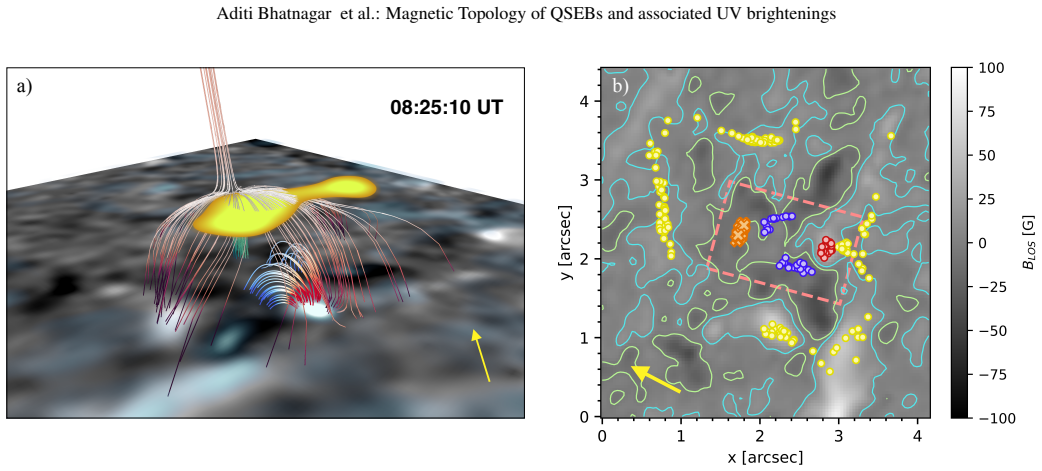
The central object is a three-dimensional magnetic null point, a location where the magnetic field vanishes, together with its fan-spine skeleton: a dome-shaped separatrix surface whose footpoints ring one polarity, and two spine field lines, inner and outer, meeting at the null. The argument is carried by potential-field extrapolations of line-of-sight photospheric magnetograms, with nulls located by tracing field lines seeded where the squashing factor is large. The dipole case provides the minimal mechanism: loops between opposite polarities shrink and cancel, releasing energy as the apex drops. In the fan-spine cases, the null is the presumed reconnection site and the ultraviolet brightening marks it, while the QSEB marks the footpoint reached by energy transport along a spine or dome.
What would settle it
Observe the same two regions from a disk-center or high-mu vantage that resolves the full magnetic vector and reconstruct the magnetic skeleton with a nonlinear force-free or magnetohydrostatic extrapolation; if the 3D nulls identified here disappear, move by more than the few-hundred-kilometer spatial offsets, or fail to sit at the UV brightening locations, the claimed topological link is refuted.
Extended reading notes
Core claim
The central claim is that co-spatial, co-temporal quiet-Sun Ellerman bombs and ultraviolet brightenings are linked by a small set of repeatable magnetic topologies, and that in the most common complex cases the link is a three-dimensional magnetic null with a fan-spine structure. The paper identifies four such topologies in two regions of a quiet-Sun field: a dipole whose loops shrink as opposite polarities cancel, with the UV brightening near the loop tops, and three variants of a fan-spine null in which the UV brightening forms at the null and the QSEB forms at the footpoint of the outer spine, the footpoint of the inner spine, or the footpoints of the fan surface. The null height varies from about 0.2 Mm to 2.6 Mm with footpoint field strength, and the estimated QSEB energy release is $10^{23}$ to $10^{24}$ ergs, toward the lower end of active-region Ellerman-bomb energies. Some QSEBs that appear near a UV brightening are not topologically connected to it, so proximity by itself does not establish a shared reconnection episode.
Load-bearing premise
The results rest on the assumption that a current-free potential-field extrapolation of the line-of-sight magnetic field, uncorrected for projection effects, reproduces the real magnetic topology and null-point heights in this quiet-Sun region; if the neglected transverse fields and currents matter, the identified spines, fan connections, and null heights would not match the actual structure.
Editorial extensions
If this is right
- Fan-spine topologies with a 3D null become a standard explanation for why some QSEBs are accompanied by transition-region brightenings while most are not.
- Null height is set by the strength of the footpoint field: stronger footpoints push the reconnection site higher, so events with higher nulls should more often show coronal counterparts.
- A QSEB and a nearby UV brightening may be unrelated; studies pairing the two must check magnetic connectivity, not just overlap.
- Energy estimates of $10^{23}$ to $10^{24}$ ergs give a quantitative target for simulations of quiet-Sun reconnection.
- If the same topology drives all four configurations, simultaneous brightenings at dipole, inner-spine, outer-spine, and dome footpoints should be possible, but small events appear to favor only the strongest footpoints.
Reading between the lines
- The four topologies may be successive phases of a single evolving structure rather than separate classes: flux emergence builds a dipole against pre-existing field, forming a fan-spine null whose height rises and falls with flux cancellation.
- If energy transport down spines is the mechanism, H-beta wing brightening should have a threshold in footpoint field strength; this could be tested by comparing the line-of-sight field at many dome footpoints with and without QSEBs.
- At disk center the UV brightening should appear vertically above the null rather than offset toward the limb; measuring the offset distribution in a larger sample would test the projection interpretation and the null heights directly.
- Applying the same analysis to active-region Ellerman bombs and UV bursts with stronger fields predicts taller nulls and larger energy releases, extending the scenario beyond the quiet Sun.
Signed reviews
Editorial analysis
A structured set of objections, weighed in public.
Referee Report
Summary. The paper analyzes coordinated SST Hβ, IRIS SJI 1400, and photospheric magnetogram observations of quiet Sun regions to investigate the magnetic topology of quiet-Sun Ellerman bombs (QSEBs) and their associated ultraviolet (UV) brightenings. Using FFT-based potential field extrapolations from line-of-sight magnetograms, the authors identify four magnetic configurations that link QSEBs to UV brightenings: a simple dipole and three fan-spine topologies with a 3D magnetic null point. In the fan-spine cases, UV brightenings are claimed to occur near the null while QSEBs are located at the outer spine, inner spine, or fan-surface footpoints. The reported null heights range from 0.2 to 2.6 Mm, and the estimated energy release during QSEBs falls in the range of 10^23 to 10^24 ergs. The paper explicitly acknowledges several limitations, including the use of only BLOS without projection correction, the potential field (current-free) assumption, and the approximate nature of the energy estimates.
Significance. If the topological associations are correct, this paper provides valuable observational evidence that QSEBs and UV brightenings in the quiet Sun can be linked through 3D null reconnection, extending the EB-UV burst connection to smaller, quieter regions and demonstrating a variety of magnetic configurations. The use of high-resolution SST Hβ and IRIS SJI data is a strength, and the authors are transparent about many methodological limitations. However, the central claim that UV brightenings occur at the 3D null is not yet independently established because the vertical placement of the SJI 1400 layer is tied to the null height and because the extrapolation relies on uncorrected line-of-sight data at a large viewing angle. The paper also supplies energy estimates that are explicitly based on potential-field energy changes, which need to be framed carefully. Overall, the work is a useful observational study, but the main topological conclusions require robustness checks before they can be accepted as definitive.
major comments (3)
- [Section 3.2] The 3D rendering places the SJI 1400 layer at the height of the extrapolated 3D null point, so the vertical coincidence between the UV brightening and the null is an interpretive choice rather than an independent measurement. The horizontal association shown in Fig. 7c is then computed from the same extrapolated field that defines the null. To break this circularity, the authors should present the UV brightening as a 2D detection, report the horizontal distance between its centroid and the projected null position with uncertainty estimates, and avoid assigning a single height to the SJI 1400 layer in the visualizations.
- [Section 5.1] The potential field extrapolation uses only the line-of-sight component of the magnetic field at µ=0.48 without correcting for projection effects, and it assumes a current-free field. At a viewing angle of 61°, a null at 2.5 Mm height is displaced by roughly 4.5 Mm along the line of sight, which is comparable to the QSEB-UV offsets and to the null heights themselves. The authors should quantify how the null location, the spine/fan connectivity, and the null height change if the boundary is deprojected, if the transverse field components (from the Milne-Eddington inversions) are included in a linear force-free or nonlinear force-free extrapolation, or if the 6.4 G noise is propagated through the extrapolation. Without such a robustness test, the inferred topology and the statement that UV brightenings occur at the null are not yet firmly established.
- [Section 4.1, Fig. 5] The energy release is estimated from the decrease in potential field energy within a fixed volume. Since the potential field is the minimum-energy state for a given boundary, this quantity is not the free magnetic energy that can be converted during reconnection; it is a lower bound on the energy change of the potential component. The results section should clearly state that the quoted 10^23–10^24 erg values are potential-field energy changes, not the actual released free energy, and that the true energy release could be higher.
minor comments (5)
- [Section 3.2] The description of the seed point biasing for field line tracing is vague; please specify the number of seeds, the exact bias rule, and how the results depend on the seed distribution.
- [Figure 7c] The caption lists several markers (orange crosses, yellow circles, red star, blue/red circles, cyan star) but does not define all of them; a complete legend in the caption would improve readability.
- [Section 4.2] The statement that QSEB-A 'likely occurs due to energy transport from the reconnection site' is a plausible interpretation but is not directly tested; please mark such interpretive statements clearly as speculation.
- [Abstract and text] The notation for numerical ranges is inconsistent (e.g., '10^23 to 10^24' in the abstract vs. '10 23 to 1024' in the text); please ensure consistent superscript formatting throughout.
- [General] The paper is a case study of six events in two regions; the authors should explicitly state that the four configurations are representative examples rather than a statistically validated classification.
Circularity Check
The key 'UV brightening near the 3D null' association is partially built into the visualization: the SJI 1400 layer is placed at the null height, so vertical coincidence is imposed rather than measured; otherwise the magnetic-topology analysis is not circular.
-
self definitional
[Section 3.2, Magnetic field extrapolation (last sentence)]
"For a visual comparison of the extrapolated magnetic field lines with QSEBs in Hβ and UV brightenings in the SJI 1400 Å channel in 3D, we have placed the QSEBs in Hβ slightly above the photosphere, while for the UV brightenings, the SJI 1400 layer is placed at different heights based on the height of the 3D null point."
The SJI 1400 image is a 2D map; its vertical position in the 3D renderings is an interpretive choice. Placing that layer at the extrapolated null height makes the UV brightening appear at the same altitude as the null by construction. The later statements that 'the UV brightenings occur near the 3D null point' (Sections 4.2-4.4, Fig. 7a-b, Fig. 12) therefore rest in part on the placement rather than on an independent height measurement. Only the horizontal offset between the UV feature and the null projection is data-derived; the vertical coincidence is imposed by the chosen rendering. The classification into dipole versus fan-spine topologies is independent of this choice, so the circularity is partial.
full rationale
The core magnetic-topology identification is not circular: the potential-field extrapolation is computed from photospheric BLOS data, the QSEB events are detected in Hβ via k-means clustering, and the UV brightenings are selected by a 5σ threshold in SJI 1400; none of these are fitted to the extrapolated null positions. The four topologies are read off the extrapolated field lines and squashing-factor-weighted null detection, so they have independent content relative to the UV data. However, the headline association 'UV brightenings occur near the 3D null point' is weakened by construction: the paper explicitly places the 2D SJI 1400 layer at the height of the extrapolated null for all 3D visualizations, which forces vertical coincidence between the UV map and the null in the figures. The horizontal agreement (e.g., orange null projections in Fig. 7c and Fig. 9b) is genuine data, but the claimed near-null location in 3D is partly an artifact of the rendering choice rather than a measured height coincidence. The potential-field assumption, projection effects at µ=0.48, and neglect of transverse field components are acknowledged in Section 5.1 and are correctness risks rather than circularity. The self-citation to Bhatnagar et al. (2024, Paper I) for event detection and alignment is methodological and not load-bearing for the topological conclusion. Overall, the paper contains one partial self-definitional step, giving a circularity score of 4 rather than 0.
Assumptions & free parameters
free parameters (4)
- UV brightening detection threshold =
5 sigma above median background
- Extrapolation box sizes =
256x256x256 pixels (Region 1), 600x560x256 pixels (Region 2)
- Energy integration height =
z = 415 km or 276 km depending on the event
- Seed point biasing for field line tracing =
bias toward stronger |BLOS| and large squashing factor
assumptions (4)
- domain assumption The coronal magnetic field is potential (current-free) over the observed regions.
- domain assumption The line-of-sight component of the photospheric magnetic field is sufficient to reconstruct the magnetic topology when the transverse components are noisy.
- domain assumption Spatial offsets between QSEBs and UV brightenings are primarily due to projection of different formation heights.
- standard math The squashing factor computed from the extrapolated potential field correctly identifies separatrices and null points.
Cite this review
Pith. "Pith review of Magnetic Topology of quiet-Sun Ellerman bombs and associated Ultraviolet brightenings." pith.science (2026). https://pith.science/paper/TNVKTD5Y
@misc{pith2026241203211,
  author       = {Pith},
  title        = {Pith review of: Magnetic Topology of quiet-Sun Ellerman bombs and associated Ultraviolet brightenings},
  year         = {2026},
  howpublished = {\url{https://pith.science/paper/TNVKTD5Y}},
  note         = {Machine review of arXiv:2412.03211}
}
read the original abstract
Quiet-Sun Ellerman bombs (QSEBs) are small-scale magnetic reconnection events in the lower atmosphere of the quiet Sun. Recent work has shown that a small percentage of them can occur co-spatially and co-temporally to ultraviolet (UV) brightenings in the transition region. We aim to understand how the magnetic topologies associated with closely occurring QSEBs and UV brightenings can facilitate energy transport and connect these events. We used high-resolution H-beta observations from the Swedish 1-m Solar Telescope (SST) and detected QSEBs using k-means clustering. We obtained the magnetic field topology from potential field extrapolations using spectro-polarimetric data in the photospheric Fe I 6173 A line. To detect UV brightenings, we used coordinated and co-aligned data from the Interface Region Imaging Spectrograph (IRIS) and imposed a threshold of 5 sigma above the median background on the (IRIS) 1400 A slit-jaw image channel. We identify four distinct magnetic configurations that associate QSEBs with UV brightenings, including a simple dipole configuration and more complex fan-spine topologies with a three-dimensional (3D) magnetic null point. In the fan-spine topology, the UV brightenings occur near the 3D null point, while QSEBs can be found close to the footpoints of the outer spine, the inner spine, and the fan surface. We find that the height of the 3D null varies between 0.2 Mm to 2.6 Mm, depending on the magnetic field strength in the region. We note that some QSEBs and UV brightenings, though occurring close to each other, are not topologically connected with the same reconnection process. We find that the energy released during QSEBs falls in the range of 10^23 to 10^24 ergs. This study shows that magnetic connectivity and topological features, like 3D null points, are crucial in linking QSEBs in the lower atmosphere with UV brightenings in the transition region.
Figures


Figures from the paper (9 more)




Forward citations
Cited by 1 Pith paper
-
Automatic detection of Ellerman bombs in the H$\alpha$ line
An automated star-finding-based pipeline detects and tracks 2,257 Ellerman bombs across ten solar datasets, reporting an average area of 0.44 arcsec^2, peak contrast of 1.4 times the quiet Sun, and a median lifetime o...
Reference graph
Works this paper leans on
-
[1]
Alissandrakis, C. E. 1981, A&A, 100, 197
work page 1981
- [2]
-
[3]
2024, A&A, 689, A156
Bhatnagar, A., Rouppe van der V oort, L., & Joshi, J. 2024, A&A, 689, A156
2024
- [4]
-
[5]
Chitta, L. P., Peter, H., Young, P. R., & Huang, Y . M. 2017, A&A, 605, A49 de la Cruz Rodríguez, J. 2019, A&A, 631, A153 de la Cruz Rodríguez, J., Löfdahl, M. G., Sütterlin, P., Hillberg, T., & Rouppe van der V oort, L. 2015, A&A, 573, A40 De Pontieu, B., Title, A. M., Lemen, J. R., et al. 2014, Sol. Phys., 289, 2733
work page 2017
-
[6]
C., Priest, E
Demoulin, P., Henoux, J. C., Priest, E. R., & Mandrini, C. H. 1996, A&A, 308, 643
1996
- [7]
- [8]
Show all 62 references
-
[9]
Everitt, B. S. 1972, British Journal of Psychiatry, 120, 143–145
1972
-
[10]
K., Rust, D
Georgoulis, M. K., Rust, D. M., Bernasconi, P. N., & Schmieder, B. 2002, ApJ, 575, 506
2002
-
[11]
V ., Carlsson, M., Hansteen, V
Gudiksen, B. V ., Carlsson, M., Hansteen, V . H., et al. 2011, A&A, 531, A154
2011
-
[12]
Gupta, G. R. & Tripathi, D. 2015, ApJ, 809, 82
2015
-
[13]
2019, A&A, 626, A33
Hansteen, V ., Ortiz, A., Archontis, V ., et al. 2019, A&A, 626, A33
2019
-
[14]
H., Archontis, V ., Pereira, T
Hansteen, V . H., Archontis, V ., Pereira, T. M. D., et al. 2017, ApJ, 839, 22
2017
-
[15]
2010, PASJ, 62, 879
Hashimoto, Y ., Kitai, R., Ichimoto, K., et al. 2010, PASJ, 62, 879
2010
-
[16]
S., Scullion, E
Huang, Z., Madjarska, M. S., Scullion, E. M., et al. 2017, MNRAS, 464, 1753
2017
-
[17]
& Rouppe van der V oort, L
Joshi, J. & Rouppe van der V oort, L. H. M. 2022, A&A, 664, A72
2022
-
[18]
Joshi, J., Rouppe van der V oort, L. H. M., & de la Cruz Rodríguez, J. 2020, A&A, 641, L5
2020
-
[19]
2024, A&A, 687, A172
Joshi, R., Aulanier, G., Radcliffe, A., et al. 2024, A&A, 687, A172
2024
-
[20]
K., et al
Kahil, F., Hirzberger, J., Solanki, S. K., et al. 2022, A&A, 660, A143
2022
-
[21]
& Panos, B
Kleint, L. & Panos, B. 2022, A&A, 657, A132
2022
-
[22]
1982, Sol
Kurokawa, H., Kawaguchi, I., Funakoshi, Y ., & Nakai, Y . 1982, Sol. Phys., 79, 77
1982
-
[23]
R., Title, A
Lemen, J. R., Title, A. M., Akin, D. J., et al. 2012, Sol. Phys., 275, 17
2012
-
[24]
2019, Atmosphere, 10, 488
Li, S., Jaroszynski, S., Pearse, S., Orf, L., & Clyne, J. 2019, Atmosphere, 10, 488
2019
-
[25]
S., et al
Liu, R., Kliem, B., Titov, V . S., et al. 2016, ApJ, 818, 148 Löfdahl, M. G., Hillberg, T., de la Cruz Rodríguez, J., et al. 2021, A&A, 653, A68
2016
-
[26]
Longcope, D. W. 2005, Living Reviews in Solar Physics, 2, 7
2005
-
[27]
Longcope, D. W. & Parnell, C. E. 2009, Sol. Phys., 254, 51
2009
-
[28]
& Raadu, M
Nakagawa, Y . & Raadu, M. A. 1972, Sol. Phys., 25, 127
1972
-
[29]
J., Freij, N., Reid, A., et al
Nelson, C. J., Freij, N., Reid, A., et al. 2017, ApJ, 845, 16
2017
-
[30]
J., Scullion, E
Nelson, C. J., Scullion, E. M., Doyle, J. G., Freij, N., & Erdélyi, R. 2015, ApJ, 798, 19
2015
-
[31]
& Zirin, H
Nindos, A. & Zirin, H. 1998, Sol. Phys., 182, 381 Nóbrega-Siverio, D., Cabello, I., Bose, S., et al. 2024, A&A, 686, A218 Nóbrega-Siverio, D., Martínez-Sykora, J., Moreno-Insertis, F., & Rouppe van der V oort, L. 2017, ApJ, 850, 153 Nóbrega-Siverio, D. & Moreno-Insertis, F. 20...
1998
-
[32]
H., Nóbrega-Siverio, D., & Rouppe van der V oort, L
Ortiz, A., Hansteen, V . H., Nóbrega-Siverio, D., & Rouppe van der V oort, L. 2020, A&A, 633, A58
2020
-
[33]
2004, ApJ, 614, 1099
Pariat, E., Aulanier, G., Schmieder, B., et al. 2004, ApJ, 614, 1099
2004
-
[34]
2006, Advances in Space Research, 38, 902
Pariat, E., Aulanier, G., Schmieder, B., et al. 2006, Advances in Space Research, 38, 902
2006
-
[35]
D., Thompson, B
Pesnell, W. D., Thompson, B. J., & Chamberlin, P. C. 2012, Sol. Phys., 275, 3
2012
-
[36]
2014, Science, 346, 1255726
Peter, H., Tian, H., Curdt, W., et al. 2014, Science, 346, 1255726
2014
-
[37]
2020, ApJ, 903, 129
Prasad, A., Dissauer, K., Hu, Q., et al. 2020, ApJ, 903, 129
2020
-
[38]
Priest, E. R. & Forbes, T. G. 2002, A&A Rev., 10, 313
2002
-
[39]
K., et al
Przybylski, D., Cameron, R., Solanki, S. K., et al. 2022, A&A, 664, A91
2022
-
[40]
G., et al
Reid, A., Mathioudakis, M., Doyle, J. G., et al. 2016, ApJ, 823, 110
2016
-
[41]
Reid, H. A. S., Vilmer, N., Aulanier, G., & Pariat, E. 2012, A&A, 547, A52
2012
-
[42]
L., & Murabito, M
Romano, P., Falco, M., Guglielmino, S. L., & Murabito, M. 2017, ApJ, 837, 173 Rouppe van der V oort, L., De Pontieu, B., Scharmer, G. B., et al. 2017, ApJ, 851, L6 Rouppe van der V oort, L. H. M., Joshi, J., & Krikova, K. 2024, A&A, 683, A190 Rouppe van der V oort, L. H. M., R...
2017
-
[43]
2013, in Journal of Physics Conference Series, V ol
Vitas, N. 2013, in Journal of Physics Conference Series, V ol. 440, Journal of Physics Conference Series, 012007
2013
-
[44]
2017, in SOLARNET IV: The Physics of the Sun from the Interior to the Outer Atmosphere, 85
Scharmer, G. 2017, in SOLARNET IV: The Physics of the Sun from the Interior to the Outer Atmosphere, 85
2017
-
[45]
B., Bjelksjo, K., Korhonen, T
Scharmer, G. B., Bjelksjo, K., Korhonen, T. K., Lindberg, B., & Petterson, B. 2003, in Society of Photo-Optical Instrumentation Engineers (SPIE) Confer- ence Series, V ol. 4853, Innovative Telescopes and Instrumentation for Solar Astrophysics, ed. S. L. Keil & S. V . Avakyan, 341–350,
2003
-
[46]
B., Narayan, G., Hillberg, T., et al
Scharmer, G. B., Narayan, G., Hillberg, T., et al. 2008, ApJ, 689, L69
2008
-
[47]
B., Sliepen, G., Sinquin, J
Scharmer, G. B., Sliepen, G., Sinquin, J. C., et al. 2024, A&A, 685, A32
2024
-
[48]
Severny, A. B. 1964, ARA&A, 2, 363
1964
-
[49]
2023, A&A, 672, A47
Skan, M., Danilovic, S., Leenaarts, J., Calvo, F., & Rempel, M. 2023, A&A, 672, A47
2023
-
[50]
N., Chitta, L
Smitha, H. N., Chitta, L. P., Wiegelmann, T., & Solanki, S. K. 2018, A&A, 617, A128
2018
-
[51]
2016, ApJ, 824, 96
Tian, H., Xu, Z., He, J., & Madsen, C. 2016, ApJ, 824, 96
2016
-
[52]
2018, ApJ, 854, 174
Tian, H., Zhu, X., Peter, H., et al. 2018, ApJ, 854, 174
2018
-
[53]
S., Forbes, T
Titov, V . S., Forbes, T. G., Priest, E. R., Miki ´c, Z., & Linker, J. A. 2009, ApJ, 693, 1029
2009
-
[54]
S., Hornig, G., & Démoulin, P
Titov, V . S., Hornig, G., & Démoulin, P. 2002, Journal of Geophysical Research (Space Physics), 107, 1164
2002
-
[55]
Toriumi, S., Katsukawa, Y ., & Cheung, M. C. M. 2017, ApJ, 836, 63 Török, T., Linton, M. G., Leake, J. E., et al. 2024, ApJ, 962, 149 Van Noort, M., Rouppe Van Der V oort, L., & Löfdahl, M. G. 2005, Sol. Phys., 228, 191
2017
-
[56]
Vissers, G. J. M., Rouppe van der V oort, L. H. M., & Rutten, R. J. 2013, ApJ, 774, 32
2013
-
[57]
Vissers, G. J. M., Rouppe van der V oort, L. H. M., Rutten, R. J., Carlsson, M., & De Pontieu, B. 2015, ApJ, 812, 11 Vögler, A., Shelyag, S., Schüssler, M., et al. 2005, A&A, 429, 335
2015
-
[58]
2008, ApJ, 684, 736
Watanabe, H., Kitai, R., Okamoto, K., et al. 2008, ApJ, 684, 736
2008
-
[59]
Watanabe, H., Vissers, G., Kitai, R., Rouppe van der V oort, L., & Rutten, R. J. 2011, ApJ, 736, 71
2011
-
[60]
R., Tian, H., Peter, H., et al
Young, P. R., Tian, H., Peter, H., et al. 2018, Space Sci. Rev., 214, 120
2018
-
[61]
2024, Reviews of Modern Plasma Physics, 8, 7
Zhang, Q. 2024, Reviews of Modern Plasma Physics, 8, 7
2024
-
[62]
2017, ApJ, 836, 52 Article number, page 14 of 14
Zhao, J., Schmieder, B., Li, H., et al. 2017, ApJ, 836, 52 Article number, page 14 of 14
2017
Reviewed August 11, 2026 · model on record in the stance chip above.
Discussion (0). Continue with ORCID to comment.