REVIEW 2 major objections 5 minor 2 cited by
Ultra-High Reliability by Predictive Interference Management Using Extreme Value Theory
T0 review · 2 major / 5 minor · reviewed 2026-08-10 · deepseek-v4-flash
Pith's one-line read Extreme-value tail modeling plus a kernel-density bulk can predict next-slot interference accurately enough to meet 10^-7 outage targets while using roughly 20% more radio resources than a genie with perfect knowledge.
desk verdict The paper's headline outage numbers contradict its own confidence-level definition, and the sample-efficiency claim is not backed by the stated algorithm. read the letter →
The pith
A machine-rendered reading of the paper's core claim, the machinery that carries it, and where it could break.
The reading
What carries the argument
The load-bearing object is the per-state conditional interference distribution built as a KDE-bulk/GPD-tail mixture. The tail is driven by the generalized Pareto distribution H_u(y)=1-(1+ξy/σ_u)^{-1/ξ}, whose parameters (σ_u, ξ) are estimated by maximum likelihood from exceedances above the threshold u; the extreme quantile used for prediction is X_ε = u + (σ_u/ξ)((ρ_u/ε)^ξ - 1), where ρ_u is the probability of exceeding the threshold and ε=1-η. The bulk is a Gaussian-kernel density estimate with bandwidth chosen by minimizing asymptotic mean integrated squared error. These two pieces are combined per conditional interference space I_l, and the resulting quantile is converted to a blocklength using the finite-blocklength AWGN approximation b ≈ M C(γ) - $Q^{{-1}}$(ε)√(M V(γ)).
What would settle it
Run the proposed predictor with 1000 training samples under the paper's parameters (L=15, u=97th percentile) and record the number of exceedances per state; if the achieved outage at target $10^{-7}$ degrades when states with fewer than five exceedances are excluded from the GPD fit, or if a synthetic heavy-tailed interferer with known shape parameter produces biased ξ estimates at these sample counts, the sample-efficiency claim is falsified.
Extended reading notes
Core claim
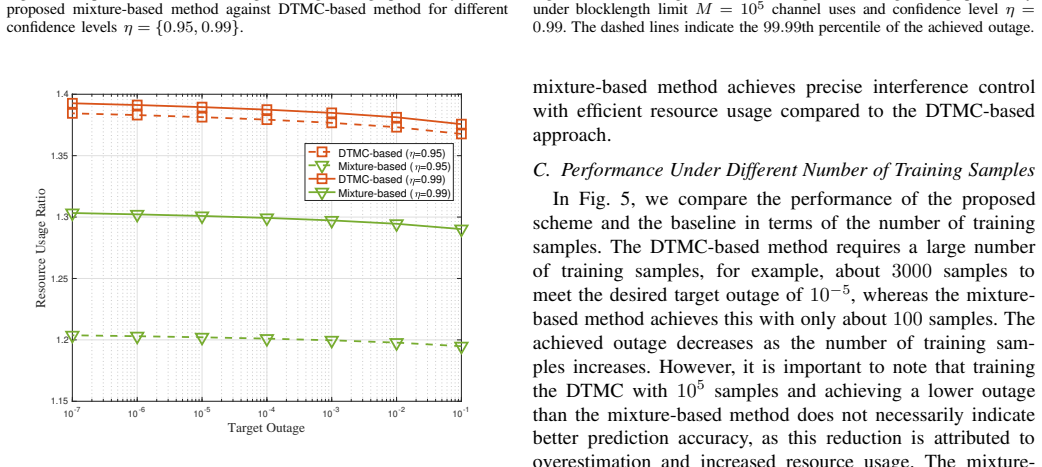
The central claim is that the conditional distribution of next-slot interference, given the current quantile state among L=15 states, is accurately captured by the mixture f(x)=g(x) for x<u and f(x)=h(x) for x≥u, where g is a kernel density estimate and h is a generalized Pareto distribution fitted to exceedances above the 97th percentile. Predicting the confidence-level η quantile of this mixture, then converting the predicted SINR into a blocklength via the finite-blocklength capacity formula (12)–(13), achieves target outage probabilities down to $10^{-7}$. Quantitatively, the method reduces achieved outage by up to 100-fold compared with the first-order DTMC baseline at the same confidence level, consumes roughly 15% less radio resource than DTMC, and requires blocklength only about 1.2 times the genie-aided optimum at η=0.95. The claimed sample efficiency is that the mixture reaches a $10^{-5}$ target with about 100 training samples and stabilizes around 1000 samples, whereas the DTMC baseline needs about 3000 samples for $10^{-5}$.
Load-bearing premise
With 1000 training samples split into 15 quantile states and a 97th-percentile threshold, each state's generalized Pareto tail fit is based on roughly two exceedances, and with 100 samples fewer than one, so the claimed sample efficiency assumes that maximum-likelihood GPD parameter estimates from that many points are still reliable.
Editorial extensions
If this is right
- Link adaptation for URLLC can meet 10^-7 outage targets with training sets of about 1000 samples, a budget far below what Markov-chain transition-matrix estimation requires.
- The ~20% resource overhead over perfect interference knowledge quantifies the price of predicting rather than knowing the future, giving a concrete benchmark for any alternative predictor.
- The confidence level η acts as a tunable reliability-efficiency knob: at η=0.95 the predictor operates in the KDE bulk regime, while at η=0.99 it switches to the EVT tail regime.
- Under a blocklength cap of M=10^5, the mixture method's achieved outage stays below the target across all target levels, whereas the DTMC baseline overshoots, implying more consistent interference control.
Reading between the lines
- The sample-efficiency numbers should be treated with caution: with 1000 training samples, L=15 states, and a 97th-percentile threshold, each state's GPD fit rests on roughly two exceedances, and with 100 samples on fewer than one, so the maximum-likelihood estimate of (σ_u, ξ) is statistically degenerate; a natural robustness test is to plot achieved outage versus the threshold percentile and the
- The DTMC baseline comparison may be unfair at a fixed training budget because the Markov-chain transition matrix needs many more samples; a fairer head-to-head would optimize both methods' hyperparameters under identical training budgets.
- The paper leaves open the optimal choice of threshold and confidence level; a testable extension is to adapt u online so that each state keeps a minimum number of exceedances (for example at least 10) before the GPD tail is trusted.
- Because the confidence level η and threshold u are coupled, with η=0.95 below u=0.97 meaning the KDE regime is used, the EVT component only engages for η>0.97; reporting performance at η≈0.999 or η≈0.9999 would show where the tail model actually matters.
Editorial analysis
A structured set of objections, weighed in public.
Referee Report
Summary. The paper proposes a predictive link-adaptation scheme for URLLC in which the conditional distribution of next-slot interference given the current interference state is modeled as a mixture of a kernel density estimate for the bulk and a generalized Pareto distribution (GPD) for the tail. The predicted interference is chosen as an eta-level quantile, and the blocklength is obtained from a finite-blocklength formula. The scheme is compared with a first-order DTMC baseline and a genie-aided predictor in simulations, with claims of up to 100-fold outage reduction, roughly 20% resource overhead over genie, and sample-efficient operation with as few as 100 training samples.
Significance. The proposed framework is a reasonable direction: EVT-based tail modeling is a natural tool for URLLC, and the simulation comparison against the DTMC baseline is a sensible test. If the sample-efficiency results were valid, the method would be an interesting practical contribution. The manuscript clearly describes the mixture model and the finite-blocklength resource allocation. However, the paper does not provide code or machine-checked artifacts, and the two load-bearing gaps described below—degenerate per-state tail fits at the claimed training sizes and the missing relationship between the confidence parameter and achieved outage—prevent me from endorsing the claims as stated.
major comments (2)
- [Section III.A.1; Table I; Fig. 5] The algorithm fits a two-parameter GPD (sigma_u, xi) to exceedances above the 97th percentile separately for each of L=15 conditional states. With N_train=100, quantile-based states contain on average about 6.7 transitions per state, so at the 97th percentile there are on average 0.2 exceedances per state; most states contain zero exceedances and the MLE for Eq. (7) is undefined. At N_train=1000 there are about two exceedances per state, which is far too few for a stable GPD fit. The manuscript describes no pooling, regularization, lower threshold, or other remedy, so the outage values at 100 training samples in Fig. 5 cannot be produced by the algorithm as written.
- [Section III.A; Section IV.A; Eq. (4); Fig. 2] The manuscript states that an outage occurs if the predicted interference is lower than the actual value, and Eq. (4) bounds the under-coverage probability by 1-eta. For eta=0.99, this would place an outage floor of about 10^-2 if under-coverage were itself an outage, yet Fig. 2 reports achieved outages near 10^-7. If 'achieved outage' is instead the average BLER, the paper must derive or at least formally motivate the mapping from the quantile under-coverage event to BLER; without that, the central claim of meeting 10^-7 targets is not supported.
minor comments (5)
- [Eq. (3)] The indicator function is rendered with an invalid symbol '/BD'; use standard notation such as \mathbb{1}_A(x).
- [Abstract] The strings '∼not15 %' and '∼not20 %' appear to be LaTeX editing artifacts; they should read 'approximately 15%' and 'approximately 20%'.
- [Section III.A] The statement 'An outage will occur if the predicted interference is lower than the actual value' is inconsistent with the finite-blocklength averaging used later, where a small under-prediction need not produce a block error. Please clarify the definition of outage.
- [Section IV] The paper reports 'averaging over 100 random INRs' but does not state whether the achieved outage is an empirical block-error frequency or the average of theoretical BLER values; this distinction matters for interpreting values as low as 10^-7.
- [Fig. 5] The figure would benefit from confidence intervals or error bars; with 100 random INR scenarios, point estimates at outage levels near 10^-7 are based on very few (possibly zero) events unless the outage is computed analytically.
Circularity Check
No significant circularity: the derivation is self-contained and the claimed predictions are evaluated on held-out realizations.
full rationale
The paper's central claim is that the proposed mixture of KDE bulk and GPD tail predicts conditional interference quantiles accurately enough for URLLC resource allocation. The derivation chain is self-contained: Section III.A defines the conditional interference spaces I_l from quantile-based state clustering (Eq. 3), adopts the standard GPD threshold-excess model (Eq. 7) with parameters estimated by MLE from exceedances, uses KDE for the bulk (Eq. 10), and computes extreme quantiles via Eq. (9). The resource allocation then uses the finite-blocklength bound (Eqs. 12-13) from Polyanskiy et al. and Anand & de Veciana, which are external, machine-independent results. None of these steps defines the target quantity in terms of itself; the quantile prediction is a function of fitted distributions, not a re-statement of the training data. The performance evaluation in Section IV compares the achieved outage and resource usage on held-out realizations of the same simulated process, which is standard statistical evaluation, not circular reasoning. The self-citations ([8], [10], [11]) are used only in the introduction as related work and do not provide any load-bearing mathematical input; no uniqueness theorem or ansatz is imported from those works. The paper's sample-efficiency claim with very small training sets may be statistically fragile, but that is a correctness risk, not circularity. Therefore the circularity score is 0.
Assumptions & free parameters
free parameters (7)
- GPD scale parameter sigma_u per cluster =
MLE estimate
- GPD shape parameter xi per cluster =
MLE estimate
- Exceedance probability rho_u per cluster =
Empirical fraction above threshold
- Exceedance threshold u =
97th percentile
- Number of states L =
15
- Confidence level eta =
0.95, 0.99
- Kernel bandwidth T =
Minimizer of asymptotic mean integrated squared error
assumptions (6)
- standard math Pickands-Balkema-de Haan theorem: excesses over a high threshold converge to a generalized Pareto distribution.
- domain assumption Interference samples within each state and time lag are treated as i.i.d. for GPD and KDE fitting.
- domain assumption The conditional distribution of I_{t+1} given I_t in state S_l is stationary and representative of the runtime distribution.
- domain assumption Rayleigh block-fading and independent Bernoulli activation model for interferers.
- standard math The finite blocklength capacity approximation and blocklength formula apply.
- ad hoc to paper Achieved outage can be lower than the under-coverage probability 1-eta.
Cite this review
Pith. "Pith review of Ultra-High Reliability by Predictive Interference Management Using Extreme Value Theory." pith.science (2026). https://pith.science/paper/TQD3W4GG
@misc{pith2026250111704,
  author       = {Pith},
  title        = {Pith review of: Ultra-High Reliability by Predictive Interference Management Using Extreme Value Theory},
  year         = {2026},
  howpublished = {\url{https://pith.science/paper/TQD3W4GG}},
  note         = {Machine review of arXiv:2501.11704}
}
abstract
Ultra-reliable low-latency communications (URLLC) require innovative approaches to modeling channel and interference dynamics, extending beyond traditional average estimates to encompass entire statistical distributions, including rare and extreme events that challenge achieving ultra-reliability performance regions. In this paper, we propose a risk-sensitive approach based on extreme value theory (EVT) to predict the signal-to-interference-plus-noise ratio (SINR) for efficient resource allocation in URLLC systems. We employ EVT to estimate the statistics of rare and extreme interference values, and kernel density estimation (KDE) to model the distribution of non-extreme events. Using a mixture model, we develop an interference prediction algorithm based on quantile prediction, introducing a confidence level parameter to balance reliability and resource usage. While accounting for the risk sensitivity of interference estimates, the prediction outcome is then used for appropriate resource allocation of a URLLC transmission under link outage constraints. Simulation results demonstrate that the proposed method outperforms the state-of-the-art first-order discrete-time Markov chain (DTMC) approach by reducing outage rates up to 100-fold, achieving target outage probabilities as low as \(10^{-7}\). Simultaneously, it minimizes radio resource usage \(\simnot15 \%\) compared to DTMC, while remaining only \(\simnot20 \%\) above the optimal case with perfect interference knowledge, resulting in significantly higher prediction accuracy. Additionally, the method is sample-efficient, able to predict interference effectively with minimal training data.
Figures


Figures from the paper (1 more)

Forward citations
Cited by 2 Pith papers
-
Extreme Value Theory-based Distributed Interference Prediction for 6G Industrial Sub-networks
A hybrid transformer, extreme value theory, and conformal prediction framework claims calibrated interference tail forecasts with coverage guarantees for 6G sub-networks.
-
Towards Ultra-Reliable 6G in-X Subnetworks: Dynamic Link Adaptation by Deep Reinforcement Learning
A SAC-based link adaptation agent that picks transmit power and blocklength from the observed SINR reduces consecutive packet outages and cuts energy use to about 18 percent of a full-resource policy in simulation.
Reference graph
Works this paper leans on
-
[1]
Extreme ultra-reliable and low-latency communication,
J. Park, S. Samarakoon et al. , “Extreme ultra-reliable and low-latency communication,” Nature Electronics, vol. 5, no. 3, pp. 133–141, 2022
work page 2022
-
[2]
QoS prediction-based radio resource manageme nt,
J. Perdomo, M. Gutierrez-Estevez, A. Kousaridas, C. Zho u, and J. F. Monserrat, “QoS prediction-based radio resource manageme nt,” in 2022 IEEE 96th V ehicular Technology Conference (VTC2022-Fall), 2022, pp. 1–6
work page 2022
-
[3]
H. Malik, M. M. Alam, H. Pervaiz, Y . L. Moullec, A. Al-Dula imi, S. Parand, and L. Reggiani, “Radio resource management in NB -IoT systems: Empowered by interference prediction and flexible duplexing,” IEEE Network , vol. 34, no. 1, pp. 144–151, 2020
work page 2020
-
[4]
Interference prediction in wireless networks: Stochastic geometry meet s recursive filtering,
J. F. Schmidt, U. Schilcher, M. K. Atiq, and C. Bettstette r, “Interference prediction in wireless networks: Stochastic geometry meet s recursive filtering,” IEEE Trans. V eh., vol. 70, no. 3, pp. 2783–2793, 2021
work page 2021
-
[5]
Sense-and -predict: Harnessing spatial interference correlation for cognitiv e radio networks,
S. Kim, H. Cha, J. Kim, S.-W. Ko, and S.-L. Kim, “Sense-and -predict: Harnessing spatial interference correlation for cognitiv e radio networks,” IEEE Trans. Wirel. , vol. 18, no. 5, pp. 2777–2793, 2019
work page 2019
-
[6]
A. Brighente, J. Mohammadi, P . Baracca, S. Mandelli, and S. Tomasin, “Interference prediction for low-complexity link adaptat ion in beyond 5G ultra-reliable low-latency communications,” IEEE Trans. Wirel. , vol. 21, no. 10, pp. 8403–8415, 2022
work page 2022
-
[7]
A predictive interference management algorithm for URLLC in beyond 5G networks,
N. H. Mahmood, O. A. Lopez, H. Alves, and M. Latva-Aho, “A predictive interference management algorithm for URLLC in beyond 5G networks,” IEEE Commun. Lett. , vol. 25, no. 3, pp. 995–999, 2020
work page 2020
-
[8]
Rel iable interference prediction and management with time-correla ted traffic for URLLC,
F. Salehi, A. Mahmood, N. H. Mahmood, and M. Gidlund, “Rel iable interference prediction and management with time-correla ted traffic for URLLC,” in GLOBECOM 2023 - 2023 IEEE Global Communications Conference, 2023, pp. 6699–6704
work page 2023
Show all 17 references
-
[9]
Ultrareliable and l ow-latency wireless communication: Tail, risk, and scale,
M. Bennis, M. Debbah, and H. V . Poor, “Ultrareliable and l ow-latency wireless communication: Tail, risk, and scale,” Proc. IEEE , vol. 106, no. 10, pp. 1834–1853, 2018
2018
-
[10]
Wireless channel modeling ba sed on extreme value theory for ultra-reliable communications,
N. Mehrnia and S. Coleri, “Wireless channel modeling ba sed on extreme value theory for ultra-reliable communications,” IEEE Transactions on Wireless Communications, vol. 21, no. 2, pp. 1064–1076, 2022
2022
-
[11]
Multivariate extreme value theory based channel m odeling for ultra-reliable communications,
——, “Multivariate extreme value theory based channel m odeling for ultra-reliable communications,” IEEE Transactions on Wireless Commu- nications, vol. 23, no. 5, pp. 4964–4975, 2024
2024
-
[12]
Prediction of rare channel conditions using b ayesian statistics and extreme value theory,
T. Kallehauge, A. E. Kalør, P . Rem´ ırez-Espinosa, C. Bi scio, and P . Popovski, “Prediction of rare channel conditions using b ayesian statistics and extreme value theory,” arXiv preprint arXiv:2407.01188 , 2024
2024 arXiv
-
[13]
A review of extreme value threshold estimation and uncertainty quantification,
C. Scarrott and A. MacDonald, “A review of extreme value threshold estimation and uncertainty quantification,” REVSTAT-Statistical journal, vol. 10, no. 1, pp. 33–60, 2012
2012
-
[14]
Coles, J
S. Coles, J. Bawa, L. Trenner, and P . Dorazio, An introduction to statistical modeling of extreme values . Springer, 2001, vol. 208
2001
-
[15]
Kernel de nsity estimation via diffusion,
Z. I. Botev, J. F. Grotowski, and D. P . Kroese, “Kernel de nsity estimation via diffusion,” The Annals of Statistics , vol. 38, no. 5, pp. 2916 – 2957, 2010
2010
-
[16]
Channel codin g rate in the finite blocklength regime,
Y . Polyanskiy, H. V . Poor, and S. V erd´ u, “Channel codin g rate in the finite blocklength regime,” IEEE Trans. Inf. Theory . , vol. 56, no. 5, pp. 2307–2359, 2010
2010
-
[17]
Resource allocation and HAR Q optimiza- tion for URLLC traffic in 5G wireless networks,
A. Anand and G. de V eciana, “Resource allocation and HAR Q optimiza- tion for URLLC traffic in 5G wireless networks,” IEEE J. Sel. Areas Commun., vol. 36, no. 11, pp. 2411–2421, 2018
2018
Reviewed August 10, 2026 · model on record in the stance chip above.
Discussion (0). Continue with ORCID to comment.