REVIEW 68 references
Distillation can be skipped in distributed quantum computers by turning photonic phase noise into repeated measurement errors, so one nucleus per node is enough.
Reviewed by Pith at T0; open to challenge. T0 means a machine referee read the full paper against a public rubric. the ladder, T0–T4 →
T0 review · grok-4.5
2026-07-31 06:07 UTC pith:TSYWPWVG
load-bearing objection Solid architecture paper: route link phase bias into non-propagating measurement error so the code replaces distillation, dropping to one nucleus (Floquet) or one ancilla (stabilizer), with clean stim thresholds—but the headline Floquet gains lean on independent pz shots that real electron baths may not give.
Fault-tolerant distributed quantum computing with a single nucleus per node
The pith
A machine-rendered reading of the paper's core claim, the machinery that carries it, and where it could break.
Core claim
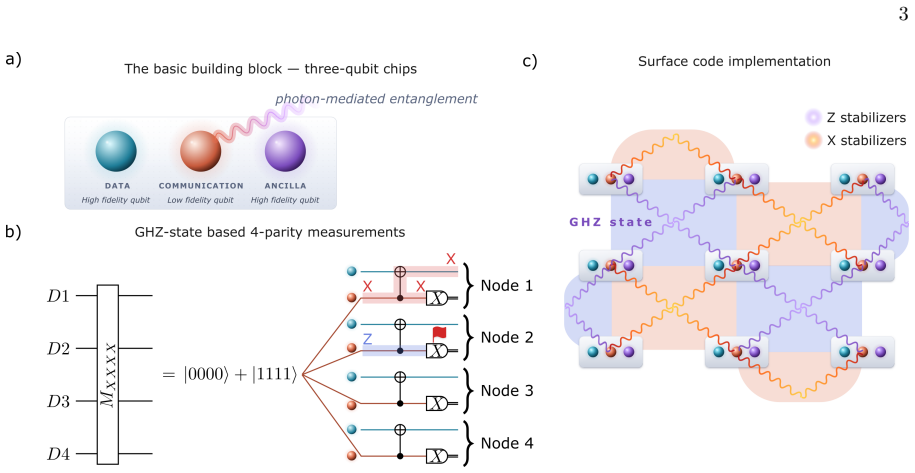
By engineering photonic Bell pairs that suffer frequent phase errors but rare bit flips, and by designing syndrome extraction so that phase noise appears only as non-propagating measurement error, distillation can be avoided. The code itself purifies the link through repeated measurements. That cut reduces Floquet nodes to a single nucleus and general stabilizer nodes to one data qubit plus one ancilla, while still supporting high error-correction thresholds and lattice-surgery logical gates near the memory threshold.
What carries the argument
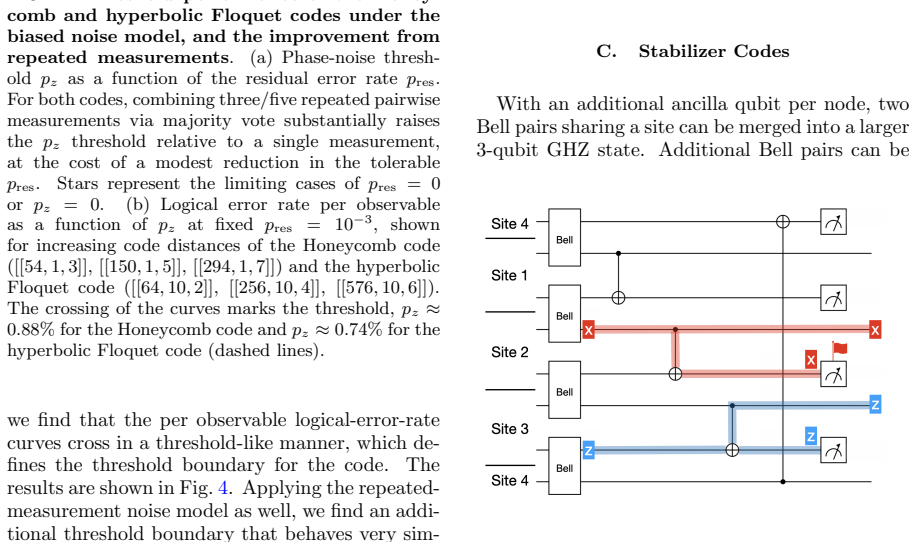
Communication error bias plus bias-preserving syndrome extraction: phase noise on Bell pairs or GHZ states is routed so it only flips the measured parity (a bulk measurement error), while residual bit-flip channels stay weak; majority-vote or repeated rounds then suppress the measurement errors without dedicated distillation.
Load-bearing premise
Inter-node links can be run deep in a phase-biased regime while every other error—nuclear idling, gates, residual Bell bit flips, and GHZ assembly—stays at one much smaller residual rate.
What would settle it
Circuit-level simulations or hardware runs in which residual bit-flip, gate, or idling noise cannot be held far below the engineered phase noise should erase the reported single-nucleus thresholds and force distillation or extra nuclei back into the architecture.
If this is right
- Floquet codes become implementable on nodes that hold only one high-coherence nucleus plus a communication electron.
- General stabilizer and qLDPC codes need only one extra ancilla nucleus for GHZ-based stabilizer readout, without multi-round Bell distillation.
- Photon indistinguishability and communication-qubit coherence requirements can be relaxed into the several-percent phase-error range.
- Lattice surgery remains viable for logical multi-qubit gates at thresholds close to quantum memory under the same bulk-measurement noise.
- Overall logical performance is limited by nuclear data-qubit quality rather than by the optical link.
Where Pith is reading between the lines
- Materials and defects previously dismissed for having only one usable nucleus become candidate distributed nodes under this protocol.
- The same bias-preserving GHZ construction may lift circuit distance toward code-capacity distance for weight-6+ qLDPC codes by suppressing single-error hooks.
- A global decoder that consumes every raw repeated outcome, rather than local majority vote, is a natural next lever the paper leaves open and could raise thresholds further.
- Transversal logical gates built from repeated two-qubit measurements instead of teleported CNOTs would keep the same non-propagating measurement-error structure across full algorithms.
Editorial analysis
A structured set of objections, weighed in public.
Circularity Check
No circularity: thresholds are independent Monte Carlo outputs under a declared noise model; bias and GHZ ingredients are external protocols, not self-definitions.
full rationale
The paper’s central claims—that engineered Bell-pair phase bias plus syndrome circuits that map phase noise to non-propagating measurement errors allow Floquet codes with one nucleus (and stabilizer codes with one ancilla) without dedicated distillation—are architectural and circuit-design claims, validated by stim/pymatching threshold simulations under an explicitly stated biased noise model (pz vs pres). Those thresholds (e.g. honeycomb pz≈0.88% at pres=10^-3; surface memory pz≈4.4%/pGHZ≈15%; lattice surgery ~4%) are empirical decoder outputs, not algebraic restatements of fitted constants. The binomial majority-vote identity and pGHZ≈4pz are standard independent-error channel reductions used as consistency checks, not predictions forced by a fit. Double-click bias (Barrett–Kok) and GHZ fusion/fault-tolerance (Nickerson, Shor-style, de Bone et al.) are cited as external ingredients. Author self-citations (Stairway codes, related Floquet work) supply optional code families or context and are not load-bearing uniqueness theorems. No parameter is fitted to data and re-exported as a prediction; no result reduces to its input by definition. Quasi-static correlation of pz (a physical-assumption risk) is outside circularity.
Axiom & Free-Parameter Ledger
free parameters (3)
- pres (residual error rate) =
typically 10^-3 in main threshold figures
- measurement repetition count r (majority vote) =
1, 3, or 5
- lattice-surgery merge rounds r_merge =
r ∈ [d, 3d]
axioms (5)
- standard math Circuit-level Pauli/stabilizer error correction and threshold decoding with MWPM (stim/pymatching) correctly predict correctability in the simulated models.
- domain assumption Double-click (and even-repetition single-click) photonic protocols can produce Bell pairs with strong phase-vs-bit-flip bias, with accepted X errors dominated by controllable microwave/dark-count floors.
- domain assumption Nuclear data qubits have high coherence and can be protected from electron-induced noise so their errors sit in pres; electron dephasing can be budgeted entirely as non-propagating pz on communication qubits.
- ad hoc to paper Local majority vote on r repeated pairwise measurements is adequately modeled by a leading-order effective DEM for outer-code thresholds.
- domain assumption GHZ fusion from Bell pairs is bias-preserving and detects single X errors so weight-1 X on the GHZ is O(pres) and multi-data hooks are higher order.
read the original abstract
Distributed quantum computing interconnects small, high-quality nodes through optical links, but this architecture carries a pronounced asymmetry: in-node gates and measurements are cheap and high-fidelity, whereas inter-node communication relies on a low-coherence communication qubit and faulty photonics. Previous approaches overcame the noisy link by placing several high-quality data qubits in each node and consuming them for Bell pair and GHZ state distillation. Here we show that distillation can be avoided altogether. The key observation is that we can engineer a communication error bias, where photonic Bell pairs suffer frequent phase errors but only rare bit-flip errors. We design the syndrome-extraction circuits so that this phase noise appears solely as a measurement error that does not propagate to the data qubits, and is therefore suppressed by simply repeating the measurement; letting the error-correcting code itself, rather than a dedicated distillation subroutine, to purify the link. This dramatically reduces the need for ancillary nuclei: Floquet codes require only a single data qubit per node, while general stabilizer codes require just one additional ancilla. We demonstrate high error-correction thresholds throughout this regime, and we identify lattice surgery as inherently robust for this setting, enabling logical operations at a threshold close to that of quantum memory. As a result, the performance of the quantum computer is limited by the high-quality data qubits, while the requirements on photon indistinguishability and coherence of the communication qubit are substantially relaxed.
Figures





Reference graph
Works this paper leans on
-
[1]
S. de Bone, P. M¨ oller, C. E. Bradley, T. H. Taminiau, and D. Elkouss, A VS Quantum Sci- ence6(2024), 10.1116/5.0200190
-
[3]
Floquetified
+p ∗ 3 3 =p ∗ z.A similar condition applies to the 5-repetition case. Naively, one would expect thep z = 0 points of single and 3- or 5-fold repeated measurements to have ap res threshold smaller by a factor of 3 or 5, respectively, but we observe a different behavior in practice. Although the noise on the data qubits is multiplied by 3 or 5, the syndrome...
-
[4]
Sutcliffe, B
E. Sutcliffe, B. Jonnadula, C. Le Gall, A. E. Moylett, and C. M. Westoby, in2025 IEEE Inter- national Conference on Quantum Computing and Engineering (QCE)(IEEE, 2025) p. 649–657
2025
-
[5]
S. Sunami, Y. Hirano, T. Hinokuma, and H. Yamasaki, “Entanglement boosting: Low- volume logical bell pair preparation for dis- tributed fault-tolerant quantum computation,” (2026), arXiv:2511.10729 [quant-ph]
Pith/arXiv arXiv 2026
-
[6]
N. K. Chandra, E. Kaur, and K. P. Seshadreesan, in2025 IEEE 7th International Conference on Trust, Privacy and Security in Intelligent Sys- tems, and Applications (TPS-ISA)(IEEE, 2025) p. 561–572
2025
-
[7]
N. K. Chandra, D. Tipper, R. Nejabati, E. Kaur, and K. P. Seshadreesan, in2025 IEEE Interna- tional Conference on Quantum Computing and Engineering (QCE)(IEEE, 2025) p. 2482–2492
2025
-
[8]
Ruskuc, C.-J
A. Ruskuc, C.-J. Wu, E. Green, S. L. Hermans, W. Pajak, J. Choi, and A. Faraon, Nature639, 54 (2025)
2025
-
[9]
Saggio, H
V. Saggio, H. Larocque, M. Tao, M. Prabhu, A. Buzzi, Q. Gu, M. Pirro, C. Papon, O. Hooy- bergs, L. De Santis,et al., inCLEO: Science and Innovations(Optica Publishing Group, 2025) p. SS193 1
2025
-
[10]
P. Inc, F. Afzal, M. Akhlaghi, S. J. Beale, O. Bedroya, K. Bell, L. Bergeron, K. Bonsma- Fisher, P. Bychkova, Z. M. Chaisson,et al., arXiv preprint arXiv:2406.01704 (2024)
Pith/arXiv arXiv 2024
-
[12]
Barral, F
D. Barral, F. J. Cardama, G. D ´ ıaz-Camacho, D. Fa ´ ılde, I. F. Llovo, M. Mussa-Juane, J. V´ azquez-P´ erez, J. Villasuso, C. Pi˜ neiro, N. Costas,et al., Computer Science Review57, 100747 (2025)
2025
-
[13]
Fault-tolerant connection of error- corrected qubits with noisy links,
J. Ramette, J. Sinclair, N. P. Breuckmann, and V. Vuleti´ c, “Fault-tolerant connection of error- corrected qubits with noisy links,” (2023), arXiv:2302.01296 [quant-ph]
Pith/arXiv arXiv 2023
-
[14]
Networked re- alization of quantum ldpc codes,
S. Shaw and N. Rengaswamy, “Networked re- alization of quantum ldpc codes,” (2026), arXiv:2604.25026 [quant-ph]
Pith/arXiv arXiv 2026
-
[15]
A. Aubele, G. Bayer, T. R. Eichhorn, T. Hahn, F. Jelezko, P. Mentzel, P. Neumann, M. Pfender, M. B. Plenio, A. Retzker, S. Roggors, A. Salhov, J. Scharpf, T. A. Schaub, N. Striegler, T. Un- den, J. Zolg, S. Brosh, and I. Schwartz, “Piqc: Scalable distributed quantum computing via pho- tonic integration of designed molecular quantum nodes,” (2026), arXiv:2...
Pith/arXiv arXiv 2026
-
[16]
A single-molecule spin-photon inter- face,
S. Roggors, T. Unden, A. Aubele, P. Mentzel, G. Bayer, A. Salhov, J. Scharpf, M. B. Ple- nio, A. Retzker, F. Jelezko, T. R. Eichhorn, T. A. Schaub, M. Pfender, P. Neumann, and I. Schwartz, “A single-molecule spin-photon inter- face,” (2026), arXiv:2605.10077 [quant-ph]
Pith/arXiv arXiv 2026
-
[17]
Van der Sar, Z
T. Van der Sar, Z. Wang, M. Blok, H. Bernien, T. Taminiau, D. Toyli, D. Lidar, D. Awschalom, R. Hanson, and V. Dobrovitski, Nature484, 82 (2012)
2012
-
[19]
Quantum communication networks with defects in silicon carbide,
P. Sohr, P. Koller, S. Ecker, M. Fink, T. Scheidl, R. Ursin, M. J. Arshad, C. Bonato, P. Cilib- rizzi, A. Gali, P. Udvarhelyi, A. Politi, O. J. Tro- jak, M. Ghezellou, J. U. Hassan, I. G. Ivanov, N. T. Son, G. Burkard, B. Tissot, J. Hendriks, C. M. Gilardoni, C. H. van der Wal, C. David, M. Mokhtarzadeh, T. Astner, and M. Trupke, “Quantum communication ne...
Pith/arXiv arXiv 2026
-
[20]
T. Astner, P. Koller, C. M. Gilardoni, J. Hen- driks, N. T. Son, I. G. Ivanov, J. U. Hassan, C. H. van der Wal, and M. Trupke, “Vanadium in sili- con carbide: Telecom-ready spin centres with long relaxation lifetimes and hyperfine-resolved opti- cal transitions,” (2022), arXiv:2206.06240 [quant- ph]
Pith/arXiv arXiv 2022
-
[21]
R. E. Evans, M. K. Bhaskar, D. D. Sukachev, C. T. Nguyen, A. Sipahigil, M. J. Burek, B. Machielse, G. H. Zhang, A. S. Zibrov, E. Biele- jec, H. Park, M. Lonˇ car, and M. D. Lukin, Science 362, 662–665 (2018)
2018
-
[22]
C. Nguyen, D. Sukachev, M. Bhaskar, B. Machielse, D. Levonian, E. Knall, P. Stroganov, R. Riedinger, H. Park, M. Lonˇ car, and M. Lukin, Physical Review Letters123 (2019), 10.1103/physrevlett.123.183602
-
[23]
Putterman, K
H. Putterman, K. Noh, C. T. Hann, G. S. Mac- Cabe, S. Aghaeimeibodi, R. N. Patel, M. Lee, W. M. Jones, H. Moradinejad, R. Rodriguez, et al., Nature638, 927 (2025)
2025
-
[24]
I. Zuk, D. Cohen, A. V. Gorshkov, and A. Ret- zker, Physical Review Research6, 013217 (2024)
2024
-
[25]
N. Mehta, J. D. Teoh, T. Noh, A. Agrawal, A. An- derson, B. Birdsall, A. Brahmbhatt, W. Byrd, M. Cacioppo, A. Cabrera,et al., arXiv preprint arXiv:2503.10935 (2025)
Pith/arXiv arXiv 2025
-
[26]
Untangling qldpc codes with biased noise ancilla,
R. Bi, K. Chang, and S. Puri, “Untangling qldpc codes with biased noise ancilla,” (2026), arXiv:2606.30592 [quant-ph]
Pith/arXiv arXiv 2026
-
[27]
de Bone, P
S. de Bone, P. M¨ oller, C. E. Bradley, T. H. Taminiau, and D. Elkouss, A VS Quantum Sci- ence6, 033801 (2024)
2024
-
[28]
P. W. Shor, inProceedings of 37th Conference on Foundations of Computer Science(IEEE, 1996) pp. 56–65
1996
-
[29]
D. P. DiVincenzo and P. Aliferis, Physical Review Letters98, 020501 (2007)
2007
-
[30]
Tansuwannont, B
T. Tansuwannont, B. Pato, and K. R. Brown, Quantum7, 1075 (2023)
2023
-
[31]
Prabhu and B
P. Prabhu and B. W. Reichardt, Quantum7, 1154 (2023)
2023
-
[32]
S. de Bone, P. M¨ oller, C. E. Bradley, T. H. Taminiau, and D. Elkouss, arXiv preprint arXiv:2401.10770 (2024), 10.48550/arXiv.2401.10770
-
[33]
N. H. Nickerson, Y. Li, and S. C. Benjamin, Na- ture Communications4, 1756 (2013)
2013
- [34]
-
[35]
Bravyi, A
S. Bravyi, A. W. Cross, J. M. Gambetta, D. Maslov, P. Rall, and T. J. Yoder, Nature (Lon- don)627, 778 (2024)
2024
-
[36]
Panteleev and G
P. Panteleev and G. Kalachev, inProceedings of the 54th Annual ACM SIGACT Symposium on Theory of Computing(ACM, Rome Italy, 2022) pp. 375–388
2022
- [37]
-
[38]
Cabrillo, J
C. Cabrillo, J. I. Cirac, P. Garcia-Fernandez, and P. Zoller, Physical Review A59, 1025 (1999)
1999
-
[39]
S. D. Barrett and P. Kok, Physical Review A71, 060310 (2005)
2005
-
[40]
I. Cohen, T. Unden, F. Jelezko, and A. Retzker, arXiv preprint arXiv:1703.01596 (2017)
Pith/arXiv arXiv 2017
-
[41]
Brunelle, J
N. Brunelle, J. Kanaganayagam, M. Keshavarz, C. Clear, O. Soykal, M. Ruether, A. DeAbreu, A. AlizadehKhaledi, Y. Xiong, N. V. Abrosimov, et al., Physical Review B113, 035201 (2026)
2026
-
[42]
M. B. Hastings and J. Haah, Quantum5, 564 (2021)
2021
-
[43]
S. Gu, A. Retzker, and A. Kubica, Physical Re- view Research7, 013249 (2025)
2025
-
[44]
Stair- way codes: Floquetifying bivariate bicycle codes and beyond,
S. Jacoby, A. Retzker, and F. Pastawski, “Stair- way codes: Floquetifying bivariate bicycle codes and beyond,” (2026), arXiv:2603.00228 [quant- ph]
arXiv 2026
-
[45]
Gidney, M
C. Gidney, M. Newman, A. Fowler, and M. Broughton, Quantum5, 605 (2021)
2021
-
[46]
Gidney, M
C. Gidney, M. Newman, and M. McEwen, Quan- tum6, 813 (2022)
2022
-
[47]
Dennis, A
E. Dennis, A. Kitaev, A. Landahl, and J. Preskill, Journal of Mathematical Physics43, 4452 (2002)
2002
-
[49]
O. Higgott and N. P. Breuckmann, PRX Quantum 5(2024), 10.1103/prxquantum.5.040327
-
[50]
Fahimniya, H
A. Fahimniya, H. Dehghani, K. Bharti, S. Mathew, A. J. Koll´ ar, A. V. Gorshkov, and M. J. Gullans, Quantum9, 1849 (2025)
2025
-
[51]
C. A. Pattison, M. E. Beverland, M. P. da Silva, and N. Delfosse, arXiv preprint arXiv:2107.13589 (2021)
Pith/arXiv arXiv 2021
-
[52]
Gidney, Quantum5, 497 (2021)
C. Gidney, Quantum5, 497 (2021)
2021
-
[53]
Higgott, ACM Transactions on Quantum Com- puting3, 1 (2022)
O. Higgott, ACM Transactions on Quantum Com- puting3, 1 (2022)
2022
-
[54]
Short shor-style syndrome sequences,
N. Delfosse and B. W. Reichardt, “Short shor-style syndrome sequences,” (2020), arXiv:2008.05051 [quant-ph]
Pith/arXiv arXiv 2020
-
[55]
N. P. Breuckmann, PRX Quantum2, 040101 (2021)
2021
-
[56]
Gottesman, Quantum Info
D. Gottesman, Quantum Info. Comput.14, 1338 (2014)
2014
-
[57]
M. A. Tremblay, N. Delfosse, and M. E. Bever- land, Phys. Rev. Lett.129, 050504 (2022)
2022
-
[58]
Leverrier and G
A. Leverrier and G. Zemor, in2022 IEEE 63rd Annual Symposium on Foundations of Computer 17 Science (FOCS)(IEEE, Denver, CO, USA, 2022) pp. 872–883
2022
-
[59]
M. Cain, Q. Xu, R. King, L. R. Picard, H. Levine, M. Endres, J. Preskill, H.-Y. Huang, and D. Blu- vstein, arXiv:2603.28627 (2026)
Pith/arXiv arXiv 2026
-
[60]
C. Zhao, C. Duckering, A. Gu, N. Maskara, and H. Zhou, arXiv:2604.16209 (2026)
Pith/arXiv arXiv 2026
-
[61]
Gidney, Quantum6, 786 (2022)
C. Gidney, Quantum6, 786 (2022)
2022
-
[62]
Horsman, A
C. Horsman, A. G. Fowler, S. Devitt, and R. Van Meter, New Journal of Physics14, 123011 (2012)
2012
-
[63]
Litinski, Quantum3, 128 (2019)
D. Litinski, Quantum3, 128 (2019)
2019
-
[64]
Vuillot, L
C. Vuillot, L. Lao, B. Benalcazar, and B. M. Ter- hal, New Journal of Physics21, 093021 (2019)
2019
-
[65]
Quantum computing by color-code lattice surgery,
A. J. Landahl and C. Ryan-Anderson, “Quantum computing by color-code lattice surgery,” (2014), arXiv:1407.5103 [quant-ph]
Pith/arXiv arXiv 2014
-
[66]
Low overhead quan- tum computation using lattice surgery,
A. G. Fowler and C. Gidney, “Low overhead quan- tum computation using lattice surgery,” (2019), arXiv:1808.06709 [quant-ph]
Pith/arXiv arXiv 2019
-
[67]
Data for “fault-tolerant distributed quantum computing with a single nucleus per node
Y. Vaknin, S. Jacoby, R. Nevo, A. Kubica, and A. Retzker, “Data for “fault-tolerant distributed quantum computing with a single nucleus per node”,” Zenodo (2026)
2026
-
[68]
J. P. Bonilla Ataides, D. K. Tuckett, S. D. Bartlett, S. T. Flammia, and B. J. Brown, Nature Communications12(2021), 10.1038/s41467-021- 22274-1
-
[69]
A. G. Manes and J. Claes, Quantum9, 1618 (2025)
2025
-
[70]
S. J. S. Tan and L. Stambler, Quantum9, 1897 (2025)
2025
-
[71]
Bravyi, A
S. Bravyi, A. W. Cross, J. M. Gambetta, D. Maslov, P. Rall, and T. J. Yoder, Nature627, 778–782 (2024)
2024
-
[72]
E. T. Campbell and S. C. Benjamin, Physi- cal Review Letters101(2008), 10.1103/phys- revlett.101.130502
doi:10.1103/phys- 2008
discussion (0)
Sign in with ORCID, Apple, or X to comment. Anyone can read and Pith papers without signing in.