Quantum communication networks with defects in silicon carbide
Pith reviewed 2026-05-24 03:11 UTC · model grok-4.3
The pith
Silicon carbide defects with telecom optical transitions can form quantum nodes if they reach the coherence and coupling parameters identified by modeling a memory-enhanced protocol.
A machine-rendered reading of the paper's core claim, the machinery that carries it, and where it could break.
Core claim
Silicon carbide defects supply spin-photon interfaces whose optical transitions lie in the telecom band, allowing direct fiber coupling, while their long spin coherence times support storage of quantum information; modeling of a memory-enhanced protocol extracts the concrete thresholds on coherence, coupling strength, and efficiency that these defects must meet to exceed the performance of a direct point-to-point quantum link.
What carries the argument
The memory-enhanced quantum communication protocol, which stores photonic qubits in the defect spin memory to overcome loss by enabling entanglement swapping or purification steps at the node.
If this is right
- Reaching the modeled coherence and coupling values would allow SiC nodes to extend quantum communication range beyond the loss limit of direct transmission.
- Telecom-range transitions remove the need for frequency conversion, simplifying node design and reducing added noise.
- Integration with existing semiconductor fabrication processes could enable on-chip control electronics and photonic circuits around each defect.
- The overview of multiple defect species supplies concrete candidates for different roles such as memory, entanglement source, or detector.
- The listed fabrication and control steps define a roadmap that can be checked against current experimental progress in defect creation and spin readout.
Where Pith is reading between the lines
- If the required parameters are met, SiC nodes could be placed at intermediate points in fiber networks without the cryogenic or vacuum infrastructure demanded by some other defect platforms.
- The same modeling approach could be applied to compare SiC performance against nitrogen-vacancy centers in diamond or rare-earth ions in other hosts under identical protocol assumptions.
- Hybrid devices that combine SiC defects with silicon photonic waveguides would allow on-chip routing of the telecom photons while keeping the spin memory in the SiC layer.
- Failure to observe the modeled scaling in early network tests would point to additional decoherence sources, such as charge noise or spectral diffusion, that the simple protocol model omits.
Load-bearing premise
The simplified model of the memory-enhanced protocol correctly identifies the dominant loss and decoherence channels that would dominate in a deployed silicon carbide network.
What would settle it
An experiment that implements the modeled protocol with a real SiC defect and measures end-to-end rates below the direct-link baseline even when all other parameters match the model would falsify the claim that the required parameters suffice.
Figures


read the original abstract
Quantum communication promises unprecedented capabilities enabled by the transmission of quantum states of light. However, current implementations face severe distance limitations due to photon loss. Silicon carbide (SiC) defects have emerged as a promising quantum device platform, offering strong optical transitions, long spin coherence lifetimes and the opportunity for integration with semiconductor devices. Some defects with optical transitions in the telecom range have been identified, allowing to interface with fiber networks without the need for wavelength conversion. These unique properties make SiC an attractive platform for the implementation of quantum nodes for quantum communication networks. We provide an overview of the most prominent defects in SiC and their implementation in spin-photon interfaces. Furthermore, we model an exemplary, memory-enhanced quantum communication protocol in order to extract the parameters required to surpass a direct point-to-point link performance. Based on these insights, we summarize the key steps required towards the deployment of SiC devices in large-scale quantum communication networks.
Editorial analysis
A structured set of objections, weighed in public.
Referee Report
Summary. The manuscript provides an overview of prominent defects in silicon carbide (SiC) that support spin-photon interfaces, with emphasis on those exhibiting telecom-range optical transitions. It reviews their optical and spin properties, integration prospects, and then models an exemplary memory-enhanced quantum communication protocol to determine the device parameters (such as coherence time and coupling efficiency) needed for the SiC-based nodes to outperform direct point-to-point transmission. The work concludes by outlining key experimental and engineering steps toward large-scale SiC-based quantum networks.
Significance. If the modeling assumptions hold, the paper supplies concrete performance benchmarks that can guide experimental efforts on SiC defects toward regimes where memory-enhanced protocols yield a clear advantage. The consolidated overview of SiC defect platforms is a useful reference for researchers entering this area, and the forward-looking parameter extraction helps prioritize which metrics (e.g., spin coherence, optical linewidth) must be improved for network relevance.
minor comments (3)
- §4 (modeling section): the protocol diagram and accompanying equations would benefit from an explicit statement of all loss and decoherence channels included in the rate calculation; a short table listing the numerical values assigned to each parameter would improve reproducibility.
- Figure 3: the plotted threshold curves are difficult to read at the scale shown; adding a second panel with zoomed insets around the crossover points would clarify the parameter regimes of interest.
- The reference list omits several recent experimental reports on telecom-wavelength SiC defects (e.g., 2022–2023 works on V_Si and related centers); adding these would strengthen the overview section.
Simulated Author's Rebuttal
We thank the referee for their positive assessment of the manuscript, including the overview of SiC defects and the modeling of memory-enhanced protocols, and for recommending minor revision. No specific major comments were provided in the report.
Circularity Check
No significant circularity detected
full rationale
The paper is an overview of SiC defects for quantum nodes combined with forward-looking modeling of a memory-enhanced protocol to identify performance thresholds versus direct transmission. No load-bearing steps reduce by construction to fitted inputs, self-citations, or ansatzes imported from prior author work. The modeling is presented as illustrative extraction of required parameters rather than a prediction forced by data fitting or definitional equivalence. The derivation chain remains self-contained against external benchmarks with no quoted reductions of the central claims to their own inputs.
Axiom & Free-Parameter Ledger
Forward citations
Cited by 1 Pith paper
-
Quantifying electron-nuclear spin entanglement dynamics in central-spin systems using one-tangles
Generalization of the one-tangle metric to higher-spin nuclei enables quantification of maximal electron-nuclear entanglement and direct computation of dephasing times in central-spin systems such as (In)GaAs quantum dots.
Reference graph
Works this paper leans on
-
[1]
Prerequisites Regarding materials development, the properties of most defects in SiC can be improved by carefully control- ling the properties of the host crystal [139]. Important aspects are the control of dopant density for charge state stability, a pristine crystalline structure to avoid strain inhomogeneity and undesired charge traps, and isotopic con...
work page 2025
-
[2]
Applications Photonic quantum links with memory units are broadly seen as having four distinct applications, which pose slightly different requirements: Repeaters for quantum key distribution that are integrated in a global network additionally require an ef- ficient interface to space-based quantum communication systems, which currently operate at visibl...
-
[3]
Prioritization These differences notwithstanding, the overall set of re- quirements allows to set priority levels for development of different aspects of the technology. We focus here on aspects which are specifically connected to SiC devices, thereby excluding wavelength conversion and cryogenic infrastructure, to which advances in SiC photonics can- not...
-
[4]
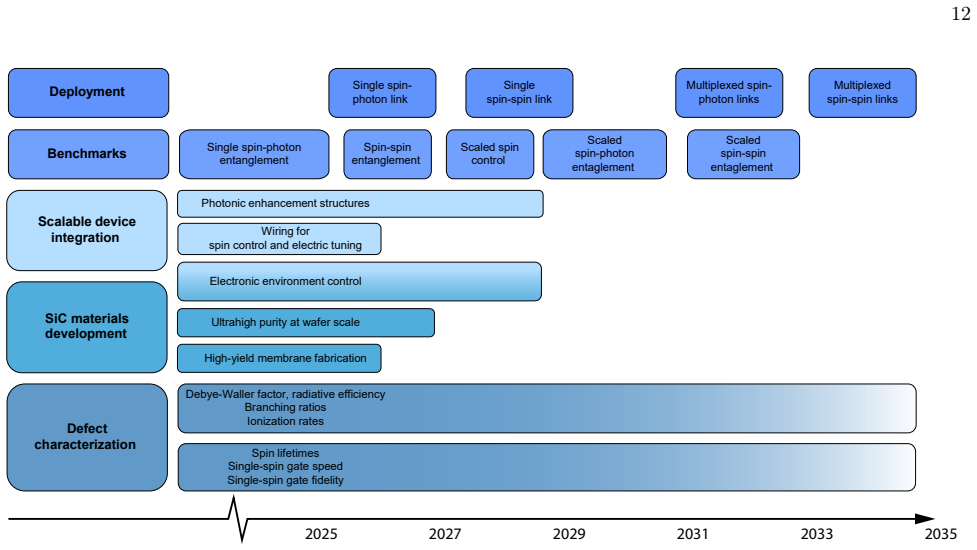
Timeline For these developments to take place within the next decade, a concerted effort by the SiC photonics commu- nity with strong industrial participation will be required. The payoff, however, will be large for all involved stake- holders, andwillprovidetechnologicaldevelopmentswith beneficial effects far beyond the science and technology domains. Wh...
work page 2020
- [5]
-
[6]
Z. Zhang and Q. Zhuang, Distributed quantum sensing, Quantum Science and Technology6, 043001 (2021)
work page 2021
-
[7]
J. L. Park, The concept of transition in quantum me- chanics, Foundations of physics1, 23 (1970)
work page 1970
-
[8]
W. K. Wootters and W. H. Zurek, A single quantum cannot be cloned, Nature299, 802 (1982)
work page 1982
-
[9]
C.-Y. Lu, Y. Cao, C.-Z. Peng, and J.-W. Pan, Micius quantum experiments in space, Rev. Mod. Phys. 94, 035001 (2022)
work page 2022
-
[10]
S.-K. Liao, W.-Q. Cai, J. Handsteiner, B. Liu, J. Yin, L. Zhang, D. Rauch, M. Fink, J.-G. Ren, W.-Y. Liu, Y. Li, Q. Shen, Y. Cao, F.-Z. Li, J.-F. Wang, Y.- M. Huang, L. Deng, T. Xi, L. Ma, T. Hu, L. Li, N.- L. Liu, F. Koidl, P. Wang, Y.-A. Chen, X.-B. Wang, M. Steindorfer, G. Kirchner, C.-Y. Lu, R. Shu, R. Ursin, T. Scheidl, C.-Z. Peng, J.-Y. Wang, A. Zei...
work page 2018
-
[11]
S. Ecker, J. Pseiner, J. Piris, and M. Bohmann, Ad- vances in entanglement-based QKD for space appli- cations, in International Conference on Space Optics — ICSO 2022 , Vol. 12777, edited by K. Minoglou, N. Karafolas, and B. Cugny, International Society for Optics and Photonics (SPIE, 2023) p. 1277727
work page 2022
-
[12]
H.-J. Briegel, W. Dür, J. I. Cirac, and P. Zoller, Quan- tum repeaters: The role of imperfect local operations in quantum communication, Physical Review Letters81, 5932 (1998)
work page 1998
-
[13]
D.P.DiVincenzo,Thephysicalimplementationofquan- tum computation, Fortschritte der Physik: Progress of Physics 48, 771 (2000)
work page 2000
-
[14]
D. M. Lukin, M. A. Guidry, and J. Vučković, Integrated quantum photonics with silicon carbide: challenges and prospects, PRX Quantum1, 020102 (2020)
work page 2020
-
[15]
A.Dréau, A.Tchebotareva, A.E.Mahdaoui, C.Bonato, and R. Hanson, Quantum frequency conversion of sin- gle photons from a nitrogen-vacancy center in diamond to telecommunication wavelengths, Phys. Rev. Appl.9, 064031 (2018)
work page 2018
-
[16]
A. Tchebotareva, S. L. Hermans, P. C. Humphreys, D. Voigt, P. J. Harmsma, L. K. Cheng, A. L. Verlaan, N. Dijkhuizen, W. de Jong, A. Dréau, and R. Han- son, Entanglement between a diamond spin qubit and a photonic time-bin qubit at telecom wavelength, Physi- calReview Letters123,10.1103/physrevlett.123.063601 (2019)
-
[17]
J. V. Rakonjac, D. Lago-Rivera, A. Seri, M. Mazzera, S. Grandi, and H. de Riedmatten, Entanglement be- tween a telecom photon and an on-demand multimode solid-state quantum memory, Phys. Rev. Lett. 127, 210502 (2021)
work page 2021
-
[18]
K. Hammerer, A. S. Sørensen, and E. S. Polzik, Quan- tum interface between light and atomic ensembles, Rev. Mod. Phys.82, 1041 (2010)
work page 2010
-
[19]
S. T. Y ılmaz, P. Fallahi, and A. Imamoğlu, Quantum- dot-spin single-photon interface, Phys. Rev. Lett.105, 033601 (2010)
work page 2010
-
[20]
P. Lodahl, Quantum-dot based photonic quantum net- works, Quantum Science and Technology 3, 013001 (2017). 15
work page 2017
-
[21]
D. Lago-Rivera, S. Grandi, J. V. Rakonjac, A. Seri, and H. de Riedmatten, Telecom-heralded entanglement be- tweenmultimodesolid-statequantummemories,Nature 594, 37 (2021)
work page 2021
-
[22]
X. Liu, J. Hu, Z. F. Li, X. Li, P. Y. Li, P. J. Liang, Z. Q. Zhou, C. F. Li, and G. C. Guo, Heralded entanglement distributionbetweentwoabsorptivequantummemories, Nature 594, 41 (2021)
work page 2021
-
[23]
V. Krutyanskiy, M. Galli, V. Krcmarsky, S. Baier, D. A. Fioretto, Y. Pu, A. Mazloom, P. Sekatski, M. Canteri, M. Teller, J. Schupp, J. Bate, M. Meraner, N. San- gouard, B. P. Lanyon, and T. E. Northup, Entangle- ment of trapped-ion qubits separated by 230 meters, Phys. Rev. Lett.130, 050803 (2023)
work page 2023
-
[24]
L. Spindlberger, A. Csóré, G. Thiering, S. Putz, R. Karhu, J. Hassan, N. Son, T. Fromherz, A. Gali, and M. Trupke, Optical properties of vanadium in 4 h silicon carbide for quantum technology, Physical Review Applied 12, 10.1103/physrevapplied.12.014015 (2019)
- [25]
-
[26]
R. Vasconcelos, S. Reisenbauer, C. Salter, G. Wachter, D. Wirtitsch, J. Schmiedmayer, P. Walther, and M. Trupke, Scalable spin–photon entanglement by time- to-polarization conversion, npj Quantum Information6, 10.1038/s41534-019-0236-x (2020)
-
[27]
M. K. Bhaskar, R. Riedinger, B. Machielse, D. S. Levo- nian, C. T. Nguyen, E. N. Knall, H. Park, D. Englund, M. Lončar, D. D. Sukachev, and M. D. Lukin, Exper- imental demonstration of memory-enhanced quantum communication, Nature580, 60 (2020)
work page 2020
-
[28]
M. Pompili, S. L. Hermans, S. Baier, H. K. Beukers, P. C. Humphreys, R. N. Schouten, R. F. Vermeulen, M. J. Tiggelman, L. dos Santos Martins, B. Dirkse, et al., Realization of a multinode quantum network of remote solid-state qubits, Science372, 259 (2021)
work page 2021
- [29]
-
[30]
C. Panayi, M. Razavi, X. Ma, and N. Lütkenhaus, Memory-assisted measurement-device-independent quantum key distribution, New Journal of Physics16, 10.1088/1367-2630/16/4/043005 (2014)
- [31]
- [32]
-
[33]
A.Gali, A.Gällström, N.T.Son,andE.Janzén,Theory of Neutral Divacancy in SiC: A Defect for Spintronics, Materials Science Forum645-648, 395 (2010)
work page 2010
-
[34]
D. J. Christle, A. L. Falk, P. Andrich, P. V. Klimov, J. U. Hassan, N. T. Son, E. Janzén, T. Ohshima, and D. D. Awschalom, Isolated electron spins in silicon car- bide with millisecond coherence times, Nature Materials 14, 160 (2015)
work page 2015
-
[35]
M. Widmann, S.-Y. Lee, T. Rendler, N. T. Son, H. Fedder, S. Paik, L.-P. Yang, N. Zhao, S. Yang, I. Booker, A. Denisenko, M. Jamali, S. A. Momen- zadeh, I. Gerhardt, T. Ohshima, A. Gali, E. Janzén, and J. Wrachtrup, Coherent control of single spins in silicon carbide at room temperature, Nature Materials 14, 164 (2015)
work page 2015
-
[36]
D. J. Christle, P. V. Klimov, C. F. de las Casas, K. Szász, V. Ivády, V. Jokubavicius, J. Ul Hassan, M. Syväjärvi, W. F. Koehl, T. Ohshima, N. T. Son, E. Janzén, A. Gali, and D. D. Awschalom, Isolated Spin Qubits in SiC with a High-Fidelity Infrared Spin-to- Photon Interface, Physical Review X7, 021046 (2017)
work page 2017
-
[37]
J.-F. Wang, F.-F. Yan, Q. Li, Z.-H. Liu, H. Liu, G.-P. Guo, L.-P. Guo, X. Zhou, J.-M. Cui, J. Wang, Z.-Q. Zhou, X.-Y. Xu, J.-S. Xu, C.-F. Li, and G.-C. Guo, Coherent Control of Nitrogen-Vacancy Center Spins in Silicon Carbide at Room Temperature, Physical Review Letters 124, 223601 (2020)
work page 2020
-
[38]
G. Wolfowicz, C. P. Anderson, B. Diler, O. G. Poluek- tov, F. J. Heremans, and D. D. Awschalom, Vanadium spin qubits as telecom quantum emitters in silicon car- bide, Science Advances6, eaaz1192 (2020)
work page 2020
-
[39]
P. Cilibrizzi, M. J. Arshad, B. Tissot, N. T. Son, I. G. Ivanov, T. Astner, P. Koller, M. Ghezellou, J. Ul- Hassan, D. White, C. Bekker, G. Burkard, M. Trupke, and C. Bonato, Ultra-narrow inhomogeneous spectral distribution of telecom-wavelength vanadium centres in isotopically-enriched silicon carbide, Nature Communi- cations 14, 8448 (2023)
work page 2023
- [40]
-
[41]
H. J. von Bardeleben, J. L. Cantin, A. Csóré, A. Gali, E. Rauls, and U. Gerstmann, NV centers in3C, 4H, and 6H silicon carbide: A variable platform for solid-state qubits and nanosensors, Physical Review B94, 121202 (2016)
work page 2016
- [42]
-
[43]
J.-F. Wang, Z.-H. Liu, F.-F. Yan, Q. Li, X.-G. Yang, L. Guo, X. Zhou, W. Huang, J.-S. Xu, C.-F. Li, and G.-C. Guo, Experimental Optical Properties of Single Nitrogen Vacancy Centers in Silicon Carbide at Room Temperature, ACS Photonics7, 1611 (2020)
work page 2020
-
[44]
Z. Mu, S. A. Zargaleh, H. J. von Bardeleben, J. E. Fröch, M. Nonahal, H. Cai, X. Yang, J. Yang, X. Li, I. Aharonovich, and W. Gao, Coherent Manipulation with Resonant Excitation and Single Emitter Creation of Nitrogen Vacancy Centers in 4H Silicon Carbide, Nano Letters20, 6142 (2020)
work page 2020
-
[45]
F. F. Murzakhanov, B. V. Yavkin, G. V. Mamin, S. B. Orlinskii, H. J. von Bardeleben, T. Biktagirov, U. Ger- stmann, and V. A. Soltamov, Hyperfine and nuclear quadrupole splitting of the NV− ground state in 4H- SiC, Physical Review B103, 245203 (2021)
work page 2021
-
[46]
H. Jurgen von Bardeleben, J.-L. Cantin, U. Gerstmann, W. G. Schmidt, and T. Biktagirov, Spin Polarization, Electron–Phonon Coupling, and Zero-Phonon Line of the NV Center in 3C-SiC, Nano Letters21, 8119 (2021)
work page 2021
-
[47]
T. Narahara, S.-i. Sato, K. Kojima, Y. Hijikata, and T. Ohshima, Influences of hydrogen ion irradiation on 16 ncv− si formation in 4H-silicon carbide, Applied Physics Express 14, 021004 (2021)
work page 2021
-
[48]
J. Schneider, H. D. Müller, K. Maier, W. Wilkening, F. Fuchs, A. Dörnen, S. Leibenzeder, and R. Stein, In- frared spectra and electron spin resonance of vanadium deep level impurities in silicon carbide, Applied Physics Letters 56, 1184 (1990)
work page 1990
-
[49]
B. Kaufmann, A. Dörnen, and F. S. Ham, Zeeman Spec- troscopy and Crystal-Field Model of Neutral Vandium in 6H-Silicon Carbide, Materials Science Forum196– 201, 707 (1995)
work page 1995
-
[50]
J. Baur, M. Kunzer, and J. Schneider, Transition Metals in SiC Polytypes, as Studied by Magnetic Resonance Techniques, physica status solidi (a)162, 153 (1997)
work page 1997
-
[51]
A. L. Falk, P. V. Klimov, V. Ivády, K. Szász, D. J. Christle, W. Koehl, A. Gali, and D. D. Awschalom, Op- tical Polarization of Nuclear Spins in Silicon Carbide, Physical Review Letters114, 247603 (2015)
work page 2015
- [52]
-
[53]
A. Bourassa, C. P. Anderson, K. C. Miao, M. Onizhuk, H. Ma, A. L. Crook, H. Abe, J. Ul-Hassan, T. Ohshima, N. T. Son, G. Galli, and D. D. Awschalom, Entangle- ment and control of single nuclear spins in isotopically engineered silicon carbide, Nature Materials 19, 1319 (2020)
work page 2020
-
[54]
L. Robledo, L. Childress, H. Bernien, B. Hensen, P. F. A. Alkemade, and R. Hanson, High-fidelity pro- jective read-out of a solid-state spin quantum register, Nature 477, 574 (2011)
work page 2011
-
[55]
R. Nagy, M. Niethammer, M. Widmann, Y.-C. Chen, P. Udvarhelyi, C. Bonato, J. U. Hassan, R. Karhu, I. G. Ivanov, N. T. Son, J. R. Maze, T. Ohshima, O. O. Soykal, A. Gali, S.-Y. Lee, F. Kaiser, and J. Wrachtrup, High-fidelity spin and optical control of single silicon- vacancy centres in silicon carbide, Nature Communica- tions 10, 1954 (2019)
work page 1954
-
[56]
C. Yin, M. Rancic, G. G. de Boo, N. Stavrias, J. C. Mc- Callum, M. J. Sellars, and S. Rogge, Optical addressing of an individual erbium ion in silicon, Nature497, 91 (2013)
work page 2013
- [57]
-
[58]
C. P. Anderson, E. O. Glen, C. Zeledon, A. Bourassa, Y. Jin, Y. Zhu, C. Vorwerk, A. L. Crook, H. Abe, J. Ul- Hassan, T. Ohshima, N. T. Son, G. Galli, and D. D. Awschalom, Five-second coherence of a single spin with single-shot readout in silicon carbide, Science Advances 8, eabm5912 (2022)
work page 2022
-
[59]
R.-Z. Fang, X.-Y. Lai, T. Li, R.-Z. Su, B.-W. Lu, C.-W. Yang, R.-Z. Liu, Y.-K. Qiao, C. Li, Z.-G. He, J. Huang, H. Li, L.-X. You, Y.-H. Huo, X.-H. Bao, and J.-W. Pan, Experimental generation of spin-photon entanglement in silicon carbide (2023), arXiv:2311.17455 [quant-ph]
-
[60]
T. H. Taminiau, J. J. T. Wagenaar, T. van der Sar, F. Jelezko, V. V. Dobrovitski, and R. Hanson, Detection and control of individual nuclear spins using a weakly coupled electron spin, Phys. Rev. Lett. 109, 137602 (2012)
work page 2012
-
[61]
C. E. Bradley, J. Randall, M. H. Abobeih, R. C. Berrevoets, M. J. Degen, M. A. Bakker, M. Markham, D. J. Twitchen, and T. H. Taminiau, A ten-qubit solid- state spin register with quantum memory up to one minute, Phys. Rev. X9, 031045 (2019)
work page 2019
- [62]
-
[63]
S. K. Parthasarathy, B. Kallinger, F. Kaiser, P. Berwian, D. B. Dasari, J. Friedrich, and R. Nagy, Scalable quantum memory nodes using nuclear spins in silicon carbide, Phys. Rev. Appl.19, 034026 (2023)
work page 2023
- [64]
- [65]
-
[66]
P. G. Baranov, A. P. Bundakova, A. A. Soltamova, S. B. Orlinskii, I. V. Borovykh, R. Zondervan, R. Verberk, and J. Schmidt, Silicon vacancy in SiC as a promis- ing quantum system for single-defect and single-photon spectroscopy, Physical Review B83, 125203 (2011)
work page 2011
-
[67]
A. Gali, Excitation spectrum of point defects in semi- conductors studied by time-dependent density func- tional theory, Journal of Materials Research 27, 897 (2012)
work page 2012
- [68]
-
[69]
V. A. Soltamov, A. A. Soltamova, P. G. Baranov, and I. I. Proskuryakov, Room Temperature Coherent Spin Alignment of Silicon Vacancies in 4H- and 6H-SiC, Physical Review Letters108, 226402 (2012)
work page 2012
-
[70]
O. O. Soykal, P. Dev, and S. E. Economou, Silicon va- cancy center in4H-SiC: Electronic structure and spin- photon interfaces, Physical Review B93, 081207 (2016)
work page 2016
-
[71]
O. O. Soykal and T. L. Reinecke, Quantum metrology with a single spin-3 2 defect in silicon carbide, Physical Review B95, 081405 (2017)
work page 2017
-
[72]
W.Dong, M.W.Doherty,andS.E.Economou,Spinpo- larization through intersystem crossing in the silicon va- cancy of silicon carbide, Physical Review B99, 184102 (2019)
work page 2019
-
[73]
M. Widmann, M. Niethammer, D. Y. Fedyanin, I. A. Khramtsov, T. Rendler, I. D. Booker, J. Ul Hassan, N. Morioka, Y.-C. Chen, I. G. Ivanov,et al., Electrical charge state manipulation of single silicon vacancies in a silicon carbide quantum optoelectronic device, Nano letters 19, 7173 (2019)
work page 2019
-
[74]
J.-F. Wang, F.-F. Yan, Q. Li, Z.-H. Liu, J.-M. Cui, Z.- D. Liu, A. Gali, J.-S. Xu, C.-F. Li, and G.-C. Guo, Robust coherent control of solid-state spin qubits us- ing anti-Stokes excitation, Nature Communications12, 3223 (2021)
work page 2021
-
[75]
N. T. Son, P. Carlsson, J. ul Hassan, E. Janzén, T. Umeda, J. Isoya, A. Gali, M. Bockstedte, N. Mor- ishita, T. Ohshima, and H. Itoh, Divacancy in 4H-SiC, 17 Physical Review Letters96, 055501 (2006)
work page 2006
-
[76]
A. Gali, Time-dependent density functional study on the excitation spectrum of point defects in semiconduc- tors, physica status solidi (b)248, 1337 (2011)
work page 2011
-
[77]
W. F. Koehl, B. B. Buckley, F. J. Heremans, G. Calu- sine,andD.D. Awschalom,Roomtemperaturecoherent control of defect spin qubits in silicon carbide, Nature 479, 84 (2011)
work page 2011
-
[78]
V. Ivády, J. Davidsson, N. Delegan, A. L. Falk, P. V. Klimov, S. J. Whiteley, S. O. Hruszkewycz, M. V. Holt, F. J. Heremans, N. T. Son, D. D. Awschalom, I. A. Abrikosov, and A. Gali, Stabilization of point-defect spin qubits by quantum wells, Nature Communications 10, 5607 (2019)
work page 2019
- [79]
-
[80]
H. Sternschulte, K. Thonke, R. Sauer, P. C. Münzinger, and P. Michler, 1.681-eV luminescence center in chemical-vapor-deposited homoepitaxial diamond films, Physical Review B50, 14554 (1994)
work page 1994
discussion (0)
Sign in with ORCID, Apple, or X to comment. Anyone can read and Pith papers without signing in.