Engineering stable quantum currents at bulk boundaries
Pith reviewed 2026-05-25 19:52 UTC · model grok-4.3
The pith
Quantum walks support stable directed currents along curves through topological charge transport.
A machine-rendered reading of the paper's core claim, the machinery that carries it, and where it could break.
Core claim
We prove existence of a non trivial charge transport and that the absolutely continuous spectrum covers the whole unit circle under mild assumptions. For Quantum Walks we exhibit explicit constructions of coins which imply existence of stable directed quantum currents along classical curves. The results are of topological nature and independent of the details of the model.
What carries the argument
Topological invariants ensuring non-trivial charge transport independent of model details.
If this is right
- Non-trivial charge transport exists in the studied systems.
- The absolutely continuous spectrum covers the full unit circle.
- Explicit coin constructions yield stable directed currents along classical curves in quantum walks.
- The transport properties are topological and independent of model details.
Where Pith is reading between the lines
- The constructions provide a way to select coin operators that fix the direction of currents in advance.
- The topological argument may carry over to other discrete-time quantum systems on lattices.
- If the mild assumptions can be verified for a concrete model, the spectrum and transport claims follow directly.
Load-bearing premise
The models satisfy mild assumptions that make the topological index well-defined and the transport results hold.
What would settle it
A counterexample model meeting the mild assumptions but with vanishing charge transport or incomplete absolutely continuous spectrum on the unit circle.
Figures





read the original abstract
We study transport properties of discrete quantum dynamical systems on the lattice, in particular Coined Quantum Walks and the Chalker--Coddington model. We prove existence of a non trivial charge transport and that the absolutely continuous spectrum covers the whole unit circle under mild assumptions. For Quantum Walks we exhibit explicit constructions of coins which imply existence of stable directed quantum currents along classical curves. The results are of topological nature and independent of the details of the model.
Editorial analysis
A structured set of objections, weighed in public.
Referee Report
Summary. The manuscript studies transport in discrete quantum dynamical systems on the lattice, focusing on coined quantum walks and the Chalker-Coddington model. It proves existence of non-trivial charge transport and that the absolutely continuous spectrum covers the full unit circle under mild assumptions. Explicit coin constructions are given for quantum walks that yield stable directed currents along classical curves. All results are topological in nature and independent of microscopic model details.
Significance. If the central claims hold, the work supplies a rigorous topological bulk-boundary correspondence for quantum walks that directly yields explicit, stable current constructions. The use of the standard winding-number index of the symbol together with the Fredholm index of the half-plane operator, combined with the finite-range and uniform ellipticity hypotheses, gives a model-independent existence result that strengthens the case for topological protection of directed transport. The explicit constructions constitute a concrete, falsifiable output that goes beyond abstract index theorems.
major comments (1)
- [Theorem 3.2] Theorem 3.2: the argument that the absence of eigenvalues for the perturbed walk follows from the non-vanishing Fredholm index is only sketched; a short paragraph clarifying why the index obstruction precludes point spectrum (rather than merely guaranteeing essential spectrum) would make the AC-spectrum claim fully self-contained.
minor comments (3)
- [§2.3] §2.3: the phrase 'uniformly elliptic' is used without an explicit quantitative bound; adding the precise lower bound on the coin-matrix entries would remove any ambiguity in the 'mild assumptions' list.
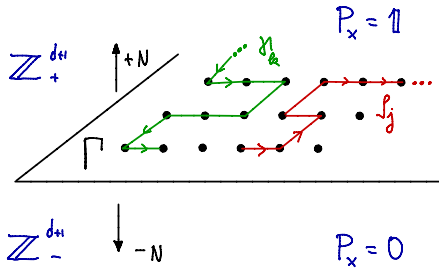
- [Figure 2] Figure 2 caption: the classical curve is drawn but its parametrization is not stated; a one-line formula would help readers reproduce the current direction.
- [Abstract] Abstract, line 3: 'non trivial' should read 'non-trivial'.
Simulated Author's Rebuttal
We thank the referee for the positive evaluation of the manuscript and for the constructive suggestion regarding Theorem 3.2. We address the single major comment below and will incorporate the requested clarification in the revised version.
read point-by-point responses
-
Referee: [Theorem 3.2] Theorem 3.2: the argument that the absence of eigenvalues for the perturbed walk follows from the non-vanishing Fredholm index is only sketched; a short paragraph clarifying why the index obstruction precludes point spectrum (rather than merely guaranteeing essential spectrum) would make the AC-spectrum claim fully self-contained.
Authors: We agree that the link between the non-vanishing Fredholm index and the absence of point spectrum is only sketched in the current proof of Theorem 3.2. In the revised manuscript we will insert a short clarifying paragraph immediately after the proof. The added text will recall that a non-zero Fredholm index for the half-plane operator implies that the essential spectrum must fill the entire unit circle (by the properties of the winding-number index of the symbol under the finite-range and uniform ellipticity assumptions). It will further note that any isolated eigenvalue would constitute a compact perturbation that cannot alter the index, thereby ruling out point spectrum and ensuring the spectrum is purely absolutely continuous. This addition will make the AC-spectrum claim fully self-contained while leaving the statement and overall proof strategy of Theorem 3.2 unchanged. revision: yes
Circularity Check
No significant circularity detected
full rationale
The derivation relies on explicit assumptions (finite-range, uniformly elliptic coins with spectral gap) and standard topological tools (Fredholm index of the half-plane operator, winding number of the symbol) to prove bulk-boundary correspondence and absence of eigenvalues. These steps are mathematically independent of the target claims and do not reduce to self-definition, fitted inputs renamed as predictions, or load-bearing self-citations. The constructions for coins are explicit and the independence from microscopic details follows from the topological invariance under the stated hypotheses. No circular steps identified.
Axiom & Free-Parameter Ledger
Forward citations
Cited by 1 Pith paper
-
Mobility edges in pseudo-unitary quasiperiodic quantum walks
A pseudo-unitary quasiperiodic quantum walk model exhibits a novel mobility edge sharply dividing metallic and insulating phases plus a second transition unique to discrete time, with PT-symmetry breaking quantified b...
Reference graph
Works this paper leans on
-
[1]
Asch, J., Bourget, O., Joye, A., Localization Properties of the Chalker- Coddington Model. Ann. H. Poincar´ e, 11, 1341–1373, (2010). 25
work page 2010
-
[2]
Asch, J., Bourget, O., Joye, A., Dynamical Localization of the Chalker- Coddington Model far from Transition, J. Stat. Phys., 147, 194-205 (2012)
work page 2012
-
[3]
Asch, J., Bourget, O., Joye, A., Spectral Stability of Unitary Network Mod- els, Rev. Math. Phys. , 27, 1530004, (2015)
work page 2015
-
[4]
Asch, J., Bourget, O., Joye, A., Chirality induced Interface Currents in the Chalker Coddington Model, Journal of Spectral Theory, to appear (2019)
work page 2019
-
[5]
Asch, J., Joye, A., ”Lower Bounds on the Localisation Length of Bal- anced Random Quantum Walks”, Letters in Mathematical Physics,to appear (2019)
work page 2019
-
[6]
Ahlbrecht, A., Scholz, V.B., Werner, A.H.: Disordered quantum walks in one lattice dimension, J. Math. Phys. 52, 102201 (2011)
work page 2011
-
[7]
Avron, J., Seiler, R., Simon, B., The Index of a Pair of Projections, J. Func. Anal., 120, 220-237, (1994)
work page 1994
-
[8]
Spectral analysis of unitary band matri- ces
Bourget, O., Howland, J., Joye, A. Spectral analysis of unitary band matri- ces. Commun. Math. Phys. , 234, 191–227, (2003)
work page 2003
-
[9]
A., Stahl, C., Vel´ azquez, L., Werner, A
Cedzich, C., Geib, T., Gr¨ unbaum, F. A., Stahl, C., Vel´ azquez, L., Werner, A. H., Werner, R. F., The topological classification of one-dimensional sym- metric quantum walks. Ann. H. Poincar´ e, 19, 325-383, (2018)
work page 2018
-
[10]
Chalker, J. T., Coddington, P. D. Percolation, quantum tunnelling and the integer Hall effect. J. Phys. C: Solid State Physics , 21, 2665, (1988)
work page 1988
-
[11]
Phase rotation symmetry and the topology of oriented scattering networks
Delplace, P., Fruchart, M., Tauber, C. Phase rotation symmetry and the topology of oriented scattering networks. Phys. Rev. B, 95, 205413, (2017)
work page 2017
-
[12]
Graf, G. M., Tauber, C. Bulk-Edge correspondence for two-dimensional Flo- quet topological insulators. Ann. H. Poincar´ e, 19, 709–741, (2018)
work page 2018
-
[13]
E.Hamza, A.Joye : Spectral Transition for Random Quantum Walks on Trees, Commun. Math. Phys. , 326, 415-439, (2014)
work page 2014
-
[14]
A.Joye, L.Marin : ”Spectral Properties of Quantum Walks on Rooted Binary Trees”, J. Stat. Phys. , 155, 1249-1270, (2014)
work page 2014
-
[15]
A.Joye and M.Merkli: ”Dynamical Localization of Quantum Walks in Ran- dom Environments”, J. Stat. Phys. , 140, 1025-1053, (2010). 26
work page 2010
-
[16]
A.Joye: ”Dynamical Localization for d-Dimensional Random Quantum Walks”, Quantum Inf. Proc. , Special Issue: Quantum Walks, 11, 1251- 1269, (2012)
work page 2012
-
[17]
Anyons in an exactly solved model and beyond
Kitaev, A. Anyons in an exactly solved model and beyond. Ann. of Phys. , 321, 2111, (2006)
work page 2006
-
[18]
Kramer, B., Ohtsuki, T., Kettemann, S., Random network models and quan- tum phase transitions in two dimensions, Physics Reports, 417, 211, (2005)
work page 2005
-
[19]
Geometry, Topology and Physics, chapter 13.2 (IOP, Briston and Philadelphia, 2003)
Nakahara, M. Geometry, Topology and Physics, chapter 13.2 (IOP, Briston and Philadelphia, 2003)
work page 2003
-
[20]
Portugal, Quantum Walks and Search Algorithms (Springer, New York, 2013)
R. Portugal, Quantum Walks and Search Algorithms (Springer, New York, 2013)
work page 2013
-
[21]
Rudner M.S, Lindner N. H., Berg E., Levin M., ”Anomalous edge states and the bulk-edge correspondence for periodically driven two-dimensional systems”. Phys. Rev. X 3, 031005 (2013)
work page 2013
-
[22]
Sz.-Nagy, B., Foias, C., Berkovici, H., K´ erchy, J., Harmonic Analysis of Operators in Hilbert Spaces , Springer (2010)
work page 2010
-
[23]
Topological boundary invariants for Floquet systems and quantum walks
Sadel, C., Schulz-Baldes, H. Topological boundary invariants for Floquet systems and quantum walks. Math Phys Anal Geom (2017) 20–22
work page 2017
-
[24]
Venegas-Andraca, Salvador Elias, Quantum walks: a comprehensive review, Quantum Inf. Process. , 11, 1015-1106, (2012). 27
work page 2012
discussion (0)
Sign in with ORCID, Apple, or X to comment. Anyone can read and Pith papers without signing in.