REVIEW 3 major objections 6 minor 43 references
Normal-NeRF: Ambiguity-Robust Normal Estimation for Highly Reflective Scenes
T0 review · 3 major / 6 minor · reviewed 2026-08-10 · deepseek-v4-flash
Pith's one-line read This paper claims that surface normals for NeRF should be computed from gradients of ray transmittance rather than density, and that doing so makes reconstruction of highly reflective scenes stable enough to render them faithfully.
desk verdict The transmittance gradient is a genuinely new normal estimator and the reported gains look real, but the paper's theoretical story for why it works does not survive contact with the math. read the letter →
The pith
A machine-rendered reading of the paper's core claim, the machinery that carries it, and where it could break.
The reading
What carries the argument
The load-bearing object is the transmittance gradient: for a ray origin $o$, direction $d$, and point $x = o + td$, the paper reparameterizes transmittance as $\hat{T}(x; d, t) = \exp(-\int_0^t \sigma(x - sd)\,ds)$ and defines the normal estimate as the normalized gradient of this quantity with respect to $x$ (Eq. (8)), approximated in Eq. (9) by the normalized negative cumulative sum of density gradients over earlier samples along the ray. Two supporting mechanisms carry the argument: the dual activated densities module, which feeds one shared pre-activation density through $\exp$ for rendering weights and $\operatorname{softplus}$ for normal computation so sharp boundaries and smooth normals coexist, and a stop-gradient warmup schedule on the predicted-normal loss that gradually increases the gradient flow from normals into the density field. The reflection-aware appearance branch then uses the predicted normal to reflect the viewing direction and conditions a specular color network on the reflected direction.
What would settle it
Render a synthetic semi-transparent shell with a known smooth density profile (for example, a Gaussian falloff around a sphere) and compare Eq. (9) normals against analytic sphere normals; if mean angular error grows with surface curvature or shell thickness, or if the predicted normals rotate when the sampling rate changes, the transmittance-gradient premise is falsified.
Extended reading notes
Core claim
The central discovery is that the direction of the transmittance gradient, defined in Eqs. (7)-(9) as the normalized spatial gradient of accumulated transmittance over a ray segment with respect to translation of the segment, points at the true surface normal even when the density field is non-monotonic and the shape is ambiguous. Because transmittance is monotonically decreasing along a ray, its derivative is large where rendering weights are large, so normal estimates remain consistent near semi-transparent surfaces where density gradients vanish. The paper argues that this normal signal, refined by a spatial MLP and combined with the dual activated densities and stop-gradient warmup, resolves the shape-radiance ambiguity that reflection-aware models otherwise fight, and the experiments report the highest scores among the compared methods on Shiny Blender, Glossy Synthetic, and comparable performance on real captures.
Load-bearing premise
The load-bearing premise is that the transmittance gradient, approximated by a cumulative sum of density gradients along the ray, gives the true surface-normal direction even when the shape is ambiguous, a claim justified only by 1D monotonicity of transmittance rather than by a proof about its 3D gradient.
Editorial extensions
If this is right
- Normals estimated from transmittance stay aligned with surfaces in semi-transparent and specular regions where density-gradient normals scatter, enabling clean normal maps (MAE 4.241 on Shiny Blender).
- A single density MLP with two activations can simultaneously support sharp object boundaries in rendering and smooth normals for reflection parameterization, removing the need for separate geometry priors.
- The stop-gradient warmup prevents early random normal predictions from flattening or oversmoothing the density field, preserving fine geometry such as water waves.
- With these normals, a reflection-direction-based appearance model renders mirror-like scenes at higher fidelity than more complex ray-tracing or microfacet models on the tested datasets.
Reading between the lines
- The transmittance gradient is essentially a ray-wise accumulation of density gradients, so it should transfer to any differentiable ray-marching renderer as a drop-in normal regularizer.
- Because the justification uses only ray-wise monotonicity, the same construction likely applies to thin translucent objects such as smoke, glass, and water; this could be tested on datasets with ground-truth normals.
- The stop-gradient warmup may benefit other reflection-aware models that tie MLP normals to density-derived normals, since it decouples early normal supervision from density optimization.
Signed reviews
Editorial analysis
A structured set of objections, weighed in public.
Referee Report
Summary. The paper proposes Normal-NeRF, a NeRF-based method for reconstructing and rendering highly reflective scenes. The core idea is to replace density-gradient normals with a transmittance-gradient normal estimate (Eqs. 7-9), which the authors argue is robust to the shape ambiguity caused by specular reflections. The method also introduces dual activated densities (softplus and exp) to reconcile smooth surface normals with sharp object boundaries, and a stop-gradient warmup for the predicted-normal loss. The system is evaluated on NeRF Synthetic, Shiny Blender, Glossy Synthetic, and real captured scenes, with per-scene tables, ablations, and released code. The paper reports large average improvements over prior work on the two reflective datasets, e.g., PSNR 39.24 vs. 35.96 for Ref-NeRF on Shiny Blender and 33.24 vs. 30.49 for Ref-NeuS on Glossy Synthetic.
Significance. The empirical contribution is substantial: the method achieves state-of-the-art rendering quality on two challenging specular datasets, includes detailed per-scene results (Tables 7-10), multi-seed standard deviations (Table 6), controlled ablations (Tables 3-5), and public code. If the transmittance-gradient normal estimate is accepted as a heuristic, the paper is a practical step forward for reflective-scene reconstruction. However, the theoretical justification for why transmittance gradients are robust under shape ambiguity is not proven, and the per-scene normal-error results do not uniformly support the robustness claim. The central idea is therefore defensible but needs both a more careful framing and additional analysis before the paper can be accepted.
major comments (3)
- [Transmittance Gradient, Eqs. (7)-(9)] The monotonicity of the one-dimensional transmittance T(t) along a fixed ray does not constrain the three-dimensional direction of the translation gradient ∇_x T(x;d,t), so the claim that transmittance gradients are 'ambiguity-robust' normals is not established by the argument in the text. For a ray-aligned density field of the form σ(x)=f((x−o)·d), Eq. (9) reduces to n_t^i=±d for every sample on that ray, regardless of the shape of f, while T(t) remains monotone for any nonnegative f. This is exactly the kind of degenerate, view-dependent normal estimate the method is supposed to avoid. The authors should either prove the claim under explicit assumptions about the density field (e.g., locally planar opaque surfaces) or re-frame the transmittance gradient as an empirical heuristic whose validation is purely experimental.
- [Transmittance Gradient, Eq. (9)] Eq. (9) is introduced as a quadrature-based estimate of the transmittance gradient, but no derivation or error analysis is given. The sum over j<i of ∇σ(x_j)δ_j is a one-sided path integral whose accuracy for the translation gradient at x is unclear on curved, multi-layer, or deeply semi-transparent surfaces. This is load-bearing because the predicted-normal loss (Eq. 10) trains the normal MLP against this quantity, and the resulting normals determine the reflection direction (Eq. 12) used in the appearance model. Please provide a derivation, a bound, or an explicit statement that Eq. (9) is a numerical heuristic accepted on empirical grounds.
- [Table 8] The per-scene MAE results in Table 8 do not consistently favor the proposed normal estimator. On toaster, Ours reports MAE 8.329 versus ENVIDR 6.496 and Ref-NeuS 5.560; on ball, Ours reports 0.529 versus ENVIDR 0.245. Since the paper's central claim is robustness under ambiguous shape prediction, the average MAE improvement alone is insufficient evidence. Please report statistical significance, discuss the scenes where the method fails, or restrict the robustness claim to the subset of scenes where it actually holds.
minor comments (6)
- [Eq. (4)] In the definition of T_i, the summation index is written as σ_i δ_i; this should be σ_j δ_j to match the standard quadrature and to be consistent with the surrounding text.
- [Eqs. (10)-(11)] The arrow notation ← →L_n and − →L_n is used before being explained, and the decomposition in Eq. (10) is not self-explanatory. Please define the notation explicitly and clarify which term corresponds to which gradient direction.
- [Ablation Studies, Table 3] Table 3 is difficult to interpret because the rows show only checkmarks without explicit row labels; in particular, the 'Softplus' and 'Exp' columns do not uniquely indicate whether one activation is removed or both are active. Please add a clear configuration description for each row.
- [Implementation Details] The text repeatedly says 'batch size of 219 sample points' and 'hash table size of 219'. Given the Instant-NGP context, these likely mean 2^19; please use superscripts or the explicit form 2^19 to avoid ambiguity.
- [Introduction] The claim 'we are the first to identify and analyze the inherent limitations of the density gradient' is stronger than necessary, since prior work such as Ref-NeRF already discusses the unreliability of density-gradient normals on specular surfaces. Please soften the claim and cite the relevant discussion.
- [Table 2] The real-captured-scene comparison includes only Zip-NeRF and Ref-NeRF; for consistency with the other tables, please report the SDF-based baselines (ENVIDR, Ref-NeuS) on these scenes or state why they are omitted.
Circularity Check
No significant circularity: the transmittance-gradient estimator and the reported results are externally grounded.
full rationale
The derivation chain is self-contained. The transmittance gradient is defined in Eqs. (7)-(8) as the normalized spatial gradient of the ray-segment transmittance and then discretized in Eq. (9) as a cumulative sum of density gradients. Although Eq. (9) is built from the same density field that is optimized during training, this is a computational approximation of the proposed estimator, not a reduction of the claimed result to its inputs. The headline claims are evaluated against external ground-truth normals and novel-view metrics on Shiny Blender, Glossy Synthetic, and real captured scenes, so the central performance statement is independently testable. The reference list contains no self-citations by the authors, no fitted constant is relabeled as a prediction, and no uniqueness theorem is imported from the authors' prior work. The skeptical concern that Eq. (9) can degenerate to the viewing direction for ray-aligned density artifacts is a substantive correctness risk about whether the estimator is well-founded, not a circularity: the paper does not define the normal to be the viewing direction, nor does it fit a parameter that forces the reported metrics. Under the stated hard rules, no circular step can be exhibited with a specific reduction, so the appropriate finding is no significant circularity.
Assumptions & free parameters
free parameters (2)
- Stop-gradient warmup schedule for lambda_n =
Exponential from 0.01 to 1.0 over 20k iterations
- Predicted normal loss weight =
Logarithmic decay from 6e-2 to 3e-3 over first 20k iterations
assumptions (5)
- standard math Volume rendering equation (Eq. 1-4) correctly models light transport for the scene
- domain assumption Density gradients are a meaningful geometric signal for normals
- ad hoc to paper Monotonicity of 1D transmittance implies robust 3D transmittance-gradient normals
- domain assumption Shared MLP parameters keep sharp (exp) and smooth (softplus) density fields consistent
- domain assumption Reflection direction computed from predicted normals correctly parameterizes view-dependent appearance
invented entities (1)
-
Transmittance gradient n_t(x;d,t)
Cite this review
Pith. "Pith review of Normal-NeRF: Ambiguity-Robust Normal Estimation for Highly Reflective Scenes." pith.science (2026). https://pith.science/paper/TWRYQ4HV
@misc{pith2026250109460,
  author       = {Pith},
  title        = {Pith review of: Normal-NeRF: Ambiguity-Robust Normal Estimation for Highly Reflective Scenes},
  year         = {2026},
  howpublished = {\url{https://pith.science/paper/TWRYQ4HV}},
  note         = {Machine review of arXiv:2501.09460}
}
read the original abstract
Neural Radiance Fields (NeRF) often struggle with reconstructing and rendering highly reflective scenes. Recent advancements have developed various reflection-aware appearance models to enhance NeRF's capability to render specular reflections. However, the robust reconstruction of highly reflective scenes is still hindered by the inherent shape ambiguity on specular surfaces. Existing methods typically rely on additional geometry priors to regularize the shape prediction, but this can lead to oversmoothed geometry in complex scenes. Observing the critical role of surface normals in parameterizing reflections, we introduce a transmittance-gradient-based normal estimation technique that remains robust even under ambiguous shape conditions. Furthermore, we propose a dual activated densities module that effectively bridges the gap between smooth surface normals and sharp object boundaries. Combined with a reflection-aware appearance model, our proposed method achieves robust reconstruction and high-fidelity rendering of scenes featuring both highly specular reflections and intricate geometric structures. Extensive experiments demonstrate that our method outperforms existing state-of-the-art methods on various datasets.
Figures


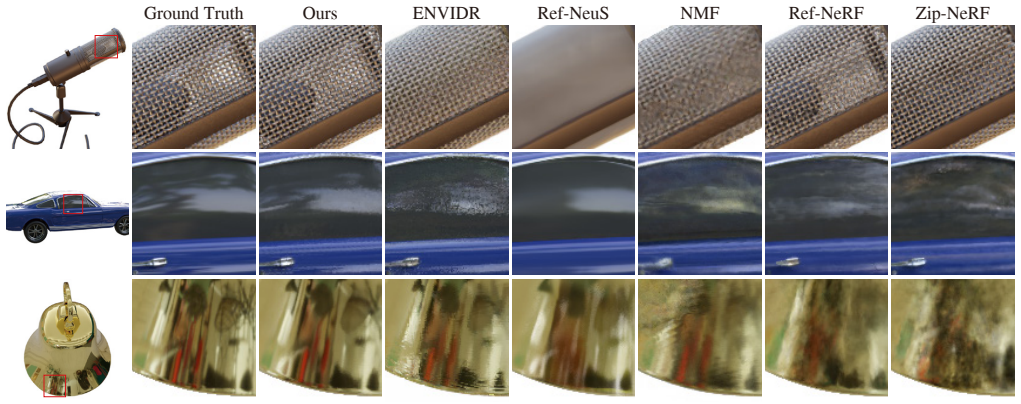
Figures from the paper (7 more)


Reference graph
Works this paper leans on
-
[1]
Anderson, M.; Motta, R.; Chandrasekar, S.; and Stokes, M. 1996. Proposal for a standard default color space for the internet—srgb. In Color and imaging conference, volume 4, 238--245. Society of Imaging Science and Technology
work page 1996
-
[2]
T.; Mildenhall, B.; Tancik, M.; Hedman, P.; Martin-Brualla, R.; and Srinivasan, P
Barron, J. T.; Mildenhall, B.; Tancik, M.; Hedman, P.; Martin-Brualla, R.; and Srinivasan, P. P. 2021. Mip-nerf: A multiscale representation for anti-aliasing neural radiance fields. In Proceedings of the IEEE/CVF International Conference on Computer Vision, 5855--5864
2021
-
[3]
T.; Mildenhall, B.; Verbin, D.; Srinivasan, P
Barron, J. T.; Mildenhall, B.; Verbin, D.; Srinivasan, P. P.; and Hedman, P. 2022. Mip-nerf 360: Unbounded anti-aliased neural radiance fields. In Proceedings of the IEEE/CVF Conference on Computer Vision and Pattern Recognition, 5470--5479
2022
-
[4]
T.; Mildenhall, B.; Verbin, D.; Srinivasan, P
Barron, J. T.; Mildenhall, B.; Verbin, D.; Srinivasan, P. P.; and Hedman, P. 2023. Zip-NeRF: Anti-Aliased Grid-Based Neural Radiance Fields. In Proceedings of the IEEE/CVF International Conference on Computer Vision (ICCV), 19697--19705
work page 2023
-
[5]
Bi, S.; Xu, Z.; Srinivasan, P.; Mildenhall, B.; Sunkavalli, K.; Hašan, M.; Hold-Geoffroy, Y.; Kriegman, D.; and Ramamoorthi, R. 2020. Neural Reflectance Fields for Appearance Acquisition. arXiv:2008.03824
arXiv 2020
-
[6]
Boss, M.; Braun, R.; Jampani, V.; Barron, J. T.; Liu, C.; and Lensch, H. 2021. Nerd: Neural reflectance decomposition from image collections. In Proceedings of the IEEE/CVF International Conference on Computer Vision, 12684--12694
work page 2021
-
[7]
Chen, A.; Xu, Z.; Geiger, A.; Yu, J.; and Su, H. 2022. Tensorf: Tensorial radiance fields. In European Conference on Computer Vision, 333--350. Springer
2022
-
[8]
Chen, A.; Xu, Z.; Zhao, F.; Zhang, X.; Xiang, F.; Yu, J.; and Su, H. 2021. Mvsnerf: Fast generalizable radiance field reconstruction from multi-view stereo. In Proceedings of the IEEE/CVF International Conference on Computer Vision, 14124--14133
work page 2021
Show all 43 references
-
[9]
Ge, W.; Hu, T.; Zhao, H.; Liu, S.; and Chen, Y.-C. 2023. Ref-NeuS: Ambiguity-Reduced Neural Implicit Surface Learning for Multi-View Reconstruction with Reflection. In Proceedings of the IEEE/CVF International Conference on Computer Vision (ICCV), 4251--4260
2023
-
[10]
Guo, Y.-C.; Kang, D.; Bao, L.; He, Y.; and Zhang, S.-H. 2022. Nerfren: Neural radiance fields with reflections. In Proceedings of the IEEE/CVF Conference on Computer Vision and Pattern Recognition, 18409--18418
2022
-
[11]
T.; Abbeel, P.; and Poole, B
Jain, A.; Mildenhall, B.; Barron, J. T.; Abbeel, P.; and Poole, B. 2022. Zero-shot text-guided object generation with dream fields. In Proceedings of the IEEE/CVF Conference on Computer Vision and Pattern Recognition, 867--876
2022
-
[12]
Jain, A.; Tancik, M.; and Abbeel, P. 2021. Putting nerf on a diet: Semantically consistent few-shot view synthesis. In Proceedings of the IEEE/CVF International Conference on Computer Vision, 5885--5894
2021
-
[13]
P.; and Ba, J
Kingma, D. P.; and Ba, J. 2015. Adam: A Method for Stochastic Optimization. In Bengio, Y.; and LeCun, Y., eds., 3rd International Conference on Learning Representations, ICLR 2015, San Diego, CA, USA, May 7-9, 2015, Conference Track Proceedings
2015
-
[14]
Kopanas, G.; Leimk \"u hler, T.; Rainer, G.; Jambon, C.; and Drettakis, G. 2022. Neural point catacaustics for novel-view synthesis of reflections. ACM Transactions on Graphics (TOG), 41(6): 1--15
2022
-
[15]
Kuang, Z.; Olszewski, K.; Chai, M.; Huang, Z.; Achlioptas, P.; and Tulyakov, S. 2022. Neroic: Neural rendering of objects from online image collections. ACM Transactions on Graphics (TOG), 41(4): 1--12
2022
-
[16]
Li, T.; Slavcheva, M.; Zollhoefer, M.; Green, S.; Lassner, C.; Kim, C.; Schmidt, T.; Lovegrove, S.; Goesele, M.; Newcombe, R.; et al. 2022. Neural 3d video synthesis from multi-view video. In Proceedings of the IEEE/CVF Conference on Computer Vision and Pattern Recognition, 5521--5531
2022
-
[17]
Liang, R.; Chen, H.; Li, C.; Chen, F.; Panneer, S.; and Vijaykumar, N. 2023. ENVIDR: Implicit Differentiable Renderer with Neural Environment Lighting. In Proceedings of the IEEE/CVF International Conference on Computer Vision (ICCV), 79--89
2023
-
[18]
Liu, Y.; Wang, P.; Lin, C.; Long, X.; Wang, J.; Liu, L.; Komura, T.; and Wang, W. 2023. NeRO: Neural Geometry and BRDF Reconstruction of Reflective Objects from Multiview Images. In SIGGRAPH
2023
-
[19]
Ma, L.; Agrawal, V.; Turki, H.; Kim, C.; Gao, C.; Sander, P.; Zollh\"ofer, M.; and Richardt, C. 2024. SpecNeRF: Gaussian Directional Encoding for Specular Reflections. In Proceedings of the IEEE/CVF Conference on Computer Vision and Pattern Recognition (CVPR), 21188--21198
2024
-
[20]
Mai, A.; Verbin, D.; Kuester, F.; and Fridovich-Keil, S. 2023. Neural Microfacet Fields for Inverse Rendering. In Proceedings of the IEEE/CVF International Conference on Computer Vision, 408--418
2023
-
[21]
P.; Tancik, M.; Barron, J
Mildenhall, B.; Srinivasan, P. P.; Tancik, M.; Barron, J. T.; Ramamoorthi, R.; and Ng, R. 2021. Nerf: Representing scenes as neural radiance fields for view synthesis. Communications of the ACM, 65(1): 99--106
2021
-
[22]
M\"uller, T.; Evans, A.; Schied, C.; and Keller, A. 2022. Instant Neural Graphics Primitives with a Multiresolution Hash Encoding. ACM Trans. Graph., 41(4): 102:1--102:15
2022
-
[23]
T.; Bouaziz, S.; Goldman, D
Park, K.; Sinha, U.; Barron, J. T.; Bouaziz, S.; Goldman, D. B.; Seitz, S. M.; and Martin-Brualla, R. 2021 a . Nerfies: Deformable neural radiance fields. In Proceedings of the IEEE/CVF International Conference on Computer Vision, 5865--5874
2021
-
[24]
T.; Bouaziz, S.; Goldman, D
Park, K.; Sinha, U.; Hedman, P.; Barron, J. T.; Bouaziz, S.; Goldman, D. B.; Martin-Brualla, R.; and Seitz, S. M. 2021 b . HyperNeRF: a higher-dimensional representation for topologically varying neural radiance fields. ACM Transactions on Graphics (TOG), 40(6): 1--12
2021
-
[25]
T.; and Mildenhall, B
Poole, B.; Jain, A.; Barron, J. T.; and Mildenhall, B. 2023. DreamFusion: Text-to-3D using 2D Diffusion. In The Eleventh International Conference on Learning Representations
2023
-
[26]
Schwarz, K.; Liao, Y.; Niemeyer, M.; and Geiger, A. 2020. Graf: Generative radiance fields for 3d-aware image synthesis. Advances in Neural Information Processing Systems, 33: 20154--20166
2020
-
[27]
P.; Deng, B.; Zhang, X.; Tancik, M.; Mildenhall, B.; and Barron, J
Srinivasan, P. P.; Deng, B.; Zhang, X.; Tancik, M.; Mildenhall, B.; and Barron, J. T. 2021. Nerv: Neural reflectance and visibility fields for relighting and view synthesis. In Proceedings of the IEEE/CVF Conference on Computer Vision and Pattern Recognition, 7495--7504
2021
-
[28]
Sun, C.; Sun, M.; and Chen, H.-T. 2022. Direct voxel grid optimization: Super-fast convergence for radiance fields reconstruction. In Proceedings of the IEEE/CVF Conference on Computer Vision and Pattern Recognition, 5459--5469
2022
-
[29]
Tagliasacchi, A.; and Mildenhall, B. 2022. Volume Rendering Digest (for NeRF). arXiv:2209.02417
2022 arXiv
-
[30]
Tancik, M.; Weber, E.; Ng, E.; Li, R.; Yi, B.; Kerr, J.; Wang, T.; Kristoffersen, A.; Austin, J.; Salahi, K.; Ahuja, A.; McAllister, D.; and Kanazawa, A. 2023. Nerfstudio: A Modular Framework for Neural Radiance Field Development. In ACM SIGGRAPH 2023 Conference Proceedings, S...
2023
-
[31]
T.; and Srinivasan, P
Verbin, D.; Hedman, P.; Mildenhall, B.; Zickler, T.; Barron, J. T.; and Srinivasan, P. P. 2022. Ref-NeRF: Structured View-Dependent Appearance for Neural Radiance Fields. In Proceedings of the IEEE/CVF Conference on Computer Vision and Pattern Recognition, 5491--5500
2022
-
[32]
P.; Hedman, P.; Mildenhall, B.; Attal, B.; Szeliski, R.; and Barron, J
Verbin, D.; Srinivasan, P. P.; Hedman, P.; Mildenhall, B.; Attal, B.; Szeliski, R.; and Barron, J. T. 2024. Nerf-casting: Improved view-dependent appearance with consistent reflections. In SIGGRAPH Asia 2024 Conference Papers, 1--10
2024
-
[33]
Wang, P.; Liu, L.; Liu, Y.; Theobalt, C.; Komura, T.; and Wang, W. 2021. NeuS: Learning Neural Implicit Surfaces by Volume Rendering for Multi-view Reconstruction. Advances in Neural Information Processing Systems, 34: 27171--27183
2021
-
[34]
Yang, J.; Pavone, M.; and Wang, Y. 2023. FreeNeRF: Improving Few-shot Neural Rendering with Free Frequency Regularization. In Proceedings of the IEEE/CVF Conference on Computer Vision and Pattern Recognition, 8254--8263
2023
-
[35]
Yariv, L.; Gu, J.; Kasten, Y.; and Lipman, Y. 2021. Volume rendering of neural implicit surfaces. Advances in Neural Information Processing Systems, 34: 4805--4815
2021
-
[36]
Yin, Z.-X.; Qiu, J.; Cheng, M.-M.; and Ren, B. 2023. Multi-Space Neural Radiance Fields. In Proceedings of the IEEE/CVF Conference on Computer Vision and Pattern Recognition (CVPR), 12407--12416
2023
-
[37]
Yu, A.; Ye, V.; Tancik, M.; and Kanazawa, A. 2021. pixelnerf: Neural radiance fields from one or few images. In Proceedings of the IEEE/CVF Conference on Computer Vision and Pattern Recognition, 4578--4587
2021
-
[38]
Zeng, J.; Bao, C.; Chen, R.; Dong, Z.; Zhang, G.; Bao, H.; and Cui, Z. 2023. Mirror-NeRF: Learning Neural Radiance Fields for Mirrors with Whitted-Style Ray Tracing. In Proceedings of the 31th ACM International Conference on Multimedia
2023
-
[39]
Zhang, K.; Riegler, G.; Snavely, N.; and Koltun, V. 2020. NeRF++: Analyzing and Improving Neural Radiance Fields. arXiv:2010.07492
2020 arXiv
-
[40]
A.; Shechtman, E.; and Wang, O
Zhang, R.; Isola, P.; Efros, A. A.; Shechtman, E.; and Wang, O. 2018. The unreasonable effectiveness of deep features as a perceptual metric. In Proceedings of the IEEE conference on computer vision and pattern recognition, 586--595
2018
-
[41]
P.; Deng, B.; Debevec, P.; Freeman, W
Zhang, X.; Srinivasan, P. P.; Deng, B.; Debevec, P.; Freeman, W. T.; and Barron, J. T. 2021. Nerfactor: Neural factorization of shape and reflectance under an unknown illumination. ACM Transactions on Graphics (ToG), 40(6): 1--18
2021
-
[42]
, " * write output.state after.block = add.period write newline
ENTRY address archivePrefix author booktitle chapter edition editor eid eprint howpublished institution isbn journal key month note number organization pages publisher school series title type volume year label extra.label sort.label short.list INTEGERS output.state before.all...
-
[43]
write newline
" write newline "" before.all 'output.state := FUNCTION n.dashify 't := "" t empty not t #1 #1 substring "-" = t #1 #2 substring "--" = not "--" * t #2 global.max substring 't := t #1 #1 substring "-" = "-" * t #2 global.max substring 't := while if t #1 #1 substring * t #2 gl...
Reviewed August 10, 2026 · model on record in the stance chip above.
Discussion (0). Continue with ORCID to comment.