REVIEW 3 major objections 5 minor 83 references
Testing the wavelength dependence of oscillations and granulation in red giants using Kepler and TESS
T0 review · 3 major / 5 minor · reviewed 2026-08-09 · deepseek-v4-flash
Pith's one-line read Using 279 red giants observed by both Kepler and TESS, this paper finds that oscillation and granulation power both drop by about 30% at TESS wavelengths, matching the theoretical prediction that both signals weaken toward redder…
desk verdict First multi-star test of red-giant oscillation/granulation wavelength dependence; the central agreement with Lund (2019) is plausible but the error budget omits a large pipeline systematic and the sample selection could bias the ratios upward. read the letter →
The pith
A machine-rendered reading of the paper's core claim, the machinery that carries it, and where it could break.
The reading
What carries the argument
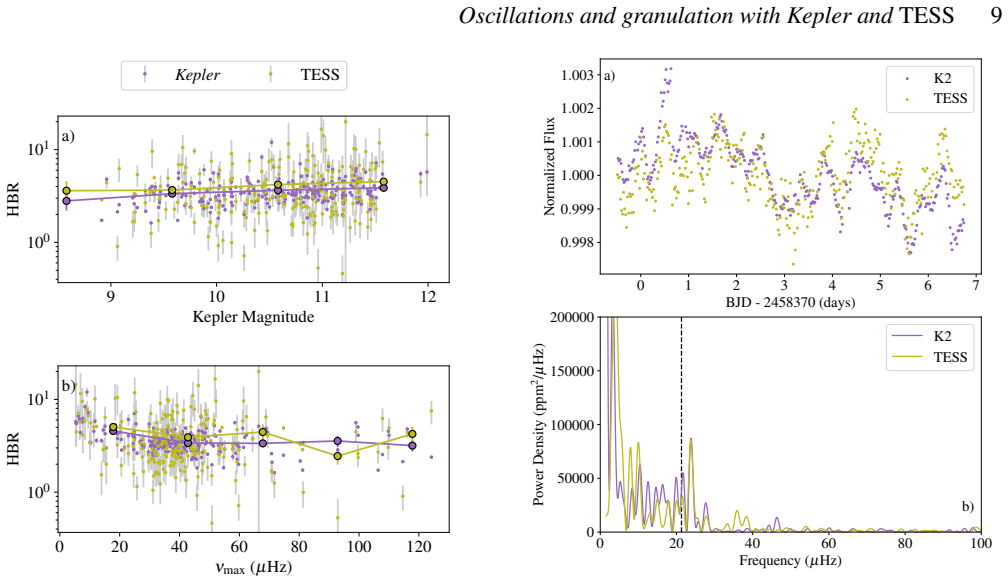
The machinery is the power density spectrum, converted to units independent of observing span. For each star, Method 1 measures mean granulation power in a region between $0.3\nu_{\max}$ and $0.5\nu_{\max}$ and mean oscillation power in a Gaussian envelope around $\nu_{\max}$. Method 2 fits the spectrum with $P(\nu)=B_{\nu_{\max}}\left(\nu/\nu_{\max}\right)^{\alpha}+H_{\mathrm{osc}}\exp\left(-(\nu-\nu_{\max})^2/2\sigma^2\right)+W$, separating the oscillation height $H_{\mathrm{osc}}$ from the granulation background $B_{\nu_{\max}}$. The comparison quantity is the TESS/Kepler ratio of each power measure, and the key interpretive object is the height-to-background ratio $H_{\mathrm{osc}}/B_{\nu_{\max}}$, which reveals whether granulation swamps oscillations at redder wavelengths.
What would settle it
Re-measure the same 279 stars from a TESS light-curve product whose amplitude scale has been independently verified and compare the TESS/Kepler oscillation-power ratio: the paper's own check with another TESS pipeline turns the 0.685 ± 0.009 ratio into 0.866 ± 0.056, so if a rigorous red-giant amplitude calibration shows the SPOC ratios are biased by more than a few percent, the wavelength-dependence result is not established.
Extended reading notes
Core claim
The central claim is that for red giants, both oscillation power and granulation power measured from TESS are about 30% lower than from Kepler, with mean TESS/Kepler power ratios of 0.68 ± 0.01 for oscillations and 0.71–0.73 ± 0.02 for granulation, in agreement with the theoretical expectation of about 0.69. The paper takes this as confirmation that both phenomena decline toward redder wavelengths and that they decline by the same factor. It also finds that the height-to-background ratio, $H_{\mathrm{osc}}/B_{\nu_{\max}}$, is independent of wavelength over the Kepler-to-TESS baseline, so granulation does not become relatively stronger and swamp oscillations at longer wavelengths.
Load-bearing premise
Everything rests on the assumption that TESS-SPOC light curves preserve the true relative brightness amplitudes of red giants; if that pipeline systematically distorts red-giant amplitudes, the measured TESS/Kepler ratios and their agreement with theory could be an artifact of the pipeline rather than a property of the stars.
Editorial extensions
If this is right
- Infrared asteroseismology programs can expect granulation to weaken in the same proportion as oscillations, so detection strategies calibrated in visible light remain valid at longer wavelengths.
- The constancy of the height-to-background ratio means that redder observations will not systematically reduce the signal-to-noise of oscillation detection relative to granulation.
- The agreement between the measured ratios and the theoretical prediction supports the use of bolometric-correction-based scalings for planning observational campaigns at new wavelengths.
- The lack of a trend in the ratios with effective temperature or metallicity indicates that redder-wavelength red-giant surveys will not be biased toward particular stellar populations.
- The pipeline-dependent amplitude differences highlighted in the paper imply that future multi-wavelength amplitude studies must audit light-curve extraction before comparing amplitudes across surveys.
Reading between the lines
- If this result extends to Roman's much redder passband, then the near-infrared detection of solar-like oscillations in red giants should face no extra penalty from granulation, but simultaneous two-color observations would be needed to confirm that extrapolation directly.
- The paper's QLP comparison shows that pipeline choice can alter measured TESS/Kepler amplitude ratios by tens of percent; this suggests that any Roman-era cross-calibration will require the same contact-binary amplitude audit before trusting amplitude ratios across surveys.
- Because stochastic oscillation and granulation phases are shared in simultaneous two-channel observations, future K2/TESS or BRITE-style overlaps could measure per-star wavelength ratios with much lower scatter than the sector-to-sector comparisons used here.
Editorial analysis
A structured set of objections, weighed in public.
Referee Report
Summary. The paper measures oscillation and granulation power in 279 Kepler red giants that also have TESS-SPOC light curves, using two independent methods: mean powers in predefined frequency regions (Method 1) and a fit of a background-plus-envelope model to the power density spectrum (Method 2). The authors report mean TESS/Kepler power ratios of about 0.68 for oscillations and 0.71-0.73 for granulation, which agree with the theoretical predictions of Lund (2019) of about 0.69 in power. They conclude that oscillation and granulation power both decrease toward redder wavelengths, that the two phenomena share the same wavelength dependence, and that the height-to-background ratio at nu_max is independent of wavelength. The paper also compares TESS-SPOC, QLP, and TGLC light curves and validates amplitude fidelity using 51 contact binaries.
Significance. If the result is sound, the paper provides the first direct observational confirmation of the predicted TESS/Kepler power ratio for red giants, which is directly relevant for planning asteroseismology with the Roman Space Telescope. The study has notable strengths: the two measurement methods are largely independent and agree with each other; the comparison to Lund (2019) is external rather than circular; and the use of contact binaries to check pipeline amplitudes is a thoughtful validation step. However, the central quantitative claim is weakened by sample selection on TESS detectability and by unquantified pipeline systematics, so the reported precision (SEM of ~0.01) does not currently reflect the total uncertainty. These issues are fixable, but they affect the paper's main conclusion.
major comments (3)
- [Sec 2.3, Sec 3.2.1] The sample is selected on the basis of TESS detectability: 226 stars come from Stello et al. (2022) with a "clear power excess with TESS" and 53 additional stars are included because they "show clear oscillations in TESS-SPOC." Since the measured TESS power is the numerator of the reported ratios, this truncation on the TESS noise distribution biases the mean TESS/Kepler ratio upward. With TESS relative uncertainties of 9-20% (Sec 3.1) and 260 of 279 stars having only one sector, the bias may be a few percent, which is comparable to the difference between the measured 0.68 and the predicted 0.69. No correction or quantitative assessment of this selection effect is provided, so the stated agreement with Lund (2019) is not yet supported.
- [Sec 2.2, Sec 3.2.1, Fig 7] The final quoted uncertainties are standard errors on the mean, which do not include the pipeline-to-pipeline systematic. The contact binary comparison in Sec 2.2 shows 5-21% scatter in amplitude ratios across TESS pipelines, and the QLP comparison in Fig 7e-h gives a mean oscillation ratio of 0.866 versus 0.685 for TESS-SPOC. Even if the QLP excess is attributed to Earthshine artifacts, the choice of TESS-SPOC introduces a systematic uncertainty that is not propagated into the reported errors. The authors should add a systematic error term or demonstrate explicitly that the result is robust to the choice of pipeline.
- [Sec 3.2.1, Table 2] The scatter in individual ratios is very large: Table 2 shows ratios ranging from about 0.35 to 1.2, but the paper quotes the mean with an SEM of 0.01. The distribution of the ratios is not shown, and robust statistics (e.g., median and interquartile range) are not given. Given the large intrinsic scatter and the small number of stars in some magnitude bins, the mean may be sensitive to outliers. The authors should present the full distribution and robust location estimates to support the claimed precision.
minor comments (5)
- [Sec 2.1] The abbreviation "PDCAP" appears to be a typo; the abstract and common usage are "PDCSAP."
- [Eq. (1)] Please define all variables in Eq. (1) explicitly, including W, and state the units of H_osc and B_nu_max.
- [Sec 2.4.1] The description of the FWHM power-law fit would benefit from stating the number of stars used and the goodness of fit, since the region 2 boundaries depend on this relation.
- [Sec 3.2.1] The sentence "The means from each of the bin were averaged with equal weights" is unclear about whether the unweighted mean of bin means is taken; specify the binning scheme and the number of bins.
- [Fig 2] The color-coding of points by temperature ratio is not easily visible in the printed figure; consider using a colorbar or distinct symbols.
Circularity Check
No significant circularity: the TESS/Kepler power ratios are measured from independent light curves and compared against the external Lund (2019) prediction, with internal fitting choices shown to be robust.
full rationale
This paper's derivation chain is self-contained and its central claims are not circular. The headline result—the TESS/Kepler power ratios for oscillations (0.68±0.01) and granulation (0.73±0.02 and 0.71±0.02)—is obtained by measuring power density in independent Kepler PDCSAP and TESS-SPOC light curves, and the comparison value ~0.69 is taken from Lund (2019), an external theoretical calculation based on bolometric corrections and passband response functions, not fitted to these data. The per-star predicted ratios in Fig. 8 are likewise computed from stellar parameters (Yu et al. 2023) using the Lund formalism, so the agreement is not enforced by the measurement procedure. Internal choices that could in principle be circular are explicitly de-risked: the FWHM relation used to set region 2 boundaries is fitted from the independent Yu et al. (2018) catalogue, and the authors test 20% boundary variations and find the ratios unchanged within the SEM; the fixed alpha=-2 background slope is a prior modelling convention applied identically to both instruments. The self-citations (nu_max from Sreenivas et al. 2024, sample from Stello et al. 2022) enter as externally measured catalogues and target selection, not as assumptions that contain the target ratios; selection effects on TESS detectability are a possible systematic bias, but bias is not circular equivalence. No equation in the paper is defined in terms of the quantity it is used to predict, and no fitted parameter is renamed as a prediction.
Assumptions & free parameters
free parameters (3)
- FWHM power-law coefficients =
scale 0.78, exponent 0.80
- Granulation region scaling =
0.3 to 0.5 nu_max
- Background slope alpha =
-2 (fixed)
assumptions (3)
- domain assumption Power density spectra of red giants are described by a power-law granulation background plus a Gaussian oscillation envelope plus white noise (Eq. 1).
- domain assumption The bolometric correction ratios computed by Lund (2019) are applicable to these red giants and predict both oscillation and granulation power ratios.
- domain assumption Kepler nu_max values can define oscillation and granulation regions in the shorter TESS spectra.
Cite this review
Pith. "Pith review of Testing the wavelength dependence of oscillations and granulation in red giants using Kepler and TESS." pith.science (2026). https://pith.science/paper/TXQCZZ3P
@misc{pith2026250201899,
  author       = {Pith},
  title        = {Pith review of: Testing the wavelength dependence of oscillations and granulation in red giants using Kepler and TESS},
  year         = {2026},
  howpublished = {\url{https://pith.science/paper/TXQCZZ3P}},
  note         = {Machine review of arXiv:2502.01899}
}
read the original abstract
Stellar oscillations and granulation in red giants are both powered by convection. Studying the wavelength dependence of their amplitudes can provide useful insights on the driving mechanism. It is also important for plans to carry out asteroseismology with the Nancy Grace Roman Space Telescope, which will operate in the near infrared, to check the dependence of oscillations and granulation on the observational wavelength. In this work, we aim to understand how the oscillation and granulation power in red giants depend on the wavelength and study how existing predictions compare with observations. We measure the mean oscillation and granulation power of 279 Kepler red giants, from the power density spectra derived using Kepler PDCSAP and TESS-SPOC light curves. We find that selection of light curves is important for the study of amplitudes, since different light curve products from TESS show different values of amplitudes. We show that the oscillation and granulation power ratios between TESS and Kepler match the theoretical prediction, confirming that both decrease as we move to redder wavelengths. We also see that the mean ratios of oscillations and granulation agree, suggesting that oscillation and granulation have the same wavelength dependence. We also find that the mean height-to-background ratio for Kepler agrees with previous results and shows good agreement with TESS. These results suggest that the granulation signals would not severely affect the detection of oscillations. We checked the dependence of these ratio between Kepler and TESS on stellar parameters, and see no trends.
Figures


Figures from the paper (7 more)



Reference graph
Works this paper leans on
-
[1]
write newline
" write newline "" before.all 'output.state := FUNCTION fin.entry write newline FUNCTION new.block output.state before.all = 'skip after.block 'output.state := if FUNCTION new.sentence output.state after.block = 'skip output.state before.all = 'skip after.sentence 'output.state := if if FUNCTION not #0 #1 if FUNCTION and 'skip pop #0 if FUNCTION or pop #1...
-
[2]
Astropy Collaboration 2013, @doi [ ] 10.1051/0004-6361/201322068 , http://adsabs.harvard.edu/abs/2013A
-
[3]
Astropy Collaboration 2018, @doi [ ] 10.3847/1538-3881/aabc4f , https://ui.adsabs.harvard.edu/abs/2018AJ....156..123A 156, 123
-
[4]
Auvergne M., et al., 2009, @doi [ ] 10.1051/0004-6361/200810860 , https://ui.adsabs.harvard.edu/abs/2009A&A...506..411A 506, 411
-
[5]
1306, The CoRoT Mission Pre-Launch Status - Stellar Seismology and Planet Finding
Baglin A., Auvergne M., Barge P., Deleuil M., Catala C., Michel E., Weiss W., COROT Team 2006, in Fridlund M., Baglin A., Lochard J., Conroy L., eds, ESA Special Publication Vol. 1306, The CoRoT Mission Pre-Launch Status - Stellar Seismology and Planet Finding. p. 33
2006
-
[6]
Ballot J., Barban C., van't Veer-Menneret C., 2011, @doi [ ] 10.1051/0004-6361/201016230 , https://ui.adsabs.harvard.edu/abs/2011A&A...531A.124B 531, A124
-
[7]
Barclay T., Barentsen G., 2018, @doi [Research Notes of the American Astronomical Society] 10.3847/2515-5172/aae9e2 , https://ui.adsabs.harvard.edu/abs/2018RNAAS...2..192B 2, 192
- [8]
Show all 83 references
-
[9]
J., et al., 2010, @doi [Science] 10.1126/science.1185402 , https://ui.adsabs.harvard.edu/abs/2010Sci...327..977B 327, 977
Borucki W. J., et al., 2010, @doi [Science] 10.1126/science.1185402 , https://ui.adsabs.harvard.edu/abs/2010Sci...327..977B 327, 977
2010 doi
-
[10]
M., Gilliland R
Brown T. M., Gilliland R. L., Noyes R. W., Ramsey L. W., 1991, @doi [ ] 10.1086/169725 , https://ui.adsabs.harvard.edu/abs/1991ApJ...368..599B 368, 599
1991 doi
-
[11]
A., et al., 2020, @doi [Research Notes of the American Astronomical Society] 10.3847/2515-5172/abc9b3 , https://ui.adsabs.harvard.edu/abs/2020RNAAS...4..201C 4, 201
Caldwell D. A., et al., 2020, @doi [Research Notes of the American Astronomical Society] 10.3847/2515-5172/abc9b3 , https://ui.adsabs.harvard.edu/abs/2020RNAAS...4..201C 4, 201
2020 doi
-
[12]
J., Miglio A., 2013, @doi [ ] 10.1146/annurev-astro-082812-140938 , https://ui.adsabs.harvard.edu/abs/2013ARA&A..51..353C 51, 353
Chaplin W. J., Miglio A., 2013, @doi [ ] 10.1146/annurev-astro-082812-140938 , https://ui.adsabs.harvard.edu/abs/2013ARA&A..51..353C 51, 353
2013 doi
-
[13]
J., et al., 2011, @doi [The Astrophysical Journal] 10.1088/0004-637X/732/1/54 , 732, 54
Chaplin W. J., et al., 2011, @doi [The Astrophysical Journal] 10.1088/0004-637X/732/1/54 , 732, 54
2011 doi
-
[14]
Christensen-Dalsgaard J., Frandsen S., 1983, @doi [ ] 10.1007/BF00145558 , https://ui.adsabs.harvard.edu/abs/1983SoPh...82..165C 82, 165
1983 doi
-
[15]
Corsaro E., et al., 2017, @doi [ ] 10.1051/0004-6361/201731094 , https://ui.adsabs.harvard.edu/abs/2017A&A...605A...3C 605, A3
2017 doi
-
[16]
Springer Netherlands, Dordrecht, pp 101--128, @doi 10.1007/978-94-009-0191-9_4 , https://doi.org/10.1007/978-94-009-0191-9_4
Fr \"o hlich C., et al., 1995, Virgo: Experiment for Helioseismology and Solar Irradiance Monitoring. Springer Netherlands, Dordrecht, pp 101--128, @doi 10.1007/978-94-009-0191-9_4 , https://doi.org/10.1007/978-94-009-0191-9_4
1995 doi
-
[17]
A., et al., 2013, @doi [Journal of Physics: Conference Series] 10.1088/1742-6596/440/1/012040 , 440, 012040
García R. A., et al., 2013, @doi [Journal of Physics: Conference Series] 10.1088/1742-6596/440/1/012040 , 440, 012040
2013 doi
-
[18]
L., Cunha M
Gehan C., Campante T. L., Cunha M. S., Pereira F., 2023, @doi [Astronomische Nachrichten] https://doi.org/10.1002/asna.20220090 , 344, e20220090
2023 doi
-
[19]
A., 1977a, @doi [ ] 10.1086/155005 , https://ui.adsabs.harvard.edu/abs/1977ApJ...211..934G 211, 934
Goldreich P., Keeley D. A., 1977a, @doi [ ] 10.1086/155005 , https://ui.adsabs.harvard.edu/abs/1977ApJ...211..934G 211, 934
-
[20]
A., 1977b, @doi [ ] 10.1086/155043 , https://ui.adsabs.harvard.edu/abs/1977ApJ...212..243G 212, 243
Goldreich P., Keeley D. A., 1977b, @doi [ ] 10.1086/155043 , https://ui.adsabs.harvard.edu/abs/1977ApJ...212..243G 212, 243
-
[21]
Gould A., Huber D., Penny M., Stello D., 2015, @doi [Journal of Korean Astronomical Society] 10.5303/JKAS.2015.48.2.93 , https://ui.adsabs.harvard.edu/abs/2015JKAS...48...93G 48, 93
2015 doi
-
[22]
D., 2023, @doi [ ] 10.3847/1538-3881/acaaa7 , https://ui.adsabs.harvard.edu/abs/2023AJ....165...71H 165, 71
Han T., Brandt T. D., 2023, @doi [ ] 10.3847/1538-3881/acaaa7 , https://ui.adsabs.harvard.edu/abs/2023AJ....165...71H 165, 71
2023 doi
-
[23]
R., et al., 2020, @doi [Nature] 10.1038/s41586-020-2649-2 , 585, 357
Harris C. R., et al., 2020, @doi [Nature] 10.1038/s41586-020-2649-2 , 585, 357
2020 doi
-
[24]
Hedges C., Luger R., Dotson J., Foreman-Mackey D., Barentsen G., 2021, @doi [The Astronomical Journal] 10.3847/1538-3881/abd31c , 161, 95
2021 doi
-
[25]
Hekker S., Christensen-Dalsgaard J., 2017, @doi [ ] 10.1007/s00159-017-0101-x , https://ui.adsabs.harvard.edu/abs/2017A&ARv..25....1H 25, 1
2017 doi
-
[26]
et al., 2012, @doi [A&A] 10.1051/0004-6361/201219328 , 544, A90
Hekker, S. et al., 2012, @doi [A&A] 10.1051/0004-6361/201219328 , 544, A90
2012 doi
- [27]
-
[28]
Hon M., et al., 2021, @doi [The Astrophysical Journal] 10.3847/1538-4357/ac14b1 , 919, 131
2021 doi
-
[29]
Houdek G., Dupret M.-A., 2015, @doi [Living Reviews in Solar Physics] 10.1007/lrsp-2015-8 , https://ui.adsabs.harvard.edu/abs/2015LRSP...12....8H 12, 8
2015 doi
-
[30]
X., et al., 2020a, @doi [Research Notes of the American Astronomical Society] 10.3847/2515-5172/abca2e , https://ui.adsabs.harvard.edu/abs/2020RNAAS...4..204H 4, 204
Huang C. X., et al., 2020a, @doi [Research Notes of the American Astronomical Society] 10.3847/2515-5172/abca2e , https://ui.adsabs.harvard.edu/abs/2020RNAAS...4..204H 4, 204
-
[31]
X., et al., 2020b, @doi [Research Notes of the American Astronomical Society] 10.3847/2515-5172/abca2d , https://ui.adsabs.harvard.edu/abs/2020RNAAS...4..206H 4, 206
Huang C. X., et al., 2020b, @doi [Research Notes of the American Astronomical Society] 10.3847/2515-5172/abca2d , https://ui.adsabs.harvard.edu/abs/2020RNAAS...4..206H 4, 206
-
[32]
Huber D., 2020, in Monteiro M. J. P. F. G., Garc \'i a R. A., Christensen-Dalsgaard J., McIntosh S. W., eds, Dynamics of the Sun and Stars. Springer International Publishing, Cham, pp 301--312
2020
- [33]
-
[34]
Huber D., et al., 2011, @doi [The Astrophysical Journal] 10.1088/0004-637X/743/2/143 , 743, 143
2011 doi
-
[35]
D., 2007, Computing in Science & Engineering, 9, 90
Hunter J. D., 2007, Computing in Science & Engineering, 9, 90
2007
-
[36]
JWST Transiting Exoplanet Community Early Release Science Team et al., 2023, @doi [ ] 10.1038/s41586-022-05269-w , https://ui.adsabs.harvard.edu/abs/2023Natur.614..649J 614, 649
2023 doi
-
[37]
Jackiewicz J., 2021, @doi [Frontiers in Astronomy and Space Sciences] 10.3389/fspas.2020.595017 , 7
2021
-
[38]
M., et al., 2016, in Chiozzi G., Guzman J
Jenkins J. M., et al., 2016, in Chiozzi G., Guzman J. C., eds, Society of Photo-Optical Instrumentation Engineers (SPIE) Conference Series Vol. 9913, Software and Cyberinfrastructure for Astronomy IV. p. 99133E, @doi 10.1117/12.2233418
2016 doi
-
[39]
Kallinger T., et al., 2014, @doi [ ] 10.1051/0004-6361/201424313 , https://ui.adsabs.harvard.edu/abs/2014A&A...570A..41K 570, A41
2014 doi
-
[40]
Kallinger T., et al., 2019, @doi [ ] 10.1051/0004-6361/201834514 , https://ui.adsabs.harvard.edu/abs/2019A&A...624A..35K 624, A35
2019 doi
-
[41]
Karoff C., et al., 2013, @doi [The Astrophysical Journal] 10.1088/0004-637X/767/1/34 , 767, 34
2013 doi
- [42]
-
[43]
R., 2011, @doi [ ] 10.1051/0004-6361/201116789 , https://ui.adsabs.harvard.edu/abs/2011A&A...529L...8K 529, L8
Kjeldsen H., Bedding T. R., 2011, @doi [ ] 10.1051/0004-6361/201116789 , https://ui.adsabs.harvard.edu/abs/2011A&A...529L...8K 529, L8
2011 doi
-
[44]
Kjeldsen H., et al., 2005, @doi [ ] 10.1086/497530 , https://ui.adsabs.harvard.edu/abs/2005ApJ...635.1281K 635, 1281
2005 doi
-
[45]
G., et al., 2010, @doi [ ] 10.1088/2041-8205/713/2/L79 , https://ui.adsabs.harvard.edu/abs/2010ApJ...713L..79K 713, L79
Koch D. G., et al., 2010, @doi [ ] 10.1088/2041-8205/713/2/L79 , https://ui.adsabs.harvard.edu/abs/2010ApJ...713L..79K 713, L79
2010 doi
-
[46]
Lightkurve Collaboration et al., 2018, Lightkurve: Kepler and TESS time series analysis in Python , Astrophysics Source Code Library ( @eprint ascl 1812.013 )
2018
-
[47]
R., 1976, @doi [ ] 10.1007/BF00648343 , https://ui.adsabs.harvard.edu/abs/1976Ap&SS..39..447L 39, 447
Lomb N. R., 1976, @doi [ ] 10.1007/BF00648343 , https://ui.adsabs.harvard.edu/abs/1976Ap&SS..39..447L 39, 447
1976 doi
-
[48]
G., et al., 2009, @doi [ ] 10.1051/0004-6361/200911930 , https://ui.adsabs.harvard.edu/abs/2009A&A...506..167L 506, 167
Ludwig H. G., et al., 2009, @doi [ ] 10.1051/0004-6361/200911930 , https://ui.adsabs.harvard.edu/abs/2009A&A...506..167L 506, 167
2009 doi
-
[49]
N., 2019, @doi [ ] 10.1093/mnras/stz2010 , https://ui.adsabs.harvard.edu/abs/2019MNRAS.489.1072L 489, 1072
Lund M. N., 2019, @doi [ ] 10.1093/mnras/stz2010 , https://ui.adsabs.harvard.edu/abs/2019MNRAS.489.1072L 489, 1072
2019 doi
-
[50]
N., Kjeldsen H., Christensen-Dalsgaard J., Handberg R., Aguirre V
Lund M. N., Kjeldsen H., Christensen-Dalsgaard J., Handberg R., Aguirre V. S., 2014, @doi [The Astrophysical Journal] 10.1088/0004-637X/782/1/2 , 782, 2
2014 doi
-
[51]
Mathur S., et al., 2011, @doi [ ] 10.1088/0004-637X/741/2/119 , https://ui.adsabs.harvard.edu/abs/2011ApJ...741..119M 741, 119
2011 doi
-
[52]
Michel E., Samadi R., Baudin F., Barban C., Appourchaux T., Auvergne M., 2009, @doi [ ] 10.1051/0004-6361:200810353 , https://ui.adsabs.harvard.edu/abs/2009A&A...495..979M 495, 979
2009 doi
-
[53]
Mosser B., et al., 2012, @doi [ ] 10.1051/0004-6361/20111735210.1086/141952 , https://ui.adsabs.harvard.edu/abs/2012A&A...537A..30M 537, A30
2012
-
[54]
M., ed., Astronomical Society of the Pacific Conference Series Vol
Murray N., 1993, in Brown T. M., ed., Astronomical Society of the Pacific Conference Series Vol. 42, GONG 1992. Seismic Investigation of the Sun and Stars. p. 3
1993
-
[55]
T., Gaudi B
Penny M. T., Gaudi B. S., Kerins E., Rattenbury N. J., Mao S., Robin A. C., Calchi Novati S., 2019, @doi [ ] 10.3847/1538-4365/aafb69 , https://ui.adsabs.harvard.edu/abs/2019ApJS..241....3P 241, 3
2019 doi
-
[56]
H., Rybicki G
Press W. H., Rybicki G. B., 1989, @doi [ ] 10.1086/167197 , https://ui.adsabs.harvard.edu/abs/1989ApJ...338..277P 338, 277
1989 doi
-
[57]
Pr s a A., Zwitter T., 2005, @doi [ ] 10.1086/430591 , https://ui.adsabs.harvard.edu/abs/2005ApJ...628..426P 628, 426
2005 doi
-
[58]
Pr s a A., et al., 2011, @doi [ ] 10.1088/0004-6256/141/3/83 , https://ui.adsabs.harvard.edu/abs/2011AJ....141...83P 141, 83
2011 doi
- [59]
-
[60]
A., Ballot J., 2016, @doi [ ] 10.1051/0004-6361/201425408 , https://ui.adsabs.harvard.edu/abs/2016A&A...589A.103R 589, A103
R \'e gulo C., Garc \' a R. A., Ballot J., 2016, @doi [ ] 10.1051/0004-6361/201425408 , https://ui.adsabs.harvard.edu/abs/2016A&A...589A.103R 589, A103
2016 doi
-
[61]
R., et al., 2014, in Oschmann Jacobus M
Ricker G. R., et al., 2014, in Oschmann Jacobus M. J., Clampin M., Fazio G. G., MacEwen H. A., eds, Society of Photo-Optical Instrumentation Engineers (SPIE) Conference Series Vol. 9143, Space Telescopes and Instrumentation 2014: Optical, Infrared, and Millimeter Wave. p. 9143...
2014 arXiv
-
[62]
F., Bigot L., Aguirre B rsen-Koch V., Lund M
Rodr \' guez D \' az L. F., Bigot L., Aguirre B rsen-Koch V., Lund M. N., R rsted J. L., Kallinger T., Sulis S., Mary D., 2022, @doi [ ] 10.1093/mnras/stac1467 , https://ui.adsabs.harvard.edu/abs/2022MNRAS.514.1741R 514, 1741
2022 doi
-
[63]
A., 2011, @doi [ ] 10.1051/0004-6361/201015946 , https://ui.adsabs.harvard.edu/abs/2011A&A...528A..25S 528, A25
Salabert D., Ballot J., Garc \' a R. A., 2011, @doi [ ] 10.1051/0004-6361/201015946 , https://ui.adsabs.harvard.edu/abs/2011A&A...528A..25S 528, A25
2011 doi
-
[64]
A., Ludwig H
Samadi R., Belkacem K., Dupret M. A., Ludwig H. G., Baudin F., Caffau E., Goupil M. J., Barban C., 2012, @doi [ ] 10.1051/0004-6361/201219253 , https://ui.adsabs.harvard.edu/abs/2012A&A...543A.120S 543, A120
2012 doi
-
[65]
D., 1982, @doi [ ] 10.1086/160554 , https://ui.adsabs.harvard.edu/abs/1982ApJ...263..835S 263, 835
Scargle J. D., 1982, @doi [ ] 10.1086/160554 , https://ui.adsabs.harvard.edu/abs/1982ApJ...263..835S 263, 835
1982 doi
-
[66]
C., et al., 2012, @doi [ ] 10.1086/667697 , https://ui.adsabs.harvard.edu/abs/2012PASP..124.1000S 124, 1000
Smith J. C., et al., 2012, @doi [ ] 10.1086/667697 , https://ui.adsabs.harvard.edu/abs/2012PASP..124.1000S 124, 1000
2012 doi
-
[67]
R., Bedding T
Sreenivas K. R., Bedding T. R., Li Y., Huber D., Crawford C. L., Stello D., Yu J., 2024, @doi [ ] 10.1093/mnras/stae991 , https://ui.adsabs.harvard.edu/abs/2024MNRAS.530.3477S 530, 3477
2024 doi
-
[68]
J., Basu S., Elsworth Y., Bedding T
Stello D., Chaplin W. J., Basu S., Elsworth Y., Bedding T. R., 2009, @doi [ ] 10.1111/j.1745-3933.2009.00767.x , https://ui.adsabs.harvard.edu/abs/2009MNRAS.400L..80S 400, L80
2009
-
[69]
Stello D., et al., 2011, @doi [ ] 10.1088/2041-8205/737/1/L10 , https://ui.adsabs.harvard.edu/abs/2011ApJ...737L..10S 737, L10
2011 doi
-
[70]
Stello D., et al., 2022, @doi [ ] 10.1093/mnras/stac414 , https://ui.adsabs.harvard.edu/abs/2022MNRAS.512.1677S 512, 1677
2022 doi
-
[71]
C., et al., 2012, @doi [ ] 10.1086/667698 , https://ui.adsabs.harvard.edu/abs/2012PASP..124..985S 124, 985
Stumpe M. C., et al., 2012, @doi [ ] 10.1086/667698 , https://ui.adsabs.harvard.edu/abs/2012PASP..124..985S 124, 985
2012 doi
-
[72]
Hofmeister, S
Sulis S., Lendl, M. Hofmeister, S. Veronig, A. Fossati, L. Cubillos, P. Van Grootel, V. 2020, @doi [A&A] 10.1051/0004-6361/201937412 , 636, A70
2020 doi
-
[73]
Tassoul M., 1980, Astrophysical Journal Supplement Series, vol. 43, Aug. 1980, p. 469-490., 43, 469
1980
-
[74]
F., 1998, in Kjeldsen H., Bedding T
Trampedach R., Christensen-Dalsgaard J., Nordlund A., Stein R. F., 1998, in Kjeldsen H., Bedding T. R., eds, The First MONS Workshop: Science with a Small Space Telescope. p. 59
1998
-
[75]
E., Caldwell D
Van Cleve J. E., Caldwell D. A., 2016, Kepler Instrument Handbook , Kepler Science Document KSCI-19033-002, id.1. Edited by Michael R. Haas and Steve B. Howell
2016
-
[76]
A., 2014, @doi [ ] 10.1086/678764 , https://ui.adsabs.harvard.edu/abs/2014PASP..126..948V 126, 948
Vanderburg A., Johnson J. A., 2014, @doi [ ] 10.1086/678764 , https://ui.adsabs.harvard.edu/abs/2014PASP..126..948V 126, 948
2014 doi
-
[77]
Virtanen P., et al., 2020, @doi [Nature Methods] 10.1038/s41592-019-0686-2 , https://rdcu.be/b08Wh 17, 261
2020 doi
-
[78]
S., 2018, @doi [ ] 10.1051/0004-6361/201732477 , https://ui.adsabs.harvard.edu/abs/2018A&A...616A..94V 616, A94
Vrard M., Kallinger T., Mosser B., Barban C., Baudin F., Belkacem K., Cunha M. S., 2018, @doi [ ] 10.1051/0004-6361/201732477 , https://ui.adsabs.harvard.edu/abs/2018A&A...616A..94V 616, A94
2018 doi
-
[79]
W., et al., 2014, @doi [ ] 10.1086/677236 , https://ui.adsabs.harvard.edu/abs/2014PASP..126..573W 126, 573
Weiss W. W., et al., 2014, @doi [ ] 10.1086/677236 , https://ui.adsabs.harvard.edu/abs/2014PASP..126..573W 126, 573
2014 doi
-
[80]
R., Stello D., Hon M., Murphy S
Yu J., Huber D., Bedding T. R., Stello D., Hon M., Murphy S. J., Khanna S., 2018, @doi [ ] 10.3847/1538-4365/aaaf74 , https://ui.adsabs.harvard.edu/abs/2018ApJS..236...42Y 236, 42
2018 doi
-
[81]
Yu J., Khanna S., Themessl N., Hekker S., Dréau G., Gizon L., Bi S., 2023, @doi [The Astrophysical Journal Supplement Series] 10.3847/1538-4365/acabc8 , 264, 41
2023 doi
-
[82]
Zhou Y., Asplund M., Collet R., Joyce M., 2020, @doi [ ] 10.1093/mnras/staa1445 , https://ui.adsabs.harvard.edu/abs/2020MNRAS.495.4904Z 495, 4904
2020 doi
-
[83]
C., et al., 2022, @doi [ ] 10.3847/1538-4357/ac2c83 , https://ui.adsabs.harvard.edu/abs/2022ApJ...926..191Z 926, 191
Zinn J. C., et al., 2022, @doi [ ] 10.3847/1538-4357/ac2c83 , https://ui.adsabs.harvard.edu/abs/2022ApJ...926..191Z 926, 191
2022 doi
Reviewed August 9, 2026 · model on record in the stance chip above.
Discussion (0). Continue with ORCID to comment.