The Impact of Host Galaxy Properties on Supernova Classification with Hierarchical Labels
Pith reviewed 2026-06-25 22:35 UTC · model grok-4.3
The pith
Host galaxy properties alone can isolate over 90 percent pure samples of Type Ia supernovae with or without redshift information.
A machine-rendered reading of the paper's core claim, the machinery that carries it, and where it could break.
Core claim
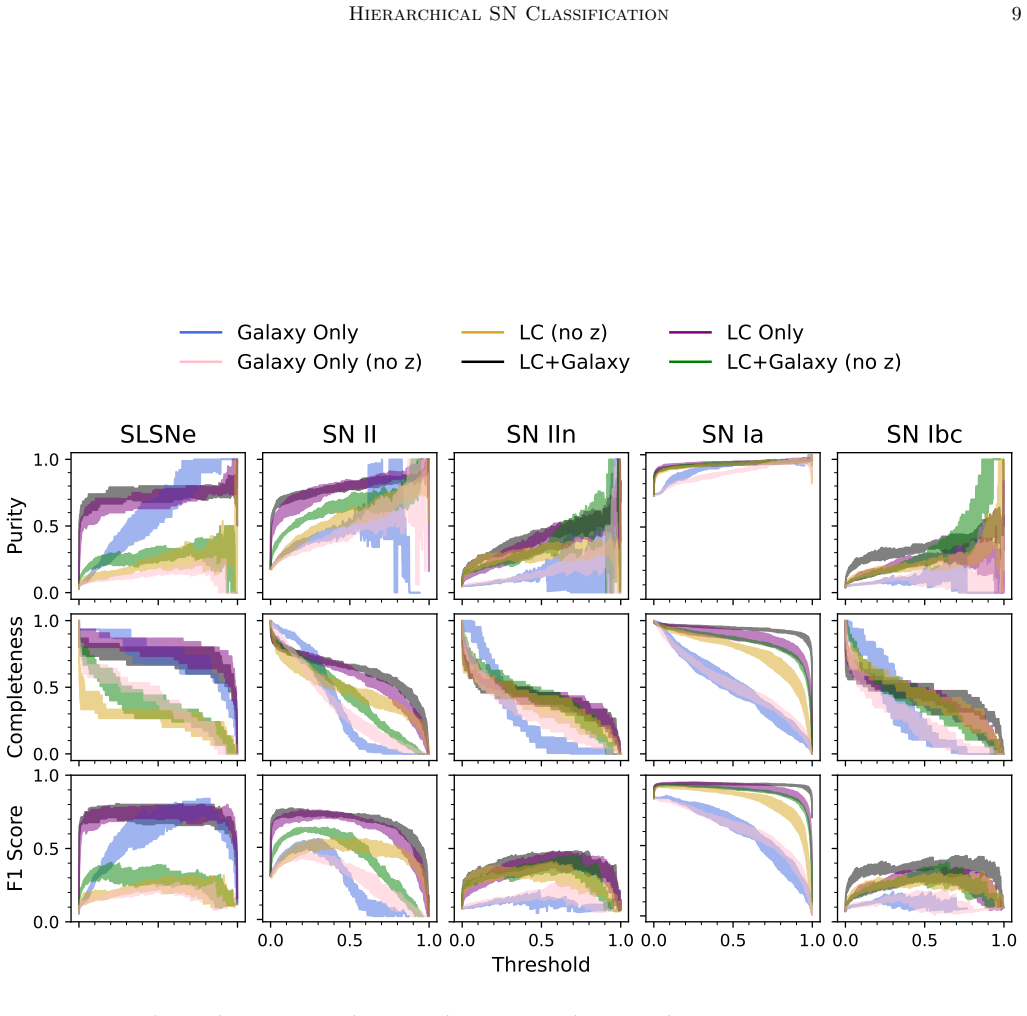
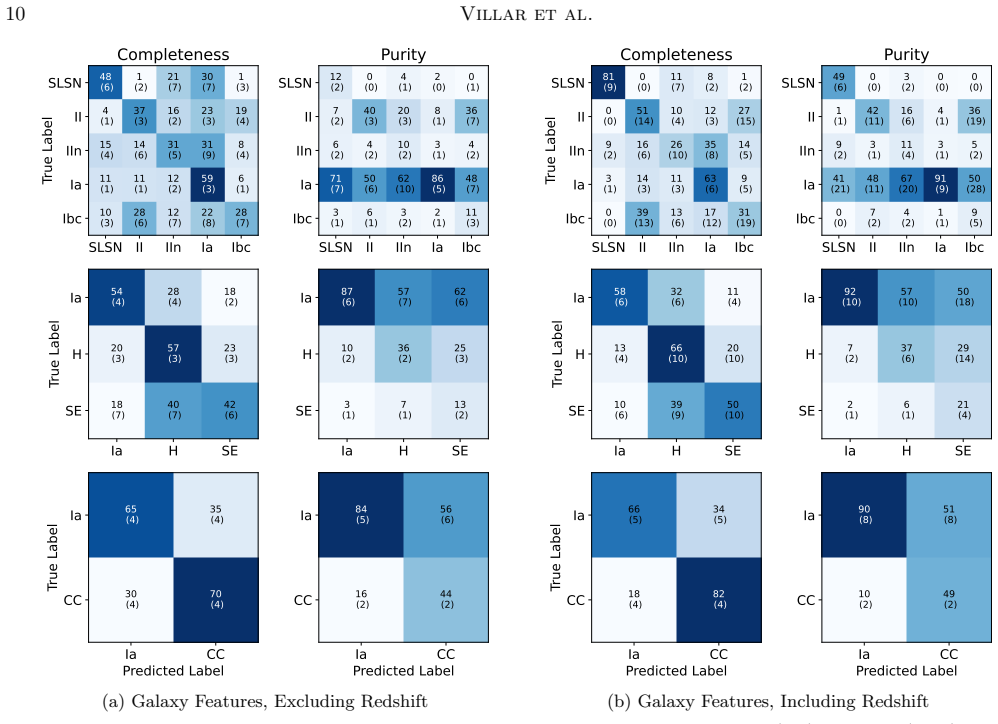
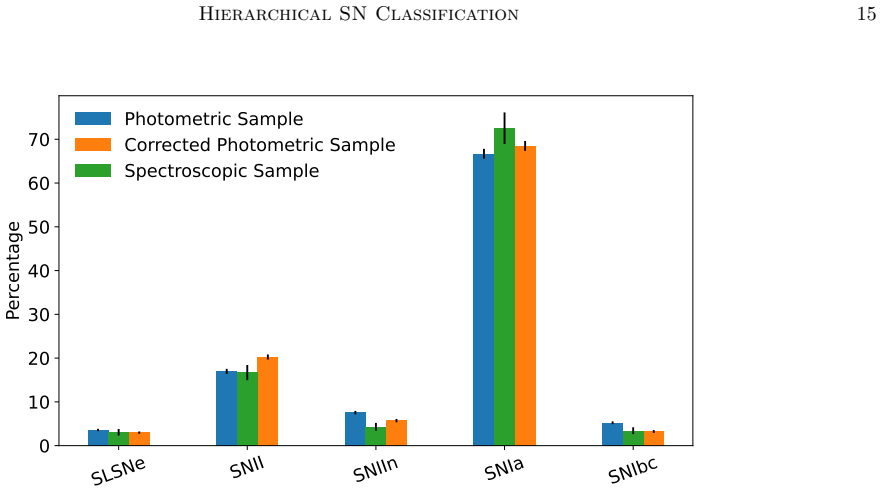
Host galaxy information alone successfully isolates relatively pure samples of Type Ia supernovae exceeding 90 percent purity, with or without redshift. With redshift, samples of Type II supernovae and superluminous supernovae exceeding 70 percent purity can also be obtained. Host galaxy properties do not significantly improve classification accuracy when complete light curves and redshifts are available, but they do when redshift is absent. A new objective function, the weighted hierarchical cross-entropy, is applied for the first time to supernova classification, and new classifications are provided for the Pan-STARRS Medium Deep Survey photometric sample.
What carries the argument
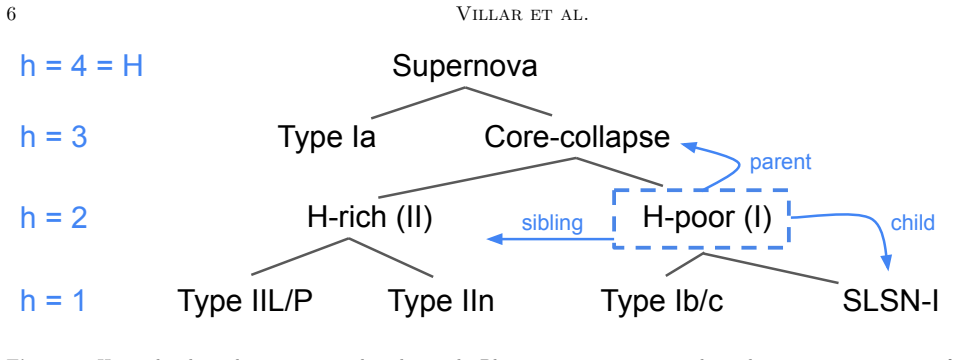
The weighted hierarchical cross-entropy objective function, which accounts for the hierarchical structure of supernova classes when training photometric classifiers that use host galaxy properties.
If this is right
- The full photometric sample of Pan-STARRS Medium Deep Survey supernovae can be increased to more than 4400 events.
- Real-time selection of events for spectroscopic followup can use host galaxy properties to achieve high purity without redshift or light-curve data.
- Archival studies can draw subsamples of Type Ia, Type II, and superluminous supernovae at stated purity levels from photometry alone.
- Classification performance improves measurably when redshift is unavailable but host galaxy data are included.
Where Pith is reading between the lines
- The same host-galaxy approach could be tested on other classes of transients whose environments differ systematically.
- Large future surveys may incorporate existing galaxy catalogs as a first-stage filter before light-curve processing.
- If the representativeness assumption holds, host properties appear to encode environmental information that is partially independent of light-curve shape.
Load-bearing premise
The spectroscopic training sample is representative of the photometric target population in host galaxy property distributions and the assigned hierarchical class labels contain no systematic bias.
What would settle it
Training the classifier on the spectroscopic sample and then measuring purity on a new set of events that later receive spectroscopic labels, finding that Type Ia purity falls below 90 percent.
Figures




read the original abstract
With the advent of the Vera C. Rubin Observatory, the discovery rate of supernovae (SNe) will surpass the rate of SNe with real time spectroscopic followup by three orders of magnitude. Accurate photometric classifiers are essential to both select interest events for followup in real time and for archival population-level studies. In this work, we investigate the impact of observable host galaxy information on the classification of SNe, both with and without additional light curve and redshift information. We find that host galaxy information alone can successfully isolate relatively pure (>90%) samples of Type Ia SNe with or without redshift information. With redshift information, we can additionally produce somewhat pure (>70%) samples of Type II SNe and superluminous supernovae. Additionally with redshift information, host galaxy properties do not significantly improve the accuracy of SN classification when paired with complete light curves. In the absence of redshift information, however, galaxy properties significantly increase the accuracy of photometric classification. As a part of this analysis, we present the first formal application of a new objective function, the weighted hierarchical cross-entropy, to the problem of supernova classification. This objective function more naturally accounts for the hierarchical nature of supernova classes and, more broadly, transients. Finally, we present a new set of SN classifications for the Pan-STARRS Medium Deep Survey of SNe that lack spectroscopic redshift, increasing the full photometric sample to >4400 events.
Editorial analysis
A structured set of objections, weighed in public.
Referee Report
Summary. The paper examines the utility of host-galaxy observables (stellar mass, SFR, color, etc.) for photometric supernova classification, both alone and combined with light curves or redshift. It reports that host properties alone yield >90% pure Type Ia samples (with or without redshift) and, with redshift, >70% pure Type II and SLSN samples. The authors introduce a weighted hierarchical cross-entropy loss to respect the SN taxonomy hierarchy, apply the classifier to the Pan-STARRS Medium Deep Survey, and release classifications for >4400 photometrically observed events lacking spectroscopic redshifts.
Significance. If the reported purities are robust, the work directly supports real-time transient selection and archival studies for Rubin/LSST, where spectroscopic follow-up will be scarce. The weighted hierarchical cross-entropy is presented as the first formal application to SN classification and offers a more natural treatment of hierarchical labels than flat cross-entropy; this methodological contribution is reusable for other transient taxonomies. The release of >4400 new classifications also augments the public Pan-STARRS sample.
major comments (3)
- [Abstract and Methods] Abstract and Methods: concrete purity thresholds (>90% Ia, >70% II/SLSN) are stated without accompanying training-set size, photometric test-set size, cross-validation procedure, or uncertainty estimates on the purity metrics. These omissions leave the central quantitative claims without visible statistical support.
- [Methods] Methods (domain-shift discussion): no quantitative comparison (KS test, propensity-score matching, or re-weighting) is reported between the joint distribution of host-galaxy properties in the spectroscopically labeled training sample and the unlabeled Pan-STARRS photometric population. Because spectroscopic follow-up is known to favor brighter hosts, any mismatch directly affects the learned decision boundaries of the weighted hierarchical cross-entropy classifier and renders the reported purities dependent on an untested transfer assumption.
- [Results] Results: the claim that host properties “significantly increase” accuracy when redshift is absent is presented without a direct ablation (light-curve-only vs. light-curve+host) on the same test objects or with error bars, making it impossible to judge the magnitude or statistical significance of the improvement.
minor comments (2)
- [Methods] Notation for the hierarchical loss weights is introduced without an explicit equation or table listing the numerical values used in the reported experiments.
- [Figures] Figure captions for the purity/completeness curves do not state the exact number of objects or the train/test split underlying each curve.
Simulated Author's Rebuttal
We thank the referee for their detailed and constructive report. We address each major comment below and have revised the manuscript accordingly to strengthen the statistical support and transparency of our results.
read point-by-point responses
-
Referee: [Abstract and Methods] Abstract and Methods: concrete purity thresholds (>90% Ia, >70% II/SLSN) are stated without accompanying training-set size, photometric test-set size, cross-validation procedure, or uncertainty estimates on the purity metrics. These omissions leave the central quantitative claims without visible statistical support.
Authors: We agree that these supporting details are necessary for evaluating the reported purities. The revised manuscript updates the abstract and methods section to explicitly state the training-set size (spectroscopically confirmed events used for model fitting), the photometric test-set size drawn from Pan-STARRS, the cross-validation procedure employed, and bootstrap-derived uncertainty estimates on all purity metrics. revision: yes
-
Referee: [Methods] Methods (domain-shift discussion): no quantitative comparison (KS test, propensity-score matching, or re-weighting) is reported between the joint distribution of host-galaxy properties in the spectroscopically labeled training sample and the unlabeled Pan-STARRS photometric population. Because spectroscopic follow-up is known to favor brighter hosts, any mismatch directly affects the learned decision boundaries of the weighted hierarchical cross-entropy classifier and renders the reported purities dependent on an untested transfer assumption.
Authors: This point is well taken. The revised methods section now includes a quantitative domain-shift analysis using two-sample Kolmogorov-Smirnov tests on the marginal and joint distributions of host-galaxy stellar mass, star-formation rate, and color between the spectroscopic training sample and the Pan-STARRS photometric population. We also discuss the implications of any detected differences for the transfer of the classifier. revision: yes
-
Referee: [Results] Results: the claim that host properties “significantly increase” accuracy when redshift is absent is presented without a direct ablation (light-curve-only vs. light-curve+host) on the same test objects or with error bars, making it impossible to judge the magnitude or statistical significance of the improvement.
Authors: We acknowledge the need for a controlled ablation study. The revised results section now presents a direct comparison of light-curve-only versus light-curve-plus-host models evaluated on identical test objects, with all metrics accompanied by error bars obtained from the cross-validation procedure. This allows quantitative assessment of the improvement and its statistical significance. revision: yes
Circularity Check
No circularity: empirical classification results on survey data
full rationale
The paper trains a classifier (using weighted hierarchical cross-entropy loss) on spectroscopically labeled supernovae and evaluates purity on the Pan-STARRS photometric sample. Reported accuracies and purities are direct outputs of this train/test procedure on real data; no step reduces a claimed prediction to a fitted input by construction, nor does any result depend on a self-citation chain or ansatz smuggled from prior work. The analysis is self-contained against external survey benchmarks.
Axiom & Free-Parameter Ledger
free parameters (1)
- class and hierarchy weights in weighted hierarchical cross-entropy
axioms (1)
- domain assumption Spectroscopically confirmed supernovae form an unbiased training distribution for photometric events with respect to host galaxy properties.
Reference graph
Works this paper leans on
-
[1]
2020, Astron
Aghanim, N., et al. 2020, Astron. Astrophys, 641, A6
2020
-
[2]
, archivePrefix = "arXiv", eprint =
Anderson, J. P., Habergham, S., James, P., & Hamuy, M. 2012, Monthly Notices of the Royal Astronomical Society, 424, 1372 Astropy Collaboration, Price-Whelan, A. M., Sip˝ ocz, B. M., et al. 2018, AJ, 156, 123, doi: 10.3847/1538-3881/aabc4f Astropy Collaboration, Price-Whelan, A. M., Lim, P. L., et al. 2022, ApJ, 935, 167, doi: 10.3847/1538-4357/ac7c74
-
[3]
2020, The Astrophysical Journal, 902, 60
Coppejans, D. 2020, The Astrophysical Journal, 902, 60
2020
-
[4]
2010, The Astrophysical Journal, 722, 1946
Berger, E. 2010, The Astrophysical Journal, 722, 1946
2010
-
[5]
Lord, N. A. 2020, in Proceedings of the IEEE/CVF Conference on Computer Vision and Pattern Recognition, 12506–12515
2020
-
[6]
S., Kulkarni, S
Bloom, J. S., Kulkarni, S. R., & Djorgovski, S. G. 2002, The Astronomical Journal, 123, 1111
2002
-
[7]
2021, The Astronomical Journal, 162, 275
Boone, K. 2021, The Astronomical Journal, 162, 275
2021
-
[8]
J., Gal-Yam, A., Schulze, S., et al
Bruch, R. J., Gal-Yam, A., Schulze, S., et al. 2021, The Astrophysical Journal, 912, 46
2021
-
[9]
2021, The Astronomical Journal, 162, 231
Carrasco-Davis, R., Reyes, E., Valenzuela, C., et al. 2021, The Astronomical Journal, 162, 231
2021
-
[10]
2013, The Astrophysical Journal, 770, 107 Hierarchical SN Classification17
Childress, M., Aldering, G., Antilogus, P., et al. 2013, The Astrophysical Journal, 770, 107 Hierarchical SN Classification17
2013
-
[11]
2022, The Astrophysical Journal, 927, 199
Dong, Y., Milisavljevic, D., Leja, J., et al. 2022, The Astrophysical Journal, 927, 199
2022
-
[12]
J., & Mandel, K
Foley, R. J., & Mandel, K. 2013, The Astrophysical Journal, 778, 167
2013
-
[13]
Aleo, P. D. 2023, arXiv preprint arXiv:2305.08894
arXiv 2023
-
[14]
2021, The Astrophysical Journal, 908, 170
Gagliano, A., Narayan, G., Engel, A., et al. 2021, The Astrophysical Journal, 908, 170
2021
-
[15]
Observational and Physical Classification of Supernovae
Gal-Yam, A. 2017, arXiv preprint arXiv:1611.09353, 195, doi: 10.1007/978-3-319-21846-5 35
work page internal anchor Pith review Pith/arXiv arXiv doi:10.1007/978-3-319-21846-5 2017
-
[16]
K., et al
Gomez, S., Berger, E., Blanchard, P. K., et al. 2023, The Astrophysical Journal, 949, 114 —. 2020, The Astrophysical Journal, 904, 74
2023
-
[17]
Graham, M. L., Connolly, A. J., Ivezi´ c,ˇZ., et al. 2018, AJ, 155, 1, doi: 10.3847/1538-3881/aa99d4
-
[18]
2012, Monthly Notices of the Royal Astronomical Society, 424, 2841
Habergham, S., James, P., & Anderson, J. 2012, Monthly Notices of the Royal Astronomical Society, 424, 2841
2012
-
[19]
Z., Aramyan, L., et al
Hakobyan, A., Adibekyan, V. Z., Aramyan, L., et al. 2012, Astronomy & Astrophysics, 544, A81
2012
-
[20]
Harris, C. R., Millman, K. J., van der Walt, S. J., et al. 2020, Nature, 585, 357, doi: 10.1038/s41586-020-2649-2
-
[21]
A., et al
Hosseinzadeh, G., Dauphin, F., Villar, V. A., et al. 2020, The Astrophysical Journal, 905, 93
2020
-
[22]
Hsu, B., Hosseinzadeh, G., Villar, V. A., & Berger, E. 2022, arXiv preprint arXiv:2204.09809
arXiv 2022
-
[23]
2012, VizieR Online Data Catalog, II
Hudelot, P., Cuillandre, J.-C., Withington, K., et al. 2012, VizieR Online Data Catalog, II
2012
-
[24]
Hunter, J. D. 2007, Computing in Science & Engineering, 9, 90, doi: 10.1109/MCSE.2007.55 Jacobson-Gal´ an, W., Dessart, L., Davis, K., et al. 2024, arXiv preprint arXiv:2403.02382
-
[25]
M., Kulkarni, S., Gal-Yam, A., et al
Kasliwal, M. M., Kulkarni, S., Gal-Yam, A., et al. 2012, The Astrophysical Journal, 755, 161
2012
-
[26]
L., & Kirshner, R
Kelly, P. L., & Kirshner, R. P. 2012, The Astrophysical Journal, 759, 107
2012
-
[27]
2019, Publications of the Astronomical Society of the Pacific, 131, 094501
Kessler, R., Narayan, G., Avelino, A., et al. 2019, Publications of the Astronomical Society of the Pacific, 131, 094501
2019
-
[28]
2016, The Astrophysical Journal, 818, 3
Khazov, D., Yaron, O., Gal-Yam, A., et al. 2016, The Astrophysical Journal, 818, 3
2016
- [29]
-
[30]
2022, arXiv e-prints, arXiv:2209.02784
Kisley, M., Qin, Y.-J., Zabludoff, A., Barnard, K., & Ko, C.-L. 2022, arXiv e-prints, arXiv:2209.02784. https://arxiv.org/abs/2209.02784
arXiv 2022
-
[31]
A., & Hlozek, R
Kunz, M., Bassett, B. A., & Hlozek, R. A. 2007, Physical Review D—Particles, Fields, Gravitation, and Cosmology, 75, 103508
2007
-
[32]
Leaman, J., Li, W., Chornock, R., & Filippenko, A. V. 2011, Monthly Notices of the Royal Astronomical Society, 412, 1419 M¨ oller, A., & de Boissi` ere, T. 2020, Monthly Notices of the Royal Astronomical Society, 491, 4277
2011
-
[33]
S., Biswas, R., & Hloˇ zek, R
Muthukrishna, D., Narayan, G., Mandel, K. S., Biswas, R., & Hloˇ zek, R. 2019, Publications of the Astronomical Society of the Pacific, 131, 118002
2019
-
[34]
PyTorch: An Imperative Style, High-Performance Deep Learning Library
Paszke, A., Gross, S., Massa, F., et al. 2019, arXiv e-prints, arXiv:1912.01703, doi: 10.48550/arXiv.1912.01703
work page internal anchor Pith review Pith/arXiv arXiv doi:10.48550/arxiv.1912.01703 2019
-
[35]
2022, The Astrophysical Journal Supplement Series, 259, 13
Qin, Y.-J., Zabludoff, A., Kisley, M., et al. 2022, The Astrophysical Journal Supplement Series, 259, 13
2022
-
[36]
2022, The Astronomical Journal, 163, 57
Qu, H., & Sako, M. 2022, The Astronomical Journal, 163, 57
2022
-
[37]
A., & Percival, S
James, P. A., & Percival, S. M. 2022, Monthly Notices of the Royal Astronomical Society, 513, 3564
2022
-
[38]
P., Tollerud, E
Robitaille, T. P., Tollerud, E. J., Greenfield, P., et al. 2013, Astronomy & Astrophysics, 558, A33 S´ anchez-S´ aez, P., Reyes, I., Valenzuela, C., et al. 2021, The Astronomical Journal, 161, 141
2013
-
[39]
2021, The Astrophysical Journal Supplement Series, 255, 29
Schulze, S., Yaron, O., Sollerman, J., et al. 2021, The Astrophysical Journal Supplement Series, 255, 29
2021
-
[40]
2019, arXiv preprint arXiv:1903.02476
Swann, E., Sullivan, M., Carrick, J., et al. 2019, arXiv preprint arXiv:1903.02476
Pith/arXiv arXiv 2019
-
[41]
2019, The Astrophysical Journal, 884, 83
Villar, V., Berger, E., Miller, G., et al. 2019, The Astrophysical Journal, 884, 83
2019
-
[42]
A., de Soto, K., & Gagliano, A
Villar, V. A., de Soto, K., & Gagliano, A. 2023, arXiv preprint arXiv:2312.02266
arXiv 2023
-
[43]
A., Nicholl, M., & Berger, E
Villar, V. A., Nicholl, M., & Berger, E. 2018, The Astrophysical Journal, 869, 166
2018
-
[44]
A., Hosseinzadeh, G., Berger, E., et al
Villar, V. A., Hosseinzadeh, G., Berger, E., et al. 2020, The Astrophysical Journal, 905, 94
2020
discussion (0)
Sign in with ORCID, Apple, or X to comment. Anyone can read and Pith papers without signing in.