REVIEW 2 major objections 4 minor 60 references
Exploring Unbiased Deepfake Detection via Token-Level Shuffling and Mixing
T0 review · 2 major / 4 minor · reviewed 2026-08-10 · deepseek-v4-flash
Pith's one-line read Deepfake detectors overfit to position and content; UDD shuffles and mixes tokens to counter both biases.
desk verdict Solid augmentation study with a useful bias decomposition, but the headline CDF result is compromised by tuning on CDF and the causal claims outrun the evidence. read the letter →
The pith
A machine-rendered reading of the paper's core claim, the machinery that carries it, and where it could break.
The reading
What carries the argument
The machinery is two token-level interventions inside a ViT, run as separate branches during training. The shuffling branch applies a shuffle module at the embedding layer: it crops and interpolates a random rectangular region of position embeddings and permutes patch tokens in s×s blocks, keeping local correlation while randomizing absolute and relative position. The mixing branch inserts a mix module at randomly selected layers: it drops a proportion γ of target patch tokens and replaces them with tokens from another same-label image, recombining content while preserving forgery cues. The original, shuffled, and mixed branches share parameters; a contrastive loss on class tokens and a Jensen–Shannon divergence on logits align them. The causal framing treats the shuffle and mix operations as the do-operator on the position and content variables.
What would settle it
Train two detectors on FF++, one with UDD and one without, then test both on a held-out set built with the same forgery methods but with faces consistently shifted to new positions, such as all faces cropped to the lower half, and with backgrounds swapped. If UDD's AUC advantage over the baseline collapses under that shift, the intervention has not removed position and content dependence.
Extended reading notes
Core claim
The central claim is that the cross-dataset generalization gap in deepfake detection has causes beyond forgery specificity: detectors overfit to the spatial position of faces and to content attributes that correlate with the label in the training set. The paper supports this with attention-map observations and with controlled experiments, including center-region cutout tests and attribute classifiers. It then claims that randomly shuffling patch tokens and their position embeddings, and randomly mixing tokens between same-label images, approximate do-operators on the position and content latent variables, severing the backdoor path X ← Zb ← U → Zf → Y. With the backbone frozen and only LoRA parameters learned, the three branches are aligned in feature space and logit space, and the resulting detector is claimed to learn Pθ(Y|Zf, do(Zb)), i.e., a representation and classifier less dependent on position and content.
Load-bearing premise
The whole 'unbiased' claim rests on the assumption that token shuffling and mixing really wipe out the spurious link between image position/content and the label, and are not just strong data augmentation.
Editorial extensions
If this is right
- The method is plug-and-play for ViT-based detectors: it only needs token-level operations plus LoRA, so any ViT or CLIP-based detector can be trained this way.
- If the causal claim holds, detectors trained this way should keep working when the same forgery method appears in new identities, new crops, and new backgrounds, not just when the forgery algorithm changes.
- The reported robustness results imply that the learned features degrade less under JPEG compression, blur, and block-wise noise than prior detectors.
- Center-cutout and attribute-classifier experiments imply the model no longer hinges decisions on central regions or on identity, gender, or race cues.
- The ablation results imply that both branches and both alignment losses contribute to the gain, and that mixing should happen in mid-stage layers where tokens already carry global content information.
Reading between the lines
- A testable extension: measure whether the improvement persists when the same forgery method is rendered with systematically shifted face positions and swapped backgrounds; if the advantage collapses, the intervention has not actually removed position and content dependence.
- The same token-level intervention could be transferred to other ViT classification tasks where position and content are known confounders, such as medical imaging or satellite image analysis.
- The mixing branch currently requires same-label pairs; extending it to soft labels or unsupervised grouping would make it usable when labels are noisy or sparse.
- The attribute-classifier diagnostic suggests a reusable bias meter: train attribute classifiers on frozen detector features and check how close their real/fake test AUC is to chance.
Editorial analysis
A structured set of objections, weighed in public.
Referee Report
Summary. The paper identifies position bias and content bias as additional causes of poor cross-dataset generalization in deepfake detection, beyond the usual forgery-method gap. To mitigate these biases, the authors propose UDD, a training framework with two token-level augmentation branches in a vision transformer: a shuffling branch that rearranges patch tokens and position embeddings, and a mixing branch that swaps a subset of latent tokens between same-label images. Both branches are aligned with the original branch using feature-level contrastive loss and logit-level divergence loss, while the backbone is frozen and adapted with LoRA. Experiments on FF++-trained models report state-of-the-art video-level AUCs of 93.1% on Celeb-DF, 88.1% on DFDC-Preview, 81.2% on DFDC, and 95.5% on DFD, together with robustness and ablation studies. The paper also offers a causal analysis claiming that shuffling and mixing approximate do-operators on position and content confounders.
Significance. If the empirical claims hold, UDD offers a simple, parameter-efficient and potentially generalizable recipe for deepfake detectors, and the identification of position/content biases is a useful conceptual contribution. The paper is strong on breadth of experiments: five standard cross-dataset benchmarks, additional WildDeepfake/FaceShifter/FFIW results, robustness to corruptions, and a detailed training setup in Table 5. The ablations are systematic and the two-branch design is clearly motivated. The main limitations are the evaluation protocol for Celeb-DF and the overreach of the causal claims; both are fixable within the manuscript's scope, so the contribution remains valuable if the claims are appropriately scoped.
major comments (2)
- [Appendix, Tables 6–8 and 10, Fig. 6; Table 1] The headline cross-dataset result on Celeb-DF is compromised by hyperparameter selection on that test set. The appendix shows that λ1 (Table 6), λ2 (Table 7), τ (Table 8), the shuffling block count s (Fig. 6), and the mixing ratio γ (Table 10) are all selected by maximizing frame-level AUC on CDF, and Table 1 then reports CDF as an 'unseen' cross-dataset test set. The video-level CDF number of 93.1% is therefore the best of several configurations evaluated on CDF, not an unbiased estimate of generalization to CDF. The same CDF-tuned configuration is used for DFDCP, DFDC, and DFD, so those results are less directly affected but still inherit any selection bias toward CDF-related properties. I recommend re-running the full pipeline with hyperparameters chosen on a validation split of FF++ (or a separate validation dataset) and reporting CDF only as a test set, or alternatively clearly reporting CDF as the model-selection set and downgrading the claim of state-of-the-art generalization to it.
- [Causal Analysis, Eqs. (1) and the paragraph after Eq. (8)] The claim that the shuffling and mixing modules approximate do(Zb) interventions is asserted without an identification argument. In the graph of Fig. 3, U is an unobserved confounder that affects both Zb and Zf; random token shuffling or mixing changes the input representation but does not by itself intervene on the data-generating process for Zb, nor does it guarantee Zb ⊥ Zf. Moreover, Pθ(Y|X) is a predictive distribution learned by the network, and no formal argument shows that after training it equals Pθ(Y|Zf, do(Zb)) or the causal effect along X ← Zf → Y. The phrase 'the correlation learned in the framework is now equal to the causality' is therefore unsupported. I suggest either providing a rigorous derivation (e.g., showing that the augmentation is equivalent to a valid intervention in the assumed SCM and satisfies backdoor adjustment) or rephrasing the claims as 'empirically reduces sensitivity to position and content' rather than 'unbiased' in the causal sense.
minor comments (4)
- [Token-Mixing Branch, 'Source & target mixing'] The sentence 'We then merge T_src' l and T_src' l to form the mixed token set' appears to be a typo; the formula T_m^l = T_tgt' l ∪ T_src' l is the correct definition. Please correct the prose.
- [Table 12 caption] The word 'Videl-level' should be 'Video-level'.
- [Implementation details and Experiments setup] The main text states the hyperparameter values as defaults (s=2, γ=0.3, τ=0.1, λ1=0.1, λ2=0.1) but does not disclose that these were chosen by evaluating on CDF. The main text should explicitly acknowledge this, because otherwise the reader cannot know that the CDF result is not an independent test.
- [Testing with Attribute Classifiers] The protocol for measuring content bias is under-specified: how are the attribute labels (ID, gender, race) obtained, and why does testing an attribute classifier on real/fake labels with AUC quantify the contribution of content to the forgery decision? Please provide the exact training and evaluation procedure, ideally in the appendix.
Circularity Check
CDF is used to select every free hyperparameter (λ1, λ2, τ, s, γ, mixing stage) and then reported as an unseen cross-dataset benchmark; the headline 93.1% CDF AUC is selected, not predicted.
-
fitted input called prediction
[Appendix A (Tables 6-10, Fig. 6, Table 4); main Table 1]
"We present an ablation study conducted to select the appropriate loss weight λ1 for Lcon with frame-level AUC scores on CDF (in Table 6). ... Ablation on Temperature τ in Lcon ... frame-level AUC scores on CDF are reported. ... As shown in Table 10, we conduct the experiments with different values of γ. It turns out that γ = 0.3 is the best choice among these values (86.74% AUC on CDF). ... Ablation of mixing stages. Video-level AUC (%) is reported for comparison."
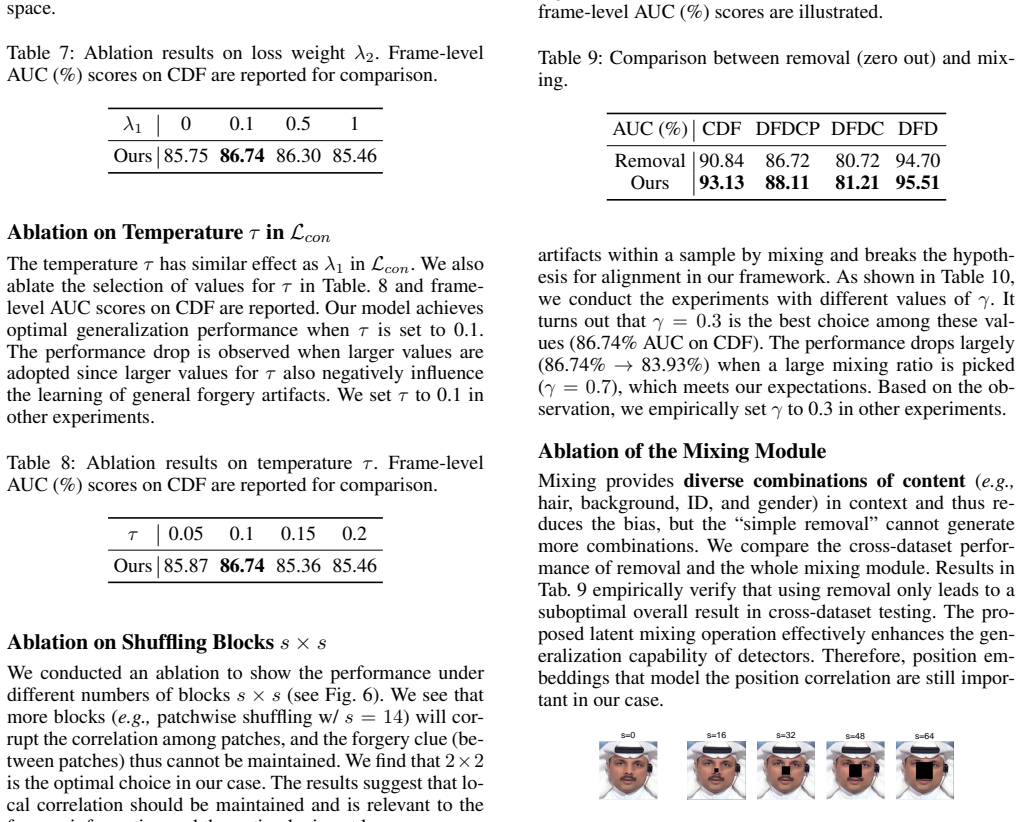
The appendix selects each free hyperparameter—λ1 (Table 6), λ2 (Table 7), τ (Table 8), shuffling block count s (Fig. 6), mixing ratio γ (Table 10), and mixing stage (Table 4)—by evaluating AUC on CDF, with Table 4 also using DFDC and DFD. These same choices are then used to produce the cross-dataset results in Table 1, including the headline CDF video AUC of 93.1%. CDF is therefore a model-selection set, not an unseen test set: the reported CDF number is the best of the compared configurations on CDF, so it is a selected (fitted) quantity presented as a prediction. The DFDCP/DFDC/DFD numbers also inherit a configuration tuned on CDF, weakening the general state-of-the-art claim.
full rationale
The main circularity is evaluation-protocol contamination. The paper's central empirical claim is state-of-the-art cross-dataset generalization, with the CDF video-level AUC of 93.1% as the flagship number. The appendix shows that the free hyperparameters are chosen by maximizing AUC on CDF, so CDF cannot honestly be called an unseen test set. This fits the fitted-input-called-prediction pattern: a configuration fitted to CDF is reported as a prediction about CDF. The other datasets (DFDCP, DFDC, DFD) are measured with the same CDF-tuned configuration, so they are not fully independent evidence either. The causal-analysis section (shuffling and mixing 'approximating' a do-operator) is an unproved assertion rather than a circular reduction; it does not derive its conclusion from its own output. The paper does not rely on load-bearing self-citations: the DeepfakeBench citation is for preprocessing, and prior-work citations are contextual, not used to forbid alternatives or to import a uniqueness theorem. The diagnostic analyses (attention maps, attribute classifiers) are somewhat self-referential because the same framework that is claimed to remove bias is used to define the bias metric, but those diagnostics are not the target result. Because the headline cross-dataset SOTA claim on CDF reduces to selection on CDF, the circularity score is 6; the underlying augmentation and alignment method still has independent content that would need re-evaluation with hyperparameters chosen on FF++ validation only.
Assumptions & free parameters
free parameters (6)
- Mixing ratio γ =
0.3
- Temperature τ =
0.1
- Loss weight λ1 =
0.1
- Loss weight λ2 =
0.1
- Shuffling block size s×s =
2×2
- LoRA rank r =
4
assumptions (4)
- domain assumption Forgery features are local and tokens exchange global information in early/mid transformer layers.
- domain assumption CLIP-pretrained ViT-B with LoRA adaptation retains and can expose forgery-relevant features.
- ad hoc to paper The generative model X ~ p(X|Zf, Zb), Y ~ p(Y|Zf), with unobserved confounder U creating the backdoor path, correctly describes deepfake data collection.
- ad hoc to paper Token shuffling and token mixing are interventions (do-operators) on position and content variables.
invented entities (1)
-
Unobserved confounder U
Cite this review
Pith. "Pith review of Exploring Unbiased Deepfake Detection via Token-Level Shuffling and Mixing." pith.science (2026). https://pith.science/paper/TYLBQHUN
@misc{pith2026250104376,
  author       = {Pith},
  title        = {Pith review of: Exploring Unbiased Deepfake Detection via Token-Level Shuffling and Mixing},
  year         = {2026},
  howpublished = {\url{https://pith.science/paper/TYLBQHUN}},
  note         = {Machine review of arXiv:2501.04376}
}
read the original abstract
The generalization problem is broadly recognized as a critical challenge in detecting deepfakes. Most previous work believes that the generalization gap is caused by the differences among various forgery methods. However, our investigation reveals that the generalization issue can still occur when forgery-irrelevant factors shift. In this work, we identify two biases that detectors may also be prone to overfitting: position bias and content bias, as depicted in Fig. 1. For the position bias, we observe that detectors are prone to lazily depending on the specific positions within an image (e.g., central regions even no forgery). As for content bias, we argue that detectors may potentially and mistakenly utilize forgery-unrelated information for detection (e.g., background, and hair). To intervene these biases, we propose two branches for shuffling and mixing with tokens in the latent space of transformers. For the shuffling branch, we rearrange the tokens and corresponding position embedding for each image while maintaining the local correlation. For the mixing branch, we randomly select and mix the tokens in the latent space between two images with the same label within the mini-batch to recombine the content information. During the learning process, we align the outputs of detectors from different branches in both feature space and logit space. Contrastive losses for features and divergence losses for logits are applied to obtain unbiased feature representation and classifiers. We demonstrate and verify the effectiveness of our method through extensive experiments on widely used evaluation datasets.
Figures


Figures from the paper (8 more)




Reference graph
Works this paper leans on
-
[1]
, " * write output.state after.block = add.period write newline
ENTRY address archivePrefix author booktitle chapter edition editor eid eprint howpublished institution isbn journal key month note number organization pages publisher school series title type volume year label extra.label sort.label short.list INTEGERS output.state before.all mid.sentence after.sentence after.block FUNCTION init.state.consts #0 'before.a...
-
[2]
write newline
" write newline "" before.all 'output.state := FUNCTION n.dashify 't := "" t empty not t #1 #1 substring "-" = t #1 #2 substring "--" = not "--" * t #2 global.max substring 't := t #1 #1 substring "-" = "-" * t #2 global.max substring 't := while if t #1 #1 substring * t #2 global.max substring 't := if while FUNCTION word.in bbl.in capitalize " " * FUNCT...
-
[3]
Ba, Z.; Liu, Q.; Liu, Z.; Wu, S.; Lin, F.; Lu, L.; and Ren, K. 2024. Exposing the deception: Uncovering more forgery clues for deepfake detection. In Proceedings of the AAAI Conference on Artificial Intelligence, volume 38, 719--728
work page 2024
-
[4]
Cao, J.; Ma, C.; Yao, T.; Chen, S.; Ding, S.; and Yang, X. 2022. End-to-end reconstruction-classification learning for face forgery detection. In Proceedings of the IEEE/CVF Conference on Computer Vision and Pattern Recognition, 4113--4122
2022
-
[5]
Chai, L.; Bau, D.; Lim, S.-N.; and Isola, P. 2020. What makes fake images detectable? understanding properties that generalize. In Computer Vision--ECCV 2020: 16th European Conference, Glasgow, UK, August 23--28, 2020, Proceedings, Part XXVI 16, 103--120. Springer
work page 2020
-
[6]
Chattopadhay, A.; Sarkar, A.; Howlader, P.; and Balasubramanian, V. N. 2018. Grad-cam++: Generalized gradient-based visual explanations for deep convolutional networks. In 2018 IEEE winter conference on applications of computer vision (WACV), 839--847. IEEE
work page 2018
-
[7]
Chen, L.; Zhang, Y.; Song, Y.; Liu, L.; and Wang, J. 2022. Self-supervised Learning of Adversarial Example: Towards Good Generalizations for Deepfake Detection. In Proceedings of the IEEE/CVF Conference on Computer Vision and Pattern Recognition, 18710--18719
work page 2022
-
[8]
Chen, T.; Kornblith, S.; Norouzi, M.; and Hinton, G. 2020. A simple framework for contrastive learning of visual representations. In International conference on machine learning, 1597--1607. PMLR
2020
Show all 60 references
-
[9]
Dang, H.; Liu, F.; Stehouwer, J.; Liu, X.; and Jain, A. K. 2020. On the detection of digital face manipulation. In Proceedings of the IEEE/CVF Conference on Computer Vision and Pattern Recognition
2020
-
[10]
Deepfakedetection. 2021. https://ai.googleblog.com/2019/09/contributing-data-to-deepfakedetection.html Accessed 2021-11-13
2021
-
[11]
Dolhansky, B.; Bitton, J.; Pflaum, B.; Lu, J.; Howes, R.; Wang, M.; and Ferrer, C. C. 2020. The deepfake detection challenge (dfdc) dataset. arXiv preprint arXiv:2006.07397
2020 arXiv
-
[12]
Dolhansky, B.; Howes, R.; Pflaum, B.; Baram, N.; and Ferrer, C. C. 2019. The deepfake detection challenge (dfdc) preview dataset. arXiv preprint arXiv:1910.08854
2019 arXiv
-
[13]
Dong, S.; Wang, J.; Ji, R.; Liang, J.; Fan, H.; and Ge, Z. 2023. Implicit Identity Leakage: The Stumbling Block to Improving Deepfake Detection Generalization. In Proceedings of the IEEE/CVF Conference on Computer Vision and Pattern Recognition, 3994--4004
2023
-
[14]
Dong, X.; Bao, J.; Chen, D.; Zhang, T.; Zhang, W.; Yu, N.; Chen, D.; Wen, F.; and Guo, B. 2022. Protecting celebrities from deepfake with identity consistency transformer. In Proceedings of the IEEE/CVF Conference on Computer Vision and Pattern Recognition, 9468--9478
2022
-
[15]
Gu, Z.; Chen, Y.; Yao, T.; Ding, S.; Li, J.; Huang, F.; and Ma, L. 2021. Spatiotemporal inconsistency learning for deepfake video detection. In Proceedings of the 29th ACM international conference on multimedia, 3473--3481
2021
-
[16]
Haliassos, A.; Vougioukas, K.; Petridis, S.; and Pantic, M. 2021. Lips Don't Lie: A Generalisable and Robust Approach To Face Forgery Detection. In Proceedings of the IEEE/CVF Conference on Computer Vision and Pattern Recognition
2021
-
[17]
J.; Wallis, P.; Allen-Zhu, Z.; Li, Y.; Wang, S.; Wang, L.; Chen, W.; et al
Hu, E. J.; Wallis, P.; Allen-Zhu, Z.; Li, Y.; Wang, S.; Wang, L.; Chen, W.; et al. 2021. LoRA: Low-Rank Adaptation of Large Language Models. In International Conference on Learning Representations
2021
-
[18]
Huang, B.; Wang, Z.; Yang, J.; Ai, J.; Zou, Q.; Wang, Q.; and Ye, D. 2023. Implicit Identity Driven Deepfake Face Swapping Detection. In Proceedings of the IEEE/CVF Conference on Computer Vision and Pattern Recognition, 4490--4499
2023
-
[19]
M.; and Forr \'e , P
Ilse, M.; Tomczak, J. M.; and Forr \'e , P. 2021. Selecting data augmentation for simulating interventions. In International conference on machine learning, 4555--4562. PMLR
2021
-
[20]
Jiang, L.; Li, R.; Wu, W.; Qian, C.; and Loy, C. C. 2020. Deeperforensics-1.0: A large-scale dataset for real-world face forgery detection. In Proceedings of the IEEE/CVF Conference on Computer Vision and Pattern Recognition
2020
-
[21]
Kim, D.; Angelova, A.; and Kuo, W. 2023. Region-aware pretraining for open-vocabulary object detection with vision transformers. In Proceedings of the IEEE/CVF conference on computer vision and pattern recognition, 11144--11154
2023
-
[22]
Larue, N.; Vu, N.-S.; Struc, V.; Peer, P.; and Christophides, V. 2023. SeeABLE: Soft Discrepancies and Bounded Contrastive Learning for Exposing Deepfakes. In Proceedings of the IEEE/CVF International Conference on Computer Vision, 21011--21021
2023
-
[23]
Li, J.; Xie, H.; Li, J.; Wang, Z.; and Zhang, Y. 2021. Frequency-aware Discriminative Feature Learning Supervised by Single-Center Loss for Face Forgery Detection. In Proceedings of the IEEE/CVF Conference on Computer Vision and Pattern Recognition
2021
-
[24]
Li, J.; Xie, H.; Yu, L.; and Zhang, Y. 2022. Wavelet-enhanced weakly supervised local feature learning for face forgery detection. In Proceedings of the 30th ACM International Conference on Multimedia, 1299--1308
2022
-
[25]
Li, L.; Bao, J.; Yang, H.; Chen, D.; and Wen, F. 2019. Faceshifter: Towards high fidelity and occlusion aware face swapping. arXiv preprint arXiv:1912.13457
2019 arXiv
-
[26]
Li, L.; Bao, J.; Zhang, T.; Yang, H.; Chen, D.; Wen, F.; and Guo, B. 2020 a . Face x-ray for more general face forgery detection. In Proceedings of the IEEE/CVF Conference on Computer Vision and Pattern Recognition
2020
-
[27]
Li, Y.; and Lyu, S. 2018. Exposing deepfake videos by detecting face warping artifacts. arXiv preprint arXiv:1811.00656
2018 arXiv
-
[28]
Li, Y.; Yang, X.; Sun, P.; Qi, H.; and Lyu, S. 2020 b . Celeb-df: A new dataset for deepfake forensics. In Proceedings of the IEEE/CVF Conference on Computer Vision and Pattern Recognition
2020
-
[29]
Liang, J.; Shi, H.; and Deng, W. 2022. Exploring Disentangled Content Information for Face Forgery Detection. In Proceedings of the European Conference on Computer Vision, 128--145. Springer
2022
-
[30]
Luo, Y.; Zhang, Y.; Yan, J.; and Liu, W. 2021. Generalizing Face Forgery Detection with High-frequency Features. In Proceedings of the IEEE/CVF Conference on Computer Vision and Pattern Recognition
2021
-
[31]
Mitrovic, J.; McWilliams, B.; Walker, J.; Buesing, L.; and Blundell, C. 2020. Representation learning via invariant causal mechanisms. arXiv preprint arXiv:2010.07922
2020 arXiv
-
[32]
Mohseni, S.; Pitale, M.; Yadawa, J.; and Wang, Z. 2020. Self-supervised learning for generalizable out-of-distribution detection. In Proceedings of the AAAI Conference on Artificial Intelligence
2020
-
[33]
Oord, A. v. d.; Li, Y.; and Vinyals, O. 2018. Representation learning with contrastive predictive coding. arXiv preprint arXiv:1807.03748
2018 arXiv
-
[34]
Pearl, J. 2009. Causality. Cambridge university press
2009
-
[35]
Qian, Y.; Yin, G.; Sheng, L.; Chen, Z.; and Shao, J. 2020. Thinking in frequency: Face forgery detection by mining frequency-aware clues. In Proceedings of the European Conference on Computer Vision
2020
-
[36]
W.; Hallacy, C.; Ramesh, A.; Goh, G.; Agarwal, S.; Sastry, G.; Askell, A.; Mishkin, P.; Clark, J.; et al
Radford, A.; Kim, J. W.; Hallacy, C.; Ramesh, A.; Goh, G.; Agarwal, S.; Sastry, G.; Askell, A.; Mishkin, P.; Clark, J.; et al. 2021. Learning transferable visual models from natural language supervision. In International conference on machine learning, 8748--8763. PMLR
2021
-
[37]
N.; Khan, S.; Khan, F
Rizve, M. N.; Khan, S.; Khan, F. S.; and Shah, M. 2021. Exploring complementary strengths of invariant and equivariant representations for few-shot learning. In Proceedings of the IEEE/CVF conference on computer vision and pattern recognition, 10836--10846
2021
-
[38]
Rossler, A.; Cozzolino, D.; Verdoliva, L.; Riess, C.; Thies, J.; and Nie ner, M. 2019. Faceforensics++: Learning to detect manipulated facial images. In Proceedings of the IEEE/CVF Conference on International Conference on Computer Vision
2019
-
[39]
R.; Cogswell, M.; Das, A.; Vedantam, R.; Parikh, D.; and Batra, D
Selvaraju, R. R.; Cogswell, M.; Das, A.; Vedantam, R.; Parikh, D.; and Batra, D. 2017. Grad-cam: Visual explanations from deep networks via gradient-based localization. In Proceedings of the IEEE/CVF Conference on Computer Vision and Pattern Recognition, 618--626
2017
-
[40]
Shiohara, K.; and Yamasaki, T. 2022. Detecting deepfakes with self-blended images. In Proceedings of the IEEE/CVF Conference on Computer Vision and Pattern Recognition, 18720--18729
2022
-
[41]
Song, L.; Li, X.; Fang, Z.; Jin, Z.; Chen, Y.; and Xu, C. 2022. Face forgery detection via symmetric transformer. In Proceedings of the 30th ACM International Conference on Multimedia, 4102--4111
2022
-
[42]
D.; and Wang, S
Sun, H.; Li, C.; Liu, B.; Liu, Z.; Wang, M.; Zheng, H.; Feng, D. D.; and Wang, S. 2020. AUNet: attention-guided dense-upsampling networks for breast mass segmentation in whole mammograms. Physics in Medicine & Biology, 65(5): 055005
2020
-
[43]
Sun, K.; Yao, T.; Chen, S.; Ding, S.; Li, J.; and Ji, R. 2022. Dual contrastive learning for general face forgery detection. In Proceedings of the AAAI Conference on Artificial Intelligence, volume 36, 2316--2324
2022
-
[44]
Tan, M.; and Le, Q. 2019. Efficientnet: Rethinking model scaling for convolutional neural networks. In Proceedings of the International Conference on Machine Learning, 6105--6114. PMLR
2019
-
[45]
Van der Maaten, L.; and Hinton, G. 2008. Visualizing data using t-SNE. Journal of Machine Learning Research
2008
-
[46]
Williams, R. J. 1992. Simple statistical gradient-following algorithms for connectionist reinforcement learning. ML, 8(3): 229--256
1992
-
[47]
Xu, Y.; Liang, J.; Sheng, L.; and Zhang, X.-Y. 2024. Learning Spatiotemporal Inconsistency via Thumbnail Layout for Face Deepfake Detection. International Journal of Computer Vision, 1--18
2024
-
[48]
Yan, Z.; Luo, Y.; Lyu, S.; Liu, Q.; and Wu, B. 2024 a . Transcending forgery specificity with latent space augmentation for generalizable deepfake detection. In Proceedings of the IEEE/CVF Conference on Computer Vision and Pattern Recognition, 8984--8994
2024
-
[49]
Yan, Z.; Yao, T.; Chen, S.; Zhao, Y.; Fu, X.; Zhu, J.; Luo, D.; Wang, C.; Ding, S.; Wu, Y.; and Yuan, L. 2024 b . Df40: Toward next-generation deepfake detection. In Advances in Neural Information Processing Systems
2024
-
[50]
Yan, Z.; Zhang, Y.; Fan, Y.; and Wu, B. 2023 a . UCF: Uncovering common features for generalizable deepfake detection. In Proceedings of the IEEE/CVF Conference on International Conference on Computer Vision, 22412--22423
2023
-
[51]
Yan, Z.; Zhang, Y.; Yuan, X.; Lyu, S.; and Wu, B. 2023 b . DeepfakeBench: A Comprehensive Benchmark of Deepfake Detection. In Oh, A.; Neumann, T.; Globerson, A.; Saenko, K.; Hardt, M.; and Levine, S., eds., Advances in Neural Information Processing Systems, volume 36, 4534--45...
2023
-
[52]
Yan, Z.; Zhang, Y.; Yuan, X.; Lyu, S.; and Wu, B. 2023 c . DeepfakeBench: A Comprehensive Benchmark of Deepfake Detection. Advances in Neural Information Processing Systems
2023
-
[53]
Yang, X.; Li, Y.; and Lyu, S. 2019. Exposing Deep Fakes Using Inconsistent Head Poses. In Proceedings of the IEEE International Conference on Acoustics, Speech, and Signal Processing
2019
-
[54]
Yuan, Y.; Fu, X.; Yu, Y.; and Li, X. 2023. DenseDINO: boosting dense self-supervised learning with token-based point-level consistency. arXiv preprint arXiv:2306.04654
2023 arXiv
-
[55]
Zhao, H.; Zhou, W.; Chen, D.; Wei, T.; Zhang, W.; and Yu, N. 2021 a . Multi-attentional Deepfake Detection. In Proceedings of the IEEE/CVF Conference on Computer Vision and Pattern Recognition
2021
-
[56]
Zhao, T.; Xu, X.; Xu, M.; Ding, H.; Xiong, Y.; and Xia, W. 2021 b . Learning Self-Consistency for Deepfake Detection. In Proceedings of the IEEE/CVF Conference on International Conference on Computer Vision
2021
-
[57]
Zheng, Y.; Bao, J.; Chen, D.; Zeng, M.; and Wen, F. 2021. Exploring Temporal Coherence for More General Video Face Forgery Detection. In Proceedings of the IEEE/CVF Conference on International Conference on Computer Vision, 15044--15054
2021
-
[58]
Zhou, T.; Wang, W.; Liang, Z.; and Shen, J. 2021. Face forensics in the wild. In Proceedings of the IEEE/CVF conference on computer vision and pattern recognition, 5778--5788
2021
-
[59]
Zhuang, W.; Chu, Q.; Tan, Z.; Liu, Q.; Yuan, H.; Miao, C.; Luo, Z.; and Yu, N. 2022. UIA-ViT: Unsupervised inconsistency-aware method based on vision transformer for face forgery detection. In European Conference on Computer Vision, 391--407. Springer
2022
-
[60]
Zi, B.; Chang, M.; Chen, J.; Ma, X.; and Jiang, Y.-G. 2020. Wilddeepfake: A challenging real-world dataset for deepfake detection. In Proceedings of the 28th ACM international conference on multimedia, 2382--2390
2020
Reviewed August 10, 2026 · model on record in the stance chip above.
Discussion (0). Continue with ORCID to comment.