Energy-Flow Moments for Elliptic Gluon Wigner Tomography
Pith reviewed 2026-07-01 04:41 UTC · model grok-4.3
The pith
The normalized cos2φ moment of an azimuthal energy-flow observable in DIS dijet production projects the elliptic small-x gluon Wigner distribution after kinematic subtraction.
A machine-rendered reading of the paper's core claim, the machinery that carries it, and where it could break.
Core claim
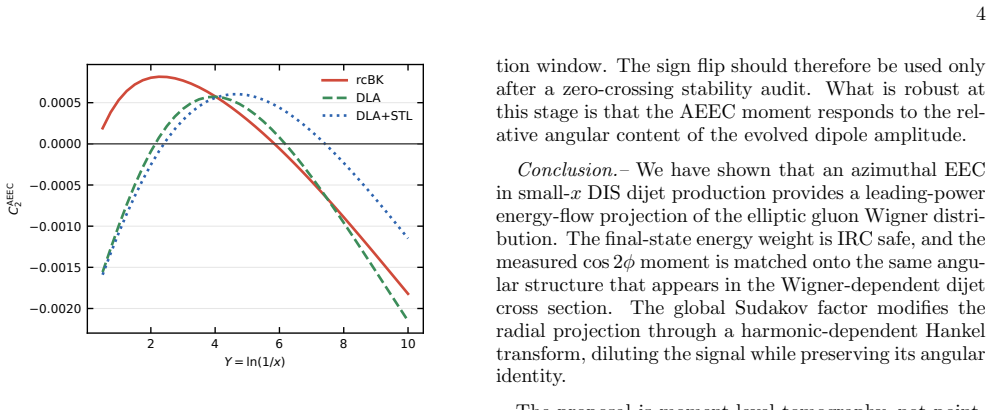
Within leading-power small-x dijet factorization the normalized cos2φ moment of the proposed azimuthal energy-flow observable is a linear projection of the elliptic Wigner harmonic after calculable kinematic subtraction. The final-state energy weighting is infrared and collinear safe. In conjugate recoil space a rotationally scalar Sudakov factor evolves the isotropic and elliptic channels through a fixed J0/J2 Hankel pair without W0 to W1 leakage. A proof-of-principle calculation gives a per-mille Sudakov-level moment in an unoptimized conservative window, while auxiliary perturbative-window scans reach several per mille.
What carries the argument
Azimuthal energy-flow moment in DIS dijet production whose normalized cos2φ component projects the elliptic Wigner harmonic after subtraction and evolves via a J0/J2 Hankel pair in recoil space.
If this is right
- The energy weighting guarantees infrared and collinear safety of the observable.
- Sudakov evolution separates isotropic and elliptic channels through a fixed Hankel pair without mixing.
- Statistical reach of the measurement can be assessed by simple angular-moment counting.
- Proof-of-principle yields per-mille level moments in conservative kinematic windows.
Where Pith is reading between the lines
- The same moment construction could be tested in other small-x processes if the leading-power factorization assumption continues to hold.
- Experimental extraction at electron-ion colliders would rely on the infrared safety to reduce systematic uncertainties from soft radiation.
- The absence of channel leakage suggests the method cleanly isolates elliptic effects from isotropic ones across a range of recoil scales.
Load-bearing premise
The proposed energy-flow moment must lie inside leading-power small-x dijet factorization so that its normalized cos2φ component directly projects the elliptic Wigner harmonic after subtraction.
What would settle it
A calculation or measurement in which the normalized cos2φ moment deviates from the predicted linear projection of the elliptic Wigner harmonic after the kinematic subtraction, or in which the Sudakov evolution exhibits W0 to W1 leakage.
Figures

read the original abstract
The elliptic small-$x$ gluon Wigner distribution correlates transverse momentum with impact parameter, but it is usually accessed through exclusive diffractive dijets whose recoil is sensitive to soft radiation. We propose instead an azimuthal energy-flow moment in DIS dijet production. Within leading-power small-$x$ dijet factorization, its normalized $\cos2\phi$ moment is a linear projection of the elliptic Wigner harmonic after a calculable kinematic subtraction, while the final-state energy weighting is infrared and collinear safe. In conjugate recoil space a rotationally scalar Sudakov factor evolves the isotropic and elliptic channels through a fixed $J_0/J_2$ Hankel pair without $W_0\to W_1$ leakage. A proof-of-principle calculation gives a per-mille Sudakov-level moment in an unoptimized conservative window, while auxiliary perturbative-window scans reach several per mille. The observable therefore formulates elliptic Wigner tomography as a moment-level energy-flow measurement whose statistical reach can be assessed by simple angular-moment counting.
Editorial analysis
A structured set of objections, weighed in public.
Referee Report
Summary. The paper proposes an azimuthal energy-flow moment in DIS dijet production as a new observable for elliptic small-x gluon Wigner tomography. Within leading-power small-x dijet factorization, the normalized cos2φ moment is claimed to be a linear projection of the elliptic Wigner harmonic after a calculable kinematic subtraction. The final-state energy weighting is asserted to be infrared and collinear safe. In conjugate recoil space, a rotationally scalar Sudakov factor evolves the isotropic and elliptic channels through a fixed J0/J2 Hankel pair without W0→W1 leakage. A proof-of-principle calculation reports a per-mille Sudakov-level moment in a conservative window, with auxiliary scans reaching several per mille.
Significance. If the leading-power factorization holds for the weighted observable, the construction provides a statistically accessible moment-level probe of the elliptic Wigner distribution that avoids the soft-radiation sensitivity of exclusive diffractive dijets. Credit is due for the explicit IR/collinear safety argument, the rotationally scalar Sudakov with fixed Hankel pair, and the concrete per-mille numerical demonstration in the proof-of-principle. These elements make the proposal falsifiable via angular-moment counting once the factorization assumption is validated.
major comments (2)
- [Abstract, §2] Abstract and §2: The central claim that the normalized cos2φ moment equals a linear projection of the elliptic Wigner harmonic after kinematic subtraction rests on the assumption that the energy-flow weighted dijet cross section lies inside leading-power small-x dijet factorization. The manuscript invokes this without deriving the factorization theorem for the weighted observable or showing that the energy weighting introduces neither power-suppressed corrections nor mixing with other small-x distributions in the cos2φ channel. This is load-bearing for the projection relation.
- [§4] §4 (Sudakov evolution): The assertion of a rotationally scalar Sudakov that evolves via a fixed J0/J2 Hankel pair with no W0→W1 leakage must be shown to survive the specific energy weighting at the order needed for per-mille accuracy; the current argument appears to transplant the unweighted dijet Sudakov without an explicit check that the weighting preserves the rotational scalar property and channel decoupling.
minor comments (2)
- Notation for the elliptic Wigner harmonic (W2 or similar) should be defined explicitly on first use and kept consistent with standard small-x literature.
- The kinematic subtraction procedure in the projection relation would benefit from an explicit formula or algorithm in an appendix to allow independent verification of the per-mille result.
Simulated Author's Rebuttal
We thank the referee for the thoughtful report and for highlighting the load-bearing assumptions in our proposal. We address each major comment below and will incorporate clarifications and explicit justifications in the revised manuscript.
read point-by-point responses
-
Referee: [Abstract, §2] Abstract and §2: The central claim that the normalized cos2φ moment equals a linear projection of the elliptic Wigner harmonic after kinematic subtraction rests on the assumption that the energy-flow weighted dijet cross section lies inside leading-power small-x dijet factorization. The manuscript invokes this without deriving the factorization theorem for the weighted observable or showing that the energy weighting introduces neither power-suppressed corrections nor mixing with other small-x distributions in the cos2φ channel. This is load-bearing for the projection relation.
Authors: We agree that the extension of leading-power small-x dijet factorization to the energy-weighted case is central and was invoked rather than re-derived. The manuscript already notes that the weighting is infrared and collinear safe, which protects against soft and collinear singularities, but a more explicit argument is needed to confirm absence of power corrections or channel mixing in the cos2φ projection. In the revision we will add a short subsection in §2 sketching why the final-state energy weighting (being a collinear-safe jet observable) preserves the leading-power structure of the unweighted dijet factorization without introducing new small-x distributions or power-suppressed terms at the order relevant for the normalized moment. revision: yes
-
Referee: [§4] §4 (Sudakov evolution): The assertion of a rotationally scalar Sudakov that evolves via a fixed J0/J2 Hankel pair with no W0→W1 leakage must be shown to survive the specific energy weighting at the order needed for per-mille accuracy; the current argument appears to transplant the unweighted dijet Sudakov without an explicit check that the weighting preserves the rotational scalar property and channel decoupling.
Authors: The Sudakov is formulated in conjugate recoil space after the hard scattering, where the energy weighting acts as a rotationally invariant multiplicative factor on the final-state jets. Because the weighting commutes with the azimuthal Fourier decomposition and does not introduce additional transverse-momentum dependence that breaks rotational invariance, the J0/J2 Hankel structure and absence of W0→W1 leakage are preserved. Nevertheless, an explicit verification at the per-mille level for the weighted case was not provided. In the revised §4 we will include a short perturbative check (or reference to an auxiliary calculation) confirming that the weighted Sudakov remains rotationally scalar with the same fixed Hankel pair, thereby supporting the per-mille accuracy claim. revision: yes
Circularity Check
New observable proposal grounded in standard small-x factorization; no circular reduction to inputs
full rationale
The paper proposes an azimuthal energy-flow moment in DIS dijet production. Its central relation—that the normalized cos2φ moment equals a linear projection of the elliptic Wigner harmonic after kinematic subtraction—is stated as holding within the existing leading-power small-x dijet factorization framework, which is treated as an external input rather than derived from the paper's own results. The IR/collinear safety and Sudakov evolution via J0/J2 Hankel pair are presented as consequences of that framework applied to the weighted observable. No equations reduce the claimed projection to a fit, self-definition, or self-citation chain; the factorization theorem is invoked as standard and independent. The derivation chain therefore remains self-contained against external benchmarks with no load-bearing step that collapses by construction.
Axiom & Free-Parameter Ledger
axioms (1)
- domain assumption Leading-power small-x dijet factorization holds for the energy-flow moment observable
Reference graph
Works this paper leans on
-
[1]
The denominator containsA 2 0 + 2A2 1 be- cause R dϕcos 2 2ϕ=πwhile R dϕ= 2π
(11) 3 HeredΦ 0 =dz P T dPT qT dqT , and the arguments ofA 0,1 are suppressed. The denominator containsA 2 0 + 2A2 1 be- cause R dϕcos 2 2ϕ=πwhile R dϕ= 2π. Equation (11) is the main result. The observable is not an absolute measurement ofW 1(x, k, b) at a point. It is a weighted elliptic-to-isotropic moment, with weights fixed by the photon wave function...
-
[2]
Electron Ion Collider: The Next QCD Frontier - Understanding the glue that binds us all
A. Accardiet al., Eur. Phys. J. A52, 268 (2016), arXiv:1212.1701 [nucl-ex]
work page internal anchor Pith review Pith/arXiv arXiv 2016
-
[3]
Science Requirements and Detector Concepts for the Electron-Ion Collider: EIC Yellow Report
R. Abdul Khaleket al., Nucl. Phys. A1026, 122447 (2022), arXiv:2103.05419 [physics.ins-det]
work page internal anchor Pith review Pith/arXiv arXiv 2022
-
[4]
A. V. Belitsky, X. Ji, and F. Yuan, Phys. Rev. D69, 074014 (2004), arXiv:hep-ph/0307383
work page internal anchor Pith review Pith/arXiv arXiv 2004
-
[5]
Generalized parton correlation functions for a spin-1/2 hadron
S. Meissner, A. Metz, and M. Schlegel, JHEP2009, 056 (2009), arXiv:0906.5323 [hep-ph]
work page internal anchor Pith review Pith/arXiv arXiv 2009
-
[6]
Quark Wigner Distributions and Orbital Angular Momentum
C. Lorc´ e and B. Pasquini, Phys. Rev. D84, 014015 (2011), arXiv:1106.0139 [hep-ph]
work page internal anchor Pith review Pith/arXiv arXiv 2011
-
[7]
Probing the Small-$x$ Gluon Tomography in Correlated Hard Diffractive Dijet Production in DIS
Y. Hatta, B.-W. Xiao, and F. Yuan, Phys. Rev. Lett. 116, 202301 (2016), arXiv:1601.01585 [hep-ph]
work page internal anchor Pith review Pith/arXiv arXiv 2016
-
[8]
Wigner, Husimi and GTMD distributions in the Color Glass Condensate
Y. Hagiwara, Y. Hatta, and T. Ueda, Phys. Rev. D94, 094036 (2016), arXiv:1609.05773 [hep-ph]
work page internal anchor Pith review Pith/arXiv arXiv 2016
-
[9]
On the linearly polarized gluon distributions in the color dipole model
F. Dominguez, J.-W. Qiu, B.-W. Xiao, and F. Yuan, Phys. Rev. D85, 045003 (2012), arXiv:1109.6293 [hep- ph]
work page internal anchor Pith review Pith/arXiv arXiv 2012
-
[10]
A. Dumitru, T. Lappi, and V. Skokov, Phys. Rev. Lett. 115, 252301 (2015), arXiv:1508.04438 [hep-ph]
work page internal anchor Pith review Pith/arXiv arXiv 2015
-
[11]
Gluon Tomography from Deeply Virtual Compton Scattering at Small-x
Y. Hatta, B.-W. Xiao, F. Yuan, and J. Zhou, Phys. Rev. D95, 114026 (2017), arXiv:1703.02085 [hep-ph]
work page internal anchor Pith review Pith/arXiv arXiv 2017
-
[12]
The elliptic gluon GTMD inside a large nucleus
J. Zhou, Phys. Rev. D94, 114017 (2016), arXiv:1611.02397 [hep-ph]
work page internal anchor Pith review Pith/arXiv arXiv 2016
-
[13]
D. Boer and C. Setyadi, Phys. Rev. D104, 074006 (2021), arXiv:2106.15148 [hep-ph]
-
[14]
H. M¨ antysaari, K. Roy, F. Salazar, and B. Schenke, Phys. Rev. D103, 094026 (2021), arXiv:2011.02464 [hep- ph]
-
[15]
R. Boussarie, A. V. Grabovsky, L. Szymanowski, and S. Wallon, Phys. Rev. D94, 074020 (2016), arXiv:1606.00419 [hep-ph]
work page internal anchor Pith review Pith/arXiv arXiv 2016
-
[16]
J. C. Collins, D. E. Soper, and G. F. Sterman, Nucl. Phys. B250, 199 (1985)
1985
-
[17]
A. H. Mueller, B.-W. Xiao, and F. Yuan, Phys. Rev. Lett.110, 082301 (2013), arXiv:1210.5792 [hep-ph]
work page internal anchor Pith review Pith/arXiv arXiv 2013
- [18]
-
[19]
C. L. Basham, L. S. Brown, S. D. Ellis, and S. T. Love, Phys. Rev. Lett.41, 1585 (1978)
1978
-
[20]
A. J. Larkoski, G. P. Salam, and J. Thaler, JHEP2013, 108 (2013), arXiv:1305.0007 [hep-ph]
work page internal anchor Pith review Pith/arXiv arXiv 2013
-
[21]
L. J. Dixon, M.-x. Luo, V. Shtabovenko, T.-Z. Yang, and H. X. Zhu, Phys. Rev. Lett.120, 102001 (2018), arXiv:1801.03219 [hep-ph]
work page internal anchor Pith review Pith/arXiv arXiv 2018
-
[22]
L. J. Dixon, I. Moult, and H. X. Zhu, Phys. Rev. D100, 014009 (2019), arXiv:1905.01310 [hep-ph]. 5
work page internal anchor Pith review Pith/arXiv arXiv 2019
- [23]
- [24]
- [25]
- [26]
- [27]
- [28]
- [29]
-
[30]
L. D. McLerran and R. Venugopalan, Phys. Rev. D49, 2233 (1994), arXiv:hep-ph/9309289
work page internal anchor Pith review Pith/arXiv arXiv 1994
-
[31]
The Color Glass Condensate and High Energy Scattering in QCD
E. Iancu and R. Venugopalan, Quark Gluon Plasma3, 249 (2004), arXiv:hep-ph/0303204
work page internal anchor Pith review Pith/arXiv arXiv 2004
-
[32]
F. Gelis, E. Iancu, J. Jalilian-Marian, and R. Venu- gopalan, Ann. Rev. Nucl. Part. Sci.60, 463 (2010), arXiv:1002.0333 [hep-ph]
work page internal anchor Pith review Pith/arXiv arXiv 2010
- [33]
-
[34]
Y. V. Kovchegov, Phys. Rev. D60, 034008 (1999), arXiv:hep-ph/9901281
work page internal anchor Pith review Pith/arXiv arXiv 1999
-
[35]
I. Balitsky, Phys. Rev. D75, 014001 (2007), arXiv:hep- ph/0609105
-
[36]
Y. V. Kovchegov and H. Weigert, Nucl. Phys. A784, 188 (2007), arXiv:hep-ph/0609090
work page internal anchor Pith review Pith/arXiv arXiv 2007
-
[37]
J. L. Albacete, N. Armesto, J. G. Milhano, P. Quiroga- Arias, and C. A. Salgado, Eur. Phys. J. C71, 1705 (2011), arXiv:1012.4408 [hep-ph]
work page internal anchor Pith review Pith/arXiv arXiv 2011
-
[38]
Resumming double logarithms in the QCD evolution of color dipoles
E. Iancu, J. D. Madrigal, A. H. Mueller, G. Soyez, and D. N. Triantafyllopoulos, Phys. Lett. B744, 293 (2015), arXiv:1502.05642 [hep-ph]
work page internal anchor Pith review Pith/arXiv arXiv 2015
-
[39]
Collinearly-improved BK evolution meets the HERA data
E. Iancu, J. D. Madrigal, A. H. Mueller, G. Soyez, and D. N. Triantafyllopoulos, Phys. Lett. B750, 643 (2015), arXiv:1507.03651 [hep-ph]
work page internal anchor Pith review Pith/arXiv arXiv 2015
-
[40]
P. J. Mulders and J. Rodrigues, Phys. Rev. D63, 094021 (2001), arXiv:hep-ph/0009343
work page internal anchor Pith review Pith/arXiv arXiv 2001
-
[41]
Universality of Unintegrated Gluon Distributions at small x
F. Dominguez, C. Marquet, B.-W. Xiao, and F. Yuan, Phys. Rev. D83, 105005 (2011), arXiv:1101.0715 [hep- ph]
work page internal anchor Pith review Pith/arXiv arXiv 2011
-
[42]
B.-W. Xiao, F. Yuan, and J. Zhou, Nucl. Phys. B921, 104 (2017), arXiv:1703.06163 [hep-ph]. 6 SUPPLEMENT AL MA TERIAL A. Scope of the F actorized Projection The main text uses the small-xDIS dijet factorization formula in the correlation limitq T ≪P T . Target mul- tiple scattering is encoded in Wilson-line dipole opera- tors, while unresolved final-state ...
work page internal anchor Pith review Pith/arXiv arXiv 2017
discussion (0)
Sign in with ORCID, Apple, or X to comment. Anyone can read and Pith papers without signing in.