REVIEW 4 major objections 6 minor 21 references
Origin Tracer: A Method for Detecting LoRA Fine-Tuning Origins in LLMs
T0 review · 4 major / 6 minor · reviewed 2026-08-07 · deepseek-v4-flash
Pith's one-line read The paper claims a method, Origin-Tracer, that determines whether a language model was fine-tuned from a specified base model via LoRA and recovers the LoRA rank, remaining valid under permutation obfuscation.
desk verdict Clever rank-extraction idea with real positive results, but the paper never tests the provenance-detection claim it advertises and the theory has load-bearing holes. read the letter →
The pith
A machine-rendered reading of the paper's core claim, the machinery that carries it, and where it could break.
The reading
What carries the argument
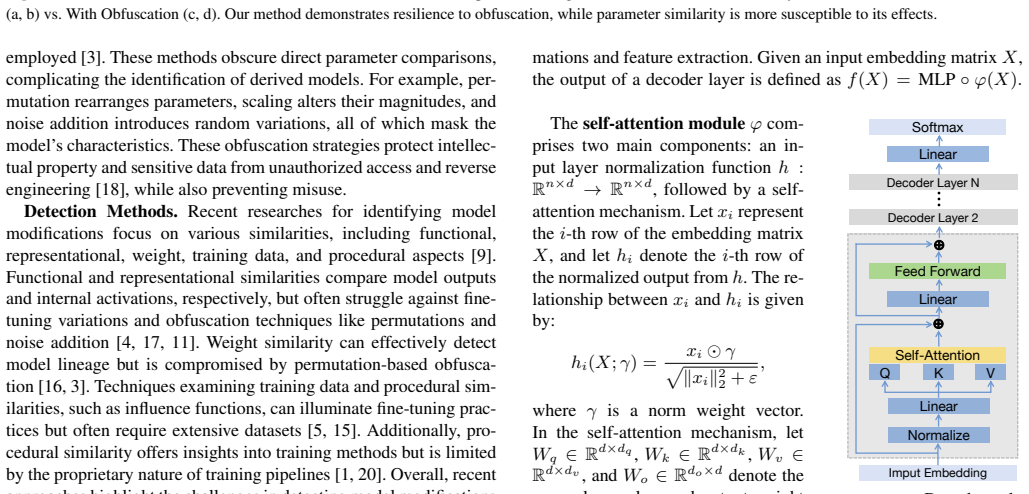
The load-bearing object is the singular-value gap of the composed difference matrix $Y = h(X;\gamma) W_{\mathrm{low}}$, built from rows $h(x_i;\gamma)$ for a set of single-token inputs $x_i$. The argument rides on two structural claims: Lemma 1, that the MLP map is injective (so the pre-MLP state $y^*_c = \mathrm{MLP}_c^{-1}(z_c)$ is recoverable by gradient descent), and Theorem 3, that the value and output matrices are uniquely determined by input–output pairs, which justifies treating $W_V W_O$ as identifiable. Together these turn the provenance problem into a low-rank matrix recovery problem: the normalized inputs times the LoRA difference have rank equal to the LoRA rank, and a sharp drop in consecutive singular values identifies that rank.
What would settle it
Take a base model, fine-tune it with LoRA of a known rank on the value and output matrices, apply a random permutation to the attention and MLP parameters, then run Origin-Tracer; if the extracted rank does not match the known rank within a small tolerance across repeated trials, the central claim fails. The same test with a small perturbation to the MLP weights (for instance, fine-tuning the down-projection) would falsify the key MLP-identity assumption.
Extended reading notes
Core claim
The paper claims that the rank of the LoRA update used to fine-tune a candidate model from a base model can be recovered from the singular-value spectrum of the reconstructed difference matrix $Y = h(X;\gamma) W_{\mathrm{low}}$, where $W_{\mathrm{low}} = W_V W_O - W^*_V W^*_O$ is the change in the value/output product that LoRA introduces. The claim is that this recovery remains valid regardless of the permutation obfuscation applied to the candidate's layers, because the reconstruction step first inverts the candidate's MLP (assumed identical to the base MLP) by gradient descent and then composes the recovered intermediate states across many single-token inputs. The paper reports that the singular-value gap appears adjacent to the true rank for all 31 models tested, including cases where the projection matrices were also fine-tuned, doubling the expected rank.
Load-bearing premise
The whole estimate stands on the assumption that the candidate model's MLP layers are functionally identical to the base model's and can be inverted exactly by gradient descent on single-token states; if that inversion drifts or the MLP differs, the recovered difference matrix is noise and the singular-value gap is meaningless.
Editorial extensions
If this is right
- Model providers can no longer hide the base of a LoRA fine-tune behind weight permutations; the pre-MLP state reconstruction exposes the low-rank update.
- The method supplies provenance evidence for open-source audits: if the recovered rank matches a claimed LoRA configuration, the lineage claim is corroborated.
- Because only the V/O projections are assumed modified, the method also detects cases where a provider secretly fine-tuned the output projection, doubling the observed rank.
- Rank estimates are most reliable in middle layers, so audits should focus on those layers rather than early or late ones.
Reading between the lines
- Extending the same singular-value argument to other parameter-efficient methods, such as adapters or task vectors that are low-rank on attention weights, would give a family of provenance tests; the paper does not explore this.
- A direct implication the authors leave implicit: if the candidate's MLP is also fine-tuned, the method silently breaks, so a determined obfuscator could defeat detection by making a small MLP change. This is a testable attack.
- The gradient-descent reconstruction opens a natural stress test: measuring reconstruction error on the exact base model for layers at various depths, and reporting per-layer error, would tell practitioners which layers to trust before running the rank extraction.
- The method's dependence on single-token inputs suggests it could be combined with input selection strategies that maximize column rank of $h(X;\gamma)$, potentially improving reliability on models where natural tokens give nearly dependent rows.
Editorial analysis
A structured set of objections, weighed in public.
Referee Report
Summary. The paper proposes Origin-Tracer, a method that attempts to determine whether a candidate LLM was LoRA fine-tuned from a given base model and to recover the LoRA rank. The method compares intermediate states before the MLP in each decoder layer, reconstructs the candidate's pre-MLP state by numerically inverting the base MLP, forms the matrix Y = h(X; gamma)(W_V W_O - W*_V W*_O), and estimates its rank from the largest gap in consecutive singular values. Theoretical support is claimed via Lemma 1 (injectivity of the MLP) and Theorem 3 (unique determination of value/output matrices), and experiments are reported on 31 open-source LoRA fine-tuned models, with estimated ranks close to ground truth in Table 1. The paper also acknowledges limitations: it does not handle MLP modifications, non-low-rank changes, or changes outside the V and O components.
Significance. If the central claim were established, the method would be a useful tool for provenance verification under permutation obfuscation. The problem is timely, and Table 1 indicates that on known positive cases the singular-value-gap heuristic often recovers the expected rank. The authors also deserve credit for stating limitations explicitly. However, the paper does not deliver a provenance test: Algorithm 1 returns only a rank estimate, Table 1 contains no negative controls, and the theoretical backbone is not valid. The significance of the empirical result is therefore limited to rank recovery under favorable conditions, not to the advertised 'rigorously determines whether' claim.
major comments (4)
- [Section 4, Lemma 1] The proof of injectivity is incorrect. The full injectivity equation is (sigma(G_X) ⊙ U_X) W_down + X = (sigma(G_Y) ⊙ U_Y) W_down + Y, which rearranges to [sigma(X W_G) ⊙ (X W_up)] W_down - [sigma(Y W_G) ⊙ (Y W_up)] W_down = Y - X. The sets M_ij in the proof equate only the two nonlinear terms to each other and omit the Y - X term, so their dimension does not constrain the actual equality. In addition, the asserted dimension dim(M_ij) = 3dp - nd is not justified for a nonlinear system; n equations do not generally reduce the dimension of the parameter space by n. Since Lemma 1 is the basis for the inversion step, this is a load-bearing gap.
- [Section 4, Theorem 3] Theorem 3 claims that injectivity of the MLP implies that for every Y there exists a unique Z with MLP(Z) = Y; this is surjectivity, not injectivity, and it is never proved. The single-token argument also treats a row vector x ∈ R^{1×d} as having rank d, which is impossible; consequently the conclusion W_V W_O = W'_V W'_O from h(x; gamma)(W_V W_O - W'_V W'_O) = 0 does not follow. As a result, Section 4.1's rank identity Y = h(X; gamma) W_low is not backed by Theorem 3.
- [Section 5, Algorithm 1 and Table 1] The central binary provenance claim is not evaluated. Algorithm 1 returns min(rank_List), an integer; no decision rule, threshold, or null distribution is defined to convert this into the binary statement "candidate fine-tuned from base." Table 1 contains only known-positive examples (candidates known to be LoRA fine-tuned from the stated base), and Section 5 has no negative controls: no candidate fine-tuned from a different base, no obfuscated base model with no fine-tuning, and no unrelated model. Without these, the observed singular-value gaps cannot be attributed to LoRA provenance, and the Abstract's and Section 1's claims are unsupported.
- [Section 4.2 and Section 4.3] The reconstruction premise is unproven. The equation phi*_c(x) = MLP_b^{-1}(z_c) requires the base MLP to be surjective onto the observed z_c and the numerical inversion to converge to the true pre-MLP state; neither is established. Section 4.3's rationale introduces a probability p_s that selected intermediates are "sufficiently close," but no construction, bound, or empirical measurement of p_s is provided. The rank estimates in Table 1 may therefore reflect properties of the reconstruction error rather than the LoRA signal.
minor comments (6)
- [Section 4.1 and Theorem 3 proof] There are typos: "Therome 3" should be "Theorem 3," and "cannot be paralleled" should likely be "cannot be parallel."
- [Figure 1 caption] The caption "The detection of Reflection-70B with (w/o) obfuscation" is confusing because the figures separately show "w/o Obfuscation" and "with Obfuscation"; please clarify the intended meaning.
- [Table 1] The column label "G-T" is not defined in the text, and the method for computing the expected rank when the O projection is also fine-tuned should be stated explicitly.
- [Algorithm 1, line 13] The arg max over consecutive singular-value ratios does not specify the valid range of the index i or how ties are broken; also, the paper should justify why min(rank_List) is the appropriate summary rather than a more robust statistic.
- [Section 5.1] The description of the NLTK-based dataset should specify how the filtering guarantees a set of h inputs that each tokenize to a single token and embed to vectors satisfying the assumed rank properties.
- [General] The paper contains no code or data availability statement; providing the implementation and the exact model versions would substantially improve reproducibility.
Circularity Check
No significant circularity: the rank extraction is evaluated against known LoRA ranks rather than fitted to them; the main issues are validation gaps and imprecise terminology, not circular derivation.
full rationale
The derivation chain does not reduce to its inputs by construction. In Section 4.1, the matrix Y = h(X;γ) W_low is formed from observed intermediate states, with W_low = W_V W_O − W*_V W*_O, and the rank is read from the singular value gap (Algorithm 1, lines 13–14). The known LoRA ranks in Table 1 are used only as evaluation ground truth for comparison, not as inputs to the algorithm; no parameter is fitted to them. The 'top 10% layers' selection and the minimum over random cycles are heuristics that can bias results, but they do not encode the target rank. The load-bearing premise that the candidate's MLP is functionally identical to the base MLP (Section 4.2, Algorithm 1 line 7) is an explicit scope assumption of the problem formulation (Section 3.3), not a conclusion derived from the detection result; the paper's own limitations (Section 5.4) acknowledge that the method fails if MLPs are modified. The absence of negative controls and the lack of a decision threshold for the binary 'determines whether' claim are correctness/validation gaps, not circularity. Theorem 3 is derived in-paper rather than imported from prior work, and the reference list contains no load-bearing self-citation. One imprecision is that Theorem 3 establishes uniqueness of the product W_V W_O, not of the individual factors, so calling the recovered rank the 'LoRA rank' is not fully justified; this is a mathematical accuracy issue, not a circular step. Overall, the method is close to self-contained against external ground-truth ranks, and no specific reduction of the output to a fitted input or self-citation chain can be exhibited.
Assumptions & free parameters
free parameters (6)
- number of single-token probes n =
h/2 (e.g., 2048 for 8B models)
- number of random cycles t =
unspecified
- gradient descent learning rate alpha =
unspecified
- gradient descent iteration count =
unspecified
- top-10% layer selection threshold =
10%
- singular-value gap criterion =
argmax over log ratios of consecutive singular values
assumptions (9)
- ad hoc to paper The MLP layer is injective on non-parallel vectors (Lemma 1), so hidden states can be uniquely recovered from layer outputs.
- ad hoc to paper The MLP layer is surjective onto every observed layer output z_c, so MLP^{-1} exists for the reconstructed states.
- domain assumption Obfuscation is exactly function-preserving: MLP_c o phi_c = MLP*_c o phi*_c with MLP*_c = MLP_b.
- domain assumption Fine-tuning changes only the value and output projections W_V and W_O via low-rank LoRA updates; MLP and other attention matrices are unchanged.
- domain assumption The stacked single-token matrix h(X;gamma) has full column rank, so rank(h(X;gamma) W_low) = rank(W_low).
- ad hoc to paper Gradient descent on the MLP inversion loss converges to the true intermediate state for a positive fraction p_s of random token selections.
- ad hoc to paper The LoRA rank is at most half the hidden size, which fixes the number of single-token probes n.
- standard math For a single token, the softmax attention score equals 1, so attention reduces to h(x;gamma) W_V W_O + x.
- domain assumption The token space C is countable, so union bounds over finitely many token pairs give measure-zero parameter sets.
Cite this review
Pith. "Pith review of Origin Tracer: A Method for Detecting LoRA Fine-Tuning Origins in LLMs." pith.science (2026). https://pith.science/paper/U3LGDKPF
@misc{pith2026250519466,
  author       = {Pith},
  title        = {Pith review of: Origin Tracer: A Method for Detecting LoRA Fine-Tuning Origins in LLMs},
  year         = {2026},
  howpublished = {\url{https://pith.science/paper/U3LGDKPF}},
  note         = {Machine review of arXiv:2505.19466}
}
read the original abstract
As large language models (LLMs) continue to advance, their deployment often involves fine-tuning to enhance performance on specific downstream tasks. However, this customization is sometimes accompanied by misleading claims about the origins, raising significant concerns about transparency and trust within the open-source community. Existing model verification techniques typically assess functional, representational, and weight similarities. However, these approaches often struggle against obfuscation techniques, such as permutations and scaling transformations. To address this limitation, we propose a novel detection method Origin-Tracer that rigorously determines whether a model has been fine-tuned from a specified base model. This method includes the ability to extract the LoRA rank utilized during the fine-tuning process, providing a more robust verification framework. This framework is the first to provide a formalized approach specifically aimed at pinpointing the sources of model fine-tuning. We empirically validated our method on thirty-one diverse open-source models under conditions that simulate real-world obfuscation scenarios. We empirically analyze the effectiveness of our framework and finally, discuss its limitations. The results demonstrate the effectiveness of our approach and indicate its potential to establish new benchmarks for model verification.
Figures


Figures from the paper (2 more)


Reference graph
Works this paper leans on
-
[1]
S. Biderman et al. Pythia: A suite for analyzing large language mod- els across training and scaling.International Conference on Machine Learning, 2023. 2
work page 2023
-
[2]
T. Dettmers, A. Pagnoni, A. Holtzman, and L. Zettlemoyer. Qlora: Ef- ficient finetuning of quantized llms.Advances in Neural Information Processing Systems, 36, 2024. 2
work page 2024
- [3]
-
[4]
K. Ethayarajh. How contextual are contextualized word representa- tions? comparing the geometry of bert, elmo, and gpt-2 embeddings.In Proceedings of the 2019 Conference on Empirical Methods in Natural Language Processing, 2019. 2
work page 2019
- [5]
-
[6]
E. J. Hu, Y . Shen, P. Wallis, Z. Allen-Zhu, Y . Li, S. Wang, L. Wang, and W. Chen. Lora: Low-rank adaptation of large language models.arXiv preprint arXiv:2106.09685, 2021. 2
arXiv 2021
-
[7]
M. Jia, L. Tang, B.-C. Chen, C. Cardie, S. Belongie, B. Hariharan, and S.-N. Lim. Visual prompt tuning. InEuropean Conference on Computer Vision, pages 709–727. Springer, 2022. 2
work page 2022
-
[8]
R. Karimi Mahabadi, J. Henderson, and S. Ruder. Compacter: Efficient low-rank hypercomplex adapter layers.Advances in Neural Information Processing Systems, 34:1022–1035, 2021. 2
work page 2021
Show all 21 references
-
[9]
Klabunde, T
M. Klabunde, T. Schumacher, M. Strohmaier, and F. Lemmerich. Simi- larity of neural network models: A survey of functional and representa- tional measures.arXiv preprint arXiv:2305.06329, 2023. 2
2023 arXiv
-
[10]
Klabunde, J
M. Klabunde, J. Schäffer, G. Henning, S. Wermter, and S. Lüdtke. To- wards measuring representational similarity of large language models. InNeurIPS 2023 Workshop on UniReps: Unifying Understanding of Representations, 2023. URL https://mklabunde.github.io/publication/ 2023-llms. 1
2023
-
[11]
Kornblith, M
S. Kornblith, M. Norouzi, H. Lee, and G. Hinton. Similarity of neural network representations revisited.In Proceedings of the 36th Interna- tional Conference on Machine Learning, 2019. 2
2019
-
[12]
T. Lee, B. Edwards, I. Molloy, and D. Su. Defending against model stealing attacks using obfuscations.arXiv preprint arXiv:1806.00054,
-
[13]
Maron, H
H. Maron, H. Ben-Hamu, H. Serviansky, and Y . Lipman. On the uni- versality of invariant networks. InInternational Conference on Machine Learning (ICML), pages 4363–4371. PMLR, 2020. 3.2
2020
-
[14]
Z. Pan, Y . Hua, Y . Zhang, et al. On the risk of misinformation pollution with large language models.arXiv preprint arXiv:2302.05678, 2023. 1
2023 arXiv
-
[15]
H. Shah, S. M. Park, A. Ilyas, and A. Madry. Modeldiff: A framework for comparing learning algorithms.Proceedings of the 40th Interna- tional Conference on Machine Learning, 2023. 2
2023
-
[16]
G. Wang, G. Wang, W. Liang, and J. Lai. Understanding weight sim- ilarity of neural networks via chain normalization rule and hypothesis- training-testing.arXiv preprint arXiv:2208.04369, 2022. 2
2022 arXiv
-
[17]
J. Wu, Y . Belinkov, H. Sajjad, N. Durrani, F. Dalvi, and J. Glass. Sim- ilarity analysis of contextual word representation models.In Proceed- ings of the 58th Annual Meeting of the Association for Computational Linguistics, 2020. 2
2020
-
[18]
Yousefi, L
S. Yousefi, L. Betthauser, et al. In-context learning in large language models: A neuroscience-inspired analysis of representations.arXiv preprint arXiv:2304.13712, 2023. 2
2023 arXiv
-
[19]
Zaheer, S
M. Zaheer, S. Kottur, S. Ravanbakhsh, B. Poczos, R. Salakhutdinov, and A. Smola. Deep sets. InAdvances in Neural Information Processing Systems (NeurIPS), pages 3391–3401, 2017. 3.2
2017
-
[20]
W. Zhao, K. Zhou, J. Li, T. Tang, et al. A survey of large language models.arXiv preprint arXiv:2303.18223, 2023. 2
2023 arXiv
-
[21]
Zhou et al
T. Zhou et al. Permutation equivariant neural functionals.arXiv preprint arXiv:2307.10865, 2023. 1
2023 arXiv
Reviewed August 7, 2026 · model on record in the stance chip above.
Discussion (0). Continue with ORCID to comment.