Redshift-Dependent Intrinsic Dispersion in the Quasar UV/X-ray Luminosity Relation
Pith reviewed 2026-06-26 03:53 UTC · model grok-4.3
The pith
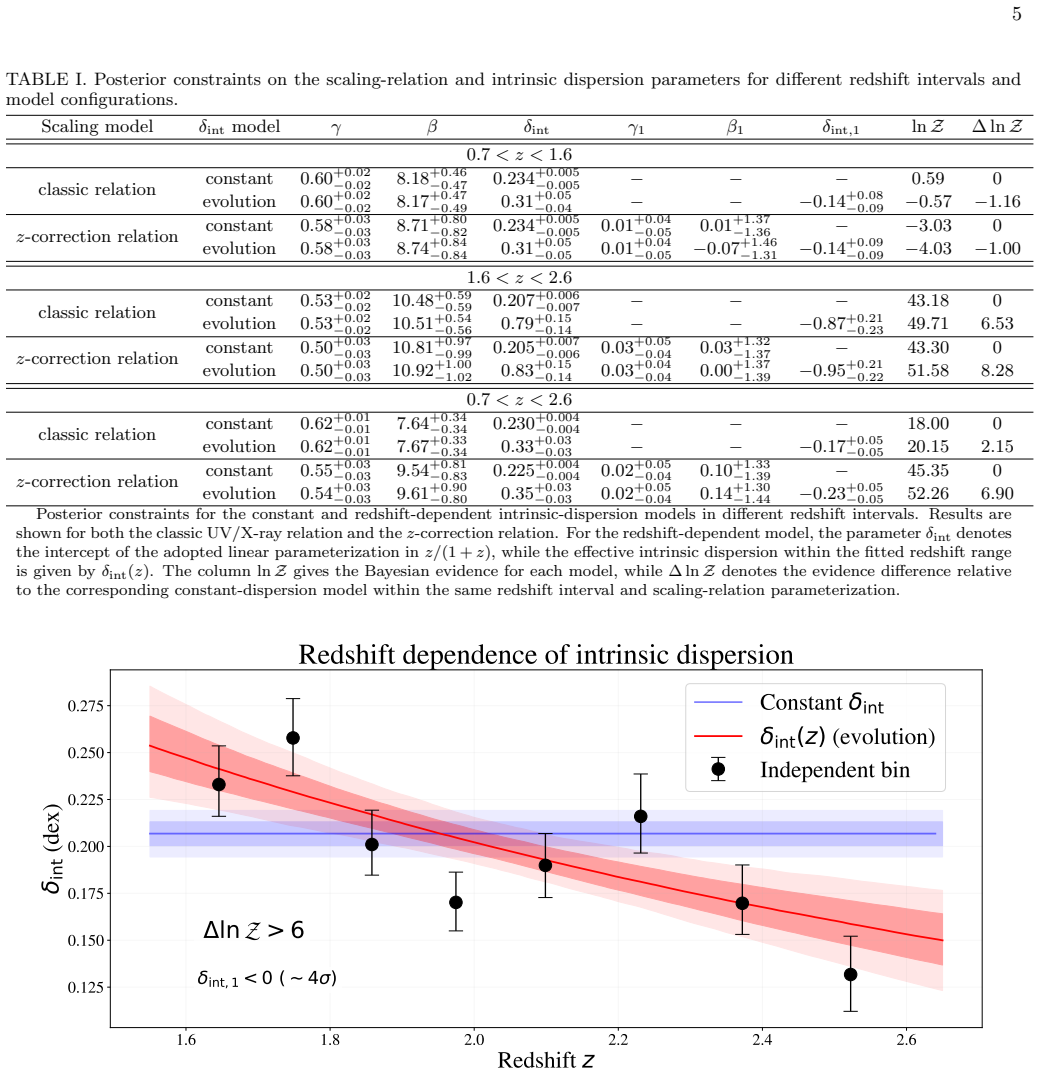
The intrinsic dispersion in the quasar UV/X-ray luminosity relation decreases above redshift 1.6
A machine-rendered reading of the paper's core claim, the machinery that carries it, and where it could break.
Core claim
Bayesian model comparison and posterior constraints show that the intrinsic dispersion is not well described by a single redshift-independent constant over 0.7<z<2.6. It remains approximately constant at 0.7<z<1.6, but shows an overall decreasing trend in the higher-redshift interval 1.6<z<2.6, where the redshift-dependent intrinsic-dispersion model is decisively favored. This conclusion remains qualitatively robust against changes in the scaling-relation parameterization, GP kernel, and redshift binning scheme. Under the adopted calibration setup, the redshift-dependent model shifts the posterior median of Omega_m0 by Delta Omega_m0 simeq 0.025 in the flat LambdaCDM model.
What carries the argument
Bayesian evidence comparison between constant and redshift-dependent models for intrinsic dispersion, using luminosity distances reconstructed via Gaussian-process regression on cosmic chronometer and BAO data as an independent calibration.
If this is right
- Dispersion remains approximately constant over 0.7<z<1.6
- Dispersion shows a decreasing trend over 1.6<z<2.6 and the dependent model is decisively favored there
- The modeling choice shifts the posterior median of Omega_m0 by approximately 0.025 in flat LambdaCDM
- Intrinsic-dispersion modeling forms a non-negligible part of the systematic-error budget for quasar cosmology
Where Pith is reading between the lines
- The observed decrease may trace changes in quasar emission mechanisms or selection effects that become important at higher redshifts
- Variable dispersion modeling may be required for other high-redshift distance indicators to keep cosmological inferences unbiased
- Next-generation quasar surveys should test whether the downward trend continues or stabilizes beyond z=2.6
Load-bearing premise
The luminosity distances reconstructed from cosmic chronometer and baryon acoustic oscillation measurements through Gaussian-process regression provide an unbiased, independent calibration set for the quasar relation.
What would settle it
Independent distance measurements or an alternative reconstruction method that instead favors a single constant dispersion across the full 0.7<z<2.6 range would falsify the redshift dependence.
Figures


read the original abstract
Accurate modeling of the intrinsic dispersion in the quasar UV/X-ray luminosity relation is essential for reliable cosmological inference. We investigate its redshift dependence using luminosity distances reconstructed from cosmic chronometer and baryon acoustic oscillation measurements through Gaussian-process (GP) regression. Bayesian model comparison and posterior constraints show that the intrinsic dispersion is not well described by a single redshift-independent constant over $0.7<z<2.6$. It remains approximately constant at $0.7<z<1.6$, but shows an overall decreasing trend in the higher-redshift interval $1.6<z<2.6$, where the redshift-dependent intrinsic-dispersion model is decisively favored. This conclusion remains qualitatively robust against changes in the scaling-relation parameterization, GP kernel, and redshift binning scheme. We further examine its impact on cosmological inference in the flat $\Lambda$CDM model and find that, under the adopted calibration setup, the redshift-dependent intrinsic-dispersion model shifts the posterior median of $\Omega_{\rm m0}$ by $\Delta\Omega_{\rm m0}\simeq 0.025$. This indicates that intrinsic-dispersion modeling is a non-negligible component of the systematic-error budget for quasar cosmology and should be accounted for in future precision analyses.
Editorial analysis
A structured set of objections, weighed in public.
Referee Report
Summary. The paper claims that luminosity distances reconstructed via Gaussian-process regression from cosmic chronometer and BAO data reveal a redshift-dependent intrinsic dispersion in the quasar UV/X-ray luminosity relation over 0.7<z<2.6. The dispersion is approximately constant at 0.7<z<1.6 but shows a decreasing trend at 1.6<z<2.6, where Bayesian model comparison decisively favors the redshift-dependent model over a constant-dispersion alternative. The result is stated to be robust to changes in scaling-relation parameterization, GP kernel, and redshift binning, and it shifts the posterior median of Omega_m0 by ~0.025 in flat LambdaCDM.
Significance. If the central claim holds, the work is significant for quasar cosmology because it quantifies how unmodeled redshift dependence in intrinsic scatter enters the systematic-error budget and biases cosmological parameters at a level comparable to current statistical uncertainties. The use of independent GP-reconstructed distances from CC+BAO as an external anchor is a methodological strength that avoids circularity with the quasar sample itself.
major comments (1)
- [Abstract (method paragraph) and robustness discussion] Abstract (method paragraph) and robustness discussion: the conclusion that the decreasing dispersion trend at z>1.6 is intrinsic to the quasars rests on the GP-reconstructed distances being free of redshift-dependent systematics. While robustness to GP kernel choice is reported, the manuscript does not test or discuss how redshift-dependent modeling assumptions in the input CC (stellar population synthesis) or BAO (sound-horizon, bias) data could propagate through the GP mean distance and be absorbed into the fitted dispersion parameters, potentially mimicking the reported trend.
Simulated Author's Rebuttal
We thank the referee for this constructive comment highlighting a potential source of systematic uncertainty. We address the point below and agree that additional discussion is warranted.
read point-by-point responses
-
Referee: [Abstract (method paragraph) and robustness discussion] Abstract (method paragraph) and robustness discussion: the conclusion that the decreasing dispersion trend at z>1.6 is intrinsic to the quasars rests on the GP-reconstructed distances being free of redshift-dependent systematics. While robustness to GP kernel choice is reported, the manuscript does not test or discuss how redshift-dependent modeling assumptions in the input CC (stellar population synthesis) or BAO (sound-horizon, bias) data could propagate through the GP mean distance and be absorbed into the fitted dispersion parameters, potentially mimicking the reported trend.
Authors: We agree that the manuscript does not explicitly test or discuss the propagation of redshift-dependent systematics from the input CC (e.g., stellar population synthesis models) or BAO (e.g., sound-horizon calibration and bias) datasets through the GP reconstruction. Such effects could in principle introduce redshift-dependent biases in the mean distance function that are then absorbed into the fitted dispersion parameters. While the GP is non-parametric and data-driven, and we have demonstrated robustness to kernel choice, we acknowledge this as a limitation not addressed in the current analysis. In the revised manuscript we will add a dedicated paragraph in the robustness section (and a brief note in the abstract/methods) acknowledging this possibility, noting that the adopted CC and BAO compilations are standard in the literature, and stating that future work could vary the underlying modeling assumptions to quantify any residual impact. We maintain that the reported trend is unlikely to be entirely mimicked by these effects given the consistency across independent datasets, but we accept that an explicit caveat improves the paper. revision: partial
Circularity Check
No significant circularity; derivation grounded in independent external distances
full rationale
The paper reconstructs luminosity distances from cosmic chronometer ages and BAO measurements via GP regression, then uses those distances to fit and compare dispersion models on the quasar sample. This calibration chain relies on external data sources whose assumptions (stellar populations for CC, sound horizon for BAO) are independent of the quasar UV/X-ray relation itself. The Bayesian model comparison favoring redshift-dependent dispersion is therefore a statistical outcome on the quasar data given the external anchor, not a self-definitional or fitted-input-renamed-as-prediction result. No load-bearing self-citations, uniqueness theorems, or ansatzes imported from prior author work appear in the provided text. The central claim remains falsifiable against the independent distance posterior.
Axiom & Free-Parameter Ledger
free parameters (2)
- redshift-dependent dispersion parameters
- GP kernel hyperparameters
axioms (1)
- domain assumption Gaussian-process regression on cosmic chronometer and BAO data yields unbiased luminosity distances independent of the quasar relation
Reference graph
Works this paper leans on
-
[1]
D. J. Mortlocket al., Nature474, 616 (2011), arXiv:1106.6088 [astro-ph.CO]
Pith/arXiv arXiv 2011
-
[2]
G. Risaliti and E. Lusso, Astron. Nachr.338, 329 (2017), arXiv:1612.02838 [astro-ph.CO]
Pith/arXiv arXiv 2017
-
[3]
Banadoset al., Nature553, 473 (2018), arXiv:1712.01860 [astro-ph.GA]
E. Banadoset al., Nature553, 473 (2018), arXiv:1712.01860 [astro-ph.GA]
Pith/arXiv arXiv 2018
-
[4]
E. Lussoet al., Astron. Astrophys.642, A150 (2020), arXiv:2008.08586 [astro-ph.GA]
arXiv 2020
-
[5]
W. L. Freedman, Astrophys. J.919, 16 (2021), arXiv:2106.15656 [astro-ph.CO]
arXiv 2021
-
[6]
A. G. Riess, S. Casertano, W. Yuan, J. B. Bowers, L. Macri, J. C. Zinn, and D. Scolnic, Astrophys. J. Lett. 908, L6 (2021), arXiv:2012.08534 [astro-ph.CO]
arXiv 2021
-
[7]
F. Wanget al., Astrophys. J. Lett.907, L1 (2021), arXiv:2101.03179 [astro-ph.GA]
arXiv 2021
-
[8]
A. G. Riesset al., Astrophys. J. Lett.934, L7 (2022), arXiv:2112.04510 [astro-ph.CO]
Pith/arXiv arXiv 2022
-
[9]
D. Broutet al., Astrophys. J.938, 110 (2022), arXiv:2202.04077 [astro-ph.CO]
Pith/arXiv arXiv 2022
-
[10]
´A. Bogd´ an, A. D. Goulding, P. Natarajan, O. E. Kov´ acs, G. R. Tremblay, U. Chadayammuri, M. Volon- teri, R. P. Kraft, W. R. Forman, C. Jones, E. Chura- zov, and I. Zhuravleva, Nature Astronomy8, 126 (2024), arXiv:2305.15458 [astro-ph.GA]
arXiv 2024
-
[11]
J. A. Baldwin, Astrophys. J.214, 679 (1977)
1977
-
[12]
P. S. Osmer and J. C. Shields, ASP Conf. Ser.162, 235 (1999), arXiv:astro-ph/9811459
Pith/arXiv arXiv 1999
-
[13]
M. Elvis and M. Karovska, Astrophys. J. Lett.581, L67 (2002), arXiv:astro-ph/0211385
Pith/arXiv arXiv 2002
-
[14]
D. Watson, K. D. Denney, M. Vestergaard, and T. M. Davis, Astrophys. J. Lett.740, L49 (2011), arXiv:1109.4632 [astro-ph.CO]
Pith/arXiv arXiv 2011
-
[15]
J. M. Wang, P. Du, D. Valls-Gabaud, C. Hu, and H. Netzer, Phys. Rev. Lett.110, 081301 (2013), arXiv:1301.4225 [astro-ph.CO]
Pith/arXiv arXiv 2013
-
[16]
P. Marziani and J. W. Sulentic, Adv. Space Res.54, 1331 (2014), arXiv:1310.3143 [astro-ph.CO]
Pith/arXiv arXiv 2014
-
[17]
F. La Franca, S. Bianchi, G. Ponti, E. Branchini, and G. Matt, Astrophys. J. Lett.787, L12 (2014), arXiv:1404.2607 [astro-ph.CO]
Pith/arXiv arXiv 2014
-
[18]
E. Kilerci Eser, M. Vestergaard, B. M. Peterson, K. D. Denney, and M. C. Bentz, Astrophys. J.801, 8 (2015), arXiv:1411.2977 [astro-ph.GA]
Pith/arXiv arXiv 2015
-
[19]
Tananbaum, Y
H. Tananbaum, Y. Avni, G. Branduardi, M. Elvis, G. Fabbiano, E. Feigelson, R. Giacconi, J. P. Henry, J. P. Pye, A. Soltan, and G. Zamorani, Astrophys. J. Lett. 234, L9 (1979)
1979
-
[20]
Zamorani, J
G. Zamorani, J. P. Henry, T. Maccacaro, H. Tananbaum, A. Soltan, Y. Avni, J. Liebert, J. Stocke, P. A. Strittmat- ter, R. J. Weymann, M. G. Smith, and J. J. Condon, Astrophys. J.245, 357 (1981)
1981
-
[21]
Avni and H
Y. Avni and H. Tananbaum, Astrophys. J.305, 83 (1986)
1986
-
[22]
G. Risaliti and E. Lusso, Astrophys. J.815, 33 (2015), arXiv:1505.07118 [astro-ph.CO]
Pith/arXiv arXiv 2015
-
[23]
E. Lusso and G. Risaliti, Astrophys. J.819, 154 (2016), arXiv:1602.01090 [astro-ph.GA]
Pith/arXiv arXiv 2016
-
[24]
M. G. Dainotti, G. Bargiacchi, A. L. Lenart, S. Capozziello, E. ´O Colg´ ain, R. Solomon, D. Sto- jkovic, and M. M. Sheikh-Jabbari, Astrophys. J.931, 106 (2022), arXiv:2203.12914 [astro-ph.HE]
arXiv 2022
- [25]
- [26]
- [27]
-
[28]
Li, Z.-H
G.-X. Li, Z.-H. Li, N. Song, C. Chen, C. Dong, J.-W. Tian, Z.-C. Zhang, J.-Y.-H. Li, H.-L. Tian, and M.-Y.- N. Ma, Astron. Astrophys.706, A337 (2026)
2026
-
[29]
Svensson and A
R. Svensson and A. A. Zdziarski, Astrophys. J.436, 599 (1994)
1994
-
[30]
A. Merloni and A. C. Fabian, Mon. Not. R. Astron. Soc. 332, 165 (2002), arXiv:astro-ph/0112451 [astro-ph]
Pith/arXiv arXiv 2002
-
[31]
E. Lusso and G. Risaliti, Astron. Astrophys.602, A79 (2017), arXiv:1703.05299 [astro-ph.HE]
Pith/arXiv arXiv 2017
-
[32]
A. Kubota and C. Done, Mon. Not. R. Astron. Soc.480, 1247 (2018), arXiv:1804.00171 [astro-ph.HE]
Pith/arXiv arXiv 2018
-
[33]
M. Signorini, G. Risaliti, E. Lusso, E. Nardini, G. Bar- giacchi, A. Sacchi, and B. Trefoloni, Astron. Astrophys. 676, A143 (2023), arXiv:2306.16438 [astro-ph.CO]
arXiv 2023
-
[34]
J. Marriner, J. P. Bernstein, R. Kessler, H. Lampeitl, R. Miquel, J. Mosher, R. C. Nichol, M. Sako, D. P. Schneider, and M. Smith, Astrophys. J.740, 72 (2011), arXiv:1107.4631 [astro-ph.CO]
Pith/arXiv arXiv 2011
-
[35]
J. Mosher, J. Guy, R. Kessler, P. Astier, J. Marriner, M. Betoule, M. Sako, P. El-Hage, R. Biswas, R. Pain, S. Kuhlmann, N. Regnault, J. A. Frieman, and D. P. Schneider, Astrophys. J.793, 16 (2014), arXiv:1401.4065 [astro-ph.CO]
Pith/arXiv arXiv 2014
-
[36]
D. Scolnic and R. Kessler, Astrophys. J. Lett.822, L35 (2016), arXiv:1603.01559 [astro-ph.CO]
Pith/arXiv arXiv 2016
-
[37]
R. Kessler and D. Scolnic, Astrophys. J.836, 56 (2017), arXiv:1610.04677 [astro-ph.CO]
Pith/arXiv arXiv 2017
-
[38]
D. Brout and D. Scolnic, Astrophys. J.909, 26 (2021), arXiv:2004.10206 [astro-ph.CO]
arXiv 2021
-
[39]
Lusso, Astronomische Nachrichten340, 267 (2019), arXiv:1812.03179 [astro-ph.HE]
E. Lusso, Astronomische Nachrichten340, 267 (2019), arXiv:1812.03179 [astro-ph.HE]
Pith/arXiv arXiv 2019
-
[40]
M. Signorini, G. Risaliti, E. Lusso, E. Nardini, G. Bar- giacchi, A. Sacchi, and B. Trefoloni, Astron. Astrophys. 687, A32 (2024), arXiv:2312.08448 [astro-ph.CO]
arXiv 2024
-
[41]
S. A. Prokhorenko, S. Y. Sazonov, M. R. Gilfanov, S. A. Balashev, I. F. Bikmaev, A. V. Ivanchik, P. S. Medvedev, A. A. Starobinsky, and R. A. Sunyaev, Mon. Not. R. 11 Astron. Soc.528, 5972 (2024), arXiv:2401.12860 [astro- ph.HE]
arXiv 2024
-
[42]
S. Prokhorenko, S. Sazonov, M. Gilfanov, S. Balashev, A. Meshcheryakov, A. Ivanchik, I. Bikmaev, and R. Sun- yaev, JHEAp53, 100611 (2026), arXiv:2512.05807 [astro- ph.HE]
arXiv 2026
-
[43]
T. Yang, A. Banerjee, and E. ´O Colg´ ain, Phys. Rev. D 102, 123532 (2020), arXiv:1911.01681 [astro-ph.CO]
arXiv 2020
-
[44]
E. ´O Colg´ ain, M. M. Sheikh-Jabbari, R. Solomon, G. Bargiacchi, S. Capozziello, M. G. Dainotti, and D. Stojkovic, Phys. Rev. D106, L041301 (2022), arXiv:2203.10558 [astro-ph.CO]
arXiv 2022
-
[45]
E. ´O Colg´ ain, M. M. Sheikh-Jabbari, R. Solomon, M. G. Dainotti, and D. Stojkovic, Physics of the Dark Universe 44, 101464 (2024), arXiv:2206.11447 [astro-ph.CO]
arXiv 2024
-
[46]
E. ´O Colg´ ain, M. M. Sheikh-Jabbari, and L. Yin, Physics of the Dark Universe49, 101975 (2025), arXiv:2405.19953 [astro-ph.CO]
arXiv 2025
-
[47]
N. Khadka and B. Ratra, Mon. Not. R. Astron. Soc.497, 263 (2020), arXiv:2004.09979 [astro-ph.CO]
arXiv 2020
-
[48]
N. Khadka and B. Ratra, Mon. Not. R. Astron. Soc.502, 6140 (2021), arXiv:2012.09291 [astro-ph.CO]
arXiv 2021
-
[49]
Z. Li, L. Huang, and J. Wang, Mon. Not. R. Astron. Soc. 517, 1901 (2022), arXiv:2210.02816 [astro-ph.CO]
arXiv 1901
- [50]
-
[51]
J. Wu, Y. Liu, H. Yu, and P. Wu, Chinese Physics C49, 075101 (2025), arXiv:2504.10862 [astro-ph.CO]
arXiv 2025
-
[52]
X. Li, R. E. Keeley, and A. Shafieloo, Astrophys. J.983, 141 (2025), arXiv:2408.15547 [astro-ph.CO]
arXiv 2025
-
[53]
J. Gao, Y. Chen, L. Xu, J. Hu, and X. Cao, arXiv e-prints , arXiv:2606.12265 (2026), arXiv:2606.12265 [astro-ph.CO]
Pith/arXiv arXiv 2026
-
[54]
J. P. Hu, X. D. Jia, D. H. Gao, J. Z. Gao, B. Q. Gao, and F. Y. Wang, Mon. Not. R. Astron. Soc.542, 1063 (2025), arXiv:2508.05389 [astro-ph.CO]
arXiv 2025
-
[55]
J. Simon, L. Verde, and R. Jimenez, Phys. Rev. D71, 123001 (2005), arXiv:astro-ph/0412269
Pith/arXiv arXiv 2005
-
[56]
Morescoet al., JCAP2012, 006 (2012), arXiv:1201.3609 [astro-ph.CO]
M. Morescoet al., JCAP2012, 006 (2012), arXiv:1201.3609 [astro-ph.CO]
Pith/arXiv arXiv 2012
-
[57]
C. Zhang, H. Zhang, S. Yuan, S. Liu, T.-J. Zhang, and Y.-C. Sun, Research in Astronomy and Astrophysics14, 1221-1233 (2014), arXiv:1207.4541 [astro-ph.CO]
Pith/arXiv arXiv 2014
-
[58]
M. Moresco, L. Pozzetti, A. Cimatti, R. Jimenez, C. Maraston, L. Verde, D. Thomas, A. Citro, R. To- jeiro, and D. Wilkinson, JCAP2016, 014 (2016), arXiv:1601.01701 [astro-ph.CO]
Pith/arXiv arXiv 2016
- [59]
-
[60]
M. Moresco, Mon. Not. R. Astron. Soc.450, L16 (2015), arXiv:1503.01116 [astro-ph.CO]
Pith/arXiv arXiv 2015
-
[61]
A. L. Ratsimbazafy, S. I. Loubser, S. M. Crawford, C. M. Cress, B. A. Bassett, R. C. Nichol, and P. V¨ ais¨ anen, Mon. Not. R. Astron. Soc.467, 3239 (2017), arXiv:1702.00418 [astro-ph.CO]
Pith/arXiv arXiv 2017
-
[62]
K. Jiao, N. Borghi, M. Moresco, and T.-J. Zhang, As- trophys. J. Suppl. Ser.265, 48 (2023), arXiv:2205.05701 [astro-ph.CO]
arXiv 2023
-
[63]
R. Jimenez, M. Moresco, L. Verde, and B. D. Wan- delt, JCAP2023, 047 (2023), arXiv:2306.11425 [astro- ph.CO]
arXiv 2023
-
[64]
E. Tomasetti, M. Moresco, N. Borghi, K. Jiao, A. Cimatti, L. Pozzetti, A. C. Carnall, R. J. McLure, and L. Pentericci, Astron. Astrophys.679, A96 (2023), arXiv:2305.16387 [astro-ph.CO]
arXiv 2023
-
[65]
R. Jimenez and A. Loeb, Astrophys. J.573, 37 (2002), arXiv:astro-ph/0106145 [astro-ph]
Pith/arXiv arXiv 2002
-
[66]
Morescoet al., Living Reviews in Relativity25, 6 (2022), arXiv:2201.07241 [astro-ph.CO]
M. Morescoet al., Living Reviews in Relativity25, 6 (2022), arXiv:2201.07241 [astro-ph.CO]
arXiv 2022
-
[67]
M. Moresco, R. Jimenez, L. Verde, A. Cimatti, and L. Pozzetti, Astrophys. J.898, 82 (2020), arXiv:2003.07362 [astro-ph.GA]
arXiv 2020
-
[68]
A. G. Adameet al.(DESI Collaboration), JCAP2025, 021 (2025), arXiv:2404.03002 [astro-ph.CO]
Pith/arXiv arXiv 2025
-
[69]
A. G. Adameet al.(DESI Collaboration), JCAP2025, 124 (2025), arXiv:2404.03001 [astro-ph.CO]
Pith/arXiv arXiv 2025
-
[70]
A. G. Adameet al.(DESI Collaboration), JCAP2025, 012 (2025), arXiv:2404.03000 [astro-ph.CO]
Pith/arXiv arXiv 2025
-
[71]
E. Gazta˜ naga, A. Cabr´ e, and L. Hui, Mon. Not. R. As- tron. Soc.399, 1663 (2009), arXiv:0807.3551 [astro-ph]
Pith/arXiv arXiv 2009
-
[72]
Y. Wanget al., Mon. Not. R. Astron. Soc.469, 3762 (2017), arXiv:1607.03154 [astro-ph.CO]
Pith/arXiv arXiv 2017
-
[73]
S. Alamet al., Mon. Not. R. Astron. Soc.470, 2617 (2017), arXiv:1607.03155 [astro-ph.CO]
Pith/arXiv arXiv 2017
-
[74]
C.-H. Chuang, F. Prada, A. J. Cuesta, D. J. Eisen- stein, E. Kazin, N. Padmanabhan, A. G. S´ anchez, X. Xu, F. Beutler, M. Manera, D. J. Schlegel, D. P. Schneider, D. H. Weinberg, J. Brinkmann, J. R. Brownstein, and D. Thomas, Mon. Not. R. Astron. Soc.433, 3559 (2013), arXiv:1303.4486 [astro-ph.CO]
Pith/arXiv arXiv 2013
-
[75]
L. Andersonet al., Mon. Not. R. Astron. Soc.441, 24 (2014), arXiv:1312.4877 [astro-ph.CO]
Pith/arXiv arXiv 2014
-
[76]
C. Blakeet al., Mon. Not. R. Astron. Soc.425, 405 (2012), arXiv:1204.3674 [astro-ph.CO]
Pith/arXiv arXiv 2012
-
[77]
R. Neveuxet al., Mon. Not. R. Astron. Soc.499, 210 (2020), arXiv:2007.08999 [astro-ph.CO]
arXiv 2020
-
[78]
N. G. Buscaet al., Astron. Astrophys.552, A96 (2013), arXiv:1211.2616 [astro-ph.CO]
Pith/arXiv arXiv 2013
-
[79]
T. Delubacet al., Astron. Astrophys.574, A59 (2015), arXiv:1404.1801 [astro-ph.CO]
Pith/arXiv arXiv 2015
-
[80]
Font-Riberaet al., JCAP2014, 027 (2014), arXiv:1311.1767 [astro-ph.CO]
A. Font-Riberaet al., JCAP2014, 027 (2014), arXiv:1311.1767 [astro-ph.CO]
Pith/arXiv arXiv 2014
discussion (0)
Sign in with ORCID, Apple, or X to comment. Anyone can read and Pith papers without signing in.