REVIEW 3 major objections 4 minor 1 cited by
The paper claims a previously unrecognized polar-axis branch of the Tayler-Spruit dynamo operates in strongly stratified stellar radiative zones, persists to Ω/N≈0.0077, and yields a minimum-shear threshold far below previous predictions.
Reviewed by Pith at T0; open to challenge. T0 means a machine referee read the full paper against a public rubric. the ladder, T0–T4 →
A new polar-axis Tayler-Spruit dynamo branch operates at strong stratification and yields scaling laws (toroidal field independent of stratification, weaker shear threshold) that differ from earlier analytical predictions.
T0 review reviewed 2026-08-03 challenge →
load-bearing objection Substantial DNS paper: the polar Tayler-Spruit branch looks real, but the new q_min is a persistence threshold for a seeded branch, not a demonstrated trigger criterion — and the authors say so themselves. the 3 major comments →
Coexisting Tayler instability-driven dynamos in radiative zones: New dynamo solution and its impacts on stellar physics
The pith
A machine-rendered reading of the paper's core claim, the machinery that carries it, and where it could break.
The reading
Core claim
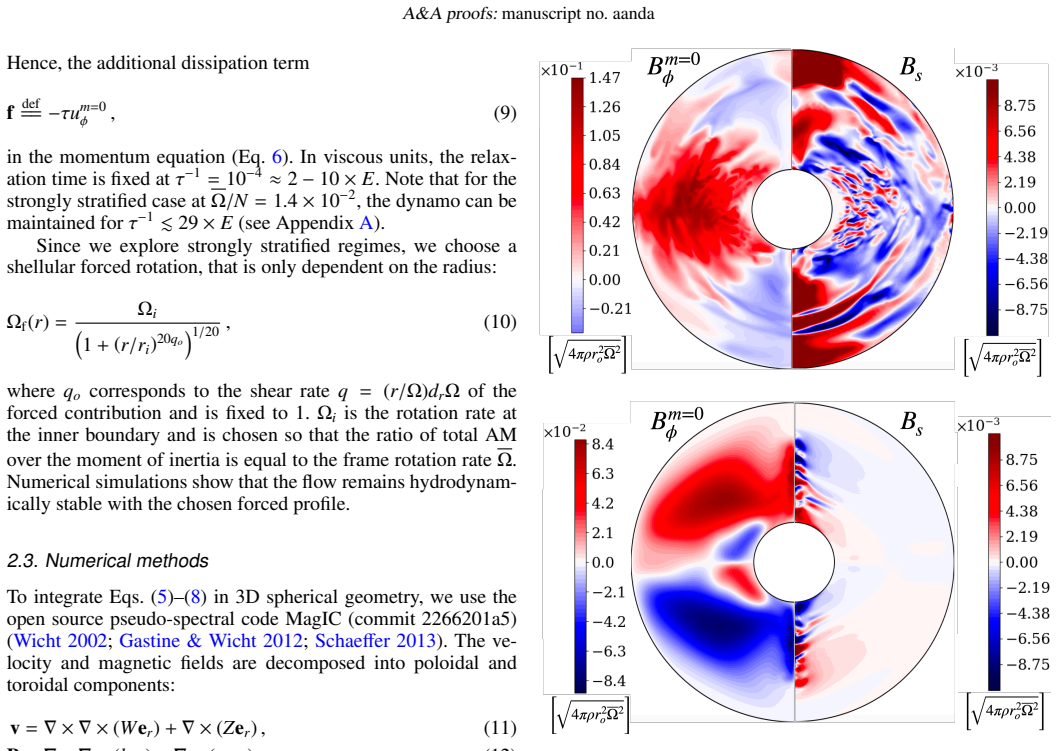
The central claim is that a bistable Tayler-Spruit dynamo exists in a stably stratified, differentially rotating spherical shell: an equatorial MRI-like branch appears only above Ω/N ≈ 0.11, while a polar branch driven by the standard Tayler instability persists to Ω/N = 0.0077 (N_eff ≈ 130 Ω). In the saturated polar state, the toroidal field is independent of stratification, B_φ^{m=0}=0.34√(4πρr²)|q|^{2/3}Ω, while B_r^{m=0}∝(Ω/N_eff)^{5/3}. Combining these with the standard critical Alfvén frequency yields a minimum shear q_min≈5.2(N_eff/Ω)^{3/4}(η/(r²Ω))^{3/8}, far below earlier analytic thresholds at strong stratification.
What carries the argument
The central object is the Tayler-Spruit dynamo, a self-sustaining loop in which differential rotation winds a poloidal seed into a strong toroidal field, the toroidal field becomes unstable to the Tayler (current-driven) instability, and the resulting non-axisymmetric motions regenerate the poloidal field. The numerical setup is a Boussinesq MHD flow between concentric spheres with a volumetric force relaxing the azimuthal velocity to a shellular rotation profile, which avoids the parasitic instabilities of boundary-driven Taylor–Couette configurations. The polar branch is selected by the symmetry of the initial poloidal seed (l=1,m=0) and is identified as Tayler-driven by the location of un
Load-bearing premise
The load-bearing assumption is that a Boussinesq, uniform-density fluid with a volumetrically forced shellular rotation profile represents a real stellar radiative zone; if contraction-driven latitudinal differential rotation or realistic density gradients suppress the polar branch, the new scaling laws would not transfer to stars.
What would settle it
Repeat the same spherical-shell setup with anelastic or compressible dynamics and a realistic stellar density profile while keeping the shellular rotation forcing: if the polar branch does not persist near Ω/N = 0.0077, or if the measured B_φ^{m=0} shows a clear dependence on N_eff, the central scaling and its stellar implications are falsified.
If this is right
- The dynamo persists to Ω/N = 0.0077, so it can operate in strongly stratified layers such as red-giant hydrogen-burning shells where previous prescriptions were thought to shut it off.
- The measured q_min ∝ (N_eff/Ω)^{3/4} is orders of magnitude below earlier analytic thresholds at strong stratification, so weak shear can trigger the dynamo and extend its active volume.
- Maxwell stresses dominate angular momentum transport, with a viscosity scaling close to the recent analytic prescription but with a prefactor that can now be calibrated; stellar evolution codes can implement ν_M and q_min directly.
- The generated radial field is far too weak to explain the fields detected in red giants, but the toroidal field is strong; asteroseismic magnetic shifts would scale as ν^{-1} for such fields rather than the widely used ν^{-3}.
- In fast-rotating main-sequence stars (γ Doradus), the predicted radial fields are strong enough to affect magneto-gravity-inertial modes, offering a possible indirect detection channel.
Where Pith is reading between the lines
- If q_min extrapolates to stellar parameters, the dynamo could also slow the cores of massive-star progenitors before core collapse, potentially bringing neutron-star spin predictions closer to observed ~100 ms periods.
- The bistability implies that the same star could host either a polar or equatorial magnetic geometry depending on its magnetic history; whether real radiative zones select one branch depends on fossil-field seeds, which the paper does not model.
- The independence of B_φ from N_eff is a direct challenge to the standard saturation balance; a revised one-zone theory would need to account for the different latitudes where B_r and B_φ peak.
- A direct numerical test is to repeat the runs with anelastic or compressible stratification and a realistic density profile; if the flat B_φ scaling disappears, the stellar conclusions weaken.
Editorial analysis
A structured set of objections, weighed in public.
Referee Report
Summary. This paper reports direct numerical simulations (DNS) of the Tayler-Spruit dynamo in a stably stratified, differentially rotating Boussinesq spherical shell. The authors identify two coexisting self-sustained dynamo branches: an equatorial branch driven by the magnetorotational instability (MRI) and a previously unreported polar branch driven by the Tayler instability. The polar branch is claimed to survive strong stratification down to Ω/N ≈ 0.0077, much deeper than earlier estimates. From the saturated states they extract scaling laws for the axisymmetric and non-axisymmetric magnetic field components and for the Maxwell and Reynolds stress viscosities, and they derive a new minimum shear criterion q_min ∝ (N_eff/Ω)^{3/4} (Eq. 27). They then use these scalings to argue that the dynamo could transport angular momentum efficiently in red giants and γ Dor stars, and to discuss asteroseismic signatures of strong toroidal fields.
Significance. If the central claim survives scrutiny, this is an important numerical result: it would establish that a Tayler-instability-driven dynamo can operate at stratification levels relevant to evolved stellar radiative zones, and that the shear threshold may be orders of magnitude below the analytical estimates of Spruit (2002) and Fuller et al. (2019). The paper is honest and transparent in important respects: the control experiments in Appendix C cleanly separate the MRI and Tayler modes; bistability is demonstrated at the same control parameters (e.g. PolNO4 and QuadNO4 in Table F.1); all runs and measured quantities are tabulated in Appendix F; and the limitations of the Boussinesq approximation, the volumetric forcing, and the diffusivity values are explicitly acknowledged in Sections 6.1-6.3. The existence of the new polar branch is numerically credible. The quantitative stellar-physics impact, however, depends on the interpretation of Eq. (27) as a trigger threshold, which is the main weakness discussed below.
major comments (3)
- [§3.1, §7, Eq. (27)] The "minimum shear to trigger" is not a measured trigger threshold. Every polar-branch run is initialized with a finite-amplitude ℓ=1,m=0 poloidal field or continued from a saturated weaker-stratification state (Sec. 2.3, Table F.1), and §7 lists the minimal-seed problem as unsolved and calls the criterion "very simplistic". Eq. (27) is derived by equating the saturated-field scaling Eq. (19) with the linear critical-field relation Eq. (18); for a subcritical dynamo this yields at most a persistence estimate, not a statement that infinitesimal or generic seeds will reach the branch. The use of q_min as an operating condition in Sec. 5.2, and the trigger language in the abstract and conclusion, are therefore not supported. The authors should add seed-amplitude/edge-state tests or explicitly re-label Eq. (27) as a persistence threshold and temper the trigger claims.
- [Sec. 4, Tables F.2-F.4] The scaling exponents and prefactors in Eqs. (19)-(20), (23)-(24), (28)-(29), and (27) are fitted to 13 runs without reported uncertainties. The exponents are load-bearing: ν_M ∝ (Ω/N_eff)^{9/4} and q_min ∝ (N_eff/Ω)^{3/4} enter the stellar extrapolations of Sec. 5.2. A bootstrap or leave-one-out analysis over the tabulated data is needed to show, e.g., that the flat B_φ scaling (Eq. 19) is robust rather than dominated by the endpoints (PolNO2, PolNO130). Without uncertainties, the apparent agreement with Fuller et al. (2019) or the claimed 10^2-10^3 decrease in q_min relative to earlier models cannot be assessed.
- [Sec. 3.2, Fig. 5, Eq. (27)] Eq. (27) inherits the quantitative accuracy of Eq. (18), but the data in Fig. 5 only locate the Tayler-mode length scale within the Eq. (16) bounds after multiplying by a factor 4, which the authors call "reasonable". If the critical Alfvén frequency is uncertain by a factor of 4, the inferred q_min is uncertain by a factor 4^{3/2}=8. The paper states "global agreement" but does not propagate this uncertainty into the stellar conclusions of Sec. 5.2 or into the comparison with Fuller et al. and Spruit in Fig. 7. The q_min lines in Fig. 7 should carry, or at least mention, this systematic uncertainty.
minor comments (4)
- [Sec. 2.2] The momentum equation is Eq. (5), not Eq. (6); the sentence "Hence, in the momentum equation (Eq. 6)" is a typo.
- [Notation] The superscript "m,0" (e.g. B^{m,0}_{tot}) is confusing; it should be "m≠0" or explicitly defined as the non-axisymmetric part.
- [Abstract / Sec. 7] The abstract states "minimum shear to trigger the dynamo" while Sec. 7 calls the criterion "very simplistic" and unsolved; the wording should be aligned after the major comment is addressed.
- [Table F.1] The column heading for the initial field amplitude is unclear; specify the units and that the initial poloidal field is a single harmonic.
Circularity Check
q_min is an in-sample algebraic restatement of a fitted B_phi scaling; the claimed 'trigger' threshold is actually a finite-amplitude persistence criterion.
specific steps
-
fitted input called prediction
[Sect. 4.1, Eqs. (19) and (27), Fig. 7]
"Since B^{m=0}_φ follows Eq. 19 and the prescription for ω_{A,c} (Eq. 18) is in global agreement with our data, we can infer a minimum shear by equating both equations: q_min≈5.2 (N_eff/Ω_loc)^{3/4}(η/(r^2_loc Ω_loc))^{3/8}. This plot confirms that our new prescription of q_min is a good lower limit for the onset of the Tayler instability in our simulations, especially at Ω_loc/N_eff≲0.4."
Eq. 19 is a power-law fit to the same simulation dataset, and Eq. 27 is obtained by inserting that fit into Spruit's critical-field condition; the prefactor 5.2 is just 0.34^{-3/2}. Thus the q_min 'prediction' is algebraically forced by the fit rather than independently measured. Fig. 7 then 'confirms' it against the same simulations that produced Eq. 19, making the validation an in-sample consistency check. Moreover, every polar-branch run starts from a finite-amplitude ℓ=1,m=0 poloidal seed or continuation from a weaker-stratification state (Table F.1), so the boundary probed is persistence, not triggering; Sect. 7 admits the minimal-seed problem is unsolved.
full rationale
The existence of the new polar dynamo branch and its scaling laws are not circular: they are nonlinear saturated states of the Boussinesq MHD equations (Eqs. 5-8) computed in 3D, and the scaling laws are openly presented as fits (Fig. 6). The circularity is localized to the q_min 'prediction' (Eq. 27), which is derived by equating the fitted B_φ law (Eq. 19) with Spruit's analytic critical field (Eq. 18) and then validated on the same simulations. The prefactor and functional form therefore carry no new information about the onset; and because all runs are seeded with finite-amplitude ℓ=1,m=0 poloidal fields or continued states, the paper's 'trigger' language (abstract, Eq. 27 discussion, Sect. 7) overstates what the data show. Self-citations to Barrère et al. are used only for comparison/continuity, and the Spruit limits are external theory, so no separate self-citation circularity is present. These caveats do not invalidate the simulated coexistence of the two branches, a genuinely self-contained numerical result.
Axiom & Free-Parameter Ledger
free parameters (13)
- B_phi scaling prefactor =
0.34
- B_phi q-exponent =
2/3
- B_r scaling prefactor =
0.08
- B_r (N_eff) exponent =
5/3
- Non-axisymmetric B_tot prefactor =
0.003
- Non-axisymmetric B_r prefactor =
0.001
- ν_M prefactor =
0.06
- ν_M (N_eff) exponent =
9/4
- ν_R prefactor =
2e-5
- q_min prefactor =
5.2
- Fuller-fit prefactor α =
≈0.36
- General transport exponent n and prefactor C_T =
n≈2.4, C_T≈0.1
- Averaging threshold =
0.5 max(E_Br)
axioms (6)
- domain assumption Boussinesq approximation with uniform density
- domain assumption Shellular differential rotation maintained by volumetric forcing with relaxation time τ^-1=10^-4
- standard math MRI stability criterion with effective Brunt-Väisälä frequency (Eq. 15)
- standard math Spruit's Tayler-mode length-scale limits (Eq. 16) and critical Alfvén frequency (Eq. 18)
- domain assumption Identification of polar instability as Tayler-driven via mode location and latitudinal-gradient correlation
- ad hoc to paper Subcritical dynamo is representative: branches reached via ℓ=1,m=0 or ℓ=2,m=0 poloidal seeds
Cite this review
Pith. "Pith review of Coexisting Tayler instability-driven dynamos in radiative zones: New dynamo solution and its impacts on stellar physics." pith.science (2026). https://pith.science/paper/U72PR76I
@misc{pith2026260102129,
  author       = {Pith},
  title        = {Pith review of: Coexisting Tayler instability-driven dynamos in radiative zones: New dynamo solution and its impacts on stellar physics},
  year         = {2026},
  howpublished = {\url{https://pith.science/paper/U72PR76I}},
  note         = {Machine review of arXiv:2601.02129}
}
read the original abstract
Recent asteroseismic observations constitute a great challenge for rotating stellar evolution models, which predict overly fast internal rotation rates when only hydrodynamic processes are included. This suggests the absence of one or several unidentified angular momentum (AM) transport processes in these models. Transport by large-scale and strong magnetic fields in the radiative zone is a promising candidate to explain the observations. While these fields might be characterised by a fossil origin, the Tayler-Spruit dynamo constitutes a primary mechanism to form the necessary magnetic fields. Despite recent numerical studies, this mechanism remains poorly known. Motivated by this scenario, we investigated the Tayler-Spruit dynamo through a new set of 3D numerical simulations. We modelled the radiative zone as a Boussinesq stably stratified fluid whose differential rotation is maintained by a volumetric body force. Here, we report, for the first time, the coexistence of two dynamo solutions, which mainly differ by the magnetic field location (near the equator and the polar axis). While the equatorial dynamo is driven by an instability sharing both characteristics of the magnetorotational and Tayler instabilities, we focus mainly on the newly identified polar dynamo, which is driven by the standard Tayler instability. We show that this dynamo can still operate and transport AM efficiently in a strong stratification regime, with a Brunt-V\"ais\"al\"a frequency that is 130 times larger than the rotation rate. We extracted new scaling laws for the magnetic field, AM transport, and the minimum shear to trigger the dynamo. Finally, we were able to roughly constrain the signature of the generated magnetic fields on asteroseismic modes propagating in main sequence and evolved stars.
Figures



Forward citations
Cited by 1 Pith paper
-
Spinning down neutron-star merger remnants with the Tayler-Spruit dynamo: Global simulations reveal the formation of massive disks and neutron-rich ejecta
A subgrid Tayler–Spruit dynamo in axisymmetric GR neutrino-MHD runs flattens merger-core rotation on ~100 ms scales, builds massive neutron-rich disks, and boosts neutron-rich ejecta.
Reference graph
Works this paper leans on
-
[1]
R., Langer, N., Moriya, T
Aguilera-Dena, D. R., Langer, N., Moriya, T. J., & Schootemeijer, A. 2018, ApJ, 858, 115
2018
-
[2]
C., Brun, A
Augustson, K. C., Brun, A. S., & Toomre, J. 2016, ApJ, 829, 92
2016
-
[3]
C., Brun, A
Augustson, K. C., Brun, A. S., & Toomre, J. 2019, ApJ, 876, 83
2019
-
[4]
2006, in ESA Special Publication, V ol
Baglin, A., Auvergne, M., Barge, P., et al. 2006, in ESA Special Publication, V ol. 1306, The CoRoT Mission Pre-Launch Status - Stellar Seismology and Planet Finding, ed. M. Fridlund, A. Baglin, J. Lochard, & L. Conroy, 33
2006
-
[5]
Balbus, S. A. & Hawley, J. F. 1991, ApJ, 376, 214
1991
-
[6]
Balbus, S. A. & Hawley, J. F. 1998, Reviews of Modern Physics, 70, 1
1998
-
[7]
Barrault, L., Bugnet, L., Mathis, S., & Mombarg, J. S. G. 2025, arXiv e-prints, arXiv:2507.00308 Barrère, P., Guilet, J., Rayanud, R., & Reboul-Salze, A. 2024, To be submitted in Physical Review of Fluids Barrère, P., Guilet, J., Raynaud, R., & Reboul-Salze, A. 2023, MNRAS, 526, L88 Barrère, P., Guilet, J., Raynaud, R., & Reboul-Salze, A. 2025, A&A, 695, ...
arXiv 2025
-
[8]
P., Goupil, M
Belkacem, K., Marques, J. P., Goupil, M. J., et al. 2015b, A&A, 579, A30 Bordadágua, B., Ahlborn, F., Coppée, Q., et al. 2025, A&A, 699, A310
2025
-
[9]
J., Koch, D., Basri, G., et al
Borucki, W. J., Koch, D., Basri, G., et al. 2010, Science, 327, 977
2010
-
[10]
2013, SIAM Journal on Scientific Com- puting, 35, A22
Boscarino, S., Pareschi, L., & Russo, G. 2013, SIAM Journal on Scientific Com- puting, 35, A22
2013
-
[11]
2008, MNRAS, 386, 1947
Braithwaite, J. 2008, MNRAS, 386, 1947
2008
-
[12]
& Spruit, H
Braithwaite, J. & Spruit, H. C. 2017, Royal Society Open Science, 4, 160271
2017
-
[13]
S., Browning, M
Brun, A. S., Browning, M. K., & Toomre, J. 2005, ApJ, 629, 461
2005
-
[14]
2014, ApJ, 788, 93
Cantiello, M., Mankovich, C., Bildsten, L., Christensen-Dalsgaard, J., & Paxton, B. 2014, ApJ, 788, 93
2014
-
[15]
A., & Mathis, S
Ceillier, T., Eggenberger, P., García, R. A., & Mathis, S. 2013, A&A, 555, A54
2013
-
[16]
S., Brummell, N
Cline, K. S., Brummell, N. H., & Cattaneo, F. 2003, ApJ, 599, 1449
2003
-
[17]
2023, Physical Review Fluids, 8, 123701
Daniel, F., Petitdemange, L., & Gissinger, C. 2023, Physical Review Fluids, 8, 123701
2023
-
[18]
G., et al
Deheuvels, S., Ballot, J., Beck, P. G., et al. 2015, A&A, 580, A96
2015
-
[19]
J., et al
Deheuvels, S., Do˘gan, G., Goupil, M. J., et al. 2014, A&A, 564, A27
2014
-
[20]
2023, A&A, 670, L16 den Hartogh, J
Deheuvels, S., Li, G., Ballot, J., & Lignières, F. 2023, A&A, 670, L16 den Hartogh, J. W., Eggenberger, P., & Deheuvels, S. 2020, A&A, 634, L16 den Hartogh, J. W., Eggenberger, P., & Hirschi, R. 2019, A&A, 622, A187
2023
-
[21]
Denissenkov, P. A. & Pinsonneault, M. 2007, ApJ, 655, 1157
2007
-
[22]
2022, A&A, 661, A133
Dhouib, H., Mathis, S., Bugnet, L., Van Reeth, T., & Aerts, C. 2022, A&A, 661, A133
2022
-
[23]
2010, ApJ, 724, L34
Duez, V ., Braithwaite, J., & Mathis, S. 2010, ApJ, 724, L34
2010
-
[24]
& Mathis, S
Duez, V . & Mathis, S. 2010, A&A, 517, A58
2010
-
[25]
D., Bushby, P
Duguid, C. D., Bushby, P. J., & Wood, T. S. 2023, MNRAS, 520, 527
2023
-
[26]
2017, A&A, 599, A18
Eggenberger, P., Lagarde, N., Miglio, A., et al. 2017, A&A, 599, A18
2017
-
[27]
2005, A&A, 440, L9
Eggenberger, P., Maeder, A., & Meynet, G. 2005, A&A, 440, L9
2005
-
[28]
2012, A&A, 544, L4
Eggenberger, P., Montalbán, J., & Miglio, A. 2012, A&A, 544, L4
2012
-
[29]
D., & den Hartogh, J
Eggenberger, P., Moyano, F. D., & den Hartogh, J. W. 2022b, A&A, 664, L16 Ekström, S., Georgy, C., Eggenberger, P., et al. 2012, A&A, 537, A146
2012
-
[30]
2014, ApJ, 796, 17
Fuller, J., Lecoanet, D., Cantiello, M., & Brown, B. 2014, ApJ, 796, 17
2014
-
[31]
Fuller, J. & Lu, W. 2022, MNRAS, 511, 3951
2022
-
[32]
L., & Jermyn, A
Fuller, J., Piro, A. L., & Jermyn, A. S. 2019, MNRAS, 485, 3661
2019
-
[33]
M., Mankovich, C., & Moore, K
Garaud, P., Medrano, M., Brown, J. M., Mankovich, C., & Moore, K. 2015, ApJ, 808, 89
2015
-
[34]
& Wicht, J
Gastine, T. & Wicht, J. 2012, Icarus, 219, 428
2012
-
[35]
2018, A&A, 616, A24
Gehan, C., Mosser, B., Michel, E., Samadi, R., & Kallinger, T. 2018, A&A, 616, A24
2018
-
[36]
2012, Phys
Gissinger, C., Petitdemange, L., Schrinner, M., & Dormy, E. 2012, Phys. Rev. Lett., 108, 234501
2012
-
[37]
Goossens, M., Biront, D., & Tayler, R. J. 1981, Astrophys. Space Sci., 75, 521
1981
-
[38]
& Tayler, R
Goossens, M. & Tayler, R. J. 1980, MNRAS, 193, 833
1980
-
[39]
2022, A&A, 661, A119
Gouhier, B., Jouve, L., & Lignières, F. 2022, A&A, 661, A119
2022
-
[40]
2021, A&A, 648, A109
Gouhier, B., Lignières, F., & Jouve, L. 2021, A&A, 648, A109
2021
-
[41]
2022, A&A, 665, A147
Griffiths, A., Eggenberger, P., Meynet, G., Moyano, F., & Aloy, M.-Á. 2022, A&A, 665, A147
2022
-
[42]
2022, MN- RAS, 516, 4346
Guilet, J., Reboul-Salze, A., Raynaud, R., Bugli, M., & Gallet, B. 2022, MN- RAS, 516, 4346
2022
-
[43]
J., Ong, J
Hatt, E. J., Ong, J. M. J., Nielsen, M. B., et al. 2024, MNRAS, 534, 1060
2024
-
[44]
F., Gammie, C
Hawley, J. F., Gammie, C. F., & Balbus, S. A. 1996, ApJ, 464, 690
1996
-
[45]
E., & Spruit, H
Heger, A., Woosley, S. E., & Spruit, H. C. 2005, ApJ, 626, 350
2005
-
[46]
P., Frantsuzova, A., Gourgouliatos, K
Igoshev, A. P., Frantsuzova, A., Gourgouliatos, K. N., et al. 2022, MNRAS, 514, 4606
2022
-
[47]
2020, A&A, 641, A13
Jouve, L., Lignières, F., & Gaurat, M. 2020, A&A, 641, A13
2020
-
[48]
2024, A&A, 688, A184
Li, G., Deheuvels, S., & Ballot, J. 2024, A&A, 688, A184
2024
-
[49]
2022, Nature, 610, 43
Li, G., Deheuvels, S., Ballot, J., & Lignières, F. 2022, Nature, 610, 43
2022
-
[50]
2023, A&A, 680, A26
Li, G., Deheuvels, S., Li, T., Ballot, J., & Lignières, F. 2023, A&A, 680, A26
2023
-
[51]
R., et al
Li, G., Van Reeth, T., Bedding, T. R., et al. 2020, MNRAS, 491, 3586 Lignières, F., Ballot, J., Deheuvels, S., & Galoy, M. 2024, A&A, 683, A2
2020
-
[52]
2009, Physics, Formation and Evolution of Rotating Stars
Maeder, A. 2009, Physics, Formation and Evolution of Rotating Stars
2009
-
[53]
& Meynet, G
Maeder, A. & Meynet, G. 2000, ARA&A, 38, 143
2000
-
[54]
& Meynet, G
Maeder, A. & Meynet, G. 2003, A&A, 411, 543
2003
-
[55]
& Meynet, G
Maeder, A. & Meynet, G. 2014, ApJ, 793, 123
2014
-
[56]
M., Ponty, Y ., & Marcotte, F
Mannix, P. M., Ponty, Y ., & Marcotte, F. 2022, Phys. Rev. Lett., 129, 024502
2022
-
[57]
P., Goupil, M
Marques, J. P., Goupil, M. J., Lebreton, Y ., et al. 2013, A&A, 549, A74
2013
-
[58]
& Bugnet, L
Mathis, S. & Bugnet, L. 2023, A&A, 676, L9
2023
-
[59]
G., Jouve, L., & Lignières, F
Meduri, D. G., Jouve, L., & Lignières, F. 2024, A&A, 683, A12
2024
-
[60]
A., & Spruit, H
Menou, K., Balbus, S. A., & Spruit, H. C. 2004, ApJ, 607, 564
2004
-
[61]
J., Belkacem, K., et al
Mosser, B., Goupil, M. J., Belkacem, K., et al. 2012, A&A, 548, A10
2012
-
[62]
D., Eggenberger, P., Meynet, G., et al
Moyano, F. D., Eggenberger, P., Meynet, G., et al. 2022, A&A, 663, A180
2022
-
[63]
D., Eggenberger, P., & Salmon, S
Moyano, F. D., Eggenberger, P., & Salmon, S. J. A. J. 2024, A&A, 681, L16
2024
-
[64]
D., Eggenberger, P., Salmon, S
Moyano, F. D., Eggenberger, P., Salmon, S. J. A. J., Mombarg, J. S. G., & Ek- ström, S. 2023, A&A, 677, A6
2023
-
[65]
M., Marques, J
Ouazzani, R. M., Marques, J. P., Goupil, M. J., et al. 2019, A&A, 626, A121
2019
-
[66]
Parker, E. N. 1955, ApJ, 121, 491
1955
-
[67]
2023, Science, 379, 300
Petitdemange, L., Marcotte, F., & Gissinger, C. 2023, Science, 379, 300
2023
-
[68]
2024, A&A, 681, A75 Pinçon, C., Belkacem, K., & Goupil, M
Petitdemange, L., Marcotte, F., Gissinger, C., & Daniel, F. 2024, A&A, 681, A75 Pinçon, C., Belkacem, K., & Goupil, M. J. 2016, A&A, 588, A122 Pinçon, C., Belkacem, K., Goupil, M. J., & Marques, J. P. 2017, A&A, 605, A31
2024
-
[69]
2021, A&A, 645, A109
Reboul-Salze, A., Guilet, J., Raynaud, R., & Bugli, M. 2021, A&A, 645, A109
2021
-
[70]
2022, A&A, 667, A94
Reboul-Salze, A., Guilet, J., Raynaud, R., & Bugli, M. 2022, A&A, 667, A94
2022
-
[71]
R., Winn, J
Ricker, G. R., Winn, J. N., Vanderspek, R., et al. 2015, Journal of Astronomical
2015
-
[72]
2025, A&A, 696, A143
Rincon, F., Barrère, P., & Roudier, T. 2025, A&A, 696, A143
2025
-
[73]
2013, Journal of Fluid Mechanics, 731, 1
Riols, A., Rincon, F., Cossu, C., et al. 2013, Journal of Fluid Mechanics, 731, 1
2013
-
[74]
M., Lin, D
Rogers, T. M., Lin, D. N. C., McElwaine, J. N., & Lau, H. H. B. 2013, ApJ, 772, 21 Rüdiger, G., Gellert, M., Spada, F., & Tereshin, I. 2015, A&A, 573, A80
2013
-
[75]
Rui, N. Z. & Fuller, J. 2023, MNRAS, 523, 582
2023
-
[76]
2013, Geochemistry, Geophysics, Geosystems, 14, 751
Schaeffer, N. 2013, Geochemistry, Geophysics, Geosystems, 14, 751
2013
-
[77]
Skene, C. S., Marcotte, F., & Tobias, S. M. 2024, arXiv e-prints, arXiv:2411.05499
arXiv 2024
-
[78]
Skoutnev, V . A. & Beloborodov, A. M. 2025, ApJ, 989, L4
2025
-
[79]
2016, A&A, 589, A23
Spada, F., Gellert, M., Arlt, R., & Deheuvels, S. 2016, A&A, 589, A23
2016
-
[80]
Spruit, H. C. 1999, A&A, 349, 189
1999
This paper was first reviewed by deepseek-v4-flash on August 3, 2026.
discussion (0)
Sign in with ORCID, Apple, or X to comment. Anyone can read and Pith papers without signing in.