REVIEW 3 major objections 2 minor 1 cited by
TDEs on FIRE: Illuminating the Cosmic Evolution of Tidal Disruption Rates
T0 review · 3 major / 2 minor · reviewed 2026-06-28 · grok-4.3
Pith's one-line read Simulations find the average tidal disruption rate per galaxy peaks near redshift 2.5 then falls sharply by redshift 1.
desk verdict FIRE-2 supplies the first simulation-based TDR(z) to z=10 but the central densities sit below the resolution limit, so the numbers rest on an untested extrapolation. read the letter →
The pith
A machine-rendered reading of the paper's core claim, the machinery that carries it, and where it could break.
The reading
What carries the argument
FIRE-2 cosmological zoom-in simulations that model central stellar densities, black-hole populations, and dynamical conditions to compute per-galaxy tidal disruption rates across redshift.
What would settle it
A direct measurement or statistical sample of tidal disruption events at redshift approximately 2.5 that yields an average per-galaxy rate far below or far above 4 times 10 to the minus 4 per year.
Extended reading notes
Core claim
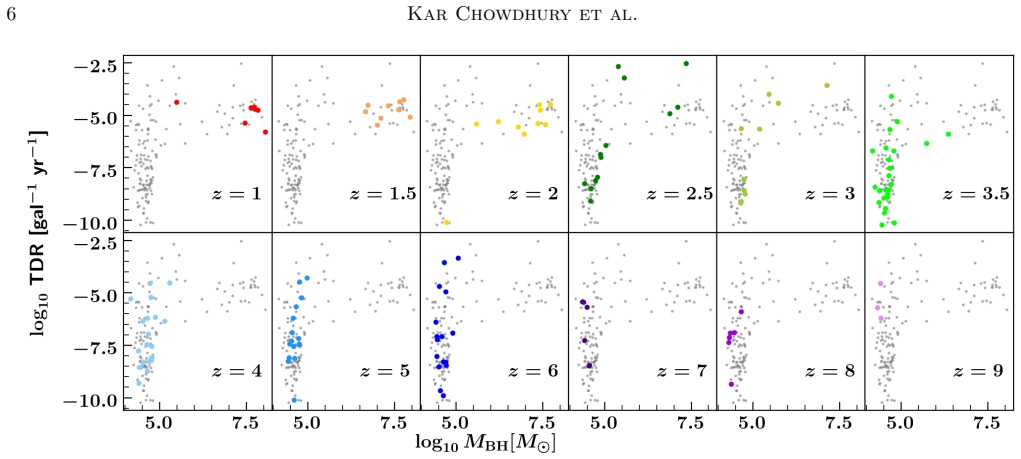
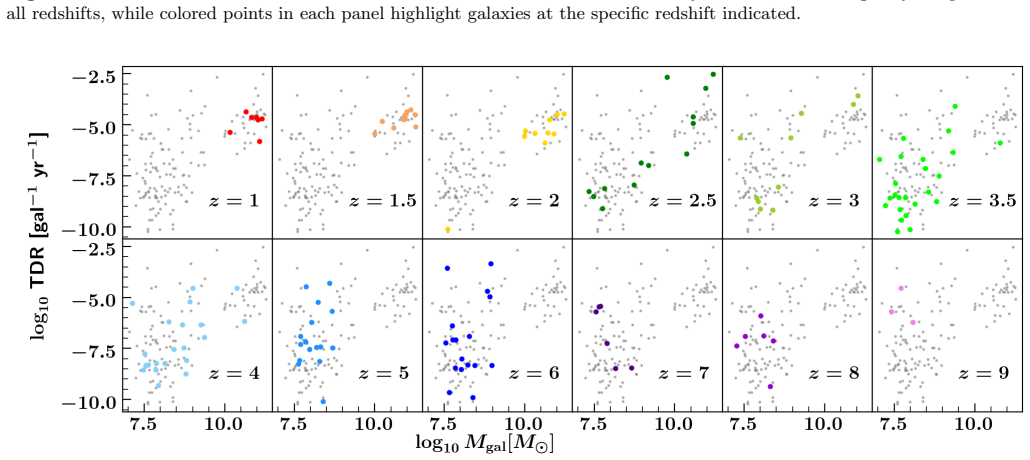
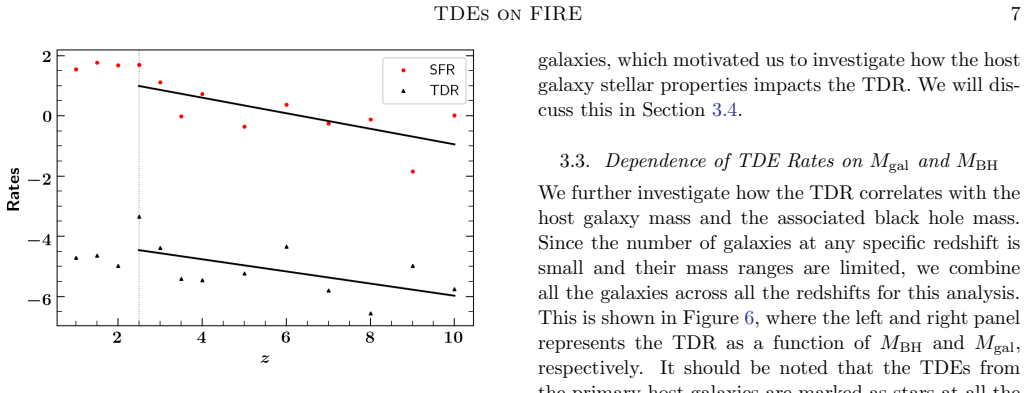
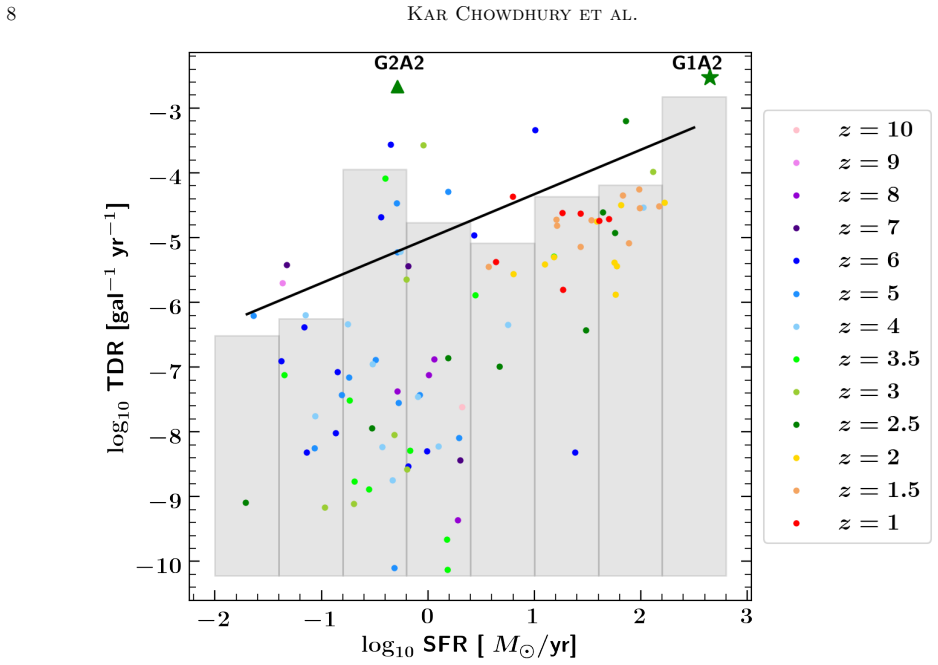
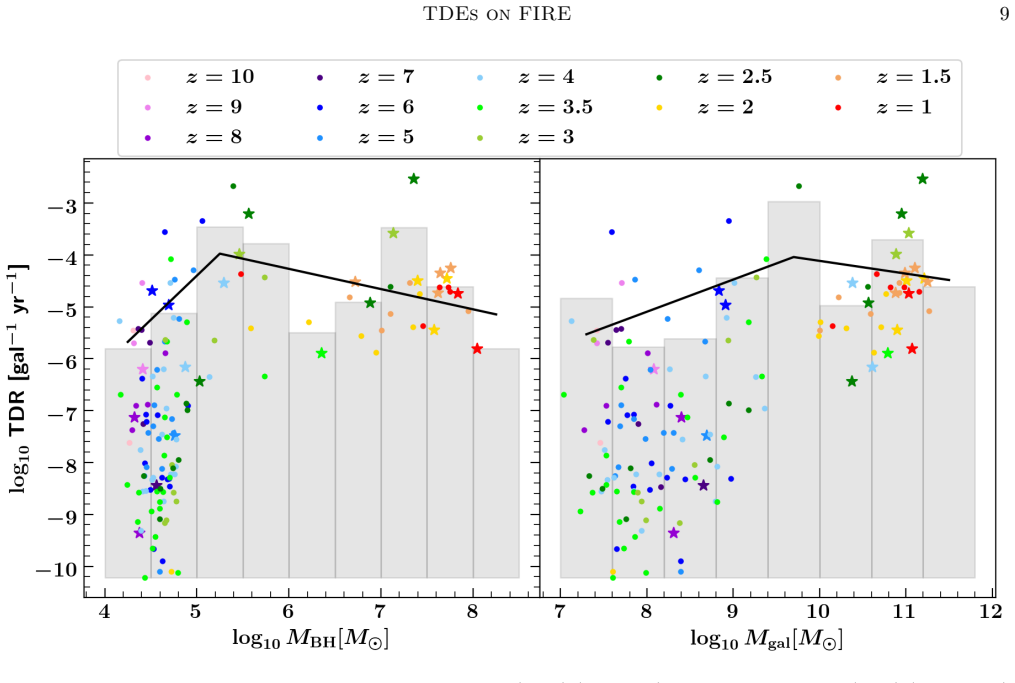
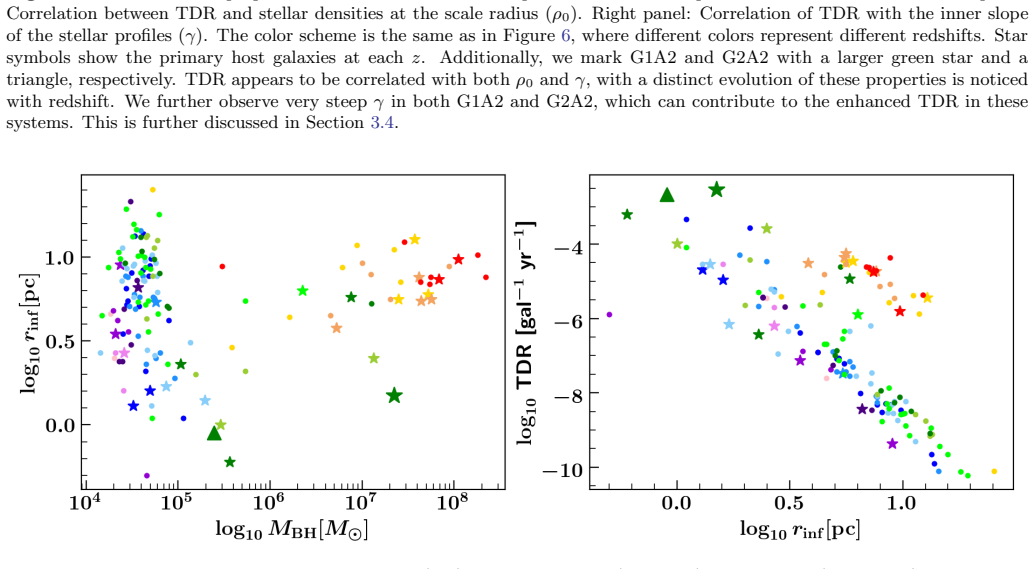
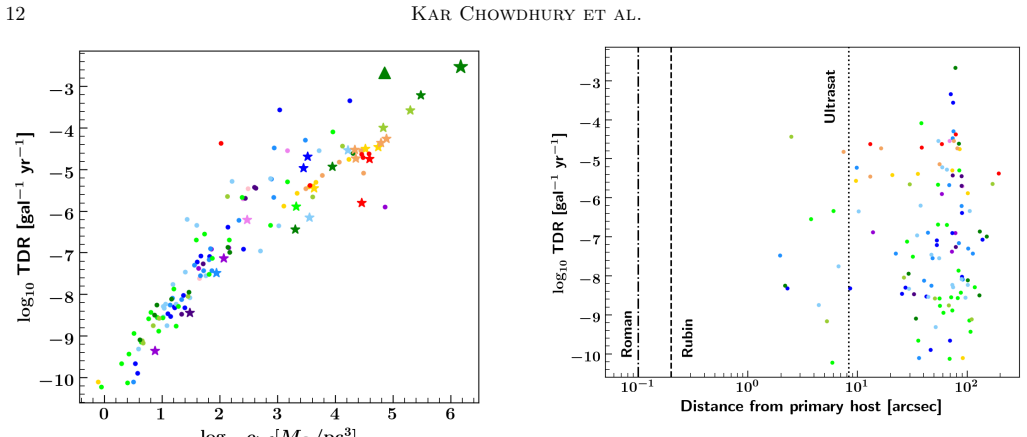
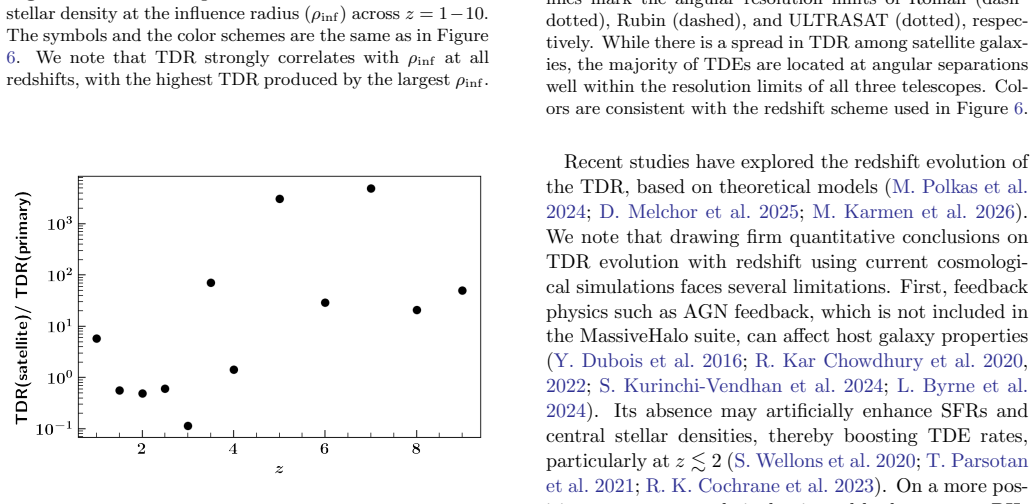
Using the FIRE-2 cosmological zoom-in simulations, the per-galaxy tidal disruption rate is computed over redshifts 1 to 10 for black holes ranging from intermediate-mass to supermassive. The averaged rate rises from the early universe, peaks at approximately 4 times 10 to the minus 4 per year near redshift 2.5, and declines to about 10 to the minus 5 per year at redshift 1. This rate correlates strongly with host-galaxy star-formation rate and central stellar density at all redshifts. The dependence on black-hole mass and galaxy mass remains qualitatively similar from high redshift to the local universe, and satellite galaxies show comparably high rates whose fractional contribution grows at
Load-bearing premise
The FIRE-2 simulations accurately capture the central stellar densities, black-hole populations, and dynamical conditions needed to compute tidal disruption rates at redshifts above 1.
Editorial extensions
If this is right
- Tidal disruption rates track star-formation rate and central density, so galaxies with elevated star formation should produce more events at any redshift.
- Satellite galaxies maintain high rates whose share increases at high redshift, making them useful targets for finding intermediate-mass black holes.
- The black-hole to galaxy mass trends stay consistent from high redshift to today, supporting similar scaling relations across cosmic time.
- Cosmological simulations can now supply predictions for the cosmic evolution of tidal disruption rates that future surveys can test directly.
Reading between the lines
- Confirmation of the redshift-2.5 peak would link the era of maximum star formation directly to the era of maximum central stellar densities that drive disruptions.
- Higher rates at earlier times could alter estimates of how much black-hole growth occurs through stellar capture rather than gas accretion.
- If satellite contributions are as large as modeled, wide-field high-redshift transient searches could preferentially detect events in merging or assembling galaxies.
Editorial analysis
A structured set of objections, weighed in public.
Referee Report
Summary. The paper uses FIRE-2 cosmological zoom-in simulations to compute per-galaxy tidal disruption rates (TDR) from z=1 to 10 across IMBH to SMBH masses. It reports that the averaged TDR rises from early times, peaks at ~4×10^{-4} yr^{-1} near z~2.5, and falls to ~10^{-5} yr^{-1} at z=1. The TDR is stated to correlate strongly with host SFR and central stellar density at all redshifts; trends with M_BH and M_gal are qualitatively similar to the local universe; satellite galaxies contribute an increasing fraction of the TDR at high z.
Significance. If robust, the work supplies the first simulation-derived TDR(z) evolution and links it to galaxy properties, offering testable predictions for high-redshift TDE searches. The approach of extracting rates directly from cosmological zoom-ins is novel for this problem. Credit is due for covering a wide redshift range and including satellites. However, the result's significance hinges on whether the unresolved central densities can be reliably mapped to TDR.
major comments (3)
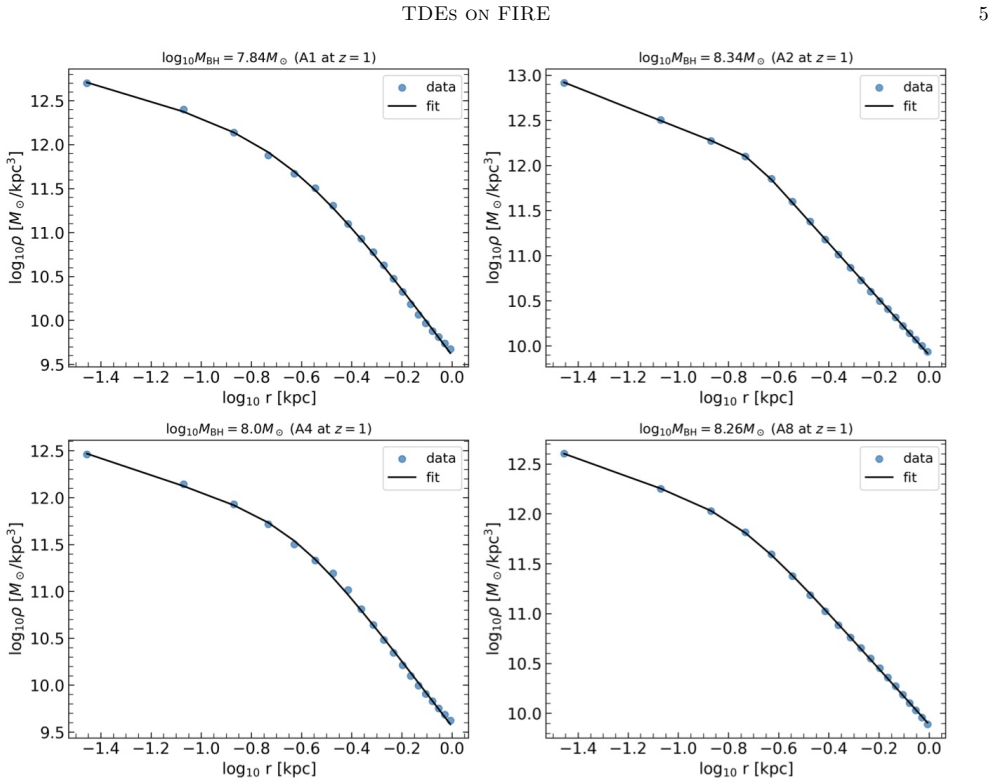
- [Abstract / Methods] Abstract and methods (TDR extraction): the headline TDR(z) curve is obtained by applying an estimator to simulated M_BH, M_gal, SFR, and central stellar density. No derivation, functional form, or sub-grid extrapolation for the loss-cone density is provided; the exponential sensitivity of TDR to density within the BH influence radius means any inaccuracy in the unresolved nuclear density shifts both normalization and peak redshift by factors of several.
- [Abstract / Results] Abstract and results (validation): no comparison of the computed local (z~0) TDR to observed rates is shown, nor are error bars or resolution convergence tests reported. Without this anchor, the claimed evolution from z=10 to z=1 cannot be assessed for systematic bias.
- [Abstract] Abstract (correlations): the reported strong correlation between TDR and central stellar density is expected by construction once the estimator is applied to that density; it therefore does not constitute independent validation of the redshift trend or the underlying density field.
minor comments (2)
- [Abstract] Abstract: include a one-sentence description of the TDR estimator and the mass range of black holes considered.
- [Figures] Figure clarity: ensure any TDR(z) plots show individual galaxy tracks or scatter in addition to the average to allow assessment of sample variance.
Simulated Author's Rebuttal
We thank the referee for their detailed and constructive report. We address each major comment below and indicate where revisions will be made to strengthen the manuscript.
read point-by-point responses
-
Referee: [Abstract / Methods] Abstract and methods (TDR extraction): the headline TDR(z) curve is obtained by applying an estimator to simulated M_BH, M_gal, SFR, and central stellar density. No derivation, functional form, or sub-grid extrapolation for the loss-cone density is provided; the exponential sensitivity of TDR to density within the BH influence radius means any inaccuracy in the unresolved nuclear density shifts both normalization and peak redshift by factors of several.
Authors: We agree that the methods section would benefit from an explicit derivation of the TDR estimator, including the functional form relating loss-cone refilling to central stellar density. The estimator follows the standard loss-cone formalism (e.g., as in Merritt & Wang 2005 and subsequent works), applied to the resolved central densities in FIRE-2. We will add this derivation, the precise functional form, and a brief discussion of sub-grid assumptions in a revised Methods section. This addresses the concern about transparency while noting that the simulations themselves provide the density evolution. revision: yes
-
Referee: [Abstract / Results] Abstract and results (validation): no comparison of the computed local (z~0) TDR to observed rates is shown, nor are error bars or resolution convergence tests reported. Without this anchor, the claimed evolution from z=10 to z=1 cannot be assessed for systematic bias.
Authors: We acknowledge the value of anchoring the results to local observations. In the revised manuscript we will include a direct comparison of our z≈0 TDR values to the observed local TDE rate range (∼10^{-5}–10^{-4} yr^{-1} per galaxy) from the literature, along with sample variance error bars derived from the zoom-in suite. Resolution convergence is limited by the fixed FIRE-2 resolution; we will add a brief discussion of this limitation and note that higher-resolution follow-up simulations would be needed for full convergence tests. revision: partial
-
Referee: [Abstract] Abstract (correlations): the reported strong correlation between TDR and central stellar density is expected by construction once the estimator is applied to that density; it therefore does not constitute independent validation of the redshift trend or the underlying density field.
Authors: We agree that the TDR–central-density correlation is expected by construction of the estimator. However, the independent correlation with SFR (which is not an input to the estimator) and the persistence of M_BH and M_gal trends across redshift provide additional support for the physical trends. We will revise the abstract and results text to clarify this distinction and to emphasize that the redshift evolution arises from the simulated evolution of galaxy properties rather than from the estimator alone. revision: yes
Circularity Check
No significant circularity in derivation chain
full rationale
The paper computes per-galaxy TDR directly from FIRE-2 simulation snapshots of M_BH, M_gal, SFR and central stellar density over z=1-10, then reports the resulting averaged TDR(z) evolution and correlations. No equations, fitted parameters, or self-citations are shown that define the output TDR in terms of itself or rename a fitted input as a prediction. The stated correlations with SFR and central density are expected consequences of applying any standard TDR estimator but do not reduce the headline TDR(z) curve to a tautology by construction; the main result remains an independent computation from the simulation data. The derivation is therefore self-contained against external simulation inputs with no load-bearing circular steps.
Assumptions & free parameters
Cite this review
Pith. "Pith review of TDEs on FIRE: Illuminating the Cosmic Evolution of Tidal Disruption Rates." pith.science (2026). https://pith.science/paper/U73YDRXB
@misc{pith2026260604740,
  author       = {Pith},
  title        = {Pith review of: TDEs on FIRE: Illuminating the Cosmic Evolution of Tidal Disruption Rates},
  year         = {2026},
  howpublished = {\url{https://pith.science/paper/U73YDRXB}},
  note         = {Machine review of arXiv:2606.04740}
}
abstract
Tidal disruption events have been extensively studied in the local universe, but their prevalence at high redshifts remains largely unexplored. Using the FIRE-2 cosmological zoom-in simulations, we compute the per-galaxy tidal disruption rate (TDR) over $z=1-10$, covering black holes from IMBHs to SMBHs. The averaged TDR rises from the early universe, peaks at $\sim 4 \times 10^{-4} \, \text{yr}^{-1}$ near $z \sim 2.5$, and declines to $\sim 10^{-5} \, \text{yr}^{-1}$ at $z=1$. The TDR correlates strongly with host galaxy star formation rate and central stellar density at all redshifts. Qualitatively, the TDR trends with the $M_{\rm BH}$ and $M_{\rm gal}$ persist from high redshift to the local universe, suggesting similar BH-galaxy scaling across cosmic time. Satellite galaxies exhibit comparably high TDRs, with their fractional contribution increasing significantly at high redshifts, highlighting their potential for probing IMBHs and early galaxy assembly. This work demonstrates that cosmological simulations offer a promising avenue for constraining the cosmic evolution of the TDR, paving the way for future comparisons with next-generation observations.
Figures
Figures from the paper (8 more)

Forward citations
Cited by 1 Pith paper
-
Rates of tidal disruption events from constrained cosmological simulations of the local Universe: population properties and implications for transient surveys
In simulated local clusters, tidal disruption events are dominated by cuspy satellite galaxies in extended halos, with a volumetric rate of ~600 Gpc^-3 yr^-1 inherited from empirical TDE scaling relations.
Reference graph
Works this paper leans on
-
[1]
Cosmological Simulation of Galaxy Groups and Clusters. I. Global Effect of Feedback from Active Galactic Nuclei. , keywords =. doi:10.3847/1538-4357/ab5b96 , archivePrefix =. 1911.07824 , primaryClass =
-
[2]
Cosmological Simulation of Galaxy Groups and Clusters. II. Studying Different Modes of Feedback through X-Ray Observations. , keywords =. doi:10.3847/1538-4357/ac951c , archivePrefix =. 2209.13349 , primaryClass =
-
[3]
Detecting Population III Stars through Tidal Disruption Events in the Era of JWST and Roman. , keywords =. doi:10.3847/2041-8213/ad41b7 , archivePrefix =. 2401.12752 , primaryClass =
-
[4]
Rates of Stellar Tidal Disruption Events around Intermediate-mass Black Holes. , keywords =. doi:10.3847/2041-8213/adace7 , archivePrefix =. 2407.09339 , primaryClass =
-
[5]
Merger Driven or Internal Evolution? A New Morphological Study of Tidal Disruption Event Host Galaxies. arXiv e-prints , keywords =. doi:10.48550/arXiv.2602.06839 , archivePrefix =. 2602.06839 , primaryClass =
-
[6]
Spatially Resolved Stellar Populations of 0.3 < z < 6.0 Galaxies in WHL 0137-08 and MACS 0647+70 Clusters as Revealed by JWST: How Do Galaxies Grow and Quench over Cosmic Time?. , keywords =. doi:10.3847/1538-4357/acba06 , archivePrefix =. 2301.02209 , primaryClass =
-
[7]
The Astropy Project: Building an inclusive, open-science project and status of the v2.0 core package
The Astropy Project: Building an Open-science Project and Status of the v2.0 Core Package. , keywords =. doi:10.3847/1538-3881/aabc4f , archivePrefix =. 1801.02634 , primaryClass =
-
[8]
The Formation of the First Star in the Universe
The Formation of the First Star in the Universe. Science , keywords =. doi:10.1126/science.295.5552.93 , archivePrefix =. astro-ph/0112088 , primaryClass =
Show all 251 references
-
[9]
, keywords =
Radio Properties of Tidal Disruption Events. , keywords =. doi:10.1007/s11214-020-00702-w , archivePrefix =. 2006.01159 , primaryClass =
2006 doi
-
[10]
, keywords =
Tidal disruption discs formed and fed by stream-stream and stream-disc interactions in global GRHD simulations. , keywords =. doi:10.1093/mnras/stab3444 , archivePrefix =. 2008.04922 , primaryClass =
2008 doi
-
[11]
, keywords =
A very luminous jet from the disruption of a star by a massive black hole. , keywords =. doi:10.1038/s41586-022-05465-8 , archivePrefix =. 2211.16530 , primaryClass =
- [12]
- [13]
-
[14]
Nature Astronomy , keywords =
A fast-rising tidal disruption event from a candidate intermediate-mass black hole. Nature Astronomy , keywords =. doi:10.1038/s41550-022-01811-y , archivePrefix =. 2209.00018 , primaryClass =
- [15]
- [16]
-
[17]
, keywords =
The Peak of the Fallback Rate from Tidal Disruption Events: Dependence on Stellar Type. , keywords =. doi:10.3847/2041-8213/ad0388 , archivePrefix =. 2310.11496 , primaryClass =
-
[18]
, keywords =
Formation of supermassive black holes by direct collapse in pre-galactic haloes. , keywords =. doi:10.1111/j.1365-2966.2006.10467.x , archivePrefix =. astro-ph/0602363 , primaryClass =
2006 doi
-
[19]
, keywords =
The ASTRID simulation: galaxy formation and reionization. , keywords =. doi:10.1093/mnras/stac648 , archivePrefix =. 2111.01160 , primaryClass =
-
[20]
, keywords =
The Broad Absorption Line Tidal Disruption Event iPTF15af: Optical and Ultraviolet Evolution. , keywords =. doi:10.3847/1538-4357/ab04b0 , archivePrefix =. 1809.07446 , primaryClass =
-
[21]
, keywords =
Electromagnetic extraction of energy from Kerr black holes. , keywords =. doi:10.1093/mnras/179.3.433 , adsurl =
- [22]
-
[23]
Nature Astronomy , keywords =
Evidence for heavy-seed origin of early supermassive black holes from a z 10 X-ray quasar. Nature Astronomy , keywords =. doi:10.1038/s41550-023-02111-9 , archivePrefix =. 2305.15458 , primaryClass =
-
[24]
, year = 1952, month = jan, volume =
On spherically symmetrical accretion. , year = 1952, month = jan, volume =. doi:10.1093/mnras/112.2.195 , adsurl =
1952 doi
- [25]
- [26]
-
[27]
, keywords =
Partial stellar tidal disruption events and their rates. , keywords =. doi:10.1093/mnras/stad2024 , archivePrefix =. 2303.03408 , primaryClass =
- [28]
-
[29]
, keywords =
The fragmentation of pre-enriched primordial objects. , keywords =. doi:10.1046/j.1365-8711.2001.04915.x , archivePrefix =. astro-ph/0104271 , primaryClass =
2001 doi
- [30]
-
[31]
, keywords =
The First Stars. , keywords =. doi:10.1146/annurev.astro.42.053102.134034 , archivePrefix =. astro-ph/0311019 , primaryClass =
- [32]
- [33]
- [34]
-
[35]
, keywords =
Effects of Multichannel Active Galactic Nuclei Feedback in FIRE Cosmological Simulations of Massive Galaxies. , keywords =. doi:10.3847/1538-4357/ad67ca , archivePrefix =. 2310.16086 , primaryClass =
-
[36]
, keywords =
COSMOS-Web: An Overview of the JWST Cosmic Origins Survey. , keywords =. doi:10.3847/1538-4357/acc2bc , archivePrefix =. 2211.07865 , primaryClass =
-
[37]
, keywords =
The Relationship between Infrared, Optical, and Ultraviolet Extinction. , keywords =. doi:10.1086/167900 , adsurl =
- [38]
-
[39]
, keywords =
A detailed spectroscopic study of tidal disruption events. , keywords =. doi:10.1051/0004-6361/202142122 , archivePrefix =. 2109.00016 , primaryClass =
-
[40]
, keywords =
Detectability of Strongly Gravitationally Lensed Tidal Disruption Events. , keywords =. doi:10.3847/1538-4357/ad19d3 , archivePrefix =. 2401.00992 , primaryClass =
-
[41]
arXiv e-prints , keywords =
Impact of the Population III Supernova Remnants on the Primeval Galaxy Formation. arXiv e-prints , keywords =. doi:10.48550/arXiv.2211.06016 , archivePrefix =. 2211.06016 , primaryClass =
- [42]
- [43]
- [44]
-
[45]
, keywords =
The impact of AGN-driven winds on physical and observable galaxy sizes. , keywords =. doi:10.1093/mnras/stad1528 , archivePrefix =. 2303.12858 , primaryClass =
-
[46]
, keywords =
High-z Stellar Masses Can Be Recovered Robustly with JWST Photometry. , keywords =. doi:10.3847/2041-8213/ad9a4d , archivePrefix =. 2412.02622 , primaryClass =
-
[47]
, keywords =
The stellar distribution around a black hole: numerical integration of the Fokker-Planck equation. , keywords =. doi:10.1086/156685 , adsurl =
-
[48]
, keywords =
A Mildly Relativistic Outflow from the Energetic, Fast-rising Blue Optical Transient CSS161010 in a Dwarf Galaxy. , keywords =. doi:10.3847/2041-8213/ab8cc7 , archivePrefix =. 2003.10503 , primaryClass =
- [49]
-
[50]
, keywords =
Structured, relativistic jets driven by radiation. , keywords =. doi:10.1093/mnras/staa3026 , archivePrefix =. 2009.03898 , primaryClass =
2009 doi
-
[51]
, keywords =
A simple and accurate prescription for the tidal disruption radius of a star and the peak accretion rate in tidal disruption events. , keywords =. doi:10.1093/mnrasl/slac106 , archivePrefix =. 2209.03982 , primaryClass =
-
[52]
, keywords =
The R136 star cluster hosts several stars whose individual masses greatly exceed the accepted 150M _ solar stellar mass limit. , keywords =. doi:10.1111/j.1365-2966.2010.17167.x , archivePrefix =. 1007.3284 , primaryClass =
2010 doi
- [53]
- [54]
- [55]
-
[56]
, keywords =
The Physics of Accretion Discs, Winds and Jets in Tidal Disruption Events. , keywords =. doi:10.1007/s11214-020-00747-x , adsurl =
- [57]
- [58]
-
[59]
, keywords =
Radiative hydrodynamical simulations of super-Eddington accretion flow in tidal disruption event: the accretion flow and wind. , keywords =. doi:10.1093/mnras/stad1696 , archivePrefix =. 2306.04313 , primaryClass =
- [60]
-
[61]
, keywords =
JWST's PEARLS: Mothra, a new kaiju star at z = 2.091 extremely magnified by MACS0416, and implications for dark matter models. , keywords =. doi:10.1051/0004-6361/202347556 , archivePrefix =. 2307.10363 , primaryClass =
- [62]
- [63]
- [64]
-
[65]
, keywords =
The Tidal Disruption of a Star by a Massive Black Hole. , keywords =. doi:10.1086/185567 , adsurl =
-
[66]
, keywords =
Simulated optical light curves of super-Eddington tidal disruption events with ZEBRA flows. , keywords =. doi:10.1093/mnras/stac3073 , archivePrefix =. 2210.12168 , primaryClass =
- [67]
- [68]
-
[69]
, year = 1964, month = dec, volume =
Neutrino Processes and Pair Formation in Massive Stars and Supernovae. , year = 1964, month = dec, volume =. doi:10.1086/190103 , adsurl =
1964 doi
-
[70]
, keywords =
Signatures of circumstellar interaction in the unusual transient AT 2018cow. , keywords =. doi:10.1093/mnras/stz1925 , archivePrefix =. 1903.01535 , primaryClass =
1903 doi
-
[71]
, keywords =
Effects of massive black holes on dense stellar systems. , keywords =. doi:10.1093/mnras/176.3.633 , adsurl =
- [72]
-
[73]
, keywords =
The Host Galaxies of Tidal Disruption Events. , keywords =. doi:10.1007/s11214-020-00657-y , archivePrefix =. 2003.02863 , primaryClass =
2003 doi
- [74]
- [75]
- [76]
-
[77]
, keywords =
Tidal Disruption Events. , keywords =. doi:10.1146/annurev-astro-111720-030029 , archivePrefix =. 2104.14580 , primaryClass =
-
[78]
, keywords =
One Relation for All Wavelengths: The Far-ultraviolet to Mid-infrared Milky Way Spectroscopic R(V)-dependent Dust Extinction Relationship. , keywords =. doi:10.3847/1538-4357/accb59 , archivePrefix =. 2304.01991 , primaryClass =
- [79]
-
[80]
arXiv e-prints , keywords =
UNCOVER spectroscopy confirms a surprising ubiquity of AGN in red galaxies at z>5. arXiv e-prints , keywords =. doi:10.48550/arXiv.2309.05714 , archivePrefix =. 2309.05714 , primaryClass =
- [81]
- [82]
-
[83]
, keywords =
eRO-ExTra: eROSITA extragalactic non-AGN X-ray transients and variables in eRASS1 and eRASS2. , keywords =. doi:10.1051/0004-6361/202451253 , archivePrefix =. 2501.04208 , primaryClass =
- [84]
-
[85]
, keywords =
Multi-scale initial conditions for cosmological simulations. , keywords =. doi:10.1111/j.1365-2966.2011.18820.x , archivePrefix =. 1103.6031 , primaryClass =
2011 doi
-
[86]
, keywords =
JWST UNCOVER: discovery of z > 9 galaxy candidates behind the lensing cluster Abell 2744. , keywords =. doi:10.1093/mnras/stad1998 , archivePrefix =. 2305.01793 , primaryClass =
-
[87]
, keywords =
Tidal Disruption Event Hosts Are Green and Centrally Concentrated: Signatures of a Post-merger System. , keywords =. doi:10.3847/2041-8213/abdcb4 , archivePrefix =. 2010.10738 , primaryClass =
-
[88]
arXiv e-prints , keywords =
NANCY: Next-generation All-sky Near-infrared Community surveY. arXiv e-prints , keywords =. doi:10.48550/arXiv.2306.11784 , archivePrefix =. 2306.11784 , primaryClass =
-
[89]
arXiv e-prints , keywords =
Counting the Unseen II: Tidal Disruption Event Rates in Nearby Galaxies with REPTiDE. arXiv e-prints , keywords =. doi:10.48550/arXiv.2412.19935 , archivePrefix =. 2412.19935 , primaryClass =
-
[90]
, keywords =
FOREVER22: The first bright galaxies with population III stars at redshifts z ≃ 10-20 and comparisons with JWST data. , keywords =. doi:10.1093/mnras/stad2497 , archivePrefix =. 2211.12970 , primaryClass =
-
[91]
, keywords =
Possible power source of Seyfert galaxies and QSOs. , keywords =. doi:10.1038/254295a0 , adsurl =
- [92]
-
[93]
, keywords =
The Koala: A Fast Blue Optical Transient with Luminous Radio Emission from a Starburst Dwarf Galaxy at z = 0.27. , keywords =. doi:10.3847/1538-4357/ab8bcf , archivePrefix =. 2003.01222 , primaryClass =
2003 doi
- [94]
-
[95]
, keywords =
An analytic model of angular momentum transport by gravitational torques: from galaxies to massive black holes. , keywords =. doi:10.1111/j.1365-2966.2011.18542.x , archivePrefix =. 1007.2647 , primaryClass =
2011 doi
- [96]
- [97]
-
[98]
, keywords =
But what about...: cosmic rays, magnetic fields, conduction, and viscosity in galaxy formation. , keywords =. doi:10.1093/mnras/stz3321 , archivePrefix =. 1905.04321 , primaryClass =
1905 doi
-
[99]
, keywords =
The proto-galaxy of Milky Way-mass haloes in the FIRE simulations. , keywords =. doi:10.1093/mnras/stad3834 , archivePrefix =. 2307.15741 , primaryClass =
- [100]
-
[101]
, year = 1941, month = jan, volume =
On the accretion theory of stellar evolution. , year = 1941, month = jan, volume =. doi:10.1093/mnras/101.4.227 , adsurl =
1941 doi
- [102]
-
[103]
, keywords =
Exploring Low-mass Black Holes through Tidal Disruption Events in the Early Universe: Perspectives in the Era of the JWST, Roman Space Telescope, and LSST Surveys. , keywords =. doi:10.3847/1538-4357/ad344c , archivePrefix =. 2312.11602 , primaryClass =
- [104]
- [105]
-
[106]
, keywords =
Super-Eddington Accretion Disks around Supermassive Black Holes. , keywords =. doi:10.3847/1538-4357/ab29ff , archivePrefix =. 1709.02845 , primaryClass =
- [107]
-
[108]
arXiv e-prints , keywords =
An Intermediate-mass Black Hole Lurking in A Galactic Halo Caught Alive during Outburst. arXiv e-prints , keywords =. doi:10.48550/arXiv.2501.09580 , archivePrefix =. 2501.09580 , primaryClass =
- [109]
- [110]
-
[111]
arXiv e-prints , keywords =
JWST Discovery of a High-Redshift Tidal Disruption Event Candidate in COSMOS-Web. arXiv e-prints , keywords =. doi:10.48550/arXiv.2504.13248 , archivePrefix =. 2504.13248 , primaryClass =
-
[112]
arXiv e-prints , keywords =
Tidal disruption event rates across cosmic time: forecasts for LSST, Roman, and JWST and their constraints on the supermassive black hole mass function. arXiv e-prints , keywords =. doi:10.48550/arXiv.2602.04947 , archivePrefix =. 2602.04947 , primaryClass =
-
[113]
, keywords =
Highly Magnified Stars in Lensing Clusters: New Evidence in a Galaxy Lensed by MACS J0416.1-2403. , keywords =. doi:10.3847/1538-4357/ab2888 , archivePrefix =. 1902.10090 , primaryClass =
1902 doi
- [114]
- [115]
- [116]
-
[117]
Stellar Structure and Evolution
-
[118]
2023 , eprint=
The first stars: formation, properties, and impact , author=. 2023 , eprint=
2023
- [119]
-
[120]
, keywords =
On the variation of the initial mass function. , keywords =. doi:10.1046/j.1365-8711.2001.04022.x , archivePrefix =. astro-ph/0009005 , primaryClass =
2001 doi
- [121]
- [122]
- [123]
-
[124]
, keywords =
On the origin of star formation quenching in massive galaxies at z 3 in the cosmological simulations IllustrisTNG. , keywords =. doi:10.1093/mnras/stae2297 , archivePrefix =. 2310.03083 , primaryClass =
-
[125]
, keywords =
A population of red candidate massive galaxies 600 Myr after the Big Bang. , keywords =. doi:10.1038/s41586-023-05786-2 , archivePrefix =. 2207.12446 , primaryClass =
-
[126]
, keywords =
The nature of the central parsec of the Galaxy. , keywords =. doi:10.1086/160402 , adsurl =
-
[127]
, keywords =
Probing the initial mass function of the first stars with transients. , keywords =. doi:10.1093/mnras/stac176 , archivePrefix =. 2110.11956 , primaryClass =
- [128]
-
[129]
, keywords =
Stellar Tidal Disruption Events with Abundances and Realistic Structures (STARS): Library of Fallback Rates. , keywords =. doi:10.3847/1538-4357/abc489 , archivePrefix =. 2007.10996 , primaryClass =
2007 doi
-
[130]
, keywords =
Growth of a Massive Black Hole in a Dense Star Cluster Via Tidal Disruption Accretion. , keywords =. doi:10.3847/1538-4357/aca75d , archivePrefix =. 2211.02376 , primaryClass =
- [131]
-
[132]
, keywords =
The Spectral Evolution of AT 2018dyb and the Presence of Metal Lines in Tidal Disruption Events. , keywords =. doi:10.3847/1538-4357/ab5792 , archivePrefix =. 1903.03120 , primaryClass =
1903 doi
- [133]
- [134]
-
[135]
, keywords =
When did Population III star formation end?. , keywords =. doi:10.1093/mnras/staa2143 , archivePrefix =. 2006.15260 , primaryClass =
2006 doi
-
[136]
, keywords =
The UV/Optical Peak and X-Ray Brightening in TDE Candidate AT 2019azh: A Case of Stream-Stream Collision and Delayed Accretion. , keywords =. doi:10.3847/1538-4357/ac33a9 , adsurl =
-
[137]
, keywords =
Multiband light curves of tidal disruption events. , keywords =. doi:10.1111/j.1365-2966.2010.17448.x , archivePrefix =. 1008.4589 , primaryClass =
2010 doi
- [138]
- [139]
-
[140]
, keywords =
Self-intersection of the fallback stream in tidal disruption events. , keywords =. doi:10.1093/mnras/stz3405 , archivePrefix =. 1904.12018 , primaryClass =
1904 doi
-
[141]
, keywords =
Fast-rising blue optical transients and AT2018cow following electron-capture collapse of merged white dwarfs. , keywords =. doi:10.1093/mnras/stz1640 , archivePrefix =. 1812.07569 , primaryClass =
- [142]
-
[143]
, keywords =
Effect of the cosmological transition to metal-enriched star formation on the hydrogen 21-cm signal. , keywords =. doi:10.1093/mnras/stac1664 , archivePrefix =. 2110.15948 , primaryClass =
-
[144]
, keywords =
Rates of tidal disruption of stars by massive central black holes. , keywords =. doi:10.1046/j.1365-8711.1999.02853.x , archivePrefix =. astro-ph/9902032 , primaryClass =
1999 doi
-
[145]
Early Results from GLASS-JWST. III. Galaxy Candidates at z 9-15. , keywords =. doi:10.3847/2041-8213/ac94d0 , archivePrefix =. 2207.09436 , primaryClass =
- [146]
- [147]
- [148]
-
[149]
, keywords =
Two Lensed Star Candidates at z ≃ 4.8 behind the Galaxy Cluster MACS J0647.7+7015. , keywords =. doi:10.3847/2041-8213/acb645 , archivePrefix =. 2211.13334 , primaryClass =
-
[150]
, keywords =
Tidal Disruption Events from the Combined Effects of Two-body Relaxation and the Eccentric Kozai-Lidov Mechanism. , keywords =. doi:10.3847/1538-4357/acfee0 , archivePrefix =. 2306.05472 , primaryClass =
-
[151]
arXiv e-prints , keywords =
Tidal Disruption Event Demographics in Supermassive Black Hole Binaries Over Cosmic Times. arXiv e-prints , keywords =. doi:10.48550/arXiv.2507.08082 , archivePrefix =. 2507.08082 , primaryClass =
- [152]
- [153]
-
[154]
, keywords =
Cooling Envelope Model for Tidal Disruption Events. , keywords =. doi:10.3847/2041-8213/ac90ba , archivePrefix =. 2207.07136 , primaryClass =
-
[155]
arXiv e-prints , keywords =
A small and vigorous black hole in the early Universe. arXiv e-prints , keywords =. doi:10.48550/arXiv.2305.12492 , archivePrefix =. 2305.12492 , primaryClass =
-
[156]
, keywords =
Luminous Fast Blue Optical Transients and Type Ibn/Icn SNe from Wolf-Rayet/Black Hole Mergers. , keywords =. doi:10.3847/1538-4357/ac6d59 , archivePrefix =. 2203.04331 , primaryClass =
- [157]
- [158]
- [159]
-
[160]
Journal of Astronomical Telescopes, Instruments, and Systems , keywords =
Properties and characteristics of the Nancy Grace Roman Space Telescope H4RG-10 detectors. Journal of Astronomical Telescopes, Instruments, and Systems , keywords =. doi:10.1117/1.JATIS.6.4.046001 , archivePrefix =. 2005.00505 , primaryClass =
2005 doi
-
[161]
, keywords =
Ionizing photon production of Population III stars: effects of rotation, convection, and initial mass function. , keywords =. doi:10.1093/mnras/stab2073 , archivePrefix =. 2105.06900 , primaryClass =
-
[162]
, keywords =
First Detection of an Overmassive Black Hole Galaxy UHZ1: Evidence for Heavy Black Hole Seed Formation from Direct Collapse. , keywords =. doi:10.3847/2041-8213/ad0e76 , archivePrefix =. 2308.02654 , primaryClass =
-
[163]
Computational Astrophysics and Cosmology , keywords =
The IllustrisTNG simulations: public data release. Computational Astrophysics and Cosmology , keywords =. doi:10.1186/s40668-019-0028-x , archivePrefix =. 1812.05609 , primaryClass =
-
[164]
General Relativity and Gravitation , keywords =
Signatures of population III supernovae at Cosmic Dawn: the case of GN-z11-flash. General Relativity and Gravitation , keywords =. doi:10.1007/s10714-022-02909-4 , archivePrefix =. 2101.12222 , primaryClass =
-
[165]
Critical halo mass of formation and total mass in stars
Population III star formation in an X-ray background - I. Critical halo mass of formation and total mass in stars. , keywords =. doi:10.1093/mnras/stab2999 , archivePrefix =. 2107.07883 , primaryClass =
-
[166]
Protostellar discs, multiplicity, and mass function of the stars
Population III star formation in an X-ray background - II. Protostellar discs, multiplicity, and mass function of the stars. , keywords =. doi:10.1093/mnras/stab3000 , archivePrefix =. 2107.07898 , primaryClass =
-
[167]
, keywords =
Generating dark matter halo merger trees. , keywords =. doi:10.1111/j.1365-2966.2007.12517.x , archivePrefix =. 0708.1382 , primaryClass =
2007 doi
-
[168]
, keywords =
Realistic mock observations of the sizes and stellar mass surface densities of massive galaxies in FIRE-2 zoom-in simulations. , keywords =. doi:10.1093/mnras/staa3765 , archivePrefix =. 2009.10161 , primaryClass =
2009 doi
-
[169]
arXiv e-prints , keywords =
JWST and Keck observations of the off-nuclear tidal disruption event TDE 2025abcr: An evolving reprocessing layer. arXiv e-prints , keywords =
- [170]
- [171]
-
[172]
, keywords =
Real-time discovery of AT2020xnd: a fast, luminous ultraviolet transient with minimal radioactive ejecta. , keywords =. doi:10.1093/mnras/stab2785 , archivePrefix =. 2103.01968 , primaryClass =
-
[173]
, keywords =
Resolved stellar population properties of PHANGS-MUSE galaxies. , keywords =. doi:10.1051/0004-6361/202245673 , archivePrefix =. 2303.13676 , primaryClass =
-
[174]
, keywords =
Tidal disruption event rates in galaxy merger remnants. , keywords =. doi:10.1093/mnrasl/slz091 , archivePrefix =. 1903.09124 , primaryClass =
1903 doi
-
[175]
, keywords =
Enhancement of the tidal disruption event rate in galaxies with a nuclear star cluster: from dwarfs to ellipticals. , keywords =. doi:10.1093/mnras/staa1962 , archivePrefix =. 2003.08133 , primaryClass =
2003 doi
-
[176]
, keywords =
Tidal disruption events in the first billion years of a galaxy. , keywords =. doi:10.1093/mnras/staa3471 , archivePrefix =. 2006.06565 , primaryClass =
2006 doi
-
[177]
, keywords =
Observable gravitational waves from tidal disruption events and their electromagnetic counterpart. , keywords =. doi:10.1093/mnras/stab3387 , archivePrefix =. 2103.05883 , primaryClass =
-
[178]
The Center of the Galaxy , year = 1989, editor =
Manifestations of a Massive Black Hole in the Galactic Center. The Center of the Galaxy , year = 1989, editor =
1989
- [179]
- [180]
-
[181]
Volumetric TDE rates and the abundance of nuclear star clusters
Demographics of tidal disruption events with L-Galaxies: I. Volumetric TDE rates and the abundance of nuclear star clusters. , keywords =. doi:10.1051/0004-6361/202449470 , archivePrefix =. 2312.13242 , primaryClass =
- [182]
-
[183]
, keywords =
From dark matter halos to pre-stellar cores: high resolution follow-up of cosmological Lyman-Werner simulations. , keywords =. doi:10.1093/mnras/stad188 , archivePrefix =. 2301.00828 , primaryClass =
-
[184]
, keywords =
The fundamental plane of early-type galaxies: non-homology of the spatial structure. , keywords =
-
[185]
, keywords =
Tidal disruption of stars by black holes of 10 ^ 6 - 10 ^ 8 solar masses in nearby galaxies. , keywords =. doi:10.1038/333523a0 , adsurl =
-
[186]
, keywords =
Detecting Pair-instability Supernovae at z 5 with the James Webb Space Telescope. , keywords =. doi:10.3847/1538-4357/ab8636 , archivePrefix =. 2002.07854 , primaryClass =
2002 doi
-
[187]
, keywords =
Recipes for Jet Feedback and Spin Evolution of Black Holes with Strongly Magnetized Super-Eddington Accretion Disks. , keywords =. doi:10.3847/2041-8213/aceda5 , archivePrefix =. 2307.04621 , primaryClass =
-
[188]
, keywords =
Unveiling the Population of Wandering Black Holes via Electromagnetic Signatures. , keywords =. doi:10.3847/2041-8213/ac1170 , archivePrefix =. 2107.02132 , primaryClass =
-
[189]
, keywords =
A low-metallicity massive contact binary undergoing slow Case A mass transfer: A detailed spectroscopic and orbital analysis of SSN 7 in NGC 346 in the SMC. , keywords =. doi:10.1051/0004-6361/202346055 , archivePrefix =. 2304.13720 , primaryClass =
- [190]
-
[191]
, keywords =
Radiative Emission Mechanisms. , keywords =. doi:10.1007/s11214-020-00735-1 , archivePrefix =. 2008.01117 , primaryClass =
2008 doi
- [192]
-
[193]
, keywords =
Impact of magnetic fields on Population III star formation. , keywords =. doi:10.1093/mnras/stac2479 , archivePrefix =. 2208.14931 , primaryClass =
- [194]
- [195]
-
[196]
arXiv e-prints , keywords =
Essentials of strong gravitational lensing. arXiv e-prints , keywords =. doi:10.48550/arXiv.2401.04165 , archivePrefix =. 2401.04165 , primaryClass =
- [197]
-
[198]
, keywords =
First tidal disruption events discovered by SRG/eROSITA: X-ray/optical properties and X-ray luminosity function at z < 0.6. , keywords =. doi:10.1093/mnras/stab2843 , archivePrefix =. 2108.02449 , primaryClass =
- [199]
- [200]
-
[201]
, keywords =
On the Probability of the Extremely Lensed z = 6.2 Earendel Source Being a Population III Star. , keywords =. doi:10.3847/2041-8213/ac7f9a , archivePrefix =. 2207.02863 , primaryClass =
- [202]
-
[203]
Boletin de la Asociacion Argentina de Astronomia La Plata Argentina , year = 1963, month = feb, volume =
Influence of the atmospheric and instrumental dispersion on the brightness distribution in a galaxy. Boletin de la Asociacion Argentina de Astronomia La Plata Argentina , year = 1963, month = feb, volume =
1963
- [204]
-
[205]
Nature Communications , keywords =
X-ray flares from the stellar tidal disruption by a candidate supermassive black hole binary. Nature Communications , keywords =. doi:10.1038/s41467-020-19675-z , archivePrefix =. 2012.11818 , primaryClass =
2012 doi
-
[206]
, keywords =
ULTRASAT: A Wide-field Time-domain UV Space Telescope. , keywords =. doi:10.3847/1538-4357/ad2704 , archivePrefix =. 2304.14482 , primaryClass =
- [207]
-
[208]
, keywords =
Modelling feedback from stars and black holes in galaxy mergers. , keywords =. doi:10.1111/j.1365-2966.2005.09238.x , archivePrefix =. astro-ph/0411108 , primaryClass =
2005 doi
-
[209]
, keywords =
Cosmic reionization by stellar sources: population III stars. , keywords =. doi:10.1111/j.1365-2966.2004.07636.x , archivePrefix =. astro-ph/0307451 , primaryClass =
2004 doi
-
[210]
VLASS Tidal Disruption Events with Optical Flares. I. The Sample and a Comparison to Optically Selected TDEs. , keywords =. doi:10.3847/1538-4357/adba4f , archivePrefix =. 2310.03791 , primaryClass =
- [211]
- [212]
- [213]
- [214]
-
[215]
, keywords =
Rates of Stellar Tidal Disruption. , keywords =. doi:10.1007/s11214-020-00651-4 , archivePrefix =. 2003.08953 , primaryClass =
2003 doi
-
[216]
Snacktime for Hungry Black Holes: Theoretical Studies of the Tidal Disruption of Stars
-
[217]
, keywords =
Optical flares from the tidal disruption of stars by massive black holes. , keywords =. doi:10.1111/j.1365-2966.2009.15599.x , archivePrefix =. 0905.3735 , primaryClass =
2009 doi
-
[218]
arXiv e-prints , keywords =
Strong lensing of tidal disruption events: Detection rates in imaging surveys. arXiv e-prints , keywords =. doi:10.48550/arXiv.2402.03443 , archivePrefix =. 2402.03443 , primaryClass =
-
[219]
, keywords =
Broad-line AGNs at 3.5 < z < 6: The Black Hole Mass Function and a Connection with Little Red Dots. , keywords =. doi:10.3847/1538-4357/add15b , archivePrefix =. 2409.06772 , primaryClass =
-
[220]
, keywords =
Dynamical Unification of Tidal Disruption Events. , keywords =. doi:10.3847/2041-8213/ac911f , archivePrefix =. 2206.02804 , primaryClass =
-
[221]
, keywords =
Population III stars: hidden or disappeared?. , keywords =. doi:10.1111/j.1365-2966.2007.12215.x , archivePrefix =. 0707.1433 , primaryClass =
2007 doi
- [222]
-
[223]
, keywords =
The low-end of the black hole mass function at cosmic dawn. , keywords =. doi:10.1093/mnras/stac062 , archivePrefix =. 2201.02630 , primaryClass =
- [224]
-
[225]
, keywords =
Seventeen Tidal Disruption Events from the First Half of ZTF Survey Observations: Entering a New Era of Population Studies. , keywords =. doi:10.3847/1538-4357/abc258 , archivePrefix =. 2001.01409 , primaryClass =
2001 doi
-
[226]
, keywords =
Candidate Population III stellar complex at z = 6.629 in the MUSE Deep Lensed Field. , keywords =. doi:10.1093/mnrasl/slaa041 , archivePrefix =. 2001.03619 , primaryClass =
2001 doi
- [227]
- [228]
-
[229]
, keywords =
Conditions for detecting lensed Population III galaxies in blind surveys with the James Webb Space Telescope, the Roman Space Telescope, and Euclid. , keywords =. doi:10.1093/mnras/stac488 , archivePrefix =. 2107.01230 , primaryClass =
-
[230]
, keywords =
Finding Lensed Direct-collapse Black Holes and Supermassive Primordial Stars. , keywords =. doi:10.3847/2041-8213/ac7802 , archivePrefix =. 2205.14163 , primaryClass =
- [231]
-
[232]
, keywords =
The High Latitude Spectroscopic Survey on the Nancy Grace Roman Space Telescope. , keywords =. doi:10.3847/1538-4357/ac4973 , archivePrefix =. 2110.01829 , primaryClass =
-
[233]
arXiv e-prints , keywords =
A strong He II 1640 emitter with extremely blue UV spectral slope at z=8.16 : presence of Pop III stars?. arXiv e-prints , keywords =. doi:10.48550/arXiv.2212.04476 , archivePrefix =. 2212.04476 , primaryClass =
-
[234]
, keywords =
A SPectroscopic Survey of Biased Halos in the Reionization Era (ASPIRE): JWST Reveals a Filamentary Structure around a z = 6.61 Quasar. , keywords =. doi:10.3847/2041-8213/accd6f , archivePrefix =. 2304.09894 , primaryClass =
-
[235]
, keywords =
A highly magnified star at redshift 6.2. , keywords =. doi:10.1038/s41586-022-04449-y , archivePrefix =. 2209.14866 , primaryClass =
-
[236]
, keywords =
Measuring dynamical masses from gas kinematics in simulated high-redshift galaxies. , keywords =. doi:10.1093/mnras/staa2229 , archivePrefix =. 1908.05274 , primaryClass =
1908 doi
-
[237]
, keywords =
Exploring supermassive black hole physics and galaxy quenching across halo mass in FIRE cosmological zoom simulations. , keywords =. doi:10.1093/mnras/stad511 , archivePrefix =. 2203.06201 , primaryClass =
-
[238]
arXiv e-prints , keywords =
Second public data release of the FIRE-2 cosmological zoom-in simulations of galaxy formation. arXiv e-prints , keywords =. doi:10.48550/arXiv.2508.06608 , archivePrefix =. 2508.06608 , primaryClass =
-
[239]
, keywords =
Public Data Release of the FIRE-2 Cosmological Zoom-in Simulations of Galaxy Formation. , keywords =. doi:10.3847/1538-4365/acb99a , archivePrefix =. 2202.06969 , primaryClass =
- [240]
- [241]
-
[242]
, keywords =
A SPectroscopic Survey of Biased Halos in the Reionization Era (ASPIRE): A First Look at the Rest-frame Optical Spectra of z > 6.5 Quasars Using JWST. , keywords =. doi:10.3847/2041-8213/acc9c8 , archivePrefix =. 2304.09888 , primaryClass =
-
[243]
, keywords =
The X-Ray and Radio Loud Fast Blue Optical Transient AT2020mrf: Implications for an Emerging Class of Engine-driven Massive Star Explosions. , keywords =. doi:10.3847/1538-4357/ac7a41 , archivePrefix =. 2112.00751 , primaryClass =
-
[244]
arXiv e-prints , keywords =
A Massive Black Hole 0.8 kpc from the Host Nucleus Revealed by the Offset Tidal Disruption Event AT2024tvd. arXiv e-prints , keywords =. doi:10.48550/arXiv.2502.17661 , archivePrefix =. 2502.17661 , primaryClass =
-
[245]
, keywords =
Tidal Disruption Event Demographics with the Zwicky Transient Facility: Volumetric Rates, Luminosity Function, and Implications for the Local Black Hole Mass Function. , keywords =. doi:10.3847/2041-8213/acf216 , archivePrefix =. 2303.06523 , primaryClass =
- [246]
- [247]
- [248]
-
[249]
Science China Physics, Mechanics, and Astronomy , keywords =
Science objectives of the Einstein Probe mission. Science China Physics, Mechanics, and Astronomy , keywords =. doi:10.1007/s11433-024-2600-3 , archivePrefix =. 2501.07362 , primaryClass =
-
[250]
, keywords =
Eccentric tidal disruption event discs around supermassive black holes: dynamics and thermal emission. , keywords =. doi:10.1093/mnras/staa3127 , archivePrefix =. 2009.06636 , primaryClass =
2009 doi
-
[251]
, keywords =
Revisit the Rate of Tidal Disruption Events: The Role of the Partial Tidal Disruption Event. , keywords =. doi:10.3847/1538-4357/ac71ad , archivePrefix =. 2205.09945 , primaryClass =
Reviewed June 28, 2026 · model on record in the stance chip above.
Discussion (0). Sign in to comment.