REVIEW 6 major objections 5 minor 29 references
Double Distillation Network for Multi-Agent Reinforcement Learning
T0 review · 6 major / 5 minor · reviewed 2026-08-09 · deepseek-v4-flash
Pith's one-line read A double-distillation network claims to remove the cumulative global-to-local error in cooperative multi-agent reinforcement learning.
desk verdict Promising distillation architecture, but the paper's own equations break the decentralized-execution claim and the metric reporting is too loose to trust the numbers. read the letter →
The pith
A machine-rendered reading of the paper's core claim, the machinery that carries it, and where it could break.
The reading
What carries the argument
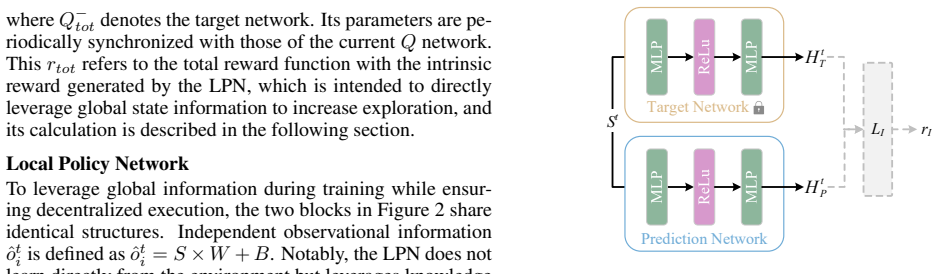
The central object is the leader-follower pair of the External Distillation Module together with the Internal Distillation Module. The Global Guiding Network (GGN) builds a personalization fusion block that transforms the global state $S$ into per-agent features $\hat{S}_i = S \times W + B$ using weights and biases produced from each agent's local observation, giving it a lossless view during training. The Local Policy Network (LPN) has the same architecture but consumes only local observations, and is driven by three losses: $L_B$ aligning the personalized state and local feature representations, $L_Q$ a KL divergence between GGN and LPN Q-values, and $L_F$ a KL divergence between intermediate MLP features. The Internal Distillation Module computes $L_I$ as the difference between target and prediction network outputs on the global state and turns it into an intrinsic reward $r_I = \mu L_I$ that is added to the environmental reward, incentivizing visits to states whose features the prediction network has not yet learned.
What would settle it
A concrete falsifier: during DDN training on 3s vs 5z, record the LPN Q-values; if they are negative or fail to sum to one over actions, the KL losses in Eq. (6) are not defined as probability divergences, so the external module cannot be training as written. Replacing $L_Q$ and $L_F$ with squared-error losses and observing unchanged win rates would confirm that the KL form is not load-bearing.
Extended reading notes
Core claim
DDN's central claim is that the cumulative inherent error between the centralized value function and the local utility functions can be eliminated by isolating the two roles: the Global Guiding Network is trained on personalized state information, while the Local Policy Network learns only from multi-level distillation (feature alignment, Q-value matching, and intermediate-feature matching) rather than from environment reward. The Internal Distillation Module adds an exploration signal computed as the prediction error between a fixed random target network and a trainable network on the global state, scaled by a mask probability and added to the environment reward. The paper reports win-rate improvements over nine value-decomposition or distillation baselines on SMAC scenarios and Predator-Prey, and shows that plugging DDN's distillation structure into VDN and Qatten improves their win rates.
Load-bearing premise
Everything rests on the two KL losses $L_Q$ and $L_F$ being well-defined, but they treat Q-values and intermediate features as probability distributions; Q-values are unbounded and often negative, so the logarithms may not exist, and if they do not, the external distillation module cannot train as specified.
Editorial extensions
If this is right
- If the isolation mechanism works, agents can execute with fully local observations while still benefiting from global state information, making the Individual-Global-Max factorization constraint less load-bearing for performance.
- The reported knowledge transfer rate from the global guiding network to the local policy network (45.69% to 96.10%) implies that decentralized policies can nearly reproduce centralized decisions, which would mean distillation-based CTDE can match or beat value-factorization methods.
- Because the internal distillation module adds an intrinsic reward without touching the execution network, the same module can be attached to existing value-decomposition methods; the paper shows win-rate gains for VDN and Qatten when DDN is integrated.
- The largest win-rate gains appear in super-hard StarCraft scenarios such as MMM2 and 3s5z vs 3s6z, suggesting that the error-elimination mechanism matters most when coordination demands long-horizon joint planning.
- The internal distillation module's mask probability has a clear optimum around $\mu = 0.75$ in the reported ablations, implying that the exploration bonus should be applied stochastically rather than at every timestep.
Reading between the lines
- If the KL losses in Eq. (6) are undefined for negative Q-values or Q-vectors that do not sum to one, the external module's reported gains may actually be carried by the feature-alignment loss $L_B$ rather than by the Q-value or feature KL terms; replacing $L_Q$ and $L_F$ with squared-error losses would test this directly.
- The personalization block's affine transform $\hat{S}_i = S \times W + B$ suggests a natural extension to continuous-action MARL, where Q-value KL divergence is ill-defined and the per-agent weights could instead gate a learned state embedding.
- The internal module's framing as curiosity about global-state novelty implies a testable extension: in environments with a fully observable state but sparse rewards, DDN should explore high-novelty states earlier than a reward-only baseline, which could be measured by state-visitation counts.
- The claim that distillation eliminates cumulative error predicts that performance should degrade smoothly as the distillation weight increases or decreases; a sweep over the relative weights of $L_B$, $L_Q$, and $L_F$ would localize where the error elimination actually happens.
Editorial analysis
A structured set of objections, weighed in public.
Referee Report
Summary. The paper proposes the Double Distillation Network (DDN), a multi-agent reinforcement learning method built around two modules: an external distillation module that transfers knowledge from a global-state-conditioned Global Guiding Network (GGN) to a Local Policy Network (LPN), and an internal distillation module that generates state-derived intrinsic rewards for exploration. The authors claim that this design eliminates the cumulative inherent error in CTDE value decomposition and improves win rates on SMAC and Predator-Prey compared with VDN, QMIX, QTRAN, Qatten, WQMIX, QPLEX, PTDE, CTDS, and IGM-DA. The paper includes an algorithm pseudocode, ablation studies, and comparisons on standard benchmarks.
Significance. If the claimed results were correct and the method internally consistent, the paper would address a real problem in CTDE: reconciling global training information with decentralized execution. The proposed architecture is concrete and the authors attempt to compare against a broad set of baselines, which is a strength. However, the central technical claims are undermined by formal errors in the loss definitions and by an internal contradiction in the LPN's input specification. The experimental evaluation also lacks error bars and tunes a key hyperparameter on the test scenarios. As written, the manuscript does not provide a sound basis for its claims.
major comments (6)
- [Section 4.2, Eq. (6)] The definition of \hat{o}_i^t = S × W + B makes the Local Policy Network directly depend on the global state S. The paper repeatedly states that the LPN 'uses only local observational information' and that agents execute with local observations (Section 3.1), and Algorithm 1 line 18 says the independent observation block receives only (o_i, u_i, i). If \hat{o}_i^t is the LPN input, then decentralized execution requires S, contradicting the CTDE premise. If the intended definition is \hat{o}_i^t = o_i × W + B, then the loss L_B becomes a different distillation target and the paper provides no derivation or experimental justification for that choice. This is a load-bearing inconsistency in the central claim of the paper.
- [Section 4.2, Eq. (6)] L_Q and L_F are written as KL divergences between Q-value vectors and feature vectors. KL divergence requires non-negative, normalized probability distributions. Q-values are unbounded real numbers and can be negative, so expressions such as log(Q^{GGN}_i / Q^{LPN}_i) are not generally defined. The same issue applies to the feature loss. Unless a normalization step (e.g., softmax) over actions or features is explicitly introduced and justified, the external distillation losses cannot be computed as written, and the external distillation module cannot be trained as specified.
- [Section 5.3, Table 5] The mask probability μ is evaluated on the same test scenarios (3s vs 5z and MMM2) that are used to report the main results. The text states that 'an optimal probability of μ = 0.75' is found from these test win rates. This is selection on the test set: the reported configuration is fitted to the evaluation scenarios, and the gains in Figures 4 and 5 that use μ = 0.75 are therefore optimistic and do not constitute validated predictions.
- [Section 5.1, Table 2] The 'knowledge transfer rate (from 45.69% to 96.10%)' is never defined anywhere in the paper. Without a precise definition (for example, a ratio of LPN win rate to GGN win rate, or a distillation-specific metric), this number cannot be interpreted or used as evidence for the claim that DDN effectively transfers global knowledge.
- [Section 5, Figures 4-5 and Tables 1-2] The paper states that 'we use results from six independent runs to minimize the impact of randomness,' but no error bars, standard deviations, confidence intervals, or significance tests are reported in any table or figure. In Figure 4 several learning curves overlap or show similar final performance, and without variance information the claimed superiority of DDN cannot be assessed statistically.
- [Section 4.3, Eq. (8)] The text says the Internal Distillation Module employs the MSE loss, but the formula L_I = (1/n) Σ(H_P − H_T) is a mean error without a square or absolute value. If this is a typo, it should be corrected to the mean squared error. If it is intentional, the intrinsic reward r_I = μ L_I can be negative and unbounded, and the claim that prediction error 'quantifies novelty' is not consistent with the formula.
minor comments (5)
- [Section 4.3] The text describes μ as 'a random mask probability,' but Eq. (9) uses μ as a multiplicative scaling factor on the intrinsic reward. Please clarify whether μ is a Bernoulli mask that selects a subset of experiences, a reward scale, or both, and specify how it is applied in the update.
- [Figure 5] In the submitted version, Figure 5 and its caption contain garbled Unicode escape sequences (e.g., '/uni00000013/uni00000014/...'), making the figure unreadable. A clean version of the figure should be provided.
- [Appendix A, Algorithm 1] There is a typo in line 17 ('bolck' should be 'block'), and the notation in line 19, 'Qglobal(St, ut) = IGM(Q1(Ŝt_1, ut_1), ..., Qn(Ŝt_n, ut_n))', is unclear because the IGM condition is not an operator; please restate this line as the standard value-decomposition loss.
- [Section 5.3, Table 3] Table 3 reports win rates for personalized versus raw state information, but it does not state whether these are the GGN or the LPN win rates. Since the paper's central claim concerns the LPN's decentralized performance, this distinction should be made explicit.
- [Section 5.2] The Predator-Prey experiment is described only in a single paragraph and Figure 5 is unreadable; please provide a quantitative comparison table with means and variances, as is done for SMAC.
Circularity Check
No substantive circularity in the distillation derivation; the only mild circular step is selecting the IDM mask probability on the same evaluation scenarios used for the headline results.
-
fitted input called prediction
[Section 5.3, Table 5]
"Additionally, stochastic mask probabilities still affect IDM performance, with an optimal probability of µ = 0.75 enhancing state information utilization and promoting effective exploration."
The mask probability µ is chosen by comparing test win rates on the same two scenarios (3s vs 5z and MMM2) that are later used to report DDN's headline numbers in Table 2 (0.9701/0.9323 and 0.8789/0.6042). The reported optimum is thus a fitted value obtained on the evaluation scenarios, not a parameter fixed before evaluation or validated on held-out scenarios. Presenting this selection as an 'optimal probability' and then using the resulting win rates as evidence of DDN's superiority makes this portion of the empirical claim a restatement of the selection criterion rather than an independent prediction. This is a mild circularity; the central distillation mechanism is otherwise compared against external baselines.
full rationale
The central derivation is not circular. The external distillation module defines the Global Guiding Network with personalized state features and the Local Policy Network with a multi-level distillation loss (Eqs. 5-7), and the claimed benefit is tested against external baselines (VDN, QMIX, QTRAN, Qatten, WQMIX, QPLEX, PTDE, CTDS, IGM-DA). The self-citations in the reference list (Wang et al. 2023, Wang et al. 2024, Zhao et al. 2024, Hu et al. 2023) are background references to related methods and are not load-bearing for the paper's own derivation. The internal inconsistency in Section 4.2, where 'Independent observational information' is defined as ô_i^t = S × W + B while the text claims the LPN 'uses only local observational information' and Algorithm 1 line 18 feeds only (o_i, u_i, i), is a correctness defect that breaks decentralized execution as written, but it is not a circular reduction: the claim fails by internal contradiction rather than by being derived from its own output. Similarly, writing L_Q and L_F as KL divergences over Q-values and features is mathematically undefined rather than circular. The only genuine circularity concern is the selection of µ = 0.75 on the same scenarios whose final win rates are then reported as DDN's performance, which is a mild fitted-input issue and is why the score is 2 rather than 0.
Assumptions & free parameters
free parameters (1)
- mu (intrinsic reward scaling/mask probability) =
0.75
assumptions (3)
- ad hoc to paper Q-values can be treated as valid probability distributions for the KL divergence losses LQ and LF in Eq. (6).
- domain assumption The intrinsic reward rI = mu * LI from global state prediction error improves exploration in these environments.
- ad hoc to paper The personalized linear transform S_hat_i = S*W+B, with W and B from local observations, retains useful global information without noise.
Cite this review
Pith. "Pith review of Double Distillation Network for Multi-Agent Reinforcement Learning." pith.science (2026). https://pith.science/paper/UAJCBLCE
@misc{pith2026250203125,
  author       = {Pith},
  title        = {Pith review of: Double Distillation Network for Multi-Agent Reinforcement Learning},
  year         = {2026},
  howpublished = {\url{https://pith.science/paper/UAJCBLCE}},
  note         = {Machine review of arXiv:2502.03125}
}
read the original abstract
Multi-agent reinforcement learning typically employs a centralized training-decentralized execution (CTDE) framework to alleviate the non-stationarity in environment. However, the partial observability during execution may lead to cumulative gap errors gathered by agents, impairing the training of effective collaborative policies. To overcome this challenge, we introduce the Double Distillation Network (DDN), which incorporates two distillation modules aimed at enhancing robust coordination and facilitating the collaboration process under constrained information. The external distillation module uses a global guiding network and a local policy network, employing distillation to reconcile the gap between global training and local execution. In addition, the internal distillation module introduces intrinsic rewards, drawn from state information, to enhance the exploration capabilities of agents. Extensive experiments demonstrate that DDN significantly improves performance across multiple scenarios.
Figures


Figures from the paper (2 more)


Reference graph
Works this paper leans on
-
[1]
Exploration by random net- work distillation
[Burda et al., 2018] Yuri Burda, Harrison Edwards, Amos Storkey, and Oleg Klimov. Exploration by random net- work distillation. arXiv preprint arXiv:1810.12894,
arXiv 2018
-
[2]
The learning rate for the neural networks is uniformly set to 5 × 10⁻⁴
B.3 Experimental Setup To ensure fairness, all algorithms are implemented based on the PyMARL framework [Samvelyan et al., 2019 ], and the hyperparameters of DDN are set to be consistent with the baseline algorithms as much as possible. The learning rate for the neural networks is uniformly set to 5 × 10⁻⁴. The Global Guiding Network uses the RMSprop opti...
work page 2019
-
[8]
Multi-agent reinforcement learning as a rehearsal for decentralized planning
[Kraemer and Banerjee, 2016] Landon Kraemer and Bikramjit Banerjee. Multi-agent reinforcement learning as a rehearsal for decentralized planning. Neurocomput- ing, 190:82–94,
work page 2016
-
[10]
A review of cooperative multi-agent deep reinforcement learning
[Oroojlooy and Hajinezhad, 2023] Afshin Oroojlooy and Davood Hajinezhad. A review of cooperative multi-agent deep reinforcement learning. Applied Intelligence , 53(11):13677–13722,
2023
-
[12]
The starcraft multi-agent challenge
[Samvelyan et al., 2019] Mikayel Samvelyan, Tabish Rashid, Christian Schroeder De Witt, Gregory Farquhar, Nantas Nardelli, Tim GJ Rudner, Chia-Man Hung, Philip HS Torr, Jakob Foerster, and Shimon Whiteson. The starcraft multi-agent challenge. arXiv preprint arXiv:1902.04043,
arXiv 2019
-
[14]
Leibo, Karl Tuyls, and Thore Grae- pel
[Sunehag et al., 2018] Peter Sunehag, Guy Lever, Audrunas Gruslys, Wojciech Marian Czarnecki, Vinicius Zam- baldi, Max Jaderberg, Marc Lanctot, Nicolas Son- nerat, Joel Z. Leibo, Karl Tuyls, and Thore Grae- pel. Value-decomposition networks for cooperative multi- agent learning based on team reward. InProceedings of the 17th International Conference on Au...
work page 2018
-
[15]
[Tan and Motani, 2023] Chong Min John Tan and Mehul Motani
International Foundation for Autonomous Agents and Multiagent Systems. [Tan and Motani, 2023] Chong Min John Tan and Mehul Motani. Go-explore with a guide: Speeding up search in sparse reward settings with goal-directed intrinsic rewards,
work page 2023
-
[16]
[Wang and Yoon, 2021] Lin Wang and Kuk-Jin Yoon. Knowledge distillation and student-teacher learning for visual intelligence: A review and new outlooks. IEEE transactions on pattern analysis and machine intelligence, 44(6):3048–3068,
work page 2021
Show all 29 references
-
[17]
Qplex: Duplex dueling multi-agent q-learning
[Wang et al., 2020] Jianhao Wang, Zhizhou Ren, Terry Liu, Yang Yu, and Chongjie Zhang. Qplex: Duplex dueling multi-agent q-learning. arXiv preprint arXiv:2008.01062,
2020 arXiv
-
[18]
Regularization-adapted anderson acceleration for multi- agent reinforcement learning
[Wang et al., 2023] Siying Wang, Wenyu Chen, Liwei Huang, Fan Zhang, Zhitong Zhao, and Hong Qu. Regularization-adapted anderson acceleration for multi- agent reinforcement learning. Knowledge-Based Systems, 275:110709,
2023
-
[19]
En- hancing collaboration in multi-agent reinforcement learn- ing with correlated trajectories
[Wang et al., 2024] Siying Wang, Hongfei Du, Yang Zhou, Zhitong Zhao, Ruoning Zhang, and Wenyu Chen. En- hancing collaboration in multi-agent reinforcement learn- ing with correlated trajectories. Knowledge-Based Sys- tems, 305:112665,
2024
-
[20]
Deep multiagent reinforce- ment learning: Challenges and directions
[Wong et al., 2023] Annie Wong, Thomas B ¨ack, Anna V Kononova, and Aske Plaat. Deep multiagent reinforce- ment learning: Challenges and directions. Artificial Intel- ligence Review, 56(6):5023–5056,
2023
-
[21]
A survey on knowledge distillation of large language models
[Xu et al., 2024] Xiaohan Xu, Ming Li, Chongyang Tao, Tao Shen, Reynold Cheng, Jinyang Li, Can Xu, Dacheng Tao, and Tianyi Zhou. A survey on knowledge distillation of large language models. arXiv preprint arXiv:2402.13116,
2024 arXiv
-
[22]
A comprehensive survey on multi-agent rein- forcement learning for connected and automated vehicles
[Yadav et al., 2023] Pamul Yadav, Ashutosh Mishra, and Shiho Kim. A comprehensive survey on multi-agent rein- forcement learning for connected and automated vehicles. Sensors, 23(10):4710,
2023
-
[23]
Qatten: A general framework for coopera- tive multiagent reinforcement learning
[Yang et al., 2020] Yaodong Yang, Jianye Hao, Ben Liao, Kun Shao, Guangyong Chen, Wulong Liu, and Hongyao Tang. Qatten: A general framework for coopera- tive multiagent reinforcement learning. arXiv preprint arXiv:2002.03939,
2020 arXiv
-
[24]
The surprising effectiveness of ppo in cooperative multi-agent games
[Yu et al., 2022] Chao Yu, Akash Velu, Eugene Vinitsky, Ji- axuan Gao, Yu Wang, Alexandre Bayen, and Yi Wu. The surprising effectiveness of ppo in cooperative multi-agent games. Advances in Neural Information Processing Sys- tems, 35:24611–24624,
2022
-
[25]
Unmanned aerial vehicle swarm cooperative decision-making for sead mis- sion: A hierarchical multiagent reinforcement learning ap- proach
[Yue et al., 2022] Longfei Yue, Rennong Yang, Jialiang Zuo, Ying Zhang, Qiuni Li, and Yijie Zhang. Unmanned aerial vehicle swarm cooperative decision-making for sead mis- sion: A hierarchical multiagent reinforcement learning ap- proach. IEEE Access, 10:92177–92191,
2022
-
[26]
Ctds: Centralized teacher with decentralized student for mul- tiagent reinforcement learning
[Zhao et al., 2022] Jian Zhao, Xunhan Hu, Mingyu Yang, Wengang Zhou, Jiangcheng Zhu, and Houqiang Li. Ctds: Centralized teacher with decentralized student for mul- tiagent reinforcement learning. IEEE Transactions on Games, 16(1):140–150,
2022
-
[27]
Qdap: Downsizing adaptive policy for cooperative multi-agent reinforcement learning
[Zhao et al., 2024] Zhitong Zhao, Ya Zhang, Siying Wang, Fan Zhang, Malu Zhang, and Wenyu Chen. Qdap: Downsizing adaptive policy for cooperative multi-agent reinforcement learning. Knowledge-Based Systems , 294:111719,
2024
-
[28]
Multirobot collaborative task dynamic scheduling based on multiagent reinforcement learning with heuristic graph convolution considering robot service performance
[Zhou et al., 2024] Jian Zhou, Lianyu Zheng, and Wei Fan. Multirobot collaborative task dynamic scheduling based on multiagent reinforcement learning with heuristic graph convolution considering robot service performance. Jour- nal of Manufacturing Systems, 72:122–141,
2024
-
[2015]
Rethinking individual global max in cooperative multi- agent reinforcement learning
[Hong et al., 2022] Yitian Hong, Yaochu Jin, and Yang Tang. Rethinking individual global max in cooperative multi- agent reinforcement learning. Advances in neural infor- mation processing systems, 35:32438–32449,
2022
-
[2016]
A concise introduction to decentralized POMDPs, volume
[Oliehoek et al., 2016] Frans A Oliehoek, Christopher Am- ato, et al. A concise introduction to decentralized POMDPs, volume
2016
-
[2018]
Ptde: Personalized training with dis- tilled execution for multi-agent reinforcement learning
[Chen et al., 2024] Yiqun Chen, Hangyu Mao, Jiaxin Mao, Shiguang Wu, Tianle Zhang, Bin Zhang, Wei Yang, and Hongxing Chang. Ptde: Personalized training with dis- tilled execution for multi-agent reinforcement learning. In Kate Larson, editor, Proceedings of the Thirty-Third In...
2024
-
[2019]
Qtran: Learn- ing to factorize with transformation for cooperative multi- agent reinforcement learning
[Son et al., 2019] Kyunghwan Son, Daewoo Kim, Wan Ju Kang, David Earl Hostallero, and Yung Yi. Qtran: Learn- ing to factorize with transformation for cooperative multi- agent reinforcement learning. In International conference on machine learning, pages 5887–5896. PMLR,
2019
-
[2020]
Policy distillation
[Rusu et al., 2015] Andrei A Rusu, Sergio Gomez Col- menarejo, Caglar Gulcehre, Guillaume Desjardins, James Kirkpatrick, Razvan Pascanu, V olodymyr Mnih, Koray Kavukcuoglu, and Raia Hadsell. Policy distillation. arXiv preprint arXiv:1511.06295,
2015 arXiv
-
[2021]
Distilling the knowledge in a neural network,
[Hinton et al., 2015] Geoffrey Hinton, Oriol Vinyals, and Jeff Dean. Distilling the knowledge in a neural network,
2015
-
[2022]
Rethinking the implementation tricks and monotonicity constraint in cooperative multi-agent re- inforcement learning
[Hu et al., 2023] Jian Hu, Siying Wang, Siyang Jiang, and Weixun Wang. Rethinking the implementation tricks and monotonicity constraint in cooperative multi-agent re- inforcement learning. In ICLR Blogposts 2023 ,
2023
-
[2023]
[Huang et al., 2024] Anqi Huang, Yongli Wang, Xiaoliang Zhou, Haochen Zou, Xu Dong, and Xun Che
https://iclr-blogposts.github.io/2023/blog/2023/riit/. [Huang et al., 2024] Anqi Huang, Yongli Wang, Xiaoliang Zhou, Haochen Zou, Xu Dong, and Xun Che. Optimistic sequential multi-agent reinforcement learning with moti- vational communication. Neural Networks, 179:106547,
2023
-
[2024]
[Gou et al., 2021] Jianping Gou, Baosheng Yu, Stephen J Maybank, and Dacheng Tao
Main Track. [Gou et al., 2021] Jianping Gou, Baosheng Yu, Stephen J Maybank, and Dacheng Tao. Knowledge distillation: A survey. International Journal of Computer Vision , 129(6):1789–1819,
2021
Reviewed August 9, 2026 · model on record in the stance chip above.
Discussion (0). Continue with ORCID to comment.