Practical blueprint for low-depth photonic quantum computing with quantum dots
Pith reviewed 2026-05-22 00:27 UTC · model grok-4.3
The pith
Quantum dots with adaptive fusions and low-connectivity architecture deliver a practical blueprint for fault-tolerant photonic quantum computing at low optical depth.
A machine-rendered reading of the paper's core claim, the machinery that carries it, and where it could break.
Core claim
By synergistically integrating deterministic photon emission from quantum dots, adaptive repeat-until-success fusions, and an optimised architectural design, we propose a complete blueprint for a photonic quantum computer using quantum dots and linear optics. It features time-bin qubit encoding, reconfigurable entangled-photon sources, and a fusion-based architecture with low optical connectivity, significantly reducing the required optical depth per photon and resource overheads. We present in detail the hardware required for resource-state generation and fusion networking, experimental pulse sequences, and exact resource estimates for preparing a logical qubit. We estimate that one logical
What carries the argument
The low-connectivity fusion-based architecture with time-bin encoding and adaptive repeat-until-success fusions from reconfigurable quantum-dot sources, which reduces optical depth per photon while preserving fault tolerance.
Load-bearing premise
The blueprint assumes that the full catalogue of real-world quantum-dot error sources accurately models all relevant imperfections and that the reconfigurable sources and adaptive fusion network can be realized at the stated performance without extra unmodeled decoherence or fabrication flaws.
What would settle it
A small-scale laboratory demonstration that measures the achieved optical loss, timing jitter, entanglement fidelity, and fusion success rates in a network of quantum-dot sources and shows that the resulting effective error rates lie below the simulated fault-tolerance threshold would confirm the claim; rates above the threshold would falsify it.
Figures





read the original abstract
Fusion-based quantum computing is an attractive model for fault-tolerant computation based on photonics requiring only finite-sized entangled resource states followed by linear-optics operations and photon measurements. Large-scale implementations have so far been limited due to the access only to probabilistic photon sources, vulnerability to photon loss, and the need for massive multiplexing. Deterministic photon sources offer an alternative and resource-efficient route. By synergistically integrating deterministic photon emission, adaptive repeat-until-success fusions, and an optimised architectural design, we propose a complete blueprint for a photonic quantum computer using quantum dots and linear optics. It features time-bin qubit encoding, reconfigurable entangled-photon sources, and a fusion-based architecture with low optical connectivity, significantly reducing the required optical depth per photon and resource overheads. We present in detail the hardware required for resource-state generation and fusion networking, experimental pulse sequences, and exact resource estimates for preparing a logical qubit. We estimate that one logical clock cycle of error correction can be executed within microseconds, which scales linearly with the code distance. We also simulate error thresholds for fault-tolerance by accounting for a full catalogue of intrinsic error sources found in real-world quantum dot devices. Our work establishes a practical blueprint for a low-optical-depth, emitter-based fault-tolerant photonic quantum computer.
Editorial analysis
A structured set of objections, weighed in public.
Referee Report
Summary. The paper proposes a complete blueprint for fault-tolerant photonic quantum computing using quantum dots as deterministic photon sources. It combines time-bin encoding, reconfigurable entangled-photon sources, adaptive repeat-until-success fusions, and a low-connectivity fusion-based architecture to reduce optical depth per photon and resource overheads. The manuscript details the required hardware, experimental pulse sequences, exact resource estimates for logical qubits, and error-threshold simulations that incorporate a full catalogue of real-world quantum-dot error sources, claiming microsecond-scale logical clock cycles that scale linearly with code distance.
Significance. If the derivations and simulations hold, the work provides a concrete, resource-efficient path to photonic fault tolerance that leverages deterministic emitters to bypass the multiplexing demands of probabilistic sources. The explicit integration of measured QD error parameters and the low-connectivity design are notable strengths that could lower experimental barriers relative to earlier photonic architectures.
major comments (1)
- [Error-threshold simulations] Error-threshold simulations section: the central fault-tolerance claim rests on the simulations correctly bounding all relevant errors (loss, timing jitter, entanglement infidelity, reconfigurability-induced decoherence). The manuscript does not include an independent validation or sensitivity analysis showing that the adopted catalogue fully captures fabrication-induced spectral diffusion or additional jitter arising from the proposed reconfigurable sources; any underestimation would compound across the repeat-until-success loops and time-bin encoding, directly affecting the reported thresholds.
minor comments (1)
- [Hardware and pulse-sequence figures] Figure captions for the resource-state generation and fusion-network diagrams should explicitly state the assumed loss and timing values used in the accompanying estimates.
Simulated Author's Rebuttal
We thank the referee for their detailed and constructive comments on our manuscript. We address the major comment regarding the error-threshold simulations below.
read point-by-point responses
-
Referee: Error-threshold simulations section: the central fault-tolerance claim rests on the simulations correctly bounding all relevant errors (loss, timing jitter, entanglement infidelity, reconfigurability-induced decoherence). The manuscript does not include an independent validation or sensitivity analysis showing that the adopted catalogue fully captures fabrication-induced spectral diffusion or additional jitter arising from the proposed reconfigurable sources; any underestimation would compound across the repeat-until-success loops and time-bin encoding, directly affecting the reported thresholds.
Authors: We appreciate the referee's emphasis on the robustness of our error model. The catalogue of error sources used in our simulations is derived from a comprehensive review of experimental characterizations of quantum dot devices, encompassing spectral diffusion, timing jitter, entanglement infidelity, and decoherence effects associated with reconfigurable sources as reported in the literature. However, we acknowledge that an explicit sensitivity analysis to variations in these parameters, particularly for fabrication-induced effects and additional jitter in the proposed architecture, was not included in the original manuscript. To strengthen the fault-tolerance claims, we have conducted additional simulations exploring a range of these error rates and included the results in a new appendix of the revised version. These analyses confirm that the reported thresholds are stable within experimentally observed ranges, with the thresholds degrading gracefully rather than abruptly. revision: yes
Circularity Check
No significant circularity; derivation uses external error catalogue and independent resource calculations
full rationale
The paper constructs its blueprint by combining deterministic quantum-dot photon emission, adaptive repeat-until-success fusions, time-bin encoding, and a low-connectivity fusion network, then derives resource estimates, pulse sequences, and optical-depth figures directly from the proposed hardware layout. Error thresholds are obtained by feeding a pre-existing catalogue of measured quantum-dot imperfections (loss, jitter, entanglement infidelity) into standard fusion-based error-correction simulations; the catalogue is taken from the broader experimental literature rather than being fitted or redefined to guarantee the reported thresholds. No equation reduces the final performance metric to the input assumptions by construction, no uniqueness theorem is imported from the authors' prior work to force the architecture, and the central claims remain falsifiable against independent device characterization outside the present manuscript.
Axiom & Free-Parameter Ledger
free parameters (1)
- quantum-dot error rates
axioms (2)
- standard math Linear optics and photon measurements suffice for the fusion operations described.
- domain assumption Adaptive repeat-until-success can be implemented with the stated reconfigurable sources.
Forward citations
Cited by 5 Pith papers
-
Cavity-Enhanced Collective Quantum Processing with Polarization-Encoded Qubits
A cavity-enhanced system encodes qubits in polarization of intracavity modes and uses polarization-selective nonlinearities to implement universal gates, with scaling analysis indicating feasible conditional phases in...
-
Near-identical photons from distant quantum dot-cavity devices
Two distant quantum dot-cavity sources were tuned to produce photons with 88% two-photon indistinguishability, matching the intrinsic limit set by each source individually.
-
PIQC: Scalable Distributed Quantum Computing via Photonic Integration of Designed Molecular Quantum Nodes
PIQC proposes a distributed FTQC architecture based on molecular quantum nodes with photonic integration, nuclear registers, loss-tolerant entanglement, and Floquetified qLDPC codes.
-
Securing Elliptic Curve Cryptocurrencies against Quantum Vulnerabilities: Resource Estimates and Mitigations
Resource estimates show Shor's algorithm can break 256-bit ECDLP with fewer than 1450 logical qubits and 90 million Toffoli gates on fast-clock quantum hardware, enabling on-spend attacks on cryptocurrency mempools.
-
Routing single photons with quantum emitters coupled to nanostructures
A review summarizing input-output methods, theoretical proposals, and experimental demonstrations of emitter-based single-photon switches in nanophotonic structures.
Reference graph
Works this paper leans on
-
[1]
Branching error due to finite cyclicity As covered in Sec. III A 3, the time-bin protocol re- quires repeated excitation and photon emission through the same optical transition. In practice, the excited state may decay through the diagonal transition with a small probability. This branching error not only results in the emission of a photon with an undesir...
-
[2]
is valid when γc ≈ γnc j 1. This means that for a peak threshold of 0.174% observed at N = 6, the QD must cycle through at least C = 574 correct transitions before a branching error or photon loss occurs
-
[3]
Finite T2 Finite spin coherence T2 originating from charge and nuclear noises was previously modelled as spin depolar- ising errors ( X, Y , Z) after each gate in the Lindner- Rudolph protocol [ 32]. Here, we include its effect in the time-bin protocol, where each Pauli error is sam- pled from the Pauli group {I, X, Y , Z} to occur after every step in the ...
-
[4]
Laser-induced spin-flip errors during spin rotation The use of a red-detuned laser for driving spin rotation pulses in QDs has been shown to induce spin decoherence, as characterised by a linear increase in the spin-flip rate κ with spin Rabi frequency Ω R, corresponding to a non- zero normalised spin flip rate: ¯ κ = κ/Ωr [ 34, 46, 50, 61]. For SiV centres,...
-
[5]
Photon distinguishability Successful type-II fusion gates rely on Hong-Ou- Mandel (HOM) interference [ 67], requiring highly indis- tinguishable photons emitted from different or the same emitter. Here we describe the dominant noise processes that limit photon indistinguishability, and present their respective fault-tolerant thresholds. Emitter-emitter pho...
-
[6]
Optical excitation errors During optical excitation of the cycling |1ð ´ | 2ð tran- sition with a π-pulse, two errors could occur depending on the excitation pulse duration [ 51, 65]: a short pulse may excite the off-resonant cycling transition |0ð ´ | 3ð owing to partial spectral overlap, emitting a photon of unwanted frequency; a longer driving pulse may...
-
[7]
Blinking A charged QD may intermittently stop emitting pho- tons ( blinking) due to slow tunnelling of carriers in and out of the QD [ 42, 71], effectively leading to photon loss that is correlated in time. This results in bursts of se- quentially lost photons in the photonic resource states. We model this non-Markovian blinking effect on the generation seq...
-
[8]
Ground-state dephasing The fluctuating nuclear spin environment in the QD vicinity induces decoherence of the spin qubit via the Overhauser effect [ 65, 72], limiting the intrinsic spin de- phasing time T ∗ 2 . Here, we model its effects for emitter- based architectures which rely on resource-state genera- tion protocols that do not have a built-in spin echo...
-
[9]
and ρZ(N ) to obtain: ∆2 OH = − 2 ln(1 − 2N pZ) τ 2 roundN 2 , (17) 18 FIG. 9. V erifying Markovianity in the low-error limit for ground-state dephasing. Average infidelity as a func- tion of the number of encoded qubits M , for encoded linear cluster states with maximum allowable fusion attempt N = 8. We observe good agreement between the simulated infidel...
-
[10]
( 17), we can express T ∗ 2 in terms of τround
and Eq. ( 17), we can express T ∗ 2 in terms of τround. For the peak threshold at N = 10, this cor- responds to T ∗ 2 = 56 τround. Initially, adding more pho- tons per encoded qubit increases the protection against dephasing and lowers the required T ∗ 2 , a benefit that is eventually outweighed by the increased wait time associ- ated with more physical fu...
-
[11]
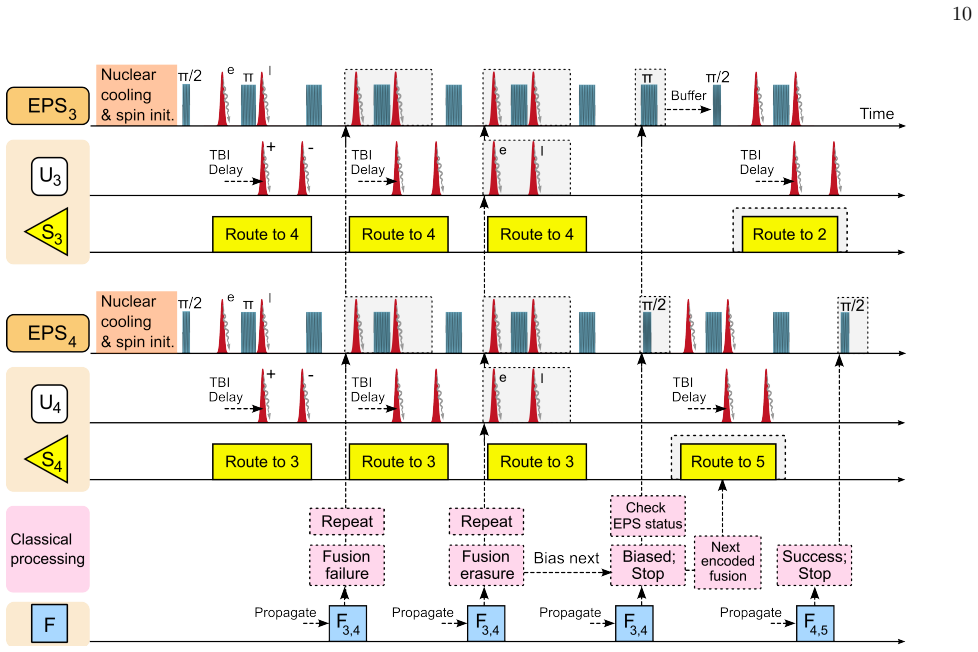
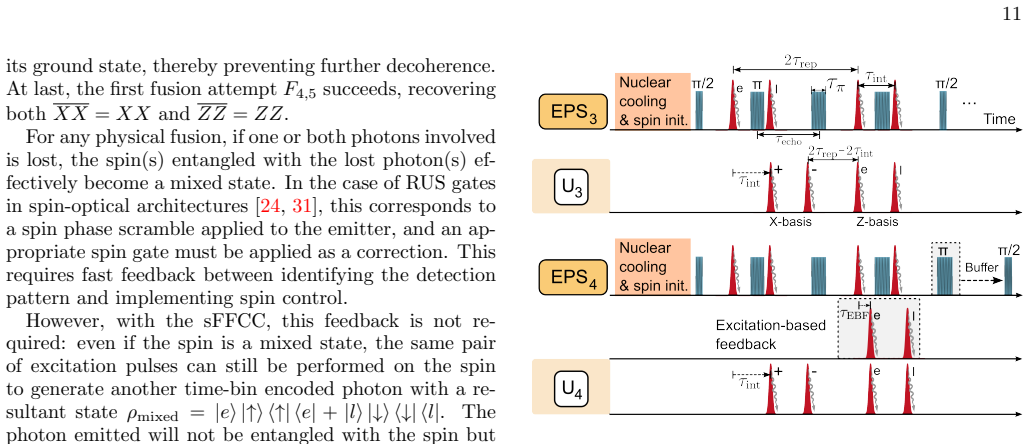
Excitation-based feedback As discussed in Sec. III C 2, in the case of photon loss, the next physical fusion is biased in ZZ , which requires both the active phase shifters in the unitary and fusion gates to be modified. The phase shifter in the latter must be configured to set the VBS to fully reflect in order to perform single-qubit measurements instead of...
-
[12]
Number of physical elements and optical depth We estimate the number of individual components of the fusion measurement circuit by counting the num- ber of fusion gates (corresponding to edges of the lat- tice in Fig. 1a), photon switches (vertices), and unitary gates (vertices), whereas the numbers of beamsplitters and phase shifters per component are ex...
-
[13]
Comparing footprints with other photonic architectures Comparing photonic architectures solely by the aver- age number of photons per resource state or their loss thresholds can be misleading. A recent survey of existing FBQC proposals [ 26] suggests that the average number of photons per resource state is a limited footprint met- ric, since it depends he...
-
[14]
with ni max = N . For a wider comparison, we benchmark our estima- tion of the logical clock cycle time with other quantum computing platforms, as shown in Table IV. Assuming that the optimal spin-echo delay τecho ≈ 29 ns [ 34], τlogical ≈ 6 µs for L = 3, N = 8 and a photon loss of 8%. Our blueprint projection achieves a competitive, microsecond-fast logi...
work page 2024
-
[15]
D. Bluvstein, A. A. Geim, S. H. Li, S. J. Evered, J. P. B. Ataides, G. Baranes, A. Gu, T. Manovitz, M. Xu, M. Kalinowski, S. Majidy, C. Kokail, N. Maskara, E. C. Trapp, L. M. Stewart, S. Hollerith, H. Zhou, M. J. Gullans, S. F. Yelin, M. Greiner, V. Vuletic, M. Cain, and M. D. Lukin, Architectural mechanisms of a universal fault-tolerant quantum computer ...
-
[16]
J. E. Bourassa, R. N. Alexander, M. Vasmer, A. Patil, I. Tzitrin, T. Matsuura, D. Su, B. Q. Baragiola, S. Guha, G. Dauphinais, K. K. Sabapathy, N. C. Menicucci, and I. Dhand, Blueprint for a scalable photonic fault-tolerant quantum computer, Quantum 5, 392 (2021)
work page 2021
-
[17]
H. Choi, M. Pant, S. Guha, and D. Englund, Percolation- based architecture for cluster state creation using photon-mediated entanglement between atomic memo- ries, npj Quantum Information 5, 104 (2019)
work page 2019
-
[18]
M. Guti´ errez, J. S. Rojas-Arias, D. Obando, and C.- Y. Chang, Comparison of spin-qubit architectures for quantum error-correcting codes (2025), arXiv:2506.17190 [quant-ph]
-
[19]
M. V. Larsen, X. Guo, C. R. Breum, J. S. Neergaard- Nielsen, and U. L. Andersen, Deterministic multi-mode gates on a scalable photonic quantum computing plat- form, Nature Physics 17, 1018 (2021)
work page 2021
-
[20]
J. M. Auger, S. Bergamini, and D. E. Browne, Blueprint for fault-tolerant quantum computation with rydberg atoms, Phys. Rev. A 96, 052320 (2017)
work page 2017
-
[21]
J. Kim, J. H. Han, and I. H. Kim, Fault-tolerant Quan- tum Error Correction Using a Linear Array of Emitters, Quantum 9, 1676 (2025)
work page 2025
-
[22]
J. M. Pino, J. M. Dreiling, C. Figgatt, J. P. Gaebler, S. A. Moses, M. S. Allman, C. H. Baldwin, M. Foss-Feig, D. Hayes, K. Mayer, C. Ryan-Anderson, and B. Neyen- huis, Demonstration of the trapped-ion quantum ccd computer architecture, Nature 592, 209–213 (2021)
work page 2021
-
[23]
C. Chamberland, K. Noh, P. Arrangoiz-Arriola, E. T. Campbell, C. T. Hann, J. Iverson, H. Putterman, T. C. Bohdanowicz, S. T. Flammia, A. Keller, G. Refael, J. Preskill, L. Jiang, A. H. Safavi-Naeini, O. Painter, and F. G. Brand˜ ao, Building a fault-tolerant quantum computer using concatenated cat codes, PRX Quantum 3, 010329 (2022) . 24
work page 2022
- [24]
-
[25]
S. Bartolucci, P. Birchall, H. Bomb ´ ın, H. Cable, C. Daw- son, M. Gimeno-Segovia, E. Johnston, K. Kieling, N. Nickerson, M. Pant, F. Pastawski, T. Rudolph, and C. Sparrow, Fusion-based quantum computation, Nature Communications 14, 912 (2023)
work page 2023
-
[26]
A. P. Lund, T. C. Ralph, and H. L. Haselgrove, Fault- tolerant linear optical quantum computing with small- amplitude coherent states, Phys. Rev. Lett. 100, 030503 (2008)
work page 2008
-
[27]
S. Bartolucci, P. M. Birchall, M. Gimeno-Segovia, E. Johnston, K. Kieling, M. Pant, T. Rudolph, J. Smith, C. Sparrow, and M. D. Vidrighin, Creation of en- tangled photonic states using linear optics (2021), arXiv:2106.13825 [quant-ph]
-
[28]
S. Bartolucci, P. Birchall, D. Bonneau, H. Ca- ble, M. Gimeno-Segovia, K. Kieling, N. Nicker- son, T. Rudolph, and C. Sparrow, Switch networks for photonic fusion-based quantum computing (2021), arXiv:2109.13760 [quant-ph]
-
[29]
K. Alexander, A. Bahgat, A. Benyamini, D. Black, D. Bonneau, S. Burgos, B. Burridge, G. Campbell, G. Catalano, A. Ceballos, C.-M. Chang, C. Chung, F. Danesh, T. Dauer, M. Davis, E. Dudley, P. Er-Xuan, J. Fargas, A. Farsi, C. Fenrich, J. Frazer, M. Fukami, Y. Ganesan, G. Gibson, M. Gimeno-Segovia, S. Goeldi, P. Goley, R. Haislmaier, S. Halimi, P. Hansen, S...
-
[30]
S. Omkar, S.-H. Lee, Y. S. Teo, S.-W. Lee, and H. Jeong, All-photonic architecture for scalable quantum comput- ing with greenberger-horne-zeilinger states, PRX Quan- tum 3, 030309 (2022)
work page 2022
-
[31]
T. J. Bell, L. A. Pettersson, and S. Paesani, Optimizing graph codes for measurement-based loss tolerance, PRX Quantum 4, 020328 (2023)
work page 2023
-
[32]
W. Song, N. Kang, Y.-S. Kim, and S.-W. Lee, Encoded- fusion-based quantum computation for high thresholds with linear optics, Phys. Rev. Lett. 133, 050605 (2024)
work page 2024
-
[33]
B. Pankovich, A. Kan, K. H. Wan, M. Ostmann, A. Neville, S. Omkar, A. Sohbi, and K. Br´ adler, High photon-loss threshold quantum computing using GHZ- state measurements (2023), arXiv:2308.04192 [math-ph, physics:quant-ph]
-
[34]
M. C. L¨ obl, S. Paesani, and A. S. Sørensen, Loss-tolerant architecture for quantum computing with quantum emit- ters, Quantum 8, 1302 (2024)
work page 2024
- [35]
-
[36]
J. Borregaard, H. Pichler, T. Schr¨ oder, M. D. Lukin, P. Lodahl, and A. S. Sørensen, One-way quantum re- peater based on near-deterministic photon-emitter inter- faces, Phys. Rev. X 10, 021071 (2020)
work page 2020
-
[37]
D. Buterakos, E. Barnes, and S. E. Economou, Determin- istic generation of all-photonic quantum repeaters from solid-state emitters, Phys. Rev. X 7, 041023 (2017)
work page 2017
-
[38]
G. de Gliniasty, P. Hilaire, P.-E. Emeriau, S. C. Wein, A. Salavrakos, and S. Mansfield, A Spin-Optical Quan- tum Computing Architecture, Quantum 8, 1423 (2024)
work page 2024
-
[39]
J. M. Auger, H. Anwar, M. Gimeno-Segovia, T. M. Stace, and D. E. Browne, Fault-tolerant quantum computation with nondeterministic entangling gates, Phys. Rev. A 97, 030301 (2018)
work page 2018
-
[40]
S. Bartolucci, T. Bell, H. Bombin, P. Birchall, J. Bul- mer, C. Dawson, T. Farrelly, S. Gartenstein, M. Gimeno- Segovia, D. Litinski, Y. Liu, R. Knegjens, N. Nickerson, A. Olivo, M. Pant, A. Patil, S. Roberts, T. Rudolph, C. Sparrow, D. Tuckett, and A. Veitia, Comparison of schemes for highly loss tolerant photonic fusion based quantum computing (2025), a...
-
[41]
D. Litinski, Blocklet concatenation: Low-overhead fault- tolerant protocols for fusion-based quantum computation (2025), arXiv:2506.13619 [quant-ph]
-
[42]
S. Paesani and B. J. Brown, High-threshold quan- tum computing by fusing one-dimensional cluster states, Phys. Rev. Lett. 131, 120603 (2023)
work page 2023
-
[43]
L. A. Pettersson, A. S. Sørensen, and S. Paesani, De- terministic generation of concatenated graph codes from quantum emitters, PRX Quantum 6, 010305 (2025)
work page 2025
- [44]
-
[45]
P. Hilaire, T. Dessertaine, B. Bourdoncle, A. Denys, G. de Gliniasty, G. Valent ´ ı-Rojas, and S. Mansfield, En- hanced fault-tolerance in photonic quantum computing: Floquet code outperforms surface code in tailored archi- tecture (2024), arXiv:2410.07065 [quant-ph]
-
[46]
M. L. Chan, T. J. Bell, L. A. Pettersson, S. X. Chen, P. Yard, A. S. Sørensen, and S. Paesani, Tailoring fusion- based photonic quantum computing schemes to quantum emitters, PRX Quantum 6, 020304 (2025)
work page 2025
- [47]
-
[48]
Y. Meng, M. L. Chan, R. B. Nielsen, M. H. Appel, Z. Liu, Y. Wang, N. Bart, A. D. Wieck, A. Ludwig, L. Midolo, A. Tiranov, A. S. Sørensen, and P. Lodahl, Determinis- tic photon source of genuine three-qubit entanglement, Nature Communications 15, 7774 (2024)
work page 2024
-
[49]
H. Huet, P. R. Ramesh, S. C. Wein, N. Coste, P. Hilaire, N. Somaschi, M. Morassi, A. Lema ˆ ıtre, I. Sagnes, M. F. Doty, O. Krebs, L. Lanco, D. A. Fioretto, and P. Senel- lart, Deterministic and reconfigurable graph state gener- ation with a single solid-state quantum emitter, Nature Communications 16, 4337 (2025)
work page 2025
-
[50]
D. Cogan, Z.-E. Su, O. Kenneth, and D. Gershoni, De- terministic generation of indistinguishable photons in a 25 cluster state, Nature Photonics 17, 324 (2023)
work page 2023
-
[51]
Y. Meng, C. F. D. Faurby, M. L. Chan, P. I. Sund, Z. Liu, Y. Wang, N. Bart, A. D. Wieck, A. Ludwig, L. Midolo, A. S. Sørensen, S. Paesani, and P. Lodahl, Photonic fu- sion of entangled resource states from a quantum emit- ter (2023), accepted in Nat. Comms., arXiv:2312.09070 [quant-ph]
-
[53]
R. Raussendorf and H. J. Briegel, A one-way quantum computer, Phys. Rev. Lett. 86, 5188 (2001)
work page 2001
-
[54]
D. E. Browne and T. Rudolph, Resource-efficient lin- ear optical quantum computation, Phys. Rev. Lett. 95, 010501 (2005)
work page 2005
-
[55]
R. Uppu, L. Midolo, X. Zhou, J. Carolan, and P. Lodahl, Quantum-dot-based deterministic photon–emitter inter- faces for scalable photonic quantum technology, Nature Nanotechnology 16, 1308 (2021)
work page 2021
- [56]
- [57]
-
[58]
M. H. Appel, A. Tiranov, A. Javadi, M. C. L¨ obl, Y. Wang, S. Scholz, A. D. Wieck, A. Ludwig, R. J. War- burton, and P. Lodahl, Coherent spin-photon interface with waveguide induced cycling transitions, Phys. Rev. Lett. 126, 013602 (2021)
work page 2021
-
[59]
X. Zhou, I. Kulkova, T. Lund-Hansen, S. L. Hansen, P. Lodahl, and L. Midolo, High-efficiency shallow-etched grating on gaas membranes for quantum photonic appli- cations, Applied Physics Letters 113, 251103 (2018)
work page 2018
-
[60]
J. H. Bodey, R. Stockill, E. V. Denning, D. A. Gangloff, G. ´Ethier-Majcher, D. M. Jackson, E. Clarke, M. Hugues, C. L. Gall, and M. Atat¨ ure, Optical spin locking of a solid-state qubit, npj Quantum Information 5, 95 (2019)
work page 2019
-
[61]
D. M. Jackson, U. Haeusler, L. Zaporski, J. H. Bodey, N. Shofer, E. Clarke, M. Hugues, M. Atat¨ ure, C. Le Gall, and D. A. Gangloff, Optimal purification of a spin ensem- ble by quantum-algorithmic feedback, Phys. Rev. X 12, 031014 (2022)
work page 2022
-
[62]
D. A. Gangloff, G. ´Ethier-Majcher, C. Lang, E. V. Den- ning, J. H. Bodey, D. M. Jackson, E. Clarke, M. Hugues, C. Le Gall, and M. Atat¨ ure, Quantum interface of an electron and a nuclear ensemble, Science 364, 62 (2019)
work page 2019
-
[63]
N. H. Lindner and T. Rudolph, Proposal for Pulsed On- Demand Sources of Photonic Cluster State Strings, Phys- ical Review Letters 103, 113602 (2009)
work page 2009
-
[64]
M. H. Appel, A. Tiranov, S. Pabst, M. L. Chan, C. Starup, Y. Wang, L. Midolo, K. Tiurev, S. Scholz, A. D. Wieck, A. Ludwig, A. S. Sørensen, and P. Lo- dahl, Entangling a Hole Spin with a Time-Bin Pho- ton: A Waveguide Approach for Quantum Dot Sources of Multi-Photon Entanglement, Physical Review Letters 128, 233602 (2022)
work page 2022
- [65]
-
[66]
M. S. Kesselring, J. C. Magdalena de la Fuente, F. Thom- sen, J. Eisert, S. D. Bartlett, and B. J. Brown, Anyon condensation and the color code, PRX Quantum 5, 010342 (2024)
work page 2024
-
[67]
C. Wang, M. Zhang, X. Chen, M. Bertrand, A. Shams- Ansari, S. Chandrasekhar, P. Winzer, and M. Lonˇ car, Integrated lithium niobate electro-optic modulators op- erating at cmos-compatible voltages, Nature 562, 101 (2018)
work page 2018
-
[68]
P. I. Sund, E. Lomonte, S. Paesani, Y. Wang, J. Car- olan, N. Bart, A. D. Wieck, A. Ludwig, L. Midolo, W. H. Pernice, P. Lodahl, and F. Lenzini, High-speed thin-film lithium niobate quantum processor driven by a solid- state quantum emitter, Science Advances 9, eadg7268 (2023)
work page 2023
-
[69]
Y. Wang, C. F. D. Faurby, F. Ruf, P. I. Sund, K. Nielsen, N. Volet, M. J. R. Heck, N. Bart, A. D. Wieck, A. Lud- wig, L. Midolo, S. Paesani, and P. Lodahl, Deterministic photon source interfaced with a programmable silicon- nitride integrated circuit, npj Quantum Information 9, 94 (2023)
work page 2023
- [70]
-
[71]
P. Laccotripes, J. Huang, G. Shooter, A. Barbiero, M. S. Winnel, D. A. Ritchie, A. J. Shields, T. Muller, and R. M. Stevenson, An entangled photon source for the telecom c-band based on a semiconductor-confined spin (2025), arXiv:2507.01648
-
[72]
M. Pittaluga, Y. S. Lo, A. Brzosko, R. I. Woodward, D. Scalcon, M. S. Winnel, T. Roger, J. F. Dynes, K. A. Owen, S. Ju´ arez, P. Rydlichowski, D. Vicinanza, G. Roberts, and A. J. Shields, Long-distance coherent quantum communications in deployed telecom networks, Nature 640, 911 (2025)
work page 2025
- [73]
- [74]
-
[75]
M. L. Chan, Spin-Photon Interface for Quantum Infor- mation Processing , Ph.D. thesis, Niels Bohr Institute, University of Copenhagen (2023)
work page 2023
-
[76]
N. H. Nickerson and B. J. Brown, Analysing correlated noise on the surface code using adaptive decoding algo- rithms, Quantum 3, 131 (2019)
work page 2019
-
[77]
S. D. Barrett and T. M. Stace, Fault tolerant quantum computation with very high threshold for loss errors, Phys. Rev. Lett. 105, 200502 (2010)
work page 2010
-
[78]
O. Higgott and C. Gidney, Sparse blossom: correcting a million errors per core second with minimum-weight matching, Quantum 9, 1600 (2025)
work page 2025
-
[79]
M. H. Appel, A Quantum Dot Source of Time-Bin Multi- Photon Entanglement, Ph.D. thesis, Niels Bohr Institute, University of Copenhagen (2021)
work page 2021
-
[80]
M. K. Bhaskar, R. Riedinger, B. Machielse, D. S. Lev- onian, C. T. Nguyen, E. N. Knall, H. Park, D. En- 26 glund, M. Lonˇ car, D. D. Sukachev, and M. D. Lukin, Experimental demonstration of memory-enhanced quan- tum communication, Nature 580, 60 (2020)
work page 2020
-
[81]
C. K. Hong, Z. Y. Ou, and L. Mandel, Measurement of subpicosecond time intervals between two photons by interference, Phys. Rev. Lett. 59, 2044 (1987)
work page 2044
discussion (0)
Sign in with ORCID, Apple, or X to comment. Anyone can read and Pith papers without signing in.