Separate and efficient characterization of state-preparation and measurement errors using single-qubit operations
Pith reviewed 2026-05-18 14:17 UTC · model grok-4.3
The pith
A protocol using only single-qubit gates and repeated non-destructive measurements can separately characterize state-preparation and measurement errors with circuit depth independent of system size.
A machine-rendered reading of the paper's core claim, the machinery that carries it, and where it could break.
Core claim
We show how to construct a protocol that can efficiently and separately characterize the SP and M error parameters by using only high-fidelity single-qubit gates and repeated single-qubit measurements without reset. The measurements are assumed to be non-destructive and M errors are taken to be (spatially and temporally) uncorrelated and classical. Notably, the circuit depth of the protocol is independent of system size, and the target parameters may be characterized to a precision that is only limited by the number of experimental repetitions.
What carries the argument
A fixed-depth sequence of single-qubit gates interleaved with repeated non-destructive measurements that isolates state-preparation errors from measurement errors through their distinct signatures in the observed outcome statistics.
If this is right
- SP and M errors can be extracted separately for many qubits at once without multi-qubit gates or resets.
- Precision of the estimates is limited only by the number of experimental repetitions, not by circuit depth.
- Accounting for state-preparation errors removes bias that remains when only measurement-error mitigation is applied.
- The same fixed sequence works on devices of any size because depth does not scale with qubit number.
Where Pith is reading between the lines
- The method could be embedded in routine calibration loops on large processors where full SPAM tomography becomes impractical.
- Relaxing the classical uncorrelated measurement-error assumption would require additional sequences to detect temporal or spatial correlations.
- Combining the extracted rates with gate-error data could produce more accurate overall error budgets for algorithm design.
Load-bearing premise
Measurement errors are assumed to be spatially and temporally uncorrelated and classical, while measurements themselves are non-destructive.
What would settle it
Apply the protocol on a device, then compare the extracted state-preparation and measurement error rates against an independent characterization performed with a different method; significant disagreement would show the separation is inaccurate.
Figures



read the original abstract
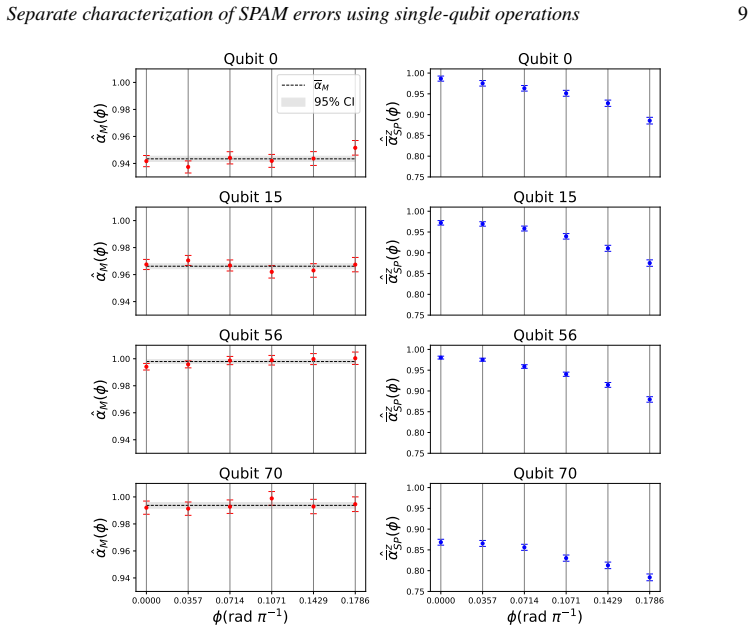
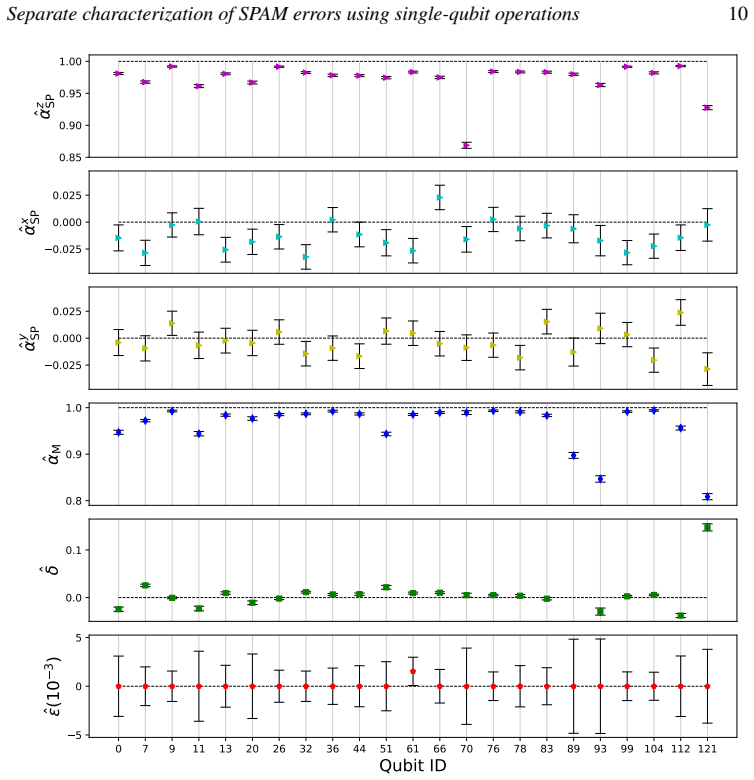
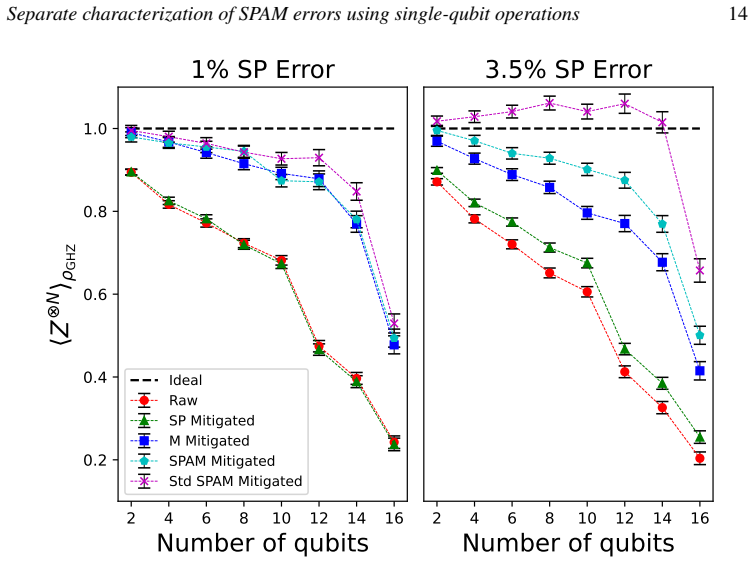
In many platforms, errors from state-preparation and measurement (SPAM) dominate over single-qubit gate errors. To inform further hardware improvements and the development of more effective SPAM mitigation strategies, it is necessary to separately characterize the error contributions from state-preparation (SP) and measurement (M). Here, we show how to construct a protocol that can efficiently and separately characterize the SP and M error parameters by using only high-fidelity single-qubit gates and repeated single-qubit measurements without reset. The measurements are assumed to be non-destructive and M errors are taken to be (spatially and temporally) uncorrelated and classical. Notably, the circuit depth of the protocol is independent of system size, and the target parameters may be characterized to a precision that is only limited by the number of experimental repetitions. We employ our protocol for the parallel characterization of SPAM errors on multiple qubits in the IBM Quantum Platform devices, where we find SP infidelities up to $6.57\%$ and readout assignment errors up to $19.1\%$. Using numerical simulations, we also demonstrate how measurement-error mitigation that does not properly account for SP errors generally leads to a biased estimate of measured observable expectation values.
Editorial analysis
A structured set of objections, weighed in public.
Referee Report
Summary. The manuscript proposes a protocol to separately characterize state-preparation (SP) infidelity and measurement (M) assignment errors using repeated single-qubit measurements without reset and high-fidelity single-qubit gates. Linear combinations of outcome statistics from sequences of varying lengths isolate the two error sources under the assumptions that measurements are non-destructive and that M errors are classical, spatially independent, and temporally uncorrelated. The protocol depth is independent of qubit number. Experimental application on IBM Quantum devices yields SP infidelities up to 6.57% and readout assignment errors up to 19.1%; numerical simulations illustrate bias in observable estimates when SP errors are neglected in mitigation.
Significance. If the stated assumptions hold, the work supplies a scalable, low-depth method for disentangling SP and M contributions that addresses a practical bottleneck in near-term devices. The size-independent circuit depth and parallel multi-qubit characterization are clear strengths, as is the explicit demonstration that ignoring SP errors biases mitigated expectation values. Experimental numbers on real hardware add relevance, though the absence of full data tables, error-propagation details, and robustness checks limits immediate adoption.
major comments (2)
- The separation procedure (protocol derivation and linear-combination construction): the closed set of equations used to extract independent SP and M parameters is derived under the strict assumptions of classical, uncorrelated M errors and non-destructive measurements. In superconducting platforms, readout-induced relaxation or weak back-action can introduce temporal correlations or non-classical components that mix the extracted values; the manuscript provides no quantitative bounds or sensitivity analysis on the resulting bias.
- Experimental results section: the reported peak values (SP infidelity 6.57%, readout error 19.1%) are stated without accompanying statistical uncertainties, full shot counts per sequence, or explicit propagation of finite-sampling error through the linear inversion. This omission prevents independent verification of the claimed precision limit set only by the number of repetitions.
minor comments (2)
- Notation for the assignment probabilities and SP error parameters should be introduced with a clear table or diagram early in the protocol section to aid readability.
- The simulation section would benefit from an explicit statement of the noise model used for the 'biased estimate' demonstration, including whether SP errors were modeled as preparation infidelity or as a separate channel.
Simulated Author's Rebuttal
We thank the referee for their thorough review and constructive comments on our manuscript. We address each major comment point by point below, indicating where revisions will be made.
read point-by-point responses
-
Referee: The separation procedure (protocol derivation and linear-combination construction): the closed set of equations used to extract independent SP and M parameters is derived under the strict assumptions of classical, uncorrelated M errors and non-destructive measurements. In superconducting platforms, readout-induced relaxation or weak back-action can introduce temporal correlations or non-classical components that mix the extracted values; the manuscript provides no quantitative bounds or sensitivity analysis on the resulting bias.
Authors: The protocol derivation explicitly relies on the assumptions of non-destructive measurements and classical, spatially and temporally uncorrelated measurement errors, as stated in the manuscript. These assumptions enable the isolation of SP and M parameters through linear combinations of measurement outcome statistics from sequences of varying lengths. We acknowledge that real superconducting devices may exhibit readout-induced relaxation or weak back-action, potentially introducing correlations not captured by the model. The manuscript focuses on the protocol under the stated assumptions to highlight its efficiency and size-independent depth. In the revised manuscript, we will add a discussion section addressing the robustness to small deviations from these assumptions, including a qualitative analysis of how such effects could bias the extracted parameters. A full quantitative sensitivity analysis would require device-specific noise modeling beyond the scope of this work and is suggested as future research. revision: partial
-
Referee: Experimental results section: the reported peak values (SP infidelity 6.57%, readout error 19.1%) are stated without accompanying statistical uncertainties, full shot counts per sequence, or explicit propagation of finite-sampling error through the linear inversion. This omission prevents independent verification of the claimed precision limit set only by the number of repetitions.
Authors: We agree that providing statistical uncertainties, shot counts, and details on error propagation is essential for reproducibility and independent verification. In the revised manuscript, we will include the number of experimental repetitions (shots) used for each sequence length, report the statistical uncertainties on the extracted SP infidelity and readout assignment error values, and describe the propagation of finite-sampling errors through the linear inversion procedure. This will support the claim that precision is limited only by the number of repetitions. revision: yes
Circularity Check
Protocol derives SP/M separation from explicit error model without definitional or fitted-input circularity
full rationale
The paper constructs a protocol using sequences of single-qubit gates and repeated non-destructive measurements to form linear combinations whose statistics isolate state-preparation infidelities from readout assignment probabilities. This inversion is derived directly from the assumed classical, uncorrelated, diagonal measurement-error model and the non-destructive projection property; the extracted parameters are not redefined in terms of the same fitted quantities, nor is any central equation shown to reduce to its inputs by construction. No load-bearing self-citations or uniqueness theorems from prior author work are invoked to justify the separation. The derivation remains self-contained once the stated assumptions are granted, with precision limited only by shot statistics rather than by tautological fitting.
Axiom & Free-Parameter Ledger
axioms (2)
- domain assumption Measurements are non-destructive.
- domain assumption M errors are spatially and temporally uncorrelated and classical.
Lean theorems connected to this paper
-
IndisputableMonolith/Foundation/AbsoluteFloorClosure.leanreality_from_one_distinction unclear?
unclearRelation between the paper passage and the cited Recognition theorem.
We show how to construct a protocol that can efficiently and separately characterize the SP and M error parameters by using only high-fidelity single-qubit gates and repeated single-qubit measurements without reset.
-
IndisputableMonolith/Cost/FunctionalEquation.leanwashburn_uniqueness_aczel unclear?
unclearRelation between the paper passage and the cited Recognition theorem.
M errors are taken to be (spatially and temporally) uncorrelated and classical; measurements are assumed to be non-destructive.
What do these tags mean?
- matches
- The paper's claim is directly supported by a theorem in the formal canon.
- supports
- The theorem supports part of the paper's argument, but the paper may add assumptions or extra steps.
- extends
- The paper goes beyond the formal theorem; the theorem is a base layer rather than the whole result.
- uses
- The paper appears to rely on the theorem as machinery.
- contradicts
- The paper's claim conflicts with a theorem or certificate in the canon.
- unclear
- Pith found a possible connection, but the passage is too broad, indirect, or ambiguous to say the theorem truly supports the claim.
discussion (0)
Sign in with ORCID, Apple, or X to comment. Anyone can read and Pith papers without signing in.