REVIEW 3 major objections 4 minor 25 references
Block Flow: Learning Straight Flow on Data Blocks
T0 review · 3 major / 4 minor · reviewed 2026-08-10 · deepseek-v4-flash
Pith's one-line read Block matching pairs labels with Gaussian prior blocks to straighten flow-matching trajectories.
desk verdict Useful empirical recipe with an interesting label-conditioned prior idea, but the paper doesn't show that the block mechanism is what drives the gains. read the letter →
The pith
A machine-rendered reading of the paper's core claim, the machinery that carries it, and where it could break.
The reading
What carries the argument
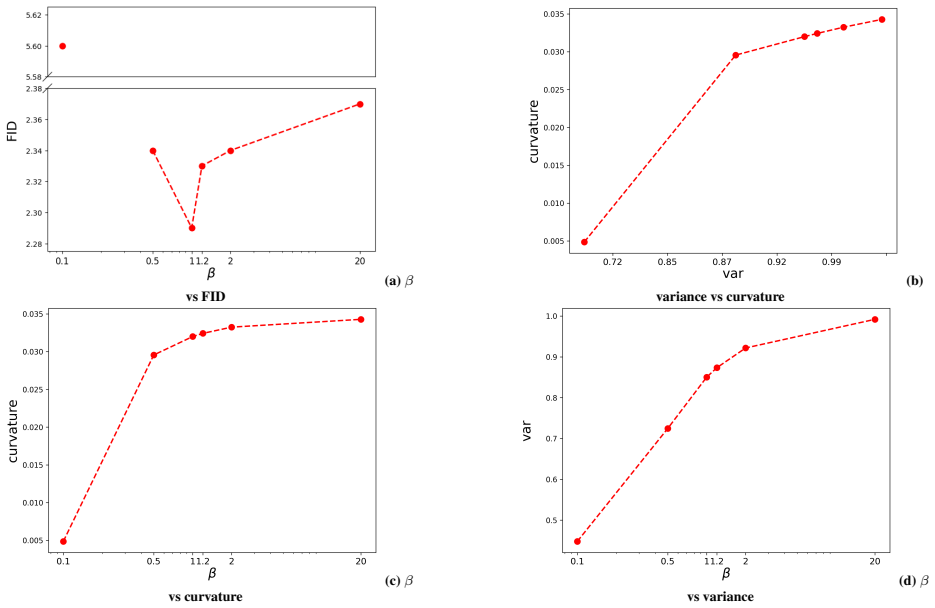
Block matching partitions $p(x_0)$ into conditional blocks $p(x_0 \mid y)$ and pairs each with a Gaussian $q_\phi(z \mid y) = N(\mu_\phi(y), \Sigma_\phi(y))$; the overall prior is the mixture $\int p(y) q_\phi(z \mid y)\,dy$. The load-bearing identity is Proposition 2, $V((x_0,x_1)) \leq (\sqrt{\mathrm{Var}(x_1)} + \sqrt{\mathrm{Var}(x_0)})^2$, proved by writing $V$ as an integral of conditional variances and applying the law of total variance. A small encoder produces $(\mu_\phi, \Sigma_\phi)$, and the training loss is the flow-matching regression plus $\beta$ times a regularization $R(\phi)$ that constrains $\log \Sigma_\phi$ or a KL divergence. The regularization coefficient $\beta$ is the dial that trades prior variance, and therefore curvature, against sample diversity.
What would settle it
Train the same U-Net on CIFAR-10 with a single Gaussian prior whose total variance matches the learned mixture at $\beta=1$, keeping all regularization identical, and compare FID plus the measured curvature at 20 Euler steps. If the single-Gaussian control matches Block Flow's numbers, block separation is not the active mechanism; if Block Flow is clearly better, block matching is confirmed.
Extended reading notes
Core claim
The paper's central claim is that choosing the prior distribution blockwise, conditioned on labels, reduces intersections in forward trajectories and therefore straightens the learned generative flow. Formally, for any joint distribution, $V((x_0,x_1)) \leq (\sqrt{\mathrm{Var}(x_1)} + \sqrt{\mathrm{Var}(x_0)})^2$, with $V$ the straightness measure of rectified flow; hence the variance of the prior controls the curvature upper bound. The prior is a Gaussian mixture with learnable per-label means and covariances produced by a small encoder, and several regularization schemes constrain those parameters. At $\beta=1$ the prior variance is large enough to preserve diversity but small enough to keep curvature low; the reported CIFAR-10 FID is competitive with same-scale models. The paper also reports that the between-group variance ratio is tiny, around $10^{-7}$ at $\beta=1$ for FABR, so the mixture components overlap heavily.
Load-bearing premise
The benefit of block matching depends on label-conditioned Gaussian blocks staying separated enough to reduce cross-label intersections, while the paper's Table 2 shows the between-group variance is only about $10^{-7}$ of total variance at $\beta=1$, so the blocks heavily overlap.
Editorial extensions
If this is right
- Tuning $\beta$ after training adjusts the prior variance and hence the curvature upper bound, so users can trade diversity for solver accuracy without retraining the vector field.
- Label-conditioned matching removes a large class of forward-trajectory intersections, namely cross-label ones, which should reduce the averaging effect that bends reverse trajectories.
- At $\beta=1$ all four regularization schemes land in the same FID range on CIFAR-10, so the benefit does not depend on the particular alignment scheme.
- The method is compatible with existing straightening techniques such as reflow or step-size straightening, promising further reductions in sampling steps.
- For unlabeled data, clustering can synthesize labels, extending block matching beyond datasets that come with annotations.
Reading between the lines
- The between-group variance ratio reported near $10^{-7}$ at $\beta=1$ means the mixture prior is effectively a single Gaussian; the empirical gains may come from variance regularization rather than from block separation, and a control experiment with a single-Gaussian prior of matched total variance would settle this.
- The paper's own discussion acknowledges this collapse; an open question is whether constraining block means to stay separated, for example with a penalty on between-group variance, would make block matching's mechanism genuinely active and improve quality further.
- The label-diversity tradeoff suggests a sweet spot: enough labels to separate modes but few enough to keep the label distribution simple; semantic or continuous labels might behave differently from discrete class labels.
- Because the decoder can also run without labels, block matching could serve as a prior-construction tool independent of conditional generation.
Editorial analysis
A structured set of objections, weighed in public.
Referee Report
Summary. The paper proposes Block Flow, a flow-matching method that partitions the data distribution by label and matches each block to a label-conditioned Gaussian prior component. The central theoretical claim is Proposition 2, which states that the curvature measure V((x0,x1)) is upper-bounded by (sqrt(Var(x1))+sqrt(Var(x0)))^2, so reducing the prior variance can control the curvature bound. The method introduces several regularization strategies to tune the prior variance, and reports competitive FID/IS scores on CIFAR-10 and MNIST with a DDPM++-based architecture. The paper also releases code.
Significance. If the mechanism claimed in Section 3.1 were actually operative, the paper would offer a simple, label-based way to straighten flow trajectories and improve few-step sampling, backed by a clean variance bound. The proofs of Propositions 1 and 2 are correct as written, the code is available, and the empirical results are competitive with models of the same parameter scale. However, the central mechanism is not currently demonstrated: the reported between-group variance ratios in Table 2 are extremely small, and Section 6 explicitly concedes that the Gaussian mixture closely resembles a single Gaussian. Without an ablation against a single-Gaussian prior with the same architecture and regularization, the empirical gains cannot be attributed to block matching rather than to the regularized low-variance prior. The theoretical bound is also loose, so the link from Proposition 2 to actual curvature reduction remains an unverified assumption.
major comments (3)
- [Section 3.1, Table 2, Section 6] The load-bearing claim that block matching reduces cross-label intersections is not supported by the reported results. Table 2 shows that for FABR at beta=1, the between-group variance ratio is 1.3e-7, and Table 3 shows that the component means are on the order of 1e-4 with nearly identical log-variances. Section 6 explicitly states that the mixture 'closely resembles a single Gaussian' and 'fails to effectively model complex data distributions or capture the label-dependent characteristics.' If the mixture has collapsed, the proposed block-partition mechanism is not operating, and the reported gains may come solely from the regularized low-variance prior. The paper needs an ablation that compares the same architecture, training objective, and regularization against a single Gaussian prior with matched total variance; without this, the central method claim is not established.
- [Section 3.2, Proposition 2] Proposition 2 provides an upper bound, not an equality: V((x0,x1)) <= (sqrt(Var(x1))+sqrt(Var(x0)))^2. Reducing Var(x1) necessarily lowers this particular upper bound, but it does not necessarily reduce the actual curvature V((x0,x1)), because the bound can be loose. The paper's own Figures 3 and the discussion show correlations between beta, prior variance, and curvature, but no direct evidence that the bound is tight or that the variance control is the operative cause. The authors should report the gap between the bound and the measured V, or provide an experiment that varies the prior variance independently of other training factors and shows that V decreases monotonically, to support the 'variance controls curvature' claim.
- [Section 3.3 and Figure 3] The selection of beta=1 is made post hoc based on FID, and the paper does not describe a validation protocol or error bars for the reported FID and curvature numbers. Since beta directly controls the prior variance, and the paper claims an optimal trade-off, it is important to know whether the choice of beta is stable across seeds and whether the reported improvements over the baseline (e.g., Fast ODE Euler at 8 NFEs, FID 13.52 versus 12.95) are statistically meaningful. Reporting standard deviations over multiple runs would strengthen the empirical claim.
minor comments (4)
- [Abstract] There is a missing space in 'scale.Code is available'; also 'systhesis' appears twice in the Introduction and should be 'synthesis'.
- [Section 2, Eq. (7)] The definition of V((x0,x1)) is said to be 'equal to the straightness measure introduced in [16]', but the exact correspondence is not shown; citing the specific definition from [16] would help.
- [Section 3.3.2 and Appendix B] Appendix B states that in HACBR the variance of q_phi(z|x,y) is set to 1, but the main text's Eq. (16) writes the KL as D_KL(q_phi(z|x,y)||p_theta(z|y)). Please clarify whether the conditional prior p_theta(z|y) has fixed unit variance or learnable variance in this scheme.
- [Algorithm 1] Algorithm 1 writes x1 = mu_phi(y0) + Sigma_phi(y0) z without specifying whether Sigma_phi is a diagonal covariance or a full matrix; clarifying this would make the sampling procedure unambiguous.
Circularity Check
No significant circularity: Proposition 2 is an elementary variance bound proved from first principles, and the reported gains are empirical rather than fitted-prediction equivalences.
full rationale
The paper's central theoretical claim, Proposition 2, is derived self-containedly: V((x0,x1)) = ∫ Ext Var(x1−x0|xt) dt ≤ Var(x1−x0) ≤ (√Var(x1)+√Var(x0))^2, which is just the law of total variance and the Cauchy–Schwarz inequality. This does not assume the conclusion it is used to justify, and it is not a renamed fit. The proposed block-matching method is empirical: β is a tuned regularization hyperparameter, and the FID/curvature tables are measurements rather than quantities forced by construction from fitted inputs. There are no load-bearing self-citations: the only notable external reference for architecture is [18], which is not by the present authors and merely supplies the small encoder design. No uniqueness theorem is invoked, and no ansatz is smuggled in by self-citation. The paper does contain a substantive limitation statement that should be weighed: Section 6 concedes that the Gaussian mixture 'closely resembles a single Gaussian', and Table 2 gives between-group variance ratios on the order of 1e-7 for FABR at β=1, meaning the learned label-conditioned blocks are almost completely overlapping. This is a legitimate concern about whether the block-matching mechanism is actually operating and whether a single-Gaussian-prior ablation would match the results, but it is a correctness and ablation issue, not circularity: the method's empirical results are not equivalent by definition to its inputs, and Proposition 2 remains independently derivable. Accordingly, no specific circular step can be quoted, and the appropriate score is 0.
Assumptions & free parameters
free parameters (2)
- beta (regularization coefficient) =
1 (also 0.1 and 20 tested)
- variance of q_phi(z|x,y) in HACBR =
1
assumptions (6)
- standard math Law of total variance and conditional variance identities
- domain assumption The flow-matching interpolation xt = t*x1 + (1-t)*x0 defines the probability path
- domain assumption The learned vector field v_theta approximates the conditional expectation E[x1-x0|xt]
- domain assumption Labels y provide meaningful data blocks p(x0|y)
- domain assumption The Gaussian mixture q_phi(z|y) remains a valid sampling prior that matches training
- ad hoc to paper Reducing the upper bound in Proposition 2 reduces actual curvature
Cite this review
Pith. "Pith review of Block Flow: Learning Straight Flow on Data Blocks." pith.science (2026). https://pith.science/paper/UDTK665R
@misc{pith2026250111361,
  author       = {Pith},
  title        = {Pith review of: Block Flow: Learning Straight Flow on Data Blocks},
  year         = {2026},
  howpublished = {\url{https://pith.science/paper/UDTK665R}},
  note         = {Machine review of arXiv:2501.11361}
}
read the original abstract
Flow-matching models provide a powerful framework for various applications, offering efficient sampling and flexible probability path modeling. These models are characterized by flows with low curvature in learned generative trajectories, which results in reduced truncation error at each sampling step. To further reduce curvature, we propose block matching. This novel approach leverages label information to partition the data distribution into blocks and match them with a prior distribution parameterized using the same label information, thereby learning straighter flows. We demonstrate that the variance of the prior distribution can control the curvature upper bound of forward trajectories in flow-matching models. By designing flexible regularization strategies to adjust this variance, we achieve optimal generation performance, effectively balancing the trade-off between maintaining diversity in generated samples and minimizing numerical solver errors. Our results demonstrate competitive performance with models of the same parameter scale.Code is available at \url{https://github.com/wpp13749/block_flow}.
Figures


Figures from the paper (5 more)


Reference graph
Works this paper leans on
-
[1]
Deep unsupervised learning using nonequilibrium thermodynamics
Jascha Sohl-Dickstein, Eric Weiss, Niru Maheswaranathan, and Surya Ganguli. Deep unsupervised learning using nonequilibrium thermodynamics. In International conference on machine learning, pages 2256–2265. PMLR, 2015
2015
-
[2]
Denoising diffusion probabilistic models
Jonathan Ho, Ajay Jain, and Pieter Abbeel. Denoising diffusion probabilistic models. Advances in neural information processing systems, 33:6840–6851, 2020
2020
-
[3]
Score-based generative modeling through stochastic differential equations
Yang Song, Jascha Sohl-Dickstein, Diederik P Kingma, Abhishek Kumar, Stefano Ermon, and Ben Poole. Score-based generative modeling through stochastic differential equations. arXiv preprint arXiv:2011.13456, 2020
arXiv 2011
-
[4]
High-resolution image synthesis with latent diffusion models
Robin Rombach, Andreas Blattmann, Dominik Lorenz, Patrick Esser, and Björn Ommer. High-resolution image synthesis with latent diffusion models. In Proceedings of the IEEE/CVF conference on computer vision and pattern recognition, pages 10684–10695, 2022
2022
-
[5]
Scaling rectified flow transformers for high-resolution image synthesis
Patrick Esser, Sumith Kulal, Andreas Blattmann, Rahim Entezari, Jonas Müller, Harry Saini, Yam Levi, Dominik Lorenz, Axel Sauer, Frederic Boesel, et al. Scaling rectified flow transformers for high-resolution image synthesis. In Forty-first International Conference on Machine Learning, 2024
2024
-
[6]
Video diffusion models
Jonathan Ho, Tim Salimans, Alexey Gritsenko, William Chan, Mohammad Norouzi, and David J Fleet. Video diffusion models. Advances in Neural Information Processing Systems, 35:8633–8646, 2022
2022
-
[7]
Lumiere: A space-time diffusion model for video generation
Omer Bar-Tal, Hila Chefer, Omer Tov, Charles Herrmann, Roni Paiss, Shiran Zada, Ariel Ephrat, Junhwa Hur, Guanghui Liu, Amit Raj, et al. Lumiere: A space-time diffusion model for video generation. In SIGGRAPH Asia 2024 Conference Papers, pages 1–11, 2024
2024
-
[8]
Diffwave: A versatile diffusion model for audio synthesis
Zhifeng Kong, Wei Ping, Jiaji Huang, Kexin Zhao, and Bryan Catanzaro. Diffwave: A versatile diffusion model for audio synthesis. arXiv preprint arXiv:2009.09761, 2020
arXiv 2009
Show all 25 references
-
[9]
Accurate structure prediction of biomolecular interactions with alphafold 3
Josh Abramson, Jonas Adler, Jack Dunger, Richard Evans, Tim Green, Alexander Pritzel, Olaf Ronneberger, Lindsay Willmore, Andrew J Ballard, Joshua Bambrick, et al. Accurate structure prediction of biomolecular interactions with alphafold 3. Nature, pages 1–3, 2024
2024
-
[10]
A connection between score matching and denoising autoencoders
Pascal Vincent. A connection between score matching and denoising autoencoders. Neural computation, 23(7):1661–1674, 2011
2011
-
[11]
Hierarchical text-conditional image generation with clip latents
Aditya Ramesh, Prafulla Dhariwal, Alex Nichol, Casey Chu, and Mark Chen. Hierarchical text-conditional image generation with clip latents. arXiv preprint arXiv:2204.06125, 1(2):3, 2022
2022 arXiv
-
[12]
Photorealistic text-to-image diffusion models with deep language understanding
Chitwan Saharia, William Chan, Saurabh Saxena, Lala Li, Jay Whang, Emily L Denton, Kamyar Ghasemipour, Raphael Gontijo Lopes, Burcu Karagol Ayan, Tim Salimans, et al. Photorealistic text-to-image diffusion models with deep language understanding. Advances in neural information...
2022
-
[13]
Neural ordinary differential equations
Ricky TQ Chen, Yulia Rubanova, Jesse Bettencourt, and David K Duvenaud. Neural ordinary differential equations. Advances in neural information processing systems, 31, 2018
2018
-
[14]
Maximum likelihood training of score-based diffusion models
Yang Song, Conor Durkan, Iain Murray, and Stefano Ermon. Maximum likelihood training of score-based diffusion models. Advances in neural information processing systems, 34:1415–1428, 2021
2021
-
[15]
Yaron Lipman, Ricky T. Q. Chen, Heli Ben-Hamu, Maximilian Nickel, and Matt Le. Flow matching for generative modeling, 2023
2023
-
[16]
Flow straight and fast: Learning to generate and transfer data with rectified flow, 2022
Xingchao Liu, Chengyue Gong, and Qiang Liu. Flow straight and fast: Learning to generate and transfer data with rectified flow, 2022
2022
-
[17]
Bellman optimal step-size straightening of flow-matching models
Bao Nguyen, Binh Nguyen, and Viet Anh Nguyen. Bellman optimal step-size straightening of flow-matching models. arXiv preprint arXiv:2312.16414, 2023
2023 arXiv
-
[18]
Minimizing trajectory curvature of ode-based generative models
Sangyun Lee, Beomsu Kim, and Jong Chul Ye. Minimizing trajectory curvature of ode-based generative models. arXiv preprint arXiv:2301.12003, 2023
2023 arXiv
-
[19]
Kevin P. Murphy. Machine Learning: A Probabilistic Perspective. MIT Press, 2012
2012
-
[20]
Training generative adversarial networks with limited data
Tero Karras, Miika Aittala, Janne Hellsten, Samuli Laine, Jaakko Lehtinen, and Timo Aila. Training generative adversarial networks with limited data. Advances in neural information processing systems, 33:12104–12114, 2020
2020
-
[21]
Differentiable augmentation for data-efficient gan training
Shengyu Zhao, Zhijian Liu, Ji Lin, Jun-Yan Zhu, and Song Han. Differentiable augmentation for data-efficient gan training. Advances in neural information processing systems, 33:7559–7570, 2020. 10
2020
-
[22]
Transgan: Two pure transformers can make one strong gan, and that can scale up
Yifan Jiang, Shiyu Chang, and Zhangyang Wang. Transgan: Two pure transformers can make one strong gan, and that can scale up. Advances in Neural Information Processing Systems, 34:14745–14758, 2021
2021
-
[23]
Spiking diffusion models
Jiahang Cao, Hanzhong Guo, Ziqing Wang, Deming Zhou, Hao Cheng, Qiang Zhang, and Renjing Xu. Spiking diffusion models. IEEE Transactions on Artificial Intelligence, 2024
2024
-
[24]
Pfgm++: Unlocking the potential of physics-inspired generative models
Yilun Xu, Ziming Liu, Yonglong Tian, Shangyuan Tong, Max Tegmark, and Tommi Jaakkola. Pfgm++: Unlocking the potential of physics-inspired generative models. In International Conference on Machine Learning, pages 38566–38591. PMLR, 2023
2023
-
[25]
Structured diffusion models with mixture of gaussians as prior distribution, 2024
Nanshan Jia, Tingyu Zhu, Haoyu Liu, and Zeyu Zheng. Structured diffusion models with mixture of gaussians as prior distribution, 2024. 11 A Proof of Proposition proposition 1. If the probability distribution of xc is a Dirac delta function, i.e., xc ∼ δ(x − c), then: V ((x0, x...
2024
Reviewed August 10, 2026 · model on record in the stance chip above.
Discussion (0). Continue with ORCID to comment.