A Framework for Directed Hypergraph Signal Processing via tensor t-SVD
Pith reviewed 2026-06-26 00:00 UTC · model grok-4.3
The pith
Directed hypergraph signal processing defines a topologically faithful shift operator and lossless Fourier transform using tensor t-SVD.
A machine-rendered reading of the paper's core claim, the machinery that carries it, and where it could break.
Core claim
Directed Hypergraph Signal Processing (DHGSP) is introduced by constructing a novel adjacency tensor for directed hypergraphs, applying the t-product algebra to obtain a topologically faithful shift operator, and defining the lossless Directed Hypergraph Fourier Transform (t-DHGFT) via t-SVD; the resulting framework simultaneously encodes higher-order and asymmetric relations and demonstrates lower denoising error than matrix-based graph and digraph methods or undirected tensor hypergraph methods on real traffic data.
What carries the argument
The t-SVD-derived adjacency tensor and shift operator inside the t-product algebra, which together encode both polyadic and directional structure to support frequency analysis.
If this is right
- Frequency-domain filtering on directed hypergraphs becomes possible while preserving all higher-order and directional information.
- Denoising performance on networks with multi-way directed interactions improves over pairwise or undirected models.
- The same t-product construction applies to any task that previously relied on graph or hypergraph Fourier transforms but required directionality.
- Traffic and flow networks can be modeled with explicit multi-lane or multi-entity directional dependencies.
Where Pith is reading between the lines
- The same tensor construction could be tested on citation or biological interaction networks where group-level directed relations appear.
- If the shift operator remains faithful under small topological perturbations, the framework could support online signal processing on evolving directed hypergraphs.
- Comparison against other tensor decompositions would clarify whether t-SVD is essential or whether alternative factorizations yield similar fidelity.
Load-bearing premise
The t-product algebra and t-SVD yield a shift operator that faithfully represents the directed hypergraph topology without loss or artifact.
What would settle it
A concrete directed hypergraph on which the forward and inverse t-DHGFT fail to recover the original signal values exactly, or on which the proposed shift operator produces filtering results indistinguishable from an undirected hypergraph baseline.
Figures



read the original abstract
We introduce Directed Hypergraph Signal Processing (DHGSP), a unified framework that extends graph signal processing to accommodate both higher-order (polyadic) and asymmetric (directional) relationships simultaneously. Using the tensor singular value decomposition (t-SVD) within the t-product algebra, we define a novel adjacency tensor for directed hypergraphs, a topologically faithful shift operator, and a lossless Directed Hypergraph Fourier Transform (t-DHGFT). Experiments on real traffic networks demonstrate that DHGSP outperforms matrix-based (graph and digraph) and undirected tensor-based (hypergraph) baselines in denoising tasks.
Editorial analysis
A structured set of objections, weighed in public.
Referee Report
Summary. The paper introduces Directed Hypergraph Signal Processing (DHGSP), extending graph signal processing to directed hypergraphs via the t-product algebra and t-SVD. It defines a novel adjacency tensor, a topologically faithful shift operator, and a lossless Directed Hypergraph Fourier Transform (t-DHGFT). Experiments on real traffic networks show DHGSP outperforming matrix-based (graph/digraph) and undirected tensor-based (hypergraph) baselines in denoising tasks.
Significance. If the constructions are correct, the framework would enable unified processing of higher-order asymmetric relations, a notable extension beyond existing GSP and hypergraph methods, with demonstrated practical gains in traffic denoising. The t-SVD approach for a lossless transform is a promising modeling choice, but its significance depends on rigorous validation of topological faithfulness, which cannot be assessed from the abstract alone.
major comments (1)
- The manuscript text provided consists solely of the abstract; no sections, equations, derivations, proofs of topological faithfulness for the shift operator, or dataset/experimental details are available. This prevents any verification of whether the t-product algebra yields a lossless t-DHGFT or correctly encodes both polyadic and directional structure without artifacts.
Simulated Author's Rebuttal
We thank the referee for their review. The concern raised appears to stem from receiving only the abstract rather than the full manuscript. The complete paper (arXiv:2606.25112) contains all requested sections, definitions, derivations, proofs of topological faithfulness for the shift operator, the lossless property of t-DHGFT, and full experimental details. We address the point below and are happy to provide the full PDF directly if needed.
read point-by-point responses
-
Referee: The manuscript text provided consists solely of the abstract; no sections, equations, derivations, proofs of topological faithfulness for the shift operator, or dataset/experimental details are available. This prevents any verification of whether the t-product algebra yields a lossless t-DHGFT or correctly encodes both polyadic and directional structure without artifacts.
Authors: The full manuscript (available on arXiv:2606.25112) includes dedicated sections on the directed hypergraph adjacency tensor construction, the topologically faithful shift operator via t-product, the t-DHGFT definition with proofs establishing losslessness and faithful encoding of both polyadic and directional relations, and complete experimental protocols on real traffic networks with dataset descriptions and baseline comparisons. The t-SVD-based approach is shown to preserve the required structure without introducing artifacts, as validated through the algebraic properties and empirical denoising results. We can supply the full document immediately upon request. revision: no
Circularity Check
No significant circularity detected
full rationale
The provided abstract and description define a novel adjacency tensor for directed hypergraphs and a t-DHGFT via the standard t-product algebra and t-SVD; these are presented as modeling choices rather than derived from fitted parameters or prior self-citations that reduce the result to its inputs. No equations or steps are shown that equate a claimed prediction or uniqueness result back to a fitted quantity or self-referential definition by construction. The experimental comparison to baselines on traffic data supplies an external check, leaving the framework self-contained against the supplied text.
Axiom & Free-Parameter Ledger
Reference graph
Works this paper leans on
-
[1]
The emerging field of signal processing on graphs: Ex- tending high-dimensional data analysis to networks and other irregular domains,
D. I. Shuman, S. K. Narang, P. Frossard, A. Ortega, and P. Van- dergheynst, “The emerging field of signal processing on graphs: Ex- tending high-dimensional data analysis to networks and other irregular domains,”IEEE signal processing magazine, vol. 30, no. 3, pp. 83–98, 2013
2013
-
[2]
Graph signal processing: Overview, challenges, and applications,
A. Ortega, P. Frossard, J. Kova ˇcevi´c, J. M. Moura, and P. Vandergheynst, “Graph signal processing: Overview, challenges, and applications,”Pro- ceedings of the IEEE, vol. 106, no. 5, pp. 808–828, 2018
2018
-
[3]
Discrete signal processing on graphs,
A. Sandryhaila and J. M. Moura, “Discrete signal processing on graphs,” IEEE transactions on signal processing, vol. 61, no. 7, pp. 1644–1656, 2013
2013
-
[4]
Discrete signal processing on graphs: Frequency analysis,
——, “Discrete signal processing on graphs: Frequency analysis,”IEEE Transactions on signal processing, vol. 62, no. 12, pp. 3042–3054, 2014
2014
-
[5]
Signal processing on directed graphs: The role of edge directionality when processing and learning from network data,
A. G. Marques, S. Segarra, and G. Mateos, “Signal processing on directed graphs: The role of edge directionality when processing and learning from network data,”IEEE Signal Processing Magazine, vol. 37, no. 6, pp. 99–116, 2020
2020
-
[6]
Introducing hypergraph signal process- ing: Theoretical foundation and practical applications,
S. Zhang, Z. Ding, and S. Cui, “Introducing hypergraph signal process- ing: Theoretical foundation and practical applications,”IEEE Internet of Things Journal, vol. 7, no. 1, pp. 639–660, 2019
2019
-
[7]
T-hgsp: Hypergraph signal processing using t-product tensor decompositions,
K. Pena-Pena, D. L. Lau, and G. R. Arce, “T-hgsp: Hypergraph signal processing using t-product tensor decompositions,”IEEE Transactions on Signal and Information Processing over Networks, vol. 9, pp. 329– 345, 2023
2023
-
[8]
Factorization strategies for third-order tensors,
M. E. Kilmer and C. D. Martin, “Factorization strategies for third-order tensors,”Linear Algebra and its Applications, vol. 435, no. 3, pp. 641– 658, 2011
2011
-
[9]
Third-order tensors as operators on matrices: A theoretical and computational framework with applications in imaging,
M. E. Kilmer, K. Braman, N. Hao, and R. C. Hoover, “Third-order tensors as operators on matrices: A theoretical and computational framework with applications in imaging,”SIAM Journal on Matrix Analysis and Applications, vol. 34, no. 1, pp. 148–172, 2013
2013
-
[10]
Directed hypergraphs and applications,
G. Gallo, G. Longo, S. Pallottino, and S. Nguyen, “Directed hypergraphs and applications,”Discrete applied mathematics, vol. 42, no. 2-3, pp. 177–201, 1993
1993
-
[11]
Circulant tensors with applications to spectral hyper- graph theory and stochastic process,
Z. Chen and L. Qi, “Circulant tensors with applications to spectral hyper- graph theory and stochastic process,”arXiv preprint arXiv:1312.2752, 2013
Pith/arXiv arXiv 2013
-
[12]
On the spectrum of directed uniform and non-uniform hypergraphs,
A. Banerjee and A. Char, “On the spectrum of directed uniform and non-uniform hypergraphs,”arXiv preprint arXiv:1710.06367, 2017
Pith/arXiv arXiv 2017
-
[13]
Synchronization induced by directed higher-order interactions,
L. Gallo, R. Muolo, L. V . Gambuzza, V . Latora, M. Frasca, and T. Car- letti, “Synchronization induced by directed higher-order interactions,” Communications Physics, vol. 5, no. 1, p. 263, 2022
2022
-
[14]
Graph fourier transform based on singular value decomposition of the directed laplacian,
Y . Chen, C. Cheng, and Q. Sun, “Graph fourier transform based on singular value decomposition of the directed laplacian,”Sampling Theory, Signal Processing, and Data Analysis, vol. 21, no. 2, p. 24, 2023
2023
-
[15]
Gsp-traffic dataset: Graph signal processing dataset based on traffic simulation,
R. Kumagai, H. Kojima, H. Higashi, and Y . Tanaka, “Gsp-traffic dataset: Graph signal processing dataset based on traffic simulation,” inGraph Signal Processing Workshop 2024, Delft, The Netherlands, Jun 2024
2024
-
[16]
Dhmconv: Directed hypergraph momen- tum convolution framework,
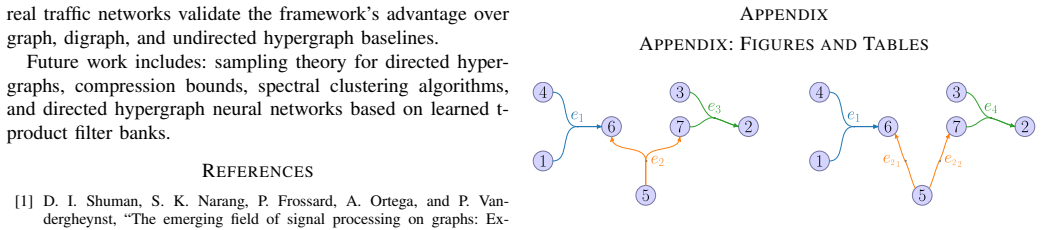
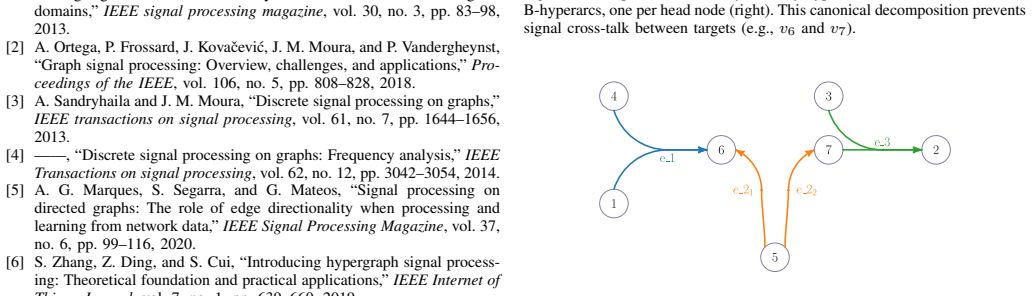
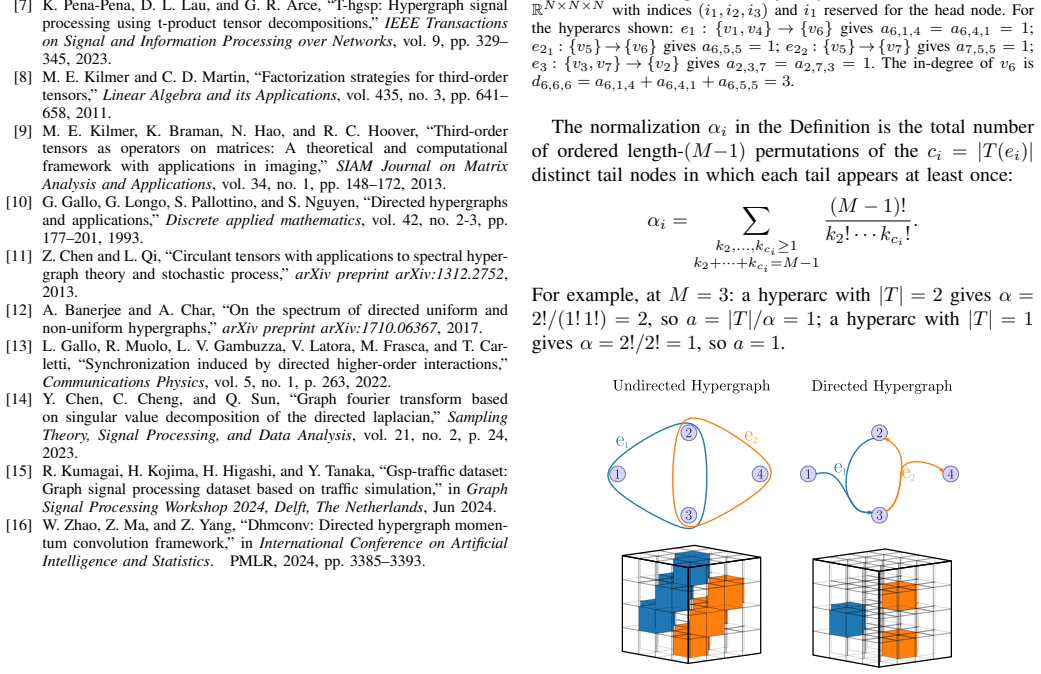
W. Zhao, Z. Ma, and Z. Yang, “Dhmconv: Directed hypergraph momen- tum convolution framework,” inInternational Conference on Artificial Intelligence and Statistics. PMLR, 2024, pp. 3385–3393. APPENDIX APPENDIX: FIGURES ANDTABLES Fig. 2. Decomposition of a many-to-many hyperarc (left) into a collection of B-hyperarcs, one per head node (right). This canonic...
2024
discussion (0)
Sign in with ORCID, Apple, or X to comment. Anyone can read and Pith papers without signing in.