REVIEW 2 major objections 4 minor 75 references
A steep mass transition for bar-driven ISM structuring revealed by PHANGS-JWST
T0 review · 2 major / 4 minor · reviewed 2026-07-12 · grok-4.5
Pith's one-line read Bars reorganise cold gas only above a stellar-mass watershed of 10^10 solar masses.
desk verdict Solid JWST confirmation of the ~10^10 M☉ bar-driven ISM watershed already seen in Hα, UV and simulations; the PAH radial dips and PDFs are new quantitative evidence, not a rebrand. read the letter →
The pith
A machine-rendered reading of the paper's core claim, the machinery that carries it, and where it could break.
The reading
What carries the argument
Continuum-subtracted 7.7 µm PAH surface-brightness maps (F770Wss), treated as a structural tracer of cold ISM, analysed via deprojected radial profiles, density PDFs, and automated detection of central discs or rings, all ordered by host stellar mass.
What would settle it
If independent molecular-gas maps (CO) of the same low-mass barred galaxies show clear central concentrations and bar-lane depletions that the PAH maps miss, or if high-mass barred galaxies lack those CO features while still showing PAH peaks and deserts, the claimed mass-dependent gas redistribution would be undermined.
Extended reading notes
Core claim
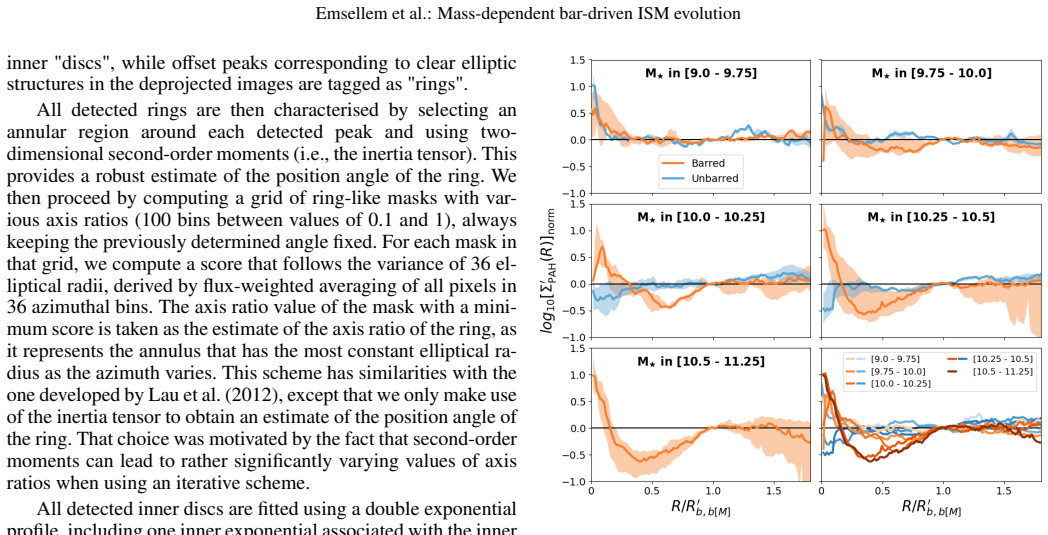
A stellar mass of about 10^10 solar masses acts as a watershed for bar-driven ISM structuring: above it, barred galaxies show well-ordered PAH features, central reservoirs inside 0.15 Rb, and systematic depletions in the [0.2–0.8] Rb range; below it the PAH distribution remains clumpy and agnostic to the presence of a stellar bar.
Load-bearing premise
The claim rests on treating continuum-subtracted 7.7 µm PAH emission as a faithful map of cold-gas column density even though heating intensity and ionisation state can change the brightness without changing the gas mass.
Editorial analysis
A structured set of objections, weighed in public.
Referee Report
Summary. The paper uses continuum-subtracted JWST F770W (7.7 µm PAH) imaging of 57 PHANGS star-forming discs (45 barred, 12 unbarred) to show that a stellar mass of ~10^10 M⊙ marks a continuous but abrupt transition in bar-driven ISM structure. Below this mass, PAH emission is clumpy and disordered regardless of bar presence; above it, barred systems develop central discs/rings within ~0.15 Rb, systematic depletion (“bar deserts”) in [0.2–0.8] Rb, and strongly non-log-normal surface-density PDFs. The result is obtained from deprojected radial profiles, automated ring/disc detection, and stacked PDFs, and is framed as confirmation of earlier Hα/UV trends and of the Verwilghen et al. (2025) simulation suite that attributes the break to the gravity-versus-feedback balance.
Significance. If the mass break is real, the paper supplies a clean, multi-tracer observational counterpart to the simulation prediction that bar-driven secular evolution operates in two distinct regimes. The use of high-resolution JWST PAH maps, independent Spitzer/S4G bar classifications, and quantitative PDF/radial-profile diagnostics strengthens the case that the ~10^10 M⊙ threshold is not an artefact of a single tracer. The work also has direct implications for bar-fraction estimates at low mass and high redshift, where ISM tracers may systematically hide bars. The open discussion of sample imbalance and of F770Wss degeneracies is a methodological strength.
major comments (2)
- Sect. 4.1 and Figs. 4–5: the central claim that the observed peaks and deserts reflect cold-gas redistribution rests on F770Wss being a faithful structural tracer. The section correctly lists ISRF and ionisation degeneracies and argues they amplify rather than invent the signal, yet no quantitative bound (e.g., a comparison of F770Wss versus CO or dust continuum for the same radial bins) is provided for the bar-desert region itself. A short, explicit test or literature cross-check limited to the [0.2–0.8] Rb zone would make the gas-redistribution interpretation more secure.
- Sect. 2.2 and Fig. 1: the unbarred control sample contains only 12 galaxies and none above 10^10.5 M⊙. While the paper states this limitation, the absence of high-mass unbarred systems means the claim that the radial dip and non-log-normal PDF are bar-driven (rather than mass-driven) cannot be tested in the highest mass bin. The manuscript should either quantify how much of the high-mass signal could be produced by mass alone or explicitly restrict the bar-versus-unbarred comparison to the mass range where both populations exist.
minor comments (4)
- Figs. 2–3 captions: the ordering is by stellar mass, but the numerical log M⋆ values are rounded to one decimal; a few galaxies near the 10^10 boundary therefore appear in the “wrong” visual group. Adding the precise log M⋆ (or a vertical line at the threshold) would remove ambiguity.
- Sect. 3.2: the automated ring/disc detection algorithm is described only briefly. A short appendix note on the prominence threshold and on how saturated centres (five galaxies) are treated would aid reproducibility.
- Table C.1: several columns (CS, R, ΔR, ε, Θ) are empty for unbarred and peculiar systems; a footnote clarifying that these fields are defined only for barred galaxies with detected central structures would avoid confusion.
- Abstract and Sect. 5: the phrase “continuous but abrupt” is used for the mass transition; a single sentence quantifying the width of the transition (e.g., from the binned profiles) would make the language more precise.
Circularity Check
No significant circularity: observational mass-threshold claim stands independently of self-cited simulations used only for post-hoc interpretation.
-
self citation load bearing
[Sect. 1 (Introduction) and Sect. 4.5]
"Recent numerical simulations of isolated main-sequence star-forming disc galaxies... have reproduced an observed trend in the distribution of gas and star-forming regions within bars (Verwilghen et al. 2024, 2025)... Our results reinforce the hypothesis that a stellar mass of about 10^10 M⊙ acts as a "watershed" for barred galaxy evolution."
Verwilghen et al. share multiple co-authors with the present work (including the first author). The citation supplies the interpretive framing (gravity vs. feedback regimes, timescales) but is not required for the observational detection of the mass-dependent PAH structures; the data analysis and stacked profiles/PDFs stand alone. Hence the self-citation is present yet non-load-bearing.
full rationale
The paper's central result is an empirical detection of a stellar-mass watershed at ~10^10 M⊙ in the spatial distribution of continuum-subtracted F770W (PAH) emission, obtained by stacking deprojected radial profiles and surface-density PDFs of 45 barred + 12 unbarred PHANGS-JWST galaxies ordered by independently measured stellar mass. Bar presence, lengths and position angles are taken from prior Spitzer/S4G catalogues (Herrera-Endoqui et al. 2015; Querejeta et al. 2021) and only lightly revised with the new 3 µm images; PAH maps are never used to decide bar classification. The mass threshold itself is not a free parameter fitted to the present data set; it is an observed break that coincides with previously reported transitions in Hα, UV and molecular-gas tracers. The authors' own hydrodynamical simulations (Verwilghen et al. 2024, 2025) are cited solely to supply a physical interpretation (gravity- versus feedback-dominated regimes) after the observational trends have already been established. No quantity is predicted from a fit to a subset of the same data, no uniqueness theorem is imported, and no ansatz is smuggled in via self-citation. The single minor self-citation therefore does not render any load-bearing step circular by construction.
Assumptions & free parameters
free parameters (2)
- F770W continuum-subtraction coefficient =
0.22
- Broken-power-law coefficients for unbarred Rb[M] proxy =
α=-4.8, β=0.5/0.8, Mbrk=10.16
assumptions (4)
- domain assumption Continuum-subtracted 7.7 µm PAH emission is a reliable structural tracer of cold-gas column density across galactic environments.
- domain assumption Bar lengths and position angles measured at 3.6 µm (or 3 µm) correctly locate the dynamical bar that organises the gas.
- domain assumption Stellar masses from Leroy et al. (2021b) are accurate to better than ∼0.2 dex, sufficient to place galaxies relative to the 10^10 M⊙ threshold.
- domain assumption Simple 2-D deprojection (constant inclination, thin disc) does not erase or create the radial features under study.
Cite this review
Pith. "Pith review of A steep mass transition for bar-driven ISM structuring revealed by PHANGS-JWST." pith.science (2026). https://pith.science/paper/UFBDHW46
@misc{pith2026260703147,
  author       = {Pith},
  title        = {Pith review of: A steep mass transition for bar-driven ISM structuring revealed by PHANGS-JWST},
  year         = {2026},
  howpublished = {\url{https://pith.science/paper/UFBDHW46}},
  note         = {Machine review of arXiv:2607.03147}
}
abstract
Galactic bars play a critical role in the secular evolution of their hosts by reorganising the ISM. We use a sample of 57 star-forming disc galaxies observed with JWST at 3 and 7.7 $\mu$m to probe how the spatial distribution of PAH emission, as a structural marker of the cold ISM, depends on stellar mass and bar presence. We find evidence for a "watershed" at a stellar mass of $10^{10}$ Msun, marking a fundamental transition in the bar-driven distribution of PAH emission. This confirms trends previously predicted by numerical simulations and observed via ionised gas or UV light. While lower-mass galaxies exhibit a disordered and clumpy distribution of PAH emission regardless of bar presence, higher-mass barred hosts display well-structured dynamical features traced by PAH emission with significant gas reservoirs (e.g., discs and rings) within the central 15% of the bar radius (Rb). Furthermore, we observe a systematic depletion of PAH emission within the [0.2-0.8] Rb range in barred systems with stellar masses above $10^{10}$ Msun. Such central discs, rings, and associated radial dips ("bar deserts") appear to be a mass-dependent phenomenon: ubiquitous in massive galaxies but mostly absent in lower-mass counterparts. In contrast to the structured features in massive hosts, the disorganised ISM in lower-mass galaxies masks commonly observed bar-driven signatures. This suggests that tracer selection and dust obscuration may significantly bias observed bar fractions. Our study underlines two regimes of secular evolution, with different impacts and observability of bar-driven processes: it reaffirms bars as primary drivers of rapid secular evolution in galaxies above $10^{10}$ Msun$, while their impact is significantly reduced or delayed below this threshold. It further underscores the need to account for these processes when modelling galaxy evolution in cosmological simulations.
Figures


Figures from the paper (2 more)

Reference graph
Works this paper leans on
-
[1]
E., et al
Ansar, S., Pearson, S., Sanderson, R. E., et al. 2025, The Astrophysical Journal, 978, 37, aDS Bibcode: 2025ApJ...978...37A Astropy Collaboration, Price-Whelan, A. M., Lim, P. L., et al. 2022, ApJ, 935, 167 Astropy Collaboration, Price-Whelan, A. M., Sip˝ocz, B. M., et al. 2018, AJ, 156, 123 Astropy Collaboration, Robitaille, T. P., Tollerud, E. J., et al...
2025
-
[2]
1992, MNRAS, 259, 345
Athanassoula, E. 1992, MNRAS, 259, 345
1992
-
[3]
M., Rosolowsky, E., et al
Baron, D., Sandstrom, K. M., Rosolowsky, E., et al. 2024, ApJ, 968, 24
2024
-
[4]
M., Sutter, J., et al
Baron, D., Sandstrom, K. M., Sutter, J., et al. 2025, ApJ, 978, 135
2025
-
[5]
2026, A&A, 706, A40
Bazzi, Z., Colombo, D., Bigiel, F., et al. 2026, A&A, 706, A40
2026
-
[6]
A., et al
Bittner, A., Sánchez-Blázquez, P., Gadotti, D. A., et al. 2020, A&A, 643, A65
2020
-
[7]
A., Lu, Y ., Benson, A., Katsianis, A., & Barraza, M
Blanc, G. A., Lu, Y ., Benson, A., Katsianis, A., & Barraza, M. 2019, ApJ, 877, 6
2019
-
[8]
2025, ApJ, 994, 22
Bland-Hawthorn, J., Tepper-Garcia, T., Agertz, O., et al. 2025, ApJ, 994, 22
2025
Show all 75 references
-
[9]
& Combes, F
Bournaud, F. & Combes, F. 2002, A&A, 392, 83
2002
-
[10]
A., Law, D
Bundy, K., Bershady, M. A., Law, D. R., et al. 2015, ApJ, 798, 7
2015
-
[11]
L., & Kawata, D
Carles, C., Martel, H., Ellison, S. L., & Kawata, D. 2016, MNRAS, 463, 1074, arXiv:1610.02366 [astro-ph]
2016 arXiv
-
[12]
K., Bolatto, A
Chown, R., Leroy, A. K., Bolatto, A. D., et al. 2025a, arXiv e-prints, arXiv:2504.08069
-
[13]
K., Sandstrom, K., et al
Chown, R., Leroy, A. K., Sandstrom, K., et al. 2025b, ApJ, 983, 64 Comerón, S., Knapen, J. H., Beckman, J. E., et al. 2010, MNRAS, 402, 2462 Díaz-García, S., Moyano, F. D., Comerón, S., et al. 2020, A&A, 644, A38
2010
-
[14]
P., Lai, T
Donnelly, G. P., Lai, T. S.-Y ., Armus, L., et al. 2025, ApJ, 983, 79
2025
-
[15]
E., Martig, M., James, P
Donohoe-Keyes, C. E., Martig, M., James, P. A., & Kraljic, K. 2019, MNRAS, 489, 4992
2019
-
[16]
T., Li, A., Hensley, B
Draine, B. T., Li, A., Hensley, B. S., et al. 2021, ApJ, 917, 3 Díaz-García, S., Díaz-Suárez, S., Knapen, J. H., & Salo, H. 2019, A&A, 625, A146
2021
-
[17]
W., Gordon, K
Engelbracht, C. W., Gordon, K. D., Rieke, G. H., et al. 2005, ApJ, 628, L29
2005
-
[18]
W., Rieke, G
Engelbracht, C. W., Rieke, G. H., Gordon, K. D., et al. 2008, ApJ, 678, 804
2008
-
[19]
2018, MNRAS, 474, 5372
Erwin, P. 2018, MNRAS, 474, 5372
2018
-
[20]
2019, MNRAS, 489, 3553
Erwin, P. 2019, MNRAS, 489, 3553
2019
-
[21]
2024, MNRAS, 528, 3613
Erwin, P. 2024, MNRAS, 528, 3613
2024
-
[22]
& Debattista, V
Erwin, P. & Debattista, V . P. 2017, MNRAS, 468, 2058
2017
-
[23]
P., & Anderson, S
Erwin, P., Debattista, V . P., & Anderson, S. R. 2023, MNRAS, 524, 3166
2023
-
[24]
B., Frogel, J
Eskridge, P. B., Frogel, J. A., Pogge, R. W., et al. 2000, AJ, 119, 536
2000
-
[25]
Fragkoudi, F., Grand, R. J. J., Pakmor, R., et al. 2025, MNRAS, 538, 1587
2025
-
[26]
2020, MN- RAS, 495, 4158
Fraser-McKelvie, A., Aragón-Salamanca, A., Merrifield, M., et al. 2020, MN- RAS, 495, 4158
2020
-
[27]
R., Stuber, S
Gleis, D. R., Stuber, S. K., Schinnerer, E., et al. 2026, A&A, 707, A121
2026
-
[28]
R., Millman, K
Harris, C. R., Millman, K. J., van der Walt, S. J., et al. 2020, Nature, 585, 357
2020
-
[29]
Hayward, C. C. & Hopkins, P. F. 2017, MNRAS, 465, 1682, aDS Bibcode: 2017MNRAS.465.1682H
2017
-
[30]
2015, A&A, 582, A86, arXiv:1509.05328 [astro-ph]
Herrera-Endoqui, M., Díaz-García, S., Laurikainen, E., & Salo, H. 2015, A&A, 582, A86, arXiv:1509.05328 [astro-ph]
2015 arXiv
-
[31]
Hunter, J. D. 2007, Computing in Science & Engineering, 9, 90
2007
-
[32]
A., Bretherton, C
James, P. A., Bretherton, C. F., & Knapen, J. H. 2009, A&A, 501, 207
2009
-
[33]
James, P. A. & Percival, S. M. 2018, MNRAS, 474, 3101
2018
-
[34]
A., Park, M.-g., et al
Kim, T., Gadotti, D. A., Park, M.-g., et al. 2025, ApJ, 994, 105
2025
-
[35]
H., Beckman, J
Knapen, J. H., Beckman, J. E., Heller, C. H., Shlosman, I., & de Jong, R. S. 1995, ApJ, 454, 623
1995
-
[36]
2026, ApJ, submitted
Koziol, H., Sandstrom, K., Baron, D., & others. 2026, ApJ, submitted
2026
-
[37]
J., D’Onghia, E., et al
Krishnarao, D., Pace, Z. J., D’Onghia, E., et al. 2022, ApJ, 929, 112
2022
-
[38]
2007, PASJ, 59, 117
Kuno, N., Sato, N., Nakanishi, H., et al. 2007, PASJ, 59, 117
2007
-
[39]
E., Rosolowsky, E., et al
Lang, P., Meidt, S. E., Rosolowsky, E., et al. 2020, ApJ, 897, 122
2020
-
[40]
T., Nagai, D., Kravtsov, A
Lau, E. T., Nagai, D., Kravtsov, A. V ., Vikhlinin, A., & Zentner, A. R. 2012, ApJ, 755, 116 Le Conte, Z. A., Gadotti, D. A., Ferreira, L., et al. 2024, MNRAS, 530, 1984
2012
-
[41]
C., Sandstrom, K
Lee, J. C., Sandstrom, K. M., Leroy, A. K., et al. 2023, ApJ, 944, L17
2023
-
[42]
K., Sandstrom, K., Rosolowsky, E., et al
Leroy, A. K., Sandstrom, K., Rosolowsky, E., et al. 2023, ApJ, 944, L9
2023
-
[43]
K., Schinnerer, E., Hughes, A., et al
Leroy, A. K., Schinnerer, E., Hughes, A., et al. 2021b, ApJS, 257, 43 López, P. D., Scannapieco, C., Cora, S. A., & Gargiulo, I. D. 2024, MNRAS, 529, 979
2024
-
[44]
Lu, S., Du, M., & Debattista, V . P. 2025, A&A, 697, A236
2025
-
[45]
& Kalnajs, A
Lynden-Bell, D. & Kalnajs, A. J. 1972, MNRAS, 157, 1
1972
-
[46]
2014, MNRAS, 438, 2882 Menéndez-Delmestre, K., Sheth, K., Schinnerer, E., Jarrett, T
Melvin, T., Masters, K., Lintott, C., et al. 2014, MNRAS, 438, 2882 Menéndez-Delmestre, K., Sheth, K., Schinnerer, E., Jarrett, T. H., & Scoville, N. Z. 2007, ApJ, 657, 790
2014
-
[47]
L., et al
Mukundan, K., Nair, P., Masters, K. L., et al. 2025, MNRAS, 542, 151
2025
-
[48]
2020, A&A, 637, A56
Neumann, J., Fragkoudi, F., Pérez, I., et al. 2020, A&A, 637, A56
2020
-
[49]
K., Thompson, T
Pathak, D., Leroy, A. K., Thompson, T. A., et al. 2024, AJ, 167, 39
2024
-
[50]
2026, ApJ, submitted
Pathak, D., Sandstrom, K., Leroy, A., & others. 2026, ApJ, submitted
2026
-
[51]
2021, A&A, 656, A133
Querejeta, M., Schinnerer, E., Meidt, S., et al. 2021, A&A, 656, A133
2021
-
[52]
W., Thornley, M
Regan, M. W., Thornley, M. D., V ogel, S. N., et al. 2006, ApJ, 652, 1112
2006
-
[53]
W., Huntley, J
Roberts, Jr., W. W., Huntley, J. M., & van Albada, G. D. 1979, ApJ, 233, 67
1979
-
[54]
K., Ishizuki, S., & Scoville, N
Sakamoto, K., Okumura, S. K., Ishizuki, S., & Scoville, N. Z. 1999, ApJ, 525, 691
1999
-
[55]
Sanders, R. H. & Tubbs, A. D. 1980, ApJ, 235, 803
1980
-
[56]
M., Koch, E
Sandstrom, K. M., Koch, E. W., Leroy, A. K., et al. 2023, ApJ, 944, L8
2023
-
[57]
& Leroy, A
Schinnerer, E. & Leroy, A. K. 2024, ARA&A, 62, 369
2024
-
[58]
C., & Gadotti, D
Schultheis, M., Sormani, M. C., & Gadotti, D. A. 2025, A&A Rev., 33, 7
2025
-
[59]
K., Falcón-Barroso, J., Martínez-Valpuesta, I., et al
Seidel, M. K., Falcón-Barroso, J., Martínez-Valpuesta, I., et al. 2015, MNRAS, 451, 936
2015
-
[60]
M., Elmegreen, B
Sheth, K., Elmegreen, D. M., Elmegreen, B. G., et al. 2008, ApJ, 675, 1141
2008
-
[61]
L., et al
Sheth, K., Regan, M., Hinz, J. L., et al. 2010, PASP, 122, 1397
2010
-
[62]
N., Regan, M
Sheth, K., V ogel, S. N., Regan, M. W., Thornley, M. D., & Teuben, P. J. 2005, ApJ, 632, 217
2005
-
[63]
K., Schinnerer, E., Williams, T
Stuber, S. K., Schinnerer, E., Williams, T. G., et al. 2023, A&A, 676, A113
2023
-
[64]
K., Schruba, A., et al
Sun, J., Leroy, A. K., Schruba, A., et al. 2018, ApJ, 860, 172
2018
-
[65]
2024, ApJ, 971, 178
Sutter, J., Sandstrom, K., Chastenet, J., et al. 2024, ApJ, 971, 178
2024
-
[66]
2025, ApJ, 992, L7
Sutter, J., Sandstrom, K., Chown, R., et al. 2025, ApJ, 992, L7
2025
-
[67]
2002, A&A, 385, 337
Teyssier, R. 2002, A&A, 385, 337
2002
-
[68]
2016, A&A, 595, A63
Vera, M., Alonso, S., & Coldwell, G. 2016, A&A, 595, A63
2016
-
[69]
2025, A&A, 700, A3
Verwilghen, P., Emsellem, E., Renaud, F., et al. 2025, A&A, 700, A3
2025
-
[70]
2025, A&A, 700, A3, aDS Bib- code: 2025A&A...700A...3V
Verwilghen, P., Emsellem, E., Renaud, F., et al. 2025, A&A, 700, A3, aDS Bib- code: 2025A&A...700A...3V
2025
-
[71]
2024, A&A, 687, A53
Verwilghen, P., Emsellem, E., Renaud, F., et al. 2024, A&A, 687, A53
2024
-
[72]
Weinberg, M. D. 1985, MNRAS, 213, 451
1985
-
[73]
G., Lee, J
Williams, T. G., Lee, J. C., Larson, K. L., et al. 2024, ApJS, 273, 13
2024
-
[74]
C., Debattista, V
Zhao, D., Du, M., Ho, L. C., Debattista, V . P., & Shi, J. 2020, ApJ, 904, 170 Article number, page 10 of 17 Emsellem et al.: Mass-dependent bar-driven ISM evolution 1 European Southern Observatory, Karl-Schwarzschild-Straße 2, 85748 Garching, Germany e-mail:eric.emsellem@eso....
2020
-
[75]
Emsellem_bar_transition Appendix A: Portfolio of galaxies in the sample In Figs
Astronomy, The University of Manchester, Oxford Road, Manch- ester, M13 9PL, UK Article number, page 11 of 17 A&A proofs:manuscript no. Emsellem_bar_transition Appendix A: Portfolio of galaxies in the sample In Figs. A.1 and A.2, we present the full set of JWST NIR- CAM 7.7µm-...
2021
Reviewed July 12, 2026 · model on record in the stance chip above.
Discussion (0). Continue with ORCID to comment.