Signatures of Ultralight Dark Matter in Space-Based Laser Interferometers
Pith reviewed 2026-06-28 09:31 UTC · model grok-4.3
The pith
Ultralight dark matter effects on test masses survive data processing in space interferometers while laser frequency variations do not.
A machine-rendered reading of the paper's core claim, the machinery that carries it, and where it could break.
Core claim
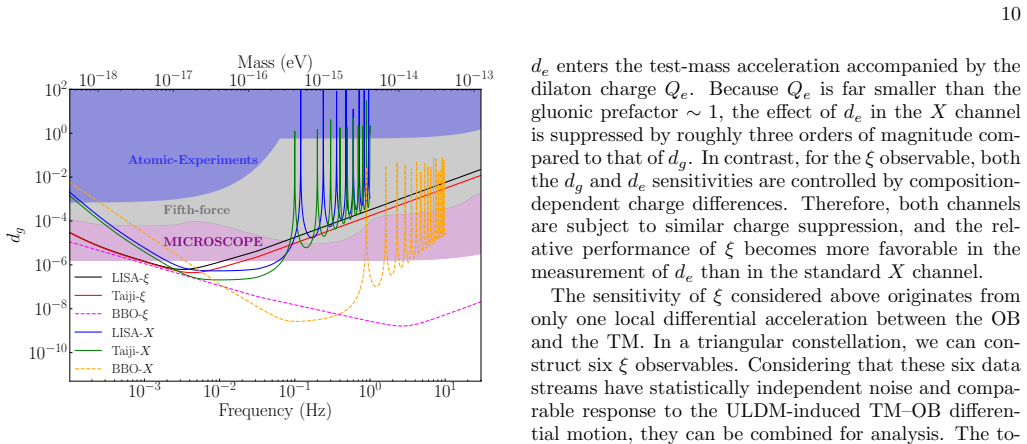
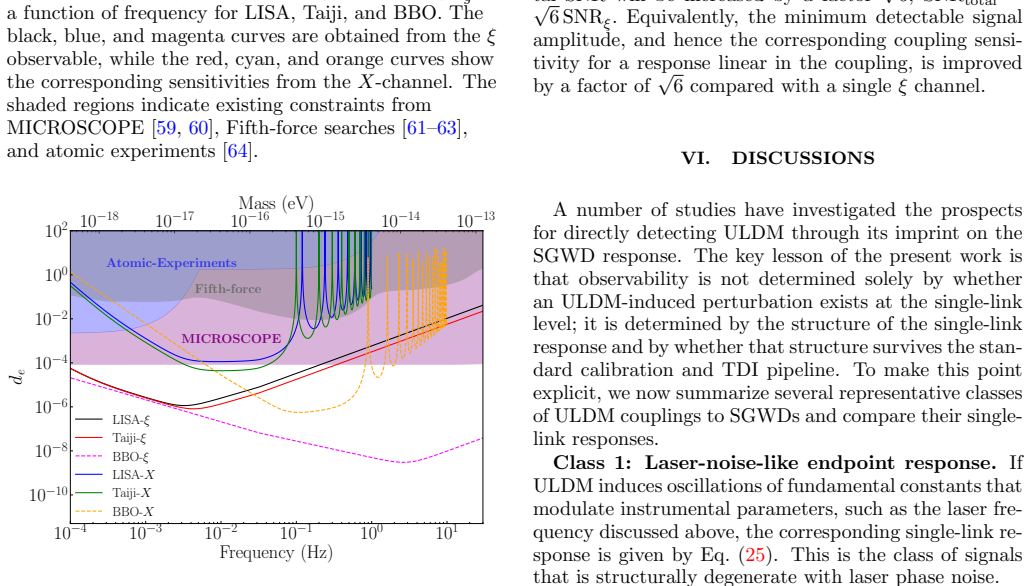
The ULDM-driven variation in laser frequency appears in the raw link observable with the same form as laser phase noise and is therefore strongly suppressed in the final interferometry channels, while signals with explicit directional patterns such as ULDM-induced test-mass oscillations are not eliminated; the local observable yields sensitivities comparable to the standard Michelson interferometer for d_g but better by three orders of magnitude for d_e.
What carries the argument
Single-link response structure, which determines whether an ULDM effect is eliminated by time-delay interferometry and clock-noise suppression.
If this is right
- ULDM-induced laser frequency variations are suppressed identically to laser phase noise in the final channels.
- ULDM-induced test-mass oscillations with directional patterns remain visible after processing.
- The local observable provides sensitivity to d_g at the level of the Michelson channel.
- The local observable improves sensitivity to d_e by three orders of magnitude over the Michelson channel for LISA, Taiji, and BBO.
Where Pith is reading between the lines
- Search strategies for ULDM in space interferometers should include the local observable as a primary channel rather than relying solely on Michelson combinations.
- The same single-link response logic may apply to other precision metrology systems that use TDI-like combinations to cancel common-mode noise.
- Future mission designs could optimize optical-bench instrumentation specifically to enhance the local observable for electron-coupling searches.
Load-bearing premise
Modeling every ULDM-induced instrument effect from the one-way link observables and propagating it through the full TDI and clock-elimination chain captures all relevant contributions without unaccounted systematics.
What would settle it
Simulate an ULDM signal with fixed d_e in the raw links, apply the standard TDI pipeline, and check whether the power in the Michelson channel drops by the predicted factor relative to the local observable.
Figures
read the original abstract
Ultralight dark matter (ULDM) coupled to the Standard Model may effectively induce coherent oscillations of fundamental constants and thereby generate narrow-band signals in precision interferometric experiments. Here we present a systematic study of how these oscillations leave distinctive imprints on space-based laser interferometers, including LISA and Taiji. Starting from the one-way inter-spacecraft link observables, we analyze several instrument-level effects induced by ULDM, including composition-dependent acceleration of test masses, laser-frequency variations associated with cavity-length modulation, refractive-index effects, and clock-related contributions. We then propagate these signals through the standard data processing chain, including time-delay interferometry and clock-noise elimination. We show that the observability of an ULDM-induced effect is determined by the structure of its single-link response. In particular, the ULDM-driven variation in laser frequency appears in the raw link observable with the same form as laser phase noise. As a consequence, it is strongly suppressed in the final interferometry channels. In contrast, signals that possess an explicit directional pattern are not eliminated by this procedure, such as the ULDM-induced oscillations of the test masses. We further construct a local observable that isolates the differential motion between the test mass and the optical bench, and derive its sensitivity to both the dilaton--gluon coupling $d_g$ and the dilaton--electron coupling $d_e$ for LISA, Taiji, and BBO. We find that the local observable yields sensitivities comparable to the standard Michelson interferometer for $d_g$, but better than Michelson channel by three orders of magnitude for $d_e$.
Editorial analysis
A structured set of objections, weighed in public.
Referee Report
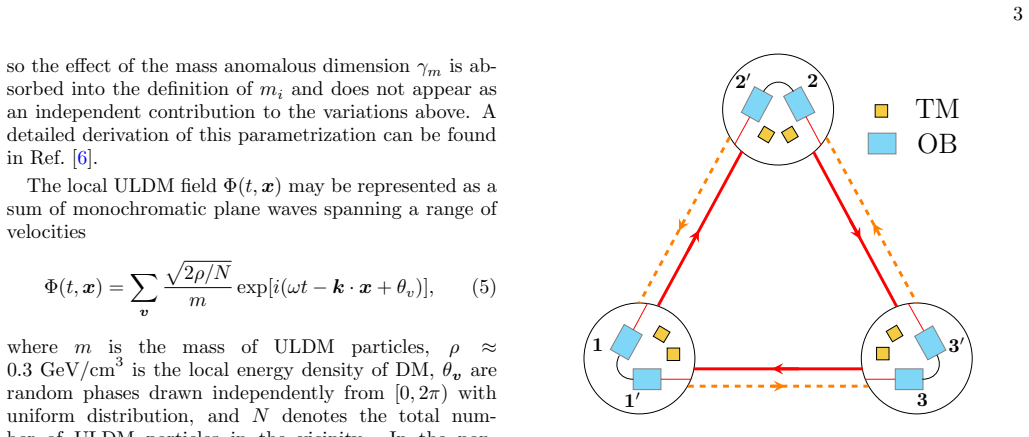
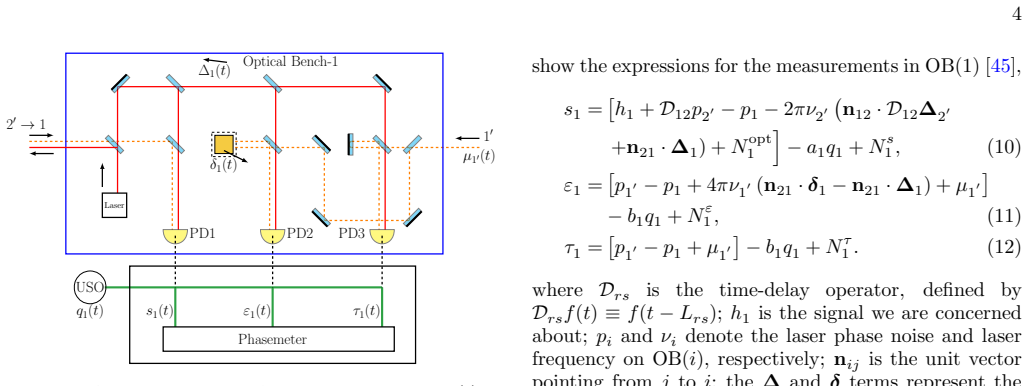
Summary. The paper claims that ultralight dark matter (ULDM) induces coherent oscillations in fundamental constants that produce narrowband signals in space-based interferometers (LISA, Taiji, BBO). Starting from one-way inter-spacecraft link observables, it models instrument effects including composition-dependent test-mass acceleration, cavity-length modulation causing laser-frequency variations, refractive-index changes, and clock contributions. These are propagated through standard TDI combinations and clock-noise elimination. The central result is that ULDM-driven laser-frequency variations enter the raw link observable identically to laser phase noise and are therefore strongly suppressed in the final channels, whereas signals with explicit directional dependence (e.g., test-mass oscillations) survive. A local observable isolating differential test-mass/optical-bench motion is constructed and shown to yield sensitivities to the dilaton couplings d_g and d_e that are comparable to the Michelson channel for d_g but three orders of magnitude better for d_e.
Significance. If the response-function equivalence and propagation hold, the work supplies a concrete framework for searching ULDM in existing and planned space-based GW detectors by exploiting the structure of single-link responses. It identifies a local observable that improves reach on d_e without new hardware and clarifies why certain ULDM effects are automatically rejected by TDI while others are not. The systematic use of the standard TDI formalism and the explicit construction of the local channel are strengths that allow direct comparison with existing noise budgets and other new-physics analyses.
major comments (2)
- [Abstract / instrument-level effects section] Abstract and the section deriving single-link responses: the central claim that 'the ULDM-driven variation in laser frequency appears in the raw link observable with the same form as laser phase noise' (including identical time delays and integration) is asserted but not demonstrated by explicit response functions or equations. This equivalence is load-bearing for the subsequent assertion of strong TDI suppression; without the displayed derivation it cannot be verified that all instrument effects (cavity modulation, refractive index, clock terms) propagate identically to intrinsic laser phase noise.
- [TDI propagation and local observable section] Section on propagation through TDI and clock-noise elimination: the modeling of composition-dependent acceleration, cavity-length modulation, refractive-index effects, and clock contributions is described at the level of one-way links, but the manuscript does not display the full set of response functions after TDI combinations or the numerical error budget confirming that no residual systematics remain in the local observable. This is required to substantiate the quoted sensitivity improvement for d_e.
minor comments (2)
- [Local observable construction] Notation for the local observable and the Michelson channel should be defined once with explicit transfer functions to avoid ambiguity when comparing sensitivities.
- [Sensitivity plots] Figure captions for sensitivity curves should state the assumed integration time, ULDM coherence time, and noise model parameters used for the d_g and d_e projections.
Simulated Author's Rebuttal
We thank the referee for the careful and constructive review, which highlights both the potential impact of the work and the need for greater explicitness in the derivations. We agree that the manuscript would benefit from additional displayed equations and will revise accordingly.
read point-by-point responses
-
Referee: The central claim that the ULDM-driven variation in laser frequency appears in the raw link observable with the same form as laser phase noise (including identical time delays and integration) is asserted but not demonstrated by explicit response functions or equations. This equivalence is load-bearing for the subsequent assertion of strong TDI suppression.
Authors: We agree that the equivalence requires explicit demonstration. In the revised manuscript we will add the full derivation of the single-link response functions for the ULDM-induced laser-frequency variations (arising from cavity-length modulation), showing that they enter the observable identically to intrinsic laser phase noise, including the same time-delay and integration structure. We will also display the corresponding response functions for the other instrument effects (refractive index, clock terms) to confirm they propagate in the same manner. revision: yes
-
Referee: The modeling of composition-dependent acceleration, cavity-length modulation, refractive-index effects, and clock contributions is described at the level of one-way links, but the manuscript does not display the full set of response functions after TDI combinations or the numerical error budget confirming that no residual systematics remain in the local observable.
Authors: We acknowledge that the post-TDI response functions and a supporting numerical error budget were not included. The revision will present the complete TDI response functions for each ULDM-induced effect (including the local observable) and will add a short numerical section that quantifies residual systematics in the local channel, thereby substantiating the quoted sensitivity reach for d_e. revision: yes
Circularity Check
No circularity; derivation starts from standard link observables and applies existing TDI without reduction to inputs or self-citations.
full rationale
The paper models ULDM effects from one-way inter-spacecraft link observables, then propagates them through standard TDI and clock-noise elimination. The key claim that laser-frequency variations match laser phase noise (leading to suppression) follows directly from the modeled single-link response structure, with no fitted parameters renamed as predictions, no self-definitional loops, and no load-bearing self-citations. The local observable construction and sensitivity comparisons are independent of the target results. This is the normal case of a self-contained analysis against external benchmarks.
Axiom & Free-Parameter Ledger
axioms (2)
- domain assumption ULDM induces coherent oscillations of fundamental constants via dilaton couplings to gluons and electrons
- domain assumption Standard one-way inter-spacecraft link observables and TDI processing chain accurately represent the instrument response
Reference graph
Works this paper leans on
-
[1]
is independent of the fundamental constants becauseN∝a −3 B andν 0 ∝m eα2. Therefore, δn n ≈ νlaser n ∂n ∂νlaser δνlaser νlaser −2 δα α − δme me .(21) For a laser wavelengthλ= 1064 nm and a silica beam splitter, one has approximatelyn≈1.5 and νlaser n ∂n ∂νlaser ≈5×10 −3. Substituting Eq. (18) into Eq. (21), we can get δn n ≈ −5×10 −3 δα α .(22) The same ...
-
[2]
L. Hui, J. P. Ostriker, S. Tremaine, and E. Witten, Phys- ical Review D95, 043541 (2017)
2017
-
[3]
D. J. E. Marsh, Physics Reports643, 1 (2016)
2016
-
[4]
E. G. M. Ferreira, Astron. Astrophys. Rev.29, 7 (2021), arXiv:2005.03254 [astro-ph.CO]
arXiv 2021
-
[5]
Chavanis, Front
P.-H. Chavanis, Front. Astron. Space Sci.12, 1538434 (2025)
2025
-
[6]
V. V. Flambaum, International Journal of Modern Physics A22, 4937 (2007)
2007
-
[7]
Damour and J
T. Damour and J. F. Donoghue, Physical Review D82, 084033 (2010)
2010
-
[8]
Derevianko and M
A. Derevianko and M. Pospelov, Nature Physics10, 933 (2014)
2014
-
[9]
Arvanitaki, J
A. Arvanitaki, J. Huang, and K. Van Tilburg, Physical Review D91, 015015 (2015)
2015
-
[10]
Wcislo, P
P. Wcislo, P. Ablewski, K. Beloy, S. Bilicki, M. Bober, R. Brown, R. Fasano, R. Ciurylo, H. Hachisu, T. Ido, J. Lodewyck, A. Ludlow, W. McGrew, P. Morzynski, D. Nicolodi, M. Schioppo, M. Sekido, R. Le Targat, P. Wolf, X. Zhang, B. Zjawin, and M. Zawada, Science Advances4, eaau4869 (2018)
2018
-
[11]
Filzinger, S
M. Filzinger, S. D¨ orscher, R. Lange, J. Klose, M. Steinel, E. Benkler, E. Peik, C. Lisdat, and N. Huntemann, Phys. Rev. Lett.130, 253001 (2023)
2023
-
[12]
C. J. Kennedy, E. Oelker, J. M. Robinson, T. Bothwell, D. Kedar, W. R. Milner, G. E. Marti, A. Derevianko, and J. Ye, Physical Review Letters125, 201302 (2020)
2020
-
[13]
Y. V. Stadnik and V. V. Flambaum, Physical Review Letters114, 161301 (2015)
2015
-
[14]
A. Aoki and J. Soda, Int. J. Mod. Phys. D26, 1750063 (2016), arXiv:1608.05933
Pith/arXiv arXiv 2016
-
[15]
Arvanitaki, P
A. Arvanitaki, P. W. Graham, J. M. Hogan, S. Rajen- dran, and K. Van Tilburg, Physical Review D97, 075020 (2018)
2018
-
[16]
H. Grote and Y. V. Stadnik, Phys. Rev. Research1, 033187 (2019), arXiv:1906.06193
arXiv 2019
-
[17]
Nagano, T
K. Nagano, T. Fujita, Y. Michimura, and I. Obata, Phys- ical Review Letters123, 111301 (2019)
2019
-
[18]
Pierce, K
A. Pierce, K. Riles, and Y. Zhao, Physical Review Letters 121, 061102 (2018)
2018
-
[19]
S. M. Vermeulen, P. Relton, H. Grote, V. Raymond, C. Affeldt, F. Bergamin, A. Bisht, M. Brinkmann, K. Danzmann, S. Doravari, V. Kringel, J. Lough, H. Lueck, M. Mehmet, N. Mukund, S. Nadji, E. Schreiber, B. Sorazu, K. A. Strain, H. Vahlbruch, M. Weinert, B. Willke, and H. Wittel, Nature600, 424 (2021)
2021
-
[20]
Morisaki, T
S. Morisaki, T. Fujita, Y. Michimura, H. Nakatsuka, and I. Obata, Physical Review D103, L051702 (2021)
2021
-
[21]
A. L. Milleret al., Phys. Rev. D103, 103002 (2021), arXiv:2010.01925
arXiv 2021
-
[22]
E. Hall and N. Aggarwal, Advanced LIGO, LISA, and Cosmic Explorer as dark matter transducers (2022), arXiv:2210.17487 [gr-qc]
arXiv 2022
-
[23]
Michimura, T
Y. Michimura, T. Fujita, S. Morisaki, H. Nakatsuka, and I. Obata, Physical Review D102, 102001 (2020)
2020
-
[24]
H.-K. Guo, K. Riles, F.-W. Yang, and Y. Zhao, Commu- nications Physics2, 155 (2019)
2019
-
[25]
Amaro-Seoaneet al., Laser interferometer space an- tenna (2017), arXiv:1702.00786 [astro-ph.IM]
P. Amaro-Seoaneet al., Laser interferometer space an- tenna (2017), arXiv:1702.00786 [astro-ph.IM]
Pith/arXiv arXiv 2017
-
[26]
Hu and Y.-L
W.-R. Hu and Y.-L. Wu, National Science Review4, 685 (2017)
2017
-
[27]
W.-H. Ruan, C. Liu, Z.-K. Guo, Y.-L. Wu, and R.-G. Cai, Nature Astronomy4, 108 (2020)
2020
-
[28]
Luoet al., Classical and Quantum Gravity33, 035010 (2016)
J. Luoet al., Classical and Quantum Gravity33, 035010 (2016)
2016
-
[29]
S. Morisaki and T. Suyama, Phys. Rev. D100, 123512 (2019), arXiv:1811.05003. 15
arXiv 2019
- [30]
-
[31]
Yao and Y
Y.-H. Yao and Y. Tang, Physical Review D110, 095015 (2024)
2024
- [32]
-
[33]
J.-C. Yu, Y. Cao, Y. Tang, and Y.-L. Wu, Phys. Rev. D 110, 023025 (2024), arXiv:2404.04333
arXiv 2024
-
[34]
Zhang, J
J.-R. Zhang, J. Chen, H.-S. Jiao, R.-G. Cai, and Y.-L. Zhang, Phys. Rev. D112, 064030 (2025)
2025
-
[35]
Y.-H. Yao, T. Jiang, and Y. Tang, Physical Review D 111, 055031 (2025)
2025
-
[36]
Gu´ e, A
J. Gu´ e, A. Hees, and P. Wolf, Classical and Quantum Gravity42, 055015 (2025)
2025
- [37]
-
[38]
Liu, J.-R
Y.-Y. Liu, J.-R. Zhang, M.-H. Du, H.-S. Liu, P. Xu, and Y.-L. Zhang, The European Physical Journal C86, 347 (2026)
2026
-
[39]
J. Frerick, J. Jaeckel, F. Kahlhoefer, and K. Schmidt- Hoberg, Physics Letters B848, 138328 (2024), arXiv:2310.06017 [hep-ph]
arXiv 2024
-
[40]
A. L. Miller and L. Mendes, Physical Review D107, 063015 (2023)
2023
-
[41]
Tinto and S
M. Tinto and S. V. Dhurandhar, Living Reviews in Rel- ativity24, 1 (2020)
2020
-
[42]
J. W. Armstrong, F. B. Estabrook, and M. Tinto, The Astrophysical Journal527, 814 (1999)
1999
-
[43]
F. B. Estabrook, M. Tinto, and J. W. Armstrong, Phys- ical Review D62, 042002 (2000)
2000
-
[44]
G. Wang, W.-T. Ni, W.-B. Han, and C.-F. Qiao, Phys. Rev. D103, 122006 (2021), arXiv:2010.15544 [gr-qc]
arXiv 2021
-
[45]
M. Otto, G. Heinzel, and K. Danzmann, Classical and Quantum Gravity29, 205003 (2012)
2012
-
[46]
Tinto and O
M. Tinto and O. Hartwig, Physical Review D98, 042003 (2018)
2018
-
[47]
Hartwig and J.-B
O. Hartwig and J.-B. Bayle, Physical Review D103, 123027 (2021)
2021
-
[48]
W. M. Campbell, B. T. McAllister, M. Goryachev, E. N. Ivanov, and M. E. Tobar, Physical Review Letters126, 071301 (2021)
2021
- [49]
-
[50]
L. c. v. F. Paˇ steka, Y. Hao, A. Borschevsky, V. V. Flambaum, and P. Schwerdtfeger, Phys. Rev. Lett.122, 160801 (2019)
2019
-
[51]
D. J. Griffiths and D. F. Schroeter,Introduction to Quan- tum Mechanics, 3rd ed. (Cambridge University Press, Cambridge, 2018)
2018
-
[52]
R. W. P. Drever, J. L. Hall, F. V. Kowalski, J. Hough, G. M. Ford, A. J. Munley, and H. Ward, Applied Physics B31, 97 (1983)
1983
-
[53]
H.-T. Xu, Y.-H. Yao, Y. Tang, and Y.-L. Wu, Phys. Rev. D112, 095021 (2025), arXiv:2506.09744 [hep-ph]
Pith/arXiv arXiv 2025
-
[54]
J. Gu´ e, P. Wolf, and A. Hees, Phys. Rev. D112, 115020 (2025), arXiv:2508.13847 [gr-qc]
Pith/arXiv arXiv 2025
-
[55]
Y.-H. Yao, T. Jiang, W. Ren, D. Chen, Y. Tang, and Y.-F. Zhou, (2025), arXiv:2508.14655 [hep-ph]
arXiv 2025
-
[56]
G. D. Racca and P. W. McNamara, Space Science Re- views151, 10.1007/s11214-009-9602-x (2010)
-
[57]
LISA Pathfinder Collaboration, Physical Review D99, 082001 (2019)
2019
-
[58]
Corbin and N
V. Corbin and N. J. Cornish, Classical and Quantum Gravity23, 2435 (2006)
2006
-
[59]
D. Budker, P. W. Graham, M. Ledbetter, S. Rajendran, and A. O. Sushkov, Physical Review X4, 10.1103/Phys- RevX.4.021030 (2014)
-
[60]
Touboul, G
P. Touboul, G. M´ etris, M. Rodrigues, Y. Andr´ e, Q. Baghi, J. Berg´ e, D. Boulanger, S. Bremer, P. Carle, R. Chhun, B. Christophe, V. Cipolla, T. Damour, P. Danto, H. Dittus, P. Fayet, B. Foulon, C. Gageant, P.- Y. Guidotti, D. Hagedorn, E. Hardy, P.-A. Huynh, H. In- chauspe, P. Kayser, S. Lala, C. L¨ ammerzahl, V. Lebat, P. Leseur, F. m. c. Liorzou, M....
2017
-
[61]
Touboul, G
P. Touboul, G. M´ etris, M. Rodrigues, J. Berg´ e, A. Robert, Q. Baghi, Y. Andr´ e, J. Bedouet, D. Boulanger, S. Bremer, P. Carle, R. Chhun, B. Christophe, V. Cipolla, T. Damour, P. Danto, L. De- mange, H. Dittus, O. Dhuicque, P. Fayet, B. Foulon, P.-Y. Guidotti, D. Hagedorn, E. Hardy, P.-A. Huynh, P. Kayser, S. Lala, C. L¨ ammerzahl, V. Lebat, F. m. c. L...
2022
-
[62]
E. Fischbach and C. Talmadge, Ten years of the fifth force (1996), arXiv:hep-ph/9606249 [hep-ph]
Pith/arXiv arXiv 1996
-
[63]
J. H. Lee, E. G. Adelberger, T. S. Cook, S. M. Fleis- cher, and B. R. Heckel, Physical Review Letters124, 10.1103/physrevlett.124.101101 (2020)
-
[64]
Tan, A.-B
W.-H. Tan, A.-B. Du, W.-C. Dong, S.-Q. Yang, C.-G. Shao, S.-G. Guan, Q.-L. Wang, B.-F. Zhan, P.-S. Luo, L.- C. Tu, and J. Luo, Phys. Rev. Lett.124, 051301 (2020)
2020
-
[65]
V. A. Dzuba, V. V. Flambaum, and A. J. Mansour, Physical Review D110, 055022 (2024), arXiv:2402.09643 [hep-ph]
arXiv 2024
-
[66]
Ni, J.-T
W.-T. Ni, J.-T. Shy, S.-M. Tseng, X. Xu, H.-C. Yeh, W.- Y. Hsu, W.-L. Liu, S.-D. Tzeng, P. Fridelance, E. Samain, D. Lee, Z.-Y. Su, and A.-M. Wu, inSmall Spacecraft, Space Environments, and Instrumentation Technologies, Vol. 3116, edited by F. A. Allahdadi, E. K. Casani, T. D. Maclay, F. A. Allahdadi, and T. D. Maclay, International Society for Optics and...
1997
discussion (0)
Sign in with ORCID, Apple, or X to comment. Anyone can read and Pith papers without signing in.