WKB Spectral Asymptotics for a One-Dimensional Dirac Operator with a Slowly Varying Mass Profile
Pith reviewed 2026-06-29 14:59 UTC · model grok-4.3
The pith
A WKB construction for the Dirac operator yields a modified Bohr-Sommerfeld condition with a pseudo-spin-dependent half-integer shift that recovers the topologically protected zero mode.
A machine-rendered reading of the paper's core claim, the machinery that carries it, and where it could break.
Core claim
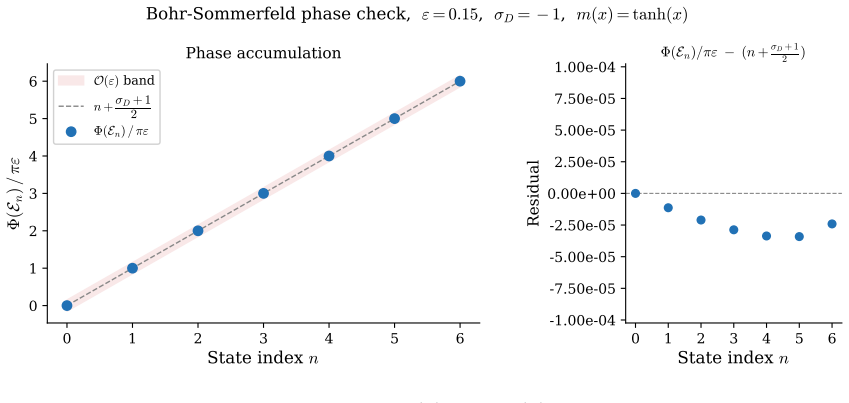
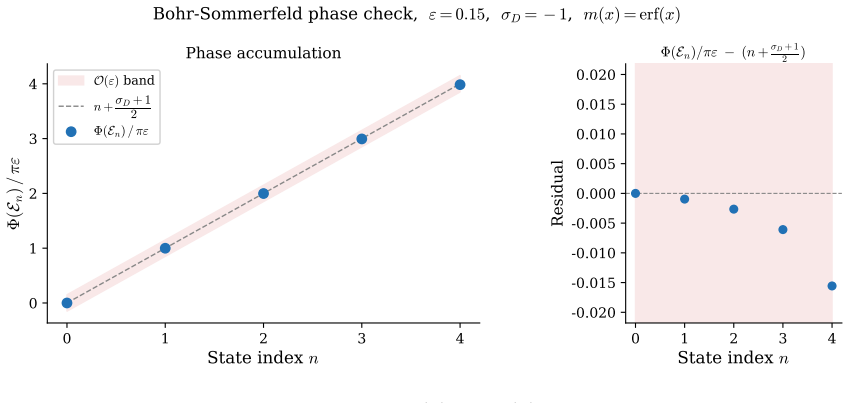
We study the semiclassical spectral theory of a one-dimensional Dirac operator describing waves at the interface between topologically distinct media. We derive a modified Bohr-Sommerfeld quantization condition for the squared operator via a systematic formal WKB construction producing approximate eigenpairs. Our result differs from the standard result by the half-integer shift depending on the pseudo-spin index which allows for recovering the topologically protected zero mode. We verify our result for the solvable Pöschl--Teller potential and provide numerical computations confirming the convergence of eigenvalues and eigenfunctions to their WKB approximations.
What carries the argument
The formal WKB construction applied to the squared Dirac operator, which produces the modified Bohr-Sommerfeld quantization condition incorporating a pseudo-spin index dependent half-integer shift.
If this is right
- The modified condition recovers the topologically protected zero mode.
- Eigenvalues and eigenfunctions converge to the WKB approximations as the semiclassical parameter tends to zero.
- The result holds for the Pöschl-Teller potential and general slowly varying mass profiles.
- Approximate eigenpairs can be constructed systematically for the Dirac operator in this setting.
Where Pith is reading between the lines
- This modified quantization might be used to design numerical schemes that better preserve topological features in discretizations of Dirac operators.
- Similar half-integer corrections could appear in other semiclassical analyses of topological systems, such as in higher dimensions or with different potentials.
- The approach may connect to phase-space methods or Maslov index calculations in semiclassical analysis.
Load-bearing premise
The mass profile varies sufficiently slowly that the formal WKB construction produces approximate eigenpairs whose convergence to true eigenpairs can be verified in the semiclassical limit.
What would settle it
Numerical computation of the eigenvalues for a specific slowly varying mass profile, such as a smoothed step function, showing that they fail to approach the values predicted by the modified Bohr-Sommerfeld condition as the semiclassical parameter approaches zero.
Figures




read the original abstract
We study the semiclassical spectral theory of a one-dimensional Dirac operator describing waves at the interface between topologically distinct media. We derive a modified Bohr-Sommerfeld quantization condition for the squared operator via a systematic formal WKB construction producing approximate eigenpairs. Our result differs from the standard result by the half-integer shift depending on the pseudo-spin index which allows for recovering the topologically protected zero mode. We verify our result for the solvable P\"{o}schl--Teller potential and provide numerical computations confirming the convergence of eigenvalues and eigenfunctions to their WKB approximations.
Editorial analysis
A structured set of objections, weighed in public.
Referee Report
Summary. The paper presents a formal WKB construction for the semiclassical spectral asymptotics of a one-dimensional Dirac operator with slowly varying mass profile. It derives a modified Bohr-Sommerfeld quantization condition for the squared operator that includes a pseudo-spin-dependent half-integer shift, claims this recovers the topologically protected zero mode, verifies the condition exactly on the solvable Pöschl-Teller potential, and provides numerical evidence of convergence for selected profiles.
Significance. If the formal construction can be upgraded to include explicit error control showing that the approximate eigenpairs converge to true ones as the semiclassical parameter tends to zero, the result would supply a concrete asymptotic tool linking WKB methods to topological spectral features in one dimension; the exact match on Pöschl-Teller and the numerical checks are positive indicators of plausibility.
major comments (3)
- [Abstract, §3 (WKB construction)] The central claim (abstract and introduction) is that the WKB approximations produce eigenpairs converging to true eigenpairs in the semiclassical limit for slowly varying mass; however, the construction remains purely formal and no explicit remainder estimates or proof that the error vanishes as h→0 are supplied for general smooth mass profiles.
- [§3, §4 (verification)] The modified quantization condition is asserted to differ from the standard result by the half-integer shift and thereby recover the zero mode; without a rigorous justification that the formal eigenpairs are indeed O(h^∞)-close to true eigenpairs, this topological recovery is not yet secured beyond the exactly solvable case.
- [§5 (numerics)] Numerical confirmation is provided only for selected profiles; this does not substitute for an analytic error bound that would establish convergence uniformly for mass profiles satisfying the slow-variation hypothesis.
minor comments (2)
- [§2] Notation for the pseudo-spin index and the precise definition of the semiclassical parameter h should be introduced earlier and used consistently.
- [§3] A brief comparison table or statement contrasting the new quantization condition with the classical Bohr-Sommerfeld rule would improve readability.
Simulated Author's Rebuttal
We thank the referee for the thorough review and for noting the positive aspects of the exact verification and numerical checks. Our manuscript presents a formal WKB construction, as stated throughout, and we address each major comment while preserving the intended scope of the work.
read point-by-point responses
-
Referee: [Abstract, §3 (WKB construction)] The central claim (abstract and introduction) is that the WKB approximations produce eigenpairs converging to true eigenpairs in the semiclassical limit for slowly varying mass; however, the construction remains purely formal and no explicit remainder estimates or proof that the error vanishes as h→0 are supplied for general smooth mass profiles.
Authors: The abstract and §3 explicitly describe the analysis as a 'formal WKB construction producing approximate eigenpairs.' The central contribution is the derivation of the modified Bohr-Sommerfeld quantization condition incorporating the pseudo-spin-dependent half-integer shift. The manuscript does not claim or prove that the approximate eigenpairs converge to true ones for general profiles; such a claim would require error estimates that are absent by design. The scope is therefore accurately represented, and no revision is needed. revision: no
-
Referee: [§3, §4 (verification)] The modified quantization condition is asserted to differ from the standard result by the half-integer shift and thereby recover the zero mode; without a rigorous justification that the formal eigenpairs are indeed O(h^∞)-close to true eigenpairs, this topological recovery is not yet secured beyond the exactly solvable case.
Authors: In §3 the modified condition is obtained formally. Section 4 verifies that this condition recovers the zero mode exactly on the Pöschl-Teller potential, where the quantization holds with no error. For general profiles the recovery remains at the formal level, consistent with the paper's stated objectives. We do not assert O(h^∞) closeness outside the exactly solvable case. revision: no
-
Referee: [§5 (numerics)] Numerical confirmation is provided only for selected profiles; this does not substitute for an analytic error bound that would establish convergence uniformly for mass profiles satisfying the slow-variation hypothesis.
Authors: The computations in §5 are presented as supporting illustrations of convergence for chosen profiles. They are not offered as a substitute for analytic bounds. The primary aim of the work remains the formal derivation of the modified quantization condition rather than a complete rigorous asymptotic theory. revision: no
- Supplying explicit remainder estimates and a proof that approximate eigenpairs converge to true eigenpairs as h→0 for general smooth mass profiles
Circularity Check
No circularity in formal WKB derivation
full rationale
The paper derives a modified Bohr-Sommerfeld quantization condition via a systematic formal WKB construction applied to the squared operator, producing approximate eigenpairs that differ from the standard result by a pseudo-spin-dependent half-integer shift. This construction is presented as an independent asymptotic procedure rather than a self-referential definition, fitted parameter, or result imported solely via self-citation. Exact verification on the Pöschl-Teller potential and numerical checks for other profiles serve as external confirmation but do not reduce the central claim to its inputs by construction. The derivation chain remains self-contained with no load-bearing steps that collapse to tautology or prior author work.
Axiom & Free-Parameter Ledger
axioms (1)
- domain assumption The mass profile varies slowly enough for the semiclassical WKB construction to yield approximate eigenpairs that converge in the appropriate limit.
Reference graph
Works this paper leans on
-
[1]
An introduction to topological insulators.Comptes Rendus Physique, 14:779–815, 2013
M Fruchart and D Carpentier. An introduction to topological insulators.Comptes Rendus Physique, 14:779–815, 2013
2013
-
[2]
Topological edge spectrum along curved interfaces.In- ternational Mathematics Research Notices, 2024(22):13870–13889, 10 2024
Alexis Drouot and Xiaowen Zhu. Topological edge spectrum along curved interfaces.In- ternational Mathematics Research Notices, 2024(22):13870–13889, 10 2024
2024
-
[3]
Guillaume Bal, Simon Becker, Alexis Drouot, Clotilde Fermanian Kammerer, Jianfeng Lu, and Alexander B. Watson. Edge state dynamics along curved interfaces.SIAM Journal on Mathematical Analysis, 55(5):4219–4254, 2023
2023
-
[4]
Microlocal analysis of the bulk-edge correspondence.Communications in Mathematical Physics, 383:2069–2112, 2021
Alexis Drouot. Microlocal analysis of the bulk-edge correspondence.Communications in Mathematical Physics, 383:2069–2112, 2021
2069
-
[5]
Quantization of edge currents for continuous magnetic operators.Journal of Functional Analysis, 209:388–413, 2004
J Kellendonk and H Schulz-Baldes. Quantization of edge currents for continuous magnetic operators.Journal of Functional Analysis, 209:388–413, 2004
2004
-
[6]
The bulk-edge correspondence for disordered chiral chains
G M Graf and J Shapiro. The bulk-edge correspondence for disordered chiral chains. Communications in Mathematical Physics, 363:829–846, 2018
2018
-
[7]
Watson, and Michael I
Jianfeng Lu, Alexander B. Watson, and Michael I. Weinstein. Dirac operators and domain walls.SIAM Journal on Mathematical Analysis, 52(2):1115–1145, 2020
2020
-
[8]
American Mathematical Society, 2017
C Fefferman, J Lee-Thorp, and M Weinstein.Topologically protected states in one- dimensional systems, volume 247. American Mathematical Society, 2017
2017
-
[9]
Topological protection of perturbed edge states.Communications in Math- ematical Sciences, 17:193–225, 2019
Guillaume Bal. Topological protection of perturbed edge states.Communications in Math- ematical Sciences, 17:193–225, 2019
2019
-
[10]
Topology in shallow-water waves: A violation of bulk-edge correspondence.Communications in Mathematical Physics, 383(2):731–761, Apr 2021
Gian Michele Graf, Hansueli Jud, and Cl´ ement Tauber. Topology in shallow-water waves: A violation of bulk-edge correspondence.Communications in Mathematical Physics, 383(2):731–761, Apr 2021
2021
-
[11]
Topological origin of equatorial waves.Science, 358:1075–1077, 2017
P Delplace, J B Marston, and A Venaille. Topological origin of equatorial waves.Science, 358:1075–1077, 2017. 26
2017
-
[12]
Cobordism invariance of topological edge- following states.Advances in Theoretical and Mathematical Physics, 26(3):673–710, 2022
Matthias Ludewig and Guo Chuan Thiang. Cobordism invariance of topological edge- following states.Advances in Theoretical and Mathematical Physics, 26(3):673–710, 2022
2022
-
[13]
Topological photonics.Reviews of modern physics, 91:15006, 2019
T Ozawa, H M Price, A Amo, N Goldman, M Hafezi, L Lu, M Rechtsman, D Schuster, J Simon, O Zilberberg, and I Carusotto. Topological photonics.Reviews of modern physics, 91:15006, 2019
2019
-
[14]
Matthew J. Gilbert. Topological electronics.Communications Physics, 4:1–12, 2021
2021
-
[15]
Springer, Berlin, 1971
Siegfried Fl¨ ugge.Practical Quantum Mechanics. Springer, Berlin, 1971
1971
-
[16]
Bender and Steven A
Carl M. Bender and Steven A. Orszag.Advanced Mathematical Methods for Scientists and Engineers. McGraw-Hill, 1978
1978
-
[17]
American Mathematical Society, 2012
Maciej Zworski.Semiclassical Analysis. American Mathematical Society, 2012
2012
-
[18]
F. W. J. Olver et al. NIST digital library of mathematical functions. https://dlmf.nist.gov/,
-
[19]
Release 1.1.12, F. W. J. Olver et al., eds
-
[20]
Stegun.Handbook of Mathematical Functions
Milton Abramowitz and Irene A. Stegun.Handbook of Mathematical Functions. National Bureau of Standards, 1964
1964
-
[21]
Academic Press, 7th edition, 2007
Izrail Solomonovich Gradshteyn and Iosif Moiseevich Ryzhik.Table of Integrals, Series, and Products. Academic Press, 7th edition, 2007
2007
-
[22]
Cambridge University Press, 1999
Mouez Dimassi and Johannes Sj¨ ostrand.Spectral Asymptotics in the Semi-Classical Limit, volume 268 ofLondon Mathematical Society Lecture Note Series. Cambridge University Press, 1999. 27
1999
discussion (0)
Sign in with ORCID, Apple, or X to comment. Anyone can read and Pith papers without signing in.