Spatially Distributed Task-Oriented Compression for Multi-Emitter Localization and Characterization with Spectral Overlap
Pith reviewed 2026-06-28 16:11 UTC · model grok-4.3
The pith
Task-oriented compression at distributed RF receivers preserves enough information for central multi-emitter localization and characterization despite spectral overlap.
A machine-rendered reading of the paper's core claim, the machinery that carries it, and where it could break.
Core claim
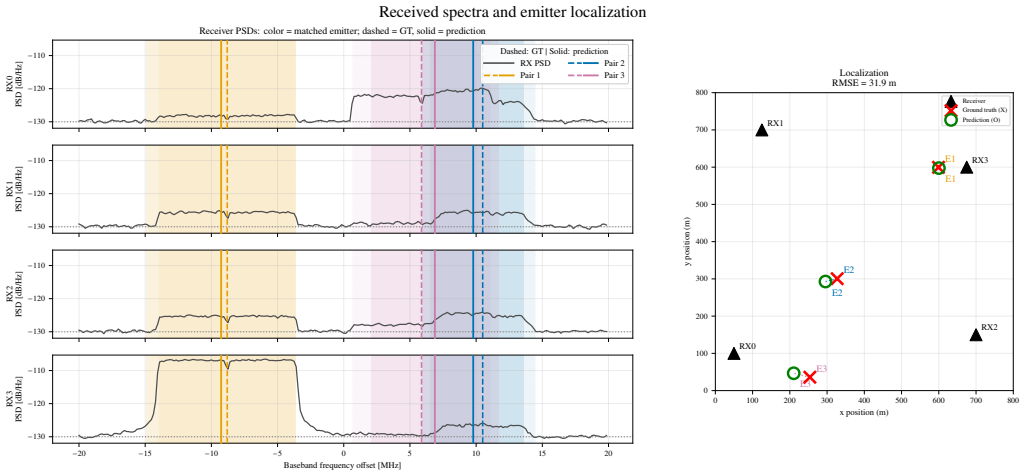
Each receiver encodes a time-frequency representation of its IQ observation into a compact latent vector; a central decoder fuses these latents to recover an unordered collection of emitters including locations, frequency offsets, bandwidths, and waveform families, using a permutation-invariant objective for training.
What carries the argument
The task-oriented distributed compression framework that maps each receiver's time-frequency observation to a low-dimensional latent vector for central fusion decoding.
If this is right
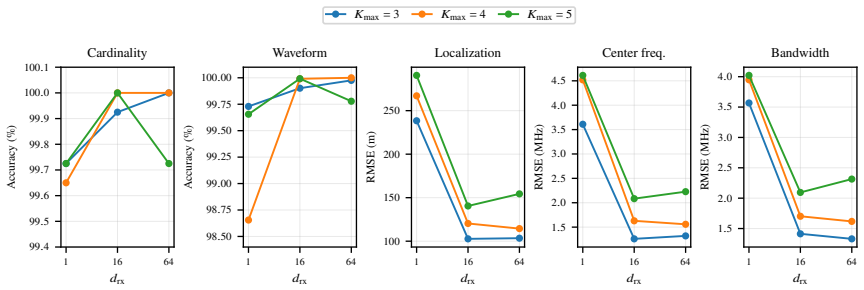
- Extremely compact receiver representations suffice for emitter counting and waveform-family estimation.
- Accurate localization and spectral-parameter regression require larger latent dimensions, with the largest gains when increasing from dimension 1 to 16.
- Further increases from dimension 16 to 64 produce smaller additional improvements.
- The approach supports communication-efficient distributed spectrum awareness in dense environments.
Where Pith is reading between the lines
- If the synthetic scenes capture typical propagation and noise statistics, the same latent-dimension trade-offs could guide hardware deployments.
- The framework could be tested on longer observation windows to handle emitters that appear or disappear over time.
- Adding explicit modeling of propagation channels inside the compression stage might reduce the latent size needed for localization.
Load-bearing premise
The synthetic multi-emitter scenes with spectral overlap used for experiments are representative of real-world conditions including noise, propagation, and emitter characteristics.
What would settle it
Collecting real RF recordings from multiple synchronized receivers in an environment containing several overlapping emitters and measuring whether the reported compression performance holds on that data.
Figures
read the original abstract
Radio frequency spectrum awareness requires the ability to detect, localize, and characterize emitters in dense and contested wireless environments. In this work, we propose a task-oriented distributed compression framework for joint multi-emitter localization and characterization using spatially distributed receivers. Each receiver observes a short window of complex IQ samples, converts the observation to a time--frequency representation, and encodes it into a compact latent vector. A central fusion decoder combines the receiver latents to estimate an unordered set of active emitters, including their locations, center-frequency offsets, occupied bandwidths, and waveform families. A permutation-invariant training objective is used to handle the arbitrary ordering of emitters and predictions. Experiments on synthetic multi-emitter scenes with spectral overlap show that even extremely compact receiver-side representations can preserve useful information for emitter counting and waveform-family estimation. However, accurate localization and spectral-parameter regression require larger latent dimensions. Increasing the receiver latent dimension from $d_{\mathrm{rx}}=1$ to $d_{\mathrm{rx}}=16$ provides the largest improvement, while further increasing to $d_{\mathrm{rx}}=64$ gives smaller gains. These results demonstrate the potential of learned task-oriented compression for communication-efficient distributed spectrum awareness.
Editorial analysis
A structured set of objections, weighed in public.
Referee Report
Summary. The manuscript proposes a task-oriented distributed compression framework for joint multi-emitter localization and characterization in RF spectrum awareness. Spatially distributed receivers convert short windows of complex IQ samples to time-frequency representations, encode them into compact latent vectors, and transmit these to a central fusion decoder. The decoder estimates an unordered set of active emitters including locations, center-frequency offsets, occupied bandwidths, and waveform families, trained via a permutation-invariant objective to handle arbitrary emitter ordering. Experiments on synthetic multi-emitter scenes with spectral overlap indicate that extremely compact receiver latents (d_rx=1) suffice for emitter counting and waveform-family estimation, while accurate localization and spectral-parameter regression require larger dimensions (largest gains from d_rx=1 to 16, smaller from 16 to 64).
Significance. If the synthetic results generalize, the framework could support communication-efficient distributed spectrum sensing by showing that task-oriented compression preserves key information even at very low rates for some subtasks. The permutation-invariant loss is a clear methodological strength for set-valued outputs. However, the significance is constrained by the exclusive reliance on synthetic data whose generation details (channel model, multipath, hardware effects) are unspecified, leaving open whether the reported d_rx scaling reflects a general property or an artifact of an overly idealized simulator.
major comments (2)
- [Abstract / Experiments] Abstract (and Experiments section): the central claim that compact latents preserve information for counting and family estimation rests on synthetic multi-emitter scenes, yet no details are provided on the channel model, multipath fading, phase noise, AGC, or exact overlap statistics. This makes it impossible to determine whether the observed scaling with d_rx is robust or specific to a free-space-plus-AWGN simulator, directly undermining the load-bearing experimental support for the task-oriented compression utility.
- [Abstract] Abstract: the statement that 'increasing the receiver latent dimension from d_rx=1 to d_rx=16 provides the largest improvement' is presented without error bars, baseline comparisons, or training-procedure details. Without these, it is unclear whether the reported trends are statistically reliable or sensitive to random seeds and hyper-parameters, weakening the quantitative claims about dimension requirements.
minor comments (2)
- [Abstract] Notation: d_rx is introduced without an explicit definition of the latent dimension in the receiver encoder; a short clarifying sentence would improve readability.
- [Method] The time-frequency representation step is mentioned but not specified (e.g., STFT parameters, window type); adding these details would aid reproducibility even if they are standard.
Simulated Author's Rebuttal
We thank the referee for the detailed and constructive report. We address each major comment below. Where the manuscript is missing necessary information, we will revise accordingly.
read point-by-point responses
-
Referee: [Abstract / Experiments] Abstract (and Experiments section): the central claim that compact latents preserve information for counting and family estimation rests on synthetic multi-emitter scenes, yet no details are provided on the channel model, multipath fading, phase noise, AGC, or exact overlap statistics. This makes it impossible to determine whether the observed scaling with d_rx is robust or specific to a free-space-plus-AWGN simulator, directly undermining the load-bearing experimental support for the task-oriented compression utility.
Authors: We agree that the current manuscript does not provide sufficient detail on the synthetic data generation process. In the revised version we will add a dedicated subsection in the Experiments section that explicitly describes the channel model (free-space path loss plus AWGN), the deliberate omission of multipath, phase noise, and AGC effects in the present study, and the precise statistics used to generate spectral overlap. This will allow readers to judge the scope of the reported d_rx scaling. revision: yes
-
Referee: [Abstract] Abstract: the statement that 'increasing the receiver latent dimension from d_rx=1 to d_rx=16 provides the largest improvement' is presented without error bars, baseline comparisons, or training-procedure details. Without these, it is unclear whether the reported trends are statistically reliable or sensitive to random seeds and hyper-parameters, weakening the quantitative claims about dimension requirements.
Authors: The abstract statement summarizes results that are shown with error bars (across multiple random seeds) and baseline comparisons in the Experiments section and associated figures. However, we acknowledge that the abstract itself does not convey this information. In revision we will either qualify the claim or add a short parenthetical reference to the statistical reliability and training protocol reported in the main text. revision: partial
Circularity Check
No circularity; claims rest on independent experimental evaluation
full rationale
The paper proposes a learned compression framework and reports empirical performance scaling with latent dimension on synthetic multi-emitter scenes. No derivation chain, equations, or claims reduce by construction to fitted inputs, self-definitions, or self-citations; the permutation-invariant objective and reported improvements (d_rx=1 to 16) are outcomes of training and testing rather than tautological renamings or load-bearing self-references. The work is self-contained against external benchmarks via its experimental protocol.
Axiom & Free-Parameter Ledger
Reference graph
Works this paper leans on
-
[1]
A survey on inter-cell interference coordination techniques in OFDMA-based cellular networks,
A. S. Hamza, S. S. Khalifa, H. S. Hamza, and K. Elsayed, “A survey on inter-cell interference coordination techniques in OFDMA-based cellular networks,”IEEE Communications Surveys & Tutorials, vol. 15, no. 4, pp. 1642–1670, 2013
2013
-
[2]
Interference coordination and cancellation for 4G networks,
G. Boudreau, J. Panicker, N. Guo, R. Chang, N. Wang, and S. Vrzic, “Interference coordination and cancellation for 4G networks,”IEEE Communications Magazine, vol. 47, no. 4, pp. 74–81, 2009
2009
-
[3]
Next generation/dynamic spectrum access/cognitive radio wireless networks: a survey,
I. F. Akyildiz, W.-Y . Lee, M. C. Vuran, and S. Mohanty, “Next generation/dynamic spectrum access/cognitive radio wireless networks: a survey,”Comput. Netw., vol. 50, no. 13, p. 2127–2159, Sep. 2006. [Online]. Available: https://doi.org/10.1016/j.comnet.2006.05.001
-
[4]
Jamming attacks and anti-jamming strategies in wireless networks: A comprehensive survey,
H. Pirayesh and H. Zeng, “Jamming attacks and anti-jamming strategies in wireless networks: A comprehensive survey,”IEEE Communications Surveys & Tutorials, vol. 24, no. 2, pp. 767–809, 2022
2022
-
[5]
ALDO: An anomaly detection framework for dynamic spectrum access networks,
S. Liu, Y . Chen, W. Trappe, and L. J. Greenstein, “ALDO: An anomaly detection framework for dynamic spectrum access networks,” inIEEE INFOCOM 2009, 2009, pp. 675–683
2009
-
[6]
SNR walls for signal detection,
R. Tandra and A. Sahai, “SNR walls for signal detection,”IEEE Journal of Selected Topics in Signal Processing, vol. 2, no. 1, pp. 4–17, 2008
2008
-
[7]
A survey of spectrum sensing algorithms for cognitive radio applications,
T. Yucek and H. Arslan, “A survey of spectrum sensing algorithms for cognitive radio applications,”IEEE Communications Surveys & Tutorials, vol. 11, no. 1, pp. 116–130, 2009
2009
-
[8]
Collaborative spectrum sensing for op- portunistic access in fading environments,
A. Ghasemi and E. Sousa, “Collaborative spectrum sensing for op- portunistic access in fading environments,” inFirst IEEE International Symposium on New Frontiers in Dynamic Spectrum Access Networks,
-
[9]
DySPAN 2005., 2005, pp. 131–136
2005
-
[10]
Cooperative spectrum sensing in cognitive radio networks: A survey,
I. F. Akyildiz, B. F. Lo, and R. Balakrishnan, “Cooperative spectrum sensing in cognitive radio networks: A survey,”Physical Communication, vol. 4, no. 1, pp. 40–62, 2011. [Online]. Available: https://www.sciencedirect.com/science/article/pii/S187449071000039X
2011
-
[11]
Learning task-oriented communication for edge inference: An information bottleneck approach,
J. Shao, Y . Mao, and J. Zhang, “Learning task-oriented communication for edge inference: An information bottleneck approach,”IEEE J.Sel. A. Commun., vol. 40, no. 1, p. 197–211, Jan. 2022. [Online]. Available: https://doi.org/10.1109/JSAC.2021.3126087
-
[12]
Task-oriented communication for mul- tidevice cooperative edge inference,
J. Shao, Y . Mao, and J. Zhang, “Task-oriented communication for mul- tidevice cooperative edge inference,”IEEE Transactions on Wireless Communications, vol. 22, no. 1, pp. 73–87, 2023
2023
-
[13]
Deep sets,
M. Zaheer, S. Kottur, S. Ravanbakhsh, B. P ´oczos, R. Salakhutdinov, and A. J. Smola, “Deep sets,” inProceedings of the 31st International Conference on Neural Information Processing Systems, ser. NIPS’17. Red Hook, NY , USA: Curran Associates Inc., 2017, p. 3394–3404
2017
-
[14]
D. Yu, M. Kolbæk, Z.-H. Tan, and J. Jensen, “Permutation invariant training of deep models for speaker-independent multi-talker speech separation,” in2017 IEEE International Conference on Acoustics, Speech and Signal Processing (ICASSP). IEEE Press, 2017, p. 241–245. [Online]. Available: https://doi.org/10.1109/ICASSP.2017.7952154
-
[15]
The CEO problem,
T. Berger, Z. Zhang, and H. Viswanathan, “The CEO problem,”IEEE Transactions on Information Theory, vol. 42, no. 3, pp. 887–902, 1996
1996
-
[16]
Distributed information bottleneck method for discrete and gaussian sources,
I. Estella Aguerri and A. Zaidi, “Distributed information bottleneck method for discrete and gaussian sources,” inInternational Zurich Seminar on Information and Communication (IZS 2018). Proceedings. Zurich, Switzerland: ETH Zurich, Feb. 2018, pp. 35–39
2018
-
[17]
Deeptxfinder: Multiple transmitter localization by deep learning in crowdsourced spectrum sensing,
A. Zubow, S. Bayhan, P. Gawłowicz, and F. Dressler, “Deeptxfinder: Multiple transmitter localization by deep learning in crowdsourced spectrum sensing,” in2020 29th International Conference on Computer Communications and Networks (ICCCN), 2020, pp. 1–8
2020
-
[18]
DeepMTL: Deep learning based multiple transmitter localization,
C. Zhan, M. Ghaderibaneh, P. Sahu, and H. Gupta, “DeepMTL: Deep learning based multiple transmitter localization,” in2021 IEEE 22nd International Symposium on a World of Wireless, Mobile and Multimedia Networks (WoWMoM), 2021, pp. 41–50
2021
-
[19]
DeepMTL Pro: Deep learning based multiple transmitter localization and power estimation,
C. Zhan, M. Ghaderibaneh, P. Sahu, and H. Gupta, “DeepMTL Pro: Deep learning based multiple transmitter localization and power estimation,”Pervasive Mob. Comput., vol. 82, no. C, Jun. 2022. [Online]. Available: https://doi.org/10.1016/j.pmcj.2022.101582
-
[20]
Passband signal detection at the edge,
G. Parpart, P. Martin, S. Jones, N. Elmore, and J. Rounds, “Passband signal detection at the edge,” inMILCOM 2025 - 2025 IEEE Military Communications Conference (MILCOM), 2025, pp. 1–5
2025
-
[21]
Goldsmith,Wireless Communications
A. Goldsmith,Wireless Communications. Cambridge, U.K.: Cam- bridge University Press, 2005
2005
-
[22]
Robust drone detection and classification from radio frequency signals using convolutional neural networks,
S. Gl ¨uge, M. Nyfeler, N. Ramagnano, C. Horn, and C. Sch ¨upbach, “Robust drone detection and classification from radio frequency signals using convolutional neural networks,” inProc. 15th Int. Joint Conf. Comput. Intell., 2023, pp. 496–504
2023
discussion (0)
Sign in with ORCID, Apple, or X to comment. Anyone can read and Pith papers without signing in.