REVIEW 2 major objections 3 minor 2 cited by
Gauging Non-Invertible Symmetries in (2+1)d Topological Orders
T0 review · 2 major / 3 minor · reviewed 2026-08-06 · deepseek-v4-flash
Pith's one-line read Gauging a non-invertible symmetry turns toric code into the non-Abelian theory D(D6).
desk verdict A serious, mostly convincing framework for gauging non-invertible symmetries in (2+1)d TQFTs; the constructive core looks sound, but the main no-go constraint rests on an unproven near-group assumption and needs repair before the paper can be accepted. read the letter →
The pith
A machine-rendered reading of the paper's core claim, the machinery that carries it, and where it could break.
The reading
What carries the argument
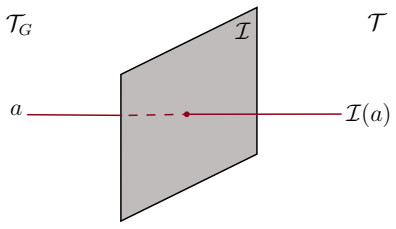
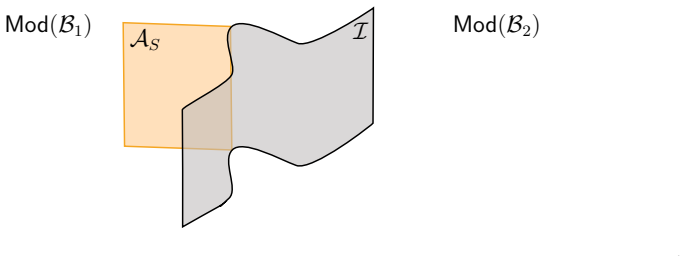
The machine is the algebra of surfaces $A_S$: a separable algebra in the fusion 2-category $\mathrm{Mod}(\mathcal{B})$ of module 1-categories over the anyon category $\mathcal{B}$. Its underlying object is a condensation surface—a codimension-one defect built by higher-gauging a 1-form symmetry, i.e., inserting a mesh of lines for a condensable algebra $A_L$. Two relations carry the argument: $A_S \simeq I^\dagger \otimes I$ and $\widehat{A}_S \simeq I \otimes I^\dagger$, where $I$ is the topological interface that half-gauges $A_L$; associativity of interface fusion then gives $A_S \otimes I \simeq I \otimes \widehat{A}_S$. The Morita theory of fusion 2-categories supplies the dualization: gauging $A_S$ in $\mathrm{Mod}(\mathcal{B})$ yields $\mathrm{Mod}(\mathcal{Z}_{\mathcal{B}}(A_S))$, and the constraint $\mathcal{Z}(A_S) \simeq \mathcal{B}_1 \boxtimes \mathcal{B}_2$ encodes gaugeability. A generalized fixed-point theorem equates the rank of the twisted-sector fusion 1-category with the number of fixed points of the surface action on lines, and this equality is what forces dual surface algebras to have matching numbers of twisted lines.
What would settle it
Compute the full fusion 1-category of twisted sector lines for $\widehat{A}_S = S_1 \boxplus S_{D(H),\psi}$ in the untwisted Abelian Dijkgraaf–Witten theory with $H = \mathbb{Z}_2 \times \mathbb{Z}_3$ and verify whether the non-trivial object obeys the near-group rule with $n$ in the forbidden range $0 < n < |H|^2 - 1$; finding any consistent fusion category or braided tensor functor $D(H) \to \mathcal{Z}(\widehat{A}_S)$ for a non-invertible $S_{D(H),\psi}$ would falsify Constraint 4.4.
Extended reading notes
Core claim
On its own terms, the paper establishes that the distinction between gauging a 0-form and a 1-form symmetry is not fundamental: both are realized by summing over a network of condensation surfaces, with the choice of a fusion 1-category on the bounding lines specifying generalized symmetry fractionalization and generalized discrete torsion. The duality is carried by a topological interface $I$ between two topological orders: fusing $I$ with its orientation reversal gives the surface algebra $A_S \simeq I^\dagger \otimes I$ in the first theory, while $I \otimes I^\dagger$ gives the dual algebra $\widehat{A}_S$ in the second, and gauging either reproduces the other. The concrete flagship computation is that gauging $\widehat{A}_S = S_1 \boxplus S_e$ in $D(\mathbb{Z}_2)$, the toric code, yields $D(D_6)$, the non-Abelian quantum double of the dihedral group of order six; the paper also works out $D(\mathbb{Z}_2) \to Z(\mathrm{Ising})$, $D(\mathbb{Z}_2) \to D(D_4)$, $D(\mathbb{Z}_2) \to D(\mathbb{Z}_4)$, $D(\mathbb{Z}_2) \to D(D_8)$, and the twisted $D_6$ family. A generalized fixed point theorem states that the number of twisted sector lines bounding a condensation surface equals the number of lines it fixes, and a set of constraints delimits which surface algebras can be gaugeable.
Load-bearing premise
The proof of Constraint 4.4 assumes that the twisted sector lines of $S_1 \boxplus S_{D(H),\psi}$ form a near-group fusion category with a single non-trivial object $\rho$ satisfying $\rho\otimes\rho = \oplus_{(m,e)\in H\oplus\hat{H}}(m,e)\oplus n\cdot\rho$; if the same object admits a different fusion category, the contradiction that rules out such gaugeable symmetries does not follow.
Editorial extensions
If this is right
- Non-invertible 0-form gauging can be performed by the same recipe as 1-form gauging: pick $A_L$, form $A_S$, then gauge it; the flagship example maps $D(\mathbb{Z}_2)$ to $D(D_6)$ and can be checked directly by decomposing the resulting line spectrum.
- Generalized symmetry fractionalization is a choice of fusion ring for the twisted sector lines of $A_S$, and generalized discrete torsion is a choice of associator; both are constrained by the requirement that a braided tensor functor $\mathcal{B} \to \mathcal{Z}(A_S)$ exist.
- The fixed-point theorem means the dual surface algebra $\widehat{A}_S$ must have exactly as many twisted sector lines as $A_S$; this consistency condition rules out otherwise plausible gaugings.
- Iterated gauging of invertible symmetries reproduces a single non-invertible gauging exactly when the surface algebra admits an increasing sequence of sub-algebras, with examples $D(\mathbb{Z}_2) \to D(D_8)$ decomposing as $D(\mathbb{Z}_2) \to D(D_4) \to D(D_8)$, while $D(\mathbb{Z}_2) \to D(D_6)$ does not decompose.
- Constraints in Section 4 delimit gaugeable symmetries in Abelian discrete gauge theories: for instance, a surface algebra $S_1 \boxplus S_{D(H),\psi}$ with non-invertible $S_{D(H),\psi}$ is not gaugeable when $|H|$ is a product of distinct primes.
Reading between the lines
- Because the paper reduces non-invertible 0-form gauging to 1-form gauging data, its recipes could plausibly be translated into explicit local operations on stabilizer codes, making the $D(\mathbb{Z}_2) \to D(D_6)$ step a candidate circuit primitive rather than just a formal map.
- The framework suggests there should be a cohomological classification of generalized symmetry fractionalization and discrete torsion for surface algebras; a concrete next step would be to match the paper's three fusion categories on the $D_6$ example with an appropriate categorified cohomology theory.
- Constraint 4.4's reliance on near-group fusion categories implies that finding even one gaugeable non-invertible $S_1 \boxplus S_{D(H),\psi}$ in a theory with more prime factors would open a new family of dualities, giving a testable extension of the paper's no-go result.
Editorial analysis
A structured set of objections, weighed in public.
Referee Report
Summary. The paper develops a framework for gauging non-invertible symmetries in (2+1)d topological orders, representing such symmetries as algebras of surfaces in the fusion 2-category Mod(B). The central mechanism is the relation AS ≃ I†⊗I and bAS ≃ I⊗I† for an interface I, so that gauging a non-invertible 0-form symmetry is dual to 1-form gauging of a condensable algebra AL. The authors generalize symmetry fractionalization and discrete torsion, prove a fixed-point theorem for condensation surfaces, derive constraints on gaugeable surface algebras (Constraints 4.1–4.5), analyze when non-invertible gaugings resolve into invertible steps, and illustrate the method on D(Z2), including the maps D(Z2)→D(D6), D(Z2)→Z(Ising), and the twisted D6 theories.
Significance. If correct, the paper gives a practical and conceptually unifying recipe for non-invertible gauging and for producing non-Abelian from Abelian topological orders. Its strengths are the explicit examples, which include concrete line decompositions, spin matching, and Morita equivalences, and the systematic use of separable algebras in fusion 2-categories. The advertised D(Z2)→D(D6) example is not merely an existence claim: the authors exhibit the action of bAS, the splitting of lines, and identify the resulting spectrum. The negative constraints, especially Constraint 4.4, are less securely established and require repair.
major comments (2)
- [Sec. 4, Eq. (4.14)] Constraint 4.4 is load-bearing for the paper's classification claims, as it is used in Sec. 6.8 to rule out surface algebras of the form S1 ⊞ Sme and S1 ⊞ S̃me. The proof assumes without derivation that the twisted-sector fusion category of bAS ≃ S1 ⊞ S_{D(H),ψ} is a near-group category of the form H ⊕ H + n. Given only that the D(H) lines form a pointed subcategory and that they act trivially on ρ under fusion, the most general self-fusion is ρ⊗ρ ≃ ⊕_{(m,e)} N_{(m,e)} (m,e) ⊕ n·ρ with integer multiplicities N_{(m,e)}. Nothing in the text establishes N_{(m,e)} = 1. The classification theorems [63–65] invoked to obtain the contradiction (4.20) apply to the N=1 near-group family, so if multiplicities differ, the inequality 0 < n < |H|^2 − 1 need not follow and Constraint 4.4 collapses. Please derive (4.14) from the module-category data defining S_{D(H),ψ}, or replace the no-go statement by a conditional one with a direct classification of the possible fusion categories, for instance for H = Z_p.
- [Sec. 5, Claims 5.5–5.6] The sequential-decomposition results are advertised as a main contribution, but the proofs are presented as sketches. Claim 5.5 is established by an induction whose base case appeals to [59, Remark 4.12], and Claim 5.6 is stated after a short paragraph invoking Theorem 4.10 of [59] and Sec. 3.1 of [69] without spelling out how the G-grading on bAS yields invertible gaugings at each step. Since these claims are used in Sec. 6.6 to conclude that D(Z2)→D(D8) can be decomposed into a sequence of invertible gaugings, please either state the relevant imported theorems precisely and complete the induction, or explicitly label these results as conjectural.
minor comments (3)
- [Sec. 4, before Eq. (4.14)] The sentence 'we loose no generality' should read 'we lose no generality.'
- [Secs. 6.5 and 6.6] The notation 'D(AS)' appears without definition; since AS is used both for a surface algebra and for the associated fusion category, the intended object (presumably the Drinfeld center Z(AS)) should be defined explicitly.
- [Sec. 6.3] The verification that the gauged theory is D(D6) lists quantum dimensions and the spins of only the first five of the eight lines; presenting the fusion ring or the full T-matrix of the equivalence classes would make the 'agrees with untwisted Dijkgraaf–Witten theory' check complete.
Circularity Check
No circularity found: Constraint 4.4's chain uses an unproven near-group ansatz, an independent published prior result by the authors ([21]), and external classifications; the D(Z2) to D(D6) example is computed and verified rather than imposed, and no output equals an input by construction or fit.
full rationale
The derivation chain is not circular in any of the flagged senses. The core identifications AS = I^+ (x) I and bAS = I (x) I^+ (Eqs. 3.3-3.4) are imported from Decoppet's internal-hom construction [23]; the Morita-duality formulas (3.35)-(3.37) and the sandwich decompositions (Figs. 13, 20) come from [32] and [20, 26] - external works with no author overlap. The principal no-go, Constraint 4.4, proceeds from three premises: the near-group ansatz (4.14) ('we lose no generality in assuming...'), the bound d_AL < |H|^2 + 1 citing the authors' own [21], and the external near-group classification [63-65]. The skeptic's objection - that rho (x) rho is restricted to the form with unit multiplicities without derivation, so [63-65] need not apply - identifies a genuine proof gap, but a gap in justification is not a circular reduction: (4.14) is an asserted ansatz, not an input defined in terms of the no-go claim it supports, and no equation in the chain equals another by construction or is tuned to force the contradiction. The self-citation to [21] is repeated and genuinely load-bearing in the constraint proofs, but under the evidentiary rule it is real evidence: a peer-reviewed, published (Comm. Math. Phys.) derivation of condensation-defect properties whose stated assumptions do not include Constraint 4.4, the D(D6) example, or any quantity fitted in this paper, so it does not raise the circularity score. The constructive flagship result - gauging S1 boxplus Se in D(Z2) to obtain D(D6) - is computed rather than imposed: from the fixed algebra AL = ([1],1) oplus ([1],pi) the paper derives the module category D(D6)_AL, the dual surface bAS, the action (6.26), and the line splittings (6.29)-(6.32), then matches the resulting dimensions and spins against the independently known fusion and spin data (6.18)-(6.19); the same verified round-trip pattern holds for Z(Ising), D(D4), D(D8), and the twisted-D6 family. No fitted parameter is renamed as a prediction, and the 'uniqueness' invoked in footnote 17 is Ostrik's external rank-2 classification, not an author-imported forcing theorem. The generalized fixed-point theorem (Sec. 3.2) extends [19]'s invertible result with a new proof rather than rebranding it; App. C's Abelian re-proof leans on [21], again an independent published source. The paper is self-contained against external benchmarks, so the honest finding is no circularity; the near-group assumption gap should be tracked as a correctness risk, not as circularity.
Assumptions & free parameters
assumptions (5)
- domain assumption Every gapped topological interface between MTCs B1 and B2 can be decomposed into a sandwich of 1-form gauging interfaces and an invertible surface (Fig. 20).
- standard math The internal hom construction gives AS ≃ I†⊗I and bAS ≃ I⊗I† for surface algebras dual to an interface I.
- standard math Gauging a separable algebra AS in Mod(B) yields Mod(B)^*_{Mod(AS)} ≃ Mod(Z_B(AS)), and Z(CI) ≃ Z(AS) ≃ B1 ⊠ B2.
- standard math In a 2d TQFT, the dimension of the space of local operators equals the number of simple boundary conditions.
- ad hoc to paper The fusion category of twisted sector lines for bAS ≃ S1 ⊞ S_{D(H),ψ} is a near-group fusion category of the form H ⊕ H + n with ρ⊗ρ = ⊕_{(m,e)} (m,e) ⊕ n·ρ (Eq. 4.14).
Cite this review
Pith. "Pith review of Gauging Non-Invertible Symmetries in (2+1)d Topological Orders." pith.science (2026). https://pith.science/paper/UK7JHE6E
@misc{pith2026250701142,
  author       = {Pith},
  title        = {Pith review of: Gauging Non-Invertible Symmetries in (2+1)d Topological Orders},
  year         = {2026},
  howpublished = {\url{https://pith.science/paper/UK7JHE6E}},
  note         = {Machine review of arXiv:2507.01142}
}
read the original abstract
We present practical and formal methods for gauging non-invertible symmetries in (2+1)d topological quantum field theories. Along the way, we generalize various aspects of invertible 0-form gauging, including symmetry fractionalization, discrete torsion, and the fixed point theorem for symmetry action on lines. Our approach involves two complementary strands: the fusion of topological interfaces and Morita theory of fusion 2-categories. We use these methods to derive constraints on gaugeable symmetries and their duals while unifying the prescription for gauging non-invertible 0-form and 1-form symmetries and various higher structures. With a view toward recent advances in creating non-Abelian topological orders from Abelian ones, we give a simple recipe for non-invertible 0-form gauging that takes large classes of the latter to the former. We also describe conditions under which iterated gauging of invertible 0-form symmetries is equivalent to a single-step gauging of a non-invertible symmetry. We conclude with a set of concrete examples illustrating these various phenomena involving gauging symmetries of the infrared limit of the toric code.
Figures


Figures from the paper (25 more)




Forward citations
Cited by 2 Pith papers
-
Characterizing gapped phases by smeared boundary conformal field theories: Duality in unusual ordering with spontaneously broken generalized symmetries
Gapped phases dual to massless RG flows in 2D CFTs exhibit unusual ordering via spontaneous breaking of non-group-like symmetries and are characterized using smeared boundary CFTs applied to smeared Ishibashi states.
-
Notes on (-2)-form symmetries
Introduces (-2)-form symmetries that modify the SymTFT action to relate QFTs differing by anomaly data or non-invertible symmetry associators, illustrated in 2D-4D models, fusion categories, club-sandwich RG flows, an...
Reference graph
Works this paper leans on
-
[21]
Invertibility of Condensation Defects and Symme- tries of 2 + 1d QFTs
M. Buican & R. Radhakrishnan, “Invertibility of Condensation Defects and Symme- tries of 2 + 1d QFTs” , Commun. Math. Phys. 405, 217 (2024), arXiv:2309.15181 [hep-th] 85
arXiv 2024
-
[59]
The Witt group of non- degenerate braided fusion categories
A. Davydov, M. M¨ uger, D. Nikshych & V. Ostrik, “The Witt group of non- degenerate braided fusion categories”, Journal f¨ ur die reine und angewandte Mathe- matik (Crelles Journal) 2013, 135 (2013)
2013
-
[69]
Centers of graded fusion categories
S. Gelaki, D. Naidu & D. Nikshych, “Centers of graded fusion categories” , arXiv:0905.3117 [math.QA], https://arxiv.org/abs/0905.3117
-
[1]
Orbifolds of Reshetikhin-Turaev TQFTs
N. Carqueville, I. Runkel & G. Schaumann, “Orbifolds of Reshetikhin-Turaev TQFTs”, Theor. Appl. Categor. 35, 513 (2020), arXiv:1809.01483 [math.QA]
arXiv 2020
-
[2]
On generalized symmetries and structure of modular categories
S. X. Cui, M. S. Zini & Z. Wang, “On generalized symmetries and structure of modular categories”, Science China Mathematics 62, 417 (2019)
2019
-
[3]
Fibonacci-type orbifold data in Ising modular categories
V. Mulevicius & I. Runkel, “Fibonacci-type orbifold data in Ising modular categories” , J. Pure Appl. Algebra 227, 107301 (2023), arXiv:2010.00932 [math.QA]
arXiv 2023
-
[4]
Condensation inversion and Witt equivalence via generalised orbifolds
V. Mulevicius, “Condensation inversion and Witt equivalence via generalised orbifolds” , arXiv:2206.02611 [math.QA]
-
[5]
Higher categorical symmetries and gauging in two- dimensional spin systems
C. Delcamp & A. Tiwari, “Higher categorical symmetries and gauging in two- dimensional spin systems”, SciPost Phys. 16, 110 (2024), arXiv:2301.01259 [hep-th]
arXiv 2024
Show all 122 references
-
[6]
Fractionalization of Coset Non-Invertible Sym- metry and Exotic Hall Conductance
P.-S. Hsin, R. Kobayashi & C. Zhang, “Fractionalization of Coset Non-Invertible Sym- metry and Exotic Hall Conductance” , SciPost Phys. 17, 095 (2024), arXiv:2405.20401 [cond-mat.str-el]
2024 arXiv
-
[7]
Topological Holography for 2+1-D Gapped and Gapless Phases with Generalized Symmetries
R. Wen, “Topological Holography for 2+1-D Gapped and Gapless Phases with Generalized Symmetries”, arXiv:2503.13685 [hep-th]
-
[8]
Anomalies of Coset Non-Invertible Symmetries
P.-S. Hsin, R. Kobayashi & C. Zhang, “Anomalies of Coset Non-Invertible Symmetries” , arXiv:2503.00105 [cond-mat.str-el]
-
[9]
(2+1)d Lattice Models and Tensor Networks for Gapped Phases with Categorical Symmetry
K. Inamura, S.-J. Huang, A. Tiwari & S. Schafer-Nameki, “(2+1)d Lattice Models and Tensor Networks for Gapped Phases with Categorical Symmetry” , arXiv:2506.09177 [cond-mat.str-el] 84
-
[10]
Gauging non-invertible symmetries on the lattice
S. Seifnashri, S.-H. Shao & X. Yang, “Gauging non-invertible symmetries on the lattice”, arXiv:2503.02925 [cond-mat.str-el]
-
[11]
Universal Lower Bound on Topological Entanglement Entropy
I. H. Kim, M. Levin, T.-C. Lin, D. Ranard & B. Shi, “Universal Lower Bound on Topological Entanglement Entropy” , Phys. Rev. Lett. 131, 166601 (2023), arXiv:2302.00689 [quant-ph]
2023 arXiv
-
[12]
Efficiently preparing Schr¨ odinger’s cat, fractons and non-Abelian topological order in quantum devices
R. Verresen, N. Tantivasadakarn & A. Vishwanath, “Efficiently preparing Schr¨ odinger’s cat, fractons and non-Abelian topological order in quantum devices”, arXiv:2112.03061 [quant-ph]
-
[13]
Long-Range Entanglement from Measuring Symmetry-Protected Topological Phases
N. Tantivasadakarn, R. Thorngren, A. Vishwanath & R. Verresen, “Long-Range Entanglement from Measuring Symmetry-Protected Topological Phases”, Phys. Rev. X 14, 021040 (2024), https://link.aps.org/doi/10.1103/PhysRevX.14.021040
2024 doi
-
[14]
Hierarchy of Topological Order From Finite-Depth Unitaries, Measurement, and Feedforward
N. Tantivasadakarn, A. Vishwanath & R. Verresen, “Hierarchy of Topological Order From Finite-Depth Unitaries, Measurement, and Feedforward” , PRX Quantum 4, 020339 (2023), https://link.aps.org/doi/10.1103/PRXQuantum.4.020339
2023 doi
-
[15]
Efficient Preparation of Solvable Anyons with Adaptive Quantum Circuits
Y. Ren, N. Tantivasadakarn & D. J. Williamson, “Efficient Preparation of Solvable Anyons with Adaptive Quantum Circuits” , arXiv:2411.04985 [quant-ph]
-
[16]
Higher Gauging and Non-invertible Condensation Defects
K. Roumpedakis, S. Seifnashri & S.-H. Shao, “Higher Gauging and Non-invertible Condensation Defects” , Communications in Mathematical Physics 401, 3043–3107 (2023), http://dx.doi.org/10.1007/s00220-023-04706-9
2023 doi
-
[17]
Higher condensation theory
L. Kong, Z.-H. Zhang, J. Zhao & H. Zheng, “Higher condensation theory” , arXiv:2403.07813 [cond-mat.str-el]
-
[18]
On the Classification of Bosonic and Fermionic One-Form Symmetries in 2+1d and ’t Hooft Anomaly Matching
M. Balasubramanian, M. Buican & R. Radhakrishnan, “On the Classification of Bosonic and Fermionic One-Form Symmetries in 2+1d and ’t Hooft Anomaly Matching”, arXiv:2408.00866 [hep-th]
-
[19]
Symmetry Fractionalization, Defects, and Gauging of Topological Phases
M. Barkeshli, P. Bonderson, M. Cheng & Z. Wang, “Symmetry Fractionalization, Defects, and Gauging of Topological Phases” , Phys. Rev. B 100, 115147 (2019), arXiv:1410.4540 [cond-mat.str-el]
2019 arXiv
-
[20]
Composing topological domain walls and anyon mobility
P. Huston, F. Burnell, C. Jones & D. Penneys, “Composing topological domain walls and anyon mobility” , SciPost Phys. 15, 076 (2023), arXiv:2208.14018 [cond-mat.str-el]
2023 arXiv
-
[22]
On Gauging Symmetry of Mod- ular Categories
S. X. Cui, C. Galindo, J. Y. Plavnik & Z. Wang, “On Gauging Symmetry of Mod- ular Categories”, Communications in Mathematical Physics 348, 1043–1064 (2016), http://dx.doi.org/10.1007/s00220-016-2633-8
2016 doi
-
[24]
An Algebraic Theory of Gapped Domain Wall Partons
M. Buican, R. Geiko, M. Moses & B. Shi, “An Algebraic Theory of Gapped Domain Wall Partons” , arXiv:2506.22544 [cond-mat.str-el]
-
[25]
Gapped Domain Walls, Gapped Boundaries and Topological Degeneracy
T. Lan, J. C. Wang & X.-G. Wen, “Gapped Domain Walls, Gapped Boundaries and Topological Degeneracy”, Phys. Rev. Lett. 114, 076402 (2015), arXiv:1408.6514 [cond-mat.str-el]
2015 arXiv
-
[26]
On the structure of the Witt group of braided fusion categories
A. Davydov, D. Nikshych & V. Ostrik, “On the structure of the Witt group of braided fusion categories”, Selecta Mathematica 19, 237 (2013)
2013
-
[27]
D-branes and K-theory in 2D topological field theory
G. W. Moore & G. Segal, “D-branes and K-theory in 2D topological field theory” , hep-th/0609042
-
[28]
Construction of two-dimensional topo- logical field theories with non-invertible symmetries
T.-C. Huang, Y.-H. Lin & S. Seifnashri, “Construction of two-dimensional topo- logical field theories with non-invertible symmetries” , JHEP 2112, 028 (2021), arXiv:2110.02958 [hep-th]
2021 arXiv
-
[29]
Fusion categories of rank 2
V. Ostrik, “Fusion categories of rank 2” , math/0203255 [math.QA], https://arxiv.org/abs/math/0203255
-
[30]
Tensor categories
P. Etingof, S. Gelaki, D. Nikshych & V. Ostrik, “Tensor categories”, American Mathematical Soc. (2016)
2016
-
[31]
Rigid and separable algebras in fusion 2-categories
T. D. D´ ecoppet,“Rigid and separable algebras in fusion 2-categories”, Advances in Math- ematics 419, 108967 (2023)
2023
-
[32]
The Morita theory of fusion 2-categories
T. D. D´ ecoppet,“The Morita theory of fusion 2-categories.” , High. Struct. 7, 234 (2023), arXiv:2311.16827 [math.CT]
2023 arXiv
-
[33]
Remarks on boundaries, anomalies, and noninvertible symmetries
Y. Choi, B. C. Rayhaun, Y. Sanghavi & S.-H. Shao, “Remarks on boundaries, anomalies, and noninvertible symmetries” , Phys. Rev. D 108, 125005 (2023), arXiv:2305.09713 [hep-th]
2023 arXiv
-
[34]
Braidings on topological operators, anomaly of higher- form symmetries and the SymTFT
P. Putrov & R. Radhakrishnan, “Braidings on topological operators, anomaly of higher- form symmetries and the SymTFT” , arXiv:2503.13633 [hep-th] 86
-
[35]
Hamiltonian and Algebraic Theories of Gapped Boundaries in Topological Phases of Matter
I. Cong, M. Cheng & Z. Wang, “Hamiltonian and Algebraic Theories of Gapped Boundaries in Topological Phases of Matter” , Commun. Math. Phys. 355, 645 (2017), arXiv:1707.04564 [cond-mat.str-el]
2017 arXiv
-
[36]
Correspondences of ribbon categories
J. Frohlich, J. Fuchs, I. Runkel & C. Schweigert, “Correspondences of ribbon categories”, Adv. Math. 199, 192 (2006), math/0309465
2006 arXiv
-
[37]
Anyon condensation and tensor categories
L. Kong, “Anyon condensation and tensor categories” , Nucl. Phys. B 886, 436 (2014), arXiv:1307.8244 [cond-mat.str-el]
2014 arXiv
-
[38]
String net condensation: A Physical mechanism for topological phases
M. A. Levin & X.-G. Wen, “String net condensation: A Physical mechanism for topological phases”, Phys. Rev. B 71, 045110 (2005), cond-mat/0404617
2005 arXiv
-
[39]
String-net model of Turaev-Viro invariants
A. Kirillov, Jr, “String-net model of Turaev-Viro invariants” , arXiv:1106.6033 [math.AT]
-
[40]
Fusion 2-categories and a state-sum invariant for 4-manifolds
C. L. Douglas & D. J. Reutter, “Fusion 2-categories and a state-sum invariant for 4-manifolds”, arXiv:1812.11933 [math.QA]
-
[41]
Condensations in higher categories
D. Gaiotto & T. Johnson-Freyd, “Condensations in higher categories” , arXiv:1905.09566 [math.CT]
1905 arXiv
-
[42]
Higher Gauging and Non-invertible Condensation Defects
K. Roumpedakis, S. Seifnashri & S.-H. Shao, “Higher Gauging and Non-invertible Condensation Defects”, Commun. Math. Phys. 401, 3043 (2023), arXiv:2204.02407 [hep-th]
2023 arXiv
-
[43]
Decomposition, Condensation Defects, and Fusion
L. Lin, D. G. Robbins & E. Sharpe, “Decomposition, Condensation Defects, and Fusion”, Fortsch. Phys. 70, 2200130 (2022), arXiv:2208.05982 [hep-th]
2022 arXiv
-
[44]
Non-invertible Condensa- tion, Duality, and Triality Defects in 3+1 Dimensions
Y. Choi, C. Cordova, P.-S. Hsin, H. T. Lam & S.-H. Shao, “Non-invertible Condensa- tion, Duality, and Triality Defects in 3+1 Dimensions” , Commun. Math. Phys. 402, 489 (2023), arXiv:2204.09025 [hep-th]
2023 arXiv
-
[45]
Non-invertible and higher-form symmetries in 2+1d lattice gauge theories
Y. Choi, Y. Sanghavi, S.-H. Shao & Y. Zheng, “Non-invertible and higher-form symmetries in 2+1d lattice gauge theories” , arXiv:2405.13105 [cond-mat.str-el]
-
[46]
Non-invertible Symmetries and Higher Representation Theory I
T. Bartsch, M. Bullimore, A. E. V. Ferrari & J. Pearson, “Non-invertible Symmetries and Higher Representation Theory I” , arXiv:2208.05993 [hep-th]
-
[47]
Non-invertible Symmetries and Higher Representation Theory II
T. Bartsch, M. Bullimore, A. E. V. Ferrari & J. Pearson, “Non-invertible Symmetries and Higher Representation Theory II” , arXiv:2212.07393 [hep-th]
-
[48]
Non-invertible higher- categorical symmetries
L. Bhardwaj, L. E. Bottini, S. Schafer-Nameki & A. Tiwari, “Non-invertible higher- categorical symmetries”, SciPost Phys. 14, 007 (2023), arXiv:2204.06564 [hep-th] 87
2023 arXiv
-
[49]
Tensor network approach to electromagnetic duality in (3+1)d topological gauge models
C. Delcamp, “Tensor network approach to electromagnetic duality in (3+1)d topological gauge models”, JHEP 2208, 149 (2022), arXiv:2112.08324 [cond-mat.str-el]
2022 arXiv
-
[50]
Twisted gauging and topological sectors in (2+1)d abelian lattice gauge theories
B. Vancraeynest-De Cuiper & C. Delcamp, “Twisted gauging and topological sectors in (2+1)d abelian lattice gauge theories” , arXiv:2501.16301 [cond-mat.str-el]
-
[51]
Fusion categories and homotopy theory
P. Etingof, D. Nikshych, V. Ostrik & with an appendix by Ehud Meir, “Fusion categories and homotopy theory” , arXiv:0909.3140 [math.QA], https://arxiv.org/abs/0909.3140
-
[52]
Monoidal 2-structure of bimodule cat- egories
J. Greenough, “Monoidal 2-structure of bimodule cat- egories”, Journal of Algebra 324, 1818 (2010), https://www.sciencedirect.com/science/article/pii/S0021869310002942
2010
-
[53]
The relative Deligne tensor product over pointed braided fusion categories
T. D. D´ ecoppet, “The relative Deligne tensor product over pointed braided fusion categories” , Journal of Algebra 620, 89–112 (2023), http://dx.doi.org/10.1016/j.jalgebra.2022.12.029
2023 doi
-
[54]
On dualizability of braided tensor categories
A. Brochier, D. Jordan & N. Snyder, “On dualizability of braided tensor categories” , Compositio Mathematica 157, 435–483 (2021)
2021
-
[55]
Finite Semisimple Module 2-Categories
T. D. D´ ecoppet, “Finite Semisimple Module 2-Categories” , arXiv:2107.11037 [math.QA]
-
[56]
Fusion 3-Categories for Duality Defects
L. Bhardwaj, T. D´ ecoppet, S. Schafer-Nameki & M. Yu, “Fusion 3-Categories for Duality Defects”, arXiv:2408.13302 [math.CT]
-
[57]
Dualities between 2+1d fusion surface models from braided fusion categories
L. Eck, “Dualities between 2+1d fusion surface models from braided fusion categories” , arXiv:2501.14722 [cond-mat.str-el]
-
[58]
Levin-Wen is a Gauge Theory: Entanglement from Topology
K. Kawagoe, C. Jones, S. Sanford, D. Green & D. Penneys, “Levin-Wen is a Gauge Theory: Entanglement from Topology” , Commun. Math. Phys. 405, 266 (2024), arXiv:2401.13838 [cond-mat.str-el]
2024 arXiv
-
[60]
A study of time reversal symmetry of abelian anyons
Y. Lee & Y. Tachikawa, “A study of time reversal symmetry of abelian anyons” , JHEP 1807, 090 (2018), arXiv:1805.02738 [hep-th]
2018 arXiv
-
[61]
Near-group categories
J. Siehler, “Near-group categories”, Algebraic & Geometric Topology 3, 719 (2003)
2003
-
[62]
Generalized near-group categories
J. E. Thornton, “Generalized near-group categories” 88
-
[63]
Near-group fusion categories and their doubles
D. E. Evans & T. Gannon, “Near-group fusion categories and their doubles” , Ad- vances in Mathematics 255, 586 (2014)
2014
-
[64]
A Cuntz algebra approach to the classification of near-group categories
M. Izumi, “A Cuntz algebra approach to the classification of near-group categories” , arXiv:1512.04288 [math.OA], https://arxiv.org/abs/1512.04288
-
[65]
Uniqueness of unitary structure for unitarizable fusion categories
D. Reutter, “Uniqueness of unitary structure for unitarizable fusion categories” , Com- munications in Mathematical Physics 397, 37 (2023)
2023
-
[66]
Non-Abelian topological order and anyons on a trapped-ion processor
M. Iqbal et al., “Non-Abelian topological order and anyons on a trapped-ion processor” , Nature 626, 505 (2024), arXiv:2305.03766 [quant-ph]
2024 arXiv
-
[67]
Protocols for Creating Anyons and Defects via Gauging
A. Lyons, C. F. B. Lo, N. Tantivasadakarn, A. Vishwanath & R. Verresen, “Protocols for Creating Anyons and Defects via Gauging” , arXiv:2411.04181 [quant-ph]
-
[68]
Qutrit Toric Code and Parafermions in Trapped Ions
M. Iqbal et al., “Qutrit Toric Code and Parafermions in Trapped Ions” , arXiv:2411.04185 [quant-ph]
-
[70]
Braided fusion categories, gravitational anomalies, and the mathematical framework for topological orders in any dimensions
L. Kong & X.-G. Wen, “Braided fusion categories, gravitational anomalies, and the mathematical framework for topological orders in any dimensions” , arXiv:1405.5858 [cond-mat.str-el]
-
[71]
Cheshire charge in (3+1)- dimensional topological phases
D. V. Else & C. Nayak, “Cheshire charge in (3+1)- dimensional topological phases” , Phys. Rev. B 96, 045136 (2017), https://link.aps.org/doi/10.1103/PhysRevB.96.045136
2017 doi
-
[72]
Defects in the 3-dimensional toric code model form a braided fusion 2-category
L. Kong, Y. Tian & Z.-H. Zhang, “Defects in the 3-dimensional toric code model form a braided fusion 2-category” , JHEP 2012, 078 (2020), arXiv:2009.06564 [cond-mat.str-el]
2020 arXiv
-
[73]
A toy model for categorical charges
C. Delcamp, “A toy model for categorical charges” , arXiv:2208.07361 [cond-mat.str-el]
-
[74]
Topological phase transition on the edge of two-dimensional Z2 topological order
W.-Q. Chen, C.-M. Jian, L. Kong, Y.-Z. You & H. Zheng, “Topological phase transition on the edge of two-dimensional Z2 topological order”, Phys. Rev. B 102, 045139 (2020), https://link.aps.org/doi/10.1103/PhysRevB.102.045139
2020 doi
-
[75]
Topological Order with a Twist: Ising Anyons from an Abelian Model
H. Bombin, “Topological Order with a Twist: Ising Anyons from an Abelian Model” , Phys. Rev. Lett. 105, 030403 (2010), arXiv:1004.1838 [cond-mat.str-el]
2010 arXiv
-
[76]
Models for Gapped Boundaries and Domain Walls
A. Kitaev & L. Kong, “Models for Gapped Boundaries and Domain Walls” , Com- mun. Math. Phys. 313, 351 (2012), arXiv:1104.5047 [cond-mat.str-el] 89
2012 arXiv
-
[77]
Quasi hope algebras, group cohomology and orbifold models
R. Dijkgraaf, V. Pasquier & P. Roche, “Quasi hope algebras, group cohomology and orbifold models”, Nuclear Physics B - Proceedings Supplements 18, 60 (1991)
1991
-
[78]
The Quantum Double Model with Boundary: Condensations and Symmetries
S. Beigi, P. W. Shor & D. Whalen, “The Quantum Double Model with Boundary: Condensations and Symmetries” , Communications in Mathematical Physics 306, 663 (2011)
2011
-
[79]
Universal quantum computation with weakly integral anyons
S. X. Cui, S.-M. Hong & Z. Wang, “Universal quantum computation with weakly integral anyons”, Quantum Information Processing 14, 2687 (2015)
2015
-
[80]
Classification of fusion categories of dimension pq
P. Etingof, S. Gelaki & V. Ostrik, “Classification of fusion categories of dimension pq”, math/0304194 [math.QA], https://arxiv.org/abs/math/0304194
-
[81]
Hasse Diagrams for Gapless SPT and SSB Phases with Non-Invertible Symmetries
L. Bhardwaj, D. Pajer, S. Schafer-Nameki & A. Warman, “Hasse Diagrams for Gapless SPT and SSB Phases with Non-Invertible Symmetries” , arXiv:2403.00905 [cond-mat.str-el], https://arxiv.org/abs/2403.00905
-
[82]
Tensor Categories with Fusion Rules of Self-Duality for Finite Abelian Groups
D. Tambara & S. Yamagami, “Tensor Categories with Fusion Rules of Self-Duality for Finite Abelian Groups”, J. Algebra 209, 692 (1998)
1998
-
[83]
Anyons in an exactly solved model and beyond
A. Kitaev, “Anyons in an exactly solved model and beyond” , Annals Phys. 321, 2 (2006), cond-mat/0506438
2006 arXiv
-
[84]
Generalised Orbifolds and G- equivariantisation
S. Heinrich, J. Plavnik, I. Runkel & A. Watkins, “Generalised Orbifolds and G- equivariantisation”, arXiv:2506.08154 [math.QA]
-
[85]
2-Group Symmetries of 3-dimensional Defect TQFTs and Their Gauging
N. Carqueville & B. Haake, “2-Group Symmetries of 3-dimensional Defect TQFTs and Their Gauging” , arXiv:2506.08178 [math.QA]
-
[86]
Duality and defects in rational conformal field theory
J. Frohlich, J. Fuchs, I. Runkel & C. Schweigert, “Duality and defects in rational conformal field theory” , Nucl. Phys. B 763, 354 (2007), hep-th/0607247
2007 arXiv
-
[87]
On finite symmetries and their gauging in two dimen- sions
L. Bhardwaj & Y. Tachikawa, “On finite symmetries and their gauging in two dimen- sions”, JHEP 1803, 189 (2018), arXiv:1704.02330 [hep-th]
2018 arXiv
-
[88]
Topological Defect Lines and Renormalization Group Flows in Two Dimensions
C.-M. Chang, Y.-H. Lin, S.-H. Shao, Y. Wang & X. Yin, “Topological Defect Lines and Renormalization Group Flows in Two Dimensions” , JHEP 1901, 026 (2019), arXiv:1802.04445 [hep-th]
2019 arXiv
-
[89]
Fusion category symmetry. Part I. Anomaly in-flow and gapped phases
R. Thorngren & Y. Wang, “Fusion category symmetry. Part I. Anomaly in-flow and gapped phases”, JHEP 2404, 132 (2024), arXiv:1912.02817 [hep-th]
2024 arXiv
-
[90]
Alge- braic higher symmetry and categorical symmetry: A holographic and 90 entanglement view of symmetry
L. Kong, T. Lan, X.-G. Wen, Z.-H. Zhang & H. Zheng, “Alge- braic higher symmetry and categorical symmetry: A holographic and 90 entanglement view of symmetry” , Phys. Rev. Res. 2, 043086 (2020), https://link.aps.org/doi/10.1103/PhysRevResearch.2.043086
2020 doi
-
[91]
Module categories over the Drinfeld double of a finite group
V. Ostrik, “Module categories over the Drinfeld double of a finite group” , math/0202130
-
[92]
Module categories, weak Hopf algebras and modular invariants
V. Ostrik, “Module categories, weak Hopf algebras and modular invariants” , Transfor- mation groups 8, 177 (2003)
2003
-
[93]
TFT construction of RCFT cor- relators I: partition functions
J. Fuchs, I. Runkel & C. Schweigert, “TFT construction of RCFT cor- relators I: partition functions” , Nuclear Physics B 646, 353–497 (2002), http://dx.doi.org/10.1016/S0550-3213(02)00744-7
2002 doi
-
[94]
On Frobenius algebras in rigid monoidal categories
J. Fuchs & C. Stigner, “On Frobenius algebras in rigid monoidal categories” , arXiv:0901.4886 [math.CT]
-
[95]
Semisimple and separable algebras in multi-fusion categories
L. Kong & H. Zheng, “Semisimple and separable algebras in multi-fusion categories” , arXiv:1706.06904 [math.QA]
-
[96]
Dualities in One-Dimensional Quantum Lattice Models: Symmetric Hamiltonians and Matrix Product Operator Inter- twiners
L. Lootens, C. Delcamp, G. Ortiz & F. Verstraete, “Dualities in One-Dimensional Quantum Lattice Models: Symmetric Hamiltonians and Matrix Product Operator Inter- twiners”, PRX Quantum 4, 020357 (2023), arXiv:2112.09091 [quant-ph]
2023 arXiv
-
[97]
Dualities in One-Dimensional Quantum Lat- tice Models: Topological Sectors
L. Lootens, C. Delcamp & F. Verstraete, “Dualities in One-Dimensional Quantum Lat- tice Models: Topological Sectors”, PRX Quantum 5, 010338 (2024), arXiv:2211.03777 [quant-ph]
2024 arXiv
-
[98]
Low-Depth Unitary Quantum Circuits for Dualities in One-Dimensional Quantum Lattice Models
L. Lootens, C. Delcamp, D. Williamson & F. Verstraete, “Low-Depth Unitary Quantum Circuits for Dualities in One-Dimensional Quantum Lattice Models” , Phys. Rev. Lett. 134, 130403 (2025), arXiv:2311.01439 [quant-ph]
2025 arXiv
-
[99]
Symmetry topological field theory and non-abelian Kramers- Wannier dualities of generalised Ising models
C. Delcamp & N. Ishtiaque, “Symmetry topological field theory and non-abelian Kramers- Wannier dualities of generalised Ising models” , arXiv:2408.06074 [hep-th]
-
[100]
Traces on module categories over fu- sion categories
G. Schaumann, “Traces on module categories over fu- sion categories” , Journal of Algebra 379, 382 (2013), https://www.sciencedirect.com/science/article/pii/S0021869313000380
2013
-
[101]
Discrete torsion defects
I. Brunner, N. Carqueville & D. Plencner, “Discrete torsion defects” , Com- mun. Math. Phys. 337, 429 (2015), arXiv:1404.7497 [hep-th]
2015 arXiv
-
[102]
Entanglement and the density matrix renor- malisation group in the generalised Landau paradigm
L. Lootens, C. Delcamp & F. Verstraete, “Entanglement and the density matrix renor- malisation group in the generalised Landau paradigm” , arXiv:2408.06334 [quant-ph] 91
-
[103]
Realizing triality and p-ality by lattice twisted gauging in (1+1)d quantum spin systems
D.-C. Lu, Z. Sun & Y.-Z. You, “Realizing triality and p-ality by lattice twisted gauging in (1+1)d quantum spin systems” , SciPost Phys. 17, 136 (2024), arXiv:2405.14939 [cond-mat.str-el]
2024 arXiv
-
[104]
Exploring G-ality defects in 2-dim QFTs
D.-C. Lu, Z. Sun & Z. Zhang, “Exploring G-ality defects in 2-dim QFTs” , arXiv:2406.12151 [hep-th]
-
[105]
Non-anomalous non-invertible symmetries in 1+1D from gapped boundaries of SymTFTs
P. Putrov & R. Radhakrishnan, “Non-anomalous non-invertible symmetries in 1+1D from gapped boundaries of SymTFTs” , arXiv:2405.04619 [hep-th]
-
[106]
State sum invariants of 3 manifolds and quantum 6j symbols
V. G. Turaev & O. Y. Viro, “State sum invariants of 3 manifolds and quantum 6j symbols”, Topology 31, 865 (1992)
1992
-
[107]
Invariants of piecewise linear three manifolds
J. W. Barrett & B. W. Westbury, “Invariants of piecewise linear three manifolds” , Trans. Am. Math. Soc. 348, 3997 (1996), hep-th/9311155 [hep-th]
1996 arXiv
-
[108]
Symmetry TFTs from String Theory
F. Apruzzi, F. Bonetti, I. n. Garc ´ ıa Etxebarria, S. S. Hosseini & S. Schafer-Nameki, “Symmetry TFTs from String Theory” , Commun. Math. Phys. 402, 895 (2023), arXiv:2112.02092 [hep-th]
2023 arXiv
-
[109]
Topological symmetry in quantum field theory
D. S. Freed, G. W. Moore & C. Teleman, “Topological symmetry in quantum field theory”, arXiv:2209.07471 [hep-th]
-
[110]
Symmetry TFTs for Non-invertible Defects
J. Kaidi, K. Ohmori & Y. Zheng, “Symmetry TFTs for Non-invertible Defects” , Commun. Math. Phys. 404, 1021 (2023), arXiv:2209.11062 [hep-th]
2023 arXiv
-
[111]
Symmetry TFTs and anomalies of non-invertible symmetries
J. Kaidi, E. Nardoni, G. Zafrir & Y. Zheng, “Symmetry TFTs and anomalies of non-invertible symmetries” , JHEP 2310, 053 (2023), arXiv:2301.07112 [hep-th]
2023 arXiv
-
[112]
Boundary-bulk rela- tion in topological orders
L. Kong, X.-G. Wen & H. Zheng, “Boundary-bulk rela- tion in topological orders” , Nuclear Physics B 922, 62 (2017), https://www.sciencedirect.com/science/article/pii/S0550321317302183
2017
-
[113]
Categorical symmetry and noninvertible anomaly in symmetry- breaking and topological phase transitions
W. Ji & X.-G. Wen, “Categorical symmetry and noninvertible anomaly in symmetry- breaking and topological phase transitions” , Phys. Rev. Res. 2, 033417 (2020), https://link.aps.org/doi/10.1103/PhysRevResearch.2.033417
2020 doi
-
[114]
A unified view on symmetry, anomalous symmetry and non- invertible gravitational anomaly
W. Ji & X.-G. Wen, “A unified view on symmetry, anomalous symmetry and non- invertible gravitational anomaly” , arXiv:2106.02069 [cond-mat.str-el]
-
[115]
Symmetry as a shadow of topological order and a derivation of topological holographic principle
A. Chatterjee & X.-G. Wen, “Symmetry as a shadow of topological order and a derivation of topological holographic principle” , Phys. Rev. B 107, 155136 (2023), arXiv:2203.03596 [cond-mat.str-el] 92
2023 arXiv
-
[116]
Topological holography, quantum criticality, and boundary states
S.-J. Huang & M. Cheng, “Topological holography, quantum criticality, and boundary states”, arXiv:2310.16878 [cond-mat.str-el]
-
[117]
Fermionic quantum criticality through the lens of topological holography
S.-J. Huang, “Fermionic quantum criticality through the lens of topological holography” , arXiv:2405.09611 [cond-mat.str-el]
-
[118]
Wave Function and Strange Correlator of Short-Range Entangled States
Y.-Z. You, Z. Bi, A. Rasmussen, K. Slagle & C. Xu, “Wave Function and Strange Correlator of Short-Range Entangled States” , Phys. Rev. Lett. 112, 247202 (2014), https://link.aps.org/doi/10.1103/PhysRevLett.112.247202
2014 doi
-
[119]
Mapping Topological to Conformal Field Theories through strange Correlators
R. Vanhove, M. Bal, D. J. Williamson, N. Bultinck, J. Haegeman & F. Verstraete, “Mapping Topological to Conformal Field Theories through strange Correlators” , Phys. Rev. Lett. 121, 177203 (2018), https://link.aps.org/doi/10.1103/PhysRevLett.121.177203
2018 doi
-
[120]
Condensate-induced transitions between topologically ordered phases
F. A. Bais & J. Slingerland, “Condensate-induced transitions between topologically ordered phases”, Physical Review B—Condensed Matter and Materials Physics 79, 045316 (2009)
2009
-
[121]
Centre of an algebra
A. Davydov, “Centre of an algebra” , Advances in Mathematics 225, 319 (2010)
2010
-
[122]
On Lagrangian algebras in group-theoretical braided fusion categories
A. Davydov & D. Simmons, “On Lagrangian algebras in group-theoretical braided fusion categories”, Journal of Algebra 471, 149 (2017)
2017
-
[123]
On the Structure of Modular Categories
M. Mueger, “On the Structure of Modular Categories” , math/0201017 [math.CT], https://arxiv.org/abs/math/0201017 93
Reviewed August 6, 2026 · model on record in the stance chip above.
Discussion (0). Sign in to comment.