Temporal nonlocality of a qudit resides in the input state, not the channel, and certifies temporal teleportation up to a fundamental limit
Pith reviewed 2026-07-03 11:53 UTC · model grok-4.3
The pith
The temporal nonlocality robustness of a qudit vanishes exactly when the input state is maximally mixed and bounds temporal teleportation fidelity up to (d-1)/d.
A machine-rendered reading of the paper's core claim, the machinery that carries it, and where it could break.
Core claim
The temporal nonlocality robustness satisfies TNR(ρ_A, ℰ)=0 ⇔ ρ_A=𝟙/d for the standard noise families. This quantity lower-bounds the fidelity of temporal teleportation without trusting the measuring devices, yet is decoupled from the channel's coherence transmission, so an injective unitary can produce the maximal temporal-Bell signal while teleporting below the classical baseline. The authors close the gap with a universal cap TNR ≤ (d-1)/d, an exact channel-resolved value, honest certification for the depolarizing channel and any sufficiently mixed probe, and a proof that no probe choice renders TNR channel-universal. All structure is obtained from a unified semidefinite-programming hiera
What carries the argument
The temporal nonlocality robustness (TNR), a semidefinite program quantifying the noise robustness of temporal Bell inequality violations carried by the input state.
If this is right
- TNR supplies a device-independent lower bound on temporal teleportation fidelity for any measurement devices.
- For the depolarizing channel the bound becomes exact once the probe is mixed enough, enabling honest certification.
- TNR cannot serve as a universal figure of merit for channel quality because its value is independent of channel coherence.
- The SDP hierarchy places temporal entanglement robustness strictly above temporal steering robustness which is strictly above TNR.
Where Pith is reading between the lines
- Temporal resource theories may need to separate state-preparation effects from channel effects when designing time-based protocols.
- Experimental tests could fix the input to the maximally mixed state and verify that all temporal Bell violation disappears for every standard channel.
- The decoupling suggests exploring whether other temporal correlation measures exhibit the same input-only dependence.
Load-bearing premise
The upper hierarchy of temporal resources holds only under the no-signaling in time condition.
What would settle it
Finding TNR strictly positive for an input state equal to the maximally mixed state 𝟙/d under any standard noise family would disprove the central equivalence.
Figures



read the original abstract
Correlations between two moments in time can be too strong for any classical explanation -- and, remarkably, this can happen for a single quantum system measured twice, with no second particle involved. We show that when one qudit is sent through a noisy channel, the strength of this "nonlocality in time" -- the temporal nonlocality robustness $\mathrm{TNR}$ -- is carried entirely by the starting state: it vanishes precisely when the input is maximally mixed (completely random), $\mathrm{TNR}(\rho_A,\mathcal{E})=0\Leftrightarrow\rho_A=\mathbb{1}/d$, for the standard noise families. The resource is not any coherence in the channel but the back-action of the input's mixedness, and it survives even complete decoherence. This is at once a power and a trap. As a power, $\mathrm{TNR}$ device-independently lower-bounds the fidelity of temporal teleportation -- sending an unknown state forward in time -- reaching $7/9$ at $d=3$, without trusting the measuring devices. As a trap, because the certified quantity is decoupled from the channel's actual coherence transmission, it can certify more than the channel delivers: an injective (reversible) unitary attains the maximal temporal-Bell signal yet teleports below the classical baseline. We resolve this over-certification completely -- a universal cap $\mathrm{TNR}\le(d-1)/d$ with an exact channel-resolved value, honest certification for the depolarizing channel and for any sufficiently mixed probe, and a proof that no choice of probes makes it channel-universal. Underpinning the results is a unified semidefinite-programming hierarchy of the temporal entanglement, steering and nonlocality robustnesses ($\mathrm{TER}$, $\mathrm{TSR}$, $\mathrm{TNR}$), with a strict lower hierarchy and an upper one conditional on no-signaling in time ($\mathrm{NSIT}$). All structure is verified numerically for $d=2$ through $5$.
Editorial analysis
A structured set of objections, weighed in public.
Referee Report
Summary. The paper claims that temporal nonlocality robustness (TNR) for a single qudit traversing a noisy channel is determined solely by the input state, vanishing precisely when the input is maximally mixed (TNR(ρ_A, ℰ)=0 ⇔ ρ_A=𝟙/d) for standard noise families. It introduces a unified SDP hierarchy for temporal entanglement robustness (TER), temporal steering robustness (TSR), and TNR, featuring a strict lower hierarchy and an upper hierarchy conditional on no-signaling in time (NSIT). The work establishes a universal cap TNR ≤ (d-1)/d with channel-resolved values, resolves over-certification for temporal teleportation (providing device-independent fidelity lower bounds such as 7/9 at d=3), shows honest certification for the depolarizing channel with sufficiently mixed probes, and verifies all structure numerically for d=2 to 5.
Significance. If the results hold, the manuscript advances temporal quantum resource theory by decoupling TNR from channel coherence and tying it to input mixedness, while supplying a practical SDP framework for computing TER/TSR/TNR. The explicit strengths include the unified SDP hierarchy, numerical verification across d=2–5, the device-independent teleportation fidelity bound, and the resolution of the over-certification issue via the universal cap together with honest certification for depolarizing channels. These elements provide falsifiable, computable tools for temporal tasks that survive complete decoherence.
major comments (3)
- [Abstract and SDP hierarchy] Abstract and the SDP hierarchy section: The universal cap TNR ≤ (d-1)/d and the honest certification claims rest on the upper hierarchy being valid only under the NSIT assumption; the manuscript should supply a theorem or explicit check confirming that the chosen input states and standard channels satisfy NSIT, because violation would invalidate the cap and weaken the device-independent teleportation bound.
- [Derivation of TNR equivalence] The section deriving TNR(ρ_A, ℰ)=0 ⇔ ρ_A=𝟙/d: This equivalence is shown for standard noise families via the SDP definitions; because the central claim of state-only dependence is load-bearing, the paper should include at least one explicit counter-example (or proof of non-equivalence) for a non-standard channel to delineate the scope.
- [Temporal teleportation] Temporal teleportation certification section: The device-independent lower bound reaching 7/9 at d=3 is obtained from TNR; the explicit mapping (including how the universal cap enters the fidelity bound) must be stated with the governing equation so that the numerical value can be reproduced from the SDP output.
minor comments (3)
- Define 'standard noise families' explicitly (e.g., list depolarizing, amplitude damping, etc.) in the main text rather than leaving it to the abstract.
- Add a summary table comparing the lower and upper SDP hierarchies for TER, TSR, and TNR, including the role of NSIT.
- Report SDP solver tolerances or convergence criteria alongside the numerical results for d=2–5 to support the claimed exact channel-resolved values.
Simulated Author's Rebuttal
We thank the referee for the careful reading and constructive suggestions. We address each major comment below.
read point-by-point responses
-
Referee: [Abstract and SDP hierarchy] The universal cap TNR ≤ (d-1)/d and the honest certification claims rest on the upper hierarchy being valid only under the NSIT assumption; the manuscript should supply a theorem or explicit check confirming that the chosen input states and standard channels satisfy NSIT.
Authors: We agree that an explicit confirmation is needed. In the revision we will add a short lemma verifying that the input states (including maximally mixed) and the standard noise families (depolarizing, amplitude damping, phase damping) satisfy NSIT for the chosen measurement bases, as these channels are completely positive and trace-preserving with no signaling from future to past. This will be placed immediately before the upper-hierarchy definition. revision: yes
-
Referee: [Derivation of TNR equivalence] The equivalence TNR(ρ_A, ℰ)=0 ⇔ ρ_A=𝟙/d is shown for standard noise families; the paper should include at least one explicit counter-example for a non-standard channel to delineate the scope.
Authors: We accept the point. The revised manuscript will include an explicit counter-example using a non-standard channel (a coherence-generating map that violates the standard noise assumptions) where TNR(𝟙/d, ℰ) > 0, thereby clarifying that the state-only dependence holds only for the listed standard families. revision: yes
-
Referee: [Temporal teleportation] The device-independent lower bound reaching 7/9 at d=3 is obtained from TNR; the explicit mapping (including how the universal cap enters the fidelity bound) must be stated with the governing equation.
Authors: We agree. The revision will insert the explicit relation F ≥ 1/2 + TNR/2 (with the universal cap TNR ≤ (d-1)/d inserted to obtain the tight bound) together with the governing equation that converts the SDP value of TNR into the fidelity lower bound, allowing direct reproduction of the 7/9 figure at d=3. revision: yes
Circularity Check
No circularity; TNR/TER/TSR and derived claims follow directly from SDP definitions under NSIT
full rationale
The paper defines the temporal robustness quantities (TNR, TER, TSR) explicitly via a unified semidefinite-programming hierarchy. The central equivalences TNR(ρ_A,ℰ)=0 ⇔ ρ_A=𝟙/d (for standard noise families) and the universal cap TNR ≤ (d-1)/d with channel-resolved honest certification are obtained by direct analysis of these SDP programs together with the NSIT condition; no parameter is fitted to data and then re-labeled as a prediction, no self-citation supplies a load-bearing uniqueness theorem or ansatz, and no known empirical pattern is merely renamed. The derivation chain is therefore self-contained against the stated definitions and assumptions.
Axiom & Free-Parameter Ledger
axioms (2)
- domain assumption Standard quantum mechanics for qudits and completely positive trace-preserving maps
- domain assumption No-signaling in time (NSIT) condition
Reference graph
Works this paper leans on
-
[1]
75 ℓ1 coherence of ρA
-
[2]
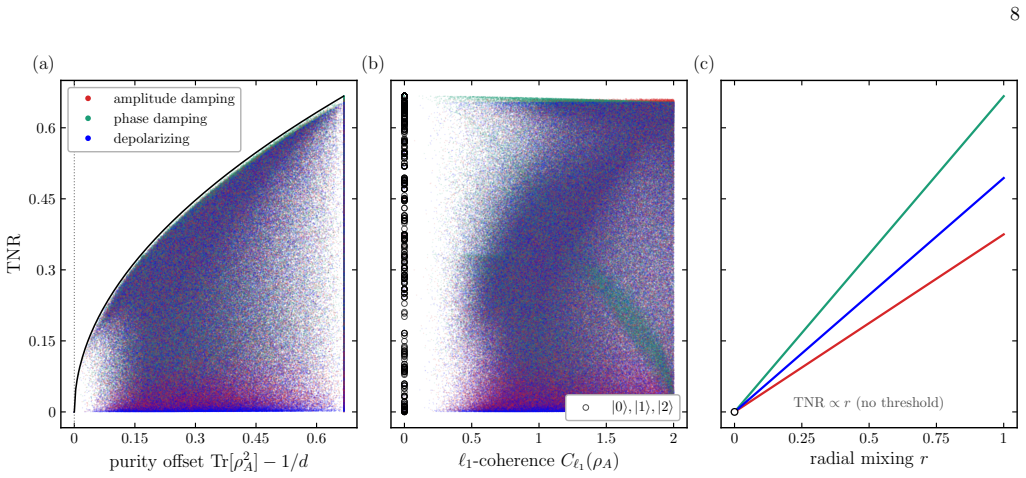
2 NSIT violation VNSIT FIG. 4. The two universal bounds over aρ A-adapted Monte-Carlo sweep of 10 6 configurations (random states, channels and continuous times) atd= 3; columns are the three channels (amplitude damping, phase damping, depolarizing). The NSIT-violation monitorV NSIT [equation (8)] is the temporal analogue of signaling, vanishing iffρ A =1...
-
[3]
if and only if it isnotfully discharged (ρ A ̸=1/d). The three-way equivalence promotes this to a behavior-level capacity test: a battery’s remaining charge can be cer- tified by measuringV NSIT on Bob’s marginal — a single setting-dependence check rather than full state tomogra- phy or work-extraction calorimetry. The temporal dynamics of TNR under the s...
-
[4]
This is the locus of pure inputs; it isinteriorto the cloud (mixed inputs fall∼0.05 below), hence not the true lower envelope, which has no elementary form. •Bottom-row floor (exact):y bot = 0, attained by all pure inputs and by basis / maximally mixed inputs. •Amplitude-damping lower (top) and dome (bot- tom):traced by|+⟩respectively|0⟩–|1⟩coher- ent inp...
-
[5]
0 TERPPT + 1 2VNSIT − TSR (a) amplitude damping (b) phase damping (c) depolarizing
-
[6]
0 0. 2 0. 4 0. 6 0. 8 1. 0 NSIT violation VNSIT
-
[7]
0 0. 2 0. 4 0. 6 0. 8 1. 0 NSIT violation VNSIT (e)
-
[8]
0 0. 2 0. 4 0. 6 0. 8 1. 0 NSIT violation VNSIT (f) ρA = 1/d (NSIT axis) bound ( y = 0) pure-state locus
-
[9]
0 ℓ1 coherence of ρA d = 2 0 1 2 3TERPPT + 1 2VNSIT − TSR (a) amplitude damping (b) phase damping (c) depolarizing
-
[10]
0 0. 5 1. 0 1. 5 NSIT violation VNSIT
-
[11]
0 0. 5 1. 0 1. 5 NSIT violation VNSIT (e)
-
[12]
0 0. 5 1. 0 1. 5 NSIT violation VNSIT (f) ρA = 1/d (NSIT axis) bound ( y = 0) pure-state locus
-
[13]
5 ℓ1 coherence of ρA d = 4 FIG. S4. Hierarchy gaps versusV NSIT atd= 2 (qubit, top) andd= 4 (prime power, bottom)—the analogues of Fig. 4. Dashed green: the analytic pure-state locus; black dots: theρ A =1/daxis (TNR = 0). Since the trace ofRis invariant under unitaries, and ρ,Rhave unit trace, TER is invariant under the same, proving (ii). For (iii), let...
-
[14]
H. M. Wiseman, S. J. Jones, and A. C. Doherty, Phys. Rev. Lett.98, 140402 (2007)
work page 2007
-
[15]
N. Brunner, D. Cavalcanti, S. Pironio, V. Scarani, and S. Wehner, Rev. Mod. Phys.86, 419 (2014)
work page 2014
-
[16]
R. Uola, A. C. S. Costa, H. C. Nguyen, and O. G¨ uhne, Rev. Mod. Phys.92, 015001 (2020)
work page 2020
-
[17]
K. Jir´ akov´ a, A.ˇCernoch, K. Lemr, K. Bartkiewicz, and A. Miranowicz, Phys. Rev. A104, 062436 (2021)
work page 2021
-
[18]
A. J. Leggett and A. Garg, Phys. Rev. Lett.54, 857 (1985)
work page 1985
- [19]
-
[20]
Y.-N. Chen, C.-M. Li, N. Lambert, S.-L. Chen, Y. Ota, G.-Y. Chen, and F. Nori, Phys. Rev. A89, 032112 (2014)
work page 2014
-
[21]
K. Bartkiewicz, A. ˇCernoch, K. Lemr, A. Miranowicz, and F. Nori, Phys. Rev. A93, 062345 (2016)
work page 2016
-
[22]
K. Bartkiewicz, A. ˇCernoch, K. Lemr, A. Miranowicz, and F. Nori, Sci. Rep.6, 38076 (2016)
work page 2016
-
[23]
S.-L. Chen, N. Lambert, C.-M. Li, A. Miranowicz, Y.-N. Chen, and F. Nori, Phys. Rev. Lett.116, 020503 (2016)
work page 2016
-
[24]
J. F. Fitzsimons, J. A. Jones, and V. Vedral, Sci. Rep.5, 18281 (2015)
work page 2015
-
[25]
W. K. Wootters, Ann. Phys. (N.Y.)176, 1 (1987)
work page 1987
-
[26]
K. S. Gibbons, M. J. Hoffman, and W. K. Wootters, Phys. Rev. A70, 062101 (2004)
work page 2004
- [27]
-
[28]
S. H. Lie and J. Fullwood, Phys. Rev. Lett.135, 230204 (2025)
work page 2025
-
[29]
J. Fullwood and A. J. Parzygnat, Operator represen- tation of spatiotemporal quantum correlations (2024), arXiv:2405.17555 [quant-ph], arXiv:2405.17555 [quant- ph]
- [30]
- [31]
- [32]
-
[33]
J. J. Halliwell, Phys. Rev. A96, 012121 (2017)
work page 2017
-
[34]
S. Mal, A. S. Majumdar, and D. Home, Probing hi- erarchy of temporal correlation requires either gen- eralised measurement or nonunitary evolution (2016), arXiv:1510.00625 [quant-ph]
work page internal anchor Pith review Pith/arXiv arXiv 2016
-
[35]
D. Maskalaniec and K. Bartkiewicz, Hierarchy and robustness of multilevel two-time temporal quan- tum correlations (2021), arXiv:2106.02844 [quant-ph], arXiv:2106.02844 [quant-ph]
-
[36]
A. W´ ojcik and J. W´ ojcik, In defense of temporal Tsirelson bound (2025), arXiv:2512.24304 [quant-ph], 33 arXiv:2512.24304 [quant-ph]
-
[37]
A. Chatterjee, H. S. Karthik, T. S. Mahesh, and A. R. Usha Devi, Phys. Rev. Lett.135, 220202 (2025)
work page 2025
-
[38]
L. Letertre, Brit. J. Philos. Sci. 10.1086/734907 (2025), arXiv:2501.12870 [quant-ph]
- [39]
-
[40]
C. Budroni, A. Cabello, O. G¨ uhne, M. Kleinmann, and J.-˚A. Larsson, Rev. Mod. Phys.94, 045007 (2022)
work page 2022
-
[41]
A. A. Klyachko, M. A. Can, S. Binicio˘ glu, and A. S. Shumovsky, Phys. Rev. Lett.101, 020403 (2008)
work page 2008
- [42]
-
[43]
C. H. Bennett, G. Brassard, C. Cr´ epeau, R. Jozsa, A. Peres, and W. K. Wootters, Phys. Rev. Lett.70, 1895 (1993)
work page 1993
-
[44]
J.-P. W. MacLean, K. Ried, R. W. Spekkens, and K. J. Resch, Nat. Commun.8, 15149 (2017)
work page 2017
-
[45]
R. Pisarczyk, Z. Zhao, Y. Ouyang, V. Vedral, and J. F. Fitzsimons, Phys. Rev. Lett.123, 150502 (2019)
work page 2019
-
[46]
D. Horsman, C. Heunen, M. F. Pusey, J. Barrett, and R. W. Spekkens, Proc. R. Soc. A473, 20170395 (2017)
work page 2017
-
[47]
E. Megidish, A. Halevy, T. Shacham, T. Dvir, L. Dovrat, and H. S. Eisenberg, Phys. Rev. Lett.110, 210403 (2013)
work page 2013
- [48]
- [49]
- [50]
-
[51]
S.-L. Chen, N. Lambert, C.-M. Li, G.-Y. Chen, Y.-N. Chen, A. Miranowicz, and F. Nori, Sci. Rep.7, 3728 (2017)
work page 2017
-
[52]
N. E. Comar, L. C. C´ eleri, M. Stamatova, V. Vedral, A. V. Iyer, and R. Chaves, Using spatiotemporal Born rule for testing macroscopic realism: some applications to the pseudo-density matrices and nonclassical tem- poral correlations (2026), arXiv:2603.21793 [quant-ph], arXiv:2603.21793 [quant-ph]
- [53]
-
[54]
M. Horodecki, P. Horodecki, and R. Horodecki, Phys. Lett. A223, 1 (1996)
work page 1996
- [55]
-
[56]
S. Abramsky, R. S. Barbosa, and S. Mansfield, Phys. Rev. Lett.119, 050504 (2017)
work page 2017
-
[57]
G. Sarbicki, G. Scala, and D. Chru´ sci´ nski, Phys. Rev. A 101, 012341 (2020)
work page 2020
- [58]
- [59]
-
[60]
R. Arnon-Friedman, F. Dupuis, O. Fawzi, R. Renner, and T. Vidick, Nat. Commun.9, 459 (2018)
work page 2018
-
[61]
J. M. Renes, R. Blume-Kohout, A. J. Scott, and C. M. Caves, J. Math. Phys.45, 2171 (2004)
work page 2004
-
[62]
W. K. Wootters and B. D. Fields, Ann. Phys.191, 363 (1989)
work page 1989
-
[63]
A. J. Scott, J. Phys. A: Math. Theor.41, 055308 (2008)
work page 2008
-
[64]
CVXPY: A Python-Embedded Modeling Language for Convex Optimization
S. Diamond and S. Boyd, J. Mach. Learn. Res.17, 1 (2016), arXiv:1603.00943
work page internal anchor Pith review Pith/arXiv arXiv 2016
-
[65]
Y. Aharonov, P. G. Bergmann, and J. L. Lebowitz, Phys. Rev.134, B1410 (1964)
work page 1964
-
[66]
The Two-State Vector Formalism of Qauntum Mechanics: an Updated Review
Y. Aharonov and L. Vaidman, inTime in Quantum Me- chanics, Lect. Notes Phys., Vol. 734 (Springer, 2008) p. 399, arXiv:quant-ph/0105101
work page internal anchor Pith review Pith/arXiv arXiv 2008
-
[67]
Y. Aharonov, D. Z. Albert, and L. Vaidman, Phys. Rev. Lett.60, 1351 (1988)
work page 1988
- [68]
-
[69]
M. F. Pusey, Phys. Rev. Lett.113, 200401 (2014)
work page 2014
-
[70]
R. Kunjwal, M. Lostaglio, and M. F. Pusey, Phys. Rev. A100, 042116 (2019), arXiv:1812.06940 [quant-ph]
-
[71]
R. W. Spekkens, Phys. Rev. A71, 052108 (2005)
work page 2005
-
[72]
J. G. Kirkwood, Phys. Rev.44, 31 (1933)
work page 1933
-
[73]
P. A. M. Dirac, Rev. Mod. Phys.17, 195 (1945)
work page 1945
-
[74]
F. Campaioli, S. Gherardini, J. Q. Quach, M. Polini, and G. M. Andolina, Rev. Mod. Phys.96, 031001 (2024)
work page 2024
-
[75]
C. Branciard, E. G. Cavalcanti, S. P. Walborn, V. Scarani, and H. M. Wiseman, Phys. Rev. A85, 010301 (2012)
work page 2012
-
[76]
J. R. Johansson, P. D. Nation, and F. Nori, Comput. Phys. Commun.184, 1234 (2013)
work page 2013
- [77]
-
[78]
Choi, Linear Algebra Its Appl.10, 285 (1975)
M.-D. Choi, Linear Algebra Its Appl.10, 285 (1975)
work page 1975
- [79]
- [80]
discussion (0)
Sign in with ORCID, Apple, or X to comment. Anyone can read and Pith papers without signing in.