REVIEW 2 major objections 6 minor 44 references
GPD: Guided Polynomial Diffusion for Motion Planning
T0 review · 2 major / 6 minor · reviewed 2026-08-10 · deepseek-v4-flash
Pith's one-line read Diffusion over Bernstein polynomial coefficients, rather than raw waypoints, makes guided motion planning about ten times faster and enables collision-free trajectory stitching from a single cost function.
desk verdict Diffusing in Bernstein coefficient space is a genuine new idea with a big reported speedup, but the paper needs to close the joint-limit loophole and clean up its empirical comparisons before I'd trust the numbers. read the letter →
The pith
A machine-rendered reading of the paper's core claim, the machinery that carries it, and where it could break.
The reading
What carries the argument
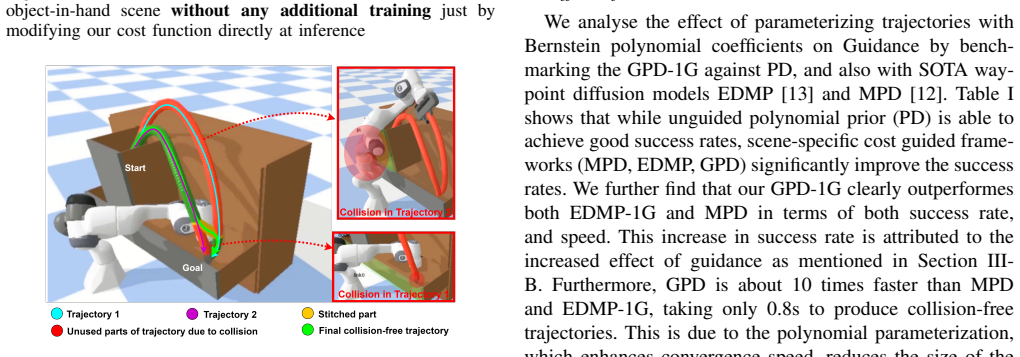
The central object is the Bernstein transform $B \in \mathbb{R}^{(c+1)\times H}$, which maps a vector of control points $\alpha \in \mathbb{R}^{m\times(c+1)}$ to an $H$-waypoint trajectory by $\tau = \alpha B$; each control point is a joint-space vector and the polynomial stays inside the convex hull of the control points. The diffusion model is trained on $\alpha$ rather than on waypoints, and guidance uses the chain-rule identity $\nabla_\alpha J = B^\top \nabla_q J(q)$, which the paper reads as preconditioning the waypoint-space gradient with $B^\top$. That identity carries the speed and success claims: it lets one waypoint's collision gradient move the whole smooth curve, and it lets a much smaller denoiser converge with $T=64$ denoising steps instead of 256. The stitching algorithm is secondary machinery: it rolls out the lowest-cost trajectory with a sliding collision window and splices in collision-free segments from other diverse trajectories using RRT-Connect.
What would settle it
Run GPD on the MπNets test scenes and record the Bernstein coefficients at every denoising step; if guidance pushes a substantial fraction of them outside the robot's joint limits, the smooth polynomial is not executable and the success-rate and speed claims would not transfer to a physical robot. A direct check is to compare success rates with and without clamping the coefficients to the joint limits after each guidance update.
Extended reading notes
Core claim
The paper's central claim is that the trajectory parameterization, not the diffusion machinery, is the bottleneck. Waypoint-space denoising produces non-smooth trajectories for most of the denoising process, so gradient guidance is weak and many steps are needed. GPD instead represents a trajectory as an 8th-order Bernstein polynomial, diffuses over the coefficient vector, and conditions the reverse process by fixing the first and last control points to the start and goal configurations. Guidance is computed by differentiating the cost through the Bernstein transform, $\nabla_\alpha J = B^\top \nabla_q J(q)$, which acts as a preconditioner that spreads each waypoint gradient across all coefficients. The paper reports smooth, prior-like trajectories within a few steps, a tenfold speedup over MPD and EDMP-1G, and, with stitching, success rates of 87.00%, 92.83%, and 92.61% on the Global, Hybrid, and Both MπNets test sets.
Load-bearing premise
The load-bearing premise is that a generated set of polynomial control points automatically corresponds to a smooth trajectory that respects the robot's joint limits; the paper asserts this but does not show that diffusion or the guidance update keeps the control points inside those limits.
Editorial extensions
If this is right
- A single cost function can replace a tuned ensemble of cost functions when stitching is available, because diverse diffusion samples cover the free space piecewise.
- Planning time drops into the reactive range: GPD is reported to generate smooth trajectories at 16 Hz in indoor and urban driving scenes.
- The compact coefficient representation shrinks the diffusion model, lowering the training and per-step inference load.
- New environments such as object-in-hand manipulation can be handled at inference time by adding cost terms, without retraining the prior.
Reading between the lines
- Because the $B^\top$ preconditioner is independent of diffusion, the same gradient transformation could be dropped into classical trajectory optimizers; the paper compares with CHOMP but does not apply its preconditioner there.
- A direct stress test would be to clamp Bernstein coefficients to joint limits after each guidance update and measure the change in success rates, since the paper does not analyse coefficient feasibility during denoising.
- Stitching relies on diversity, so adding an explicit diversity-promoting term to the guidance could make GPDS even stronger; the paper only harvests diversity from sampling multiple diffusion steps.
- The reported 0.8-second planning time is measured on one workstation, so transferring the claim to real-time control would require accounting for cost-evaluation and simulation latency, which the paper does not model.
Editorial analysis
A structured set of objections, weighed in public.
Referee Report
Summary. This paper proposes Guided Polynomial Diffusion (GPD), a diffusion-based motion planner that operates on Bernstein polynomial coefficients rather than waypoints. The authors argue that this parameterization yields smoother intermediate samples, faster convergence, and more effective cost-function guidance via the chain-rule gradient in Eq. (5). They also present a stitching algorithm (GPDS) that assembles collision-free segments from a batch of GPD trajectories. On the MpiNets benchmark, the authors report state-of-the-art success rates for a single-cost model (GPD-1G) and for the stitched variant, with planning times around 0.8 s and 1.9 s respectively, compared with 7.3–8.2 s for MPD/EDMP.
Significance. The core idea is interesting and the chain-rule derivation in Eq. (5) is correct; the preconditioning view of guidance is a useful conceptual contribution. If the feasibility issues are resolved, the method could provide a practical speed improvement for guided diffusion planners. The stitching algorithm is a sensible way to leverage sample diversity, and the qualitative navigation results suggest broader applicability. The paper also contains reproducible elements: collision checking is external (PyBullet), and the training data and benchmark are public.
major comments (2)
- [Section III / Algorithm 1] The central feasibility claim of the paper is unenforced and unverified. The key statement in Section III, "Any set of control points within the robot's joint limits represents a smooth trajectory," is used to justify that Bernstein parameterization maintains kinematic validity. However, Algorithm 1 starts from α_T ~ N(0, I) and alternates between the reverse diffusion step and the guidance update in Eq. (4); neither step includes clamping, projection, or any mechanism to keep the coefficients inside the joint-limit box. Only the first and last control points are fixed. Furthermore, no residual analysis is provided for the least-squares Bernstein fits to the MpiNets training trajectories, so it is not shown that even the training prior is supported on feasible coefficients. Since the success metric only checks whether the end-effector reaches the goal without collision, and the paper does not state whether PyBullet enforces joint limits, trajectories with out-of-limit coefficients could be counted as successes. This directly threatens the claims of producing kinematically valid, smooth trajectories and, consequently, the reported success rates and planning times. The authors should either add a projection or clamping step, or provide a direct audit of the generated coefficients (and the training fits) showing that they remain within the robot's joint limits.
- [Section IV-B / Algorithm 2] The stitching algorithm has several unspecified hyperparameters that are load-bearing for the GPDS results. In Algorithm 2, the collision window size w is an input, but no value is reported for any experiment. The RRT-Connect local planner's timeout or iteration budget is also not given. Without these details, the GPDS results are not reproducible, and one cannot determine how much of the success comes from the GPD prior versus the local planner's search effort. The paper should report these parameters and describe the behavior when no valid stitch target is found (e.g., the loop in Algorithm 2 has no termination condition for that case).
minor comments (6)
- [Section IV] The statement "We use 8th-order Bernstein polynomials with 8 control points" is inconsistent with Eq. (2), where a polynomial of order c has c+1 coefficients; please clarify whether c=8 (9 control points) or there are 8 control points (order 7).
- [Equation (4)] Equation (4) uses both γ and γ2 without defining γ2; please clarify whether γ2 is a squared learning rate or a typo in the coefficient of the guidance term.
- [Equation (3) / Algorithm 1] Equation (3) defines τ = α·B, while Algorithm 1 line 3 writes q_t = B·α_t; the dimensions of B should be stated consistently to avoid confusion.
- [Tables I and II] Tables I and II report success rates without standard deviations or the number of seeds; the reported differences are large, but adding variance measures would strengthen the empirical claims.
- [Section IV] The training duration is reported as "20k epochs" for a dataset of 6.54 million trajectories; please clarify whether this is steps or epochs and report the model size for reproducibility.
- [Section IV-C] The navigation section reports a 16 Hz planning frequency without a supporting timing table or measurement details; please add specifics on how this frequency was obtained.
Circularity Check
No circular derivation: GPD's Bernstein-space diffusion, guidance gradient, and external benchmarks form a self-contained chain.
full rationale
The paper's claimed derivation chain is not circular. The prior is learned over Bernstein coefficients obtained by least-squares fitting to the external MπNets trajectory dataset, and the guidance update in Eq. (4) uses the gradient ∇αt J(αt, ot) computed by the exact chain-rule identity in Eq. (5), ∇αt J = Bᵀ ∇qt J. This is a mathematical consequence of the reparameterization τ = α·B, not a fitted relation or a parameter chosen to reproduce a target result. Success is measured with PyBullet's external collision checker, and the speed comparison is an empirical runtime benchmark against independently published baselines (MPD, EDMP). The Bernstein convex-hull property invoked in Section III is standard external mathematics, not an assumption equivalent to the conclusion. The paper cites the authors' own EDMP work [13] for the differentiable collision cost functions and baseline scores, but that citation is not load-bearing for the central claim: GPD's improvement is demonstrated against EDMP as an external baseline rather than derived from it. The reviewer-identified concern that Algorithm 1 does not enforce joint-limit feasibility of the denoised coefficients is a potential correctness or robustness issue, not a circularity issue, because the feasibility premise is not assumed into the success metric; it is asserted but unverified. No self-definitional step, fitted-input-called-prediction step, or self-citation chain forces the reported results.
Assumptions & free parameters
free parameters (6)
- Bernstein polynomial order and number of control points =
8 control points, described as 8th-order in text
- Diffusion timesteps T =
64
- Guidance learning rate schedule and cost-function weights =
Not reported
- Stitching collision window size w =
Not reported
- Stitching batch sizes =
32 for PDS and GPDS, 1000 for GS
- RRT-Connect stitch timeout and iteration budget =
Not reported
assumptions (6)
- standard math DDPM forward and reverse Gaussian diffusion assumptions hold for the Bernstein coefficient distribution.
- standard math Bernstein convex hull property: a polynomial lies inside the convex hull of its control points.
- domain assumption MpiNets planner trajectories are valid, smooth, and diverse enough to define a good motion prior.
- ad hoc to paper For a diverse set of trajectories, the union of collision-free segments covers the free space.
- domain assumption RRT-Connect can feasibly connect a stitch between two trajectories within the allowed time.
- domain assumption The collision and smoothness cost functions are differentiable with respect to waypoints.
Cite this review
Pith. "Pith review of GPD: Guided Polynomial Diffusion for Motion Planning." pith.science (2026). https://pith.science/paper/ULN6OJX6
@misc{pith2026250118229,
  author       = {Pith},
  title        = {Pith review of: GPD: Guided Polynomial Diffusion for Motion Planning},
  year         = {2026},
  howpublished = {\url{https://pith.science/paper/ULN6OJX6}},
  note         = {Machine review of arXiv:2501.18229}
}
read the original abstract
Diffusion-based motion planners are becoming popular due to their well-established performance improvements, stemming from sample diversity and the ease of incorporating new constraints directly during inference. However, a primary limitation of the diffusion process is the requirement for a substantial number of denoising steps, especially when the denoising process is coupled with gradient-based guidance. In this paper, we introduce, diffusion in the parametric space of trajectories, where the parameters are represented as Bernstein coefficients. We show that this representation greatly improves the effectiveness of the cost function guidance and the inference speed. We also introduce a novel stitching algorithm that leverages the diversity in diffusion-generated trajectories to produce collision-free trajectories with just a single cost function-guided model. We demonstrate that our approaches outperform current SOTA diffusion-based motion planners for manipulators and provide an ablation study on key components.
Figures


Figures from the paper (5 more)




Reference graph
Works this paper leans on
-
[1]
C.-F. Yang, H. Xu, T.-L. Wu, X. Gao, K.-W. Chang, and F. Gao, Planning as in-painting: A diffusion- based embodied task planning framework for environ- ments under uncertainty , 2023. arXiv: 2312.01097 [cs.CV]
arXiv 2023
-
[2]
Compositional Diffusion-Based Continuous Constraint Solvers,
Z. Yang, J. Mao, Y . Du, et al. , “Compositional Diffusion-Based Continuous Constraint Solvers,” in Conference on Robot Learning , 2023
work page 2023
-
[3]
Denoising Heat-inspired Diffusion with Insulators for Collision Free Motion Planning
J. Chang, H. Ryu, J. Kim, et al. , “Denoising heat- inspired diffusion with insulators for collision free motion planning,” arXiv preprint arXiv:2310.12609 , 2023
work page Pith review arXiv 2023
-
[4]
DiMSam: Diffusion models as samplers for task and motion planning under partial observability,
X. Fang, C. Garrett, C. Eppner, T. Lozano-Pérez, L. Kaelbling, and D. Fox, “DiMSam: Diffusion models as samplers for task and motion planning under partial observability,” in CoRL 2023 Workshop on Learning Effective Abstractions for Planning (LEAP) , 2023. [Online]. Available: https : / / openreview . net/forum?id=a14qioqpel
work page 2023
-
[5]
Structdiffusion: Language-guided creation of physically-valid structures using unseen objects,
W. Liu, Y . Du, T. Hermans, S. Chernova, and C. Paxton, “Structdiffusion: Language-guided creation of physically-valid structures using unseen objects,” in RSS 2023, 2023
work page 2023
-
[6]
Plan- ning with diffusion for flexible behavior synthesis,
M. Janner, Y . Du, J. Tenenbaum, and S. Levine, “Plan- ning with diffusion for flexible behavior synthesis,” in International Conference on Machine Learning, 2022
work page 2022
-
[7]
Cross- way diffusion: Improving diffusion-based visuomotor policy via self-supervised learning,
X. Li, V . Belagali, J. Shang, and M. S. Ryoo, “Cross- way diffusion: Improving diffusion-based visuomotor policy via self-supervised learning,” in 2024 IEEE International Conference on Robotics and Automation (ICRA), 2024, pp. 16 841–16 849. DOI: 10 . 1109 / ICRA57147.2024.10610175
-
[8]
Shelving, stacking, hanging: Relational pose diffusion for multi- modal rearrangement,
A. Simeonov, A. Goyal, L. Manuelli, et al., “Shelving, stacking, hanging: Relational pose diffusion for multi- modal rearrangement,” Conference on Robot Learn- ing, 2023
work page 2023
Show all 44 references
-
[9]
MidasTouch: Monte-Carlo inference over distributions across sliding touch,
S. Suresh, Z. Si, S. Anderson, M. Kaess, and M. Mukadam, “MidasTouch: Monte-Carlo inference over distributions across sliding touch,” in Proc. Conf. on Robot Learning, CoRL , Auckland, NZ, Dec. 2022
2022
-
[10]
Se (3)-diffusionfields: Learning smooth cost func- tions for joint grasp and motion optimization through diffusion,
J. Urain, N. Funk, J. Peters, and G. Chalvatzaki, “Se (3)-diffusionfields: Learning smooth cost func- tions for joint grasp and motion optimization through diffusion,” in 2023 IEEE International Conference on Robotics and Automation (ICRA) , IEEE, 2023, pp. 5923–5930
2023
-
[11]
Unidexgrasp: Uni- versal robotic dexterous grasping via learning diverse proposal generation and goal-conditioned policy,
Y . Xu, W. Wan, J. Zhang, et al., “Unidexgrasp: Uni- versal robotic dexterous grasping via learning diverse proposal generation and goal-conditioned policy,” in Proceedings of the IEEE/CVF Conference on Com- puter Vision and Pattern Recognition (CVPR) , Jun. 2023, pp. 4737–4746
2023
-
[12]
Motion planning diffusion: Learning and planning of robot motions with diffusion models,
J. Carvalho, A. T. Le, M. Baierl, D. Koert, and J. Peters, “Motion planning diffusion: Learning and planning of robot motions with diffusion models,” in 2023 IEEE/RSJ International Conference on Intelli- gent Robots and Systems (IROS) , 2023, pp. 1916–
2023
-
[13]
Edmp: Ensemble-of-costs-guided diffusion for motion plan- ning,
K. Saha, V . Mandadi, J. Reddy, et al. , “Edmp: Ensemble-of-costs-guided diffusion for motion plan- ning,” in 2024 IEEE International Conference on Robotics and Automation (ICRA) , 2024, pp. 10 351– 10 358. DOI: 10 . 1109 / ICRA57147 . 2024 . 10610519
2024
-
[14]
Po- tential based diffusion motion planning,
Y . Luo, C. Sun, J. B. Tenenbaum, and Y . Du, “Po- tential based diffusion motion planning,” in Forty-first International Conference on Machine Learning, 2024
2024
-
[15]
Chomp: Gradient optimization techniques for efficient motion planning,
N. Ratliff, M. Zucker, J. A. Bagnell, and S. Srini- vasa, “Chomp: Gradient optimization techniques for efficient motion planning,” in 2009 IEEE Interna- tional Conference on Robotics and Automation , 2009, pp. 489–494. DOI: 10 . 1109 / ROBOT . 2009 . 5152817
2009
-
[16]
Storm: An integrated framework for fast joint- space model-predictive control for reactive manipula- tion,
M. Bhardwaj, B. Sundaralingam, A. Mousavian, et al., “Storm: An integrated framework for fast joint- space model-predictive control for reactive manipula- tion,” in Conference on Robot Learning, PMLR, 2022, pp. 750–759
2022
-
[17]
Finding locally optimal, collision-free trajectories with sequential convex optimization,
J. Schulman, J. Ho, A. Lee, I. Awwal, H. Bradlow, and P. Abbeel, “Finding locally optimal, collision-free trajectories with sequential convex optimization,” Jun
-
[18]
A formal basis for the heuristic determination of minimum cost paths,
P. E. Hart, N. J. Nilsson, and B. Raphael, “A formal basis for the heuristic determination of minimum cost paths,” IEEE Transactions on Systems Science and Cybernetics, vol. 4, no. 2, pp. 100–107, 1968. DOI: 10.1109/TSSC.1968.300136
1968
-
[19]
Anytime dynamic a*: An anytime, replanning algorithm.,
M. Likhachev, D. Ferguson, G. Gordon, A. Stentz, and S. Thrun, “Anytime dynamic a*: An anytime, replanning algorithm.,” Jan. 2005, pp. 262–271
2005
-
[20]
Ara*: Anytime a* with provable bounds on sub-optimality.,
M. Likhachev, G. J. Gordon, and S. Thrun, “Ara*: Anytime a* with provable bounds on sub-optimality.,” in NIPS, S. Thrun, L. K. Saul, and B. Schölkopf, Eds., MIT Press, 2003, pp. 767–774, ISBN : 0-262- 20152-6. [Online]. Available: http://dblp.uni- trier.de/db/conf/nips/nips200...
2003
-
[21]
Rrt-connect: An efficient approach to single-query path planning,
J. J. Kuffner and S. M. LaValle, “Rrt-connect: An efficient approach to single-query path planning,” Pro- ceedings 2000 ICRA. Millennium Conference. IEEE International Conference on Robotics and Automation. Symposia Proceedings (Cat. No.00CH37065) , vol. 2, 995–1001 vol.2, 200...
2000
-
[22]
Rapidly-exploring random trees : A new tool for path planning,
S. M. LaValle, “Rapidly-exploring random trees : A new tool for path planning,” The annual re- search report , 1998. [Online]. Available: https : / / api . semanticscholar . org / CorpusID : 14744621
1998
-
[23]
Real-time model predictive control for quadrotors,
M. Bangura, “Real-time model predictive control for quadrotors,” vol. 47, Aug. 2014, pp. 11 773–11 780. DOI: 10.3182/20140824-6-ZA-1003.00203
2014
-
[24]
An integrated system for real- time model predictive control of humanoid robots,
T. Erez, K. Lowrey, Y . Tassa, V . Kumar, S. Kolev, and E. Todorov, “An integrated system for real- time model predictive control of humanoid robots,” in 2013 13th IEEE-RAS International Conference on Humanoid Robots (Humanoids) , 2013, pp. 292–299. DOI: 10.1109/HUMANOIDS.2013.7029990
2013
-
[25]
Model predictive path integral control using co- variance variable importance sampling,
G. Williams, A. Aldrich, and E. A. Theodorou, “Model predictive path integral control using co- variance variable importance sampling,” ArXiv, vol. abs/1509.01149, 2015. [Online]. Available: https : / / api . semanticscholar . org / CorpusID:14146342
2015 arXiv
-
[26]
Aggressive driving with model predictive path integral control,
G. Williams, P. Drews, B. Goldfain, J. M. Rehg, and E. A. Theodorou, “Aggressive driving with model predictive path integral control,” in 2016 IEEE In- ternational Conference on Robotics and Automation (ICRA), 2016, pp. 1433–1440. DOI: 10 . 1109 / ICRA.2016.7487277
2016
-
[27]
Mo- tions in microseconds via vectorized sampling-based planning,
W. Thomason, Z. Kingston, and L. E. Kavraki, “Mo- tions in microseconds via vectorized sampling-based planning,” in 2024 IEEE International Conference on Robotics and Automation (ICRA) , 2024, pp. 8749–
2024
-
[28]
Hyperplan: A framework for motion planning algo- rithm selection and parameter optimization,
M. Moll, C. Chamzas, Z. Kingston, and L. E. Kavraki, “Hyperplan: A framework for motion planning algo- rithm selection and parameter optimization,” in 2021 IEEE/RSJ International Conference on Intelligent Robots and Systems (IROS) , 2021, pp. 2511–2518. DOI: 10.1109/IROS51168....
2021
-
[29]
Motion planning networks,
A. H. Qureshi, A. Simeonov, M. J. Bency, and M. C. Yip, “Motion planning networks,” in 2019 International Conference on Robotics and Automation (ICRA), 2019, pp. 2118–2124. DOI: 10 . 1109 / ICRA.2019.8793889
2019
-
[30]
Motion policy networks,
A. Fishman, A. Murali, C. Eppner, B. Peele, B. Boots, and D. Fox, “Motion policy networks,” in Conference on Robot Learning , PMLR, 2023, pp. 967–977
2023
-
[31]
Dipper: Diffusion-based 2d path planner applied on legged robots,
J. Liu, M. Stamatopoulou, and D. Kanoulas, “Dipper: Diffusion-based 2d path planner applied on legged robots,” in 2024 IEEE International Conference on Robotics and Automation (ICRA) , 2024, pp. 9264–
2024
-
[32]
Diffusion-es: Gradient-free planning with diffusion for autonomous and instruction-guided driving,
B. Yang, H. Su, N. Gkanatsios, et al. , “Diffusion-es: Gradient-free planning with diffusion for autonomous and instruction-guided driving,” in Proceedings of the IEEE/CVF Conference on Computer Vision and Pattern Recognition (CVPR) , Jun. 2024, pp. 15 342– 15 353
2024
-
[33]
Dpm-solver: A fast ode solver for diffusion proba- bilistic model sampling in around 10 steps,
C. Lu, Y . Zhou, F. Bao, J. Chen, C. Li, and J. Zhu, “Dpm-solver: A fast ode solver for diffusion proba- bilistic model sampling in around 10 steps,” Advances in Neural Information Processing Systems , vol. 35, pp. 5775–5787, 2022
2022
-
[34]
Denoising diffusion implicit models,
J. Song, C. Meng, and S. Ermon, “Denoising diffusion implicit models,” arXiv preprint arXiv:2010.02502 , 2020
2010 arXiv
-
[35]
Deep unsupervised learning us- ing nonequilibrium thermodynamics,
J. Sohl-Dickstein, E. Weiss, N. Maheswaranathan, and S. Ganguli, “Deep unsupervised learning us- ing nonequilibrium thermodynamics,” in Interna- tional conference on machine learning , PMLR, 2015, pp. 2256–2265
2015
-
[36]
Denoising diffusion probabilistic models,
J. Ho, A. Jain, and P. Abbeel, “Denoising diffusion probabilistic models,” Advances in neural information processing systems, vol. 33, pp. 6840–6851, 2020
2020
-
[37]
Rrt-connect: An efficient approach to single-query path planning,
J. Kuffner and S. LaValle, “Rrt-connect: An efficient approach to single-query path planning,” in Proceed- ings 2000 ICRA. Millennium Conference. IEEE In- ternational Conference on Robotics and Automation. Symposia Proceedings (Cat. No.00CH37065) , vol. 2, 2000, 995–1001 vol.2...
2000
-
[38]
Coumans and Y
E. Coumans and Y . Bai, Pybullet, a python module for physics simulation for games, robotics and machine learning, http://pybullet.org, 2016–2021
2016
-
[39]
Adaptively in- formed trees (ait): Fast asymptotically optimal path planning through adaptive heuristics,
M. P. Strub and J. D. Gammell, “Adaptively in- formed trees (ait): Fast asymptotically optimal path planning through adaptive heuristics,” in 2020 IEEE International Conference on Robotics and Automation (ICRA), IEEE, 2020, pp. 3191–3198
2020
-
[40]
Geometric fabrics for the acceleration-based design of robotic motion,
M. Xie, K. V . Wyk, A. Li, et al., “Geometric fabrics for the acceleration-based design of robotic motion,” ArXiv, vol. abs/2010.14750, 2020. [Online]. Available: https : / / api . semanticscholar . org / CorpusID:225094405
2010 arXiv
-
[1923]
1109 / IROS55552
DOI: 10 . 1109 / IROS55552 . 2023 . 10342382
2023
-
[2013]
DOI: 10.15607/RSS.2013.IX.031
2013 doi
-
[8756]
1109 / ICRA57147
DOI: 10 . 1109 / ICRA57147 . 2024 . 10611190
2024
-
[9270]
1109 / ICRA57147
DOI: 10 . 1109 / ICRA57147 . 2024 . 10610013
2024
Reviewed August 10, 2026 · model on record in the stance chip above.
Discussion (0). Continue with ORCID to comment.