Transmission Spectrum of the Benchmark Temperate Exo-Neptune TOI-1231 b
Pith reviewed 2026-07-02 05:27 UTC · model grok-4.3
The pith
JWST spectrum of TOI-1231 b detects methane and carbon dioxide consistent with a deep hydrogen-rich atmosphere.
A machine-rendered reading of the paper's core claim, the machinery that carries it, and where it could break.
Core claim
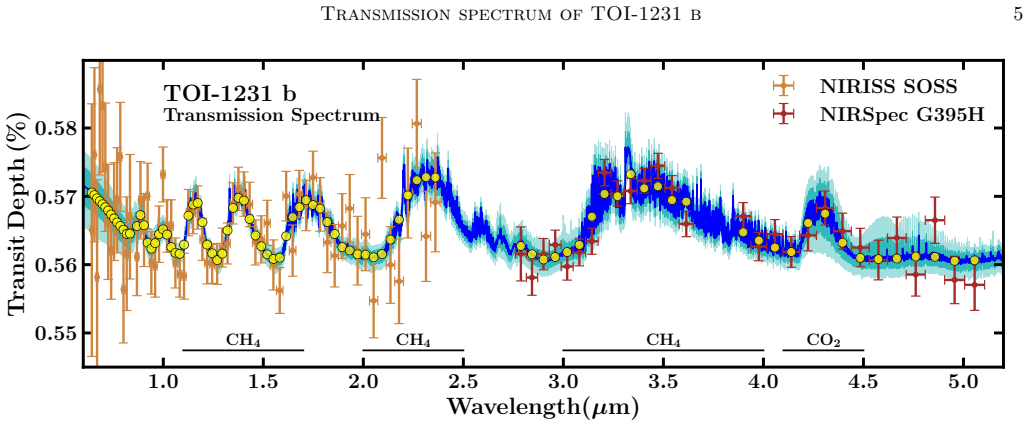
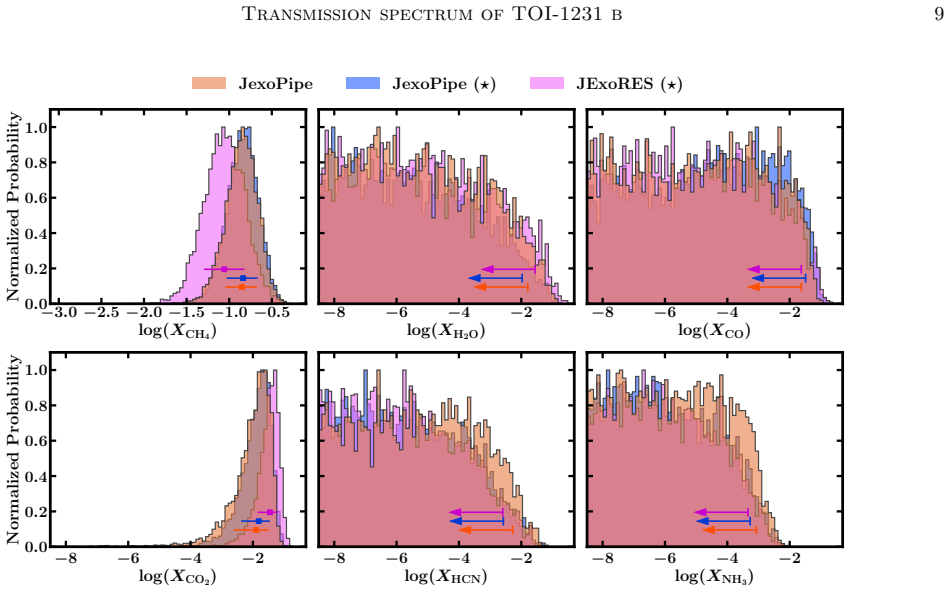
We report a strong detection of CH4 (ln B = 54.5-69.6) and moderate to strong evidence for CO2 (ln B = 2.9-6.6). We do not find significant evidence for any other prominent molecule, although we find high 95% upper limits on the mixing ratios of NH3 and CO. This composition is consistent with expectations for a temperate Neptune possessing a deep H2-rich atmosphere with no distinct surface.
What carries the argument
Atmospheric retrieval analysis applied to the combined NIRISS and NIRSpec transmission spectrum that computes Bayesian evidence for individual molecular species.
If this is right
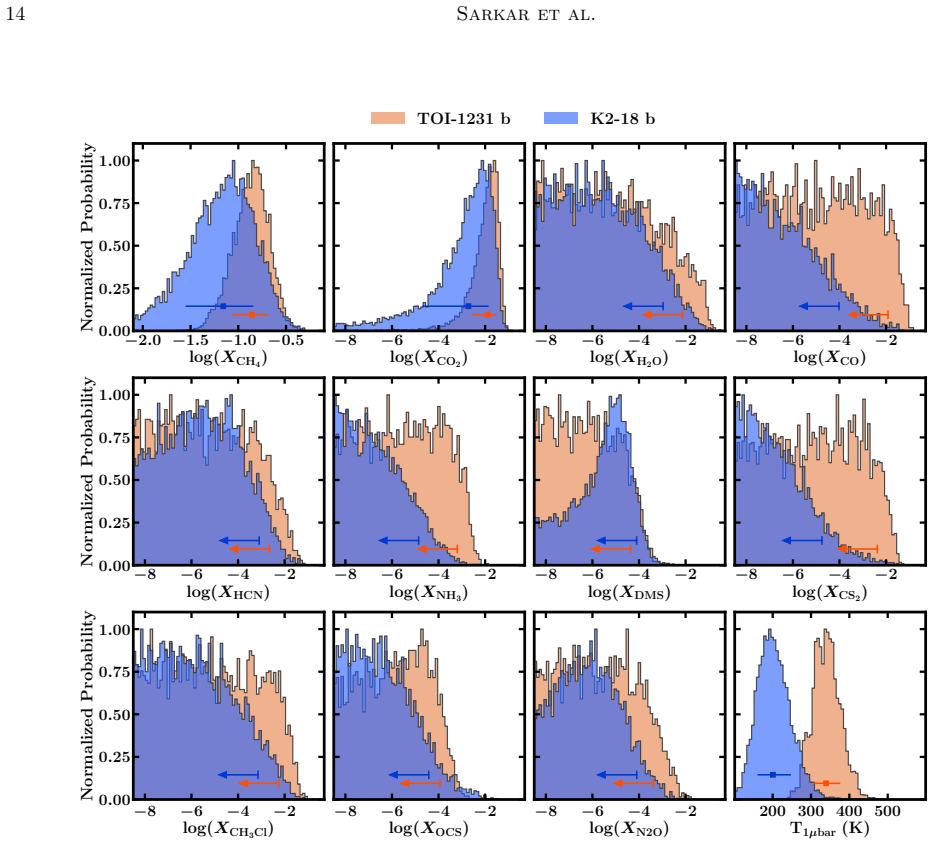
- The absence of sulfur species distinguishes this planet from some other temperate sub-Neptunes.
- High upper limits on ammonia and carbon monoxide align with predictions for deep hydrogen atmospheres.
- The result supplies an empirical anchor for theoretical predictions of compositional differences between shallow and deep atmosphere scenarios.
- It supports the mini-Neptune interpretation over hycean or gas-dwarf alternatives for this specific target.
Where Pith is reading between the lines
- Similar retrievals on other density-confirmed temperate Neptunes could test whether methane-plus-carbon-dioxide signatures are common.
- If future data on additional targets reproduce this pattern, interior models that predict distinct surfaces may need revision for the broader sub-Neptune population.
Load-bearing premise
The planet's measured bulk density is interpreted as requiring a thick hydrogen-rich atmosphere with no distinct surface.
What would settle it
A higher-precision spectrum that instead shows strong ammonia absorption or sulfur-bearing species at abundances above the current upper limits.
Figures

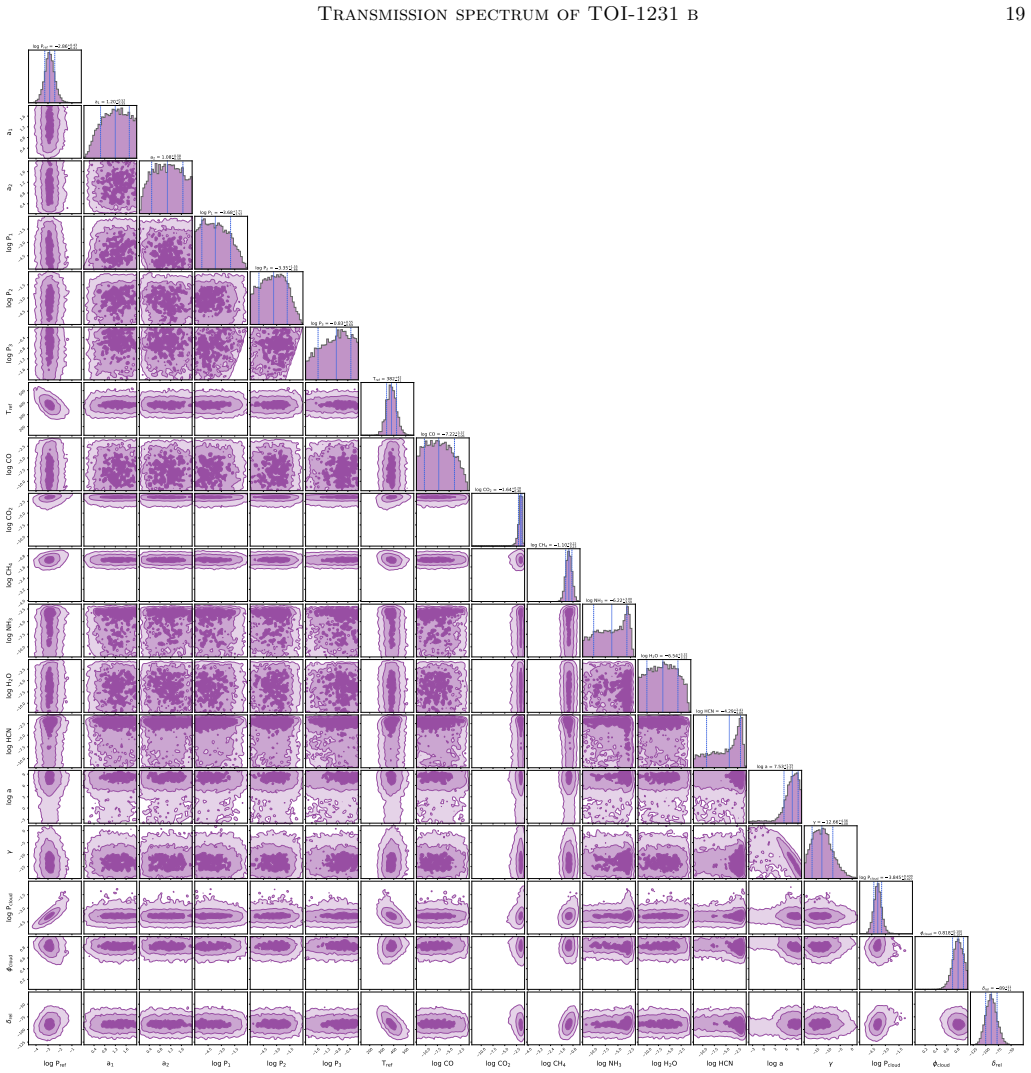
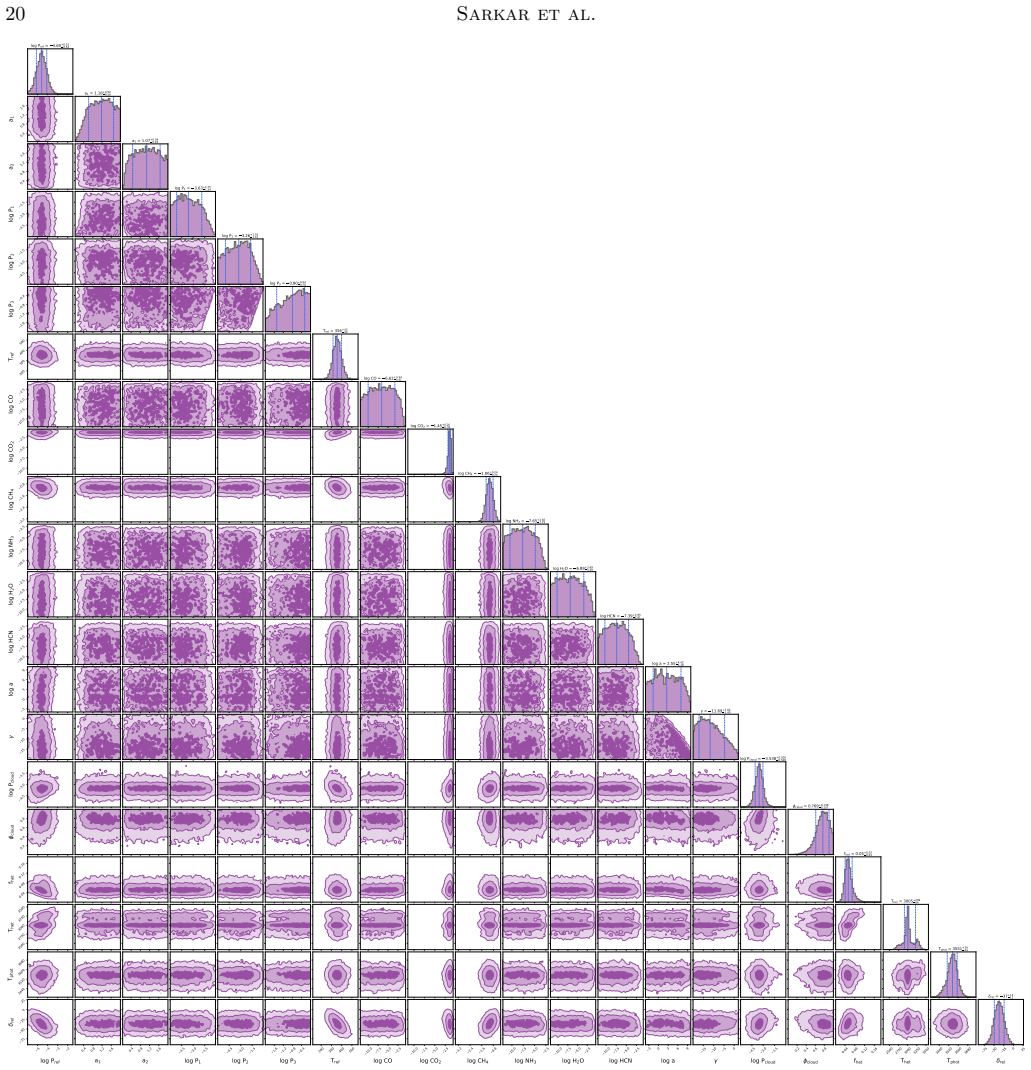
read the original abstract
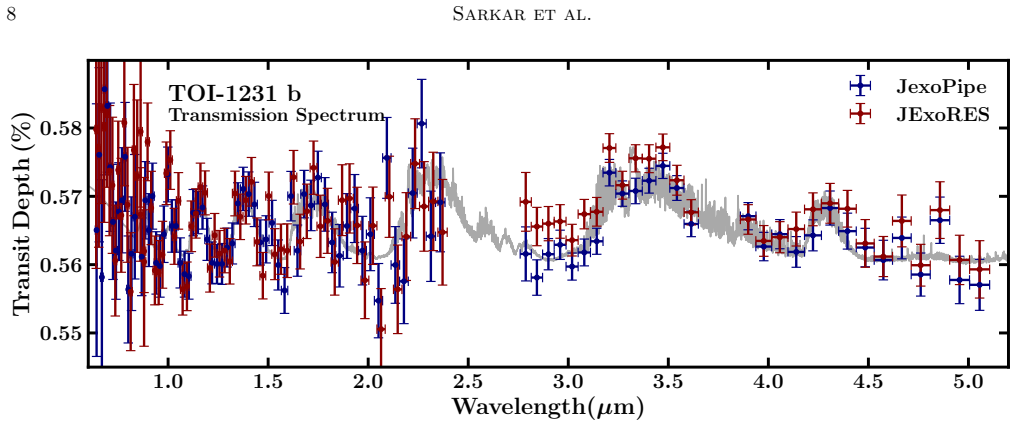
The JWST is revolutionizing our understanding of the temperate sub-Neptune population through atmospheric spectroscopy. The nature of these planets remains debated, as their bulk properties are compatible with a range of interior scenarios, including mini-Neptunes, hycean worlds, and gas dwarfs, with different predicted atmospheric compositions. While theoretical studies have predicted compositional diagnostics for shallow- versus deep-atmosphere scenarios, there is a critical need for empirical constraints for a temperate planet that is a priori known to possess a deep H$_2$-rich atmosphere. The temperate exo-Neptune TOI-1231 b provides one such benchmark target. In this work, we present the JWST near-infrared (0.65--5.2 $\mu$m) transmission spectrum of TOI-1231 b, observed with NIRISS single-object slitless spectroscopy and NIRSpec G395H, representing the first for a temperate exo-Neptune. The density of TOI-1231 b requires a thick H$_2$-rich atmosphere, making the planet a keystone reference case for testing mini-Neptune scenarios for sub-Neptunes. We report a strong detection of CH$_4$ ($\ln B = 54.5$-$69.6$) and moderate to strong evidence for CO$_2$ ($\ln B = 2.9$-$6.6$). We do not find significant evidence for any other prominent molecule, although we find high 95\% upper limits on the mixing ratios of NH$_3$ and CO, both of which are expected in deep H$_2$-rich atmospheres. We also do not find any significant evidence for sulfur-bearing species that have been inferred for some temperate sub-Neptunes. This composition is consistent with expectations for a temperate Neptune possessing a deep H$_2$-rich atmosphere with no distinct surface. We discuss the implications of our results for the characterization of temperate sub-Neptunes.
Editorial analysis
A structured set of objections, weighed in public.
Referee Report
Summary. The paper presents the first JWST near-infrared (0.65-5.2 μm) transmission spectrum of the temperate exo-Neptune TOI-1231 b, obtained with NIRISS single-object slitless spectroscopy and NIRSpec G395H. It reports a strong detection of CH4 (ln B = 54.5-69.6) and moderate to strong evidence for CO2 (ln B = 2.9-6.6), with no significant detections of other molecules including NH3, CO, or sulfur-bearing species, and high 95% upper limits on the latter two. The observed composition is interpreted as consistent with expectations for a deep H2-rich atmosphere with no distinct surface, establishing the planet as a benchmark reference for testing mini-Neptune scenarios for sub-Neptunes given its density-implied thick envelope.
Significance. If the retrieval results are robust, this work supplies a key empirical benchmark for temperate sub-Neptunes with confirmed deep H2 envelopes, directly addressing the need for observational constraints on compositional diagnostics predicted by theory. The high Bayesian evidence for CH4 constitutes a clear, high-significance detection in a challenging observational regime and provides falsifiable reference points for atmospheric chemistry models of similar planets.
minor comments (3)
- [Abstract] Abstract: the reported ranges for ln B (CH4: 54.5-69.6; CO2: 2.9-6.6) are presented without explanation of their origin (e.g., different data subsets, retrieval configurations, or model variants); this should be clarified in the main text or methods to allow readers to assess robustness.
- [Methods/Retrieval Setup] The manuscript should explicitly state the number of free parameters and priors used in the atmospheric retrievals (even if standard) to facilitate direct comparison with other JWST sub-Neptune studies.
- [Figures] Figure captions and axis labels for the transmission spectrum should clearly demarcate the NIRISS versus NIRSpec G395H wavelength coverage and note any overlapping regions or stitching procedures.
Simulated Author's Rebuttal
We thank the referee for their positive summary and recommendation of minor revision. No major comments were provided in the report, so we have no specific points to address point-by-point. We will incorporate any minor suggestions from the full report in the revised manuscript.
Circularity Check
No significant circularity; empirical result from JWST data and standard retrievals
full rationale
The paper presents an observational transmission spectrum of TOI-1231 b from NIRISS and NIRSpec G395H JWST data, with molecular detections (CH4 ln B = 54.5-69.6; CO2 ln B = 2.9-6.6) obtained via standard atmospheric retrieval methods. The claim that the planet possesses a thick H2-rich atmosphere is framed as a prior constraint from independent density measurements, not derived internally. No load-bearing steps reduce by the paper's own equations to fitted inputs, self-citations, or ansatzes; the central results are externally falsifiable against the public dataset and do not involve renaming known patterns or uniqueness theorems imported from prior author work. This is a self-contained observational analysis.
Axiom & Free-Parameter Ledger
axioms (2)
- domain assumption Standard assumptions in exoplanet atmospheric retrieval models are valid for interpreting the transmission spectrum.
- standard math Bayesian evidence (ln B) thresholds reliably indicate detection significance.
Reference graph
Works this paper leans on
-
[1]
2025, ApJL, 985, L10, doi: 10.3847/2041-8213/add010
Ahrer, E.-M., Radica, M., Piaulet-Ghorayeb, C., et al. 2025, ApJL, 985, L10, doi: 10.3847/2041-8213/add010
-
[2]
Alam, M. K., Gao, P., Adams Redai, J., et al. 2025, AJ, 169, 15, doi: 10.3847/1538-3881/ad8eb5
-
[3]
Alderson, L., Batalha, N. E., Wakeford, H. R., et al. 2024, AJ, 167, 216, doi: 10.3847/1538-3881/ad32c9
-
[4]
Alderson, L., Moran, S. E., Wallack, N. L., et al. 2025, AJ, 169, 142, doi: 10.3847/1538-3881/adad64
-
[5]
2016, MNRAS, 463, 2574, doi: 10.1093/mnras/stw2148
Awiphan, S., Kerins, E., Pichadee, S., et al. 2016, MNRAS, 463, 2574, doi: 10.1093/mnras/stw2148
-
[6]
2023, Characterization of the visit-to-visit Stability of the GR700XD Wavelength Calibration for NIRISS/SOSS
Baines, T., Espinoza, N., Filippazzo, J., & Volk, K. 2023, Characterization of the visit-to-visit Stability of the GR700XD Wavelength Calibration for NIRISS/SOSS
2023
-
[7]
Banerjee, A., Barstow, J. K., Gressier, A., et al. 2024, ApJL, 975, L11, doi: 10.3847/2041-8213/ad73d0
-
[8]
Barber, R. J., Strange, J. K., Hill, C., et al. 2014, MNRAS, 437, 1828, doi: 10.1093/mnras/stt2011
-
[9]
Barstow, J. K., & Irwin, P. G. J. 2016, MNRAS, 461, L92, doi: 10.1093/mnrasl/slw109
-
[10]
J., Chiu, C., Golpayegani, S., et al
Barton, E. J., Chiu, C., Golpayegani, S., et al. 2014, Monthly Notices of the Royal Astronomical Society, 442, 1821, doi: 10.1093/mnras/stu944
-
[11]
PandExo: A Community Tool for Transiting Exoplanet Science with JWST & HST
Batalha, N. E., Mandell, A., Pontoppidan, K., et al. 2017, PASP, 129, 064501, doi: 10.1088/1538-3873/aa65b0
work page internal anchor Pith review doi:10.1088/1538-3873/aa65b0 2017
-
[12]
G., Welbanks, L., Schlawin, E., et al
Beatty, T. G., Welbanks, L., Schlawin, E., et al. 2024, ApJL, 970, L10, doi: 10.3847/2041-8213/ad55e9 B´ eky, B., Kipping, D. M., & Holman, M. J. 2014, MNRAS, 442, 3686, doi: 10.1093/mnras/stu1061
-
[13]
Bello-Arufe, A., Damiano, M., Bennett, K. A., et al. 2025, ApJL, 980, L26, doi: 10.3847/2041-8213/adaf22
-
[14]
Benneke, B., Wong, I., Piaulet, C., et al. 2019, ApJL, 887, L14, doi: 10.3847/2041-8213/ab59dc
-
[15]
2024, arXiv e-prints, arXiv:2403.03325, doi: 10.48550/arXiv.2403.03325
Benneke, B., Roy, P.-A., Coulombe, L.-P., et al. 2024, arXiv e-prints, arXiv:2403.03325, doi: 10.48550/arXiv.2403.03325
-
[16]
2024, arXiv e-prints, arXiv:2403.03325, doi: 10.48550/arXiv.2403.03325
Benneke, B., Roy, P.-A., Coulombe, L.-P., et al. 2024, JWST Reveals CH$ 4$, CO$ 2$, and H$ 2$O in a Metal-rich Miscible Atmosphere on a Two-Earth-Radius Exoplanet, arXiv. http://arxiv.org/abs/2403.03325
-
[17]
2014, A&A, 564, A125, doi: 10.1051/0004-6361/201322971
Buchner, J., Georgakakis, A., Nandra, K., et al. 2014, A&A, 564, A125, doi: 10.1051/0004-6361/201322971
work page internal anchor Pith review doi:10.1051/0004-6361/201322971 2014
-
[18]
A., Dragomir, D., Molli` ere, P., et al
Burt, J. A., Dragomir, D., Molli` ere, P., et al. 2021, AJ, 162, 87, doi: 10.3847/1538-3881/ac0432
-
[19]
Cabot, S. H. C., Madhusudhan, N., Constantinou, S., et al. 2024, ApJL, 966, L10, doi: 10.3847/2041-8213/ad3828
-
[20]
Cadieux, C., Doyon, R., MacDonald, R. J., et al. 2024, ApJL, 970, L2, doi: 10.3847/2041-8213/ad5afa
-
[21]
Cheverall, C. J., & Madhusudhan, N. 2024, AJ, 167, 272, doi: 10.3847/1538-3881/ad380c
-
[22]
Coles, P. A., Yurchenko, S. N., & Tennyson, J. 2019, MNRAS, 490, 4638, doi: 10.1093/mnras/stz2778
-
[23]
2026, Astronomy & Astrophysics, 705, A25, doi: 10.1051/0004-6361/202452192
Constantinou, S., Madhusudhan, N., & Holmberg, M. 2026, Astronomy & Astrophysics, 705, A25, doi: 10.1051/0004-6361/202452192
-
[24]
Cooke, G. J., & Madhusudhan, N. 2024, arXiv e-prints, arXiv:2410.07313, doi: 10.48550/arXiv.2410.07313
-
[25]
2025, Nature Astronomy, 9, 512, doi: 10.1038/s41550-025-02488-9
Coulombe, L.-P., Radica, M., Benneke, B., et al. 2025, Nature Astronomy, 9, 512, doi: 10.1038/s41550-025-02488-9
-
[26]
Coxon, J. A., & Hajigeorgiou, P. G. 2015, Journal of Quantitative Spectroscopy and Radiative Transfer, 151, 133, doi: 10.1016/j.jqsrt.2014.08.028
-
[27]
Davenport, B., Kempton, E. M. R., Nixon, M. C., et al. 2025, ApJL, 984, L44, doi: 10.3847/2041-8213/adcd76
-
[28]
Daviau, K., & Lee, K. K. M. 2021, Journal of Geophysical Research: Planets, 126, e2020JE006687, doi: 10.1029/2020JE006687
-
[29]
Doyon, R., Hutchings, J. B., Beaulieu, M., et al. 2012, in Society of Photo-Optical Instrumentation Engineers (SPIE) Conference Series, Vol. 8442, Space Telescopes and Instrumentation 2012: Optical, Infrared, and Millimeter Wave, ed. M. C. Clampin, G. G. Fazio, H. A. MacEwen, & J. M. Oschmann, Jr., 84422R, doi: 10.1117/12.926578
-
[30]
Feroz, F., Hobson, M. P., & Bridges, M. 2009, Monthly Notices of the Royal Astronomical Society, 398, 1601, doi: 10.1111/j.1365-2966.2009.14548.x
-
[31]
2014, in Society of Photo-Optical Instrumentation Engineers (SPIE) Conference Series, Vol
Ferruit, P., Birkmann, S., B¨ oker, T., et al. 2014, in Society of Photo-Optical Instrumentation Engineers (SPIE) Conference Series, Vol. 9143, Space Telescopes and Instrumentation 2014: Optical, Infrared, and Millimeter Wave, ed. J. M. Oschmann, Jr., M. Clampin, G. G. Fazio, & H. A. MacEwen, 91430A, doi: 10.1117/12.2054756
-
[32]
Fisher, C. E., Hooton, M. J., Gressier, A., et al. 2026, MNRAS, 545, staf2187, doi: 10.1093/mnras/staf2187
-
[33]
Foreman-Mackey, D., Hogg, D. W., Lang, D., & Goodman, J. 2013, Publications of the Astronomical Society of the Pacific, 125, 306, doi: 10.1086/670067
-
[34]
Gordon, I. E., Rothman, L. S., Hargreaves, R. J., et al. 2022, Journal of Quantitative Spectroscopy and Radiative Transfer, 277, 107949, doi: 10.1016/j.jqsrt.2021.107949
-
[35]
Greene, T. P., Line, M. R., Montero, C., et al. 2016, ApJ, 817, 17, doi: 10.3847/0004-637X/817/1/17
-
[36]
Hargreaves, R. J., Gordon, I. E., Rothman, L. S., et al. 2019, Journal of Quantitative Spectroscopy and Radiative Transfer, 232, 35, doi: 10.1016/j.jqsrt.2019.04.040 22Sarkar et al
-
[37]
Hill, C., Yurchenko, S. N., & Tennyson, J. 2013, Icarus, 226, 1673, doi: 10.1016/j.icarus.2012.07.028
-
[38]
Holmberg, M., & Madhusudhan, N. 2023, MNRAS, 524, 377, doi: 10.1093/mnras/stad1580
-
[39]
2024, A&A, 683, L2, doi: 10.1051/0004-6361/202348238
Holmberg, M., & Madhusudhan, N. 2024, Astronomy and Astrophysics, 683, L2, doi: 10.1051/0004-6361/202348238
-
[40]
Horne, K. 1986, Publications of the Astronomical Society of the Pacific, 98, 609, doi: 10.1086/131801
-
[41]
2021, ApJ, 921, 27, doi: 10.3847/1538-4357/ac1789
Hu, R. 2021, ApJ, 921, 27, doi: 10.3847/1538-4357/ac1789
-
[42]
2021, ApJL, 921, L8, doi: 10.3847/2041-8213/ac1f92
Hu, R., Damiano, M., Scheucher, M., et al. 2021, ApJL, 921, L8, doi: 10.3847/2041-8213/ac1f92
-
[43]
2025, arXiv e-prints, arXiv:2507.12622, doi: 10.48550/arXiv.2507.12622
Hu, R., Bello-Arufe, A., Tokadjian, A., et al. 2025, arXiv e-prints, arXiv:2507.12622, doi: 10.48550/arXiv.2507.12622
-
[44]
Jenkins, J. S., D´ ıaz, M. R., Kurtovic, N. T., et al. 2020, Nature Astronomy, 4, 1148, doi: 10.1038/s41550-020-1142-z
-
[45]
Karman, T., Gordon, I. E., van der Avoird, A., et al. 2019, Icarus, 328, 160, doi: 10.1016/j.icarus.2019.02.034
-
[46]
Kipping, D. M. 2013, MNRAS, 435, 2152, doi: 10.1093/mnras/stt1435
-
[47]
A., Benneke, B., Deming, D., & Homeier, D
Knutson, H. A., Benneke, B., Deming, D., & Homeier, D. 2014, Nature, 505, 66, doi: 10.1038/nature12887
-
[48]
Kosiarek, M. R., Crossfield, I. J. M., Hardegree-Ullman, K. K., et al. 2019, AJ, 157, 97, doi: 10.3847/1538-3881/aaf79c
-
[49]
Publications of the Astronomical Society of the Pacific , author =
Kreidberg, L. 2015, Publications of the Astronomical Society of the Pacific, 127, 1161, doi: 10.1086/683602
work page internal anchor Pith review doi:10.1086/683602 2015
-
[50]
Li, G., Gordon, I. E., Bernath, P. F., & Rothman, L. S. 2011, Journal of Quantitative Spectroscopy and Radiative Transfer, 112, 1543, doi: 10.1016/j.jqsrt.2011.03.014
-
[51]
Li, G., Gordon, I. E., Le Roy, R. J., et al. 2013, Journal of Quantitative Spectroscopy and Radiative Transfer, 121, 78, doi: 10.1016/j.jqsrt.2013.02.005
-
[52]
Li, G., Gordon, I. E., Rothman, L. S., et al. 2015, ApJS, 216, 15, doi: 10.1088/0067-0049/216/1/15
-
[53]
2002, Icarus, 155, 393, doi: 10.1006/icar.2001.6740
Lodders, K., & Fegley, B. 2002, Icarus, 155, 393, doi: 10.1006/icar.2001.6740
-
[54]
Lopez, E. D., & Fortney, J. J. 2014, ApJ, 792, 1, doi: 10.1088/0004-637X/792/1/1
-
[55]
2022, Science, 377, 1211, doi: 10.1126/science.abl7164
Luque, R., & Pall´ e, E. 2022, Science, 377, 1211, doi: 10.1126/science.abl7164
-
[56]
Lustig-Yaeger, J., Meadows, V. S., & Lincowski, A. P. 2019, AJ, 158, 27, doi: 10.3847/1538-3881/ab21e0
-
[57]
MacDonald, R. J., & Madhusudhan, N. 2017, MNRAS, 469, 1979, doi: 10.1093/mnras/stx804
-
[58]
J., & Madhusudhan, N
MacDonald, R. J., & Madhusudhan, N. 2024, Astrophysics Source Code Library, ascl:2412.028. https://ui.adsabs.harvard.edu/abs/2024ascl.soft12028M
2024
-
[59]
Madhusudhan, N., Ag´ undez, M., Moses, J. I., & Hu, Y. 2016, Space Science Reviews, 205, 285, doi: 10.1007/s11214-016-0254-3
-
[60]
2025a, ApJL, 983, L40, doi: 10.3847/2041-8213/adc1c8
Madhusudhan, N., Constantinou, S., Holmberg, M., et al. 2025, ApJL, 983, L40, doi: 10.3847/2041-8213/adc1c8
-
[61]
Cooke, G. J. 2025, Proceedings of the National Academy of Sciences, 122, e2416194122, doi: 10.1073/pnas.2416194122
-
[62]
Madhusudhan, N., Moses, J. I., Rigby, F., & Barrier, E. 2023a, Faraday Discussions, 245, 80, doi: 10.1039/D3FD00075C
-
[63]
Madhusudhan, N., Nixon, M. C., Welbanks, L., Piette, A. A. A., & Booth, R. A. 2020, The Astrophysical Journal, 891, L7, doi: 10.3847/2041-8213/ab7229
-
[64]
Madhusudhan, N., Piette, A. A. A., & Constantinou, S. 2021, The Astrophysical Journal, 918, 1, doi: 10.3847/1538-4357/abfd9c
-
[66]
2023, ApJL, 956, L13, doi: 10.3847/2041-8213/acf577
Madhusudhan, N., Sarkar, S., Constantinou, S., et al. 2023, The Astrophysical Journal Letters, 956, L13, doi: 10.3847/2041-8213/acf577
-
[67]
2009, ApJ, 707, 24, doi: 10.1088/0004-637X/707/1/24
Madhusudhan, N., & Seager, S. 2009, ApJ, 707, 24, doi: 10.1088/0004-637X/707/1/24
-
[68]
Mellor, T., Owens, A., Tennyson, J., & Yurchenko, S. N. 2023, Monthly Notices of the Royal Astronomical Society, 520, 1997, doi: 10.1093/mnras/stad111
-
[69]
Moran, S. E., Stevenson, K. B., Sing, D. K., et al. 2023, High Tide or Riptide on the Cosmic Shoreline? A Water-Rich Atmosphere or Stellar Contamination for the Warm Super-Earth GJ˜486b from JWST Observations, arXiv. http://arxiv.org/abs/2305.00868
-
[70]
V., Kreidberg, L., Rustamkulov, Z., Robinson, T., & Fortney, J
Morley, C. V., Kreidberg, L., Rustamkulov, Z., Robinson, T., & Fortney, J. J. 2017, ApJ, 850, 121, doi: 10.3847/1538-4357/aa927b
-
[71]
2024, in AAS/Division for Planetary Sciences Meeting Abstracts, Vol
Moses, J., Tsai, S.-M., Fortney, J., et al. 2024, in AAS/Division for Planetary Sciences Meeting Abstracts, Vol. 56, 56th Annual Meeting of the Division for Planetary Sciences, 308.06
2024
-
[72]
Moses, J. I., Line, M. R., Visscher, C., et al. 2013, ApJ, 777, 34, doi: 10.1088/0004-637X/777/1/34
-
[73]
2025a, ApJ, 985, 209, doi: 10.3847/1538-4357/adc7b3
Ohno, K. 2025a, ApJ, 985, 209, doi: 10.3847/1538-4357/adc7b3
-
[74]
Mukherjee, S., Schlawin, E., Bell, T. J., et al. 2025b, ApJL, 982, L39, doi: 10.3847/2041-8213/adba46 Transmission spectrum of TOI-1231 b23
-
[75]
Newville, M., Otten, R., Nelson, A., et al. 2025, LMFIT: Non-Linear Least-Squares Minimization and Curve-Fitting for Python, 1.3.3, Zenodo, doi: 10.5281/zenodo.15014437
-
[76]
Nixon, M. C., & Madhusudhan, N. 2021, MNRAS, 505, 3414, doi: 10.1093/mnras/stab1500
-
[77]
Ohno, K., & Fortney, J. J. 2022, arXiv e-prints, arXiv:2211.16877, doi: 10.48550/arXiv.2211.16877
-
[78]
Owens, A., Tennyson, J., & Yurchenko, S. N. 2021, Monthly Notices of the Royal Astronomical Society, 502, 1128, doi: 10.1093/mnras/staa4041
-
[79]
Owens, A., Yurchenko, S. N., & Tennyson, J. 2024, Monthly Notices of the Royal Astronomical Society, 530, 4004, doi: 10.1093/mnras/stae1110
-
[80]
Piaulet-Ghorayeb, C., Benneke, B., Radica, M., et al. 2024, ApJL, 974, L10, doi: 10.3847/2041-8213/ad6f00
-
[81]
A Systematic Search for Trace Molecules in the Atmosphere of Exoplanet K2-18 b
Constantinou, S., & Binet, M. 2025, A Systematic Search for Trace Molecules in Exoplanet K2-18 b, arXiv, doi: 10.48550/arXiv.2505.10539
work page internal anchor Pith review Pith/arXiv arXiv doi:10.48550/arxiv.2505.10539 2025
discussion (0)
Sign in with ORCID, Apple, or X to comment. Anyone can read and Pith papers without signing in.