REVIEW 4 major objections 6 minor 162 references
Magnetic Burial in Millisecond Magnetars and Late GRB Afterglow Signatures
T0 review · 4 major / 6 minor · reviewed 2026-08-07 · deepseek-v4-flash
Pith's one-line read Magnetic burial and delayed re-emergence of a millisecond magnetar's dipole can explain the late-time X-ray brightening of GW170817, with over 90 percent of the external flux initially hidden.
desk verdict Honest about its own degeneracy in §4, but the abstract and conclusions sell a non-unique local fit as a measurement; the qualitative scenario is still worth engaging. read the letter →
The pith
A machine-rendered reading of the paper's core claim, the machinery that carries it, and where it could break.
The reading
What carries the argument
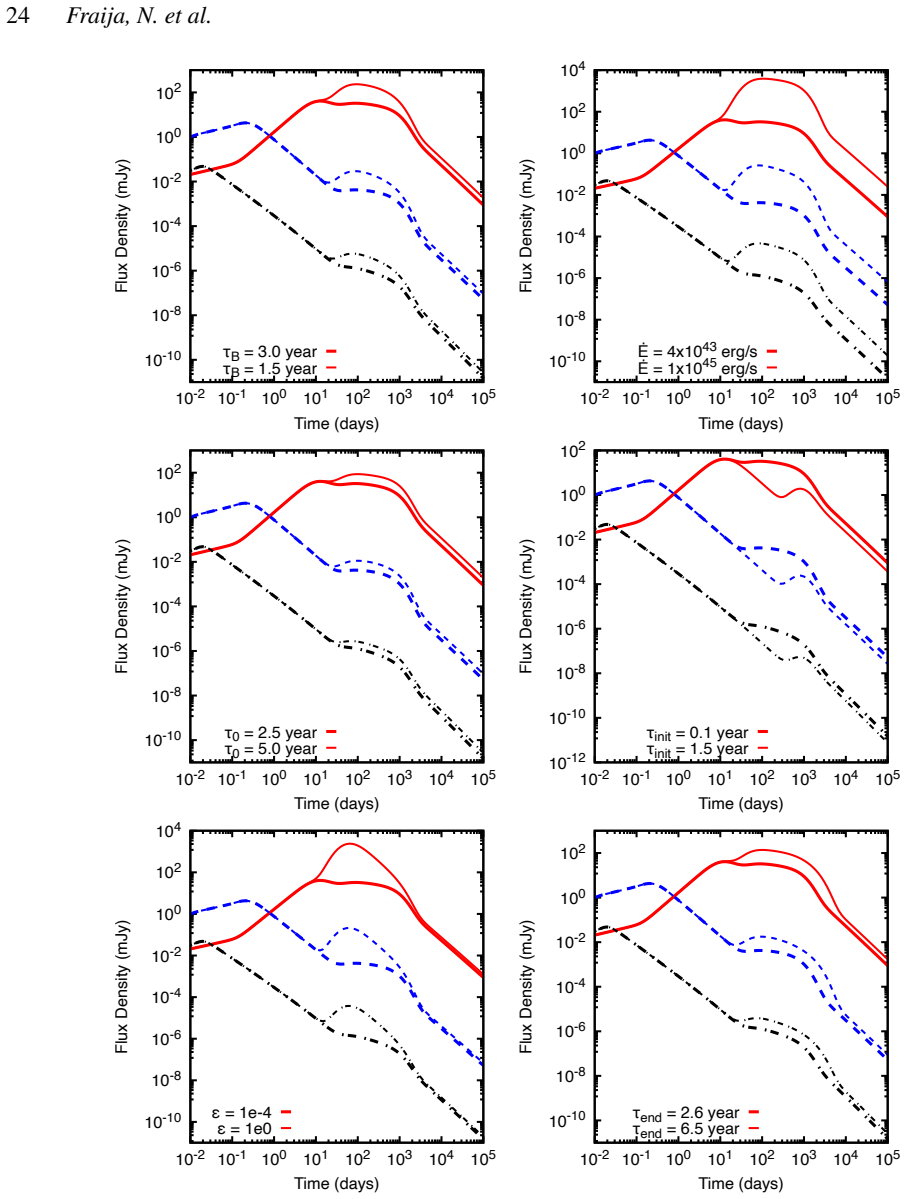
The load-bearing object is the parametric magnetic-field growth function $f(t)$ that multiplies the spin-down torque in the magnetar's equation of motion, $\dot\Omega = -k(t)\Omega^n$ with $k(t)\propto B^2 f(t)$. Three forms are used — exponential $f_1(t)=\epsilon+(1-e^{-t/\tau_B})$, hyperbolic $f_2(t)=\epsilon+\tanh(t/\tau_B)$, and power-law $f_3(t)=\epsilon+(t/\tau_B)/\sqrt{1+(t/\tau_B)^2}$ — each rising from a tiny initial value $\epsilon=(B_0/B_{\max})^2\ll1$ to unity over the diffusion timescale $\tau_B$. This function controls the spin-down luminosity $\dot E(t)$ during the phase when the crust is letting the buried field resurface; plugged into the standard non-relativistic synchrotron afterglow closure relations, it converts a delayed magnetic-field recovery into a delayed energy-injection episode that produces the late-time light-curve bump. The physical timescale $\tau_B$ is anchored to crustal Ohmic diffusion and Hall drift, with the short $\sim3$–5 yr end requiring $B\gtrsim3\times10^{15}$ G, a shallow burial layer $L\lesssim100$ m, and efficient non-linear transport.
What would settle it
Continued monitoring of GW170817 could settle it: the re-emergence fit predicts the revived spin-down luminosity peaks near $\tau_B\simeq5.5$ yr and then rejoins the standard $t^{-2}$ dipole decay, so X-ray observations that continue rising past roughly 2500 days without peaking, or a deeper exposure that shows no excess, would contradict the scenario. A microphysical calculation would also decide: if Hall-Ohm simulations of a $\simeq(2\!-\!5)\times10^{15}$ G crust with shallow burial return global re-emergence timescales above 10 yr, the fitted 5.5 yr becomes physically unattainable.
Extended reading notes
Core claim
The central claim is a specific mechanism applied to a specific event: the late-time X-ray brightening of GRB 170817A, first seen around day 1000 and still present near day 2000, is powered by the delayed re-emergence of a magnetar dipole that was buried by hypercritical accretion within the first seconds after the neutron-star merger. The paper's fit to the X-ray, optical, and radio light curves returns $\tau_B = 5.5\pm0.2$ yr, an initial suppression factor $\epsilon=(1.1\pm0.3)\times10^{-4}$, an initial spin-down time $\tau_0 = 10.5\pm0.1$ yr, and a restored surface field around $10^{15}$ G; the re-emergence scenario reproduces the late X-ray rise and the radio spectral slope, whereas the same afterglow model without burial underpredicts the X-ray flux at 1000–2000 days by more than an order of magnitude. The paper presents this as evidence that the magnetic-field submergence/re-emergence cycle is a key component of the millisecond-magnetar central-engine paradigm, capable of explaining both plateaus and late-time brightenings.
Load-bearing premise
The load-bearing premise is that the global dipole field can actually climb back through the crust in about 5.5 years, the value returned by the fit; if the global field instead takes 30–40 years to return, or only localized patches emerge, the predicted late-time bump would be weaker, later, or absent.
Editorial extensions
If this is right
- For GW170817, the model predicts the late brightening is temporary: once the field fully resurfaces the light curve should rejoin the standard $\dot E\propto t^{-2}$ spin-down decay, giving the bump a characteristic rise-and-fall shape fixed by $\tau_B$.
- If burial is a general feature of millisecond magnetars, then short GRBs with late rebrightenings beyond GW170817 are natural magnetar-remnant candidates, and the absence of an early magnetar plateau in GW170817 is explained by the dipole being hidden at birth.
- The scenario is cleanly separable from plateau models: precession or inclination-angle evolution fades once the wobble damps, whereas burial predicts a delayed rise, so periodic X-ray modulations or continuous gravitational waves would discriminate between the two.
- The very small fitted suppression factor $\epsilon\simeq10^{-4}$ implies nearly all external dipole flux was hidden at birth, so early searches for pulsar-like emission from the remnant should have failed, consistent with the first years of radio non-detections.
Reading between the lines
- An implicit extension of the single-object fit is a population test: if $\tau_B\sim5.5$ yr is typical rather than an optimistic edge of parameter space, other merger remnants with ongoing multiwavelength monitoring should develop their own late X-ray rises at ages of roughly 1–30 yr, and the distribution of bump times could be compared with crustal Hall-Ohm properties.
- The same $f(t)$ multiplies the spin-down torque, so the model implies the braking index of the GW170817 remnant deviates from $n=3$ while the field resurfaces and returns to 3 afterwards; measuring its spin evolution would directly test the time dependence, a prediction the paper does not develop.
- Because the authors flag that their fitted parameter set is degenerate and not unique, the quantitative values are best read as an existence proof for the mechanism; a stricter test would re-fit the same multiwavelength data with a microphysics-based crustal-evolution code with no free growth-function shape.
Editorial analysis
A structured set of objections, weighed in public.
Referee Report
Summary. This paper presents an analytic model in which a newborn millisecond magnetar's dipole field is buried by hypercritical fallback accretion and later re-emerges on a timescale tau_B, modifying the spin-down luminosity and hence the late multi-wavelength afterglow of a GRB. Three phenomenological growth functions f(t) are introduced, and synchrotron closure relations are derived for the afterglow with and without re-emergence. The model is applied to GW170817/GRB 170817A: fitting the X-ray data after 500 days with tau_0, tau_B, epsilon and Edot_0 free yields tau_B=5.5±0.2 yr, epsilon=(1.1±0.3)e-4, tau_0=10.5±0.1 yr, Edot_0=(1.5±0.2)e41 erg/s and a quoted chi2=1.14; the authors conclude that ≥90% of the external dipole flux was buried and that the surface field is restored to B~(2-5)e15 G, reproducing the late-time X-ray brightening better than no-burial models.
Significance. If correct, the scenario provides a concrete mechanism for delayed magnetar energy injection and would imply that GW170817 left a long-lived magnetar whose dipole field is still recovering, with observable consequences for late-time afterglows of short GRBs. The paper's analytical closure relations for three f(t) forms and its explicit application to a well-studied event are useful contributions, and the authors are candid about the non-uniqueness of their fit in Section 4. However, the quantitative headline claims currently outrun the statistical and microphysical support; the significance of the paper therefore depends on whether the parameter constraints can be made robust.
major comments (4)
- [§4, Table 4; §5 item (iv)] The quantitative claims in the abstract and Section 5 are not supported by the fit as presented. In Section 4 the authors fit the X-ray data after 500 days with four free parameters (tau_0, tau_B, epsilon, Edot_0) and state that 'the equations with the set of parameters are degenerate... our finding is only one potential solution and is not unique.' No covariance matrix, posterior distribution, or robustness scan is given, yet the abstract reports tau_B=3-40 yr, >90% burial, and B=(2-5)e15 G, and Conclusion (iv) says the model reproduces the data 'with a single additional parameter (tau_B).' Because tau_B sets the epoch of the late-time bump, the quoted ranges are not demonstrated inferences from the data. I request either a proper degeneracy analysis (e.g., MCMC over the four parameters with stated priors, showing which combinations are constrained) or a substantial softening of the abstract and conclusions to 'one possible solution'.
- [§2.2, Equations (2)-(3); Table 4] The microphysical timescale used in the GW170817 fit is the optimistic end of the range the paper itself identifies. Section 2.2 states that tau_Hall ~ 3-5 yr requires B > 3e15 G, L < 100 m, and efficient non-linear transport, and that 'most realistic systems likely fall in the broader range 10-40 yr, with the fastest emergence restricted to localized patches rather than the global field structure.' The fitted value tau_B = 5.5 yr (Table 4) is therefore only plausible if GW170817's magnetar sits at this extreme corner of parameter space, while the model's f(t) represents global dipole re-emergence. The paper needs to argue explicitly why the extreme conditions apply to this event, or to present the fit as an illustrative scenario rather than an inference; otherwise the central fit rests on an unsupported microphysical premise.
- [§4.1 and §5 item (iv)] The comparative claim that the burial model is 'far better reproduced' than models without burial is not quantified in the paper. Section 4.1 acknowledges that the late-time X-ray excess itself is preferred at only 1-2 sigma against a single-source afterglow (Ryan et al. 2024), and Figure 7 quotes chi2=1.14 for the burial model with no comparable statistic for the no-burial model after re-optimization. Conclusion (iv) asserts an underprediction by more than an order of magnitude, but no delta-chi2, information criterion, or other model-comparison statistic is provided. A quantitative comparison with the same data set and a fixed afterglow model is needed to support the central claim.
- [§5, 'Robustness to stellar structure'] The 'Robustness to stellar structure' paragraph in Section 5 is internally inconsistent with Section 4's degeneracy admission and is unsupported. It asserts that tau_B and epsilon 'remain uniquely determined' and that changing I by 30% alters tau_B by less than 10%, citing an 'analytic argument' that is not shown. If the four-parameter fit is degenerate, tau_B cannot be uniquely determined by the data without additional priors or constraints; the paragraph needs either a derivation of the claimed insensitivity or removal.
minor comments (6)
- [Figure 3 caption] The caption says the kinetic energy is varied between E=10^49 erg and E=10^49 erg, while the figure legend shows 10^47; one of the two is a typo and should be corrected.
- [Figure 2 caption] The phrase 'with alpha=1 in the latter' is unclear because the power-law function in Table 1 has no alpha parameter; please clarify which quantity is being set to unity.
- [§2.3, Eq. (2)] Calling k(t) 'the structural constant' is misleading because the quantity is time-dependent through f(t); suggest 'time-dependent coefficient' or equivalent.
- [References] The reference list contains duplicate entries for Bernal et al. 2013a/b and Torres-Forné 2016; these should be consolidated.
- [Figure 7 caption] The caption reports chi2=1.14 without defining whether this is a reduced chi-square or giving the number of degrees of freedom; please clarify.
- [§4, MCMC description] The MCMC fit of the afterglow parameters quotes 17,600 samples and 5,150 tuning steps but reports no convergence diagnostics or posterior uncertainties for those parameters, which makes the 1-sigma errors in Table 4 difficult to interpret.
Circularity Check
GW170817 re-emergence parameters are fitted to the late-time X-ray excess they are then said to reproduce; the paper's own degeneracy admission and 'single additional parameter' claim undercut the headline tau_B and burial-fraction inference.
-
fitted input called prediction
[Section 4 'PARTICULAR CASE: GRB 170817A' (fit description)]
"The best-fit curves (solid lines) of the magnetic field reemergence model described in Section 3 were performed with the LMFIT Python package, taking into account the X-ray data at 1 keV after 500 days since the burst, allowing the parameters τ0, τB, ε and (E)0 to be free. ... It is worth noting that the equations with the set of parameters are degenerate, meaning that identical findings could be obtained for an entirely other set of values."
The late-time X-ray excess is the observable that defines the model's distinctive bump, and the bump's timing and amplitude are controlled by exactly the parameters freed in the fit: τB and ε. The fit returns τB = 5.5±0.2 yr and ε ≈ 1.1e-4, and the abstract and conclusions translate these into the claimed 'initial burial of over 90 percent', the 're-emergence timescale 3-40 yr', and the recovered ~10^15 G field. These are therefore best-fit outputs from the very data feature they are said to explain, not independent predictions. The paper's own degeneracy admission confirms that the values are one non-unique local solution rather than uniquely determined inferences.
-
other
[Section 5 'Conclusions', point (iv) 'Strength of evidence']
"When burial is included, the model reproduces both the late-time rise in the X-ray flux and the radio spectral slope with a single additional parameter (τB)."
This parsimony claim contradicts the paper's own fitting procedure, which freed four emergence parameters (τ0, τB, ε, and Edot0), as stated in Section 4. The late-time rise is therefore not reproduced by one additional parameter; it is purchased with four degrees of freedom in a fit that the paper itself labels degenerate. Presenting the improvement as a one-parameter test makes the 'most economical explanation' argument appear far stronger than the analysis supports, and it converts a multi-parameter fit into an apparent predictive advantage for the burial scenario.
1 more flagged steps
-
other
[Section 5 'Conclusions', 'Robustness to stellar structure']
"Since the diffusion parameters τB and ε are tied to the timing and shape of the late-time bump, they remain uniquely determined: changing I by 30% shifts Ė0 by the same factor, but alters τB by less than 10%."
This uniqueness assertion is in direct tension with the Section 4 admission that 'our finding is only one potential solution and is not unique'. The same parameters that were just declared degenerate are here said to be 'uniquely determined'. This internal contradiction reinforces that the headline τB and ε are not robustly fixed by the data, and that the abstract's quantitative range is at least partly a property of the chosen local fit rather than a uniquely constrained physical measurement.
full rationale
The analytical machinery is largely self-contained: the spin-down equations, synchrotron closure relations, and Hall-Ohm timescale estimates follow from stated assumptions, and the comparison against a no-burial afterglow model (Fraija et al. 2019b) is an external data-anchored benchmark rather than a self-citation chain. The paper also honestly notes that a 3 yr re-emergence is an optimistic limit. The circularity is concentrated in the GW170817 application. The reemergence model's distinctive late-time bump is controlled by τB and ε, and Section 4 frees exactly those parameters, plus τ0 and Edot0, when fitting the X-ray data after 500 days, i.e., the data that constitute the 'late-time excess'. The abstract and conclusions then present the fitted τB, >90% burial, and recovered ~10^15 G field as indications or constraints from the modeling, and point (iv) claims the rise is reproduced 'with a single additional parameter (τB)' although four parameters were freed. The paper's own degeneracy admission says the solution is non-unique, which undercuts the quantitative headline. Thus the central quantitative claims are partly fit outputs renamed as inferences, though the qualitative scenario remains testable and the model-selection comparison to no-burial is legitimate. Score 5 reflects this partial circularity.
Assumptions & free parameters
free parameters (6)
- Re-emergence timescale tau_B =
5.5 ± 0.2 yr (LMFIT fit to X-ray data after 500 days); 3-40 yr window explored
- Initial field suppression epsilon = (B0/B)^2 =
(1.1 ± 0.3) × 10^-4
- Initial spin-down timescale tau_0 =
10.5 ± 0.1 yr
- Initial spin-down luminosity Edot_0 =
(1.5 ± 0.2) × 10^41 erg/s
- Afterglow parameters E, n_s, eps_e, eps_B, p, alpha, theta_j, dtheta =
Table 4: E=6.2e49 erg, n_s=2.8e-4 cm^-3, eps_e=9.3e-2, eps_B=6.9e-4, p=2.2, alpha=3.0, theta_j=7.5 deg, dtheta=18.8 deg
- Functional form f(t) of field growth =
exponential f1(t) = eps + (1 - exp(-t/tau_B)) for the analytical light curves
assumptions (5)
- domain assumption Oblique dipole spin-down with constant braking index n=3 and no magnetic alignment; moment of inertia assumed constant
- domain assumption Non-relativistic Sedov-Taylor deceleration of quasi-spherical ejecta in a homogeneous medium with velocity distribution E_beta proportional to beta^-alpha
- domain assumption Synchrotron forward-shock emission with standard microphysical parameters eps_e, eps_B and electron spectral index p > 2
- domain assumption Crustal diffusion can return the global dipole in about 3-5 yr under extreme conditions (B > 3e15 G, L < 100 m, efficient Hall or plastic transport)
- domain assumption The spin-down energy injected by the re-emerging magnetar is converted into the afterglow bands through the same forward-shock electron acceleration assumed for the original outflow
Cite this review
Pith. "Pith review of Magnetic Burial in Millisecond Magnetars and Late GRB Afterglow Signatures." pith.science (2026). https://pith.science/paper/UQJZIECD
@misc{pith2026250609402,
  author       = {Pith},
  title        = {Pith review of: Magnetic Burial in Millisecond Magnetars and Late GRB Afterglow Signatures},
  year         = {2026},
  howpublished = {\url{https://pith.science/paper/UQJZIECD}},
  note         = {Machine review of arXiv:2506.09402}
}
abstract
Millisecond magnetars, one of the potential candidates for the central engine of Gamma-ray bursts (GRBs), can experience significant magnetic field enhancement shortly after their formation. In some cases, this evolution is further influenced by the accretion of stellar debris, which modifies the dipole magnetic field strength. During a hypercritical accretion phase that lasts seconds or longer after the progenitor explosion, a thin crust may form, submerging the magnetic field (the so-called magnetic burial scenario). Once hypercritical accretion ceases, the buried field can diffuse back through the crust, delaying the external dipole's reactivation. On the other hand, observations have shown that relativistic outflows ejected by these objects and decelerated by the circumburst environment cause a late and temporary emission known as afterglow. This work investigates how the submergence and subsequent reemergence of the magnetar magnetic field, on a few years timescales, affect the GRB afterglow dynamics. Specifically, we apply this phenomenological scenario to the late-time X-ray excess observed approximately three years post-burst in GW170817/GRB 170817A, exploring how the evolving magnetic field strength may contribute to this emission. Our modelling of GRB 170817A indicates that $\gtrsim90$ percent of the external dipole flux was initially buried, re-emerging on a timescale $\tau_{B}=3-40$ yr and restoring a surface field $B\simeq(2-5)\times10^{15}\,$G; the late-time X-ray brightening is far better reproduced by this scenario than by models without burial.
Figures


Figures from the paper (4 more)



Reference graph
Works this paper leans on
-
[1]
Abac A. G., et al., 2024, @doi [ ] 10.3847/2041-8213/ad5beb , https://ui.adsabs.harvard.edu/abs/2024ApJ...970L..34A 970, L34
-
[2]
Abbott B. P., Abbott R., Abbott T. D., et al. 2017a, @doi [Phys. Rev. Lett.] 10.1103/PhysRevLett.119.161101 , 119, 161101
-
[3]
P., Abbott R., Abbott T
Abbott B. P., Abbott R., Abbott T. D., et al. 2017b, The Astrophysical Journal Letters, 848, L12
-
[4]
N., Pons J
Aguilera D. N., Pons J. A., Miralles J. A., 2008, Astronomy & Astrophysics, 486, 255
2008
-
[5]
Ajello M., et al., 2019, @doi [ ] 10.3847/1538-4357/ab1d4e , https://ui.adsabs.harvard.edu/abs/2019ApJ...878...52A 878, 52
-
[6]
Barkov M. V., Komissarov S. S., 2008, @doi [ ] 10.1111/j.1745-3933.2008.00427.x , https://ui.adsabs.harvard.edu/abs/2008MNRAS.385L..28B 385, L28
arXiv 2008
-
[7]
Beniamini P., Giannios D., Metzger B., 2017, @doi [Monthly Notices of the Royal Astronomical Society] 10.1093/mnras/stx2095 , 472, 3058
- [8]
Show all 162 references
-
[9]
G., Page D., Lee W
Bernal C. G., Page D., Lee W. H., 2013a, The Astrophysical Journal, 770, 106
-
[10]
G., Page D., Lee W
Bernal C. G., Page D., Lee W. H., 2013b, The Astrophysical Journal, 770, 106
-
[11]
G., Frajuca C., Hirsch H
Bernal C. G., Frajuca C., Hirsch H. D., Minari B., Magalhaes N. S., Selbach L. B., 2024, Frontiers in Astronomy and Space Sciences, 11, 1390597
2024
-
[12]
G., et al., 2013a, The Astrophysical Journal, 775, 67
Bernardini M. G., et al., 2013a, The Astrophysical Journal, 775, 67
-
[13]
Bernardini M., et al., 2013b, The Astrophysical Journal, 775, 67
-
[14]
D., Romani R
Blandford R. D., Romani R. W., 1988, Monthly Notices of the Royal Astronomical Society, 234, 57P
1988
-
[15]
D., Znajek R
Blandford R. D., Znajek R. L., 1977, @doi [ ] 10.1093/mnras/179.3.433 , http://adsabs.harvard.edu/abs/1977MNRAS.179..433B 179, 433
1977 doi
-
[16]
Bucciantini N., 2011, @doi [Proceedings of the International Astronomical Union] 10.1017/S1743921312013075 , 7, 289
2011 doi
-
[17]
K., Gehrels N., 2009, @doi [ ] 10.1088/0004-637X/700/2/1047 , http://adsabs.harvard.edu/abs/2009ApJ...700.1047C 700, 1047
Cannizzo J. K., Gehrels N., 2009, @doi [ ] 10.1088/0004-637X/700/2/1047 , http://adsabs.harvard.edu/abs/2009ApJ...700.1047C 700, 1047
2009 doi
-
[18]
K., Troja E., Gehrels N., 2011, @doi [ ] 10.1088/0004-637X/734/1/35 , http://adsabs.harvard.edu/abs/2011ApJ...734...35C 734, 35
Cannizzo J. K., Troja E., Gehrels N., 2011, @doi [ ] 10.1088/0004-637X/734/1/35 , http://adsabs.harvard.edu/abs/2011ApJ...734...35C 734, 35
2011 doi
-
[19]
Relativ., 11, 10
Chamel N., Haensel P., 2008, Living Rev. Relativ., 11, 10
2008
-
[20]
A., 1989a, @doi [ ] 10.1086/168066 , https://ui.adsabs.harvard.edu/abs/1989ApJ...346..847C 346, 847
Chevalier R. A., 1989a, @doi [ ] 10.1086/168066 , https://ui.adsabs.harvard.edu/abs/1989ApJ...346..847C 346, 847
-
[21]
A., 1989b, Astrophysical Journal, 346, 847
Chevalier R. A., 1989b, Astrophysical Journal, 346, 847
-
[22]
A., Emmering R
Chevalier R. A., Emmering R. T., 1986, Astrophysical Journal, 304, 140
1986
-
[23]
A., Li Z.-Y., 2000, @doi [ ] 10.1086/308914 , http://adsabs.harvard.edu/abs/2000ApJ...536..195C 536, 195
Chevalier R. A., Li Z.-Y., 2000, @doi [ ] 10.1086/308914 , http://adsabs.harvard.edu/abs/2000ApJ...536..195C 536, 195
2000 doi
-
[24]
R., Konar S., 2002, @doi [ ] 10.1046/j.1365-8711.2002.05362.x , https://ui.adsabs.harvard.edu/abs/2002MNRAS.332..933C 332, 933
Choudhuri A. R., Konar S., 2002, @doi [ ] 10.1046/j.1365-8711.2002.05362.x , https://ui.adsabs.harvard.edu/abs/2002MNRAS.332..933C 332, 933
2002
-
[25]
I., Horowitz C
Chugunov A. I., Horowitz C. J., 2010, Monthly Notices of the Royal Astronomical Society: Letters, 407, L54
2010
-
[26]
Cumming A., Arras P., Zweibel E., 2004, The Astrophysical Journal, 609, 999
2004
-
[27]
Cumming A., Macbeth J., Page D., et al., 2006, The Astrophysical Journal, 646, 429
2006
-
[28]
D'Avanzo P., et al., 2018, preprint, http://adsabs.harvard.edu/abs/2018arXiv180106164D ( @eprint arXiv 1801.06164 )
2018 arXiv
-
[29]
G., Cheng K
Dai Z. G., Cheng K. S., 2001, @doi [ ] 10.1086/323566 , https://ui.adsabs.harvard.edu/abs/2001ApJ...558L.109D 558, L109
2001 doi
-
[30]
G., Lenart A
Dainotti M. G., Lenart A. ., Fraija N., Nagataki S., Warren D. C., De Simone B., Srinivasaragavan G., Mata A., 2021a, @doi [ ] 10.1093/pasj/psab057 , https://ui.adsabs.harvard.edu/abs/2021PASJ...73..970D 73, 970
-
[31]
G., et al., 2021b, @doi [ ] 10.3847/1538-4365/abfe17 , https://ui.adsabs.harvard.edu/abs/2021ApJS..255...13D 255, 13
Dainotti M. G., et al., 2021b, @doi [ ] 10.3847/1538-4365/abfe17 , https://ui.adsabs.harvard.edu/abs/2021ApJS..255...13D 255, 13
-
[32]
Dainotti M., Levine D., Fraija N., Warren D., Veres P., Sourav S., 2023, @doi [Galaxies] 10.3390/galaxies11010025 , https://ui.adsabs.harvard.edu/abs/2023Galax..11...25D 11, 25
2023 doi
-
[33]
Dall'Osso S., Granot J., Piran T., 2011, Mon. Not. R. Astron. Soc., 415, 191
2011
-
[34]
E., Beniamini P., Cannizzo J
Dichiara S., Troja E., O'Connor B., Marshall F. E., Beniamini P., Cannizzo J. K., Lien A. Y., Sakamoto T., 2020, @doi [ ] 10.1093/mnras/staa124 , https://ui.adsabs.harvard.edu/abs/2020MNRAS.492.5011D 492, 5011
2020 doi
-
[35]
DuPont M., MacFadyen A., 2024, @doi [ ] 10.3847/2041-8213/ad66d2 , https://ui.adsabs.harvard.edu/abs/2024ApJ...971L..24D 971, L24
2024 doi
-
[36]
C., Thompson C., 1992, @doi [ ] 10.1086/186413 , https://ui.adsabs.harvard.edu/abs/1992ApJ...392L...9D 392, L9
Duncan R. C., Thompson C., 1992, @doi [ ] 10.1086/186413 , https://ui.adsabs.harvard.edu/abs/1992ApJ...392L...9D 392, L9
1992 doi
-
[37]
Fan Y., Piran T., 2006, , https://ui.adsabs.harvard.edu/abs/2006MNRAS.369..197F 369, 197
2006
-
[38]
G., 2015, Monthly Notices of the Royal Astronomical Society, 451, 455
Fraija N., Bernal C. G., 2015, Monthly Notices of the Royal Astronomical Society, 451, 455
2015
-
[39]
G., Hidalgo-Gamez A
Fraija N., Bernal C. G., Hidalgo-Gamez A. M., 2014, Monthly Notices of the Royal Astronomical Society, 442, 239
2014
-
[40]
Fraija N., Bernal C., Morales G., Negreiros R., 2018, Physical Review D, 98, 083012
2018
-
[41]
Fraija N., Pedreira A. C. C. d. E. S., Veres P., 2019a, @doi [ ] 10.3847/1538-4357/aaf80e , http://adsabs.harvard.edu/abs/2019ApJ...871..200F 871, 200
-
[42]
Fraija N., Lopez-Camara D., Pedreira A. C. C. d. E. S., Betancourt Kamenetskaia B., Veres P., Dichiara S., 2019b, @doi [ ] 10.3847/1538-4357/ab40a9 , https://ui.adsabs.harvard.edu/abs/2019ApJ...884...71F 884, 71
-
[43]
B., Dainotti M
Fraija N., Laskar T., Dichiara S., Beniamini P., Duran R. B., Dainotti M. G., Becerra R. L., 2020, @doi [ ] 10.3847/1538-4357/abc41a , https://ui.adsabs.harvard.edu/abs/2020ApJ...905..112F 905, 112
2020 doi
-
[44]
G., Ugale S., Jyoti D., Warren D
Fraija N., Dainotti M. G., Ugale S., Jyoti D., Warren D. C., 2022, @doi [ ] 10.3847/1538-4357/ac7a9c , https://ui.adsabs.harvard.edu/abs/2022ApJ...934..188F 934, 188
2022 doi
-
[45]
G., Kamenetskaia B
Fraija N., Dainotti M. G., Kamenetskaia B. B., Levine D., Galvan-Gamez A., 2023a, @doi [ ] 10.1093/mnras/stad2236 , https://ui.adsabs.harvard.edu/abs/2023MNRAS.525.1630F 525, 1630
-
[46]
G., Levine D., Kamenetskaia B
Fraija N., Dainotti M. G., Levine D., Kamenetskaia B. B., Galvan-Gamez A., 2023b, @doi [ ] 10.3847/1538-4357/acfb7f , https://ui.adsabs.harvard.edu/abs/2023ApJ...958..126F 958, 126
-
[47]
Fraija N., et al., 2024a, @doi [ ] 10.1093/mnras/stad3243 , https://ui.adsabs.harvard.edu/abs/2024MNRAS.527.1674F 527, 1674
-
[48]
G., Betancourt Kamenetskaia B., Galv \'a n-G \'a mez A., Aguilar-Ruiz E., 2024b, @doi [ ] 10.1093/mnras/stad3272 , https://ui.adsabs.harvard.edu/abs/2024MNRAS.527.1884F 527, 1884
Fraija N., Dainotti M. G., Betancourt Kamenetskaia B., Galv \'a n-G \'a mez A., Aguilar-Ruiz E., 2024b, @doi [ ] 10.1093/mnras/stad3272 , https://ui.adsabs.harvard.edu/abs/2024MNRAS.527.1884F 527, 1884
-
[49]
L., Woosley S
Fryer C. L., Woosley S. E., Hartmann D. H., 1999, @doi [ ] 10.1086/307992 , https://ui.adsabs.harvard.edu/abs/1999ApJ...526..152F 526, 152
1999 doi
-
[50]
Fryxell B., et al., 2000, The Astrophysical Journal Supplement Series, 131, 273
2000
-
[51]
Gao H., Ding X.-H., Wu X., Dai Z., Zhang B., 2015, @doi [The Astrophysical Journal] 10.1088/0004-637X/807/2/163 , 807
2015 doi
-
[52]
Geppert U., Page D., Zannias T., 1999, Astronomy and Astrophysics, v. 345, p. 847-854 (1999), 345, 847
1999
-
[53]
Giacomazzo B., Perna R., 2013, @doi [ ] 10.1088/2041-8205/771/2/L26 , https://ui.adsabs.harvard.edu/abs/2013ApJ...771L..26G 771, L26
2013 doi
-
[54]
Goldstein A., et al., 2017, @doi [ ] 10.3847/2041-8213/aa8f41 , http://adsabs.harvard.edu/abs/2017ApJ...848L..14G 848, L14
2017 doi
-
[55]
Gottlieb O., Nakar E., Piran T., Hotokezaka K., 2018, @doi [ ] 10.1093/mnras/sty1462 , https://ui.adsabs.harvard.edu/abs/2018MNRAS.479..588G 479, 588
2018 doi
-
[56]
N., Cumming A., 2014a, Phys
Gourgouliatos K. N., Cumming A., 2014a, Phys. Rev. Lett., 112, 171101
-
[57]
Gourgouliatos K., Cumming A., 2014b, Monthly Notices of the Royal Astronomical Society, 438, 1618
-
[59]
Grossman D., Korobkin O., Rosswog S., Piran T., 2014, @doi [ ] 10.1093/mnras/stt2503 , https://ui.adsabs.harvard.edu/abs/2014MNRAS.439..757G 439, 757
2014 doi
-
[60]
Hajela A., et al., 2022a, The Astrophysical Journal Letters, 927, L17
-
[61]
Hajela A., et al., 2022b, @doi [ ] 10.3847/2041-8213/ac504a , https://ui.adsabs.harvard.edu/abs/2022ApJ...927L..17H 927, L17
-
[62]
Haskell B., Samuelsson L., Glampedakis K., Andersson N., 2008, Monthly Notices of the Royal Astronomical Society, 385, 531
2008
-
[63]
C., 2011, Monthly Notices of the Royal Astronomical Society, 414, 2567
Ho W. C., 2011, Monthly Notices of the Royal Astronomical Society, 414, 2567
2011
-
[64]
Hotokezaka K., Kiuchi K., Shibata M., Nakar E., Piran T., 2018, @doi [ ] 10.3847/1538-4357/aadf92 , http://adsabs.harvard.edu/abs/2018ApJ...867...95H 867, 95
2018 doi
-
[65]
Hurley K., et al., 2005, @doi [ ] 10.1038/nature03519 , https://ui.adsabs.harvard.edu/abs/2005Natur.434.1098H 434, 1098
2005 doi
-
[66]
Ioka K., 2005, @doi [Progress of Theoretical Physics] 10.1143/PTP.114.1317 , https://ui.adsabs.harvard.edu/abs/2005PThPh.114.1317I 114, 1317
2005 doi
-
[67]
Ioka K., Toma K., Yamazaki R., Nakamura T., 2006, @doi [ ] 10.1051/0004-6361:20064939 , https://ui.adsabs.harvard.edu/abs/2006A&A...458....7I 458, 7
2006 doi
-
[68]
M., et al., 2017, @doi [Science] 10.1126/science.aap9455 , http://adsabs.harvard.edu/abs/2017Sci...358.1559K 358, 1559
Kasliwal M. M., et al., 2017, @doi [Science] 10.1126/science.aap9455 , http://adsabs.harvard.edu/abs/2017Sci...358.1559K 358, 1559
2017 doi
-
[69]
Kisaka S., Ioka K., Kashiyama K., Nakamura T., 2017, preprint, http://adsabs.harvard.edu/abs/2017arXiv171100243K ( @eprint arXiv 1711.00243 )
2017 arXiv
-
[70]
Kobayashi S., 2000, @doi [ ] 10.1086/317869 , http://adsabs.harvard.edu/abs/2000ApJ...545..807K 545, 807
2000 doi
-
[71]
Kojima Y., Kisaka S., 2012, Monthly Notices of the Royal Astronomical Society, 421, 2722
2012
-
[72]
Konar S., 2017, Journal of Astrophysics and Astronomy, 38, 47
2017
-
[73]
Konar S., Choudhuri A., 2002, in 34th COSPAR Scientific Assembly. p. 721
2002
-
[74]
W., Wong A
Kong S. W., Wong A. Y. L., Huang Y. F., Cheng K. S., 2010, @doi [Monthly Notices of the Royal Astronomical Society] 10.1111/j.1365-2966.2009.15886.x , 402, 409
2010
-
[75]
Kumar P., Panaitescu A., 2003, @doi [ ] 10.1111/j.1365-2966.2003.07138.x , http://adsabs.harvard.edu/abs/2003MNRAS.346..905K 346, 905
2003
-
[76]
Kumar P., Zhang B., 2015, @doi [ ] 10.1016/j.physrep.2014.09.008 , http://adsabs.harvard.edu/abs/2015PhR...561....1K 561, 1
2015 doi
-
[77]
L., 2008, @doi [Science] 10.1126/science.1159003 , http://adsabs.harvard.edu/abs/2008Sci...321..376K 321, 376
Kumar P., Narayan R., Johnson J. L., 2008, @doi [Science] 10.1126/science.1159003 , http://adsabs.harvard.edu/abs/2008Sci...321..376K 321, 376
2008 doi
-
[78]
P., Kobayashi S., 2017, @doi [ ] 10.1093/mnras/stx2345 , http://adsabs.harvard.edu/abs/2017MNRAS.472.4953L 472, 4953
Lamb G. P., Kobayashi S., 2017, @doi [ ] 10.1093/mnras/stx2345 , http://adsabs.harvard.edu/abs/2017MNRAS.472.4953L 472, 4953
2017 doi
-
[79]
J., Perna R., Workman J
Lazzati D., L \'o pez-C \'a mara D., Cantiello M., Morsony B. J., Perna R., Workman J. C., 2017, @doi [ ] 10.3847/2041-8213/aa8f3d , http://adsabs.harvard.edu/abs/2017ApJ...848L...6L 848, L6
2017 doi
-
[80]
Lemoine M., 2013, @doi [ ] 10.1093/mnras/sts081 , https://ui.adsabs.harvard.edu/abs/2013MNRAS.428..845L 428, 845
2013 doi
-
[81]
Levin Y., Lyutikov M., 2012, Monthly Notices of the Royal Astronomical Society, 427, 1574
2012
-
[82]
M., 2015a, Astrophys
Li S., Beloborodov A. M., 2015a, Astrophys. J., 815, 25
-
[83]
M., 2015b, The Astrophysical Journal, 815, 25
Li X., Beloborodov A. M., 2015b, The Astrophysical Journal, 815, 25
-
[84]
Li L., Dai Z.-G., 2021, @doi [ ] 10.3847/1538-4357/ac0974 , https://ui.adsabs.harvard.edu/abs/2021ApJ...918...52L 918, 52
2021 doi
-
[85]
Li L., Wu X.-F., Lei W.-H., Dai Z.-G., Liang E.-W., Ryde F., 2018, The Astrophysical Journal Supplement Series, 236, 26
2018
-
[86]
Lien A., et al., 2016, @doi [ ] 10.3847/0004-637X/829/1/7 , https://ui.adsabs.harvard.edu/abs/2016ApJ...829....7L 829, 7
2016 doi
-
[87]
L \"u H.-J., Zhang B., 2014a, @doi [ ] 10.1088/0004-637X/785/1/74 , https://ui.adsabs.harvard.edu/abs/2014ApJ...785...74L 785, 74
-
[88]
L \"u H.-J., Zhang B., 2014b, The Astrophysical Journal, 785, 74
-
[90]
I., Woosley S
MacFadyen A. I., Woosley S. E., 1999b, @doi [ ] 10.1086/307790 , https://ui.adsabs.harvard.edu/abs/1999ApJ...524..262M 524, 262
-
[91]
arXiv:2004.13028
Margalit B., Piran T., 2020, arXiv e-prints, https://ui.adsabs.harvard.edu/abs/2020arXiv200413028M p. arXiv:2004.13028
2020 arXiv
-
[92]
Margutti R., et al., 2017, @doi [ ] 10.3847/2041-8213/aa9057 , http://cdsads.u-strasbg.fr/abs/2017ApJ...848L..20M 848, L20
2017 doi
-
[93]
Metzger B., Giannios D., Thompson T., Bucciantini N., Quataert E., 2011b, Monthly Notices of the Royal Astronomical Society, 413, 2031
-
[94]
D., Giannios D., Thompson T
Metzger B. D., Giannios D., Thompson T. A., Bucciantini N., Quataert E., 2011a, @doi [ ] 10.1111/j.1365-2966.2011.18280.x , https://ui.adsabs.harvard.edu/abs/2011MNRAS.413.2031M 413, 2031
2011
-
[96]
D., Beniamini P., Giannios D., 2018b, @doi [ ] 10.3847/1538-4357/aab70c , https://ui.adsabs.harvard.edu/abs/2018ApJ...857...95M 857, 95
Metzger B. D., Beniamini P., Giannios D., 2018b, @doi [ ] 10.3847/1538-4357/aab70c , https://ui.adsabs.harvard.edu/abs/2018ApJ...857...95M 857, 95
-
[97]
C., 1994, The Astrophysical Journal, Part 1, vol
Michel F. C., 1994, The Astrophysical Journal, Part 1, vol. 431, no. 1, p. 397-401, 431, 397
1994
-
[98]
Moderski R., Sikora M., Bulik T., 2000, @doi [ ] 10.1086/308257 , https://ui.adsabs.harvard.edu/abs/2000ApJ...529..151M 529, 151
2000 doi
-
[99]
Mukherjee D., 2017a, @doi [Journal of Astrophysics and Astronomy] 10.1007/s12036-017-9465-6 , https://ui.adsabs.harvard.edu/abs/2017JApA...38...48M 38, 48
-
[100]
Mukherjee D., 2017b, Journal of Astrophysics and Astronomy, 38, 48
-
[101]
Muslimov A., Page D., 1995, The Astrophysical Journal, 458, 347
1995
-
[102]
Narayan R., Paczynski B., Piran T., 1992, @doi [ ] 10.1086/186493 , http://adsabs.harvard.edu/abs/1992ApJ...395L..83N 395, L83
1992 doi
-
[103]
Nedora V., Radice D., Bernuzzi S., Perego A., Daszuta B., Endrizzi A., Prakash A., Schianchi F., 2021, @doi [ ] 10.1093/mnras/stab2004 , https://ui.adsabs.harvard.edu/abs/2021MNRAS.506.5908N 506, 5908
2021 doi
-
[104]
Negreiros R., Bernal C., 2015, Growth of the Magnetic Field in Young Neutron Stars ( @eprint arXiv 1505.02823 )
2015 arXiv
-
[105]
B., et al., 2014, LMFIT: Non-Linear Least-Square Minimization and Curve-Fitting for Python , @doi 10.5281/zenodo.11813 , https://doi.org/10.5281/zenodo.11813
Newville M., Stensitzki T., Allen D. B., et al., 2014, LMFIT: Non-Linear Least-Square Minimization and Curve-Fitting for Python , @doi 10.5281/zenodo.11813 , https://doi.org/10.5281/zenodo.11813
2014 doi
-
[106]
A., et al., 2006, @doi [ ] 10.1086/500724 , https://ui.adsabs.harvard.edu/abs/2006ApJ...642..389N 642, 389
Nousek J. A., et al., 2006, @doi [ ] 10.1086/500724 , https://ui.adsabs.harvard.edu/abs/2006ApJ...642..389N 642, 389
2006 doi
-
[107]
R., Page M
Oates S. R., Page M. J., De Pasquale M., Schady P., Breeveld A. A., Holland S. T., Kuin N. P. M., Marshall F. E., 2012, @doi [ ] 10.1111/j.1745-3933.2012.01331.x , http://adsabs.harvard.edu/abs/2012MNRAS.426L..86O 426, L86
2012
-
[108]
\"O zel F., Freire P., 2016, @doi [ ] 10.1146/annurev-astro-081915-023322 , https://ui.adsabs.harvard.edu/abs/2016ARA&A..54..401O 54, 401
2016 doi
-
[109]
Paczy \'n ski B., 1998, @doi [ ] 10.1086/311148 , https://ui.adsabs.harvard.edu/abs/1998ApJ...494L..45P 494, L45
1998 doi
-
[110]
Panaitescu A., Kumar P., 2002, @doi [ ] 10.1086/340094 , http://adsabs.harvard.edu/abs/2002ApJ...571..779P 571, 779
2002 doi
-
[111]
Panaitescu A., M \'e sz \'a ros P., 1998, @doi [ ] 10.1086/305856 , http://adsabs.harvard.edu/abs/1998ApJ...501..772P 501, 772
1998 doi
-
[112]
Panaitescu A., M \'e sz \'a ros P., Burrows D., Nousek J., Gehrels N., O'Brien P., Willingale R., 2006, @doi [ ] 10.1111/j.1365-2966.2006.10453.x , https://ui.adsabs.harvard.edu/abs/2006MNRAS.369.2059P 369, 2059
2006
-
[113]
Payne D. J. B., Melatos A., 2004, @doi [Monthly Notices of the Royal Astronomical Society] 10.1111/j.1365-2966.2004.07798.x , 351, 569
2004
-
[114]
A., 2011, The Astrophysical Journal Letters, 727
Perna R., Pons J. A., 2011, The Astrophysical Journal Letters, 727
2011
-
[115]
L., Ott C
Piro A. L., Ott C. D., 2011a, @doi [ ] 10.1088/0004-637X/736/2/108 , https://ui.adsabs.harvard.edu/abs/2011ApJ...736..108P 736, 108
-
[116]
L., Ott C
Piro A. L., Ott C. D., 2011b, The Astrophysical Journal, 736, 108
-
[117]
A., Geppert U., 2007, Astronomy & Astrophysics, 470, 303
Pons J. A., Geppert U., 2007, Astronomy & Astrophysics, 470, 303
2007
-
[118]
A., Perna R., 2011, The Astrophysical Journal, 741, 123
Pons J. A., Perna R., 2011, The Astrophysical Journal, 741, 123
2011
-
[119]
J., Rosswog S., 2006, @doi [Science] 10.1126/science.1125201 , https://ui.adsabs.harvard.edu/abs/2006Sci...312..719P 312, 719
Price D. J., Rosswog S., 2006, @doi [Science] 10.1126/science.1125201 , https://ui.adsabs.harvard.edu/abs/2006Sci...312..719P 312, 719
2006 doi
-
[120]
Quataert E., Kasen D., 2012b, Monthly Notices of the Royal Astronomical Society: Letters, 419, L1
-
[121]
Quataert E., Kasen D., 2012a, @doi [ ] 10.1111/j.1745-3933.2011.01151.x , https://ui.adsabs.harvard.edu/abs/2012MNRAS.419L...1Q 419, L1
2011
-
[122]
L., et al., 2009, @doi [ ] 10.1088/0004-637X/698/1/43 , http://adsabs.harvard.edu/abs/2009ApJ...698...43R 698, 43
Racusin J. L., et al., 2009, @doi [ ] 10.1088/0004-637X/698/1/43 , http://adsabs.harvard.edu/abs/2009ApJ...698...43R 698, 43
2009 doi
-
[123]
G., 2022, @doi [Monthly Notices of the Royal Astronomical Society] 10.1093/mnras/stac797 , 512, 5572
Ren J., Dai Z. G., 2022, @doi [Monthly Notices of the Royal Astronomical Society] 10.1093/mnras/stac797 , 512, 5572
2022 doi
-
[124]
Riley T. E. e. a., 2021, Astrophys. J. Lett., 918, L27
2021
-
[125]
Roberts O., et al., 2021, @doi [Nature] 10.1038/s41586-020-03077-8 , 589, 207
2021 doi
-
[126]
Rogers A., Safi-Harb S., 2016, @doi [Monthly Notices of the Royal Astronomical Society] 10.1093/mnras/stw014 , 457, 1180–1189
2016 doi
-
[127]
Rowlinson A. e. a., 2013, Mon. Not. R. Astron. Soc., 430, 1061
2013
-
[128]
T., Tanvir N
Rowlinson A., O'Brien P. T., Tanvir N. R., Zhang B., Evans P. A., et al. 2010, @doi [ ] 10.1111/j.1365-2966.2010.17354.x , https://ui.adsabs.harvard.edu/abs/2010MNRAS.409..531R 409, 531
2010
-
[129]
T., Metzger B
Rowlinson A., O'Brien P. T., Metzger B. D., Tanvir N. R., Levan A. J., 2013a, @doi [ ] 10.1093/mnras/sts683 , https://ui.adsabs.harvard.edu/abs/2013MNRAS.430.1061R 430, 1061
-
[130]
J., 2013b, Monthly Notices of the Royal Astronomical Society, 430, 1061
Rowlinson A., O'brien P., Metzger B., Tanvir N., Levan A. J., 2013b, Monthly Notices of the Royal Astronomical Society, 430, 1061
-
[131]
Ryan G., van Eerten H., Troja E., Piro L., O'Connor B., Ricci R., 2024, @doi [ ] 10.3847/1538-4357/ad6a14 , https://ui.adsabs.harvard.edu/abs/2024ApJ...975..131R 975, 131
2024 doi
-
[132]
Sari R., M \'e sz \'a ros P., 2000, @doi [ ] 10.1086/312689 , http://adsabs.harvard.edu/abs/2000ApJ...535L..33S 535, L33
2000 doi
-
[133]
Sari R., Piran T., 1995, @doi [ ] 10.1086/309835 , http://adsabs.harvard.edu/abs/1995ApJ...455L.143S 455, L143
1995 doi
-
[134]
Sarin N., Lasky P., Ashton G., 2020, @doi [Monthly Notices of the Royal Astronomical Society] 10.1093/mnras/staa3090 , 499, 5986
2020 doi
-
[135]
Savchenko V., et al., 2017, @doi [ ] 10.3847/2041-8213/aa8f94 , http://adsabs.harvard.edu/abs/2017ApJ...848L..15S 848, L15
2017 doi
-
[136]
Shabaltas N., Lai D., 2012, @doi [The Astrophysical Journal] 10.1088/0004-637x/748/2/148 , 748, 148
2012 doi
-
[137]
Shalybkov D., Urpin V., 1995, Monthly Notices of the Royal Astronomical Society, 273, 643
1995
-
[138]
Sironi L., Giannios D., 2013, @doi [ ] 10.1088/0004-637X/778/2/107 , https://ui.adsabs.harvard.edu/abs/2013ApJ...778..107S 778, 107
2013 doi
-
[139]
N., 2024, Monthly Notices of the Royal Astronomical Society, 528, 5178
Skiathas D., Gourgouliatos K. N., 2024, Monthly Notices of the Royal Astronomical Society, 528, 5178
2024
-
[140]
P., Dainotti M
Srinivasaragavan G. P., Dainotti M. G., Fraija N., Hernandez X., Nagataki S., Lenart A., Bowden L., Wagner R., 2020, @doi [ ] 10.3847/1538-4357/abb702 , https://ui.adsabs.harvard.edu/abs/2020ApJ...903...18S 903, 18
2020 doi
-
[141]
L., Vecchio A., 2005, @doi [ ] 10.1086/498685 , https://ui.adsabs.harvard.edu/abs/2005ApJ...634L.165S 634, L165
Stella L., Dall'Osso S., Israel G. L., Vecchio A., 2005, @doi [ ] 10.1086/498685 , https://ui.adsabs.harvard.edu/abs/2005ApJ...634L.165S 634, L165
2005 doi
-
[142]
G., Kokkotas K
Suvorov A. G., Kokkotas K. D., 2020, Astrophys. J. Lett., 899, L10
2020
-
[143]
G., Melatos A., 2020, Monthly Notices of the Royal Astronomical Society, 499, 3243
Suvorov A. G., Melatos A., 2020, Monthly Notices of the Royal Astronomical Society, 499, 3243
2020
-
[144]
L., Racusin J., Asano K., McEnery J., 2019, @doi [ ] 10.3847/1538-4357/ab3982 , https://ui.adsabs.harvard.edu/abs/2019ApJ...883..134T 883, 134
Tak D., Omodei N., Uhm Z. L., Racusin J., Asano K., McEnery J., 2019, @doi [ ] 10.3847/1538-4357/ab3982 , https://ui.adsabs.harvard.edu/abs/2019ApJ...883..134T 883, 134
2019 doi
-
[145]
C., Matzner C
Tan J. C., Matzner C. D., McKee C. F., 2001, @doi [ ] 10.1086/320245 , http://adsabs.harvard.edu/abs/2001ApJ...551..946T 551, 946
2001 doi
-
[146]
B., Frail D
Taylor G. B., Frail D. A., Berger E., Kulkarni S. R., 2004, @doi [ ] 10.1086/422554 , http://adsabs.harvard.edu/abs/2004ApJ...609L...1T 609, L1
2004 doi
-
[147]
Thompson C., 1994, @doi [ ] 10.1093/mnras/270.3.480 , http://ukads.nottingham.ac.uk/abs/1994MNRAS.270..480T 270, 480
1994 doi
-
[148]
C., 1993, @doi [ ] 10.1086/172580 , https://ui.adsabs.harvard.edu/abs/1993ApJ...408..194T 408, 194
Thompson C., Duncan R. C., 1993, @doi [ ] 10.1086/172580 , https://ui.adsabs.harvard.edu/abs/1993ApJ...408..194T 408, 194
1993 doi
-
[149]
A., Font J
Torres-Forn \'e A., Cerd \'a -Dur \'a n P., Pons J. A., Font J. A., 2016, @doi [ ] 10.1093/mnras/stv2926 , https://ui.adsabs.harvard.edu/abs/2016MNRAS.456.3813T 456, 3813
2016 doi
-
[150]
Torres-Forné A. e. a., 2016, Mon. Not. R. Astron. Soc., 456, 3813
2016
-
[151]
T., Zhang B., Sbarufatti B., et al
Troja E., Cusumano G., O'Brien P. T., Zhang B., Sbarufatti B., et al. 2007, @doi [ ] 10.1086/519450 , https://ui.adsabs.harvard.edu/abs/2007ApJ...665..599T 665, 599
2007 doi
-
[152]
2017, @doi [Nature] 10.1038/nature24290 , 000, 1
Troja E., Piro L., van Eerten H., et al. 2017, @doi [Nature] 10.1038/nature24290 , 000, 1
2017 doi
-
[153]
Urrutia G., De Colle F., Murguia-Berthier A., Ramirez-Ruiz E., 2021, @doi [ ] 10.1093/mnras/stab723 , https://ui.adsabs.harvard.edu/abs/2021MNRAS.503.4363U 503, 4363
2021 doi
-
[154]
V., 1992, @doi [ ] 10.1038/357472a0 , http://adsabs.harvard.edu/abs/1992Natur.357..472U 357, 472
Usov V. V., 1992, @doi [ ] 10.1038/357472a0 , http://adsabs.harvard.edu/abs/1992Natur.357..472U 357, 472
1992 doi
-
[155]
A., 2012a, Monthly Notices of the Royal Astronomical Society, 425, 2487
Vigan \`o D., Pons J. A., 2012a, Monthly Notices of the Royal Astronomical Society, 425, 2487
-
[156]
A., 2012b, @doi [ ] 10.1111/j.1365-2966.2012.21679.x , https://ui.adsabs.harvard.edu/abs/2012MNRAS.425.2487V 425, 2487
Vigan \`o D., Pons J. A., 2012b, @doi [ ] 10.1111/j.1365-2966.2012.21679.x , https://ui.adsabs.harvard.edu/abs/2012MNRAS.425.2487V 425, 2487
2012
-
[157]
A., Perna R., Aguilera D
Viganò D., Rea N., Pons J. A., Perna R., Aguilera D. N., Miralles J. A., 2013, Monthly Notices of the Royal Astronomical Society, 434, 123
2013
-
[158]
Vigelius M., Melatos A., 2009, Monthly Notices of the Royal Astronomical Society, 395, 1985
2009
-
[159]
E., 1993, @doi [ ] 10.1086/172359 , https://ui.adsabs.harvard.edu/abs/1993ApJ...405..273W 405, 273
Woosley S. E., 1993, @doi [ ] 10.1086/172359 , https://ui.adsabs.harvard.edu/abs/1993ApJ...405..273W 405, 273
1993 doi
-
[160]
E., Bloom J
Woosley S. E., Bloom J. S., 2006, @doi [ ] 10.1146/annurev.astro.43.072103.150558 , https://ui.adsabs.harvard.edu/abs/2006ARA&A..44..507W 44, 507
2006 arXiv
-
[161]
E., Heger A., 2012, @doi [ ] 10.1088/0004-637X/752/1/32 , https://ui.adsabs.harvard.edu/abs/2012ApJ...752...32W 752, 32
Woosley S. E., Heger A., 2012, @doi [ ] 10.1088/0004-637X/752/1/32 , https://ui.adsabs.harvard.edu/abs/2012ApJ...752...32W 752, 32
2012 doi
-
[162]
A., Harrison F
Yost S. A., Harrison F. A., Sari R., Frail D. A., 2003, @doi [ ] 10.1086/378288 , https://ui.adsabs.harvard.edu/abs/2003ApJ...597..459Y 597, 459
2003 doi
-
[163]
Zhang B., M \'e sz \'a ros P., 2001, @doi [ ] 10.1086/320255 , http://adsabs.harvard.edu/abs/2001ApJ...552L..35Z 552, L35
2001 doi
-
[164]
Z., Dyks J., Kobayashi S., M \'e sz \'a ros P., Burrows D
Zhang B., Fan Y. Z., Dyks J., Kobayashi S., M \'e sz \'a ros P., Burrows D. N., Nousek J. A., Gehrels N., 2006, @doi [ ] 10.1086/500723 , http://adsabs.harvard.edu/abs/2006ApJ...642..354Z 642, 354
2006 doi
-
[165]
write newline
" write newline "" before.all 'output.state := FUNCTION fin.entry write newline FUNCTION new.block output.state before.all = 'skip after.block 'output.state := if FUNCTION new.sentence output.state after.block = 'skip output.state before.all = 'skip after.sentence 'output.stat...
Reviewed August 7, 2026 · model on record in the stance chip above.
Discussion (0). Continue with ORCID to comment.