REVIEW 2 major objections 5 minor 3 cited by
This paper claims that test-time adaptation can be made stable under mixed shifts, tiny batches, and imbalanced labels by filtering noisy samples, seeking flat entropy minima, and regularizing class-centroid features.
Reviewed by Pith at T0; open to challenge. T0 means a machine referee read the full paper against a public rubric. the ladder, T0–T4 →
Test-time adaptation is stabilized by filtering unreliable samples, seeking flat entropy minima, and applying redundancy and inequity regularizers to pseudo-labeled class centroids.
T0 review reviewed 2026-08-05 challenge →
load-bearing objection SAR2 is a solid extension of the authors' earlier SAR: centroid-based redundancy and inequity regularizers with a feature bank meaningfully stabilize test-time entropy minimization under mixed shifts, small batches, and online label imbalance; the main caveat is that the bank relies on the model's own pseudo-labels with no error-propagation analysis, but the empirical case is strong enough to meri the 2 major comments →
Adapt in the Wild: Test-Time Entropy Minimization with Sharpness and Feature Regularization
The pith
A machine-rendered reading of the paper's core claim, the machinery that carries it, and where it could break.
The reading
Core claim
On the paper's own terms, the central discovery is that test-time entropy minimization collapses through a characteristic path: gradient norms explode then decay to near zero, feature dimensions become increasingly correlated (redundancy rises), and the feature centroid becomes biased toward a dominant class (inequity rises). The authors argue these are not merely symptoms but actionable handles, and that acting on them prevents collapse. Their method SAR first removes high-entropy samples, which carry most of the large noisy gradients, and then perturbs weights in the direction that maximizes entropy inside a small Euclidean ball, so updates land in flat minima. SAR2 additionally penalizes
What carries the argument
The carried object is the class-centroid feature matrix C_t, built by combining per-batch pseudo-labeled centroids with an exponentially updated feature bank that supplies centroids for classes absent from the current mini-batch. On this matrix, two regularizers run: redundancy R(C_t), the averaged squared off-diagonal entries of the covariance, penalizing inter-dimension correlation, and inequity I(C_t), the negative entropy of the softmax prediction on the centroid, penalizing bias toward any class. Sharpness-aware minimization wraps the entropy loss and both regularizers, so every test-time update seeks a flat region of the loss surface. The feature bank is what makes feature regularizati
Load-bearing premise
The regularizers in SAR2 are built on class centroids computed from the model's own pseudo-labels (Eqns. 11–13), so if the model is already badly wrong under a severe shift, the centroids encode that error and the exponential moving average can lock it in; the paper does not analyze how this error propagates.
What would settle it
Re-run the paper's online-imbalanced-label experiment on ImageNet-C with the feature bank updated using ground-truth labels instead of pseudo-labels. If SAR2's accuracy gain over SAR is unchanged or larger with true labels, the pseudo-label centroids are not the mechanism the paper claims; if the gain vanishes, the method depends on pseudo-label accuracy. A second check: vary the bank's moving-average factor lambda from 0 to 1 and record accuracy; a sharp cliff at either end shows the bank is doing the work, while flat results would mean the regularizers act mainly within batches.
If this is right
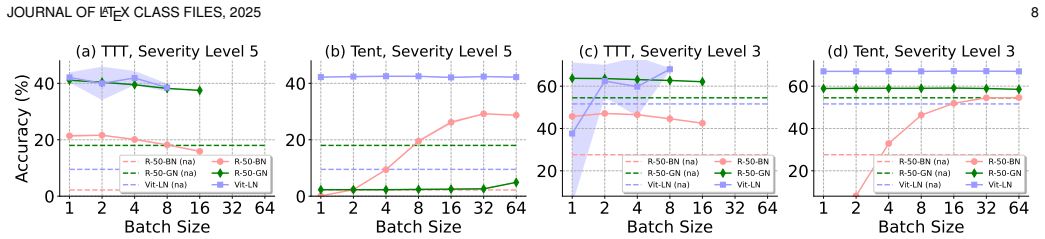
- If the paper is correct, pre-trained models with batch normalization should be swapped for group- or layer-norm variants before doing test-time adaptation in real-world streams, because batch statistics are unreliable under mixed shifts, small batch sizes, and imbalanced labels.
- Feature redundancy and inequity can be used as early-warning signals: a spike in either during online adaptation foretells an imminent collapse, giving practitioners a monitor that does not require labels.
- SAR2 should deliver state-of-the-art accuracy on ImageNet-C and ImageNet-R under batch size one and infinite imbalance ratio, with much lower variance than prior output-level sample-selection methods.
- The paper's Table 9 shows that running the feature regularizers for a few steps before adaptation improves not just SAR but also Tent, EATA, and DeYO, implying the regularizers can be used as a plug-in warm-start for existing test-time adaptation methods.
- SAR2 remains computationally reasonable: it uses about two forward and two backward passes per test sample, several orders of magnitude cheaper than augmentation- or diffusion-based alternatives.
Where Pith is reading between the lines
- The paper leaves untested whether the feature bank's pseudo-label centroids silently entrench errors during very long, strongly shifted streams; a confidence-weighted bank update or periodic bank reset would be the natural extension to probe.
- Because redundancy minimization alone improved accuracy on all tested architectures even without entropy minimization, feature decorrelation may be a general out-of-distribution signal, not just a collapse cure; testing it as a standalone objective on other tasks would settle that.
- The initial-representation results imply that any method that pre-decorrelates features before adaptation could inherit part of SAR2's gains, which would make the regularizers useful beyond the specific entropy-minimization pipeline presented here.
- The inequity regularizer's advantage over information maximization suggests that output-level diversity penalties hurt online adaptation because they flatten per-sample confidence, while a centroid-level penalty preserves confident predictions; this design principle may transfer to other online learning settings.
Editorial analysis
A structured set of objections, weighed in public.
Referee Report
Summary. The paper proposes two test-time adaptation (TTA) methods, SAR and SAR2, designed for 'wild' scenarios: mixed distribution shifts, small batch sizes, and online imbalanced label shifts. The authors first argue that batch normalization is a key source of instability and advocate batch-agnostic normalization layers (GN/LN). They then analyze collapse in entropy-based TTA, identifying gradient explosions and increases in feature redundancy/inequity as precursors. SAR combines reliable-sample filtering with sharpness-aware entropy minimization. SAR2 adds two feature-level regularizers operating on class centroids maintained in an exponentially updated feature bank: a redundancy regularizer that decorrelates features and an inequity regularizer that penalizes biased centroid predictions. Experiments on ImageNet-C and ImageNet-R across ResNet50-BN/GN, ViT-Base-LN, and ConvNeXt-LN show that SAR2 consistently improves mean accuracy and reduces variance relative to prior TTA methods, with ablations showing the contribution of each component.
Significance. If the results hold, the paper makes a practical contribution to a well-recognized problem: stabilizing fully test-time adaptation under distribution shifts that are common in deployment. The paper's strengths include a public code release, extensive benchmarking across multiple architectures and three wild settings, sensitivity analyses for several hyperparameters, and a clear diagnostic framework (feature redundancy/inequity) that could be useful beyond this specific method. The empirical claim that SAR2 substantially outperforms prior entropy-selection methods (e.g., DeYO, ReCAP) on ImageNet-C under batch size 1, mixed shifts, and continuous imbalanced shifts is well supported by the tables. The sharpness-aware and feature-regularization components are simple and likely reproducible. However, the central mechanism of the feature bank rests on an unexamined assumption about pseudo-label reliability, and the comparison between SAR and SAR2 is potentially confounded by different learning rates.
major comments (2)
- [Section 5.2, Eqns. (11)-(13) and Algorithm 1] The feature bank is updated with hard pseudo-labels from the adapting model. Under severe or online-imbalanced shifts, early pseudo-labels can be systematically wrong; Table L itself documents Tent collapsing to a single class for several corruptions. With q_max/q_min = infinity, early test batches are single-class, so if the model is biased, the centroid for the predicted class is populated with features from a different true class, and the EMA (lambda = 0.9) carries this error forward. The redundancy and inequity regularizers in Eq. (16) then optimize around potentially polluted centroids. The paper provides no confidence weighting, no centroid-purity monitoring, and no error-propagation analysis. Since the regularizers are the main claimed contribution, this missing analysis is load-bearing. I recommend adding a robustness experiment (e.g., injecting pseudo-label noise or measuring ce
- [Section 7, Models and Implementation Details; Table 7] SAR and SAR2 are trained with different learning rates: 0.00025/0.001 for SAR versus 0.001/0.005 for SAR2 on ResNet/ViT, respectively. The component ablation in Table 7 reports that adding redundancy/inequity to SAR improves accuracy from 57.1% to 62.8%/61.1% and that the combination gives 64.4%. If the 'SAR' row in Table 7 uses the SAR learning rate while the regularized variants use the SAR2 learning rate, the contribution of the regularizers is confounded with a 4x/5x learning-rate change. The authors should either run the ablation with a fixed learning rate across all rows or explicitly justify why the learning rate must be increased when the regularizers are added. This is essential for attributing the reported gains to the feature regularizers.
minor comments (5)
- [Section 5.2, Eqns. (14)-(15)] The equations for the sharpness-aware feature regularizers are written as tautologies: ∇Θ R^SA(Ct;Θ) ≈ ∇Θ R^SA(Ct;Θ)|_{Θ+...}. The right-hand side should be the gradient of the base regularizer R(Ct;Θ) evaluated at the perturbed weights. Please revise the notation and define R^SA and I^SA explicitly.
- [Section 5.1 and Figure 2] The text repeatedly refers to 'Figure 2 (d)' (e.g., 'As shown in Figure 2 (d)'), but Figure 2 contains only subfigures (a)-(c). The entropy-versus-gradient-norm plot is likely Figure 3(c). Please correct the cross-reference.
- [Section 7 / Appendix A.2] Freezing of top layers (layer4 for ResNet50-GN, blocks 9-11 for ViT-Base) is described only in the appendix. This is an important implementation detail that affects reproducibility and should be stated in the main text near the optimization description.
- [Section 5.2, Eqns. (3)-(4) applied to C_t] Equation (3) defines redundancy for a matrix Z with B rows (samples). When the same equation is applied to the centroid matrix C_t, the role of B changes to the number of classes. The paper should clarify this notation, especially since C_t may contain a subset of non-empty classes during the warm-up phase.
- [Table 2] SAR2† is introduced in Table 2 as an 'efficient implementation variant' that selects test samples for feature regularizers, but this variant is not defined or referred to elsewhere in the main text. Please provide a description or remove it.
Circularity Check
No significant circularity. The regularizers in SAR2 re-optimize the same redundancy/inequity metrics used as collapse diagnostics—a definitionally motivated design—but the paper's efficacy claims rest on external ImageNet-C/R benchmarks, fixed hyperparameters, and component ablations. Same-author citations (E0 from EATA [15], SAR [24]) are minor and not load-bearing.
full rationale
Walk-through of the claimed derivation chain: (1) The BN-instability claim is verified empirically in Section 6 (Figures 4–6), not imported from prior work. (2) The collapse diagnosis (Figure 2) and the new statistics R(·) and I(·) (Eqns. 3–4) are computed observationally from the adapting model; their correlation with collapse (Figure 3, Table L) is an empirical finding, not a quantity fitted to any later result. (3) SAR's reliable-filtering threshold is "set to 0.4×ln 1000 per EATA [15]", a same-author heuristic, but the component is ablated (Table 6) and ρ comes from external SAM [68]; the recovery scheme is triggered by entropy and fired only 3 times for SAR, never for SAR2—so no failure case is quietly fit away. (4) SAR2 writes the diagnostic metrics directly into the objective (Eqn. 16). This is partially definitional: a fully collapsed model (all features predicted as one class) has maximal redundancy and inequity by construction of Eqns. (3)–(4), so minimizing them rules out the collapsed state by design. That is the intended mechanism of a good regularizer, not circularity; the paper's claims of improved accuracy/stability are benchmark-validated against ground-truth labels, with every regularizer ablated (Tables 7, 8, O) and α, β fixed with sensitivity analyses (Tables J, K). (5) The feature bank (Eqns. 11–13) uses the model's own hard pseudo-labels; under q_max/q_min=∞ the early single-class batches can pollute centroids—the skeptic's concern. This is a real robustness/error-propagation gap and is nowhere analyzed, but it is not it a logical reduction: no fitted or pseudo-labeled quantity is later reported as a prediction. Appendix D.3 even discloses that R(·) had to be re-normalized for ResNet50-GN, rather than being retrofitted to results. No uniqueness theorems are invoked, no ansatz is smuggled via self-citation, and the inequity regularizer is empirically differentiated from InfoMax (Table 8) rather than renamed. The work is self-contained against external benchmarks; the only minor same-author imports are the EATA threshold and the SAR base, which are re-validated here. Score 1.
Axiom & Free-Parameter Ledger
free parameters (7)
- E0 (reliable entropy threshold) =
0.4 * ln 1000
- rho (SAM perturbation radius) =
0.05
- alpha (redundancy coefficient) =
10^3 / D
- beta (inequity coefficient) =
50
- lambda (feature bank moving average) =
0.9
- zeta (feature bank warm-up threshold) =
100
- e0 (recovery threshold) =
0.2
axioms (5)
- domain assumption Entropy minimization is a valid proxy for improving model confidence on test data (Tent premise).
- standard math A flat minimum of the loss surface is robust to large/noisy gradients.
- domain assumption The model's predicted pseudo-labels are reliable enough for computing class centroids.
- ad hoc to paper A well-behaved representation has a class centroid whose prediction entropy is maximized (uniform over classes).
- domain assumption Reducing inter-feature correlation improves adaptation.
invented entities (1)
-
Exponentially updated feature bank
no independent evidence
Cite this review
Pith. "Pith review of Adapt in the Wild: Test-Time Entropy Minimization with Sharpness and Feature Regularization." pith.science (2026). https://pith.science/paper/URGWGSQU
@misc{pith2026250904977,
  author       = {Pith},
  title        = {Pith review of: Adapt in the Wild: Test-Time Entropy Minimization with Sharpness and Feature Regularization},
  year         = {2026},
  howpublished = {\url{https://pith.science/paper/URGWGSQU}},
  note         = {Machine review of arXiv:2509.04977}
}
read the original abstract
Test-time adaptation (TTA) may fail to improve or even harm the model performance when test data have: 1) mixed distribution shifts, 2) small batch sizes, 3) online imbalanced label distribution shifts. This is often a key obstacle preventing existing TTA methods from being deployed in the real world. In this paper, we investigate the unstable reasons and find that the batch norm layer is a crucial factor hindering TTA stability. Conversely, TTA can perform more stably with batch-agnostic norm layers, i.e., group or layer norm. However, we observe that TTA with group and layer norms does not always succeed and still suffers many failure cases, i.e., the model collapses into trivial solutions by assigning the same class label for all samples. By digging into this, we find that, during the collapse process: 1) the model gradients often undergo an initial explosion followed by rapid degradation, suggesting that certain noisy test samples with large gradients may disrupt adaptation; and 2) the model representations tend to exhibit high correlations and classification bias. To address this, we first propose a sharpness-aware and reliable entropy minimization method, called SAR, for stabilizing TTA from two aspects: 1) remove partial noisy samples with large gradients, 2) encourage model weights to go to a flat minimum so that the model is robust to the remaining noisy samples. Based on SAR, we further introduce SAR^2 to prevent representation collapse with two regularizers: 1) a redundancy regularizer to reduce inter-dimensional correlations among centroid-invariant features; and 2) an inequity regularizer to maximize the prediction entropy of a prototype centroid, thereby penalizing biased representations toward any specific class. Promising results demonstrate that our methods perform more stably over prior methods and are computationally efficient under the above wild test scenarios.
Figures




Forward citations
Cited by 3 Pith papers
-
ZeroSiam: An Efficient Asymmetry for Test-Time Entropy Optimization without Collapse
ZeroSiam is an asymmetric architecture using a learnable predictor and stop-gradient that prevents collapse in test-time entropy minimization while also regularizing biased signals for improved performance.
-
Ramen: Robust Test-Time Adaptation of Vision-Language Models with Active Sample Selection
Ramen enables robust test-time adaptation of vision-language models under mixed-domain shifts by actively selecting domain-consistent and prediction-balanced samples via an embedding-gradient cache.
-
Decoupling Stability and Plasticity for Multi-Modal Test-Time Adaptation
DASP decouples each modality adapter into stable and plastic parts and uses asymmetric updates—plastic for biased modalities, regularized stable for unbiased ones—to balance adaptation and knowledge preservation.
Reference graph
Works this paper leans on
-
[1]
Deep residual learning for image recognition,
K. He, X. Zhang, S. Ren, and J. Sun, “Deep residual learning for image recognition,” inIEEE Conference on Computer Vision and Pattern Recognition, 2016, pp. 770–778
2016
-
[2]
Non-local neural networks,
X. Wang, R. Girshick, A. Gupta, and K. He, “Non-local neural networks,” inIEEE Conference on Computer Vision and Pattern Recognition, 2018, pp. 7794–7803
2018
-
[3]
Stargan: Unified generative adversarial networks for multi-domain image-to- image translation,
Y . Choi, M. Choi, M. Kim, J.-W. Ha, S. Kim, and J. Choo, “Stargan: Unified generative adversarial networks for multi-domain image-to- image translation,” inIEEE Conference on Computer Vision and Pattern Recognition, 2018, pp. 8789–8797
2018
-
[4]
Benchmarking neural network robustness to common corruptions and perturbations,
D. Hendrycks and T. Dietterich, “Benchmarking neural network robustness to common corruptions and perturbations,” inInternational Conference on Learning Representations, 2019, pp. 1–11
2019
-
[5]
Wilds: A benchmark of in-the-wild distribution shifts,
P. W. Koh, S. Sagawa, H. Marklund, S. M. Xie, M. Zhang, A. Balsub- ramani, W. Hu, M. Yasunaga, R. L. Phillips, I. Gaoet al., “Wilds: A benchmark of in-the-wild distribution shifts,” inInternational Conference on Machine Learning, 2021, pp. 5637–5664
2021
-
[6]
Do cifar-10 classifiers generalize to cifar-10?
B. Recht, R. Roelofs, L. Schmidt, and V . Shankar, “Do cifar-10 classifiers generalize to cifar-10?”arXiv preprint arXiv:1806.00451, 2018
Pith/arXiv arXiv 2018
-
[7]
Test-time training with self-supervision for generalization under distribution shifts,
Y . Sun, X. Wang, Z. Liu, J. Miller, A. Efros, and M. Hardt, “Test-time training with self-supervision for generalization under distribution shifts,” inInternational Conference on Machine Learning, 2020, pp. 9229–9248
2020
-
[8]
Tent: Fully test-time adaptation by entropy minimization,
D. Wang, E. Shelhamer, S. Liu, B. Olshausen, and T. Darrell, “Tent: Fully test-time adaptation by entropy minimization,” inInternational Conference on Learning Representations, 2021, pp. 1–12
2021
-
[9]
Test-time classifier adjustment module for model-agnostic domain generalization,
Y . Iwasawa and Y . Matsuo, “Test-time classifier adjustment module for model-agnostic domain generalization,” inAdvances in Neural Information Processing Systems, vol. 34, 2021, pp. 2427–2440
2021
-
[10]
Mt3: Meta test-time training for self-supervised test-time adaption,
A. Bartler, A. B ¨uhler, F. Wiewel, M. D¨obler, and B. Yang, “Mt3: Meta test-time training for self-supervised test-time adaption,” inInternational Conference on Artificial Intelligence and Statistics. PMLR, 2022, pp. 3080–3090
2022
-
[11]
Test-time model adaptation with only forward passes,
S. Niu, C. Miao, G. Chen, P. Wu, and P. Zhao, “Test-time model adaptation with only forward passes,” inInternational Conference on Machine Learning. PMLR, 2024, pp. 38 298–38 315
2024
-
[12]
Learning to generate gradients for test-time adaptation via test-time training layers,
Q. Deng, S. Niu, R. Zhang, Y . Chen, R. Zeng, J. Chen, and X. Hu, “Learning to generate gradients for test-time adaptation via test-time training layers,” inAAAI Conference on Artificial Intelligence, vol. 39, no. 15, 2025, pp. 16 235–16 243
2025
-
[13]
Boost Test-Time Performance with Closed-Loop Inference
S. Niu, J. Wu, Y . Zhang, G. Xu, H. Li, P. Zhao, J. Huang, Y . Wang, and M. Tan, “Boost test-time performance with closed-loop inference,”arXiv preprint arXiv:2203.10853, 2022
work page internal anchor Pith review Pith/arXiv arXiv 2022
-
[14]
Ttt++: When does self-supervised test-time training fail or thrive?
Y . Liu, P. Kothari, B. van Delft, B. Bellot-Gurlet, T. Mordan, and A. Alahi, “Ttt++: When does self-supervised test-time training fail or thrive?” in Advances in Neural Information Processing Systems, vol. 34, 2021, pp. 21 808–21 820
2021
-
[15]
Efficient test-time model adaptation without forgetting,
S. Niu, J. Wu, Y . Zhang, Y . Chen, S. Zheng, P. Zhao, and M. Tan, “Efficient test-time model adaptation without forgetting,” inInternational Conference on Machine Learning. PMLR, 2022, pp. 16 888–16 905
2022
-
[16]
Batch normalization: Accelerating deep network training by reducing internal covariate shift,
S. Ioffe and C. Szegedy, “Batch normalization: Accelerating deep network training by reducing internal covariate shift,” inInternational Conference on Machine Learning, 2015, pp. 448–456
2015
-
[17]
Group normalization,
Y . Wu and K. He, “Group normalization,” inEuropean Conference on Computer Vision, 2018, pp. 3–19
2018
-
[18]
J. L. Ba, J. R. Kiros, and G. E. Hinton, “Layer normalization,”arXiv preprint arXiv:1607.06450, 2016
Pith/arXiv arXiv 2016
-
[19]
In search of lost online test-time adaptation: A survey,
Z. Wang, Y . Luo, L. Zheng, Z. Chen, S. Wang, and Z. Huang, “In search of lost online test-time adaptation: A survey,”International Journal of Computer Vision, pp. 1–34, 2024
2024
-
[20]
A comprehensive survey on test-time adaptation under distribution shifts,
J. Liang, R. He, and T. Tan, “A comprehensive survey on test-time adaptation under distribution shifts,”International Journal of Computer Vision, vol. 133, no. 1, pp. 31–64, 2025
2025
-
[21]
Uncertainty-calibrated test-time model adaptation without forgetting,
M. Tan, G. Chen, J. Wu, Y . Zhang, Y . Chen, P. Zhao, and S. Niu, “Uncertainty-calibrated test-time model adaptation without forgetting,” IEEE Transactions on Pattern Analysis and Machine Intelligence, 2025
2025
-
[22]
Entropy is not enough for test-time adaptation: From the perspective of disentan- gled factors,
J. Lee, D. Jung, S. Lee, J. Park, J. Shin, U. Hwang, and S. Yoon, “Entropy is not enough for test-time adaptation: From the perspective of disentan- gled factors,” inInternational Conference on Learning Representations, 2024
2024
-
[23]
Universal test-time adaptation through weight ensembling, diversity weighting, and prior correction,
R. A. Marsden, M. D ¨obler, and B. Yang, “Universal test-time adaptation through weight ensembling, diversity weighting, and prior correction,” inWinter Conference on Applications of Computer Vision, 2024, pp. 2555–2565
2024
-
[24]
Towards stable test-time adaptation in dynamic wild world,
S. Niu, J. Wu, Y . Zhang, Z. Wen, Y . Chen, P. Zhao, and M. Tan, “Towards stable test-time adaptation in dynamic wild world,” inInternetional Conference on Learning Representations, 2023, pp. 1–14
2023
-
[25]
Learning discrete representations via information maximizing self-augmented training,
W. Hu, T. Miyato, S. Tokui, E. Matsumoto, and M. Sugiyama, “Learning discrete representations via information maximizing self-augmented training,” inInternational Conference on Machine Learning. PMLR, 2017, pp. 1558–1567
2017
-
[26]
Obtaining well calibrated probabilities using bayesian binning,
M. P. Naeini, G. Cooper, and M. Hauskrecht, “Obtaining well calibrated probabilities using bayesian binning,” inProceedings of the AAAI conference on artificial intelligence, vol. 29, no. 1, 2015, pp. 2901–2907
2015
-
[27]
Generalizing across domains via cross-gradient training,
S. Shankar, V . Piratla, S. Chakrabarti, S. Chaudhuri, P. Jyothi, and S. Sarawagi, “Generalizing across domains via cross-gradient training,” in International Conference on Learning Representations, 2018
work page 2018
-
[28]
Learning to generalize: Meta-learning for domain generalization,
D. Li, Y . Yang, Y .-Z. Song, and T. Hospedales, “Learning to generalize: Meta-learning for domain generalization,” inAAAI Conference on Artificial Intelligence, 2018, pp. 3490–3497
work page 2018
-
[29]
Domain generalization via model-agnostic learning of semantic features,
Q. Dou, D. Coelho de Castro, K. Kamnitsas, and B. Glocker, “Domain generalization via model-agnostic learning of semantic features,” in Advances in Neural Information Processing Systems, 2019, pp. 6447– 6458
work page 2019
-
[30]
Robustness properties of facebook’s resnext wsl models,
A. E. Orhan, “Robustness properties of facebook’s resnext wsl models,” arXiv preprint arXiv:1907.07640, 2019
Pith/arXiv arXiv 1907
-
[31]
S. Lim, I. Kim, T. Kim, C. Kim, and S. Kim, “Fast autoaugment,” in Advances in Neural Information Processing Systems, vol. 32, 2019, pp. 6665–6675
work page 2019
-
[32]
Augmix: A simple data processing method to improve robustness and uncertainty,
D. Hendrycks, N. Mu, E. D. Cubuk, B. Zoph, J. Gilmer, and B. Laksh- minarayanan, “Augmix: A simple data processing method to improve robustness and uncertainty,” inInternational Conference on Learning Representations, 2020
work page 2020
-
[33]
On feature normalization and data augmentation,
B. Li, F. Wu, S.-N. Lim, S. Belongie, and K. Q. Weinberger, “On feature normalization and data augmentation,” inIEEE Conference on Computer Vision and Pattern Recognition, 2021, pp. 12 383–12 392
work page 2021
-
[34]
Improving out-of-distribution robustness via selective augmentation,
H. Yao, Y . Wang, S. Li, L. Zhang, W. Liang, J. Zou, and C. Finn, “Improving out-of-distribution robustness via selective augmentation,” in International Conference on Machine Learning, 2022
work page 2022
-
[35]
Inter-class and inter-domain semantic augmentation for domain generalization,
M. Wang, Y . Liu, J. Yuan, S. Wang, Z. Wang, and W. Wang, “Inter-class and inter-domain semantic augmentation for domain generalization,”IEEE Transactions on Image Processing, vol. 33, pp. 1338–1347, 2024
work page 2024
-
[36]
H. Lin, Z. Guo, Y . Zhang, S. Niu, Y . Li, R. Zhang, S. Cui, and Z. Li, “Drivegen: Generalized and robust 3d detection in driving via controllable text-to-image diffusion generation,” inIEEE Conference on Computer Vision and Pattern Recognition, 2025, pp. 27 497–27 507
work page 2025
-
[37]
Multi-adversarial domain adaptation,
Z. Pei, Z. Cao, M. Long, and J. Wang, “Multi-adversarial domain adaptation,” inAAAI Conference on Artificial Intelligence, 2018, pp. 3934–3941. JOURNAL OF LATEX CLASS FILES, 2025 14
work page 2018
-
[38]
Maximum classifier discrepancy for unsupervised domain adaptation,
K. Saito, K. Watanabe, Y . Ushiku, and T. Harada, “Maximum classifier discrepancy for unsupervised domain adaptation,” inIEEE Conference on Computer Vision and Pattern Recognition, 2018, pp. 3723–3732
work page 2018
-
[39]
Col- laborative unsupervised domain adaptation for medical image diagnosis,
Y . Zhang, Y . Wei, Q. Wu, P. Zhao, S. Niu, J. Huang, and M. Tan, “Col- laborative unsupervised domain adaptation for medical image diagnosis,” IEEE Transactions on Image Processing, vol. 29, pp. 7834–7844, 2020
2020
-
[40]
Covid-da: deep domain adaptation from typical pneumonia to covid-19,
Y . Zhang, S. Niu, Z. Qiu, Y . Wei, P. Zhao, J. Yao, J. Huang, Q. Wu, and M. Tan, “Covid-da: deep domain adaptation from typical pneumonia to covid-19,”arXiv preprint arXiv:2005.01577, 2020
Pith/arXiv arXiv 2005
-
[41]
Prototype- guided continual adaptation for class-incremental unsupervised domain adaptation,
H. Lin, Y . Zhang, Z. Qiu, S. Niu, C. Gan, Y . Liu, and M. Tan, “Prototype- guided continual adaptation for class-incremental unsupervised domain adaptation,” inEuropean Conference on Computer Vision, 2022, pp. 351– 368
work page 2022
-
[42]
Model adaptation: Unsu- pervised domain adaptation without source data,
R. Li, Q. Jiao, W. Cao, H.-S. Wong, and S. Wu, “Model adaptation: Unsu- pervised domain adaptation without source data,” inIEEE Conference on Computer Vision and Pattern Recognition, 2020, pp. 9641–9650
work page 2020
-
[43]
Universal source-free domain adaptation,
J. N. Kundu, N. Venkat, R. V . Babuet al., “Universal source-free domain adaptation,” inIEEE Conference on Computer Vision and Pattern Recognition, 2020, pp. 4544–4553
work page 2020
-
[44]
Source- free domain adaptation via avatar prototype generation and adaptation,
Z. Qiu, Y . Zhang, H. Lin, S. Niu, Y . Liu, Q. Du, and M. Tan, “Source- free domain adaptation via avatar prototype generation and adaptation,” inInternational Joint Conference on Artificial Intelligence, 2021, pp. 2921–2927
work page 2021
-
[45]
Do we really need to access the source data? source hypothesis transfer for unsupervised domain adaptation,
J. Liang, D. Hu, and J. Feng, “Do we really need to access the source data? source hypothesis transfer for unsupervised domain adaptation,” in International Conference on Machine Learning, 2020, pp. 6028–6039
2020
-
[46]
Source data-absent unsupervised domain adaptation through hypothesis transfer and labeling transfer,
J. Liang, D. Hu, Y . Wang, R. He, and J. Feng, “Source data-absent unsupervised domain adaptation through hypothesis transfer and labeling transfer,”IEEE Transactions on Pattern Analysis and Machine Intelligence, vol. 44, no. 11, pp. 8602–8617, 2021
work page 2021
-
[47]
Unsupervised representation learning by predicting image rotations,
S. Gidaris, P. Singh, and N. Komodakis, “Unsupervised representation learning by predicting image rotations,” inInternational Conference on Learning Representations, 2018, pp. 1–14
work page 2018
-
[48]
A simple framework for contrastive learning of visual representations,
T. Chen, S. Kornblith, M. Norouzi, and G. Hinton, “A simple framework for contrastive learning of visual representations,” inInternational Conference on Machine Learning, 2020, pp. 1597–1607
work page 2020
-
[49]
MECTA: Memory-economic continual test-time model adaptation,
J. Hong, L. Lyu, J. Zhou, and M. Spranger, “MECTA: Memory-economic continual test-time model adaptation,” inInternational Conference on Learning Representations, 2023
work page 2023
-
[50]
Monotta: Fully test-time adaptation for monocular 3d object detection,
H. Lin, Y . Zhang, S. Niu, S. Cui, and Z. Li, “Monotta: Fully test-time adaptation for monocular 3d object detection,” inEuropean Conference on Computer Vision. Springer, 2024, pp. 96–114
work page 2024
-
[51]
Improving robustness against common corruptions by covariate shift adaptation,
S. Schneider, E. Rusak, L. Eck, O. Bringmann, W. Brendel, and M. Bethge, “Improving robustness against common corruptions by covariate shift adaptation,” inAdvances in Neural Information Processing Systems, vol. 33, 2020, pp. 11 539–11 551
work page 2020
-
[52]
Mixnorm: Test-time adaptation through online normalization estimation,
X. Hu, G. Uzunbas, S. Chen, R. Wang, A. Shah, R. Nevatia, and S.-N. Lim, “Mixnorm: Test-time adaptation through online normalization estimation,” arXiv preprint arXiv:2110.11478, 2021
Pith/arXiv arXiv 2021
-
[53]
Sita: Single image test-time adaptation,
A. Khurana, S. Paul, P. Rai, S. Biswas, and G. Aggarwal, “Sita: Single image test-time adaptation,”arXiv preprint arXiv:2112.02355, 2021
Pith/arXiv arXiv 2021
-
[54]
TTN: A domain-shift aware batch normalization in test-time adaptation,
H. Lim, B. Kim, J. Choo, and S. Choi, “TTN: A domain-shift aware batch normalization in test-time adaptation,” inInternational Conference on Learning Representations, 2023
work page 2023
-
[55]
DELTA: Degradation-free fully test-time adaptation,
B. Zhao, C. Chen, and S.-T. Xia, “DELTA: Degradation-free fully test-time adaptation,” inInternational Conference on Learning Representations, 2023
work page 2023
-
[56]
Memo: Test time robustness via adaptation and augmentation,
M. M. Zhang, S. Levine, and C. Finn, “Memo: Test time robustness via adaptation and augmentation,” inAdvances in Neural Information Processing Systems, 2022, pp. 38 629–38 642
work page 2022
-
[57]
Towards robust and efficient cloud-edge elastic model adaptation via selective entropy distillation,
Y . Chen, S. Niu, Y . Wang, S. Xu, H. Song, and M. Tan, “Towards robust and efficient cloud-edge elastic model adaptation via selective entropy distillation,” inInternational Conference on Learning Representations, 2024
work page 2024
-
[58]
Continual test-time domain adaptation,
Q. Wang, O. Fink, L. Van Gool, and D. Dai, “Continual test-time domain adaptation,” inIEEE Conference on Computer Vision and Pattern Recognition, 2022, pp. 7201–7211
work page 2022
-
[59]
Contrastive test- time adaptation,
D. Chen, D. Wang, T. Darrell, and S. Ebrahimi, “Contrastive test- time adaptation,” inIEEE Conference on Computer Vision and Pattern Recognition, 2022, pp. 295–305
work page 2022
-
[60]
Self-bootstrapping for versatile test-time adaptation,
S. Niu, G. Chen, P. Zhao, T. Wang, P. Wu, and Z. Shen, “Self-bootstrapping for versatile test-time adaptation,” inInternational Conference on Machine Learning, 2025
work page 2025
-
[61]
A comprehensive survey on test-time adaptation under distribution shifts,
J. Liang, R. He, and T. Tan, “A comprehensive survey on test-time adaptation under distribution shifts,”International Journal of Computer Vision, pp. 1–34, 2024
2024
-
[62]
Sotta: Robust test-time adaptation on noisy data streams,
T. Gong, Y . Kim, T. Lee, S. Chottananurak, and S.-J. Lee, “Sotta: Robust test-time adaptation on noisy data streams,”Advances in Neural Information Processing Systems, vol. 36, pp. 14 070–14 093, 2023
2023
-
[63]
Beyond entropy: Region con- fidence proxy for wild test-time adaptation,
Z. Hu, Y . Hu, X. Li, S. Tang, and L. Duan, “Beyond entropy: Region con- fidence proxy for wild test-time adaptation,” inInternational Conference on Machine Learning, 2025
work page 2025
-
[64]
Robust test-time adaptation in dynamic scenarios,
L. Yuan, B. Xie, and S. Li, “Robust test-time adaptation in dynamic scenarios,” inProceedings of the IEEE/CVF Conference on Computer Vision and Pattern Recognition, 2023, pp. 15 922–15 932
2023
-
[65]
Generalized Robust Test-Time Adaptation in Continuous Dynamic Scenarios
S. Li, L. Yuan, B. Xie, and T. Yang, “Generalized robust test-time adapta- tion in continuous dynamic scenarios,”arXiv preprint arXiv:2310.04714, 2023
work page internal anchor Pith review Pith/arXiv arXiv 2023
-
[66]
Rdumb: A simple approach that questions our progress in continual test-time adaptation,
O. Press, S. Schneider, M. K ¨ummerer, and M. Bethge, “Rdumb: A simple approach that questions our progress in continual test-time adaptation,” in Advances in Neural Information Processing Systems, vol. 36, 2023, pp. 39 915–39 935
work page 2023
-
[67]
Monitoring risks in test-time adaptation,
M. Schirmer, M. Jazbec, C. A. Naesseth, and E. Nalisnick, “Monitoring risks in test-time adaptation,” inICMLW, 2025
work page 2025
-
[68]
Sharpness-aware minimization for efficiently improving generalization,
P. Foret, A. Kleiner, H. Mobahi, and B. Neyshabur, “Sharpness-aware minimization for efficiently improving generalization,” inInternational Conference on Learning Representations, 2021
work page 2021
-
[69]
Flat minima,
S. Hochreiter and J. Schmidhuber, “Flat minima,”Neural computation, vol. 9, no. 1, pp. 1–42, 1997
1997
-
[70]
ASAM: adaptive sharpness- aware minimization for scale-invariant learning of deep neural networks,
J. Kwon, J. Kim, H. Park, and I. K. Choi, “ASAM: adaptive sharpness- aware minimization for scale-invariant learning of deep neural networks,” inInternational Conference on Machine Learning, 2021, pp. 5905–5914
work page 2021
-
[71]
Regularizing neural networks via adversarial model perturbation,
Y . Zheng, R. Zhang, and Y . Mao, “Regularizing neural networks via adversarial model perturbation,” inIEEE Conference on Computer Vision and Pattern Recognition, 2021, pp. 8156–8165
work page 2021
-
[72]
Efficient sharpness-aware minimization for improved training of neural networks,
J. Du, H. Yan, J. Feng, J. T. Zhou, L. Zhen, R. S. M. Goh, and V . Tan, “Efficient sharpness-aware minimization for improved training of neural networks,” inInternational Conference on Learning Representations, 2022
work page 2022
-
[73]
When vision transformers outperform resnets without pre-training or strong data augmentations,
X. Chen, C.-J. Hsieh, and B. Gong, “When vision transformers outperform resnets without pre-training or strong data augmentations,” inInternational Conference on Learning Representations, 2022
work page 2022
-
[74]
Barlow twins: Self- supervised learning via redundancy reduction,
J. Zbontar, L. Jing, I. Misra, Y . LeCun, and S. Deny, “Barlow twins: Self- supervised learning via redundancy reduction,” inInternational conference on machine learning. PMLR, 2021, pp. 12 310–12 320
work page 2021
-
[76]
On feature decorrelation in self-supervised learning,
T. Hua, W. Wang, Z. Xue, S. Ren, Y . Wang, and H. Zhao, “On feature decorrelation in self-supervised learning,” inProceedings of the IEEE/CVF international conference on computer vision, 2021, pp. 9598–9608
work page 2021
-
[77]
Understanding dimensional collapse in contrastive self-supervised learning,
L. Jing, P. Vincent, Y . LeCun, and Y . Tian, “Understanding dimensional collapse in contrastive self-supervised learning,” inInternational Confer- ence on Learning Representations, 2022
work page 2022
-
[78]
Decorrelated batch normaliza- tion,
L. Huang, D. Yang, B. Lang, and J. Deng, “Decorrelated batch normaliza- tion,” inProceedings of the IEEE Conference on Computer Vision and Pattern Recognition, 2018, pp. 791–800
work page 2018
-
[79]
Stochastic whitening batch normalization,
S. Zhang, E. Nezhadarya, H. Fashandi, J. Liu, D. Graham, and M. Shah, “Stochastic whitening batch normalization,” inProceedings of the IEEE/CVF Conference on Computer Vision and Pattern Recognition, 2021, pp. 10 978–10 987
work page 2021
-
[80]
Test-time training with masked autoencoders,
Y . Gandelsman, Y . Sun, X. Chen, and A. Efros, “Test-time training with masked autoencoders,” inAdvances in Neural Information Processing Systems, vol. 35, 2022, pp. 29 374–29 385
work page 2022
-
[81]
Evaluating prediction-time batch normalization for robustness under covariate shift,
Z. Nado, S. Padhy, D. Sculley, A. D’Amour, B. Lakshminarayanan, and J. Snoek, “Evaluating prediction-time batch normalization for robustness under covariate shift,”arXiv preprint arXiv:2006.10963, 2020
Pith/arXiv arXiv 2006
This paper was first reviewed by deepseek-v4-flash on August 5, 2026.
discussion (0)
Sign in with ORCID, Apple, or X to comment. Anyone can read and Pith papers without signing in.