REVIEW 3 major objections 5 minor 66 references
MambaVO: Deep Visual Odometry Based on Sequential Matching Refinement and Training Smoothing
T0 review · 3 major / 5 minor · reviewed 2026-08-10 · deepseek-v4-flash
Pith's one-line read MambaVO claims state-of-the-art monocular trajectory accuracy by refining semi-dense matches with a Mamba sequence model before bundle adjustment, while running in real time on four benchmarks.
desk verdict MambaVO is a well-built learning-to-optimize VO system with credible gains, but the KITTI SOTA claim rests on Metric3D v2's KITTI-trained depth prior, which the paper never discloses or ablates. read the letter →
The pith
A machine-rendered reading of the paper's core claim, the machinery that carries it, and where it could break.
The reading
What carries the argument
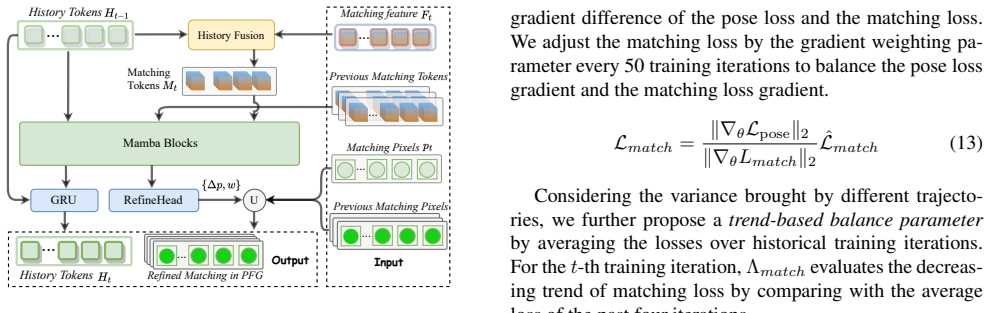
The load-bearing object is the Point-Frame Graph (PFG), a sliding-window graph whose vertices are camera poses and map points and whose edges encode which points each frame observes. The geometric argument runs through the Geometric Initialization Module (GIM) and the Geometric Mamba Module (GMM): GIM uses semi-dense matching plus monocular metric depth to seed pixel correspondences and a PnP initial pose, and GMM runs Mamba blocks—selective state-space sequence models—over the matching tokens derived from current features fused with a history token via cross-attention and a GRU, outputting per-match pixel refinements and weights that feed a differentiable bundle adjustment layer. The Mamba scan is the mechanism that carries sequential structure: it lets matching in the current frame be refined using the history of previous matches inside the PFG.
What would settle it
Run MambaVO on a sequence where the semi-dense matcher produces a low inlier ratio and the monocular depth estimate is grossly wrong, and measure ATE. If the trajectory error jumps toward the no-PnP ablation values (KITTI ATE from 50.21 m to roughly 201 m), the system's robustness is inherited from the pretrained initialization, not from the Mamba refinement. Conversely, if GMM and BA still hold the pose when the initial matches are deliberately perturbed, the refinement is the load-bearing component.
Extended reading notes
Core claim
The central claim is that replacing the matching front end of a learning-to-optimize odometer with a sequence-aware refiner—semi-dense geometric initialization followed by Mamba blocks that refine pixel coordinates and matching weights over a Point-Frame Graph—yields the best monocular absolute trajectory error among learning-based VO systems on four public benchmarks, in both odometry and loop-closure variants. The paper further claims that the gains come specifically from matching quality: on EuRoC, MambaVO raises the matching precision metric AUC@1° from 0.399 to 0.471, and ablation shows that removing the PnP initialization degrades KITTI ATE from 50.21 m to 201.16 m, while removing the Mamba blocks makes KITTI fail. The Trending-Aware Penalty is claimed to smooth the nested pose/matching optimization, improving convergence speed and final error.
Load-bearing premise
The end-to-end accuracy depends on the pretrained semi-dense matcher and monocular depth estimator being good enough that PnP produces a usable initial pose; if those fail in an unseen scene, the Mamba refinement and bundle adjustment cannot recover the trajectory.
Editorial extensions
If this is right
- If the claims hold, deep VO accuracy can be improved at the matching front end: refining a few hundred semi-dense correspondences sequentially beats dense-flow and patch-matching systems without needing stronger bundle adjustment or denser flow.
- The loop-closure variant shows that classic place recognition and pose-graph optimization on top of the learned odometer cut trajectory error by more than half on long sequences, so learned matching and geometric global optimization complement each other.
- The reported matching-precision gains (AUC@1° rising from 0.399 to 0.471 on EuRoC) give a per-frame proxy for downstream pose accuracy, suggesting matching quality is the bottleneck the system targets.
- Real-time monocular operation at 22–30 Hz with under 5 GB GPU memory means the accuracy gains are available to platforms that cannot run offline or large-batch inference.
Reading between the lines
- The paper leaves implicit that the sequence-refinement module is likely backbone-agnostic: because geometric and context features enter only as concatenated inputs, replacing the semi-dense matcher or the monocular depth source with a stronger foundation model should compound the accuracy gains without redesigning the Mamba refinement.
- A direct testable extension is a second PnP pass on the refined matches before bundle adjustment; the current pipeline feeds refined matches only into BA, so the extra loop would isolate how much of the final accuracy comes from refinement versus optimization.
- The trend-balance training rule is described for visual odometry, but the mechanism—reweighting two losses by their recent decreasing trends—is a generic stabilizer for nested differentiable optimization and could be evaluated on other learning-to-optimize problems.
Editorial analysis
A structured set of objections, weighed in public.
Referee Report
Summary. The paper proposes MambaVO, a monocular learning-to-optimize visual odometry system, and MambaVO++, its loop-closure variant. The pipeline initializes matches with EfficientLoFTR and PnP using Metric3D depth, extracts DINOv2 context features, refines and reweights matches with a Mamba-based Geometric Mamba Module, and optimizes poses and map points with differentiable bundle adjustment. A Trending-Aware Penalty is introduced to stabilize the nested training loss. Experiments on TartanAir, EuRoC, KITTI, and TUM-RGBD report state-of-the-art ATE, with ablations, a matching-AUC diagnostic, runtime, and GPU-memory comparisons.
Significance. If the accuracy claims hold, this is a solid empirical contribution to deep visual odometry: it is a plausible first use of state-space models for VO, the semi-dense geometric initialization is well motivated, the matching-AUC evaluation usefully isolates the matching improvement, and the ablation study in Table 7 supports the role of each proposed module. The real-time operation and lower GPU memory relative to DROID-VO, DPVO, and V2V are practically relevant strengths. However, the central KITTI SOTA claim is not yet verified because the geometric initialization relies on a pretrained metric-depth model with possible KITTI training overlap, and the empirical claims lack uncertainty and reproducibility details.
major comments (3)
- [Sec. 3.1.1, Eq. (2); Sec. 5, Table 3] The claimed KITTI SOTA is not yet verified because the Geometric Initialization Module obtains metric depth from Metric3D v2 before PnP, and Metric3D v2's documented multi-dataset training includes KITTI; the statement in Sec. 5 that the model is trained only on TartanAir does not cover this pretrained component. Table 7 shows that this initialization is load-bearing: removing PnP raises KITTI ATE from 50.21 m to 201.16 m, and removing the geometric feature raises it to 192.75 m. Since DROID-VO, DPVO, and V2V do not receive a KITTI-trained metric-depth prior, the monocular comparison in Table 3 may conflate the pretrained depth prior with the proposed modules. Please disclose the training data of all pretrained components and add an ablation that replaces Metric3D with a depth backbone not trained on KITTI, or trained only on TartanAir, while keeping the rest of the pipeline fixed.
- [Sec. 5.1, Tables 1-4] The paper reports mean ATE over five runs but no standard deviation, per-seed values, or significance testing, and no code is released. Several SOTA margins are small (e.g., TUM-RGBD AVG 0.076 vs. 0.089 for DPVO; EuRoC AVG 0.094 vs. 0.117 for V2V), so without variance information the central accuracy claim is difficult to assess. Please report run-to-run variability (std or min-max), specify the five seeds, and release code or detailed hyperparameters, including the number of Mamba blocks B and the number of initial matches k, which are used throughout Sec. 3 but never given values.
- [Sec. 5.2, Table 5] The matching-AUC comparison needs a more precise protocol. It is not stated how the matching outputs of DROID-VO, DPVO, and V2V are extracted, whether the same reference keyframes, the same number of matches, and the same inlier thresholds are used, and whether MambaVO's Poselib evaluation is applied identically to all methods. Without this control, the reported AUC@1 degree improvement (0.471 vs. 0.399 for V2V) may reflect evaluation choices rather than matching quality.
minor comments (5)
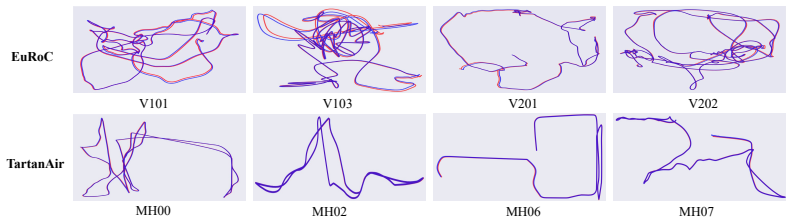
- [Sec. 3.1.2, Sec. 3.2.1, Fig. 5 caption] There are several typos: 'Divo-v2' should be 'DINOv2', 'mathing features' should be 'matching features', and 'ARE' in the Fig. 5 caption should be 'ATE'.
- [Eqs. (12)-(13)] The notation for the matching loss is ambiguous: Eq. (12) defines L_match, then Eq. (13) redefines L_match on the left while using L_match on the right. Please introduce a distinct symbol for the gradient-weighted matching loss, such as L_match_weighted.
- [Table 7] The row label 'w.o. History balance' is inconsistent with the text's 'trend-based balance parameter' in Sec. 3.3.2; the terminology should be aligned.
- [Sec. 5.4, Fig. 6] The runtime and memory comparison is underspecified: please state the GPU model, input resolution, sequence length, and whether the reported GPU memory is peak or average usage, so that the comparison with DROID-VO, DPVO, and V2V is reproducible.
- [Sec. 3.2 and Sec. 5] Hyperparameters B (number of Mamba blocks) and k (number of initial matches) are never assigned values; please report them, together with the other training and inference settings, in the experimental section.
Circularity Check
No significant circularity: empirical claims are evaluated on held-out benchmarks after TartanAir-only training; self-citations are not load-bearing.
full rationale
This is an empirical systems paper, not a derivation. The claimed predictions (ATE on EuRoC, TUM-RGBD, KITTI, and TartanAir, plus matching AUC in Table 5) are measured on held-out test splits after training only on TartanAir, as stated in Sec. 5: "Our model is trained only on the TartanAir training set, without retraining or fine-tuning on other datasets, which is the same as [21, 49, 51]." The TAP weighting in Eqs. (13)-(15) is computed from in-training losses only, so it cannot inject test-set information into the reported errors. The Geometric Initialization Module in Eq. (2) is a standard PnP initialization whose role is ablated in Table 7; removing PnP or the geometric feature degrades KITTI ATE to 201.16 m and 192.75 m, which confirms that the initializer is load-bearing but does not show circularity of the later refinement. Self-citations (e.g., [2], [23], [31], [54]-[56]) appear only in related-work and matching-evaluation contexts, not as load-bearing premises for the SOTA claim. The external concern that Metric3D v2 [22] may have been pretrained on KITTI and could advantage the KITTI comparison is a disclosure and fairness issue located in the use of Eq. (2), not an instance of a prediction reducing by construction to its inputs. No uniqueness theorem, ansatz-via-citation, or fitted-parameter-renamed-as-prediction pattern is present.
Assumptions & free parameters
free parameters (7)
- Sliding window size W =
10
- Keyframe parallax threshold =
30 px
- Gradient weighting update interval =
50 iterations
- Trend averaging window =
4 iterations
- Matching feature dimension =
384
- Number of Mamba blocks B
- Number of initial matches k
assumptions (4)
- standard math Pinhole camera model with known intrinsics K (Eq. 1)
- domain assumption Pretrained Dino-v2, EfficientLoFTR, and Metric3D provide reliable context features, semi-dense matches, and metric depth respectively
- domain assumption Training on TartanAir transfers to EuRoC, TUM-RGBD, and KITTI
- standard math Differentiable BA with Gauss-Newton from [50] correctly linearizes and backpropagates through the optimization
Cite this review
Pith. "Pith review of MambaVO: Deep Visual Odometry Based on Sequential Matching Refinement and Training Smoothing." pith.science (2026). https://pith.science/paper/URPZUUMK
@misc{pith2026241220082,
  author       = {Pith},
  title        = {Pith review of: MambaVO: Deep Visual Odometry Based on Sequential Matching Refinement and Training Smoothing},
  year         = {2026},
  howpublished = {\url{https://pith.science/paper/URPZUUMK}},
  note         = {Machine review of arXiv:2412.20082}
}
read the original abstract
Deep visual odometry has demonstrated great advancements by learning-to-optimize technology. This approach heavily relies on the visual matching across frames. However, ambiguous matching in challenging scenarios leads to significant errors in geometric modeling and bundle adjustment optimization, which undermines the accuracy and robustness of pose estimation. To address this challenge, this paper proposes MambaVO, which conducts robust initialization, Mamba-based sequential matching refinement, and smoothed training to enhance the matching quality and improve the pose estimation. Specifically, the new frame is matched with the closest keyframe in the maintained Point-Frame Graph (PFG) via the semi-dense based Geometric Initialization Module (GIM). Then the initialized PFG is processed by a proposed Geometric Mamba Module (GMM), which exploits the matching features to refine the overall inter-frame matching. The refined PFG is finally processed by differentiable BA to optimize the poses and the map. To deal with the gradient variance, a Trending-Aware Penalty (TAP) is proposed to smooth training and enhance convergence and stability. A loop closure module is finally applied to enable MambaVO++. On public benchmarks, MambaVO and MambaVO++ demonstrate SOTA performance, while ensuring real-time running.
Figures


Figures from the paper (3 more)


Reference graph
Works this paper leans on
-
[1]
The euroc micro aerial vehicle datasets
Michael Burri, Janosch Nikolic, Pascal Gohl, Thomas Schneider, Joern Rehder, Sammy Omari, Markus W Achte- lik, and Roland Siegwart. The euroc micro aerial vehicle datasets. The International Journal of Robotics Research, 35 (10):1157–1163, 2016. 2, 5
work page 2016
-
[2]
PRISM: PRogressive dependency maxImization for Scale-invariant image Matching
Xudong Cai, Yongcai Wang, Lun Luo, Minhang Wang, Dey- ing Li, Jintao Xu, Weihao Gu, and Rui Ai. Prism: Pro- gressive dependency maximization for scale-invariant image matching. arXiv preprint arXiv:2408.03598, 2024. 6
work page Pith review arXiv 2024
-
[3]
Orb-slam3: An accu- rate open-source library for visual, visual–inertial, and mul- timap slam
Carlos Campos, Richard Elvira, Juan J G ´omez Rodr´ıguez, Jos´e MM Montiel, and Juan D Tard´os. Orb-slam3: An accu- rate open-source library for visual, visual–inertial, and mul- timap slam. IEEE Transactions on Robotics , 37(6):1874– 1890, 2021. 1, 5, 7, 8
work page 2021
-
[4]
Locally opti- mized ransac
Ond ˇrej Chum, Ji ˇr´ı Matas, and Josef Kittler. Locally opti- mized ransac. In Pattern Recognition: 25th DAGM Sympo- sium, Magdeburg, Germany, September 10-12, 2003. Pro- ceedings 25, pages 236–243. Springer, 2003. 6
2003
-
[5]
Vidloc: A deep spatio-temporal model for 6-dof video-clip relocalization
Ronald Clark, Sen Wang, Andrew Markham, Niki Trigoni, and Hongkai Wen. Vidloc: A deep spatio-temporal model for 6-dof video-clip relocalization. In Proceedings of the IEEE conference on computer vision and pattern recogni- tion, pages 6856–6864, 2017. 2
work page 2017
-
[6]
Vinet: Visual-inertial odometry as a sequence-to-sequence learning problem
Ronald Clark, Sen Wang, Hongkai Wen, Andrew Markham, and Niki Trigoni. Vinet: Visual-inertial odometry as a sequence-to-sequence learning problem. In Proceedings of the AAAI conference on artificial intelligence, 2017. 2
work page 2017
-
[7]
Learning to solve non- linear least squares for monocular stereo
Ronald Clark, Michael Bloesch, Jan Czarnowski, Stefan Leutenegger, and Andrew J Davison. Learning to solve non- linear least squares for monocular stereo. In Proceedings of the European Conference on Computer Vision (ECCV) , pages 284–299, 2018. 2
work page 2018
-
[8]
Deepfactors: Real-time probabilistic dense monocular slam
Jan Czarnowski, Tristan Laidlow, Ronald Clark, and An- drew J Davison. Deepfactors: Real-time probabilistic dense monocular slam. IEEE Robotics and Automation Letters , 5 (2):721–728, 2020. 8
work page 2020
Show all 66 references
-
[9]
Factor graphs and gtsam: A hands-on in- troduction
Frank Dellaert. Factor graphs and gtsam: A hands-on in- troduction. Georgia Institute of Technology, Tech. Rep, 2:4,
-
[10]
Superpoint: Self-supervised interest point detection and description
Daniel DeTone, Tomasz Malisiewicz, and Andrew Rabi- novich. Superpoint: Self-supervised interest point detection and description. In Proceedings of the IEEE conference on computer vision and pattern recognition workshops , pages 224–236, 2018. 6
2018
-
[11]
Lsd- slam: Large-scale direct monocular slam
Jakob Engel, Thomas Sch ¨ops, and Daniel Cremers. Lsd- slam: Large-scale direct monocular slam. In European con- ference on computer vision, pages 834–849. Springer, 2014. 2
2014
-
[12]
Svo: Fast semi-direct monocular visual odometry
Christian Forster, Matia Pizzoli, and Davide Scaramuzza. Svo: Fast semi-direct monocular visual odometry. In 2014 IEEE international conference on robotics and automation (ICRA), pages 15–22. IEEE, 2014. 2, 7
2014
-
[13]
Dorian G ´alvez-L´opez and J. D. Tard´os. Bags of binary words for fast place recognition in image sequences. IEEE Trans- actions on Robotics, 28(5):1188–1197, 2012. 5
2012
-
[14]
Ldso: Direct sparse odometry with loop closure
Xiang Gao, Rui Wang, Nikolaus Demmel, and Daniel Cre- mers. Ldso: Direct sparse odometry with loop closure. In 2018 IEEE/RSJ International Conference on Intelligent Robots and Systems (IROS), pages 2198–2204. IEEE, 2018. 2, 7, 8
2018
-
[15]
Are we ready for autonomous driving? the kitti vision benchmark suite
Andreas Geiger, Philip Lenz, and Raquel Urtasun. Are we ready for autonomous driving? the kitti vision benchmark suite. In 2012 IEEE conference on computer vision and pat- tern recognition, pages 3354–3361. IEEE, 2012. 2, 5
2012
-
[16]
Openvins: A research platform for visual-inertial estimation
Patrick Geneva, Kevin Eckenhoff, Woosik Lee, Yulin Yang, and Guoquan Huang. Openvins: A research platform for visual-inertial estimation. In 2020 IEEE International Con- ference on Robotics and Automation (ICRA) , pages 4666–
2020
-
[17]
evo: Python package for the evalua- tion of odometry and slam
Michael Grupp. evo: Python package for the evalua- tion of odometry and slam. https://github.com/ MichaelGrupp/evo, 2017. 6
2017
-
[18]
Mamba: Linear-time sequence modeling with selective state spaces
Albert Gu and Tri Dao. Mamba: Linear-time sequence modeling with selective state spaces. arXiv preprint arXiv:2312.00752, 2023. 2, 4
2023 arXiv
-
[19]
Efficiently modeling long sequences with structured state spaces
Albert Gu, Karan Goel, and Christopher R ´e. Efficiently modeling long sequences with structured state spaces. arXiv preprint arXiv:2111.00396, 2021. 2
2021 arXiv
-
[20]
On the parameterization and initialization of diagonal state space models
Albert Gu, Karan Goel, Ankit Gupta, and Christopher R ´e. On the parameterization and initialization of diagonal state space models. Advances in Neural Information Processing Systems, 35:35971–35983, 2022. 2
2022
-
[21]
From variance to veracity: Unbundling and mitigating gradient variance in differentiable bundle adjustment layers
Swaminathan Gurumurthy, Karnik Ram, Bingqing Chen, Zachary Manchester, and Zico Kolter. From variance to veracity: Unbundling and mitigating gradient variance in differentiable bundle adjustment layers. In Proceedings of the IEEE/CVF Conference on Computer Vision and Pattern R...
2024
-
[22]
Metric3d v2: A versatile monocular geomet- ric foundation model for zero-shot metric depth and surface normal estimation
Mu Hu, Wei Yin, Chi Zhang, Zhipeng Cai, Xiaoxiao Long, Hao Chen, Kaixuan Wang, Gang Yu, Chunhua Shen, and Shaojie Shen. Metric3d v2: A versatile monocular geomet- ric foundation model for zero-shot metric depth and surface normal estimation. arXiv preprint arXiv:2404.15506, 2024. 3
2024 arXiv
-
[23]
Roco: Robust cooperative perception by iterative object matching and pose adjustment
Zhe Huang, Shuo Wang, Yongcai Wang, Wanting Li, Deying Li, and Lei Wang. Roco: Robust cooperative perception by iterative object matching and pose adjustment. In Proceed- ings of the 32nd ACM International Conference on Multime- dia, pages 7833–7842, 2024. 1
2024
-
[24]
Dense slam meets automatic differentiation
Krishna Murthy Jatavallabhula, Ganesh Iyer, and Liam Paull. Dense slam meets automatic differentiation. In 2020 IEEE International Conference on Robotics and Automation (ICRA), pages 2130–2137. IEEE, 2020. 2
2020
-
[25]
Splatam: Splat track & map 3d gaussians for dense rgb-d slam
Nikhil Keetha, Jay Karhade, Krishna Murthy Jatavallabhula, Gengshan Yang, Sebastian Scherer, Deva Ramanan, and Jonathon Luiten. Splatam: Splat track & map 3d gaussians for dense rgb-d slam. In Proceedings of the IEEE/CVF Con- ference on Computer Vision and Pattern Recognition,...
2024
-
[26]
3d gaussian splatting for real-time radiance field rendering
Bernhard Kerbl, Georgios Kopanas, Thomas Leimk ¨uhler, and George Drettakis. 3d gaussian splatting for real-time radiance field rendering. ACM Trans. Graph., 42(4):139–1,
-
[27]
g 2 o: A general frame- work for graph optimization
Rainer K ¨ummerle, Giorgio Grisetti, Hauke Strasdat, Kurt Konolige, and Wolfram Burgard. g 2 o: A general frame- work for graph optimization. In 2011 IEEE international conference on robotics and automation , pages 3607–3613. IEEE, 2011. 1
2011
-
[28]
PoseLib - Minimal Solvers for Camera Pose Estimation, 2020
Viktor Larsson and contributors. PoseLib - Minimal Solvers for Camera Pose Estimation, 2020. 2, 3, 6
2020
-
[29]
Videomamba: State space model for efficient video understanding
Kunchang Li, Xinhao Li, Yi Wang, Yinan He, Yali Wang, Limin Wang, and Yu Qiao. Videomamba: State space model for efficient video understanding. arXiv preprint arXiv:2403.06977, 2024. 3
2024 arXiv
-
[30]
Undeepvo: Monocular visual odometry through unsuper- vised deep learning
Ruihao Li, Sen Wang, Zhiqiang Long, and Dongbing Gu. Undeepvo: Monocular visual odometry through unsuper- vised deep learning. In 2018 IEEE international confer- ence on robotics and automation (ICRA), pages 7286–7291. IEEE, 2018. 1, 2
2018
-
[31]
Colslam: A versatile collaborative slam system for mobile phones using point-line features and map caching
Wanting Li, Yongcai Wang, Yongyu Guo, Shuo Wang, Yu Shao, Xuewei Bai, Xudong Cai, Qiang Ye, and Deying Li. Colslam: A versatile collaborative slam system for mobile phones using point-line features and map caching. In Pro- ceedings of the 31st ACM International Conference on M...
2023
-
[32]
Col- lamamba: Efficient collaborative perception with cross- agent spatial-temporal state space model
Yang Li, Quan Yuan, Guiyang Luo, Xiaoyuan Fu, Xu- anhan Zhu, Yujia Yang, Rui Pan, and Jinglin Li. Col- lamamba: Efficient collaborative perception with cross- agent spatial-temporal state space model. arXiv preprint arXiv:2409.07714, 2024. 3
2024 arXiv
-
[33]
Scale invariant feature transform
Tony Lindeberg. Scale invariant feature transform. 2012. 6
2012
-
[34]
Deep Patch Vi- sual SLAM
Lahav Lipson, Zachary Teed, and Jia Deng. Deep Patch Vi- sual SLAM. In European Conference on Computer Vision,
-
[35]
Deepvo: A deep learning approach for monocular visual odometry
Vikram Mohanty, Shubh Agrawal, Shaswat Datta, Arna Ghosh, Vishnu Dutt Sharma, and Debashish Chakravarty. Deepvo: A deep learning approach for monocular visual odometry. arXiv preprint arXiv:1611.06069, 2016. 1, 2
2016 arXiv
-
[36]
Learning correspondence uncer- tainty via differentiable nonlinear least squares
Dominik Muhle, Lukas Koestler, Krishna Murthy Jatavallab- hula, and Daniel Cremers. Learning correspondence uncer- tainty via differentiable nonlinear least squares. In Proceed- ings of the IEEE/CVF Conference on Computer Vision and Pattern Recognition, pages 13102–13112, 2023. 2
2023
-
[37]
Orb-slam2: An open- source slam system for monocular, stereo, and rgb-d cam- eras
Raul Mur-Artal and Juan D Tard ´os. Orb-slam2: An open- source slam system for monocular, stereo, and rgb-d cam- eras. IEEE transactions on robotics, 33(5):1255–1262, 2017. 8
2017
-
[38]
Orb-slam: a versatile and accurate monocular slam system
Raul Mur-Artal, Jose Maria Martinez Montiel, and Juan D Tardos. Orb-slam: a versatile and accurate monocular slam system. IEEE transactions on robotics , 31(5):1147–1163,
-
[39]
Dinov2: Learning robust visual features without supervision
Maxime Oquab, Timoth ´ee Darcet, Th ´eo Moutakanni, Huy V o, Marc Szafraniec, Vasil Khalidov, Pierre Fernandez, Daniel Haziza, Francisco Massa, Alaaeldin El-Nouby, et al. Dinov2: Learning robust visual features without supervision. arXiv preprint arXiv:2304.07193, 2023. 3
2023 arXiv
-
[40]
Theseus: A Library for Differentiable Nonlinear Optimization.Advances in Neu- ral Information Processing Systems, 2022
Luis Pineda, Taosha Fan, Maurizio Monge, Shobha Venkataraman, Paloma Sodhi, Ricky TQ Chen, Joseph Ortiz, Daniel DeTone, Austin Wang, Stuart Anderson, Jing Dong, Brandon Amos, and Mustafa Mukadam. Theseus: A Library for Differentiable Nonlinear Optimization.Advances in Neu- ral...
2022
-
[41]
Vins-mono: A robust and versatile monocular visual-inertial state estimator
Tong Qin, Peiliang Li, and Shaojie Shen. Vins-mono: A robust and versatile monocular visual-inertial state estimator. IEEE transactions on robotics, 34(4):1004–1020, 2018. 1, 2
2018
-
[42]
Deep fundamental matrix estimation
Ren ´e Ranftl and Vladlen Koltun. Deep fundamental matrix estimation. In Proceedings of the European conference on computer vision (ECCV), pages 284–299, 2018. 2
2018
-
[43]
Orb: An efficient alternative to sift or surf
Ethan Rublee, Vincent Rabaud, Kurt Konolige, and Gary Bradski. Orb: An efficient alternative to sift or surf. In 2011 International conference on computer vision , pages 2564–
2011
-
[44]
Structure-from-motion revisited
Johannes Lutz Sch ¨onberger and Jan-Michael Frahm. Structure-from-motion revisited. In Conference on Com- puter Vision and Pattern Recognition (CVPR), 2016. 7
2016
-
[45]
Dytanvo: Joint refinement of visual odometry and motion segmentation in dynamic environments
Shihao Shen, Yilin Cai, Wenshan Wang, and Sebastian Scherer. Dytanvo: Joint refinement of visual odometry and motion segmentation in dynamic environments. In 2023 IEEE International Conference on Robotics and Automation (ICRA), pages 4048–4055. IEEE, 2023. 1
2023
-
[46]
Sturm, N
J. Sturm, N. Engelhard, F. Endres, W. Burgard, and D. Cre- mers. A benchmark for the evaluation of rgb-d slam systems. In Proc. of the International Conference on Intelligent Robot Systems (IROS), 2012. 2, 5
2012
-
[47]
Ba-net: Dense bundle ad- justment network
Chengzhou Tang and Ping Tan. Ba-net: Dense bundle ad- justment network. arXiv preprint arXiv:1806.04807, 2018. 1, 2
2018 arXiv
-
[48]
Deepv2d: Video to depth with differentiable structure from motion
Zachary Teed and Jia Deng. Deepv2d: Video to depth with differentiable structure from motion. arXiv preprint arXiv:1812.04605, 2018. 7, 8
2018 arXiv
-
[49]
Droid-slam: Deep visual slam for monocular, stereo, and rgb-d cameras
Zachary Teed and Jia Deng. Droid-slam: Deep visual slam for monocular, stereo, and rgb-d cameras. Advances in neu- ral information processing systems, 34:16558–16569, 2021. 1, 2, 5, 6, 7, 8
2021
-
[50]
Tangent space backpropa- gation for 3d transformation groups
Zachary Teed and Jia Deng. Tangent space backpropa- gation for 3d transformation groups. In Proceedings of the IEEE/CVF Conference on Computer Vision and Pattern Recognition (CVPR), 2021. 4
2021
-
[51]
Deep patch vi- sual odometry
Zachary Teed, Lahav Lipson, and Jia Deng. Deep patch vi- sual odometry. Advances in Neural Information Processing Systems, 36, 2024. 1, 2, 5, 6, 7, 8
2024
-
[52]
Sfm- net: Learning of structure and motion from video
Sudheendra Vijayanarasimhan, Susanna Ricco, Cordelia Schmid, Rahul Sukthankar, and Katerina Fragkiadaki. Sfm- net: Learning of structure and motion from video. arXiv preprint arXiv:1704.07804, 2017. 2
2017 arXiv
-
[53]
Deepvo: Towards end-to-end visual odometry with deep re- current convolutional neural networks
Sen Wang, Ronald Clark, Hongkai Wen, and Niki Trigoni. Deepvo: Towards end-to-end visual odometry with deep re- current convolutional neural networks. In 2017 IEEE in- ternational conference on robotics and automation (ICRA) , pages 2043–2050. IEEE, 2017. 1, 2
2017
-
[54]
Communication efficient, distributed relative state estimation in uav networks
Shuo Wang, Yongcai Wang, Xuewei Bai, and Deying Li. Communication efficient, distributed relative state estimation in uav networks. IEEE journal on selected areas in commu- nications, 41(4):1151–1166, 2023. 1
2023
-
[55]
Distributed relative localization algorithms for multi- robot networks: A survey
Shuo Wang, Yongcai Wang, Deying Li, and Qianchuan Zhao. Distributed relative localization algorithms for multi- robot networks: A survey. Sensors, 23(5):2399, 2023. 1
2023
-
[56]
Gslamot: A tracklet and query graph-based simultaneous locating, map- ping, and multiple object tracking system
Shuo Wang, Yongcai Wang, Zhimin Xu, Yongyu Guo, Want- ing Li, Zhe Huang, Xuewei Bai, and Deying Li. Gslamot: A tracklet and query graph-based simultaneous locating, map- ping, and multiple object tracking system. In Proceedings of the 32nd ACM International Conference on Multi...
2024
-
[57]
Tartanair: A dataset to push the limits of visual slam
Wenshan Wang, Delong Zhu, Xiangwei Wang, Yaoyu Hu, Yuheng Qiu, Chen Wang, Yafei Hu, Ashish Kapoor, and Se- bastian Scherer. Tartanair: A dataset to push the limits of visual slam. In 2020 IEEE/RSJ International Conference on Intelligent Robots and Systems (IROS), pages 4909–49...
2020
-
[58]
Tartanvo: A generalizable learning-based vo
Wenshan Wang, Yaoyu Hu, and Sebastian Scherer. Tartanvo: A generalizable learning-based vo. In Conference on Robot Learning, pages 1761–1772. PMLR, 2021. 7, 8
2021
-
[59]
Efficient loftr: Semi-dense local feature matching with sparse-like speed
Yifan Wang, Xingyi He, Sida Peng, Dongli Tan, and Xiaowei Zhou. Efficient loftr: Semi-dense local feature matching with sparse-like speed. In Proceedings of the IEEE/CVF Con- ference on Computer Vision and Pattern Recognition, pages 21666–21675, 2024. 2, 3, 6
2024
-
[60]
Pop-up slam: Semantic monocular plane slam for low-texture environments
Shichao Yang, Yu Song, Michael Kaess, and Sebastian Scherer. Pop-up slam: Semantic monocular plane slam for low-texture environments. In 2016 IEEE/RSJ International Conference on Intelligent Robots and Systems (IROS), pages 1222–1229. IEEE, 2016. 1
2016
-
[61]
De- flowslam: Self-supervised scene motion decomposition for dynamic dense slam
Weicai Ye, Xingyuan Yu, Xinyue Lan, Yuhang Ming, Jinyu Li, Hujun Bao, Zhaopeng Cui, and Guofeng Zhang. De- flowslam: Self-supervised scene motion decomposition for dynamic dense slam. arXiv preprint arXiv:2207.08794 ,
-
[62]
Go-slam: Global optimization for consistent 3d in- stant reconstruction
Youmin Zhang, Fabio Tosi, Stefano Mattoccia, and Matteo Poggi. Go-slam: Global optimization for consistent 3d in- stant reconstruction. In Proceedings of the IEEE/CVF Inter- national Conference on Computer Vision, pages 3727–3737,
-
[63]
Determining the epipolar geometry and its uncertainty: A review
Zhengyou Zhang. Determining the epipolar geometry and its uncertainty: A review. International journal of computer vision, 27:161–195, 1998. 6
1998
-
[64]
Revisiting the pnp problem: A fast, general and optimal solution
Yinqiang Zheng, Yubin Kuang, Shigeki Sugimoto, Kalle As- trom, and Masatoshi Okutomi. Revisiting the pnp problem: A fast, general and optimal solution. In Proceedings of the IEEE International Conference on Computer Vision , pages 2344–2351, 2013. 2
2013
-
[65]
Unsupervised learning of depth and ego-motion from video
Tinghui Zhou, Matthew Brown, Noah Snavely, and David G Lowe. Unsupervised learning of depth and ego-motion from video. In Proceedings of the IEEE conference on computer vision and pattern recognition, pages 1851–1858, 2017. 2
2017
-
[66]
Vision mamba: Efficient visual representation learning with bidirectional state space model
Lianghui Zhu, Bencheng Liao, Qian Zhang, Xinlong Wang, Wenyu Liu, and Xinggang Wang. Vision mamba: Efficient visual representation learning with bidirectional state space model. arXiv preprint arXiv:2401.09417, 2024. 3
2024 arXiv
Reviewed August 10, 2026 · model on record in the stance chip above.
Discussion (0). Continue with ORCID to comment.