Parnassus: A GPU-enabled, Python-based Package for Fast Particle Detector Simulation and Reconstruction
Pith reviewed 2026-06-25 19:28 UTC · model grok-4.3
The pith
Parnassus supplies a Python PyTorch framework with interchangeable neural and parametric models for fast GPU detector simulation and reconstruction.
A machine-rendered reading of the paper's core claim, the machinery that carries it, and where it could break.
Core claim
Parnassus is a Python/PyTorch, GPU-compatible framework for fast detector simulation and reconstruction that supplies interchangeable detector models: neural models emulate Geant4-based chains and parametric models supply PyTorch implementations of Delphes-style responses. All models share the same process-agnostic and detector-agnostic API so a user selects a detector card once and applies the identical tool to new physics processes without retraining. The release includes two CMS models, PyTorch versions of the ATLAS and ALEPH Delphes cards, and a flow-matching neural model of ALEPH, together with direct interfaces to Pythia and FastJet.
What carries the argument
The process-agnostic and detector-agnostic API that lets a user select any released detector card (neural or parametric) and apply the same simulation and reconstruction steps to events from any generator.
If this is right
- The same API applies unchanged to Standard Model and beyond-Standard-Model processes once a detector card is chosen.
- GPU execution is available for both the flow-matching neural backends and the parametric smearing models.
- No ROOT dependency is needed, removing a common installation barrier for Python-only analysis chains.
- Users can swap between a neural CMS model and a parametric CMS model inside one script without changing any other code.
- Pre-built Delphes-style cards for ATLAS and ALEPH extend the same workflow to e+e- environments.
Where Pith is reading between the lines
- The shared API could allow analysts to test the impact of switching from a full simulation to a fast emulation on the same downstream analysis code.
- Community additions of new neural models for other detectors would expand the set of experiments that can use the framework without custom coding.
- Hybrid runs that route some particles through a neural model and others through a parametric model become possible inside the same event loop.
- Direct Pythia and FastJet hooks lower the barrier for quick generator-level studies that still include detector effects.
Load-bearing premise
The released code and models actually implement the described neural emulation and parametric responses and can be used through the stated process-agnostic API without further user validation or modification.
What would settle it
Install the package, load one of the released CMS models, generate events with the built-in Pythia interface, run the detector response, and check whether the output object distributions agree with a reference Geant4 sample to within the emulation tolerance stated in the model documentation.
Figures

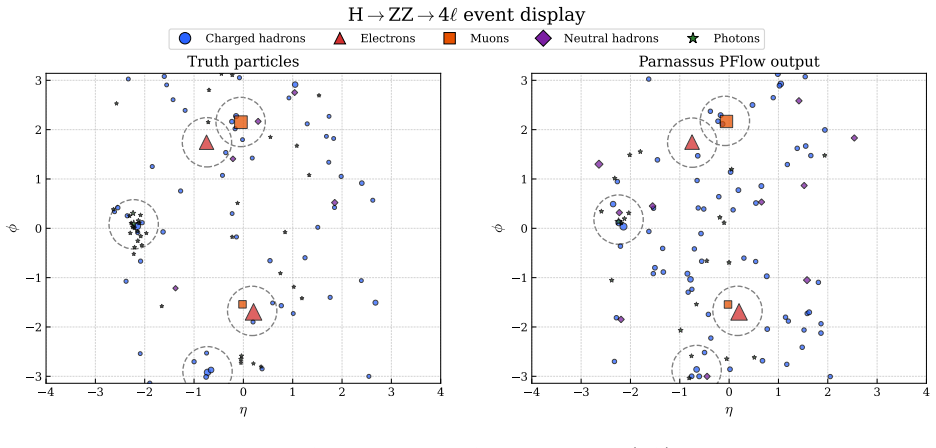
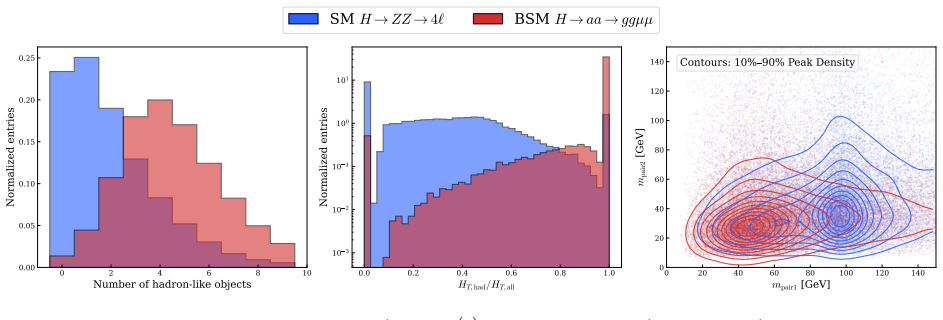
read the original abstract
We present the public software release of Parnassus, a Python/PyTorch, GPU-compatible framework for fast detector simulation and reconstruction in particle and nuclear physics. Parnassus provides a user-friendly framework with interchangeable detector models: neural models can emulate computationally expensive Geant4-based detector simulation and reconstruction chains, while parametric models provide PyTorch implementations of selected Delphes-style detector responses. This initial release includes two models of the CMS detector: one based on a flow-matching neural network architecture and one based on a PyTorch implementation of the Delphes CMS card (parametric bias and smearing). PyTorch versions of the ATLAS and ALEPH Delphes cards are also available, together with a flow-matching neural model of the ALEPH detector that extends the framework to the e+e- LEP environment. All detector-specific backends share the same process-agnostic and detector-agnostic API: users select a detector card - analogous to choosing a detector card in Delphes - and the same tool can be applied to new physics processes without retraining the released detector model. There are native interfaces to the event generator Pythia and the event clustering package FastJet. Unlike previous C++/ROOT-based tools, Parnassus provides GPU-capable PyTorch detector-response backends and requires no ROOT installation. We describe the installation, command-line and Python API, configuration system, and demonstrate the framework on Standard Model and BSM processes.
Editorial analysis
A structured set of objections, weighed in public.
Referee Report
Summary. The manuscript presents Parnassus, a Python/PyTorch, GPU-compatible framework for fast detector simulation and reconstruction. It offers interchangeable detector models: neural flow-matching networks to emulate Geant4-based simulation and reconstruction chains, and parametric PyTorch implementations of selected Delphes-style detector responses. The initial release includes two CMS detector models (one neural, one parametric), PyTorch versions of ATLAS and ALEPH Delphes cards, and a flow-matching neural model of ALEPH. All share a process-agnostic and detector-agnostic API; native interfaces to Pythia and FastJet are provided, with no ROOT dependency required. The paper describes installation, APIs, configuration, and demonstrates use on SM and BSM processes.
Significance. If the implementation is correct and the neural emulations are shown to be accurate and generalizable, Parnassus could provide a useful modern alternative to Geant4 and Delphes by enabling GPU-accelerated, Python-native detector response modeling without ROOT, potentially simplifying workflows for new physics studies.
major comments (2)
- [Abstract] Abstract: The central claim that neural models emulate the full Geant4-based detector simulation and reconstruction chains and that the released models (including the CMS flow-matching network) can be applied to arbitrary new physics processes without retraining is unsupported, as the manuscript supplies no performance numbers, validation plots, efficiency curves, or direct comparisons to Geant4 or Delphes.
- [Abstract] Abstract and demonstration section: No out-of-distribution tests are reported for the neural models on BSM processes with kinematics outside the training distribution (e.g., high-pT exotics or unusual multiplicities), which is required to substantiate the process-agnostic API claim given that flow-matching networks learn a specific transport map.
Simulated Author's Rebuttal
We thank the referee for their careful review and constructive comments on the Parnassus manuscript. We address each major comment below.
read point-by-point responses
-
Referee: [Abstract] Abstract: The central claim that neural models emulate the full Geant4-based detector simulation and reconstruction chains and that the released models (including the CMS flow-matching network) can be applied to arbitrary new physics processes without retraining is unsupported, as the manuscript supplies no performance numbers, validation plots, efficiency curves, or direct comparisons to Geant4 or Delphes.
Authors: We agree that the manuscript provides no quantitative performance numbers, validation plots, efficiency curves, or direct Geant4/Delphes comparisons. This paper is a software release note focused on the framework, API, and installation rather than model validation. The abstract describes the intended use of the released models. We will revise the abstract to remove unsupported claims about full emulation and add a brief limitations paragraph noting that the neural models are pre-trained examples whose accuracy must be assessed by users for their specific processes. revision: yes
-
Referee: [Abstract] Abstract and demonstration section: No out-of-distribution tests are reported for the neural models on BSM processes with kinematics outside the training distribution (e.g., high-pT exotics or unusual multiplicities), which is required to substantiate the process-agnostic API claim given that flow-matching networks learn a specific transport map.
Authors: We agree that no out-of-distribution tests are reported. Flow-matching networks learn transport maps specific to their training distributions, so performance on significantly different BSM kinematics is not guaranteed. We will revise the text to clarify that the process-agnostic and detector-agnostic API refers to the shared interface (users select a card and apply the same code), while explicitly noting the limitation that neural model accuracy depends on kinematic overlap with training data. A short discussion of this point will be added to the demonstration section. revision: yes
Circularity Check
No circularity: software release paper with no derivations or fitted predictions
full rationale
The paper is a software package announcement describing Parnassus, a PyTorch-based framework for detector simulation. It presents no mathematical derivations, equations, fitted parameters, or predictions that could reduce to inputs by construction. The core claims concern code implementation, API design, and availability of neural and parametric models, with no self-referential equations or load-bearing self-citations of uniqueness theorems. The reader's assessment of 0.0 circularity is confirmed by inspection of the abstract and full-text description, which contain only implementation details and usage instructions. No steps qualify under any of the enumerated circularity patterns.
Axiom & Free-Parameter Ledger
Reference graph
Works this paper leans on
-
[1]
J. de Favereau, et al., Delphes 3: A modular framework for fast simulation of a generic collider experiment, JHEP 02 (2014) 057.arXiv:1307.6346
Pith/arXiv arXiv 2014
- [2]
-
[3]
Y. Lo, D. Kobylianskii, B. Nachman, An ai-based detector simulation and reconstruction model for the aleph experiment at lep (2026).arXiv:2604.11834
Pith/arXiv arXiv 2026
-
[4]
M. Cacciari, G. P. Salam, G. Soyez, Fastjet user manual, European Physical Journal C 72 (2012) 1896.arXiv:1111.6097
Pith/arXiv arXiv 2012
-
[5]
Pivarski, et al., Uproot: Root i/o in pure python and numpy
J. Pivarski, et al., Uproot: Root i/o in pure python and numpy. URLhttps://github.com/scikit-hep/uproot5
-
[6]
Agostinelli, et al., Geant4—a simulation toolkit, Nuclear Instruments and Methods in Physics Research Section A 506 (2003) 250
S. Agostinelli, et al., Geant4—a simulation toolkit, Nuclear Instruments and Methods in Physics Research Section A 506 (2003) 250. 25
2003
-
[7]
Y. Lipman, R. T. Q. Chen, H. Ben-Hamu, M. Nickel, Flow matching for generative modeling, in: International Conference on Learning Representations, 2023.arXiv: 2210.02747
Pith/arXiv arXiv 2023
-
[8]
X. Liu, C. Gong, Q. Liu, Flow straight and fast: Learning to generate and transfer data with rectified flow, in: International Conference on Learning Representations, 2023. arXiv:2209.03003
Pith/arXiv arXiv 2023
-
[9]
R. Brun, F. Rademakers, Root—an object oriented data analysis framework, Nuclear Instruments and Methods in Physics Research Section A 389 (1997) 81–86.doi:10. 1016/S0168-9002(97)00048-X
1997
-
[10]
A. Paszke, et al., Pytorch: An imperative style, high-performance deep learning library, in: Advances in Neural Information Processing Systems, 2019.arXiv:1912.01703
Pith/arXiv arXiv 2019
- [11]
-
[12]
A. Buckley, P. Ilten, D. Konstantinov, L. Lönnblad, J. Monk, W. Pokorski, T. Przedzin- ski, A. Verbytskyi, The HepMC3 Event Record Library for Monte Carlo Event Genera- tors, Computer Physics Communications 260 (2021) 107310, arXiv:1912.08005 [hep-ph]. doi:10.1016/j.cpc.2020.107310. URLhttp://arxiv.org/abs/1912.08005
-
[13]
C. Bierlich, S. Chakraborty, N. Desai, L. Gellersen, I. Helenius, P. Ilten, L. Lönnblad, S. Mrenna, S. Prestel, C. T. Preuss, T. Sjöstrand, P. Skands, M. Utheim, R. Verheyen, A comprehensive guide to the physics and usage of PYTHIA 8.3, SciPost Physics Code- bases (2022) 008doi:10.21468/SciPostPhysCodeb.8. URLhttps://scipost.org/SciPostPhysCodeb.8
-
[14]
URLhttps://atlas.web.cern.ch/Atlas/GROUPS/PHYSICS/PLOTS/SIMU-2026-09/ 26
ATLAS Collaboration, Combined fast simulation and reconstruction in ATLAS with PARNASSUS, ATLAS Public Plot PLOT-SIMU-2026-09, accessed: 2026-06-23 (2026). URLhttps://atlas.web.cern.ch/Atlas/GROUPS/PHYSICS/PLOTS/SIMU-2026-09/ 26
2026
discussion (0)
Sign in with ORCID, Apple, or X to comment. Anyone can read and Pith papers without signing in.