General circuit mapping algorithm for neutral atom quantum computers
Pith reviewed 2026-06-26 16:46 UTC · model grok-4.3
The pith
Graph optimization framework maps circuits to neutral atom computers with fewer qubit transfers than prior methods.
A machine-rendered reading of the paper's core claim, the machinery that carries it, and where it could break.
Core claim
The central claim is that modeling the qubit mapping problem for neutral atom quantum computers as a graph-theoretic combinatorial optimization problem, which captures zone-limited gate operations and multi-qubit gates, and then solving the resulting nonlinear integer program with a genetic algorithm, produces mappings that require fewer transfers than the state-of-the-art scalable compiler, while allowing optimization either for shorter total traveled distances or for fewer parallel transfer operations.
What carries the argument
A graph-theoretic combinatorial optimization model encoded as a nonlinear integer program and solved using a genetic algorithm to minimize qubit transfers under spatial constraints.
If this is right
- Mappings can be generated that reduce movement-induced errors on NAQC devices.
- Atom transfer parallelism can be better exploited depending on the chosen optimization focus.
- Execution efficiency improves through hardware-aware compilation.
- Theoretical guarantees support identification of the minimal number of required transfers.
Where Pith is reading between the lines
- The same graph model could be adapted to evaluate zoning choices during hardware design.
- Testing the solver on circuits larger than those in the benchmarks would reveal where the genetic algorithm stops scaling well.
- Similar combinatorial encoding might apply to other platforms that move qubits between fixed interaction sites.
Load-bearing premise
The genetic algorithm reliably finds mappings that are near-optimal or better than prior methods for realistic circuit sizes and hardware constraints.
What would settle it
A side-by-side run on the same benchmark circuits where the new method requires more transfers than the prior compiler on any instance would falsify the performance claim.
Figures







read the original abstract
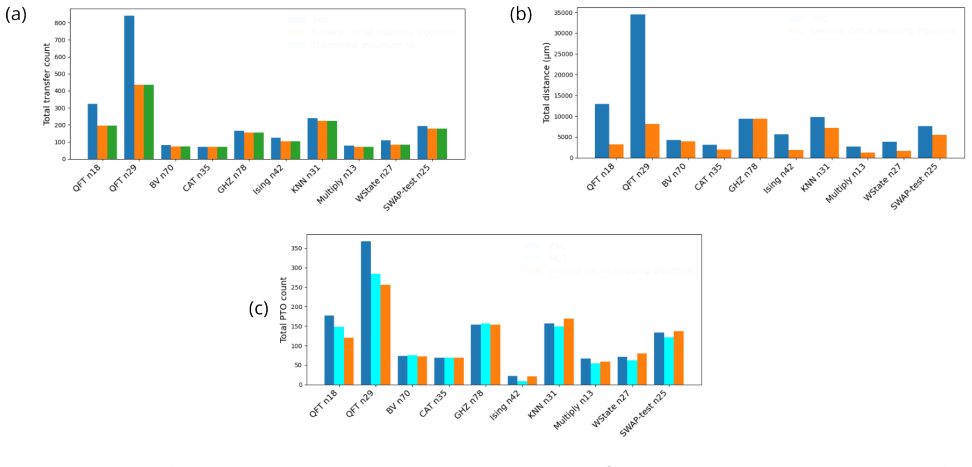
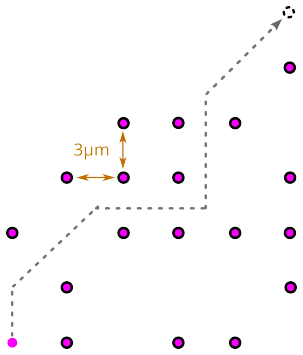
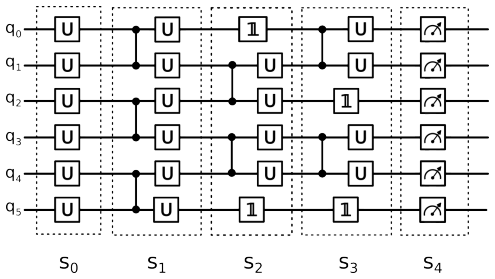
Neutral atom quantum computers (NAQC) are emerging as a promising, scalable quantum computing platform because of their long qubit coherence, flexible qubit arrangement, and multiqubit gate capabilities. However, circuit execution often requires physically moving qubits, making compilation a critical optimization challenge. We propose a circuit independent mathematical framework built on graph-theoretic combinatorial optimization that determines the minimal number of required qubit transfers. This model captures spatial constraints specific to NAQC platforms with zone-limited gate operations and multi-qubit gates. From this framework, we encode the qubit mapping problem as a nonlinear integer program and solve it using a genetic algorithm, enabling trade-offs between minimizing the total traveled distance and the number of parallel transfer operations. Compared to the state-of-the-art scalable compiler for zoned architectures, our approach consistently finds fewer transfers. Depending on the optimization focus, our method produces shorter traveled distances or fewer parallel transfer operations. This work provides both theoretical guaranties and a practical tool for efficient, architecture-aware quantum circuit compilation. As a result, practitioners can generate hardware-aware mappings that reduce movement-induced errors and better exploit atom transfer parallelism, directly improving execution efficiency on NAQC devices.
Editorial analysis
A structured set of objections, weighed in public.
Referee Report
Summary. The manuscript introduces a graph-theoretic combinatorial optimization framework for qubit mapping on neutral-atom quantum computers with zoned architectures and multi-qubit gates. It formulates the problem as a nonlinear integer program that minimizes transfers while respecting spatial constraints, solves it via a genetic algorithm to trade off total distance versus parallel operations, and reports consistent reductions in transfers relative to the prior zoned-architecture compiler together with theoretical guarantees.
Significance. A sound modeling framework that explicitly incorporates zone-limited gates and atom-transfer parallelism would be a useful addition to NAQC compilation literature; if the reported empirical gains are reproducible on standard benchmark suites with documented GA parameters, the work could directly reduce movement-induced errors on current hardware.
major comments (2)
- [Abstract] Abstract: the claim of 'theoretical guaranties' is not reconciled with the choice of a genetic algorithm, which is a stochastic meta-heuristic possessing neither convergence nor approximation guarantees. The manuscript must state precisely which theoretical results (if any) are proven about the integer-program formulation versus which statements rest on solver output.
- [Abstract] Abstract: the central empirical claim that the method 'consistently finds fewer transfers' than the SOTA zoned compiler is unsupported by any description of benchmark circuits, circuit sizes, GA population/mutation/termination settings, number of runs, or statistical tests. Without these details the superiority statement cannot be evaluated.
minor comments (1)
- [Abstract] Abstract: 'guaranties' is a misspelling of 'guarantees'.
Simulated Author's Rebuttal
We thank the referee for the detailed comments. We agree that the abstract requires clarification on the distinction between theoretical aspects of the model and the heuristic solver, as well as better contextualization of the empirical claims. We address each point below and will revise the abstract accordingly.
read point-by-point responses
-
Referee: [Abstract] Abstract: the claim of 'theoretical guaranties' is not reconciled with the choice of a genetic algorithm, which is a stochastic meta-heuristic possessing neither convergence nor approximation guarantees. The manuscript must state precisely which theoretical results (if any) are proven about the integer-program formulation versus which statements rest on solver output.
Authors: We agree the abstract phrasing is imprecise. The proven theoretical results concern the nonlinear integer program formulation, which exactly encodes the minimal-transfer qubit mapping problem under zone-limited gates, spatial constraints, and multi-qubit operations; any feasible solution to the IP is a valid mapping, and an optimal solution yields the true minimum transfers. The genetic algorithm is presented only as a practical heuristic solver without convergence or approximation guarantees. We will revise the abstract to explicitly separate these elements and remove any implication that the GA outputs carry theoretical guarantees. revision: yes
-
Referee: [Abstract] Abstract: the central empirical claim that the method 'consistently finds fewer transfers' than the SOTA zoned compiler is unsupported by any description of benchmark circuits, circuit sizes, GA population/mutation/termination settings, number of runs, or statistical tests. Without these details the superiority statement cannot be evaluated.
Authors: The full manuscript contains dedicated experimental sections that specify the benchmark circuits (standard suites from prior NAQC literature), circuit sizes, GA hyperparameters (population size, mutation/crossover rates, termination criteria), number of independent runs, and statistical comparisons. The abstract claim is therefore supported by those results. To address the referee's concern, we will add a concise clause to the abstract directing readers to the experimental evaluation for these details. revision: partial
Circularity Check
No significant circularity; independent modeling and heuristic solver
full rationale
The paper defines a graph-theoretic combinatorial optimization framework for qubit mapping, encodes the problem as a nonlinear integer program, and applies a genetic algorithm to solve it, with empirical comparison to an external SOTA compiler. No derivation step reduces by construction to its own inputs, no fitted parameters are relabeled as predictions, and no load-bearing self-citations or uniqueness theorems appear. The central claims rest on the modeling choices and solver outputs rather than tautological equivalence.
Axiom & Free-Parameter Ledger
axioms (1)
- domain assumption Graph theory can accurately capture spatial constraints and transfer costs in zoned neutral-atom architectures
Reference graph
Works this paper leans on
-
[1]
Schmid, D
L. Schmid, D. F. Locher, M. Rispler, S. Blatt, J. Zeiher, M. Müller, and R. Wille, Com- putational capabilities and compiler devel- opment for neutral atom quantum proces- sors—connecting tool developers and hard- ware experts, Quantum Sci. Technol.9, 033001 (2024)
2024
-
[2]
Henriet, L
L. Henriet, L. Béguin, A. Signoles, T. La- haye, A. Browaeys, G.-O. Reymond, and C. Jurczak, Quantum computing with neutral atoms, Quantum4, 327 (2020)
2020
-
[3]
Bluvstein, S
D. Bluvstein, S. J. Evered, A. A. Geim,et al., Logical quantum processor based on re- configurable atom arrays, Nature626, 58–65 (2023)
2023
-
[4]
H. J. Manetsch, G. Nomura, E. Bataille,et al., A tweezer array with 6,100 highly coher- ent atomic qubits, Nature647, 60–67 (2025)
2025
-
[5]
N. C. Chiu, E. C. Trapp, J. Guo,et al., Con- tinuous operation of a coherent 3,000-qubit system, Nature646, 1075–1080 (2025)
2025
-
[6]
Jaksch, J
D. Jaksch, J. I. Cirac, P. Zoller, S. L. Rolston, R. Côté, and M. D. Lukin, Fast Quantum Gates for Neutral Atoms, Phys. Rev. Lett.85, 2208 (2000)
2000
-
[7]
Pelegrí, A
G. Pelegrí, A. J. Daley, and J. D. Pritchard, High-fidelity multiqubit Rydberg gates via two-photon adiabatic rapid passage, Quan- tum Sci. Technol.7, 045020 (2022)
2022
-
[8]
S. Tang, C. Yang, D. Li, and X. Shao, Implementation of Quantum Algorithms via Fast Three-Rydberg-Atom CCZ Gates, Entropy (Basel)24, 1371 (2022), doi:10.3390/e24101371
-
[9]
D. B. Tan, D. Bluvstein, M. D. Lukin, and J. Cong, Compiling Quantum Circuits for Dynamically Field-Programmable Neutral Atoms Array Processors, Quantum8, 1281 (2024)
2024
-
[10]
J. Ludmir and T. Patel, Parallax: A Compiler for Neutral Atom Quantum Com- puters under Hardware Constraints, in 13 Proc. International Conference for High Performance Computing, Networking, Stor- age, and Analysis (SC) (2024), Art. 73, doi:10.1109/SC41406.2024.00079
work page internal anchor Pith review Pith/arXiv arXiv doi:10.1109/sc41406.2024.00079 2024
-
[11]
H. Wang, P. Liu, D. B. Tan, Y. Liu, J. Gu, D. Z. Pan, J. Cong, U. A. Acar, and S. Han, Atomique: A Quantum Compiler for Recon- figurable Neutral Atom Arrays, in Proc. 51st Annual International Symposium on Com- puter Architecture (ISCA) (2025), pp. 293– 309, doi:10.1109/ISCA59077.2024.00030
-
[12]
D. B. Tan, W.-H. Lin, and J. Cong, Compilation for Dynamically Field- Programmable Qubit Arrays with Effi- cient and Provably Near-Optimal Schedul- ing, in Proc. ACM (2025), pp. 921–929, doi:10.1145/3658617.3697778
-
[13]
J. Ruan, X. Fang, H. Zhang, A. Li, T. Hum- ble, and Y. Ding, PowerMove: Optimiz- ing Compilation for Neutral Atom Quantum Computers with Zoned Architecture, in Proc. 30thACMInternationalConferenceonArchi- tectural Support for Programming Languages and Operating Systems (ASPLOS) (2025), pp. 163–178, doi:10.1145/3676642.3736128
-
[14]
C. Huang, X. Zhao, H. Xu, W. Zhuang, M.-J. Hu, D. E. Liu, and J. Wang, ZAP: Zoned Architecture and Parallelizable Com- piler for Field Programmable Atom Array (2024), arXiv:2411.14037
Pith/arXiv arXiv 2024
-
[15]
E.Jang, Y.Kim, H.Kim, S.Choi, Y.Huang, and W. W. Ro, Qubit Movement-Optimized Program Generation on Zoned Neutral Atom Processors, in Proc. 23rd ACM/IEEE Inter- national Symposium on Code Generation and Optimization (CGO) (2025), pp. 459–475, doi:10.1145/3696443.3708937
-
[16]
W.-H. Lin, D. B. Tan, and J. Cong, Reuse- Aware Compilation for Zoned Quantum Ar- chitectures Based on Neutral Atoms, in Proc. 2025 IEEE International Symposium on High Performance Computer Architecture (HPCA) (2025), doi:10.1109/HPCA61900.2025.00021
-
[17]
Y. Stade, W.-H. Lin, J. Cong, and R. Wille, Routing-Aware Placement for Zoned Neutral Atom-based Quantum Computing, in Proc. 2025 IEEE/ACM International Conference on Computer Aided Design (ICCAD) (2025), pp. 1–9, doi:10.1109/ICCAD66269.2025.11240721
-
[18]
Y. Stade, L. Schmid, L. Burgholzer, and R. Wille, An Abstract Model and Efficient Routing for Logical Entangling Gates on Zoned Neutral Atom Archi- tectures, in Proc. IEEE International Conference on Quantum Computing and Engineering (QCE) (2024), pp. 784–795, doi:10.1109/QCE60285.2024.00098
-
[19]
Patent Application No
Part or all the research undertaken resulting from this paper is covered under U.S. Patent Application No. 63/979,588; Title: Qubit Manager for Optimized Execution of a Quan- tum Circuit on a Quantum Computer with Transportable Qubits
-
[20]
Wintersperger, F
K. Wintersperger, F. Dommert, T. Ehmer, et al., Neutral atom quantum computing hardware: performance and end-user perspec- tive, EPJ Quantum Technol.10, 32 (2023)
2023
-
[21]
Morgado and S
M. Morgado and S. Whitlock, Quantum simulation and computing with Rydberg- interacting qubits, AVS Quantum Sci.3, 023501 (2021)
2021
-
[22]
Saffman, T
M. Saffman, T. G. Walker, and K. Mølmer, Quantum information with Rydberg atoms, Rev. Mod. Phys.82, 2313 (2010)
2010
-
[23]
I. S. Madjarov, J. P. Covey, A. L. Shaw,et al., High-fidelity entanglement and detection of alkaline-earth Rydberg atoms, Nat. Phys. 16, 857–861 (2020)
2020
-
[24]
Anand, C
S. Anand, C. E. Bradley, R. White,et al., A dual-species Rydberg array, Nat. Phys.20, 1744–1750 (2024)
2024
-
[25]
M. Venderbosch, R. van Herk, Z. Guo, et al., A Robust Strontium Tweezer Ap- paratus for Quantum Computing (2026), arXiv:2601.16564
Pith/arXiv arXiv 2026
-
[26]
Barredo, V
D. Barredo, V. Lienhard, S. de Léséleuc, T. Lahaye, and A. Browaeys, Synthetic three-dimensional atomic structures assem- bled atom by atom, Nature561, 79–82 (2018)
2018
-
[27]
S. J. Evered, D. Bluvstein, M. Kalinowski,et al., High-fidelityparallelentanglinggatesona neutral-atom quantum computer, Nature622, 268–272 (2023)
2023
-
[28]
Levine, A
H. Levine, A. Keesling, G. Semeghini, A. Omran, T. T. Wang, S. Ebadi, H. Bernien, M. Greiner, V. Vuletić, H. Pichler, and M. D. Lukin, Parallel Implementation of 14 High-Fidelity Multiqubit Gates with Neutral Atoms, Phys. Rev. Lett.123, 170503 (2019)
2019
-
[29]
Béguin, A
L. Béguin, A. Vernier, R. Chicireanu, T. La- haye, and A. Browaeys, Direct Measurement of the van der Waals Interaction between Two Rydberg Atoms, Phys. Rev. Lett.110, 263201 (2013)
2013
-
[30]
Schymik, B
K.-N. Schymik, B. Ximenez, E. Bloch, D. Dreon, A. Signoles, F. Nogrette, D. Barredo, A. Browaeys, and T. La- haye, In situ equalization of single-atom loading in large-scale optical tweezer arrays, Phys. Rev. A106, 022611 (2022)
2022
-
[31]
Barredo, S
D. Barredo, S. de Léséleuc, V. Lienhard, T. Lahaye, and A. Browaeys, An atom-by- atom assembler of defect-free arbitrary two- dimensionalatomicarrays, Science354, 1021– 1023 (2016)
2016
-
[32]
Schymik, Scaling-up the Tweezer Plat- form – Trapping Arrays of Single Atoms in a Cryogenic Environment, Ph.D
K.-N. Schymik, Scaling-up the Tweezer Plat- form – Trapping Arrays of Single Atoms in a Cryogenic Environment, Ph.D. thesis, Uni- versité Paris-Saclay (2022), tel-03643133
2022
-
[33]
Bluvstein, H
D. Bluvstein, H. Levine, G. Semeghini,et al., A quantum processor based on coherent transport of entangled atom arrays, Nature 604, 451–456 (2022)
2022
-
[34]
General Circuit Mapping Algorithm Bench, https://gitlab.tue.nl/n.s.gentil/general- circuit-mapping-algorithm-bench
-
[35]
Korte and J
B. Korte and J. Vygen, Combinatorial Op- timization: Theory and Algorithms, Algo- rithms and Combinatorics, 6th ed., Springer, Berlin, Heidelberg (2018)
2018
-
[36]
P. Tian, J. Ma, and D.-M. Zhang, Non-linear integer programming by Darwin and Boltz- mann mixed strategy, Eur. J. Oper. Res.105, 224–235 (1998)
1998
-
[37]
A. Li, S. Stein, S. Krishnamoorthy, and J. Ang, QASMBench: A Low-level QASM Benchmark Suite for NISQ Evaluation and Simulation (2022), arXiv:2005.13018. A Graph Theory Of Optimum Qubit Transfers The number of instructions involved inside a stagesi isN θ,i. An instructionθi,j has a set of qubits Qi,j def={qk,ql,qm, ...}. An instruction containing only a si...
arXiv 2022
-
[38]
Then, the edge is equivalently colored black or red
The verticesθi,j andθi+1,k of a given edge are not shared with any other edges. Then, the edge is equivalently colored black or red
-
[39]
Let us assume that two or more of those edges with endpointθi+1,k are colored black
Two or more edges share the same endpointθi+1,k. Let us assume that two or more of those edges with endpointθi+1,k are colored black. Since all the instructions insi have a unique physical position, it means that at least two qubits of different instructionsθi,j andθi,j′must reach the same target instructionθi+1,k, while being static. It is absurd, and, b...
-
[40]
Step 2 to Step 5
Two or more edges share the same vertexθi,j. Similarly, the same conclusion as for the second case holds: two qubits cannot move away from each other while being static and at most one edge is colored black. We deduce that a configuration is valid iff each vertex inHi has at most one incident black edge. Therefore, the set of edges colored black is, by de...
-
[41]
The inverse of the global distance is measured as the score
Move one single stick with a maximum distance of 5 slots in the atomic grid. The inverse of the global distance is measured as the score. 200 generations are processed
-
[42]
Shuffle the substicks of a single random stick in the entanglement zone (note that sticks in the storage zone own only one substick, hence shuffling the combinations is irrelevant)
Move one single stick with a maximum distance of one slot in the grid. Shuffle the substicks of a single random stick in the entanglement zone (note that sticks in the storage zone own only one substick, hence shuffling the combinations is irrelevant). The inverse of the global distance is 23 Figure 15: Quantum circuit from Figure 2 where the gates are ex...
-
[43]
The inverse of the PTO count is measured as the score
Shuffle the substicks of a random stick in the entanglement zone. The inverse of the PTO count is measured as the score. One hundred generations are processed. Note that the best solutions of the first pass are used as initial population for the second pass. The first and second passes find potentially good candidates on the basis of the distance, whereas...
discussion (0)
Sign in with ORCID, Apple, or X to comment. Anyone can read and Pith papers without signing in.