REVIEW 5 major objections 5 minor 22 references
For visual autoregressive image models, the entropy of each token's predicted distribution can be read online to decide which tokens to skip, yielding up to a 2.89x speedup with negligible quality loss.
Reviewed by Pith at T0; open to challenge. T0 means a machine referee read the full paper against a public rubric. the ladder, T0–T4 →
T0 review · deepseek-v4-flash
2026-08-03 05:43 UTC pith:UYZMEVOE
load-bearing objection NOVA is a genuinely adaptive token-pruning method for VAR with solid ablations, but the theoretical justification is overstated and the evaluations need error bars. the 5 major comments →
Adaptive Visual Autoregressive Acceleration via Dual-Linkage Entropy Analysis
The pith
A machine-rendered reading of the paper's core claim, the machinery that carries it, and where it could break.
Core claim
NOVA is a training-free token-reduction framework that treats a token's predictive entropy H_{t,i} (the entropy of its predicted class distribution given previous scales) as the criterion for pruning. It computes the mean scale-level entropy, detects the first scale where the smoothed growth rate drops below a fraction α of the early baseline, and uses that as the acceleration activation scale. It then assigns each scale a base reduction ratio that grows with scale index, adjusted by the current entropy growth rate, and refines that ratio per layer using the relative deviation of the layer's mean entropy from the mean of preceding layers. Pruned tokens are reconstructed by interpolating the
What carries the argument
The load-bearing object is the token-level predictive entropy H_{t,i} = -Σ_v p_{t,i}(v) log p_{t,i}(v), measured at every scale and layer during generation. It serves two roles: as the online signal for detecting the entropy-growth inflection point (via smoothed discrete growth rate g_t and baseline η) that triggers acceleration, and as the criterion for which tokens to prune, with per-scale and per-layer ratios set by sigmoid and tanh functions of scale index and entropy growth. Residual cache reuse (interpolating Cache_{t,j} = R_output_{t,j} - R_input_{t,j} from scale t to t+1) reconstructs pruned positions, preserving structure without recomputation.
Load-bearing premise
The claim rests on the premise that a token's predictive entropy at the current scale reliably identifies tokens whose removal costs little future generation quality — even though the theory only bounds what high-entropy tokens could carry, not what low-entropy tokens actually contribute.
What would settle it
A concrete test: run NOVA on a diverse set of prompts where the object has fine, load-bearing structures (e.g., text, faces, tree branches) and measure GenEval/HPS against the original model; if there exist categories where the low-entropy pruned tokens are exactly those carrying structural anchors and quality drops sharply, the entropy criterion fails. Alternatively, construct a synthetic VAR process where the low-entropy tokens are decisive for later scales, and show the speedup/quality trade-off inverts.
If this is right
- If correct, any VAR-style text-to-image model can be accelerated by a training-free entropy readout, with bigger gains on larger models where latency dominates.
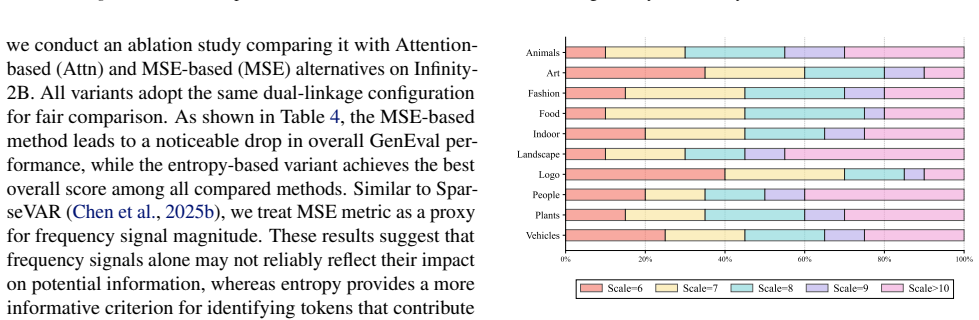
- The adaptive activation scale removes the need for hand-tuned stage boundaries; the schedule adapts per image category, suggesting content-dependent acceleration.
- The ImageReward result (1.035 vs 1.030) implies token pruning need not degrade human preference, which challenges the assumption that acceleration always trades off quality.
- Residual cache reuse provides a template for combining token sparsity with cache-based reconstruction in other dense prediction tasks.
Where Pith is reading between the lines
- The entropy signal could be re-used for other decisions, such as adaptive sampling steps in diffusion or deciding when to stop refinement, since it measures where uncertainty remains.
- The hand-set hyperparameters (α=0.5, test=5, τ=0.8, λ=0.1) are a search space; one could auto-tune them per model, or test the robustness across a wider set of prompts and random seeds than reported.
- Because the theoretical bound is one-sided, the biggest risk is that some low-entropy tokens are structurally important anchors; identifying such failure cases (e.g., object boundaries, text glyphs) would sharpen the method.
Editorial analysis
A structured set of objections, weighed in public.
Referee Report
Summary. The paper proposes NOVA, a training-free token-reduction acceleration framework for visual autoregressive (VAR) text-to-image models. NOVA uses per-token predictive entropy to identify low-information tokens, detects an instance-dependent 'inflection point' in scale-level entropy growth to decide when acceleration starts, computes per-scale and per-layer reduction ratios via scale- and layer-linkage functions, and reuses residual caches for pruned tokens. The authors report a 2.89× speedup on Infinity-2B with near-lossless GenEval performance and a 1.33× speedup on Infinity-8B with a slightly higher ImageReward score than the unpruned baseline. The paper includes ablations on the token-selection metric and on the linkage components.
Significance. Training-free acceleration for VAR is practically relevant, and the reported speedups, if robust, would be a useful contribution: NOVA adds adaptivity to a class of methods that typically rely on fixed schedules, and entropy-based token selection is a principled alternative to attention- or frequency-based heuristics. The paper provides quantitative comparisons on several backbones and benchmarks, as well as ablations for the main design choices. However, the theoretical grounding as stated does not establish pruning safety, and several algorithmic definitions are incomplete, so the significance is conditional on revision.
major comments (5)
- [Eq. (12), §3.3] H̄_{t,k}, the per-layer mean entropy, is used in Eqs. (12)–(13) but never defined. Eq. (7) defines H̄_t only for a whole token map R_t, from the token predictive entropies p_{t,i}. Since the layer-linkage adjustment operates per Transformer layer, the paper must specify which intermediate output produces the per-layer entropy or how H̄_{t,j} is computed. Without this, the layer-adaptive ratios are not implementable or reproducible.
- [§3.2, Eqs. (2)–(3)] The displayed inequalities bound the amount of information a low-entropy token could carry, but pruning does not merely ignore the token's discrete value; it deletes the hidden representation from later layers and substitutes a cached residual (Eqs. 14–16). The relevant quantity for safety is the divergence between pruned and unpruned future-scale predictive distributions, which is not bounded by H(X|Z). The statement in §3.2 that pruning 'has limited impact on potential information gain' is therefore not a theorem. Please add a bound on the actual distribution shift or explicitly reclassify the entropy criterion as an empirical heuristic supported by the ablations.
- [Table 4, §4.3] The central near-lossless claim rests on a single ablation (Infinity-2B, GenEval) with point estimates and no variance or significance testing. The headline differences (GenEval 0.72 vs 0.73; ImageReward 1.035 vs 1.030) are within typical measurement noise. Please report multiple seeds or confidence intervals for at least the key configurations, and ideally an additional backbone/benchmark, to substantiate the safety of the entropy criterion.
- [Eq. (16), §3.3] The residual cache reuse equation is written as Routput_{t,j} = Cache_{t→t+1,j} + Rinput_{t,j}, but the left-hand side should refer to the next scale (t+1), otherwise the equation is circular. Please correct the indexing. Relatedly, Eq. (13) can yield negative ratios when Δ_{t,j} > 1; specify clipping or other bounds on the reduction ratio.
- [§4.1, hyperparameters] Four hand-set hyperparameters (test=5, α=0.5, τ=0.8, λ=0.1) are used without sensitivity analysis. Because the paper emphasizes adaptivity rather than tuning, please show how results vary with these settings (e.g., a small grid) to demonstrate that the method is not brittle to their choice.
minor comments (5)
- [Eq. (10), §3.3] The threshold definition uses t_est, which is never introduced; presumably this should be test, the baseline window parameter. Please define it.
- [Abstract and §4.2] The abstract says '0.01% performance loss' but Table 1 shows GenEval Overall 0.72 vs 0.73, which is about 1.4% relative. Please clarify whether '0.01' refers to an absolute point difference or a relative percentage.
- [Eqs. (5)–(6), §3.3] The factorized likelihood assumption within a scale is central to the additive entropy decomposition. State explicitly that this is the model's parallel-prediction assumption and discuss any mismatch with actual VAR implementations that use causal masking within a scale.
- [Figure 4(b), §3.2] The caption says 600 prompts from GenEval were 'rewritten' but no details of the rewriting are given. Please provide prompt-processing details for reproducibility.
- [Notation] The manuscript alternates between 'NOVA' and 'NOV A'; standardize the name. Also, the reference list has an entry 'Li, Y., Wang, H., et al.' in §2 with missing year/venue details.
Circularity Check
No circularity: NOVA's speed/quality claims are validated on external benchmarks, and the entropy-based selection rule is a heuristic with no input-output equivalence.
full rationale
The central claim (e.g., 2.89x speedup on Infinity-2B with ~0.01 GenEval loss) is not derived from entropy by construction. Token entropy H_{t,i} (Eq. 4) is computed from the model's predictive distribution; the reduction ratios (Eqs. 11 and 13) use entropy and hand-set hyperparameters (α=0.5, τ=0.8, λ=0.1), but the resulting quality is then measured against external benchmarks (GenEval, DPG-Bench, MJHQ-30K, ImageReward) in Tables 1-3. Thus the reported outcomes are independent of the method's internal definitions. The theoretical support (Eq. 2) is a one-sided bound that does not by itself prove pruning safety; however, a weak or invalid inference is a correctness concern, not circularity. The paper's self-citations (e.g., Zhang et al. 2025b in Related Work) are background-only and do not carry any load-bearing argument. No fitted parameter is renamed as a prediction, and no uniqueness theorem or ansatz is imported from the authors' prior work. The ablation in Table 4 empirically compares entropy against attention- and MSE-based selection on the same benchmark, so the choice of criterion is tested rather than assumed. Consequently, no specific equation reduces to its own input, and no circular step can be quoted with a concrete reduction.
Axiom & Free-Parameter Ledger
free parameters (4)
- α (entropy growth threshold) =
0.5
- test (early baseline window) =
5
- τ (sigmoid temperature) =
0.8
- λ (tanh scaling) =
0.1
axioms (4)
- domain assumption Factorized conditional likelihood within each scale: p(Rt|R<t) = ∏ p(rt,i|R<t) (Eq 5)
- domain assumption Two-stage entropy dynamic: scale-mean entropy grows rapidly then plateaus for every instance
- ad hoc to paper Low-entropy tokens contribute negligible future information gain (safety of pruning)
- domain assumption Residual cache from the prior scale interpolates to a faithful substitute for the current scale's layer output on pruned tokens
Cite this review
Pith. "Pith review of Adaptive Visual Autoregressive Acceleration via Dual-Linkage Entropy Analysis." pith.science (2026). https://pith.science/paper/UYZMEVOE
@misc{pith2026260201345,
  author       = {Pith},
  title        = {Pith review of: Adaptive Visual Autoregressive Acceleration via Dual-Linkage Entropy Analysis},
  year         = {2026},
  howpublished = {\url{https://pith.science/paper/UYZMEVOE}},
  note         = {Machine review of arXiv:2602.01345}
}
read the original abstract
Visual AutoRegressive modeling (VAR) suffers from substantial computational cost due to the massive token count involved. Failing to account for the continuous evolution of modeling dynamics, existing VAR token reduction methods face three key limitations: heuristic stage partition, non-adaptive schedules, and limited acceleration scope, thereby leaving significant acceleration potential untapped. Since entropy variation intrinsically reflects the transition of predictive uncertainty, it offers a principled measure to capture modeling dynamics evolution. Therefore, we propose NOVA, a training-free token reduction acceleration framework for VAR models via entropy analysis. NOVA adaptively determines the acceleration activation scale during inference by online identifying the inflection point of scale entropy growth. Through scale-linkage and layer-linkage ratio adjustment, NOVA dynamically computes distinct token reduction ratios for each scale and layer, pruning low-entropy tokens while reusing the cache derived from the residuals at the prior scale to accelerate inference and maintain generation quality. Extensive experiments and analyses validate NOVA as a simple yet effective training-free acceleration framework.
Figures


Reference graph
Works this paper leans on
-
[1]
Ben-Hamu, H., Gat, I., Severo, D., Nolte, N., and Kar- rer, B. Accelerated sampling from masked diffusion models via entropy bounded unmasking.arXiv preprint arXiv:2505.24857,
-
[5]
Hu, X., Wang, R., Fang, Y ., Fu, B., Cheng, P., and Yu, G. Ella: Equip diffusion models with llm for enhanced semantic alignment.arXiv preprint arXiv:2403.05135,
-
[6]
Spectralar: Spectral autoregressive visual generation
Huang, Y ., Chen, W., Zheng, W., Duan, Y ., Zhou, J., and Lu, J. Spectralar: Spectral autoregressive visual generation. arXiv preprint arXiv:2506.10962,
-
[7]
Jiao, S., Zhang, G., Qian, Y ., Huang, J., Zhao, Y ., Shi, H., Ma, L., Wei, Y ., and Jie, Z. Flexvar: Flexible visual au- toregressive modeling without residual prediction.arXiv preprint arXiv:2502.20313,
-
[8]
Kumar, A., Nair, N. G., and Patel, V . M. Scale- wise var is secretly discrete diffusion.arXiv preprint arXiv:2509.22636,
-
[9]
Li, C., Zhang, J., Liu, S., Lin, S., Shi, Z., Li, Z., and Chang, X. Efficient training for human video generation with entropy-guided prioritized progressive learning.arXiv preprint arXiv:2511.21136, 2025a. Li, D., Kamko, A., Akhgari, E., Sabet, A., Xu, L., and Doshi, S. Playground v2. 5: Three insights towards enhancing aesthetic quality in text-to-image...
-
[10]
Improving the trainability of deep neural networks through layerwise batch-entropy regularization
Peer, D., Keulen, B., Stabinger, S., Piater, J., and Rodr´ıguez- S´anchez, A. Improving the trainability of deep neural networks through layerwise batch-entropy regularization. arXiv preprint arXiv:2208.01134,
-
[12]
Visual autoregressive modeling for image super- resolution.arXiv preprint arXiv:2501.18993,
Qu, Y ., Yuan, K., Hao, J., Zhao, K., Xie, Q., Sun, M., and Zhou, C. Visual autoregressive modeling for image super- resolution.arXiv preprint arXiv:2501.18993,
-
[13]
Rajagopalan, S., Narayan, K., and Patel, V . M. Restore- var: Visual autoregressive generation for all-in-one image restoration.arXiv preprint arXiv:2505.18047,
-
[14]
Ren, S., Yu, Y ., Ruiz, N., Wang, F., Yuille, A., and Xie, C. M-var: Decoupled scale-wise autoregressive model- ing for high-quality image generation.arXiv preprint arXiv:2411.10433,
-
[15]
Efficient diffusion models: A survey.arXiv preprint arXiv:2502.06805,
Shen, H., Zhang, J., Xiong, B., Hu, R., Chen, S., Wan, Z., Wang, X., Zhang, Y ., Gong, Z., Bao, G., et al. Efficient diffusion models: A survey.arXiv preprint arXiv:2502.06805,
-
[16]
Hart: Efficient visual generation with hybrid autoregressive transformer
Tang, H., Wu, Y ., Yang, S., Xie, E., Chen, J., Chen, J., Zhang, Z., Cai, H., Lu, Y ., and Han, S. Hart: Efficient visual generation with hybrid autoregressive transformer. arXiv preprint arXiv:2410.10812,
-
[17]
Dynamic mixture-of- experts for visual autoregressive model.arXiv preprint arXiv:2510.08629,
Vincenti, J., Jazbec, M., and Xia, G. Dynamic mixture-of- experts for visual autoregressive model.arXiv preprint arXiv:2510.08629,
-
[18]
Wang, Y ., Guo, L., Li, Z., Huang, J., Wang, P., Wen, B., and Wang, J. Training-free text-guided image edit- ing with visual autoregressive model.arXiv preprint arXiv:2503.23897,
-
[19]
Wu, J., Chen, X., Shi, B., Li, S., and Xu, K
URL https://arxiv.org/ abs/2510.23028. Wu, J., Chen, X., Shi, B., Li, S., and Xu, K. Sega: Structural entropy guided anchor view for graph contrastive learning. InInternational Conference on Machine Learning, pp. 37293–37312. PMLR, 2023a. Wu, X., Hao, Y ., Sun, K., Chen, Y ., Zhu, F., Zhao, R., and Li, H. Human preference score v2: A solid benchmark for e...
-
[20]
Litevar: Compressing visual autoregres- sive modelling with efficient attention and quantization
Xie, R., Zhao, T., Yuan, Z., Wan, R., Gao, W., Zhu, Z., Ning, X., and Wang, Y . Litevar: Compressing visual autoregres- sive modelling with efficient attention and quantization. arXiv preprint arXiv:2411.17178,
-
[21]
Zhang, K., Yang, R., Zhang, Y ., You, S., and Huang, T. Actvar: Activating mixtures of weights and tokens for efficient visual autoregressive generation.arXiv preprint arXiv:2511.12893, 2025a. 10 Adaptive Visual Autoregressive Acceleration via Dual-Linkage Entropy Analysis Zhang, Q., Dai, X., Yang, N., An, X., Feng, Z., and Ren, X. Var-clip: Text-to-image...
-
[22]
Zhang, Y ., Liu, J., Shi, Y ., Zhang, Q., Miao, D., Wang, C., and Cao, L. Markovian scale prediction: A new era of visual autoregressive generation.arXiv preprint arXiv:2511.23334, 2025b. 11
-
[2022]
Qin, Z., Lv, Y ., Lin, M., Guo, H., Zhang, Z., Zou, D., and Lin, W. Head-aware kv cache compression for ef- ficient visual autoregressive modeling.arXiv preprint arXiv:2504.09261,
-
[2023]
Guo, H., Li, Y ., Zhang, T., Wang, J., Dai, T., Xia, S.- T., and Benini, L. Fastvar: Linear visual autoregres- sive modeling via cached token pruning.arXiv preprint arXiv:2503.23367, 2025a. Guo, L., Xue, Z., Xu, Z., and Xu, H. Demospeedup: Accel- erating visuomotor policies via entropy-guided demon- stration acceleration.arXiv preprint arXiv:2506.05064, 2...
-
[2024]
Chen, Z., Chu, R., Chen, Y ., Zhang, S., Wei, Y ., Zhang, Y ., and Liu, X. Tts-var: A test-time scaling framework for visual auto-regressive generation.arXiv preprint arXiv:2507.18537, 2025a. Chen, Z., Fan, J., Yu, Z., Zhuang, B., and Tan, M. Frequency-aware autoregressive modeling for efficient high-resolution image synthesis. InProceedings of the IEEE/C...
-
[2025]
He, Y ., He, Y ., He, S., Chen, F., Zhou, H., Zhang, K., and Zhuang, B. Neighboring autoregressive modeling for effi- cient visual generation.arXiv preprint arXiv:2503.10696,
discussion (0)
Sign in with ORCID, Apple, or X to comment. Anyone can read and Pith papers without signing in.