Minimal Extensions of the α-Starobinsky Model: Reconciling ACT DR6 and Reheating Constraints
Pith reviewed 2026-06-25 23:40 UTC · model grok-4.3
The pith
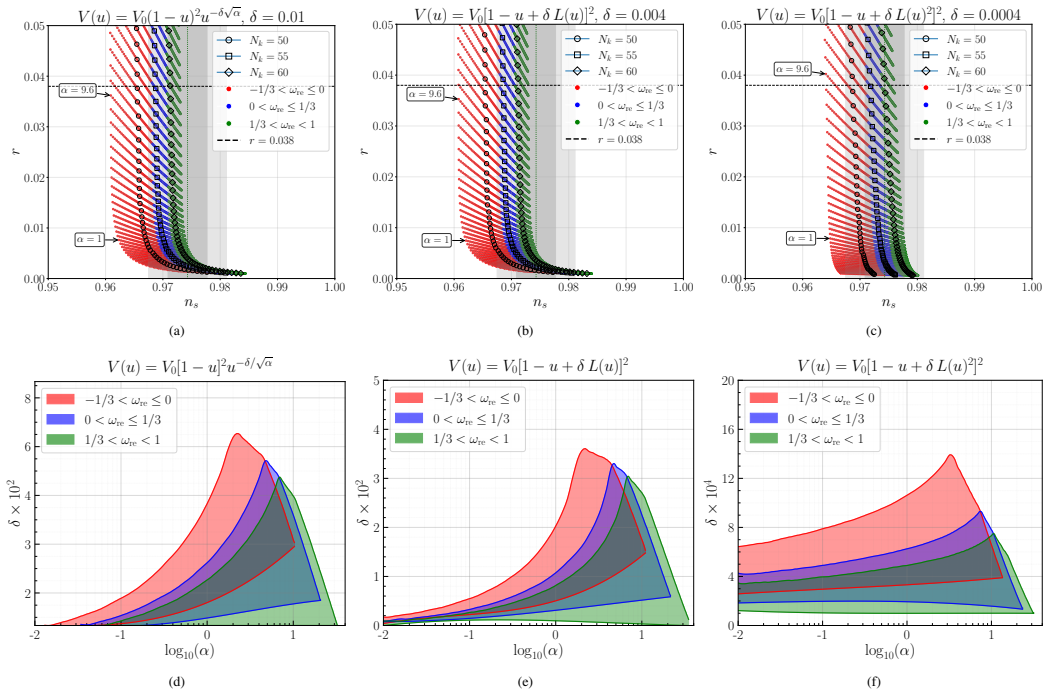
Two small-δ extensions to the α-Starobinsky model shift the predicted scalar spectral index into the 1σ region of ACT DR6 data while keeping the tensor-to-scalar ratio below 0.038.
A machine-rendered reading of the paper's core claim, the machinery that carries it, and where it could break.
Core claim
The central claim is that a single small perturbative parameter δ introduced either multiplicatively through an exponential or additively through a polynomial term allows the α-Starobinsky model to reconcile with the measured ns = 0.9743 ± 0.0034 at 1σ without exceeding r < 0.038, while the derived reheating temperatures remain between the BBN and gravitino bounds for the stated e-folding range.
What carries the argument
The δ-dependent corrections to the inflationary potential, whose effects on the slow-roll parameters are computed analytically to second order in δ and then inserted into the reheating consistency equation.
If this is right
- For the exponential extension, α ≲ 35 and δ ∼ 10^{-2} place the model inside the 1σ region.
- The additive extension requires δ ∼ 10^{-3} when p=1 and δ ∼ 10^{-4} when p=2.
- The reheating equation of state must lie in 0 < ω_re ≤ 1 for N_k between 50 and 65.
- All viable parameter combinations produce T_re ∼ 10^9 GeV.
Where Pith is reading between the lines
- The small size of the required δ suggests these corrections could arise naturally from higher-order terms in an effective field theory completion.
- Future tighter bounds on the tensor-to-scalar ratio could distinguish the exponential modification from the polynomial one.
- Analogous single-parameter deformations may resolve similar ns tensions in other plateau-type inflation models.
Load-bearing premise
The second-order expansion in δ remains accurate for the specific δ magnitudes needed to fit the data and the modifications stay small enough to keep the original plateau and attractor properties intact.
What would settle it
A future measurement finding that no value of δ in the stated ranges can place ns inside the observed 1σ interval while r stays below 0.038, or a reheating temperature outside the 10^9 GeV window for the viable α and N_k values.
Figures

read the original abstract
The latest combined data from the Atacama Cosmology Telescope (ACT) DR6, Planck, and DESI yields a scalar spectral index $n_s = 0.9743 \pm 0.0034$, which lies approximately $2\sigma$ above the prediction of the standard $\alpha$-Starobinsky inflation model. To address this tension, we propose two minimal extensions that preserve the model's plateau structure and attractor properties: a multiplicative exponential modification and an additive polynomial deformation, both governed by a single small perturbative parameter $\delta>0$. We analytically derive the slow-roll parameters and inflationary observables up to second order in $\delta$ and integrate them with reheating dynamics via the consistency equation. It is shown that the $\delta$ term effectively shifts $n_s$ into the $1\sigma$ confidence region of the joint P-ACT-LB-BK18 dataset without violating the tensor-to-scalar ratio bound ($r < 0.038$). The viable parameter space at $1\sigma$ requires $\alpha \lesssim 35$ with $\delta \sim \mathcal{O}(10^{-2})$ for the exponential model, while the additive model requires $\delta \sim \mathcal{O}(10^{-3})$ for $p=1$ and $\delta \sim \mathcal{O}(10^{-4})$ for $p=2$. For the e-folding range $N_k \in [50, 65]$, the relevant reheating equation of state is $0<\omega_{\mathrm{re}}\le1$. All viable scenarios yield a reheating temperature $T_{\mathrm{re}} \sim 10^9$ GeV, which is safely above the Big Bang Nucleosynthesis (BBN) bound and below the gravitino overproduction limit.
Editorial analysis
A structured set of objections, weighed in public.
Referee Report
Summary. The paper proposes two minimal single-parameter (δ) extensions to the α-Starobinsky model—a multiplicative exponential deformation and an additive polynomial deformation—that preserve the plateau and attractor structure. Analytic expressions for the slow-roll parameters and observables (ns, r) are derived to second order in δ, combined with a reheating consistency equation, and shown to shift ns into the 1σ region of the P-ACT-LB-BK18 dataset (ns = 0.9743 ± 0.0034) for δ ∼ O(10^{-2}) (exponential) or smaller (additive), while keeping r < 0.038, α ≲ 35, and yielding Tre ∼ 10^9 GeV for N_k ∈ [50,65] and 0 < ω_re ≤ 1.
Significance. If the second-order analytic results remain accurate for the required δ values, the work supplies a controlled, minimal modification that reconciles the α-Starobinsky family with the latest ACT DR6 data without spoiling its attractive features or violating reheating/BBN bounds. The explicit mapping from δ to Δns and the reheating-temperature predictions constitute falsifiable outputs that can be tested against future data releases.
major comments (2)
- [Abstract / analytic derivation of slow-roll parameters to O(δ²)] Abstract and the analytic-derivation section: the central claim that the O(δ²) expressions for ns and r suffice to produce the required Δns ≈ 0.003 shift for δ ∼ 10^{-2} (exponential case, α ≲ 35) is load-bearing, yet no remainder estimate or numerical cross-check against the exact potential is provided. For these δ values the O(δ³) corrections to V'' that enter ns can be comparable to the reported 1σ shift, undermining the reliability of the truncation.
- [Viable parameter space at 1σ] Viable-parameter section: the statement that δ is chosen so that ns lies inside the 1σ ACT interval makes the reconciliation at least partly by construction; the additional reheating constraint is welcome but does not remove the need to demonstrate that the same δ values simultaneously satisfy the r bound and the validity of the second-order expansion without fine-tuning.
minor comments (1)
- [Introduction / model definitions] Notation for the two deformations (multiplicative vs. additive) should be introduced with explicit potential forms in the main text rather than only in the abstract.
Simulated Author's Rebuttal
We thank the referee for the detailed and constructive report. The comments highlight important points regarding the reliability of our perturbative results and the structure of the viable parameter space. We address each major comment below and indicate where revisions will be made.
read point-by-point responses
-
Referee: [Abstract / analytic derivation of slow-roll parameters to O(δ²)] Abstract and the analytic-derivation section: the central claim that the O(δ²) expressions for ns and r suffice to produce the required Δns ≈ 0.003 shift for δ ∼ 10^{-2} (exponential case, α ≲ 35) is load-bearing, yet no remainder estimate or numerical cross-check against the exact potential is provided. For these δ values the O(δ³) corrections to V'' that enter ns can be comparable to the reported 1σ shift, undermining the reliability of the truncation.
Authors: We agree that the lack of an explicit error estimate or numerical validation for the O(δ²) truncation is a genuine limitation of the current manuscript. Although δ ∼ O(10^{-2}) is perturbatively small, O(δ³) contributions to the second derivative could affect ns at the level of the reported shift. In the revised version we will add a dedicated subsection comparing the analytic ns and r expressions to exact numerical evaluation of the slow-roll parameters from the full potential, for benchmark points across the claimed viable region (exponential and additive cases). This will either confirm the truncation accuracy or quantify the residual error. revision: yes
-
Referee: [Viable parameter space at 1σ] Viable-parameter section: the statement that δ is chosen so that ns lies inside the 1σ ACT interval makes the reconciliation at least partly by construction; the additional reheating constraint is welcome but does not remove the need to demonstrate that the same δ values simultaneously satisfy the r bound and the validity of the second-order expansion without fine-tuning.
Authors: We accept that fixing δ to place ns inside the 1σ interval is by construction for that observable alone. The manuscript already imposes the independent requirements that r < 0.038, that the slow-roll conditions remain satisfied, and that the reheating consistency equation yields T_re in the allowed window for N_k ∈ [50,65]. The reported viable regions are the intersections of these constraints. We will revise the text to make this intersection explicit, to state the range of δ for which the second-order expansion remains valid (to be quantified by the new numerical checks), and to emphasize that no additional fine-tuning beyond the single-parameter δ is introduced. revision: partial
Circularity Check
No significant circularity; parameter fitting to data is explicit and non-circular.
full rationale
The paper introduces δ as an explicit free perturbative parameter in two potential extensions, derives slow-roll observables analytically to O(δ²) from the modified potentials, and then uses the resulting expressions to identify viable ranges of α and δ that place ns inside the 1σ ACT region while satisfying r < 0.038 and reheating bounds. This is standard model extension and data-driven constraint, not a reduction of any claimed prediction to its own inputs by construction. No self-citations, uniqueness theorems, or ansatzes are invoked as load-bearing; the reheating temperature range emerges from the consistency equation applied to the fitted viable parameters rather than being presupposed. The derivation chain remains self-contained against external benchmarks.
Axiom & Free-Parameter Ledger
free parameters (2)
- δ =
O(10^{-2}) to O(10^{-4})
- α =
≲ 35
axioms (2)
- domain assumption Slow-roll approximation remains valid throughout inflation
- domain assumption Reheating can be consistently linked to inflation via the standard consistency equation relating N_k and ω_re
Reference graph
Works this paper leans on
-
[3]
A. Adame, J. Aguilar, S. Ahlen, S. Alam, D. Alexan- der, M. Alvarez, et al., Desi 2024 iii: baryon acoustic oscillations from galaxies and quasars, Journal of Cos- mology and Astroparticle Physics 2025 (04) (2025) 012. doi:10.1088/1475-7516/2025/04/012
-
[4]
Adame, J
A. Adame, J. Aguilar, S. Ahlen, et al., Desi 2024 vi: cos- mological constraints from the measurements of baryon acoustic oscillations, Journal of Cosmology and Astropar- ticle Physics 2025 (02) (2025) 021.doi:10.1088/ 1475-7516/2025/02/021
2024
- [7]
-
[8]
C. Dioguardi, A. J. Iovino, A. Racioppi, Fractional attrac- tors in light of the latest act observations, Phys. Lett. B 868 (2025) 139664.doi:10.1016/j.physletb.2025. 139664
-
[9]
A. Mohammadi, Yogesh, A. Wang, Power law plateau in- flation and primordial gravitational waves in the light of act, Phys. Lett. B 872 (2025) 140054.doi:10.1016/j. physletb.2025.140054
work page doi:10.1016/j 2025
-
[10]
M. Drees, Y . Xu, Refined predictions for starobinsky in- flation and post-inflationary constraints in light of act, Phys. Lett. B 867 (2025) 139612.arXiv:2504.20757, doi:10.1016/j.physletb.2025.139612
-
[11]
A. R. Liddle, S. M. Leach, How long before the end of inflation were observable perturbations produced?, Phys. Rev. D 68 (2003) 103503.arXiv:astro-ph/0305263, doi:10.1103/PhysRevD.68.103503
work page internal anchor Pith review Pith/arXiv arXiv doi:10.1103/physrevd.68.103503 2003
-
[12]
G. German, Reheating dynamics in inflationary cosmol- ogy: insights fromα-attractor andα-starobinsky models, The European Physical Journal Plus 140 (2) (2025) 1–14. doi:10.1140/epjp/s13360-025-06011-x
-
[13]
B. A. Bassett, S. Tsujikawa, D. Wands, Inflation dynamics and reheating, Rev. Mod. Phys. 78 (2006) 537.arXiv: astro-ph/0507632,doi:10.1103/RevModPhys.78. 537
work page internal anchor Pith review Pith/arXiv arXiv doi:10.1103/revmodphys.78 2006
-
[14]
D. I. Podolsky, G. N. Felder, L. Kofman, M. Peloso, Equa- tion of state and beginning of thermalization after preheat- ing, Phys. Rev. D 73 (2006) 023501.arXiv:hep-ph/ 0507096,doi:10.1103/PhysRevD.73.023501
-
[15]
Reheating in Inflationary Cosmology: Theory and Applications
R. Allahverdi, R. Brandenberger, F.-Y . Cyr-Racine, A. Mazumdar, Reheating in inflationary cosmology: The- ory and applications, Ann. Rev. Nucl. Part. Sci. 60 (2010) 27–51.arXiv:1001.2600,doi:10.1146/annurev. nucl.012809.104511
work page internal anchor Pith review Pith/arXiv arXiv doi:10.1146/annurev 2010
-
[16]
L. Kofman, A. D. Linde, A. A. Starobin- sky, Reheating after inflation, Phys. Rev. Lett. 73 (1994) 3195.arXiv:hep-th/9405187, doi:10.1103/PhysRevLett.73.3195
work page internal anchor Pith review Pith/arXiv arXiv doi:10.1103/physrevlett.73.3195 1994
-
[17]
M. A. G. Garcia, G. Germán, R. Gonzalez Quaglia, A. M. M. Colorado, Reheating constraints and consis- tency relations of the starobinsky model and some of its generalizations, JCAP 12 (2023) 015.arXiv:2306. 15831,doi:10.1088/1475-7516/2023/12/015
-
[18]
M. R. Haque, D. Maity, T. Paul, L. Sriramkumar, Decod- ing the phases of early and late time reheating through imprints on primordial gravitational waves, Phys. Rev. D 104 (6) (2021) 063513.doi:10.1103/PhysRevD.104. 063513
-
[19]
K. Kohri, T. Moroi, A. Yotsuyanagi, Big-bang nucleosyn- thesis with unstable gravitino and upper bound on the reheating temperature, Phys. Rev. D 73 (2006) 123511. doi:10.1103/PhysRevD.73.123511
-
[20]
M. Y . Khlopov, A. D. Linde, Is it easy to save the grav- itino?, Phys. Lett. B 138 (1984) 265.doi:10.1016/ 0370-2693(84)91656-3
1984
-
[21]
M. Bolz, A. Brandenburg, W. Buchmüller, Ther- mal production of gravitinos, Nucl. Phys. B 606 (2001) 518, erratum: Nucl. Phys. B 790 (2008) 336–337.arXiv:hep-ph/0012052,doi:10.1016/ S0550-3213(01)00132-8
Pith/arXiv arXiv 2001
-
[22]
S. S. Mishra, V . Sahni, A. A. Starobinsky, Curing infla- tionary degeneracies using reheating predictions and relic gravitational waves, JCAP 05 (2021) 075.arXiv:2101. 00271,doi:10.1088/1475-7516/2021/05/075
- [23]
-
[24]
J. Martin, C. Ringeval, V . Vennin, Encyclopædia infla- tionaris, Physics of the Dark Universe 5-6 (2014) 75–235, hunt for Dark Matter.doi:10.1016/j.dark.2014.01. 003. 7
-
[25]
A. H. Guth, The inflationary universe: A possible solu- tion to the horizon and flatness problems, Phys. Rev. D 23 (1981) 347–356.doi:10.1103/PhysRevD.23.347
-
[26]
A. A. Starobinsky, A new type of isotropic cosmological models without singularity, Phys. Lett. B 91 (1980) 99– 102.doi:10.1016/0370-2693(80)90670-X
-
[27]
Planck 2018 results. VI. Cosmological parameters
N. Aghanim, et al., Planck 2018 results. vi. cosmological parameters, Astron. Astrophys. 641 (2020) A6, [Erratum: Astron.Astrophys. 652, C4 (2021)].arXiv:1807.06209, doi:10.1051/0004-6361/201833910
work page internal anchor Pith review Pith/arXiv arXiv doi:10.1051/0004-6361/201833910 2018
-
[28]
Planck 2018 results. X. Constraints on inflation
Y . Akrami, et al., Planck 2018 results. x. constraints on inflation, Astron. Astrophys. 641 (2020) A10.arXiv: 1807.06211,doi:10.1051/0004-6361/201833887
work page internal anchor Pith review Pith/arXiv arXiv doi:10.1051/0004-6361/201833887 2018
-
[29]
P. A. R. Ade, et al., Improved constraints on primordial gravitational waves using planck, wmap, and bicep/keck observations through the 2018 observing season, Phys. Rev. Lett. 127 (2021) 151301.arXiv:2110.00483,doi: 10.1103/PhysRevLett.127.151301
-
[30]
J. Ellis, D. V . Nanopoulos, K. A. Olive, Starobinsky- like inflationary models as avatars of no-scale supergrav- ity, JCAP 10 (2013) 009.arXiv:1307.3537,doi:10. 1088/1475-7516/2013/10/009
Pith/arXiv arXiv 2013
-
[31]
R. Kallosh, A. Linde, D. Roest, Superconformal infla- tionaryα-attractors, JHEP 11 (2013) 198.arXiv:1311. 0472,doi:10.1007/JHEP11(2013)198
-
[32]
J. Ellis, M. A. G. Garcia, D. V . Nanopoulos, K. A. Olive, No-scale inflation, Class. Quant. Grav. 33 (2016) 094001.arXiv:1507.02308,doi:10.1088/ 0264-9381/33/9/094001
Pith/arXiv arXiv 2016
-
[33]
S. Saini, A. Nautiyal, Observational constraints onα- starobinsky inflation, Gravitation and Cosmology 31 (4) (2025) 517–525.doi:10.1134/S0202289325700392
-
[34]
G. Germán, Model independent results for the inflation- ary epoch and the breaking of the degeneracy of mod- els of inflation, Journal of Cosmology and Astropar- ticle Physics 2020 (11) (2020) 006.doi:10.1088/ 1475-7516/2020/11/006
2020
-
[35]
J. L. Cook, E. Dimastrogiovanni, D. A. Easson, L. M. Krauss, Reheating predictions in single field inflation, JCAP 04 (2015) 047.arXiv:1502.04673,doi:10. 1088/1475-7516/2015/04/047
Pith/arXiv arXiv 2015
-
[36]
L. Dai, M. Kamionkowski, J. Wang, Reheating con- straints to inflationary models, Phys. Rev. Lett. 113 (4) (2014) 041302.arXiv:1404.6704,doi:10.1103/ PhysRevLett.113.041302
Pith/arXiv arXiv 2014
-
[37]
M. S. Turner, Coherent scalar field oscillations in an ex- panding universe, Phys. Rev. D 28 (1983) 1243.doi: 10.1103/PhysRevD.28.1243
-
[38]
M. A. Amin, M. P. Hertzberg, D. I. Kaiser, J. Karouby, Nonperturbative dynamics of reheating after inflation: A review, Int. J. Mod. Phys. D 24 (2014) 1530003.arXiv: 1410.3808,doi:10.1142/S0218271815300037
work page internal anchor Pith review Pith/arXiv arXiv doi:10.1142/s0218271815300037 2014
-
[39]
German, Perturbative analysis of the reheating dy- namics ofα-attractors, Int
G. German, Perturbative analysis of the reheating dy- namics ofα-attractors, Int. J. Mod. Phys. D 34 (14) (2025) 2550065.arXiv:2504.14082,doi:10.1142/ S0218271825500658
arXiv 2025
-
[40]
M. Kawasaki, K. Kohri, T. Moroi, Big-bang nucleosyn- thesis and hadronic decay of long-lived massive parti- cles, Phys. Rev. D 71 (2005) 083502.arXiv:astro-ph/ 0408426,doi:10.1103/PhysRevD.71.083502
-
[41]
J. R. Ellis, J. E. Kim, D. V . Nanopoulos, Cosmological gravitino regeneration and decay, Phys. Lett. B 145 (1984) 181.doi:10.1016/0370-2693(84)90334-4
-
[42]
P. F. de Salas, M. Lattanzi, G. Mangano, G. Miele, S. Pas- tor, O. Pisanti, Bounds on very low reheating scenarios af- ter planck, Phys. Rev. D 92 (12) (2015) 123534.arXiv: 1511.00672,doi:10.1103/PhysRevD.92.123534
work page internal anchor Pith review Pith/arXiv arXiv doi:10.1103/physrevd.92.123534 2015
-
[43]
S. Ferrara, R. Kallosh, A. Linde, Cosmology with nilpo- tent superfields, JHEP 10 (2014) 143.arXiv:1408. 4096,doi:10.1007/JHEP10(2014)143
-
[44]
R. Kallosh, A. Linde, Polynomialα-attractors, JCAP 04 (2022) 017.arXiv:2202.06492,doi:10.1088/ 1475-7516/2022/04/017
arXiv 2022
-
[45]
M. Braglia, M. Hazumi, D. Lopez Nacir, F. Piazza,α- attractor inflation: Models and predictions, Phys. Rev. D 107 (10) (2023) 103530.arXiv:2212.13363,doi:10. 1103/PhysRevD.107.103530
arXiv 2023
-
[46]
C. Pallis, N. Toumbas, Starobinsky inflation: From non- susy to sugra realizations, Adv. High Energy Phys. 2017 (2017) 6759267.arXiv:1612.09202,doi:10.1155/ 2017/6759267
Pith/arXiv arXiv 2017
-
[47]
Gravitational particle production in bouncing cosmologies
J. Ellis, M. A. G. Garcia, D. V . Nanopoulos, K. A. Olive, S. Verner, Unified no-scale attractors, JCAP 09 (2019) 040.arXiv:1906.10176,doi:10.1088/1475-7516/ 2019/09/040
-
[48]
Cosmological Attractors from $\alpha$-Scale Supergravity
D. Roest, M. Scalisi, Cosmological attrac- tors fromα-scale supergravity, Phys. Rev. D 92 (4) (2015) 043525.arXiv:1503.07909, doi:10.1103/PhysRevD.92.043525. 8
work page internal anchor Pith review Pith/arXiv arXiv doi:10.1103/physrevd.92.043525 2015
discussion (0)
Sign in with ORCID, Apple, or X to comment. Anyone can read and Pith papers without signing in.