REVIEW 4 major objections 6 minor 50 references
M2Rec: Multi-scale Mamba for Efficient Sequential Recommendation
T0 review · 4 major / 6 minor · reviewed 2026-08-15 · deepseek-v4-flash
Pith's one-line read This paper claims that M2Rec—a Mamba-based sequential recommender augmented with an adaptive Fourier filter, fixed LLM text embeddings, and a learned gate—beats existing Mamba-based and Transformer-based models on next-item prediction…
desk verdict Plausible architecture combo with a real positional-FFT mechanic mismatch; the reported gains are worth checking but the periodic-story and data tables need fixing. read the letter →
The pith
A machine-rendered reading of the paper's core claim, the machinery that carries it, and where it could break.
The reading
What carries the argument
The central object is the AFFM block (Adaptive Fast Fourier Transform powered Mamba), which implements Equations 11 through 15. The user's item sequence $X_u[t]$ is Fourier-transformed over positions $t$, multiplied by a binary mask that keeps frequencies below threshold $\theta$, multiplied by learned complex weights $W$, inverse-transformed (IFFT) back to the time domain, and then processed by the Mamba SSM with SiLU gating. This module grounds the paper's claims about periodic-pattern capture and noise reduction. The second mechanism is the gate fusion in Equation 16, which forms the prediction as a linear map of $\alpha$ times the LLM embeddings plus $\beta$ times the Mamba output; the paper treats $\alpha$ and $\beta$ as adaptable parameters.
What would settle it
Train M2Rec and an otherwise identical variant that also receives timestamps or inter-arrival gaps on ML-1M. If the position-only FFT truly captures daily and weekly behavior, adding time information should not change Hit Rate@10; if it improves, the paper's stated periodic mechanism is not grounded in the model's actual input. A second check: keep item order fixed but replace all timestamps with random ones; the position-only model must be unaffected by construction, while a time-aware model should degrade.
Extended reading notes
Core claim
The central claim is that M2Rec outperforms both Transformer-based and Mamba-based sequential recommenders across four datasets (ML-1M, New York, California, Texas), with the best Hit Rate@10 of 0.3224 on ML-1M, a 3.30% relative improvement over the strongest Mamba baseline, and analogous gains in NDCG@10 and MRR@10. The paper attributes the gains to three components: the adaptive FFT (AFFT) module, which transforms the item-position signal into the frequency domain, masks high frequencies, multiplies by a learned kernel, and transforms back before entering the Mamba SSM; fixed LLM embeddings of item names, categories, and descriptions; and a gate that balances the two embedding streams. The paper also claims the FFT branch makes the model more robust to injected Gaussian noise and that the gate makes performance stable across different LLM embedding backbones.
Load-bearing premise
The load-bearing premise is that Fourier-transforming the item order in a user's history captures genuine daily and weekly behavior cycles, even though the model never sees timestamps; if user interactions are irregularly spaced in time, that premise fails and the periodic-pattern explanation for the gains collapses.
Editorial extensions
If this is right
- If the central claim is right, Mamba-based sequential recommenders can capture periodic user behavior by preprocessing sequences in the frequency domain, so future work need not replace Mamba with attention to model periodicity.
- The gate mechanism makes the model robust to which LLM produces the text embeddings, so teams can swap embedding backbones without retuning the rest of the model.
- The adaptive FFT acts as a noise filter, so M2Rec should degrade more gracefully than Mamba4Rec or BERT4Rec when embeddings are corrupted.
- Because the FFT adds only $O(BTd\log T)$ time, the approach remains practical for long user histories where Transformers' quadratic attention is prohibitive.
Reading between the lines
- Because the FFT in Equation 11 is applied to position index $t$, not to wall-clock time, the paper's daily- and weekly-cycle story is really about position-index frequencies; a direct test would be to feed the model actual timestamps or inter-arrival gaps and see whether the periodic mechanism still helps.
- The gate in Equation 16 appears to use scalar parameters $\alpha$ and $\beta$ shared across users and positions; a per-user or per-item gate would be a natural extension if context-dependent balancing is the goal.
- The LLM embeddings are fixed (bge-large-en-v1.5), so the paper's results speak to content enrichment rather than LLM reasoning; using a trainable or instruction-tuned LLM encoder could change the accuracy-efficiency trade-off.
- If the FFT's noise filtering is the source of robustness, the same adaptive filter could be applied to other sequence encoders besides Mamba—a testable transfer to attention-based recommenders.
Signed reviews
Editorial analysis
A structured set of objections, weighed in public.
Referee Report
Summary. The paper proposes M2Rec, a sequential recommendation model that combines a Mamba-based state-space encoder with an adaptive Fast Fourier Transform (AFFT), LLM-generated item embeddings, and a learned gate for fusing feature streams. The authors claim state-of-the-art performance on four datasets, with HR@10 improved by about 3.2% over Mamba-based baselines and faster inference than Transformer baselines. The manuscript includes an architecture description, complexity analysis, main results, ablations, robustness tests, and hyperparameter studies.
Significance. If the reported improvements are reproducible, the paper makes a useful empirical contribution to efficient sequential recommendation, particularly the combination of a linear-time Mamba backbone with frequency-domain filtering and semantic embeddings. The experiments cover a reasonable range of baselines and datasets, and the paper includes ablation, robustness, and efficiency analyses, which are strengths. However, the central mechanistic claim—that the FFT module explicitly models daily, weekly, and monthly periodic user behavior—is not grounded in the model's actual input, and several internal inconsistencies in the data and hyperparameter tables currently undermine confidence in the reported results.
major comments (4)
- [Section III-D, Eq. (11) and Algorithm 1] The DFT in Eq. (11) is applied to Xu[t] with t as the position index in the interaction sequence. Algorithm 1's input is Xu: (B, T, |V|) and context C used only for LLM embeddings; no timestamps or inter-arrival times enter the model. Consequently, the frequency axis is cycles per interaction, not cycles per day, and the peaks at 1 cycle/day and ~0.14 cycles/day shown in Fig. 1 cannot be obtained from Eq. (11). The paper's central claim that M2Rec explicitly captures daily, weekly, and monthly periodic user behavior is therefore not operational in the architecture as written. This is a load-bearing mismatch between the motivating analysis and the actual mechanism; please either modify the model to consume timestamps or reframe the contribution as position-frequency filtering/sequence smoothing.
- [Section IV-A and Table III] The dataset statistics are internally inconsistent. The text states that Texas has 27.2M interactions and is the largest dataset, but Table III reports only 1,344,379 interactions for Texas. In addition, the reported average interactions per user do not match Table III: New York has 478,903/6,195 = 77.3 vs the stated 106.4, and Texas has 1,344,379/24,559 = 54.7 vs the stated 66.0. These discrepancies affect the validity of the experimental setup and must be corrected and reconciled.
- [Table V] The Mamba Layer rows are verbatim identical to the θ rows (e.g., HR@10 values 4.72, 4.69, 4.56, 4.58, 4.59 appear in both blocks). As presented, the paper reports no distinct hyperparameter results for the number of Mamba layers, so the RQ6 layer analysis is unsupported. Moreover, the accompanying text says a lower cut ratio captures more high-frequency components, but Eq. (12) defines M := |F| ≤ θ, so a lower θ retains fewer high-frequency components; the interpretation is reversed.
- [Section III-E, Eq. (17) and Algorithm 1] The loss in Eq. (17) is written as a full-vocabulary binary cross-entropy over all items and all time steps, which is not the standard softmax cross-entropy used in sequential recommendation and has different optimization and computational properties. The text calls it cross-entropy without specifying the output activation (e.g., sigmoid vs softmax). Additionally, Algorithm 1 declares the output as (B, T, 1), which is inconsistent with producing a distribution over the item vocabulary. Please clarify the actual loss, the prediction head, and how the large vocabulary is handled.
minor comments (6)
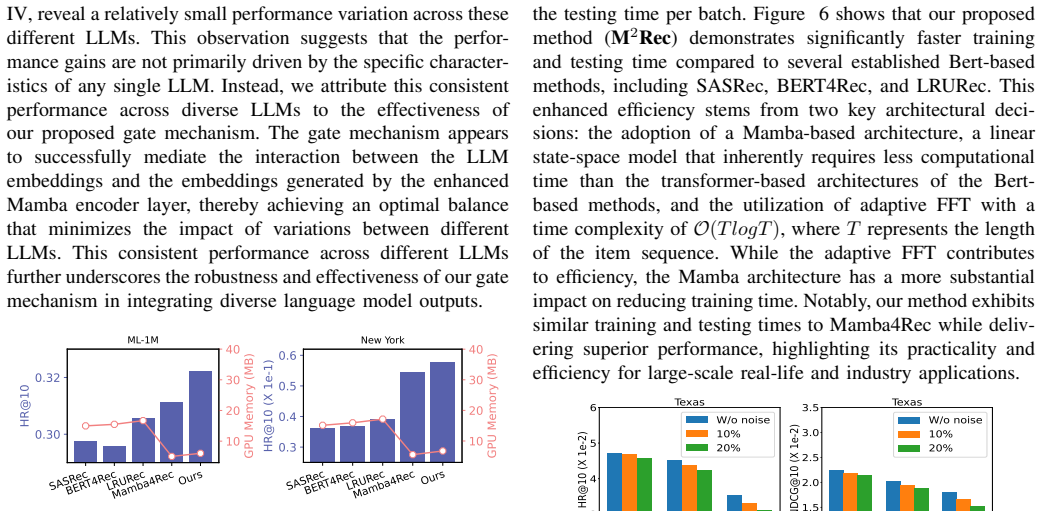
- [Abstract and Section IV-E] The abstract claims 20% faster inference than Transformer baselines, but Section IV-E reports only qualitative statements and plots without a quantitative speedup value or standard-deviation information; please provide the actual measured numbers.
- [Section III-E] The phrase 'through Long Short-Term Memories (LLMs)' appears to be a typo; it should be 'Large Language Models (LLMs)'.
- [Section IV-D] The text says results are 'presented in Figure IV', but the reference should be to Table IV.
- [Equation (11) and surrounding text] The DFT uses N in the exponential but sums to T; please use one consistent length symbol throughout the frequency-domain equations.
- [Section IV-A Parameter Settings] The parameter list repeats 'SSM state expansion factor' twice; also the descriptions of the expansion factor, state dimension, and convolution width should be clarified.
- [Section V-A] The phrase 'these approaches remain constrained on periodity caption' is grammatically unclear and should be rewritten.
Circularity Check
No circular derivation found; M2Rec's claims are supported by external benchmarks and standard architecture components.
full rationale
M2Rec is an empirical architecture paper; the headline performance claim is a computed comparison against externally defined baselines in Table II (e.g., Mamba4Rec HR@10 0.3121 vs M2Rec 0.3224 on ML-1M), not a quantity that is fitted and then re-predicted. The AFFT module (Eqs. 11-13) is a standard DFT/IFFT transform with a learned filter mask and kernel W, and the gate in Eq. 16 is a learned linear combination of two embedding streams; neither component is defined in terms of the next-item prediction target. No load-bearing uniqueness theorem or self-citation chain is invoked: citations to Mamba4Rec and RecMamba are baseline references, and the LLM choice (bge-large-en-v1.5) is an external pretrained model. The position-domain FFT versus day-domain periodicity in Figure 1 is a correctness and support concern about whether the mechanism realizes the claimed daily or weekly interpretation, not a circularity, because the empirical gains are still measured against external benchmarks. I found no passage asserting a limitation, missing support, or omitted proof that would change this assessment. The paper is therefore self-contained for circularity purposes.
Assumptions & free parameters
free parameters (3)
- Gate weights alpha and beta =
learned scalars, values not reported
- High-frequency cut threshold theta =
0.1 (best on Texas, Table V)
- Frequency-domain kernel W =
learned d_f x d_f complex matrix
assumptions (4)
- domain assumption User behavior periodicity can be recovered by FFT over sequence positions
- domain assumption High-frequency components of item embeddings are noise
- domain assumption Frozen LLM embeddings from item names, categories, and descriptions improve prediction
- domain assumption Full-vocabulary binary cross-entropy is a suitable training loss
Cite this review
Pith. "Pith review of M2Rec: Multi-scale Mamba for Efficient Sequential Recommendation." pith.science (2026). https://pith.science/paper/V5I7P72Z
@misc{pith2026250504445,
  author       = {Pith},
  title        = {Pith review of: M2Rec: Multi-scale Mamba for Efficient Sequential Recommendation},
  year         = {2026},
  howpublished = {\url{https://pith.science/paper/V5I7P72Z}},
  note         = {Machine review of arXiv:2505.04445}
}
read the original abstract
Sequential recommendation systems aim to predict users' next preferences based on their interaction histories, but existing approaches face critical limitations in efficiency and multi-scale pattern recognition. While Transformer-based methods struggle with quadratic computational complexity, recent Mamba-based models improve efficiency but fail to capture periodic user behaviors, leverage rich semantic information, or effectively fuse multimodal features. To address these challenges, we propose \model, a novel sequential recommendation framework that integrates multi-scale Mamba with Fourier analysis, Large Language Models (LLMs), and adaptive gating. First, we enhance Mamba with Fast Fourier Transform (FFT) to explicitly model periodic patterns in the frequency domain, separating meaningful trends from noise. Second, we incorporate LLM-based text embeddings to enrich sparse interaction data with semantic context from item descriptions. Finally, we introduce a learnable gate mechanism to dynamically balance temporal (Mamba), frequency (FFT), and semantic (LLM) features, ensuring harmonious multimodal fusion. Extensive experiments demonstrate that \model\ achieves state-of-the-art performance, improving Hit Rate@10 by 3.2\% over existing Mamba-based models while maintaining 20\% faster inference than Transformer baselines. Our results highlight the effectiveness of combining frequency analysis, semantic understanding, and adaptive fusion for sequential recommendation. Code and datasets are available at: https://anonymous.4open.science/r/M2Rec.
Figures


Figures from the paper (3 more)


Reference graph
Works this paper leans on
-
[1]
Sequential recommender systems: challenges, progress and prospects,
S. Wang, L. Hu, Y . Wang, L. Cao, Q. Z. Sheng, and M. Orgun, “Sequential recommender systems: challenges, progress and prospects,” arXiv preprint arXiv:2001.04830 , 2019
arXiv 2001
-
[2]
A survey of sequential recommendation systems: Techniques, evaluation, and future directions,
T. F. Boka, Z. Niu, and R. B. Neupane, “A survey of sequential recommendation systems: Techniques, evaluation, and future directions,” Information Systems, p. 102427, 2024
work page 2024
-
[3]
Sequence-aware recom- mender systems,
M. Quadrana, P. Cremonesi, and D. Jannach, “Sequence-aware recom- mender systems,” ACM computing surveys (CSUR) , vol. 51, no. 4, pp. 1–36, 2018
work page 2018
-
[4]
Sequential recommendation with graph neural networks,
J. Chang, C. Gao, Y . Zheng, Y . Hui, Y . Niu, Y . Song, D. Jin, and Y . Li, “Sequential recommendation with graph neural networks,” in Proceed- ings of the 44th international ACM SIGIR conference on research and development in information retrieval , 2021, pp. 378–387
2021
-
[5]
Lightweight self-attentive sequential recommendation,
Y . Li, T. Chen, P.-F. Zhang, and H. Yin, “Lightweight self-attentive sequential recommendation,” in Proceedings of the 30th ACM Interna- tional Conference on Information & Knowledge Management , 2021, pp. 967–977
2021
-
[6]
Im- proving sequential recommendation with knowledge-enhanced memory networks,
J. Huang, W. X. Zhao, H. Dou, J.-R. Wen, and E. Y . Chang, “Im- proving sequential recommendation with knowledge-enhanced memory networks,” in The 41st international ACM SIGIR conference on research & development in information retrieval , 2018, pp. 505–514
2018
-
[7]
Personalized top-n sequential recommendation via convolutional sequence embedding,
J. Tang and K. Wang, “Personalized top-n sequential recommendation via convolutional sequence embedding,” in Proceedings of the eleventh ACM international conference on web search and data mining , 2018, pp. 565–573
2018
-
[8]
Per- sonalized prompt for sequential recommendation,
Y . Wu, R. Xie, Y . Zhu, F. Zhuang, X. Zhang, L. Lin, and Q. He, “Per- sonalized prompt for sequential recommendation,” IEEE Transactions on Knowledge and Data Engineering , 2024
work page 2024
Show all 50 references
-
[9]
Recgpt: Generative personalized prompts for sequential recommenda- tion via chatgpt training paradigm,
Y . Zhang, W. Yu, E. Zhang, X. Chen, L. Hu, P. Jiang, and K. Gai, “Recgpt: Generative personalized prompts for sequential recommenda- tion via chatgpt training paradigm,” arXiv preprint arXiv:2404.08675 , 2024
2024 arXiv
-
[10]
Attention is all you need,
A. Vaswani, N. Shazeer, N. Parmar, J. Uszkoreit, L. Jones, A. N. Gomez, Ł. Kaiser, and I. Polosukhin, “Attention is all you need,” Advances in neural information processing systems , vol. 30, 2017
2017
-
[11]
Transformers4rec: Bridging the gap between nlp and sequential/session-based recommendation,
G. de Souza Pereira Moreira, S. Rabhi, J. M. Lee, R. Ak, and E. Oldridge, “Transformers4rec: Bridging the gap between nlp and sequential/session-based recommendation,” in Proceedings of the 15th ACM conference on recommender systems , 2021, pp. 143–153
2021
-
[12]
Continuous- time sequential recommendation with temporal graph collaborative transformer,
Z. Fan, Z. Liu, J. Zhang, Y . Xiong, L. Zheng, and P. S. Yu, “Continuous- time sequential recommendation with temporal graph collaborative transformer,” in Proceedings of the 30th ACM international conference on information & knowledge management , 2021, pp. 433–442
2021
-
[13]
Se- quential recommendation with latent relations based on large language model,
S. Yang, W. Ma, P. Sun, Q. Ai, Y . Liu, M. Cai, and M. Zhang, “Se- quential recommendation with latent relations based on large language model,” in Proceedings of the 47th International ACM SIGIR Conference on Research and Development in Information Retrieval , 2024, pp. 335– 344
2024
-
[14]
Bert4rec: Sequential recommendation with bidirectional encoder representations from transformer,
F. Sun, J. Liu, J. Wu, C. Pei, X. Lin, W. Ou, and P. Jiang, “Bert4rec: Sequential recommendation with bidirectional encoder representations from transformer,” in Proceedings of the 28th ACM international confer- ence on information and knowledge management , 2019, pp. 1441–1450
2019
-
[15]
Sse-pt: Sequential recommendation via personalized transformer,
L. Wu, S. Li, C.-J. Hsieh, and J. Sharpnack, “Sse-pt: Sequential recommendation via personalized transformer,” in Proceedings of the 14th ACM conference on recommender systems , 2020, pp. 328–337
2020
-
[16]
Mamba: Linear-time sequence modeling with selective state spaces,
A. Gu and T. Dao, “Mamba: Linear-time sequence modeling with selective state spaces,” arXiv preprint arXiv:2312.00752 , 2023
2023 arXiv
-
[17]
Mamba4rec: Towards efficient sequential recommendation with selective state space models,
C. Liu, J. Lin, J. Wang, H. Liu, and J. Caverlee, “Mamba4rec: Towards efficient sequential recommendation with selective state space models,” arXiv preprint arXiv:2403.03900 , 2024
2024 arXiv
-
[18]
Uncovering selective state space model’s capabilities in lifelong sequential recommendation,
J. Yang, Y . Li, J. Zhao, H. Wang, M. Ma, J. Ma, Z. Ren, M. Zhang, X. Xin, Z. Chen, and P. Ren, “Uncovering selective state space model’s capabilities in lifelong sequential recommendation,” 2024
2024
-
[19]
Matrrec: Uniting mamba and transformer for sequential recommendation,
S. Zhang, R. Zhang, and Z. Yang, “Matrrec: Uniting mamba and transformer for sequential recommendation,” arXiv preprint arXiv:2407.19239, 2024
2024 arXiv
-
[20]
Ssd4rec: a structured state space duality model for efficient sequential recommendation,
H. Qu, Y . Zhang, L. Ning, W. Fan, and Q. Li, “Ssd4rec: a structured state space duality model for efficient sequential recommendation,” arXiv preprint arXiv:2409.01192, 2024
2024 arXiv
-
[21]
Mlsa4rec: Mamba combined with low-rank de- composed self-attention for sequential recommendation,
J. Su and Z. Huang, “Mlsa4rec: Mamba combined with low-rank de- composed self-attention for sequential recommendation,” arXiv preprint arXiv:2407.13135, 2024
2024
-
[22]
Frequency- augmented mixture-of-heterogeneous-experts framework for sequential recommendation,
J. Zhang, R. Xie, H. Lu, W. Sun, X. Zhao, Z. Kang et al., “Frequency- augmented mixture-of-heterogeneous-experts framework for sequential recommendation,” in THE WEB CONFERENCE 2025
2025
-
[23]
I. N. Sneddon, Fourier transforms. Courier Corporation, 1995
1995
-
[24]
Leveraging large language models for sequential recommendation,
J. Harte, W. Zorgdrager, P. Louridas, A. Katsifodimos, D. Jannach, and M. Fragkoulis, “Leveraging large language models for sequential recommendation,” in Proceedings of the 17th ACM Conference on Recommender Systems, 2023, pp. 1096–1102
2023
-
[25]
Improving sequential recommendations with llms,
A. Boz, W. Zorgdrager, Z. Kotti, J. Harte, P. Louridas, V . Karakoidas, D. Jannach, and M. Fragkoulis, “Improving sequential recommendations with llms,” ACM Transactions on Recommender Systems , 2024
2024
-
[26]
A self-attentive model with gate mechanism for spoken language understanding,
C. Li, L. Li, and J. Qi, “A self-attentive model with gate mechanism for spoken language understanding,” in Proceedings of the 2018 conference on empirical methods in natural language processing , 2018, pp. 3824– 3833
2018
-
[27]
Bge m3-embedding: Multi-lingual, multi-functionality, multi-granularity text embeddings through self-knowledge distillation,
J. Chen, S. Xiao, P. Zhang, K. Luo, D. Lian, and Z. Liu, “Bge m3-embedding: Multi-lingual, multi-functionality, multi-granularity text embeddings through self-knowledge distillation,” arXiv preprint arXiv:2402.03216, 2024
2024 arXiv
-
[28]
The fourier transform,
R. N. Bracewell, “The fourier transform,” Scientific American, vol. 260, no. 6, pp. 86–95, 1989
1989
-
[29]
Empowering sequential recommendation from collaborative signals and semantic relatedness,
M. Cheng, H. Zhang, Q. Liu, F. Yuan, Z. Li, Z. Huang, E. Chen, J. Zhou, and L. Li, “Empowering sequential recommendation from collaborative signals and semantic relatedness,” arXiv preprint arXiv:2403.07623 , 2024
2024 arXiv
-
[30]
Personalized showcases: Generating multi-modal explanations for recommendations,
A. Yan, Z. He, J. Li, T. Zhang, and J. McAuley, “Personalized showcases: Generating multi-modal explanations for recommendations,” in Proceedings of the 46th International ACM SIGIR Conference on Research and Development in Information Retrieval , 2023, pp. 2251– 2255
2023
-
[31]
Uctopic: Unsupervised contrastive learning for phrase representations and topic mining,
J. Li, J. Shang, and J. McAuley, “Uctopic: Unsupervised contrastive learning for phrase representations and topic mining,” arXiv preprint arXiv:2202.13469, 2022
2022 arXiv
-
[32]
Bpr: Bayesian personalized ranking from implicit feedback,
S. Rendle, C. Freudenthaler, Z. Gantner, and L. Schmidt-Thieme, “Bpr: Bayesian personalized ranking from implicit feedback,” arXiv preprint arXiv:1205.2618, 2012
2012 arXiv
-
[33]
Neural attentive session-based recommendation,
J. Li, P. Ren, Z. Chen, Z. Ren, T. Lian, and J. Ma, “Neural attentive session-based recommendation,” in Proceedings of the 2017 ACM on Conference on Information and Knowledge Management , 2017, pp. 1419–1428
2017
-
[34]
Session-based recommendations with recurrent neural net- works,
B. Hidasi, “Session-based recommendations with recurrent neural net- works,” arXiv preprint arXiv:1511.06939 , 2015
2015 arXiv
-
[35]
Self-attentive sequential recommenda- tion,
W.-C. Kang and J. McAuley, “Self-attentive sequential recommenda- tion,” in 2018 IEEE international conference on data mining (ICDM) . IEEE, 2018, pp. 197–206
2018
-
[36]
Linear recurrent units for sequential recommendation,
Z. Yue, Y . Wang, Z. He, H. Zeng, J. McAuley, and D. Wang, “Linear recurrent units for sequential recommendation,” in Proceedings of the 17th ACM International Conference on Web Search and Data Mining , 2024, pp. 930–938
2024
-
[37]
Session-based recommendation with graph neural networks,
S. Wu, Y . Tang, Y . Zhu, L. Wang, X. Xie, and T. Tan, “Session-based recommendation with graph neural networks,” in Proceedings of the AAAI conference on artificial intelligence , vol. 33, no. 01, 2019, pp. 346–353
2019
-
[38]
Frequency enhanced hybrid attention network for sequential recommendation,
X. Du, H. Yuan, P. Zhao, J. Qu, F. Zhuang, G. Liu, Y . Liu, and V . S. Sheng, “Frequency enhanced hybrid attention network for sequential recommendation,” in Proceedings of the 46th International ACM SIGIR conference on research and development in information retrieval , 2023,...
2023
-
[39]
Addressing cold- start problem in recommendation systems,
X. N. Lam, T. Vu, T. D. Le, and A. D. Duong, “Addressing cold- start problem in recommendation systems,” in Proceedings of the 2nd international conference on Ubiquitous information management and communication, 2008, pp. 208–211
2008
-
[40]
A survey on large language models for recommendation,
L. Wu, Z. Zheng, Z. Qiu, H. Wang, H. Gu, T. Shen, C. Qin, C. Zhu, H. Zhu, Q. Liu et al. , “A survey on large language models for recommendation,” World Wide Web, vol. 27, no. 5, p. 60, 2024
2024
-
[41]
Tutorial on large language models for recommendation,
W. Hua, L. Li, S. Xu, L. Chen, and Y . Zhang, “Tutorial on large language models for recommendation,” in Proceedings of the 17th ACM Conference on Recommender Systems , 2023, pp. 1281–1283
2023
-
[42]
Recommender systems in the era of large language models (llms),
Z. Zhao, W. Fan, J. Li, Y . Liu, X. Mei, Y . Wang, Z. Wen, F. Wang, X. Zhao, J. Tang et al. , “Recommender systems in the era of large language models (llms),” IEEE Transactions on Knowledge and Data Engineering, 2024
2024
-
[43]
Reformulating sequential recommendation: Learning dynamic user interest with content-enriched language modeling,
J. Jiang, S. Qu, M. Cheng, Q. Liu, Z. Liu, H. Zhang, R. Zhang, K. Zhang, R. Li, J. Li et al., “Reformulating sequential recommendation: Learning dynamic user interest with content-enriched language modeling,” arXiv preprint arXiv:2309.10435, 2023
2023 arXiv
-
[44]
Large language models for recommendation: Progresses and future directions,
K. Bao, J. Zhang, Y . Zhang, W. Wenjie, F. Feng, and X. He, “Large language models for recommendation: Progresses and future directions,” in Proceedings of the Annual International ACM SIGIR Conference on Research and Development in Information Retrieval in the Asia Pacific Re...
2023
-
[45]
Recommender systems in the era of large language models (llms),
Z. Zhao, W. Fan, J. Li, Y . Liu, X. Mei, Y . Wang, Z. Wen, F. Wang, X. Zhao, J. Tang et al. , “Recommender systems in the era of large language models (llms),” arXiv preprint arXiv:2307.02046 , 2023
2023 arXiv
-
[46]
A survey on accuracy-oriented neural recommendation: From collaborative filtering to information-rich recommendation,
L. Wu, X. He, X. Wang, K. Zhang, and M. Wang, “A survey on accuracy-oriented neural recommendation: From collaborative filtering to information-rich recommendation,” IEEE Transactions on Knowledge and Data Engineering , vol. 35, no. 5, pp. 4425–4445, 2022
2022
-
[47]
Ubishop: Commercial item recommendation using visual part-based object rep- resentation,
H.-Y . Chi, C.-C. Chen, W.-H. Cheng, and M.-S. Chen, “Ubishop: Commercial item recommendation using visual part-based object rep- resentation,” Multimedia Tools and Applications , vol. 75, pp. 16 093– 16 115, 2016
2016
-
[48]
Multi-modal visual adversarial bayesian personalized ranking model for recommendation,
G. Li, J. Zhuo, C. Li, J. Hua, T. Yuan, Z. Niu, D. Ji, R. Wu, and H. Zhang, “Multi-modal visual adversarial bayesian personalized ranking model for recommendation,” Information Sciences , vol. 572, pp. 378–403, 2021
2021
-
[49]
An adaptive deep learning method for item recommendation system,
A. Dau, N. Salim, and R. Idris, “An adaptive deep learning method for item recommendation system,” Knowledge-Based Systems, vol. 213, p. 106681, 2021
2021
-
[50]
Cross-modal content inference and feature enrichment for cold-start recommendation,
H. Ma, Z. Qi, X. Dong, X. Li, Y . Zheng, X. Meng, and L. Meng, “Cross-modal content inference and feature enrichment for cold-start recommendation,” in 2023 International Joint Conference on Neural Networks (IJCNN). IEEE, 2023, pp. 1–8
2023
Reviewed August 15, 2026 · model on record in the stance chip above.
Discussion (0). Continue with ORCID to comment.