A Conservative Time-Accurate Local Time-Stepping DG Scheme Based on a Weakly Compressible Model for Unsteady Low-Mach-Number Flows
Pith reviewed 2026-06-26 07:35 UTC · model grok-4.3
The pith
A weakly compressible model with density-dependent pressure enables conservative local time-stepping in high-order DG for unsteady low-Mach flows.
A machine-rendered reading of the paper's core claim, the machinery that carries it, and where it could break.
Core claim
The central claim is that a continuous-extension Runge-Kutta local predictor combined with interior-common flux splitting on a weakly compressible barotropic system yields a conservative, time-accurate DG scheme that requires no global pressure solve and preserves the locality and conservation properties of compressible discretizations for unsteady low-Mach flows.
What carries the argument
Continuous-extension Runge-Kutta (CERK) cell-local predictor polynomials together with interior-common face-flux splitting that restores discrete summation-by-parts cancellation across elements.
If this is right
- Unsteady low-Mach problems can be marched with element-wise time steps without losing discrete conservation.
- No global linear solve is required at each step, preserving the locality of explicit compressible schemes.
- High-order accuracy is retained for both convective and acoustic phenomena in the same run.
- The approach extends directly to aeroacoustic calculations where both flow and sound must be captured simultaneously.
Where Pith is reading between the lines
- Because the scheme stays fully explicit and local, it maps naturally onto distributed-memory architectures without the communication overhead of global Poisson solvers.
- The same CERK splitting technique may be reusable for other hyperbolic systems that admit local time stepping but require strict conservation.
- If the barotropic assumption holds only approximately, the method could serve as an efficient predictor for subsequent fully incompressible corrections.
Load-bearing premise
The barotropic relation with pressure depending only on density remains sufficiently accurate and stable for the unsteady low-Mach flows of interest.
What would settle it
A mesh-converged simulation of a known unsteady low-Mach benchmark (such as a vortex or acoustic wave) in which the scheme's global conservation error exceeds machine precision times the time-step size or the local time-stepping solution deviates from a reference global-step solution beyond the formal order.
Figures







read the original abstract
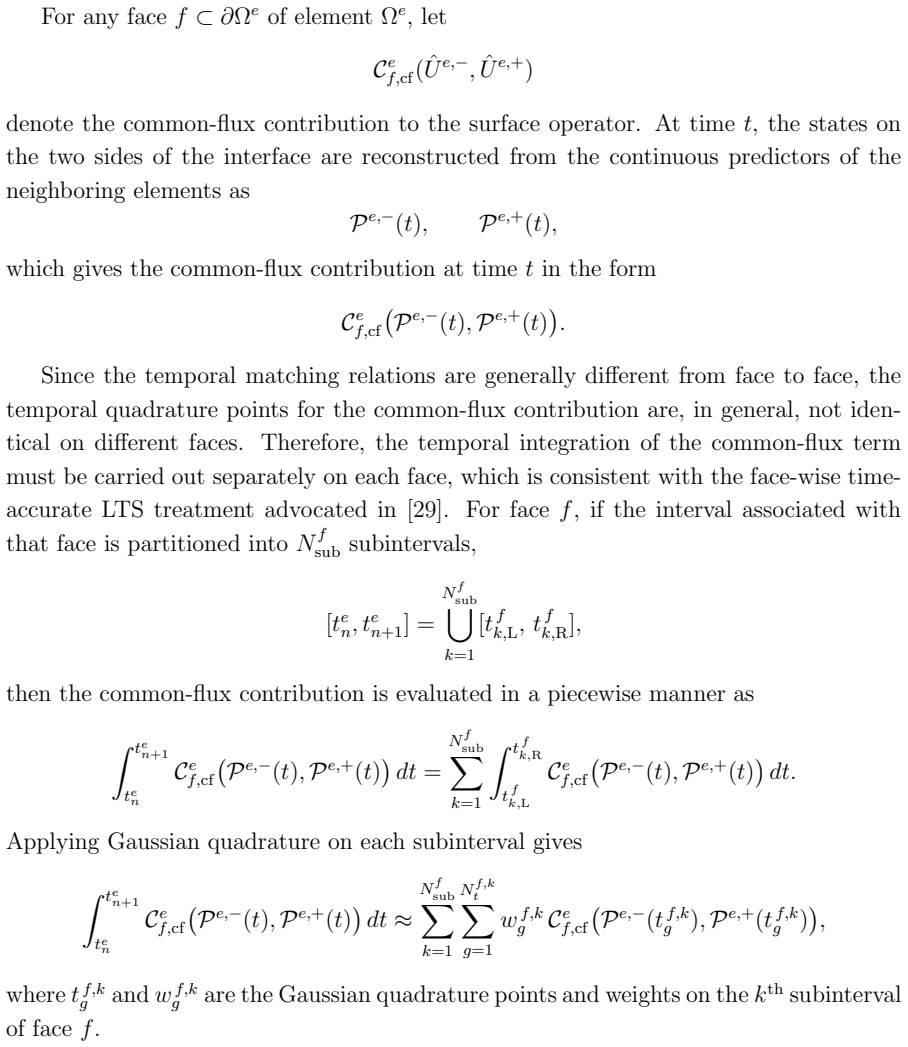
This paper presents a conservative high-order discontinuous Galerkin (DG) method featuring time-accurate local time stepping for simulating low-Mach-number unsteady flows, based on a weakly compressible formulation. In this model, pressure is defined solely as a function of density, eliminating the need for a global pressure Poisson equation typical of incompressible solvers while preserving the locality and conservation of compressible schemes. This makes it suitable for low-speed unsteady flows and aeroacoustics. The spatial discretization uses a strong-form nodal DG spectral element method (DGSEM) on Gauss-Lobatto-Legendre points. Inviscid fluxes are handled by numerical fluxes tailored to the weakly compressible system; specifically, a two-rarefaction approximate Riemann solver is developed for the constant-sound-speed barotropic equation of state. Viscous terms employ the incomplete interior penalty Galerkin (IIPG) method. For time integration, a continuous extension Runge-Kutta (CERK) scheme constructs cell-local predictor polynomials for continuous-in-time volume reconstructions. Face fluxes are split into interior and common contributions: the former matches the volume quadrature, while the latter uses piecewise Gaussian quadrature from continuous predictors. This split preserves discrete summation-by-parts cancellation and ensures conservative inter-element flux exchange.
Editorial analysis
A structured set of objections, weighed in public.
Referee Report
Summary. The paper presents a conservative high-order discontinuous Galerkin spectral element method (DGSEM) with time-accurate local time stepping for unsteady low-Mach-number flows, based on a weakly compressible barotropic model in which pressure depends only on density. It employs a two-rarefaction approximate Riemann solver for inviscid fluxes, the incomplete interior penalty Galerkin method for viscous terms, and continuous-extension Runge-Kutta (CERK) predictors to enable cell-local time stepping. Fluxes are split into interior-matching and common contributions, with the latter using piecewise Gaussian quadrature from the predictors, to preserve summation-by-parts cancellation and inter-element conservation.
Significance. If the discrete conservation property holds exactly under asynchronous local stepping and the barotropic model proves sufficiently accurate, the approach could enable efficient, high-order simulations of aeroacoustics and unsteady low-speed flows without global pressure solves or CFL restrictions from the fastest waves. The explicit construction of the flux splitting to maintain SBP properties is a methodological strength that, if verified, would distinguish it from standard local time-stepping DG schemes.
major comments (2)
- [Abstract] Abstract (flux-splitting paragraph): the assertion that the interior/common flux split 'preserves discrete summation-by-parts cancellation and ensures conservative inter-element flux exchange' with independent CERK predictors on neighboring elements is load-bearing for the central conservation claim, yet the description provides no explicit demonstration that the time-integrated common flux evaluated via piecewise Gaussian quadrature is identical from both sides when the local time-step sizes (and thus predictor polynomials) differ.
- [Time integration] Time-integration and flux sections: the skeptic concern that asynchronous predictor quadrature can break exact telescoping at interfaces is not addressed by any analytical identity or numerical conservation test; without such verification the claim that the scheme remains exactly conservative remains unconfirmed.
minor comments (1)
- The abstract would benefit from a concise statement of the formal order of accuracy of the overall scheme and the specific low-Mach test problems used for verification.
Simulated Author's Rebuttal
We thank the referee for their thorough review and for highlighting the need for explicit verification of the conservation properties under local time stepping. We address each major comment below and will incorporate the requested clarifications and tests in the revised manuscript.
read point-by-point responses
-
Referee: [Abstract] Abstract (flux-splitting paragraph): the assertion that the interior/common flux split 'preserves discrete summation-by-parts cancellation and ensures conservative inter-element flux exchange' with independent CERK predictors on neighboring elements is load-bearing for the central conservation claim, yet the description provides no explicit demonstration that the time-integrated common flux evaluated via piecewise Gaussian quadrature is identical from both sides when the local time-step sizes (and thus predictor polynomials) differ.
Authors: We appreciate the referee drawing attention to this point. The flux-splitting construction is intended to ensure that the common contribution is evaluated identically from both sides because the CERK predictors are continuous at the interface and the piecewise Gaussian quadrature uses the same interface data. However, we acknowledge that an explicit algebraic identity confirming equality of the time-integrated common fluxes (despite differing local time-step sizes) was not provided. In the revised manuscript we will add a short derivation in the time-integration section showing that the quadrature of the common flux is independent of the element-local predictor degree and step size. revision: yes
-
Referee: [Time integration] Time-integration and flux sections: the skeptic concern that asynchronous predictor quadrature can break exact telescoping at interfaces is not addressed by any analytical identity or numerical conservation test; without such verification the claim that the scheme remains exactly conservative remains unconfirmed.
Authors: We agree that both an analytical identity and a numerical conservation test are necessary to fully substantiate the exact-conservation claim. The current manuscript derives the interior/common split to retain the SBP property but does not include a dedicated numerical experiment that monitors global conservation under asynchronous stepping. We will add (i) the analytical identity referenced above and (ii) a new numerical test in the results section that demonstrates machine-precision conservation of total mass and momentum for a problem with deliberately varying local time-step sizes across element interfaces. revision: yes
Circularity Check
No circularity detected; derivation extends standard DGSEM and CERK independently
full rationale
The paper's central claims rest on explicit construction of a flux split (interior matching volume quadrature, common using piecewise Gaussian quadrature from cell-local CERK predictors) that is stated to preserve SBP cancellation, plus a new two-rarefaction Riemann solver for the barotropic EOS. These steps are presented as derived from the weakly compressible model and standard summation-by-parts properties rather than reducing to self-definition, fitted inputs renamed as predictions, or load-bearing self-citations. No equations or claims in the abstract or description collapse by construction to their own inputs; the method is self-contained against external DG and Runge-Kutta benchmarks.
Axiom & Free-Parameter Ledger
axioms (2)
- standard math Standard summation-by-parts and discrete conservation properties hold for the nodal DGSEM discretization and flux splitting.
- domain assumption The weakly compressible barotropic equation of state with pressure as a function of density accurately represents the target low-Mach unsteady flows.
Reference graph
Works this paper leans on
-
[1]
S. V. Patankar and D. B. Spalding,A calculation procedure for heat, mass and momentum transfer in three-dimensional parabolic flows, International Journal of Heat and Mass Transfer, 15 (1972), 1787–1806
1972
-
[2]
S. V. Patankar,Numerical Heat Transfer and Fluid Flow, Hemisphere, Washington, D.C., 1980
1980
-
[3]
A. J. Chorin,Numerical solution of the Navier–Stokes equations, Mathematics of Computation, 22 (1968), 745–762
1968
-
[4]
R. Temam,Sur l’approximation de la solution des ´ equations de Navier–Stokes par la m´ ethode des pas fractionnaires (I), Archive for Rational Mechanics and Analysis, 32 (1969), 135–153
1969
-
[5]
Chen and G
S. Chen and G. D. Doolen,Lattice Boltzmann method for fluid flows, Annual Review of Fluid Mechanics, 30 (1998), 329–364. 48
1998
-
[6]
Succi,The Lattice Boltzmann Equation for Fluid Dynamics and Beyond, Oxford University Press, Oxford, 2001
S. Succi,The Lattice Boltzmann Equation for Fluid Dynamics and Beyond, Oxford University Press, Oxford, 2001
2001
-
[7]
C. K. Aidun and J. R. Clausen,Lattice-Boltzmann method for complex flows, Annual Review of Fluid Mechanics, 42 (2010), 439–472
2010
-
[8]
Zou and X
Q. Zou and X. He,On pressure and velocity flow boundary conditions and bounceback for the lattice Boltzmann BGK model, Physics of Fluids, 9 (1997), 1591–1598
1997
-
[9]
Bouzidi, M
M. Bouzidi, M. Firdaouss and P. Lallemand,Momentum transfer of a Boltzmann- lattice fluid with boundaries, Physics of Fluids, 13 (2001), 3452–3459
2001
-
[10]
Z. L. Guo, C. G. Zheng and B. C. Shi,Non-equilibrium extrapolation method for velocity and pressure boundary conditions in the lattice Boltzmann method, Chinese Physics, 11 (2002), 366–374
2002
-
[11]
Ansumali and I
S. Ansumali and I. V. Karlin,Kinetic boundary conditions in the lattice Boltzmann method, Physical Review E, 66 (2002), 026311
2002
-
[12]
J. J. Monaghan,Smoothed particle hydrodynamics, Annual Review of Astronomy and Astrophysics, 30 (1992), 543–574
1992
-
[13]
J. J. Monaghan,Simulating free surface flows with SPH, Journal of Computational Physics, 110 (1994), 399–406
1994
-
[14]
J. P. Morris, P. J. Fox and Y. Zhu,Modeling low Reynolds number incompressible flows using SPH, Journal of Computational Physics, 136 (1997), 214–226
1997
-
[15]
X. Y. Hu and N. A. Adams,A multi-phase SPH method for macroscopic and meso- scopic flows, Journal of Computational Physics, 213 (2006), 844–861
2006
-
[16]
J. R. Aarnes, N. E. L. Haugen and H. I. Andersson,High-order overset grid method for detecting particle impaction on a cylinder in a cross flow, International Journal of Computational Fluid Dynamics, 33 (2019), 43–58. doi:10.1080/10618562.2019.1593385
-
[17]
Y. Li, R. Zhang, R. Shock and H. Chen,Prediction of vortex shedding from a circular cylinder using a volumetric lattice-Boltzmann boundary approach, European Physical Journal: Special Topics, 171 (2009), 91–97
2009
-
[18]
Posdziech and R
O. Posdziech and R. Grundmann,A systematic approach to the numerical calcula- tion of fundamental quantities of the two-dimensional flow over a circular cylinder, Journal of Fluids and Structures, 23 (2007), 479–499. 49
2007
-
[19]
Pan,An immersed boundary method on unstructured Cartesian meshes for in- compressible flows with heat transfer, Numerical Heat Transfer, Part B: Fundamen- tals, 49 (2006), 277–297
D. Pan,An immersed boundary method on unstructured Cartesian meshes for in- compressible flows with heat transfer, Numerical Heat Transfer, Part B: Fundamen- tals, 49 (2006), 277–297
2006
-
[20]
L. Qu, C. Norberg, L. Davidson, S.-H. Peng and F. Wang,Quantitative numerical analysis of flow past a circular cylinder at Reynolds number between 50 and 200, Journal of Fluids and Structures, 39 (2013), 347–370
2013
-
[21]
Botella and R
O. Botella and R. Peyret,Benchmark spectral results on the lid-driven cavity flow, Computers & Fluids, 27 (1998), 421–433
1998
-
[22]
G. B. Deng, J. Piquet, P. Queutey and M. Visonneau,Incompressible flow calcula- tions with a consistent physical interpolation finite volume approach, Computers & Fluids, 23 (1994), 1029–1047
1994
-
[23]
U. Ghia, K. N. Ghia and C. T. Shin,High-Re solutions for incompressible flow us- ing the Navier–Stokes equations and a multigrid method, Journal of Computational Physics, 48 (1982), 387–411
1982
-
[24]
Bruneau and C
C.-H. Bruneau and C. Jouron,An efficient scheme for solving steady incompressible Navier–Stokes equations, Journal of Computational Physics, 89 (1990), 389–413
1990
-
[25]
S. P. Vanka,Block-implicit multigrid solution of Navier–Stokes equations in primi- tive variables, Journal of Computational Physics, 65 (1986), 138–158
1986
-
[26]
Cockburn and C.-W
B. Cockburn and C.-W. Shu,Runge–Kutta discontinuous Galerkin methods for convection-dominated problems, Journal of Scientific Computing, 16 (2001), 173– 261
2001
-
[27]
J. S. Hesthaven and T. Warburton,Nodal Discontinuous Galerkin Methods: Algo- rithms, Analysis, and Applications, Springer, New York, 2008
2008
-
[28]
H. T. Huynh,A Flux Reconstruction Approach to High-Order Schemes Including Discontinuous Galerkin Methods, 18th AIAA Computational Fluid Dynamics Con- ference, AIAA Paper 2007-4079, 2007
2007
-
[29]
G. J. Gassner, F. Hindenlang and C.-D. Munz,A Runge–Kutta Based Discontinuous Galerkin Method with Time Accurate Local Time Stepping, inAdaptive High-Order Methods in Computational Fluid Dynamics, World Scientific, Singapore, 2011, pp. 95–118
2011
-
[30]
Gassner, M
G. Gassner, M. Dumbser, F. Hindenlang and C.-D. Munz,Explicit One-Step Time Discretizations for Discontinuous Galerkin and Finite Volume Schemes Based on Local Predictors, Journal of Computational Physics, 230 (2011), 4232–4247. 50
2011
-
[31]
Owren and M
B. Owren and M. Zennaro,Derivation of Efficient, Continuous, Explicit Runge– Kutta Methods, SIAM Journal on Scientific and Statistical Computing, 13 (1992), 1488–1501
1992
-
[32]
Dumbser, D
M. Dumbser, D. S. Balsara, E. F. Toro and C.-D. Munz,A unified framework for the construction of one-step finite volume and discontinuous Galerkin schemes on unstructured meshes, Journal of Computational Physics, 227 (2008), 8209–8253
2008
-
[33]
D. N. Arnold,An interior penalty finite element method with discontinuous elements, SIAM Journal on Numerical Analysis, 19 (1982), 742–760
1982
-
[34]
D. N. Arnold, F. Brezzi, B. Cockburn and L. D. Marini,Unified analysis of discontin- uous Galerkin methods for elliptic problems, SIAM Journal on Numerical Analysis, 39 (2002), 1749–1779
2002
-
[35]
Bassi and S
F. Bassi and S. Rebay,A high-order accurate discontinuous finite element method for the numerical solution of the compressible Navier–Stokes equations, Journal of Computational Physics, 131 (1997), 267–279
1997
-
[36]
Rivi` ere,Discontinuous Galerkin Methods for Solving Elliptic and Parabolic Equa- tions: Theory and Implementation, SIAM, Philadelphia, 2008
B. Rivi` ere,Discontinuous Galerkin Methods for Solving Elliptic and Parabolic Equa- tions: Theory and Implementation, SIAM, Philadelphia, 2008
2008
-
[37]
E. F. Toro,Riemann Solvers and Numerical Methods for Fluid Dynamics: A Prac- tical Introduction, 3rd ed., Springer, Berlin, 2009
2009
-
[38]
D. T. Elsworth and E. F. Toro,Riemann Solvers for Solving the Incompressible Navier–Stokes Equations Using the Artificial Compressibility Method, College of Aeronautics, Cranfield Institute of Technology, Report No. 9208, 1992
1992
-
[39]
F. C. Massa, L. Ostrowski, F. Bassi and C. Rohde,An artificial Equation of State based Riemann solver for a discontinuous Galerkin discretization of the incompress- ible Navier–Stokes equations, Journal of Computational Physics, 448 (2022), 110705
2022
-
[40]
Zhang, X
C. Zhang, X. Y. Hu and N. A. Adams,A weakly compressible SPH method based on a low-dissipation Riemann solver, Journal of Computational Physics, 335 (2017), 605–620
2017
-
[41]
K. Zhang, P. Liu, S. Lin, K. Liu and Y. Lu,Sweep Effects on Slat Tonal Noise, AIAA Journal, 64 (2026), 3399–3420. doi:10.2514/1.J066362
-
[42]
Zhang, Z
K. Zhang, Z. Zhang, S. Lin, P. Liu and S. Liu,Multiple Deep Learning Sur- rogate Models for Aeroacoustic Prediction of the 30P30N High-Lift Airfoil, 32nd AIAA/CEAS Aeroacoustics Conference, AIAA Paper 2026-3450, 2026. 51
2026
-
[43]
Min and T
M. Min and T. Lee,A spectral-element discontinuous Galerkin lattice Boltzmann method for nearly incompressible flows, Journal of Computational Physics, 230 (2011), 245–259
2011
-
[44]
Liu and Y
K. Liu and Y. Lu,Ultra-fast high order unsteady simulations on GPUs based on a new computational model, AIAA Aviation 2019 Forum, AIAA Paper 2019-3525, 2019
2019
-
[45]
M. M. Choudhari and D. P. Lockard,Assessment of slat noise predictions for 30P30N high-lift configuration from BANC-III workshop, 21st AIAA/CEAS Aeroa- coustics Conference, AIAA Paper 2015-2844, 2015
2015
-
[46]
Y. Zhang, L. N. Cattafesta, K. A. Pascioni and M. M. Choudhari,Slat noise in high-lift systems, Progress in Aerospace Sciences, 146 (2024), 100996. doi:10.1016/j.paerosci.2024.100996
-
[47]
Murayama, K
M. Murayama, K. Nakakita, K. Yamamoto, H. Ura, Y. Ito and M. M. Choud- hari,Experimental study on slat noise from 30P30N three-element high-lift airfoil at JAXA Hard-Wall Low-Speed Wind Tunnel, 20th AIAA/CEAS Aeroacoustics Con- ference, AIAA Paper 2014-2080, 2014
2014
-
[48]
Murayama, Y
M. Murayama, Y. Yokokawa, H. Ura, K. Nakakita, K. Yamamoto, Y. Ito, T. Takaishi, R. Sakai, K. Shimoda, T. Kato and T. Homma,Experimental study of slat noise from 30P30N three-element high-lift airfoil in JAXA Kevlar-Wall Low-Speed Wind Tunnel, 24th AIAA/CEAS Aeroacoustics Conference, AIAA Paper 2018-3460, 2018
2018
-
[49]
K. A. Pascioni and L. N. Cattafesta,Aeroacoustic measurements of leading-edge slat noise, 22nd AIAA/CEAS Aeroacoustics Conference, AIAA Paper 2016-2960, 2016
2016
-
[50]
G. Chen, X. Tang, X. Yang, P. Weng and J. Ding,Noise control for high-lift devices by slat wall treatment, Aerospace Science and Technology, 115 (2021), 106820
2021
-
[51]
J. Xie, X. Yang, J. Ding, P. Weng and L. Wang,Noise control of swept high-lift devices using slat cove wavy wall, Aerospace Science and Technology, 175 (2026), 111971
2026
-
[52]
K. A. Pascioni, L. N. Cattafesta and M. M. Choudhari,An experimental investiga- tion of the 30P30N multi-element high-lift airfoil, 20th AIAA/CEAS Aeroacoustics Conference, AIAA Paper 2014-3062, 2014. 52
2014
discussion (0)
Sign in with ORCID, Apple, or X to comment. Anyone can read and Pith papers without signing in.