REVIEW 3 major objections 5 minor 2 cited by
Skill Is Not Document: Query-Conditioned Compatibility for LLM Agent Skill Routing
T0 review · 3 major / 5 minor · reviewed 2026-07-12 · grok-4.5
Pith's one-line read Skill retrieval is not document retrieval: top-K success needs query-conditioned skill compatibility, recovered from LLM rejections usually thrown away.
desk verdict Solid agent-IR systems paper: query-conditional skill compatibility is real, reject-as-resource is useful, and the bi-encoder vs cross-encoder split is cleanly argued—with the LLM oracle as the main provisional piece. read the letter →
The pith
A machine-rendered reading of the paper's core claim, the machinery that carries it, and where it could break.
The reading
What carries the argument
Reject-as-Resource (R3): retain LLM SKIP annotations as compatibility negatives, train R3-Embedding with multi-positive InfoNCE plus a sibling-reward term, then train R3-Reranker with graded ListNet labels (GT=3, SKIP partner=1, other=0) so the cross-encoder can enforce C-conditioned ranking.
What would settle it
A multi-expert or real-user study that systematically re-labels a large sample of multi-skill WRITE/SKIP decisions and shows that models trained on corrected labels reverse the reported Set-Compat gains, or that SKIP-as-graded-label no longer beats the no-SKIP reranker.
Extended reading notes
Core claim
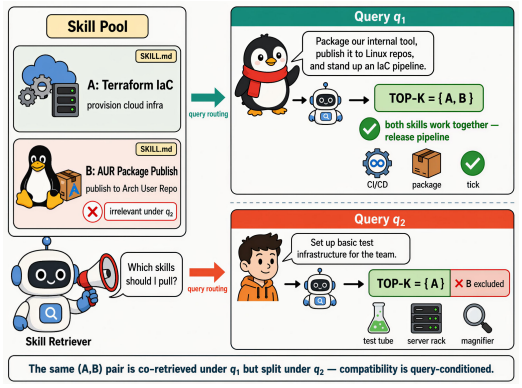
Top-K joint correctness in skill retrieval factors into per-skill relevance times a query-conditioned compatibility term C(q, S*_q) that independent relevance cannot recover. LLM WRITE/SKIP rejections supply usable binary supervision for C; injecting them as graded labels in a cross-encoder improves joint set metrics, whereas injecting them into the tested bi-encoder InfoNCE objective under bilateral balancing does not help.
Load-bearing premise
The load-bearing premise is that LLM WRITE/SKIP joint-plausibility judgments are a faithful enough stand-in for true skill compatibility under real user requests, even though training labels are not exhaustively human-verified.
Editorial extensions
If this is right
- Agent skill routers should treat joint set correctness (Set-Compat) as a first-class metric alongside Hit@K and NDCG, not as a side effect of independent relevance.
- Synthesis pipelines that currently discard LLM rejections should keep them as compatibility supervision rather than pure low-quality waste.
- Bi-encoders are a poor place to inject query-conditional compatibility under shared-vector bilateral balancing; cross-encoders can use the same signal as graded ranking labels.
- Bilingual and cross-lingual skill routing (especially Chinese queries over English skill pools) needs explicit compatibility training, not only multilingual embedding alignment.
- Sandbox and cold-start deployments that install only top-K skills per session become safer if the retriever respects query-conditioned non-co-occurrence.
Reading between the lines
- Any retrieval setting where the returned set is jointly executed (tools, workflows, agents, code packs) may inherit the same relevance-times-compatibility decomposition, not only agent skills.
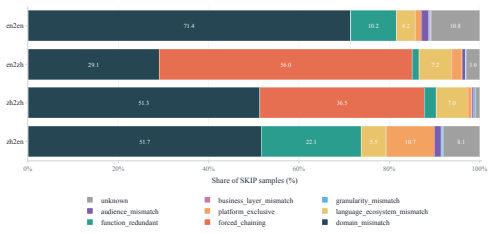
- The 8-class rejection taxonomy suggests training separate heads or curricula for hard domain mismatch versus query-conditional forced chaining, rather than one global negative class.
- Expanding the sparse Chinese skill pool and human-verifying training SKIPs would likely shift absolute numbers more than the bi-encoder vs cross-encoder split, which is structural.
- End-to-end agent completion metrics may still diverge from Set-Compat if downstream planners re-order or drop retrieved skills; the paper’s offline gains need a handoff study.
Editorial analysis
A structured set of objections, weighed in public.
Referee Report
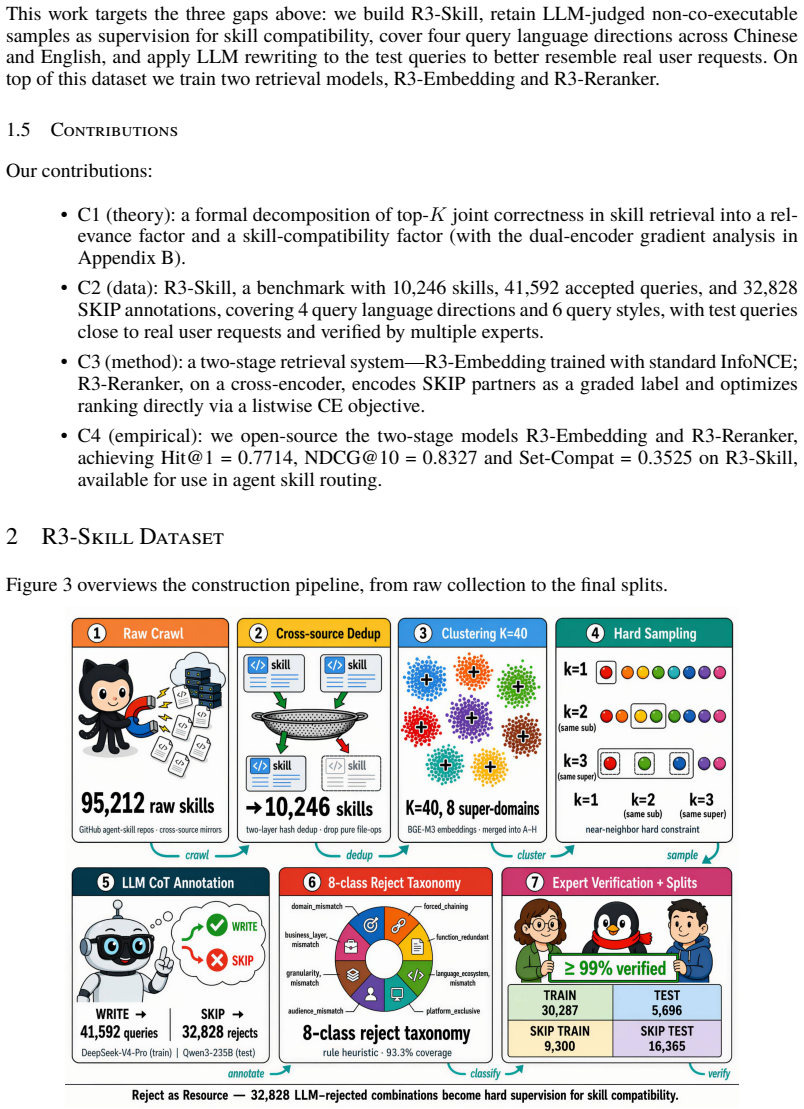
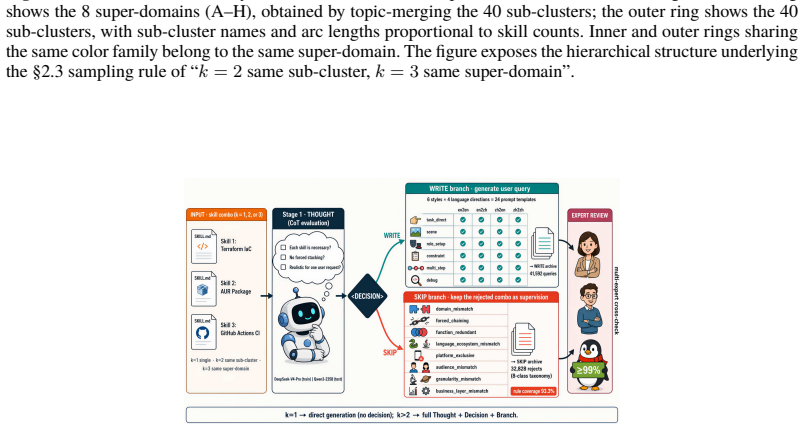
Summary. The paper argues that skill retrieval for LLM agents differs from document retrieval because top-K joint correctness depends on a query-conditioned compatibility factor C(q,S*_q) that independent per-skill relevance cannot recover. It constructs R3-Skill, a bilingual (Chinese–English) skill-routing benchmark with 10,246 skills, 41,592 WRITE queries, and 32,828 retained LLM SKIP annotations organized into an 8-class rejection taxonomy, with multi-expert verification of the test-set ground truth and a skill-pool-disjoint train/test split. On this data the authors train a two-stage system: R3-Embedding (multi-positive InfoNCE with a sibling-reward term on Qwen3-Embedding-0.6B) and R3-Reranker (graded ListNet with labels {3,1,0} for GT / SKIP partners / others on Qwen3-Reranker-0.6B). Appendix B derives bilateral balancing for bi-encoder SKIP injection (Theorem 1); ablations show SKIP hurts or fails to help the bi-encoder while helping the cross-encoder. The full pipeline reports Hit@1=0.7521, NDCG@10=0.8173, Set-Compat=0.3188 on R3-Skill and also leads on SkillRet transfer metrics.
Significance. If the results hold, the paper makes a concrete contribution to agent skill routing: it formalizes why skill retrieval is not document retrieval, releases a sizable bilingual resource that retains the usually discarded LLM rejection signal, and shows a practical two-stage training recipe with a clean dual-encoder gradient argument and stage-wise ablations. Strengths include the held-out skill-pool split, multi-expert test verification, shared-upstream reranker comparisons, SkillRet transfer, the Set-Compat metric, and the planned open release of data, weights, and scripts. These are useful for the growing ecosystem of agent skills (Anthropic Agent Skills, SkillRouter, SkillRet, etc.) where full-library prompting is infeasible and multi-skill compatibility matters.
major comments (3)
- §1.3 and §2.1–2.4 operationalize C(q,S*_q) via DeepSeek-V4-Pro / Qwen3 WRITE–SKIP joint-plausibility judgments; training SKIP labels are not exhaustively human-verified (only multi-skill test GT intent is multi-expert reviewed; Table 3). If those judgments systematically diverge from real multi-skill executability (sandbox install failures, ecosystem conflicts, or forced chaining an LLM never sees), then graded ListNet supervision and Set-Compat gains largely recover the LLM’s own rejection surface. The Limitations section already flags this; a load-bearing revision would add a human agreement study on a stratified SKIP sample (by direction and reject class) or a small end-to-end executability check, and report inter-annotator / LLM–human agreement so readers can bound oracle noise.
- Table 9 and §4.4: zh2en (105) and zh2zh (92) are very small diagnostic slices, and Chinese skills are sparse (246 raw; §2.2, Limitations). Cross-lingual claims and the en2zh forced_chaining contrast are interesting, but the paper should either demote zh2* numbers to qualitative trends only (as partially done) or enlarge those slices / the Chinese skill pool before treating bilingual coverage as a primary contribution. Without that, the four-direction framing overstates the strength of the Chinese-side evidence relative to en2en/en2zh.
- §4.1 and Appendix A define Set-Compat only on |GT|≥2 as 1 iff S*_q ⊆ top-m with m=|GT|. This is a useful set-level metric, but the manuscript should clarify how sensitive the reported 0.3188 is to the fixed reranker pool size (top-20) and to the graded labels {3,1,0}. A short sensitivity table (pool 10/20/50; label schemes binary vs graded) would show whether the Set-Compat gain is robust or an artifact of the engineering budget noted in Limitations (vi).
minor comments (5)
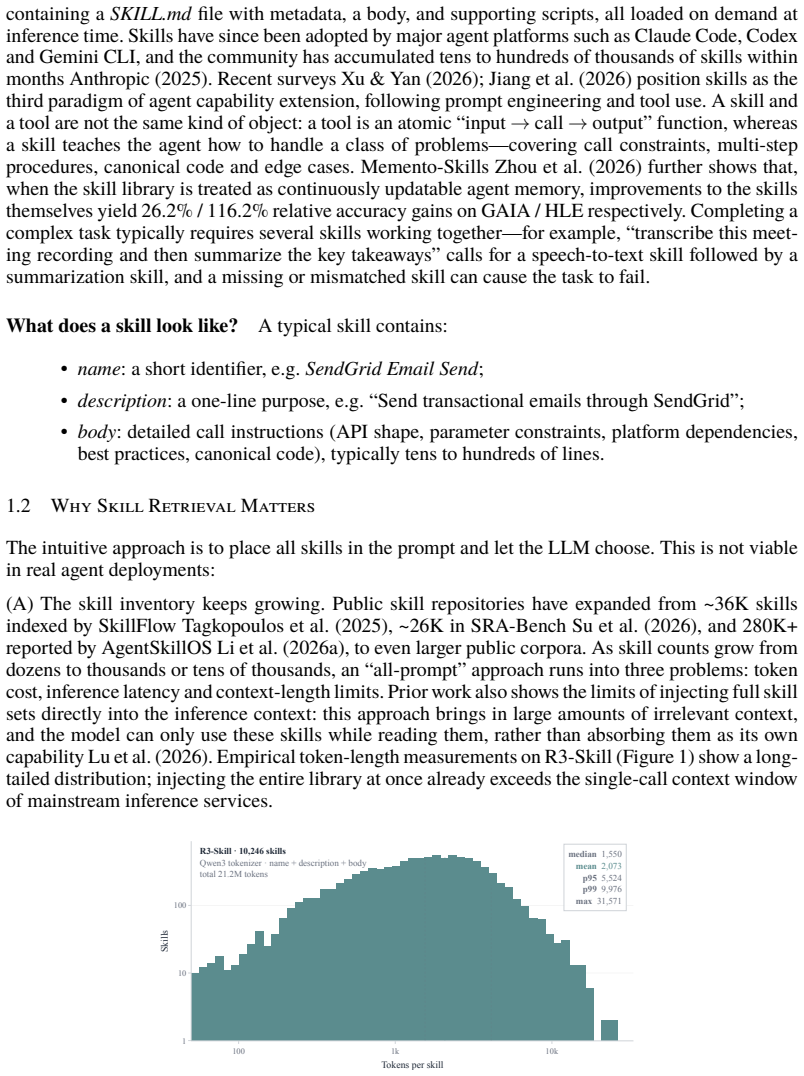
- Figure 1 caption reports p95=5,526 / p99=9,983 while the body text says p95=5,524 / p99=9,976; align the numbers.
- §3: release checklist promises optimizer, LR, batch size, epochs, seed, hardware, and checkpoint rule for both models; ensure these appear in the camera-ready or appendix so the two-stage recipe is fully reproducible.
- Table 5 note that R@K equals Comp@K on R3-Skill because |GT|≤3≤K is helpful; consider stating this once in Appendix A and dropping the redundant Comp columns on R3-Skill tables to reduce clutter.
- Appendix D prompts are valuable; a short note on temperature / decoding settings used for DeepSeek-V4-Pro and Qwen3-235B would help others regenerate or audit the synthesis pipeline.
- Typos / formatting: “Y outu Lab”, “difficult”, “official”, and occasional full-width punctuation in the PDF should be cleaned for the camera-ready.
Circularity Check
Empirical IR pipeline with held-out skill pools and expert-checked test GT; no derivation reduces by construction to its inputs.
full rationale
This paper is a benchmark-and-retriever systems paper, not a first-principles derivation. The formalization Pr[S*_q ⊆ top-K|q] ≈ (product of per-skill relevance) · C(q,S*_q) is a modeling decomposition that motivates retaining LLM WRITE/SKIP as supervision; C is operationalized as binary SKIP labels for training, not algebraically identified with the reported metrics. R3-Embedding uses multi-positive InfoNCE with a sibling-reward term; R3-Reranker uses graded ListNet with SKIP partners as intermediate labels (label=1) that are explicitly not counted as GT at evaluation. Theorem 1 (Appendix B) is a standard gradient analysis of InfoNCE bilateral balancing on a shared bi-encoder vector—it explains an ablation outcome, it does not force the headline numbers. Train and test skill pools are disjoint; test multi-skill GT is multi-expert verified; the pipeline is also evaluated on the external SkillRet official test set, where it leads on all reported columns. Ablations (Table 10) show SKIP hurts the bi-encoder and helps the cross-encoder on Hit@1/NDCG/Set-Compat—standard empirical evidence, not a fit renamed as prediction. Concerns about LLM oracle faithfulness for true executability are assumption/correctness risks, not circularity under the stated patterns. No self-definitional loop, no fitted-input-as-prediction, no load-bearing uniqueness theorem from overlapping authors, and no renaming of a known result as a derivation.
Assumptions & free parameters
free parameters (6)
- InfoNCE temperature τ
- sibling-reward weight λ
- graded ListNet labels {3,1,0}
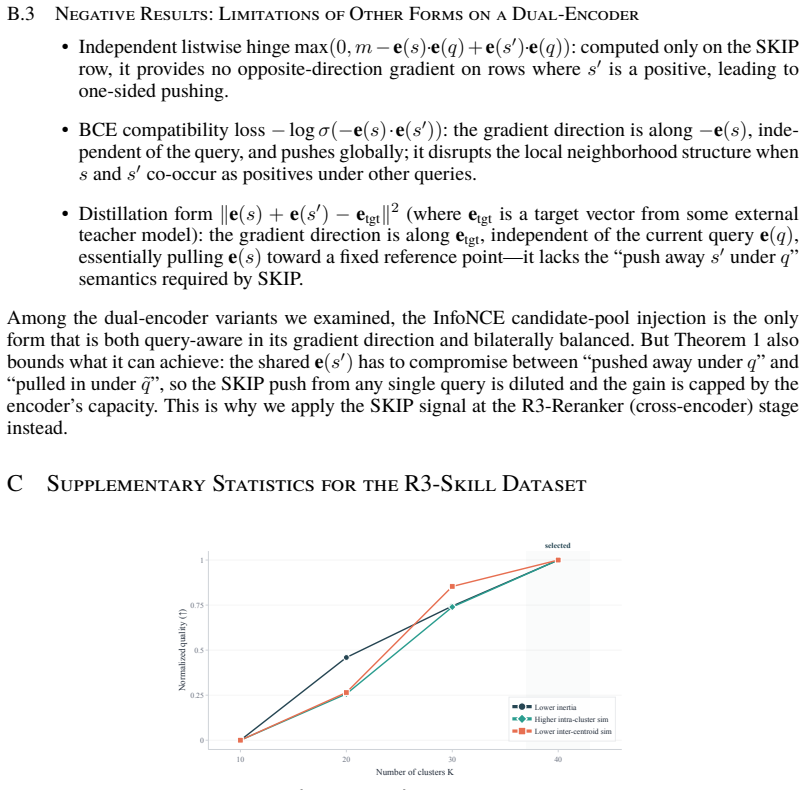
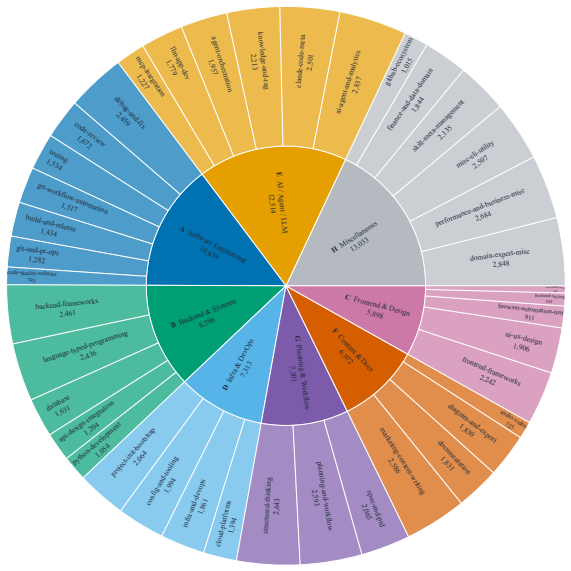
- KMeans K and hierarchy merge
- reranker candidate pool size (top-20)
- hard-negative mining band
assumptions (5)
- domain assumption Top-K joint skill correctness approximately factors as product of per-skill relevance times a query-conditioned compatibility correction C(q,S*_q).
- domain assumption LLM WRITE/SKIP joint-plausibility judgments are valid binary supervision for whether a skill set should be jointly retrieved under a query.
- domain assumption Near-neighbor hard-constraint sampling (same sub-cluster for k=2, same super-domain for k=3) yields informative compatibility negatives rather than trivial unrelated SKIPs.
- standard math Standard multi-positive InfoNCE and listwise CE / ListNet are appropriate objectives for bi-encoder recall and cross-encoder reranking respectively.
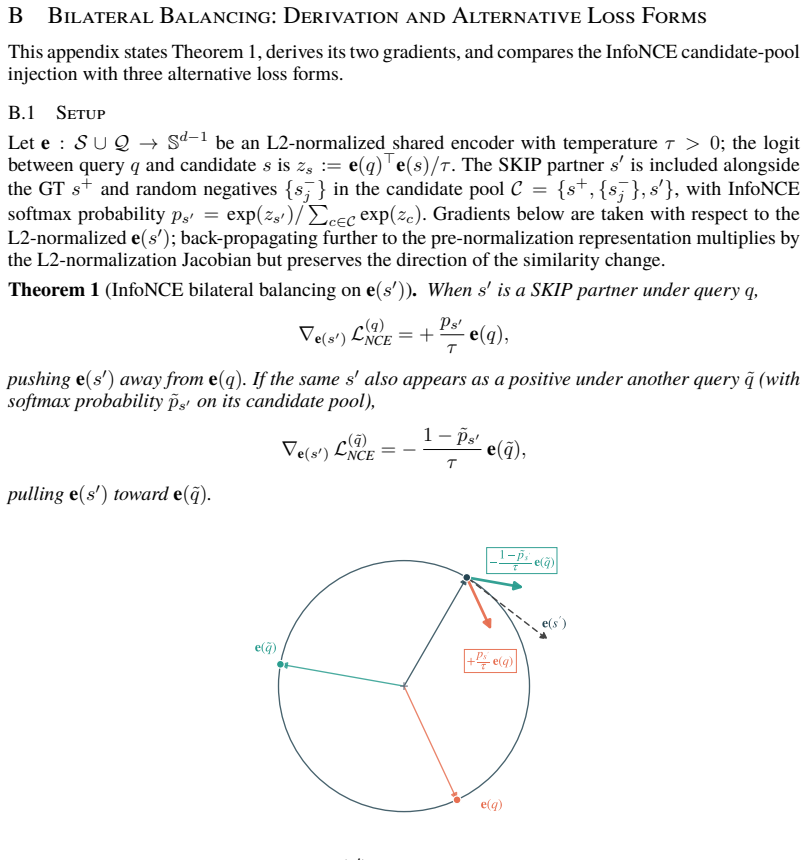
- ad hoc to paper A shared bi-encoder embedding of a skill cannot freely encode query-specific push/pull forces without bilateral balancing dilution (Theorem 1).
invented entities (3)
-
R3-Skill benchmark (skills, WRITE queries, SKIP annotations, 8-class reject taxonomy)
-
Set-Compat metric
-
skill compatibility factor C(q,S*_q)
Cite this review
Pith. "Pith review of Skill Is Not Document: Query-Conditioned Compatibility for LLM Agent Skill Routing." pith.science (2026). https://pith.science/paper/V6YRODC2
@misc{pith2026260603565,
  author       = {Pith},
  title        = {Pith review of: Skill Is Not Document: Query-Conditioned Compatibility for LLM Agent Skill Routing},
  year         = {2026},
  howpublished = {\url{https://pith.science/paper/V6YRODC2}},
  note         = {Machine review of arXiv:2606.03565}
}
abstract
Large language model agents increasingly rely on reusable skills, making skill retrieval a critical front-end component of agent systems. Skill retrieval, however, is not ordinary document retrieval: a useful top-$K$ result must contain individually relevant skills that also form an executable set for the current query. Existing benchmarks and training pipelines largely supervise pairwise relevance and discard the rejection decisions produced when a language model judges a sampled skill combination to be implausible. We introduce R3-Skill, a Chinese--English benchmark that retains these rejections as query-conditioned compatibility supervision. R3-Skill contains 10,246 deduplicated skills, 41,592 accepted queries, and 32,828 rejected annotations across four language directions; all multi-skill test labels were independently reviewed by multiple experts, and 15,962 parseable rejections are organized into an eight-class taxonomy. We further propose a two-stage system composed of R3-Embedding, a multi-positive bi-encoder for large-pool recall, and R3-Reranker, a cross-encoder trained with graded ListNet supervision. Our analysis shows that this signal is stage-dependent, helping cross-encoder reranking while providing no benefit for the tested bi-encoder objective. On R3-Skill, the complete pipeline achieves $75.39\%$ Hit@1, $81.97\%$ NDCG@10, and $33.27\%$ Set-Compat, a $36.6\%$ relative gain over the strongest reranking baseline. It also obtains $83.87\%$ NDCG@10 on SkillRet, demonstrating transfer beyond R3-Skill.
Figures

Figures from the paper (6 more)
Forward citations
Cited by 2 Pith papers
-
SkillSight: Seeing Through Shared Descriptions for Accurate Skill Retrieval
SkillSight filters corpus-shared descriptive patterns from dense embeddings and re-weights rare query terms, improving skill retrieval Recall@10 by up to 20 percentage points with no additional training.
-
From Relevance to Execution Utility: Reward-Aware Dynamic Execution Gating for Skill-Based LLM Agents
A lightweight post-retrieval gate trained on verifier feedback can skip most low-value LLM agent executions while retaining most of the achievable reward.
Reviewed July 12, 2026 · model on record in the stance chip above.
Discussion (0). Continue with ORCID to comment.