Engineered dissipation for faster adiabatic state preparation
Pith reviewed 2026-06-28 01:15 UTC · model grok-4.3
The pith
Engineered dissipation improves adiabatic state preparation scaling from O(Δ^{-2}) to O(Δ^{-1}) when relaxation exceeds the minimum gap.
A machine-rendered reading of the paper's core claim, the machinery that carries it, and where it could break.
Core claim
In the regime where the engineered relaxation strength is much larger than the minimum gap, the runtime scaling can improve from the closed-system behavior O(Δ^{-2}) to O(Δ^{-1}).
What carries the argument
A filtered reservoir that induces predominantly downward transitions in the instantaneous eigenbasis while leaving the instantaneous ground state completely dark.
If this is right
- Ground-state preparation time becomes less sensitive to the size of the minimum gap.
- The protocol can still reach a target error provided thermal heating is controlled.
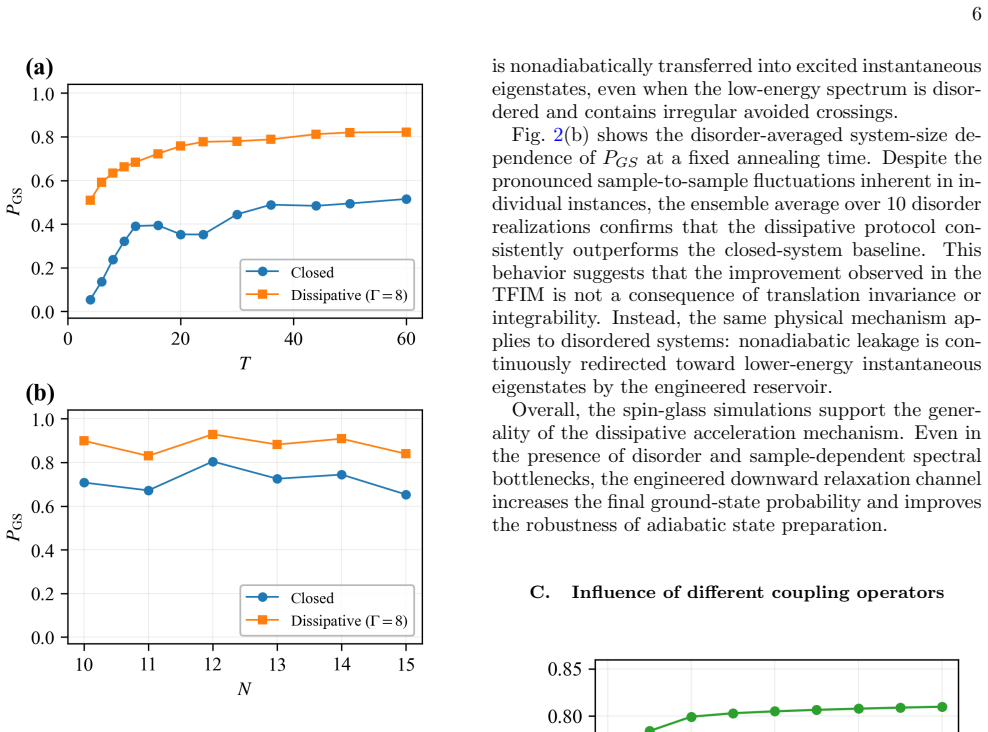
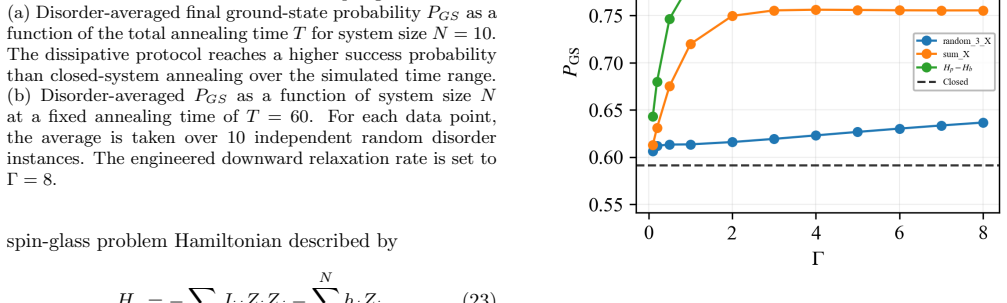
- Numerical simulations already show higher fidelity than closed-system annealing at comparable runtimes.
- The approach is compatible with existing adiabatic quantum computing hardware if suitable reservoirs can be engineered.
Where Pith is reading between the lines
- The same reservoir engineering might be combined with counter-diabatic driving to further reduce required runtimes.
- The linear scaling could change resource estimates for adiabatic algorithms on problems whose gaps close polynomially with system size.
- Structured bosonic baths in circuit QED offer one concrete testbed, but the mechanism is platform-agnostic provided the filtering condition holds.
Load-bearing premise
A filtered reservoir can be realized that induces predominantly downward transitions in the instantaneous eigenbasis while leaving the ground state dark and keeping thermal upward rates below the target error tolerance.
What would settle it
A numerical or experimental measurement of total runtime versus minimum gap Δ under the engineered dissipation protocol, checking whether the observed scaling is linear or remains quadratic in 1/Δ.
Figures


read the original abstract
Adiabatic state preparation is often slowed by nonadiabatic leakage near small spectral gaps. We propose an engineered dissipative protocol that uses a filtered reservoir to induce predominantly downward transitions in the instantaneous energy eigenbasis while leaving the instantaneous ground state dark. The leaked population generated by nonadiabatic driving is therefore continuously relaxed back toward the low-energy sector. An effective avoided-crossing analysis shows that in the regime where the engineered relaxation strength is much larger than the minimum gap, the runtime scaling can improve from the closed-system behavior $\mathcal{O}(\Delta^{-2})$ to $\mathcal{O}(\Delta^{-1})$ Finite-temperature upward transitions introduce a thermal error floor, but the enhancement survives when this heating rate remains below the target error tolerance. Numerical results show improved ground-state preparation over closed-system annealing. We also discuss a possible superconducting-circuit implementation using structured bosonic reservoirs.
Editorial analysis
A structured set of objections, weighed in public.
Referee Report
Summary. The paper proposes an engineered dissipative protocol for adiabatic state preparation that employs a filtered reservoir to induce predominantly downward transitions in the instantaneous eigenbasis while leaving the ground state dark. This relaxes nonadiabatic leakage back to the low-energy sector. An effective avoided-crossing analysis is invoked to claim that when the engineered relaxation strength Γ greatly exceeds the minimum gap Δ, the runtime scaling improves from the closed-system O(Δ^{-2}) to O(Δ^{-1}). Finite-temperature upward transitions set an error floor, but the enhancement is said to survive if the heating rate stays below target tolerance. Numerical results are reported to show improved ground-state preparation, and a superconducting-circuit implementation with structured bosonic reservoirs is discussed.
Significance. If the avoided-crossing analysis is rigorous and a concrete parameter window is shown to exist where Γ/Δ ≫ 1 while thermal upward rates remain below the target error, the result would provide a practical route to faster adiabatic preparation in open systems. The approach of using dissipation to counteract nonadiabatic errors is conceptually attractive and could complement existing techniques, but the coupling of upward and downward rates through the common spectral density must be resolved for the scaling claim to be load-bearing.
major comments (2)
- Abstract: the central scaling claim rests on an effective avoided-crossing analysis yielding O(Δ^{-1}) once Γ ≫ Δ, yet the abstract provides no explicit derivation or parameter window demonstrating that thermal upward rates (which scale with the same |g|^2 J(ω) prefactor) can be kept below target error tolerance at finite temperature; this coupling directly challenges whether the regime Γ/Δ ≫ 1 is simultaneously compatible with (upward rate) × T ≪ ε.
- Abstract: the protocol assumes a filtered reservoir can be engineered to produce predominantly downward transitions while keeping the instantaneous ground state completely dark; without a concrete spectral-density construction or bound on residual upward leakage in the full text, the assumption remains unverified and is load-bearing for the O(Δ^{-1}) improvement.
minor comments (1)
- The abstract refers to numerical results showing improved preparation but omits error-bar details, data-exclusion criteria, or the precise definition of the runtime metric; adding these would improve clarity without affecting the central claim.
Simulated Author's Rebuttal
We thank the referee for their careful reading and constructive comments. The points raised concern the presentation of the scaling result and the reservoir engineering assumption. We address each major comment below, providing clarifications from the full manuscript and indicating revisions where they strengthen the work without altering its core claims.
read point-by-point responses
-
Referee: Abstract: the central scaling claim rests on an effective avoided-crossing analysis yielding O(Δ^{-1}) once Γ ≫ Δ, yet the abstract provides no explicit derivation or parameter window demonstrating that thermal upward rates (which scale with the same |g|^2 J(ω) prefactor) can be kept below target error tolerance at finite temperature; this coupling directly challenges whether the regime Γ/Δ ≫ 1 is simultaneously compatible with (upward rate) × T ≪ ε.
Authors: The effective avoided-crossing analysis deriving the O(Δ^{-1}) scaling when Γ ≫ Δ is presented in full in the main text. The abstract is a concise summary and therefore omits the derivation. We agree that the abstract should more explicitly reference the finite-temperature condition. We will revise the abstract to state that the runtime improvement holds provided the heating rate remains below the target error tolerance. On the coupling of rates through the shared spectral density, the analysis in the manuscript treats the filtered reservoir as engineered such that downward rates dominate for the relevant transitions; we will add a short paragraph clarifying how temperature and filtering can be chosen to satisfy Γ/Δ ≫ 1 while keeping upward rates below tolerance. revision: yes
-
Referee: Abstract: the protocol assumes a filtered reservoir can be engineered to produce predominantly downward transitions while keeping the instantaneous ground state completely dark; without a concrete spectral-density construction or bound on residual upward leakage in the full text, the assumption remains unverified and is load-bearing for the O(Δ^{-1}) improvement.
Authors: The full manuscript contains a dedicated discussion of a superconducting-circuit implementation that uses structured bosonic reservoirs to realize the required spectral density. This construction is designed to produce predominantly downward transitions while leaving the instantaneous ground state dark. We acknowledge that an explicit quantitative bound on residual upward leakage would make the claim more robust. We will revise the implementation section to include a concrete estimate or bound on any residual leakage arising from imperfect filtering. revision: partial
Circularity Check
No circularity; scaling claim follows from effective avoided-crossing analysis independent of inputs
full rationale
The paper's central claim is that an effective avoided-crossing analysis yields O(Δ^{-1}) runtime scaling when engineered relaxation Γ ≫ Δ. This is presented as a derived result from the model of filtered-reservoir downward transitions, not by redefining the gap or fitting a parameter to the target scaling. No self-citations are invoked as load-bearing uniqueness theorems, no ansatz is smuggled via prior work, and no prediction reduces to a fitted input by construction. The abstract and described derivation chain remain self-contained against external benchmarks; the skeptic concern addresses physical realizability of the thermal-error assumption rather than any definitional circularity.
Axiom & Free-Parameter Ledger
axioms (1)
- domain assumption A filtered reservoir can be engineered to induce predominantly downward transitions in the instantaneous energy eigenbasis while leaving the instantaneous ground state dark
invented entities (1)
-
filtered reservoir
no independent evidence
Reference graph
Works this paper leans on
-
[1]
= 0 is relaxed, and thermal fluctuations inevitably induce undesired upward transitions from the instanta- neous ground state to excited states. To accurately capture these non-equilibrium dynamics within the two-level subspace near the minimum gap, the master equation must be generalized to include the thermal excitation channel: ˙ρ=−i[H ad(t), ρ] + ΓD[σ...
-
[2]
E. Farhi, J. Goldstone, S. Gutmann, and M. Sipser, Quantum computation by adiabatic evolution (2000), arXiv:quant-ph/0001106
Pith/arXiv arXiv 2000
-
[3]
Kadowaki and H
T. Kadowaki and H. Nishimori, Quantum annealing in the transverse ising model, Physical Review E58, 5355 (1998)
1998
-
[4]
A. Das and B. K. Chakrabarti, Colloquium: Quantum annealing and analog quantum computation, Reviews of Modern Physics80, 1061 (2008), arXiv:0801.2193 [quant- ph]
Pith/arXiv arXiv 2008
-
[5]
Albash and D
T. Albash and D. A. Lidar, Adiabatic quantum compu- tation, Reviews of Modern Physics90, 015002 (2018)
2018
- [6]
-
[7]
Kato, On the adiabatic theorem of quantum me- chanics, Journal of the Physical Society of Japan5, 435 (1950)
T. Kato, On the adiabatic theorem of quantum me- chanics, Journal of the Physical Society of Japan5, 435 (1950)
1950
-
[8]
Roland and N
J. Roland and N. J. Cerf, Quantum search by local adi- abatic evolution, Physical Review A65, 042308 (2002)
2002
-
[9]
B. Wu, H. Yu, and F. Wilczek, Quantum independent- set problem and non-abelian adiabatic mixing, Physical Review A101, 012318 (2020)
2020
-
[10]
M. S. Sarandy and D. A. Lidar, Adiabatic approximation in open quantum systems, Physical Review A71, 012331 (2005)
2005
-
[11]
M. H. S. Amin, P. J. Love, and C. J. S. Truncik, Ther- mally assisted adiabatic quantum computation, Physical Review Letters100, 060503 (2008)
2008
-
[12]
N. G. Dickson, M. W. Johnson, M. H. S. Amin,et al., Thermally assisted quantum annealing of a 16-qubit problem, Nature Communications4, 1903 (2013)
1903
-
[13]
M. H. Amin, Searching for quantum speedup in qua- sistatic quantum annealers, Physical Review A92, 052323 (2015)
2015
-
[14]
Marshall, E
J. Marshall, E. G. Rieffel, and I. Hen, Thermaliza- tion, freeze-out, and noise: Deciphering experimental quantum annealers, Physical Review Applied8, 064025 (2017)
2017
-
[15]
Mishra, T
A. Mishra, T. Albash, and D. A. Lidar, Finite tempera- ture quantum annealing solving exponentially small gap problem with non-monotonic success probability, Nature Communications9, 2917 (2018)
2018
-
[16]
Albash and D
T. Albash and D. A. Lidar, Decoherence in adiabatic quantum computation, Physical Review A91, 062320 (2015)
2015
-
[17]
J. F. Poyatos, J. I. Cirac, and P. Zoller, Quantum reser- voir engineering with laser cooled trapped ions, Physical Review Letters77, 4728 (1996)
1996
-
[18]
B. Kraus, H. P. B¨ uchler, S. Diehl, A. Kantian, A. Micheli, and P. Zoller, Preparation of entangled states by quan- tum markov processes, Physical Review A78, 042307 (2008), arXiv:0803.1463 [quant-ph]
Pith/arXiv arXiv 2008
-
[19]
S. Diehl, A. Micheli, A. Kantian, B. Kraus, H. P. B¨ uchler, and P. Zoller, Quantum states and phases in driven open quantum systems with cold atoms, Nature Physics4, 878 (2008), arXiv:0803.1482 [quant-ph]
Pith/arXiv arXiv 2008
-
[20]
Verstraete, M
F. Verstraete, M. M. Wolf, and J. I. Cirac, Quantum computation and quantum-state engineering driven by dissipation, Nature Physics5, 633 (2009)
2009
-
[21]
P. M. Harrington, E. J. Mueller, and K. W. Murch, Engi- neered dissipation for quantum information science, Na- ture Reviews Physics4, 660 (2022)
2022
-
[22]
X. Mi, A. Michailidis, S. Shabani, K. Miao, P. Klimov, J. Lloyd, E. Rosenberg, R. Acharya, I. Aleiner, T. Ander- sen,et al., Stable quantum-correlated many-body states through engineered dissipation, Science383, 1332 (2024)
2024
-
[23]
L. D. Landau, Zur theorie der energie¨ ubertragung. ii, Physikalische Zeitschrift der Sowjetunion2, 46 (1932)
1932
-
[24]
Zener, Non-adiabatic crossing of energy levels, Pro- ceedings of the Royal Society of London A137, 696 (1932)
C. Zener, Non-adiabatic crossing of energy levels, Pro- ceedings of the Royal Society of London A137, 696 (1932)
1932
-
[25]
Ding, C.-F
Z. Ding, C.-F. Chen, and L. Lin, Single-ancilla ground state preparation via lindbladians, Physical Review Re- search6, 033147 (2024)
2024
-
[26]
Y. Zhan, Z. Ding, J. Huhn, J. Gray, J. Preskill, G. K.-L. Chan, and L. Lin, Rapid quantum ground state prepa- ration via dissipative dynamics, Physical Review X16, 011004 (2026)
2026
-
[27]
J. Roland and N. J. Cerf, Quantum search by local adi- abatic evolution, Physical Review A65, 042308 (2002), arXiv:quant-ph/0107015
Pith/arXiv arXiv 2002
-
[28]
Shankar, M
S. Shankar, M. Hatridge, Z. Leghtas, K. M. Sliwa, A. Narla, U. Vool, S. M. Girvin, L. Frunzio, M. Mir- rahimi, and M. H. Devoret, Autonomously stabilized en- tanglement between two superconducting quantum bits, Nature504, 419 (2013)
2013
-
[29]
Blais, R.-S
A. Blais, R.-S. Huang, A. Wallraff, S. M. Girvin, and R. J. Schoelkopf, Cavity quantum electrodynamics for superconducting electrical circuits: An architecture for quantum computation, Physical Review A69, 062320 (2004)
2004
-
[30]
Blais, A
A. Blais, A. L. Grimsmo, S. M. Girvin, and A. Wall- raff, Circuit quantum electrodynamics, Reviews of Mod- ern Physics93, 025005 (2021)
2021
-
[31]
M. D. Reed, B. R. Johnson, A. A. Houck, L. DiCarlo, J. M. Chow, D. I. Schuster, L. Frunzio, and R. J. Schoelkopf, Fast reset and suppressing spontaneous emis- sion of a superconducting qubit, Applied Physics Letters 96, 203110 (2010)
2010
-
[32]
E. A. Sete, J. M. Martinis, and A. N. Korotkov, Quan- tum theory of a bandpass purcell filter for qubit readout, Physical Review A92, 012325 (2015)
2015
-
[33]
M. H. Devoret, Quantum fluctuations in electrical cir- cuits, inQuantum Fluctuations, edited by S. Reynaud, E. Giacobino, and J. Zinn-Justin (Elsevier, 1997) pp. 351–386
1997
-
[34]
Burkard, R
G. Burkard, R. H. Koch, and D. P. DiVincenzo, Mul- tilevel quantum description of decoherence in supercon- ducting qubits, Physical Review B69, 064503 (2004)
2004
-
[35]
A. A. Clerk, M. H. Devoret, S. M. Girvin, F. Mar- quardt, and R. J. Schoelkopf, Introduction to quantum noise, measurement, and amplification, Reviews of Mod- ern Physics82, 1155 (2010)
2010
-
[36]
K. W. Murch, U. Vool, D. Zhou, S. J. Weber, S. M. Girvin, and I. Siddiqi, Cavity-assisted quantum bath en- gineering, Physical Review Letters109, 183602 (2012)
2012
-
[37]
A. A. Houck, J. A. Schreier, B. R. Johnson, J. M. Chow, J. Koch, J. M. Gambetta, D. I. Schuster, L. Frunzio, M. H. Devoret, S. M. Girvin, and R. J. Schoelkopf, Con- 12 trolling the spontaneous emission of a superconducting transmon qubit, Physical Review Letters101, 080502 (2008)
2008
-
[38]
N. T. Bronn, Y. Liu, J. B. Hertzberg, A. D. C´ orcoles, A. A. Houck, J. M. Gambetta, and J. M. Chow, Broad- band filters for abatement of spontaneous emission in cir- cuit quantum electrodynamics, Applied Physics Letters 107, 172601 (2015)
2015
-
[39]
Feng and B
J.-J. Feng and B. Wu, Escaping local minima with quan- tum circuit coherent cooling, Physical Review A109, 032405 (2024)
2024
-
[40]
Sunada, S
Y. Sunada, S. Kono, J. Ilves, S. Tamate, T. Sugiyama, Y. Tabuchi, and Y. Nakamura, Fast readout and reset of a superconducting qubit coupled to a resonator with an intrinsic purcell filter, Physical Review Applied17, 044016 (2022)
2022
-
[41]
K. Y. Tan, M. Partanen, R. E. Lake, J. Govenius, S. Ma- suda, and M. M¨ ott¨ onen, Quantum-circuit refrigerator, Nature Communications8, 15189 (2017)
2017
discussion (0)
Sign in with ORCID, Apple, or X to comment. Anyone can read and Pith papers without signing in.