REVIEW 4 major objections 6 minor 67 references
ePBS lets proposers wait and reuse early bids, so builders shade and pool them, creating revenue and efficiency valleys that limited TEE commitment can partly reverse.
Reviewed by Pith at T0; open to challenge. T0 means a machine referee read the full paper against a public rubric. the ladder, T0–T4 →
T0 review · grok-4.5
2026-07-14 06:04 UTC pith:V7YSXAZ4
load-bearing objection Solid limited-commitment auction paper on ePBS: the ratchet is real and carefully proved; the ~25% TEE number is a best-found finite-grid illustration, not a certificate. the 4 major comments →
From PBS to ePBS: the Microstructure of Block Building
The pith
A machine-rendered reading of the paper's core claim, the machinery that carries it, and where it could break.
Core claim
When the proposer can choose to defer after observing signed stage-1 bids and then use that history to intensify stage-2 competition, builders anticipate extraction and shade or pool early bids, producing allocation inefficiency and revenue-efficiency valleys relative to the first-price benchmark. Full commitment restores the static Myerson auction; limited TEE commitment to stopping and disclosure recovers about 25% more proposer revenue than first-price in the paper's finite benchmarks.
What carries the argument
The ratchet channel in the two-stage block-building game: an early signed bid is both a pay-as-bid offer and a verifiable signal the uncommitted ePBS proposer can exploit by deferring and disclosing, which induces uni-pooling perfect Bayesian equilibria (low types pool at zero, high types separate) and the same defensive pattern in calibrated no-regret play.
Load-bearing premise
The roughly 25% TEE revenue gain is a best-found result from a restricted nonconvex program on a small discrete bid-value grid, not a proven global optimum that is known to hold for continuous or larger markets.
What would settle it
On the paper's own calibrated Titan-BuilderNet game, if raising continuation reliability k2 through the intermediate range does not produce a joint drop in proposer revenue and allocation efficiency under no-regret play, or if a TEE-style committed stop-and-disclose policy fails to raise revenue above the first-price line by a material amount on that same grid, the central mechanism claim fails.
If this is right
- Relay-mediated PBS with exogenous stopping can retain first-price payoffs under separating equilibria when stage-1 settlement is sufficiently likely; ePBS does not automatically inherit that property.
- ePBS compresses but does not eliminate fast-builder latency premia while adding a commitment-access gap that favors institutional proposers over solo validators.
- A TEE sidecar that commits only to stopping and disclosure, without rewriting the native pay-as-bid rule, is a protocol-facing way to capture part of the full-commitment Myerson gain.
- Protocol design that leaves stopping and disclosure fully ex post will induce defensive early pooling once continuation becomes credible.
Where Pith is reading between the lines
- If solo proposers cannot access TEEs or reputation, the ratchet may reintroduce centralization pressure even after relays are enshrined away.
- The same stop-and-disclose ratchet logic would apply to other short-horizon auctions with verifiable early messages and optional continuation (for example, some MEV or batch-settlement designs).
- A sharper continuous characterization of when latency premia survive endogenous disclosure would be the natural next theory step beyond the paper's simplified uni-pooling and finite TEE programs.
Editorial analysis
A structured set of objections, weighed in public.
Referee Report
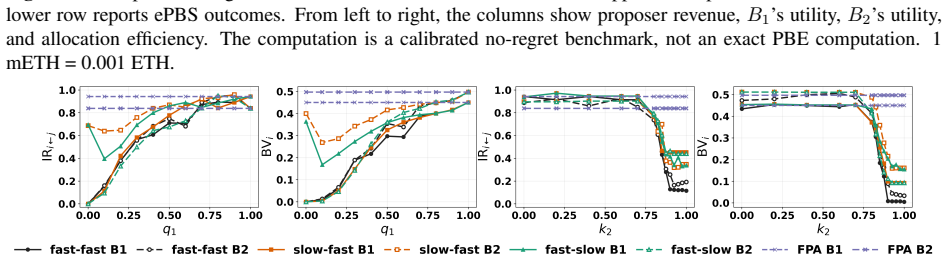
Summary. The paper models Ethereum block building under PBS and ePBS as restrictions of a common imperfect-information two-stage auction with verifiable messages and latency-asymmetric information updates. PBS has exogenous stopping and full public disclosure; ePBS endogenizes stopping and disclosure after signed stage-1 bids, at the cost of lower canonicalization probability k2. Analytically, separating PBS PBEs preserve FPA interim payoffs when q1 is large enough (Lemma 1, Theorem 1) and are ruled out when q1 is too small (Proposition 4). In simplified two-fast-builder ePBS, the paper constructs a family of uni-pooling PBEs (Theorem 2) in which builders pool or shade early bids because the proposer can defer and exploit the bid history—a ratchet effect that can produce revenue and efficiency valleys relative to FPA. Full commitment collapses to static Myerson (Proposition 6). A TEE sidecar is proposed as limited commitment to stopping/disclosure while preserving pay-as-bid; the design is reduced to a bilinear/MI-QCQP program, and best-found solutions on a 5×5 grid raise proposer revenue by roughly 25% over FPA. Calibrated CFR+ (EFCCE) runs with Titan–BuilderNet values reproduce FPA-like PBS behavior and an ePBS revenue-efficiency valley.
Significance. If the qualitative results hold, the paper makes a clear contribution to blockchain market microstructure and limited-commitment auction design: it isolates how enshrining PBS shifts the proposer from a passive auctioneer to a sequential information designer, and it links that shift to a ratchet distortion rather than a pure latency race. The analytical PBS and simplified-ePBS characterizations are carefully scoped (regular pure class, regular bang-bang class, explicit cutoff admissibility CF(k2)), with full appendix proofs and envelope/rank-space arguments that are standard and checkable. The calibration is honestly labeled as approximate EFCCE rather than PBE and is grounded in relay traces, which strengthens external validity of the valley pattern. The TEE formulation as constrained information design under native pay-as-bid is a useful protocol-facing mitigation idea. The main significance risk is quantitative overclaim on the TEE gain: the ~25% figure is a best-found nonconvex finite-grid number under report-cap restrictions, not a certified optimum, so the mitigation half of the abstract is currently weaker than the ratchet diagnosis.
major comments (4)
- Abstract and §6.4 (also Theorem 3, Appendix G.5): The abstract states that the TEE design increases proposer revenue by approximately 25% relative to FPA. The body evaluates a report-capped, no-overbidding-domain computational program on a 5×5 value–bid grid and explicitly notes that the exact problem is a nonconvex MI-QCQP (NP-hard) and that reported numbers are best-found outcomes for a restricted benchmark, not certificates for the exact program. That gap is load-bearing for the mitigation half of the central claim. Either (i) strengthen the computation (larger grids, multiple starts with optimality gaps, or a tractable policy class with certified bounds) or (ii) rephrase the abstract and evaluation as a directional finite-grid illustration with the report-cap and non-global-optimality caveats stated up front.
- Definition 5 and Theorem 2 (Section 4.3): The uni-pooling ratchet is proved only in simplified ePBS, where the proposer may only stop or fully broadcast—no selective private disclosure. Full ePBS (Definition 2) and the calibrated game allow private/targeted disclosure, which is exactly the channel highlighted in Figure 8. The paper needs a tighter argument that the simplified construction is not an artifact of forbidding selective disclosure: either extend the analytical ratchet to a nontrivial selective-disclosure class, or give a formal reduction/robustness statement explaining why full-broadcast uni-pooling still identifies the same force that appears under private disclosure in §5.
- Section 6.1–6.2 and Figure 9: Proposition 6 shows full commitment implements static Myerson at stage 1, while the TEE is deliberately limited to stop/message commitment under native pay-as-bid. The institutional discussion notes that full Myerson may require a proxy that recreates relay-like intermediation—the problem ePBS was meant to reduce. The manuscript should make the welfare/centralization trade-off quantitative or at least sharper: under what conditions does limited TEE commitment dominate both uncommitted ePBS and proxy-Myerson once proxy concentration, liveness, and key-custody risks are counted, rather than treating TEE as an unambiguous leveling device.
- Section 5.1–5.2 and Appendix A: The calibrated valley is the main external-validity support for the ratchet outside the two-builder i.i.d. theory. CFR+ yields approximate EFCCE, which the paper correctly distinguishes from PBE, but the interpretation still treats stage-1 IR/BV declines and stop/disclose heatmaps as evidence of the same strategic channel as Theorem 2. Please add a short robustness check or diagnostic that the valley is not driven by coarse correlation alone (e.g., comparison to pure-strategy best-response dynamics, or restricted strategy spaces that force independent play), so the computational pattern can be read as corroboration rather than a weaker equilibrium class with different incentives.
minor comments (6)
- Figure 6–8 captions and §5.2: State units (mETH) and the exact latency profile labels consistently in every panel; some panels refer to Titan/BuilderNet while others use B1/B2 without a legend mapping.
- Proposition 3: The non-overbidding convention for stage-2 bids is introduced for the threshold claims but is not part of the baseline bid space in Section 3; flag this modeling choice earlier when the bid space is defined.
- Appendix B.1: The 100ms response-window censoring assumption for loser values is identifying; a one-paragraph sensitivity note (e.g., δ ∈ {50,100,200}ms) would help readers assess the joint log-normal fit.
- Notation: k⋆2(βFPA), CF(k2), and K+F appear in multiple sections; a short notation table would reduce cross-reference friction.
- Related work: Concurrent competing-auctions work [41] is discussed; a slightly sharper one-paragraph contrast on sealed FPA vs endogenous timing/disclosure would help position the contribution for non-specialists.
- Typos/consistency: “Respctively” in Figure 8 caption; occasional “Glamsterdam” roadmap dating; ensure arXiv subject and JEL codes match the final framing.
Circularity Check
No significant circularity: ratchet, Myerson collapse, and TEE gains are derived or computed from stated primitives, not forced by fitted inputs or self-citation.
full rationale
The paper’s load-bearing claims are self-contained. PBS payoff equivalence (Lemma 1) and separating existence/nonexistence (Thm 1, Prop 4) follow from standard envelope and rank-space first-price arguments under exogenous stopping; they are not defined in terms of the FPA benchmark they recover. The ePBS ratchet is an explicit PBE construction (Thm 2): uni-pooling bid schedules are pinned by local IC and cutoff admissibility C_F(k_2), then outcomes are computed from those equilibria—not fitted to produce valleys. Full commitment (Prop 6) applies Myerson’s envelope to discounted virtual surplus with k_1 ≥ k_2; the collapse to static Myerson is a standard implication, not a renamed empirical pattern. The ~25% TEE figure is the objective value of a stated (report-capped) finite program (Thm 3, §6.4), i.e., a best-found optimum of an optimization problem, not a parameter fitted to data and re-labeled as prediction. Calibration (§5, App. B) fits a joint log-normal to relay traces only to parameterize the CFR+ environment; theoretical claims do not depend on those fitted values. Citations are to external auction/information-design/CFR literature (Myerson, Bergemann–Morris, Skreta, Zinkevich et al.); there is no load-bearing self-citation uniqueness chain. Soft spots (nonconvex MI-QCQP, best-found not certified global) are correctness/robustness issues, not circularity.
Axiom & Free-Parameter Ledger
free parameters (5)
- q1 (PBS exogenous stage-1 stop probability)
- k2 (ePBS delayed canonicalization probability)
- Joint log-normal (μ, Σ) / common-value decomposition for Titan–BuilderNet
- Response window δ = 100ms for loser-bid censoring
- Discretization (16 values × 31 bids for CFR; 5×5 grid for TEE)
axioms (7)
- domain assumption Terminal rule is highest-bid-wins pay-as-bid with symmetric tie-break; stage-2 bids weakly above stage-1 bids.
- domain assumption Fast vs slow builders defined by whether P→B→P RTT allows conditioning on continuation messages before stage-2 stop.
- domain assumption k1 ≥ k2 with k1=1 in ePBS (costless within-slot waiting collapsed into stage 1).
- standard math IID regular values (Assumption 1) for analytical PBS/ePBS theorems; product prior F⊗n atomless with positive density.
- ad hoc to paper In simplified ePBS, proposer may only fully broadcast or stop—no selective private disclosure.
- standard math CFR+ empirical play approximates EFCCE, not exact PBE; used only as robustness check.
- domain assumption TEE enforces committed (ϕ,ψ)/kernel μ with native pay-as-bid terminal rule retained; no reserve/no-allocation without proxy.
invented entities (2)
-
ePBS–TEE sidecar with direct information kernel μ
independent evidence
-
Regular uni-pooling stage-1 rule with cutoff c and admissibility set CF(k2)
no independent evidence
read the original abstract
Ethereum's Glamsterdam upgrade introduces enshrined proposer-builder separation (ePBS), replacing relay-centric PBS with direct builder bids to proposers. We study how this shift changes the block-building microstructure through a general imperfect-information two-stage auction with verifiable messages, where an early bid serves as both a price offer and a signal. PBS and ePBS are modeled as restrictions of the same block-building game: PBS fixes stopping and disclosure exogenously, while ePBS lets the proposer choose stopping and disclosure ex post. Latency heterogeneity is captured by asymmetric information updates: fast builders observe disclosed early information before rebidding, while slow builders do not. We combine exact perfect Bayesian equilibrium characterizations in tractable cases with calibrated no-regret learning in finite games. For PBS, we show that separating equilibria preserve the standard first-price-auction payoff benchmark and provide conditions for their existence. For ePBS, we demonstrate a ratchet effect: because the proposer can defer block proposal and use early bid information in the second stage, builders anticipate ex-post extraction and shade or pool early bids, generating allocation inefficiency and revenue-efficiency valleys. We interpret this ratchet distortion as a commitment failure. Under full commitment, the optimal policy collapses to the static Myerson auction and removes the ratchet channel. To realize part of this commitment advantage in a feasible mechanism, we propose a Trusted Execution Environment (TEE) sidecar that enforces limited commitment. We formulate the revenue-maximizing TEE mechanism as a bilinear optimization problem. In conservative finite benchmarks, the TEE design increases the proposer revenue relative to the first-price benchmark by approximately \(25\%\).
Figures




Reference graph
Works this paper leans on
-
[1]
Builder Bidding Behaviors in ePBS - Economics
(2024). Builder Bidding Behaviors in ePBS - Economics. https://ethresear.ch/t/builder-bidding-behaviors-in-epbs/20129
2024
-
[2]
Trusted Advantage in Slot Auction ePBS - Proof-of-Stake / Economics
(2024). Trusted Advantage in Slot Auction ePBS - Proof-of-Stake / Economics. https://ethresear.ch/t/trusted-advantage-in-slot-auction-epbs/20456. 31
2024
-
[3]
The Geography of Block Building - Research
(2025). The Geography of Block Building - Research. https://collective.flashbots.net/t/the-geography-of-block-building/5367
2025
-
[4]
and Li, S
Akbarpour, M. and Li, S. (2020). Credible Auctions: A Trilemma.Econometrica, 88(2):425–467
2020
-
[5]
Anagnostides, I., Farina, G., Kroer, C., Celli, A., and Sandholm, T. (2022). Faster No-Regret Learning Dynamics for Extensive-Form Correlated and Coarse Correlated Equilibria
2022
-
[6]
Bahrani, M., Garimidi, P., and Roughgarden, T. (2024). Centralization in Block Building and Proposer-Builder Separation
2024
-
[7]
Bergemann, D., Brooks, B., and Morris, S. (2017). First-Price Auctions With General Information Structures: Implications for Bidding and Revenue.Econometrica, 85(1):107–143
2017
-
[8]
and Morris, S
Bergemann, D. and Morris, S. (2016a). Bayes correlated equilibrium and the comparison of information structures in games.Theoretical Economics, 11(2):487–522
-
[9]
and Morris, S
Bergemann, D. and Morris, S. (2016b). Information Design, Bayesian Persuasion and Bayes Correlated Equilibrium.American Economic Review, 106(5):586–591
-
[10]
and Quigley, D
Best, J. and Quigley, D. (2024). Persuasion for the Long Run.Journal of Political Economy, 132(5):1740–1791
2024
-
[11]
and Sandholm, T
Brown, N. and Sandholm, T. (2019). Solving Imperfect-Information Games via Discounted Regret Minimization.Proceedings of the AAAI Conference on Artificial Intelligence, 33(01):1829–1836
2019
-
[12]
Capponi, A., Jia, R., and Olafsson, S. (2024). Proposer-Builder Separation, Payment for Order Flows, and Centralization in Blockchain
2024
-
[13]
Celli, A., Marchesi, A., Farina, G., and Gatti, N. (2020). No-Regret Learning Dynamics for Extensive-Form Correlated Equilibrium. InAdvances in Neural Information Processing Systems
2020
-
[14]
Geolocating validators
Chainbound / Dune (2026). Geolocating validators. https://dune.com/chainbound/geolocating-validators
2026
-
[15]
Mev-boost winning bid data
dataalways (2026). Mev-boost winning bid data. https://github.com/dataalways/mevboost-data. Daily winning-bid parquet files, coverage beginning October 11, 2023
2026
-
[16]
and Skreta, V
Doval, L. and Skreta, V . (2022). Mechanism Design With Limited Commitment.Econometrica, 90(4):1463–1500
2022
-
[17]
Ethereum builder api specification
Ethereum Builder API (2026). Ethereum builder api specification. https://github.com/ethereum/builder-specs
2026
-
[18]
Gloas honest builder guide
Ethereum Consensus Specifications (2026a). Gloas honest builder guide. https://ethereum.github.io/consensus-specs/specs/gloas/builder/. 32
-
[19]
Gloas honest validator guide
Ethereum Consensus Specifications (2026b). Gloas honest validator guide. https://ethereum.github.io/consensus-specs/specs/gloas/validator/
-
[20]
Gloas p2p interface.https: //ethereum.github.io/consensus-specs/specs/gloas/p2p-interface/
Ethereum Consensus Specifications (2026c). Gloas p2p interface.https: //ethereum.github.io/consensus-specs/specs/gloas/p2p-interface/
-
[21]
Eip-7732: Enshrined proposer-builder separation
Ethereum Improvement Proposals (2026). Eip-7732: Enshrined proposer-builder separation. https://eips.ethereum.org/EIPS/eip-7732
2026
-
[22]
Glamsterdam.https://ethereum.org/roadmap/glamsterdam/
ethereum.org (2026a). Glamsterdam.https://ethereum.org/roadmap/glamsterdam/. Ethereum roadmap. Page last updated: April 13, 2026
2026
-
[23]
Maximal extractable value (mev)
ethereum.org (2026b). Maximal extractable value (mev). https://ethereum.org/developers/docs/mev/
-
[24]
60m gas limit on sepolia & hoodi
ethPandaOps (samcm) (2025a). 60m gas limit on sepolia & hoodi. ethPandaOps Blog. Testnet analysis of 60M gas limit impact
-
[25]
Eip-7691 retrospective
ethPandaOps (samcm) (2025b). Eip-7691 retrospective. ethPandaOps Blog. Analysis of EIP-7691 enablement and network impact
-
[26]
Farina, G., Bianchi, T., and Sandholm, T. (2020). Coarse correlation in extensive-form games. In Proceedings of the AAAI Conference on Artificial Intelligence, volume 34, pages 1934–1941
2020
-
[27]
mev-boost readme.https://github.com/flashbots/mev-boost
Flashbots (2026). mev-boost readme.https://github.com/flashbots/mev-boost
2026
-
[28]
Gehrlein, J., Häfner, S., and Oechssler, J. (2025). The Candle Auction in the Field and the Lab
2025
-
[29]
and Maestri, L
Gerardi, D. and Maestri, L. (2020). Dynamic Contracting with Limited Commitment and the Ratchet Effect.Theoretical Economics, 15(2):583–623
2020
-
[30]
Google cloud inter-region latency and throughput
Google Looker Studio (2026). Google cloud inter-region latency and throughput. https://datastudio.google.com/reporting/ fc733b10-9744-4a72-a502-92290f608571/page/p_854mo2jmcd
2026
-
[31]
M., and Resnick, M
Gupta, T., Pai, M. M., and Resnick, M. (2023). The Centralizing Effects of Private Order Flow on Proposer-Builder Separation.LIPIcs, Volume 282, AFT 2023, 282:20:1–20:15
2023
-
[32]
and Stewart, A
Häfner, S. and Stewart, A. (2021). Front-Running and Candle Auctions
2021
-
[33]
Heimbach, L., V onlanthen, Y ., Villacis, J., Kiffer, L., and Wattenhofer, R. (2025). Deanonymizing ethereum validators: The P2P network has a privacy issue. In34th USENIX Security Symposium (USENIX Security 25), pages 1319–1338, Seattle, W A. USENIX Association
2025
-
[34]
and Gentzkow, M
Kamenica, E. and Gentzkow, M. (2011). Bayesian Persuasion.American Economic Review, 101(6):2590–2615. 33
2011
-
[35]
Kim, J. (2024). GPU-Accelerated Counterfactual Regret Minimization
2024
-
[36]
and Lou, Y
Kreutzkamp, S. and Lou, Y . (2024). Persuasion Without Ex-Post Commitment
2024
-
[37]
Lanctot, M., Waugh, K., Zinkevich, M., and Bowling, M. (2009). Monte carlo sampling for regret minimization in extensive games. InAdvances in Neural Information Processing Systems 22, pages 1078–1086
2009
-
[38]
Lipnowski, E., Ravid, D., and Shishkin, D. (2022). Persuasion via Weak Institutions.Journal of Political Economy, 130(10):2705–2730
2022
-
[39]
Liu, Q., Mierendorff, K., Shi, X., and Zhong, W. (2019). Auctions with Limited Commitment. American Economic Review, 109(3):876–910
2019
-
[40]
Mazorra, B., Öz, B., Schlegel, C., and Wu, F. (2025). The Free Option Problem of ePBS
2025
-
[41]
Mazorra, B., Pan, M., and Schlegel, C. (2026). Competing Auctions in Intermediated Markets
2026
-
[42]
C., Pai, M
Moallemi, C. C., Pai, M. M., and Robinson, D. (2025). Latency Advantages in Common-Value Auctions
2025
-
[43]
R., Bowling, M., and Greenwald, A
Morrill, D., D’Orazio, R., Lanctot, M., Wright, J. R., Bowling, M., and Greenwald, A. (2022). Efficient Deviation Types and Learning for Hindsight Rationality in Extensive-Form Games
2022
-
[44]
Myerson, R. B. (1981). Optimal auction design.Mathematics of Operations Research, 6(1):58–73
1981
-
[45]
Öz, B., Sui, D., Thiery, T., and Matthes, F. (2024). Who Wins Ethereum Block Building Auctions and Why?LIPIcs, Volume 316, AFT 2024, 316:22:1–22:25
2024
-
[46]
and Resnick, M
Pai, M. and Resnick, M. (2023). Structural Advantages for Integrated Builders in MEV-Boost
2023
-
[47]
Pardalos, P. M. and Vavasis, S. A. (1991). Quadratic programming with one negative eigenvalue is NP-hard.Journal of Global Optimization, 1(1):15–22
1991
-
[48]
Ethereum mainnet relay explorer
Rated Network (2026a). Ethereum mainnet relay explorer. https://explorer.rated.network/relays?network=mainnet&timeWindow=30d
-
[49]
Ethereum network overview.https://explorer.rated.network/ network?geoDistType=all&hostDistType=all&network=mainnet& rewardsMetric=average&soloProDist=stake&timeWindow=30d
Rated Network (2026b). Ethereum network overview.https://explorer.rated.network/ network?geoDistType=all&hostDistType=all&network=mainnet& rewardsMetric=average&soloProDist=stake&timeWindow=30d. Reports 30-day mainnet missed-block rate
-
[50]
Schwarz-Schilling, C., Saleh, F., Thiery, T., Pan, J., Shah, N., and Monnot, B. (2023). Time is Money: Strategic Timing Games in Proof-of-Stake Protocols
2023
-
[51]
Silva, M. I. (2025). An analysis of attestation timings in a 6-s slot.https://ethresear.ch/t/ an-analysis-of-attestation-timings-in-a-6-s-slot/23016. Ethereum Research post. 34
2025
-
[52]
Skreta, V . (2006). Sequentially Optimal Mechanisms.The Review of Economic Studies, 73(4):1085–1111
2006
-
[53]
Skreta, V . (2015). Optimal Auction Design under Non-Commitment.Journal of Economic Theory, 159:854–890
2015
-
[54]
Tammelin, O. (2014). Solving large imperfect information games using CFR+
2014
-
[55]
Builders and relays in epbs
Titan Builder (2025). Builders and relays in epbs. https://titanbuilder.substack.com/p/builders-and-relays-in-epbs. Titan’s Substack
2025
-
[56]
Builder integration
Titan Relay (2026). Builder integration. https://docs.titanrelay.xyz/builders/builder-integration
2026
-
[57]
Bid adjustment
Ultra Sound Relay (2026a). Bid adjustment. https://docs.ultrasound.money/builders/bid-adjustment
-
[58]
Top bid websocket
Ultra Sound Relay (2026b). Top bid websocket. https://docs.ultrasound.money/builders/top-bid-websocket
-
[59]
Wang, S., Huang, Y ., Zhang, W., Huang, Y ., Wang, X., and Tang, J. (2024). Private Order Flows and Builder Bidding Dynamics: The Road to Monopoly in Ethereum’s Block Building Market
2024
-
[60]
Wang, Y ., Feng, Y ., Li, Y ., and Xu, J. (2026). Enshrined Proposer Builder Separation in the presence of Maximal Extractable Value
2026
-
[61]
Wu, F., Sui, D., Thiery, T., and Pai, M. (2025). Measuring CEX-DEX Extracted Value and Searcher Profitability: The Darkest of the MEV Dark Forest. In7th Conference on Advances in Financial Technologies (AFT 2025), pages 26:1–26:23
2025
-
[62]
Wu, F., Thiery, T., Leonardos, S., and Ventre, C. (2024a). From Competition to Centralization: The Oligopoly in Ethereum Block Building Auctions
-
[63]
Wu, F., Thiery, T., Leonardos, S., and Ventre, C. (2024b). Strategic Bidding Wars in On-chain Auctions
-
[64]
Yang, S., Nayak, K., and Zhang, F. (2025a). Decentralization of Ethereum’s Builder Market. In2025 IEEE Symposium on Security and Privacy (SP), pages 1512–1530
-
[65]
Yang, S., Öz, B., Wu, F., and Zhang, F. (2025b). Geographical Centralization Resilience in Ethereum’s Block-Building Paradigms. Published in ACM SIGMETRICS 2026; related DOI: 10.1145/3805637
-
[66]
Zhang, M., Yang, S., Nayak, K., and Zhang, F. (2026). Boost+: Equitable, Incentive-Compatible Block Building. 35
2026
-
[67]
TX t=1 kt qi,t(v) vi # ,Π i(vi) :=E[P i(v)|v i]. Builderi’s truthful interim utility is therefore Ui(vi) =v iQi(vi)−Π i(vi). For a deviation reportˆvi, define eUi(vi,ˆvi) :=E
Zinkevich, M., Johanson, M., Bowling, M., and Piccione, C. (2007). Regret Minimization in Games with Incomplete Information.Advances in Neural Information Processing Systems, 20:1729–1736. 36 Appendix A Computational Equilibrium Background This appendix gives the formal computational-equilibrium background used in Section 5. It first defines the finite ex...
2007
discussion (0)
Sign in with ORCID, Apple, or X to comment. Anyone can read and Pith papers without signing in.