REVIEW 4 major objections 5 minor 15 references
Quantum-Inspired Fidelity-based Divergence
T0 review · 4 major / 5 minor · reviewed 2026-08-09 · deepseek-v4-flash
Pith's one-line read The paper proposes QIF, a bounded, continuous, O(n) divergence QIF(P∥Q) = −F log F built on the squared Bhattacharyya coefficient, and shows it stays finite for disjoint supports and improves dropout regularization.
desk verdict QIF is a bounded, O(n) similarity measure, but calling it a divergence is wrong because it's also zero for disjoint supports, which breaks QR-Drop in the low-fidelity regime. read the letter →
The pith
A machine-rendered reading of the paper's core claim, the machinery that carries it, and where it could break.
The reading
What carries the argument
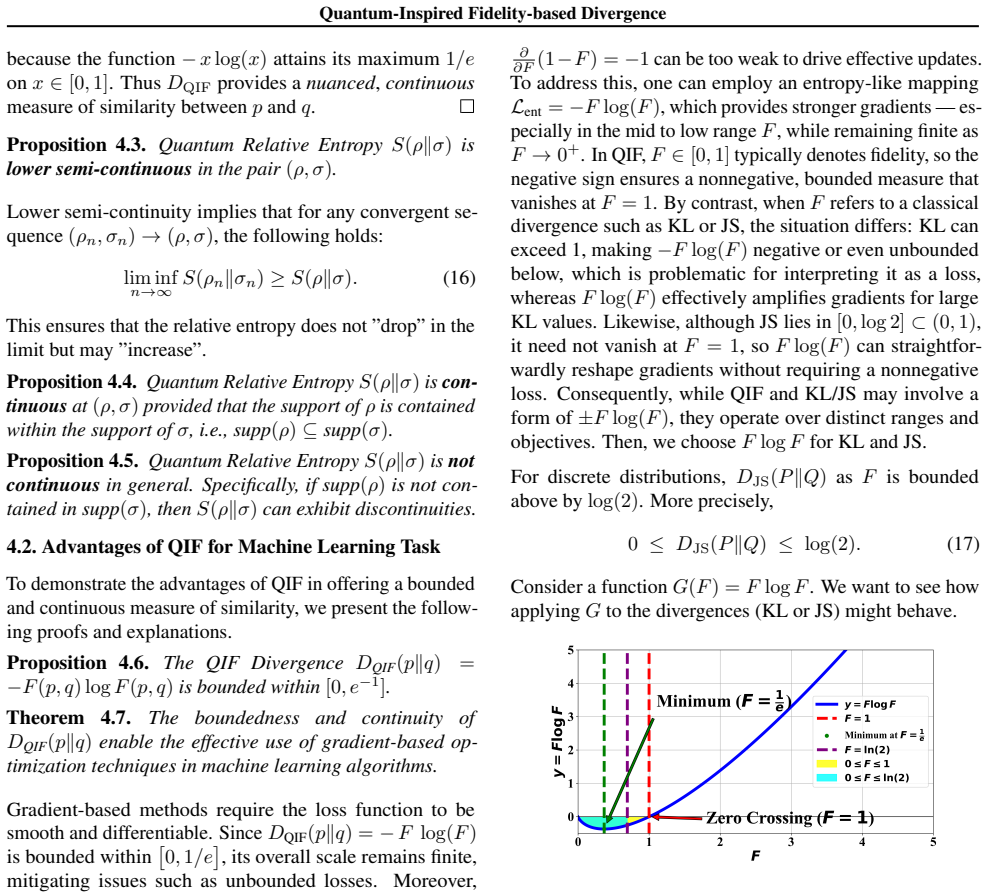
The load-bearing object is the classical fidelity F(P,Q) = (∑ᵢ √(pᵢqᵢ))², which is the squared Bhattacharyya coefficient and equals the quantum fidelity |⟨p|q⟩|² of two amplitude-encoded pure states. Composing F with the entropy function g(x) = −x log x gives QIF(P∥Q) = −F log F, mapping fidelity in [0,1] to the bounded interval [0, e⁻¹] and vanishing exactly at F = 1. The argument runs through three properties: F is computable in O(n) by one pass over the probability vectors; QIF is continuous and finite for disjoint supports, so it needs no α-mixture regularization like regularized kernel KL; and the derivative −log F − 1 yields the entropy-like gradient amplification that makes QR-Drop more effective than a plain 1−F loss.
What would settle it
Take a fixed neural network, force two dropout output distributions to have decreasing overlap (for instance by shrinking support overlap toward zero in a controlled synthetic task), and measure the QIF gradient norm; if the norm grows without bound as F → 0 and QR-Drop training diverges or degrades relative to R-Drop, the claimed stability and continuity are contradicted.
Extended reading notes
Core claim
The paper's central discovery is that the quantum fidelity between two pure states, when both density matrices are diagonal in the same basis, collapses to the classical squared Bhattacharyya coefficient, and composing that coefficient with the entropy function −x log x produces a well-behaved divergence: QIF(P∥Q) = −F(P,Q) log F(P,Q) ∈ [0, e⁻¹]. Unlike quantum relative entropy, which is 0 or +∞ for pure states, and unlike KL and kernel KL divergences, which diverge when the support of one distribution is not contained in the other, QIF is continuous everywhere and stays finite on disjoint supports without any regularization parameter. Because F is a sum of d products of square roots, evaluation is O(n), and the gradient d/dF(−F log F) = −log F − 1 supplies a logarithmically growing update at small but nonzero fidelity. This motivates the QR-Drop regularizer, which forces consistency between two dropout views of the same input; the paper's experiments show QR-Drop reducing overfitting and improving or matching R-Drop and baseline methods on MNIST, CIFAR-10, and several GLUE tasks.
Load-bearing premise
The two dropout output distributions must avoid becoming disjoint during training; otherwise the QIF gradient −log F − 1 blows up, so the claimed numerical stability fails.
Editorial extensions
If this is right
- QIF can replace KL in any regularization or loss objective that needs boundedness, at the same O(n) asymptotic cost, without tuning a mixture or smoothing parameter.
- QR-Drop inherits R-Drop's training procedure; its improvements on GLUE tasks such as RTE and CoLA suggest that the choice of divergence, not the dropout mechanism, drives the gain.
- The bounded range [0, e⁻¹] means QIF cannot produce infinite loss, so it can be added as a regularizer in settings where KL routinely saturates or explodes.
- Because QIF is the entropy of fidelity, it penalizes disagreement between two views with a finite loss even for completely disjoint outputs, whereas KL would make the objective infinite.
Reading between the lines
- A direct extension the authors do not test: apply QR-Drop to knowledge distillation or generative models, where teacher and student distributions can have near-disjoint supports; QIF's boundedness would remove the need for label smoothing that KL objectives require.
- The identity −F log F is the Shannon entropy of a Bernoulli random variable with probability F; this suggests QIF could be interpreted as the uncertainty in discriminating the two amplitude-encoded states, connecting to state-discrimination bounds not mentioned in the paper.
- One testable prediction: because dQIF/dF = −log F − 1, a task where dropout views become near-orthogonal should show gradient instability; measuring the smallest fidelity attained during QR-Drop training on long-tail or sparse-label data would confirm or refute this assumption.
Signed reviews
Editorial analysis
A structured set of objections, weighed in public.
Referee Report
Summary. The paper introduces QIF(P||Q) = -F(P,Q) log F(P,Q), where F is the classical fidelity/Bhattacharyya coefficient, and claims that QIF is a bounded, continuous, O(n) divergence that remains finite on disjoint supports and is therefore more stable than KL divergence. It then proposes QR-Drop, which replaces the KL consistency term in R-Drop with QIF, and reports experiments on MNIST, CIFAR-10, and GLUE. The paper also contains derivations from pure-state quantum fidelity, proofs of boundedness and continuity, and a comparison with quantum relative entropy.
Significance. If the central claims were correct, the construction would be practically attractive: QIF is parameter-free, computable in O(n), continuous even at support mismatch, and the pure-state derivation in Section 3 is straightforward. The boundedness and continuity calculations in Section 4 are correct as stated, and the classical reformulation in Section 3.2 is clearly described. However, QIF is not a divergence in the standard sense, and the claimed gradient stability and QR-Drop behavior are undermined by the non-monotonicity of -x log x and by an unverified low-fidelity assumption. The empirical results are too weak to independently support the headline claims. The current version therefore does not establish its main contribution.
major comments (4)
- [Section 3.1, Eq. (9)] QIF is not a divergence because it vanishes for all pairs of distributions with disjoint supports: whenever F(P,Q)=0, QIF(P||Q)=0, so D(P||Q)=0 does not imply P=Q. The paper repeatedly calls QIF a 'divergence' in the abstract, Section 1, Section 4, and Section 8, but the identity-of-indiscernibles property fails. With the continuous extension implicit in Eq. (11), QIF has global minima at both F=0 and F=1. This is not a presentation issue; the definition itself would need to be changed to a strictly decreasing function of F, which would alter all subsequent claims.
- [Sections 5-6, Eq. (24)] The non-monotonicity of x -> -x log x on [0,1] is load-bearing for QR-Drop. Since dL_QIF/dF = -log F - 1, the derivative is positive for F < 1/e, so gradient descent on the total loss in Eq. (24) decreases F whenever the two dropout output distributions have fidelity below 1/e. In the near-disjoint regime that the paper claims to stabilize, QR-Drop therefore actively drives the two distributions toward disjoint supports (F=0), where the QIF term is zero, rather than enforcing consistency. The text never addresses this sign-reversal behavior.
- [Section 4.2, Theorem 4.7] The claim that QIF enables stable gradient-based optimization is overstated. The derivative -log F - 1 is unbounded as F approaches 0, so the loss is not uniformly smooth on [0,1]; the proof of Theorem 4.7 only considers F in (0,1] and then assumes that rho and sigma are not perfectly orthogonal. The clamping in Eq. (11) bounds the loss value but does not bound the gradient magnitude. No evidence is provided that the dropout output distributions in the MNIST, CIFAR-10, or GLUE experiments maintain F above 1/e, which is the critical threshold for the sign of the derivative.
- [Section 7, Table 1 and Figures 7-9] The empirical claim that QR-Drop 'outperforms state-of-the-art methods' is not supported as reported. Table 1 shows average GLUE gains of only 0.1-0.3 points over R-Drop, and for RoBERTa-large the QRD average (86.62) is effectively tied with RD (86.56). No standard deviations, training runs over multiple seeds, or significance tests are reported, and Figures 7-9 do not include error bars. These results cannot carry the paper's generalization claim, especially in light of the theoretical issues above.
minor comments (5)
- [Section 3.2] In the paragraph after Eq. (12), 'avoid amplitude encoding of the probability distributions p and p' should read 'p and q'.
- [Section 4.2] The sentence 'small regularization or smoothing strategies can also handle the case F ≈ 0 as σ in Eq. 11' appears to contain a typo: it should refer to the constant ε, not σ.
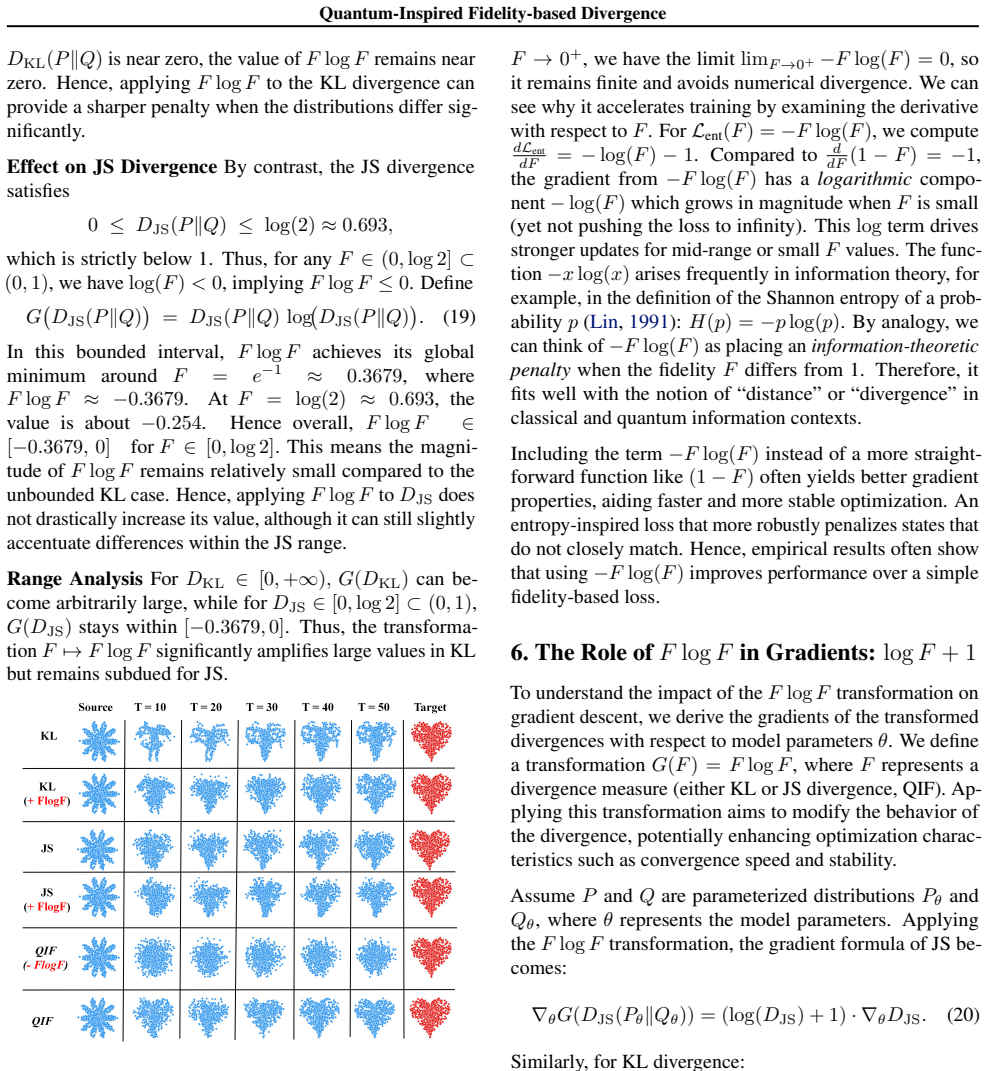
- [Section 6] The text contains a duplicated article in 'the the JS divergence', and the closing claim that 'QIF without F log F shows poor convergence' is confusing because QIF is defined using -F log F; the intended baseline should be clarified.
- [Eq. (13)] The Bhattacharyya distance is written as DB(p,q) = -ln(∑ √p_i q_i), which appears to be a typo for -ln(∑ √(p_i q_i)); the relation to the fidelity in Eq. (12) should be stated explicitly.
- [Figures 1, 4, 7-9] The figure captions do not specify how the compared divergences are normalized or how the optimization is configured, and the 'Sinkhorn distance' used in Figures 1 and 4 is neither defined nor cited in the text.
Circularity Check
No significant circularity: QIF is an explicit parameter-free definition, its boundedness is a direct calculus fact, and QR-Drop is validated on external benchmarks.
full rationale
QIF is introduced as an explicit definition (Eqs. 5, 9, 10): QIF(P||Q) = -F(P,Q) log F(P,Q), with F(P,Q) = (sum_i sqrt(p_i q_i))^2 obtained by substituting the pure-state fidelity formula. No parameter is fitted to data, and the boundedness and continuity claims (Theorem 4.2, Proposition 4.6) are immediate analytic properties of x -> -x log x on [0,1], not predictions inferred from the same measurements that define the quantity. QR-Drop then simply replaces the KL term in R-Drop with QIF (Eq. 24) and is evaluated on MNIST, CIFAR-10, and GLUE against external baselines, so the empirical claim does not reduce to the definition. The self-citations (Ding et al. 2020; Peng et al. 2024; Li et al. 2024; Liang et al. 2022, 2024; Wang et al. 2022) appear only in the quantum-computing background and are not load-bearing for the central QIF or QR-Drop claims. The paper also explicitly records a real assumption in Theorem 4.7, that rho and sigma are not perfectly orthogonal so F does not vanish, and an honest limitations paragraph about task scope; these are correctness and scope caveats, not circularity. The non-monotonicity of -F log F for F < 1/e is a substantive correctness concern for QR-Drop and for calling QIF a divergence, but it is not an instance of the derivation reducing to its own inputs, so it does not raise the circularity score.
Assumptions & free parameters
free parameters (1)
- beta =
1.0
assumptions (4)
- standard math Fidelity between pure states equals the squared modulus of the inner product, and amplitude encoding of probability vectors yields pure states.
- domain assumption The two dropout sub-model output distributions are not perfectly orthogonal, so the fidelity F does not approach 0 during training.
- domain assumption Softmax outputs of neural networks can be treated as discrete probability distributions over the same label space for fidelity computation.
- domain assumption KL divergence becomes numerically unstable in high-dimensional, partially disjoint support settings, motivating QR-Drop.
Cite this review
Pith. "Pith review of Quantum-Inspired Fidelity-based Divergence." pith.science (2026). https://pith.science/paper/VCZXXESP
@misc{pith2026250119307,
  author       = {Pith},
  title        = {Pith review of: Quantum-Inspired Fidelity-based Divergence},
  year         = {2026},
  howpublished = {\url{https://pith.science/paper/VCZXXESP}},
  note         = {Machine review of arXiv:2501.19307}
}
read the original abstract
Kullback--Leibler (KL) divergence is a fundamental measure of the dissimilarity between two probability distributions, but it can become unstable in high-dimensional settings due to its sensitivity to mismatches in distributional support. To address robustness limitations, we propose a novel Quantum-Inspired Fidelity-based Divergence (QIF), leveraging quantum information principles yet efficiently computable on classical hardware. Compared to KL divergence, QIF demonstrates improved numerical stability under partial or near-disjoint support conditions, thereby reducing the need for extensive regularization in specific scenarios. Moreover, QIF admits well-defined theoretical bounds and continuous similarity measures. Building on this, we introduce a novel regularization method, QR-Drop, which utilizes QIF to improve generalization in machine learning models. Empirical results show that QR-Drop effectively mitigates overfitting and outperforms state-of-the-art methods.
Figures


Figures from the paper (6 more)


Reference graph
Works this paper leans on
-
[6]
Ding, Y ., Wu, X.-C., Holmes, A., Wiseth, A., Franklin, D., Martonosi, M., and Chong, F. T. Square: Strategic quantum ancilla reuse for modular quantum programs via cost-effective uncomputation. In 2020 ACM/IEEE 47th Annual International Symposium on Computer Architec- ture (ISCA), pp. 570–583. IEEE,
work page 2020
-
[15]
Wang, H., Ding, Y ., Gu, J., Lin, Y ., Pan, D. Z., Chong, F. T., and Han, S. Quantumnas: Noise-adaptive search for robust quantum circuits. In 2022 IEEE International Symposium on High-Performance Computer Architecture (HPCA), pp. 692–708. IEEE,
work page 2022
-
[1948]
Dropout: a simple way to prevent neural networks from overfitting
Srivastava, N., Hinton, G., Krizhevsky, A., Sutskever, I., and Salakhutdinov, R. Dropout: a simple way to prevent neural networks from overfitting. The journal of machine learning research, 15(1):1929–1958,
1929
-
[2003]
J., Bergholm, V ., and Salomaa, M
Mottonen, M., Vartiainen, J. J., Bergholm, V ., and Salomaa, M. M. Transformation of quantum states using uniformly controlled rotations. arXiv preprint quant-ph/0407010,
-
[2009]
Kingma, D. P. Auto-encoding variational bayes. arXiv preprint arXiv:1312.6114,
-
[2010]
Qsco: A Quantum Scoring Module for Open-set Supervised Anomaly Detection
Peng, Y ., Li, X., Liang, Z., and Wang, Y . Qsco: A quantum scoring module for open-set supervised anomaly detec- tion. arXiv preprint arXiv:2405.16368,
- [2012]
-
[2013]
Glue: A multi-task benchmark and analysis plat- form for natural language understanding
Wang, A. Glue: A multi-task benchmark and analysis plat- form for natural language understanding. arXiv preprint arXiv:1804.07461,
Show all 15 references
-
[2016]
Roberta: A robustly optimized bert pretraining approach
Liu, Y . Roberta: A robustly optimized bert pretraining approach. arXiv preprint arXiv:1907.11692, 364,
1907 arXiv
-
[2017]
Kullback-leibler divergence between quan- tum distributions, and its upper-bound
Bonnici, V . Kullback-leibler divergence between quan- tum distributions, and its upper-bound. arXiv preprint arXiv:2008.05932,
2008 arXiv
-
[2018]
Electra: Pre-training text encoders as dis- criminators rather than generators
Clark, K. Electra: Pre-training text encoders as dis- criminators rather than generators. arXiv preprint arXiv:2003.10555,
2003 arXiv
-
[2019]
Efficient quantum gradient and higher-order derivative estimation via generalized hadamard test
Li, D., Dulal, D., Ohorodnikov, M., Wang, H., and Ding, Y . Efficient quantum gradient and higher-order derivative estimation via generalized hadamard test. arXiv preprint arXiv:2408.05406,
-
[2020]
Statistical and geo- metrical properties of regularized kernel kullback-leibler divergence
Chazal, C., Korba, A., and Bach, F. Statistical and geo- metrical properties of regularized kernel kullback-leibler divergence. arXiv preprint arXiv:2408.16543,
-
[2021]
S., Qian, X., Han, S., et al
Liang, Z., Wang, H., Cheng, J., Ding, Y ., Ren, H., Gao, Z., Hu, Z., Boning, D. S., Qian, X., Han, S., et al. Variational quantum pulse learning. In 2022 IEEE International Conference on Quantum Computing and Engineering (QCE), pp. 556–565. IEEE,
2022
-
[2022]
Bhattacharyya, A
URL https://arxiv.org/abs/1811.04968. Bhattacharyya, A. On a measure of divergence between two statistical populations defined by their probability distri- bution. Bulletin of the Calcutta Mathematical Society, 35: 99–110,
Reviewed August 9, 2026 · model on record in the stance chip above.
Discussion (0). Continue with ORCID to comment.