Reconstruction of Reionization Histories from 21 cm Power-Spectrum Evolution with Artificial Neural Networks
Pith reviewed 2026-05-21 02:20 UTC · model grok-4.3
The pith
A neural network learns to reconstruct the neutral hydrogen history during cosmic reionization from the redshift evolution of the 21 cm power spectrum at fixed scales.
A machine-rendered reading of the paper's core claim, the machinery that carries it, and where it could break.
Core claim
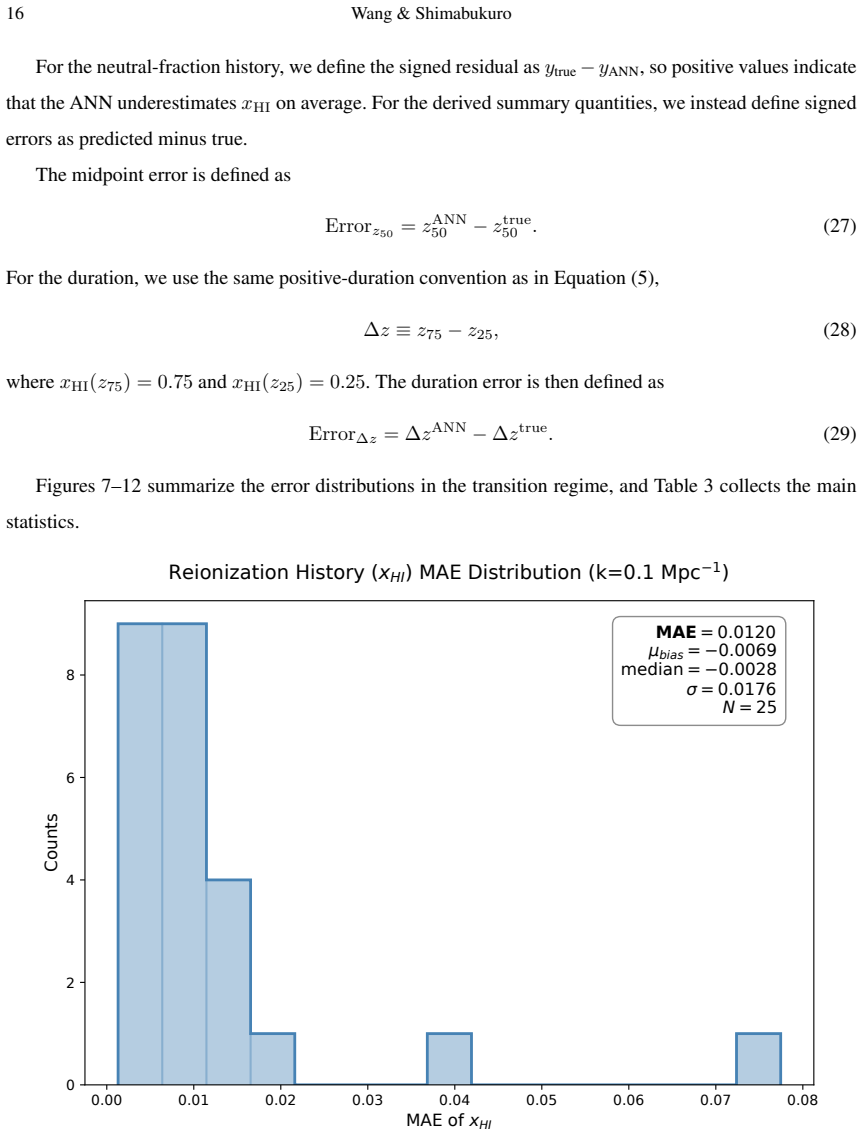
The redshift evolution of the fixed-k dimensionless 21 cm power spectrum contains sufficient information to reconstruct reionization histories with artificial neural networks. Using a restricted three-parameter model family, a compact feed-forward network learns the inverse mapping from power-spectrum trajectories to the neutral-fraction history. Representative tests recover the midpoint redshift with MAE of 0.0046 and RMSE of 0.0100, while the duration yields MAE of 0.0302 and RMSE of 0.0378, indicating stronger information about timing than about transition width. The reconstruction remains stable under an idealized foreground-free noise model.
What carries the argument
A compact feed-forward neural network trained to perform the inverse mapping from the redshift evolution of the fixed-k 21 cm power spectrum to the neutral-fraction history x_HI(z).
If this is right
- The midpoint redshift of reionization is recovered with high accuracy.
- The duration of the reionization transition is recovered with moderate accuracy.
- Fixed-scale power spectrum evolution provides stronger constraints on the timing than on the width of reionization.
- The reconstruction is stable when an idealized thermal-plus-sample-variance noise model is included.
Where Pith is reading between the lines
- If real observations match the patterns in the training set, this network approach could serve as a rapid estimator for reionization parameters from power-spectrum data alone.
- Training on a wider range of reionization models might allow the network to handle more realistic histories beyond the three-parameter family.
- Combining this method with data at multiple spatial scales could reduce errors in estimating the duration of reionization.
Load-bearing premise
Reionization histories are generated inside a narrow three-parameter family of a semi-numerical simulation model, and the redshift evolution of the power spectrum at one fixed scale contains enough information to recover the neutral-fraction history inside that family.
What would settle it
Generate power-spectrum evolution tracks from reionization models that use more than three parameters or different physical assumptions, apply the trained network, and verify whether the errors on the recovered midpoint and duration stay below 0.01 and 0.04 respectively.
Figures





read the original abstract
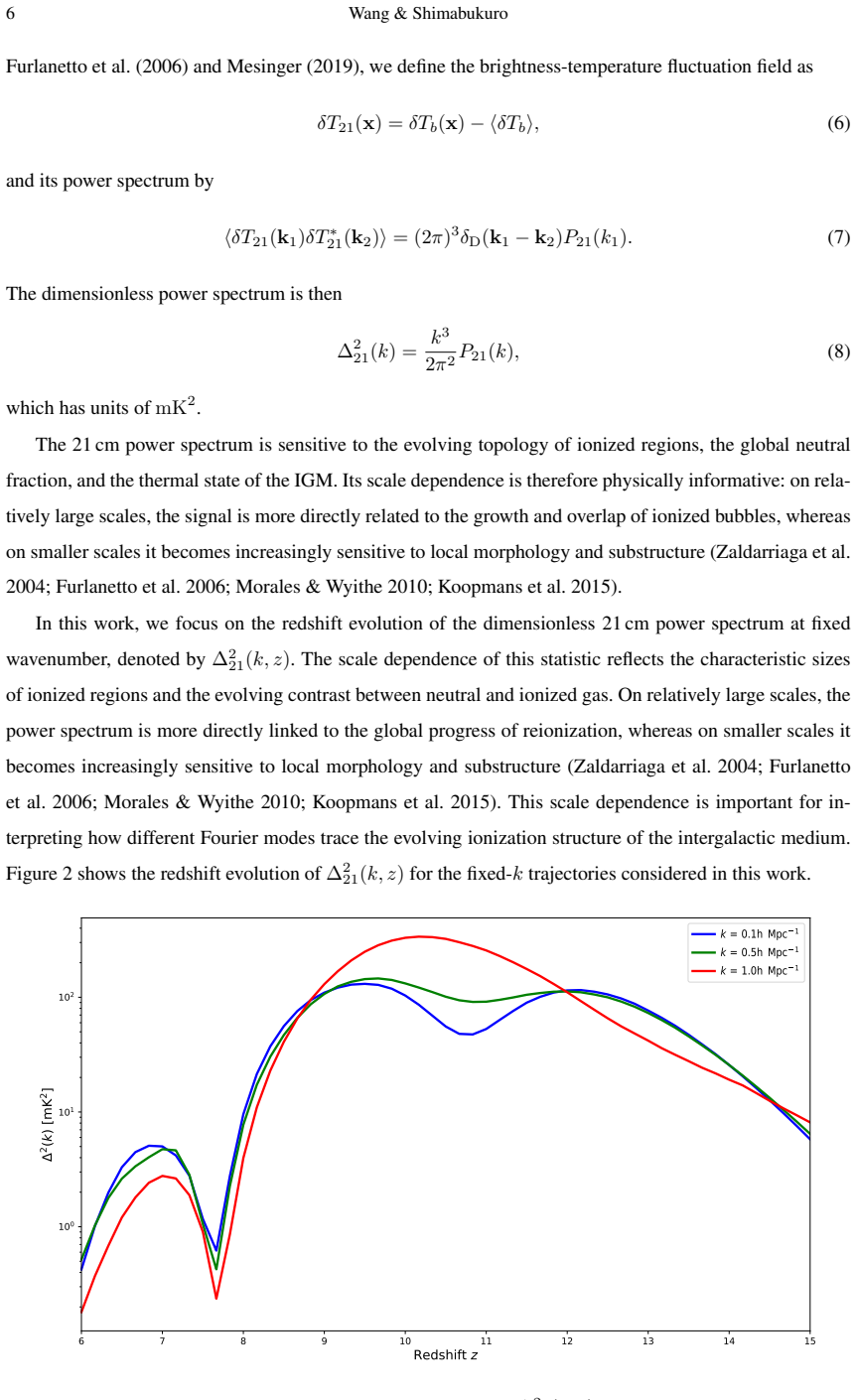
We investigate whether the redshift evolution of the fixed-$k$ dimensionless 21 cm power spectrum, $\Delta^2_{21}(k, z)$, contains sufficient information to reconstruct reionization histories $x_{\mathrm{HI}}(z)$ with artificial neural networks. Using semi-numerical realizations generated within a restricted three-parameter 21cmFAST model family, we train a compact feed-forward network to learn the inverse mapping from power-spectrum trajectories to the neutral-fraction history over $6 \le z \le 15$. For $k = 0.1$, $0.5$, and $1.0\ h\ \mathrm{Mpc}^{-1}$, representative tests on an independent test set show that the midpoint redshift $z_{50}$ is recovered more accurately than the duration $\Delta z = z_{75} - z_{25}$: $z_{50}$ is reconstructed with MAE = 0.0046 and RMSE = 0.0100, whereas $\Delta z$ yields MAE = 0.0302 and RMSE = 0.0378. This result indicates that fixed-$k$ power-spectrum evolution carries stronger information about the timing of reionization than about the detailed width of the transition within the adopted prior. We further test an idealized foreground-free SKA1-Low-like thermal-plus-sample-variance noise model and find that the reconstruction remains stable in the favorable signal-to-noise regime considered here. These results demonstrate that neural networks can serve as prior-dependent inverse mapping for reconstructing reionization histories from 21 cm power-spectrum evolution.
Editorial analysis
A structured set of objections, weighed in public.
Referee Report
Summary. The paper claims that the redshift evolution of the fixed-k dimensionless 21 cm power spectrum Δ²₂₁(k, z) contains sufficient information to reconstruct reionization histories x_HI(z) with artificial neural networks. Using semi-numerical realizations from a restricted three-parameter 21cmFAST model family, a compact feed-forward network is trained to map power-spectrum trajectories to the neutral-fraction history over 6 ≤ z ≤ 15. On an independent test set, the midpoint redshift z₅₀ is recovered with MAE = 0.0046 and RMSE = 0.0100, while the duration Δz = z₇₅ - z₂₅ yields MAE = 0.0302 and RMSE = 0.0378. The reconstruction remains stable under an idealized foreground-free SKA1-Low-like noise model. The work demonstrates that neural networks can serve as prior-dependent inverse mappings for this task.
Significance. If the reported mapping holds, the paper provides a clear quantitative demonstration that fixed-k 21 cm power-spectrum evolution carries usable information about reionization timing (z₅₀) within the adopted three-parameter prior, with weaker but still measurable constraints on transition duration (Δz). The explicit scoping to a prior-dependent inverse, the independent test-set metrics, and the idealized noise stability check are strengths that allow direct assessment of information content. This contributes a concrete example of machine-learning-assisted inversion in 21 cm cosmology, useful for guiding analysis of future SKA data under similar model assumptions.
minor comments (3)
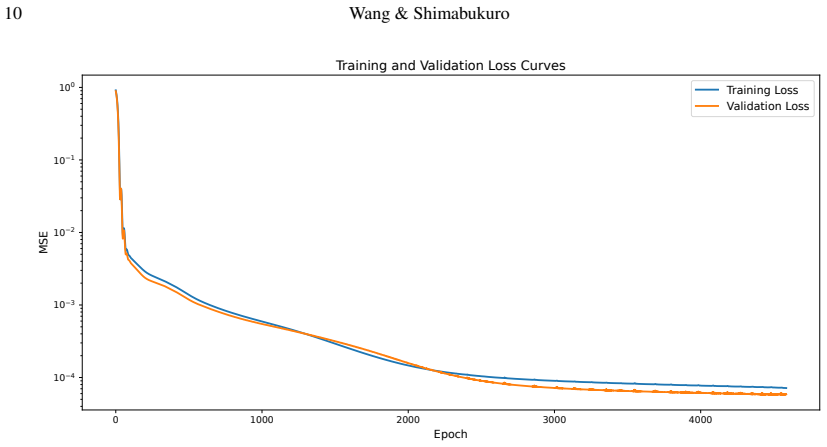
- [Abstract and §3] The abstract and methods should explicitly state the total number of simulations, the parameter ranges sampled for training versus test sets, and the precise network architecture (number of layers, neurons, activation functions) to allow reproducibility and assessment of overfitting risk.
- [Results] Clarify whether the reported MAE/RMSE values are computed on the full x_HI(z) trajectory or only on the summary parameters z₅₀ and Δz; if the former, include an example reconstruction plot with residuals.
- [Noise test subsection] The idealized noise model is described as 'foreground-free'; add a brief statement on how residual foregrounds or other systematics might affect the claimed stability, even if only qualitatively.
Simulated Author's Rebuttal
We thank the referee for their positive summary and significance assessment, which accurately reflect the scope and results of our manuscript. We appreciate the recommendation for minor revision. No specific major comments were raised in the provided report, so we have no point-by-point responses or revisions to propose at this stage. We remain available to address any additional questions or suggestions from the editor.
Circularity Check
No significant circularity
full rationale
The paper scopes its central claim explicitly to a prior-dependent inverse mapping learned by a neural network inside a restricted three-parameter 21cmFAST model family. Training data and independent test data are both drawn from the same forward model, and the reported MAE/RMSE values simply quantify how much information the fixed-k power-spectrum trajectories carry for x_HI(z) within that prior; no load-bearing step reduces by construction to a self-definition, a fitted parameter renamed as a prediction, or a self-citation chain. The derivation is therefore self-contained as a standard supervised inversion exercise on simulated data.
Axiom & Free-Parameter Ledger
free parameters (1)
- three parameters of the 21cmFAST model family
axioms (1)
- domain assumption Semi-numerical realizations generated by 21cmFAST accurately capture the redshift evolution of the 21 cm power spectrum during reionization.
Lean theorems connected to this paper
-
IndisputableMonolith/Cost/FunctionalEquation.leanwashburn_uniqueness_aczel unclear?
unclearRelation between the paper passage and the cited Recognition theorem.
We train a compact feed-forward network to learn the inverse mapping from power-spectrum trajectories to the neutral-fraction history over 6 ≤ z ≤ 15. For k = 0.1, 0.5, and 1.0 h Mpc⁻¹, representative tests on an independent test set show that the midpoint redshift z₅₀ is recovered more accurately than the duration Δz
-
IndisputableMonolith/Foundation/DimensionForcing.leanalexander_duality_circle_linking unclear?
unclearRelation between the paper passage and the cited Recognition theorem.
Using semi-numerical realizations generated within a restricted three-parameter 21cmFAST model family
What do these tags mean?
- matches
- The paper's claim is directly supported by a theorem in the formal canon.
- supports
- The theorem supports part of the paper's argument, but the paper may add assumptions or extra steps.
- extends
- The paper goes beyond the formal theorem; the theorem is a base layer rather than the whole result.
- uses
- The paper appears to rely on the theorem as machinery.
- contradicts
- The paper's claim conflicts with a theorem or certificate in the canon.
- unclear
- Pith found a possible connection, but the passage is too broad, indirect, or ambiguous to say the theorem truly supports the claim.
Reference graph
Works this paper leans on
- [1]
-
[2]
2019, arXiv e-prints, arXiv:1912.12699
Braun, R., Bonaldi, A., Bourke, T., Keane, E., & Wagg, J. 2019, arXiv e-prints, arXiv:1912.12699
-
[3]
2004, Astrophysical Journal, 602, 1
Chen, X., & Miralda-Escud´e, J. 2004, Astrophysical Journal, 602, 1
work page 2004
-
[4]
2008, Astrophysical Journal, 684, 18
Chen, X., & Miralda-Escud´e, J. 2008, Astrophysical Journal, 684, 18
work page 2008
- [5]
-
[6]
DeBoer, D. R., Parsons, A. R., Aguirre, J. E., et al. 2017, PASP, 129, 045001
work page 2017
-
[7]
Dewdney, P. E., Hall, P. J., Schilizzi, R. T., & Lazio, T. J. L. W. 2009, Proceedings of the IEEE, 97, 1482
work page 2009
- [8]
-
[9]
Field, G. B. 1958, Proceedings of the IRE, 46, 240
work page 1958
-
[10]
Field, G. B. 1959, Astrophysical Journal, 129, 536
work page 1959
-
[11]
Furlanetto, S. R., & Briggs, F. H. 2004, New Astronomy Reviews, 48, 1039
work page 2004
- [12]
-
[13]
R., Zaldarriaga, M., & Hernquist, L
Furlanetto, S. R., Zaldarriaga, M., & Hernquist, L. 2004, ApJ, 613, 1
work page 2004
-
[14]
2015, Monthly Notices of the Royal Astronomical Society, 449, 4246
Greig, B., & Mesinger, A. 2015, Monthly Notices of the Royal Astronomical Society, 449, 4246
work page 2015
-
[15]
Haslam, C. G. T., Salter, C. J., Stoffel, H., & Wilson, W. E. 1982, A&AS, 47, 1
work page 1982
-
[16]
Hirata, C. M. 2006, Monthly Notices of the Royal Astronomical Society, 367, 259
work page 2006
-
[17]
Hornik, K., Stinchcombe, M., & White, H. 1989, Neural Networks, 2, 359
work page 1989
- [18]
-
[19]
Koopmans, L., Pritchard, J., Mellema, G., et al. 2015, in Advancing Astrophysics with the Square Kilometre Array (AASKA14), 1 La Plante, P., & Ntampaka, M. 2019, The Astrophysical Journal, 880, 110
work page 2015
-
[20]
Lidz, A., Furlanetto, S. R., Peng Oh, S., et al. 2011, The Astrophysical Journal, 741, 70
work page 2011
-
[21]
Madau, P., Haardt, F., & Rees, M. J. 1999, ApJ, 514, 648
work page 1999
-
[22]
Madau, P., Meiksin, A., & Rees, M. J. 1997, ApJ, 475, 429
work page 1997
-
[23]
Mao, Y ., D’Aloisio, A., Zhang, J., & Shapiro, P. R. 2013, Phys. Rev. D, 88, 081303 22 Wang & Shimabukuro
work page 2013
-
[24]
Mao, Y ., Tegmark, M., McQuinn, M., Zaldarriaga, M., & Zahn, O. 2008, Phys. Rev. D, 78, 023529
work page 2008
-
[25]
McQuinn, M., Zahn, O., Zaldarriaga, M., Hernquist, L., & Furlanetto, S. R. 2006, ApJ, 653, 815
work page 2006
-
[26]
2019, The Cosmic 21-cm Revolution; Charting the first billion years of our universe
Mesinger, A. 2019, The Cosmic 21-cm Revolution; Charting the first billion years of our universe
work page 2019
- [27]
-
[28]
Morales, M. F., & Wyithe, J. S. B. 2010, Annual Review of Astronomy and Astrophysics, 48, 127
work page 2010
-
[29]
2020, The Journal of Open Source Software, 5, 2582
Murray, S., Greig, B., Mesinger, A., et al. 2020, The Journal of Open Source Software, 5, 2582
work page 2020
-
[30]
Nair, V ., & Hinton, G. E. 2010, Omnipress
work page 2010
-
[31]
Park, J., Mesinger, A., Greig, B., & Gillet, N. 2019, MNRAS, 484, 933
work page 2019
-
[32]
Parsons, A. R., Pober, J. C., Aguirre, J. E., et al. 2012, ApJ, 756, 165 Planck Collaboration, Aghanim, N., Akrami, Y ., et al. 2020, A&A, 641, A6
work page 2012
-
[33]
Pritchard, J. R., & Loeb, A. 2012, Reports on Progress in Physics, 75, 086901
work page 2012
-
[34]
Robertson, B. E. 2022, ARA&A, 60, 121
work page 2022
-
[35]
Rumelhart, D. E., Hinton, G. E., & Williams, R. J. 1986, Nature, 323, 533
work page 1986
-
[36]
Scott, D., & Rees, M. J. 1990, MNRAS, 247, 510
work page 1990
-
[37]
2025, Research in Astronomy and Astrophysics, 25, 085017
Shimabukuro, H. 2025, Research in Astronomy and Astrophysics, 25, 085017
work page 2025
-
[38]
Shimabukuro, H., Hasegawa, K., Kuchinomachi, A., Yajima, H., & Yoshiura, S. 2023, PASJ, 75, S1
work page 2023
-
[39]
2022, Research in Astronomy and Astrophysics, 22, 035027
Shimabukuro, H., Mao, Y ., & Tan, J. 2022, Research in Astronomy and Astrophysics, 22, 035027
work page 2022
- [40]
-
[41]
Sikder, S., Barkana, R., Reis, I., & Fialkov, A. 2024, MNRAS, 527, 9977
work page 2024
- [42]
-
[43]
2025, The Astrophysical Journal Supplement Series, 277, 37
Umeda, H., Ouchi, M., Kikuta, S., et al. 2025, The Astrophysical Journal Supplement Series, 277, 37
work page 2025
-
[44]
Wouthuysen, S. A. 1952, Astronomical Journal, 57, 31
work page 1952
-
[45]
Zaldarriaga, M., Furlanetto, S. R., & Hernquist, L. 2004, Astrophysical Journal, 608, 622
work page 2004
discussion (0)
Sign in with ORCID, Apple, or X to comment. Anyone can read and Pith papers without signing in.