Quantum Ghost Spectroscopy Reveals Hidden Electronic Coherence in Molecular Aggregates
Pith reviewed 2026-05-25 04:09 UTC · model grok-4.3
The pith
Time-resolved quantum ghost spectroscopy captures hidden electronic coherence in molecular aggregates
A machine-rendered reading of the paper's core claim, the machinery that carries it, and where it could break.
Core claim
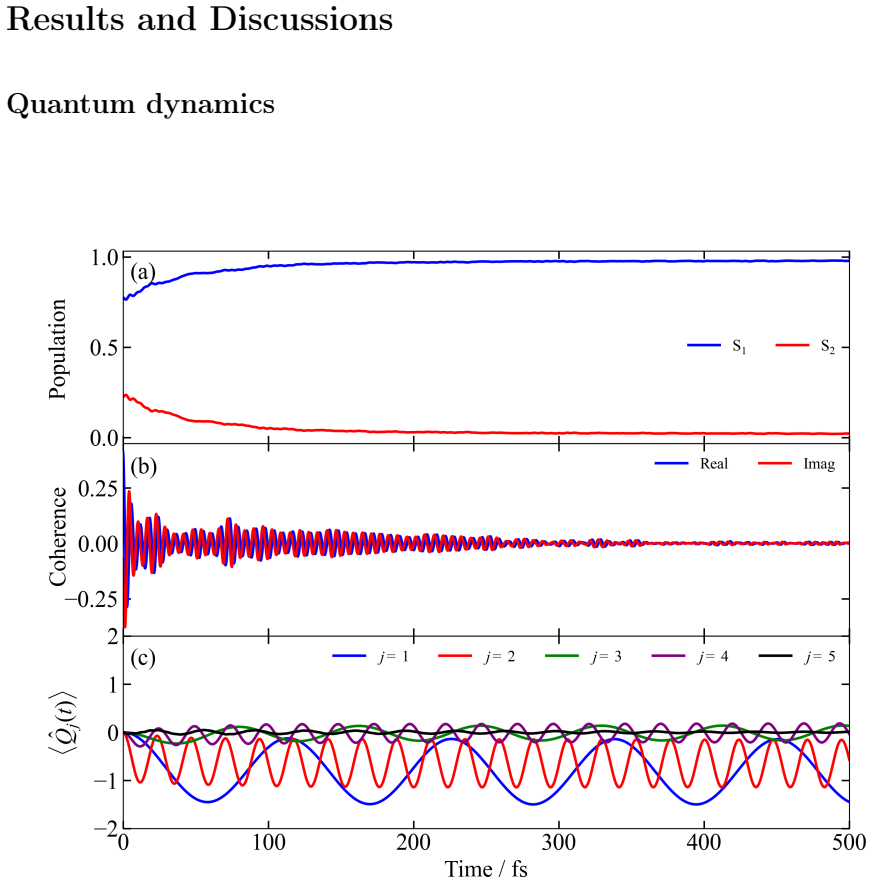
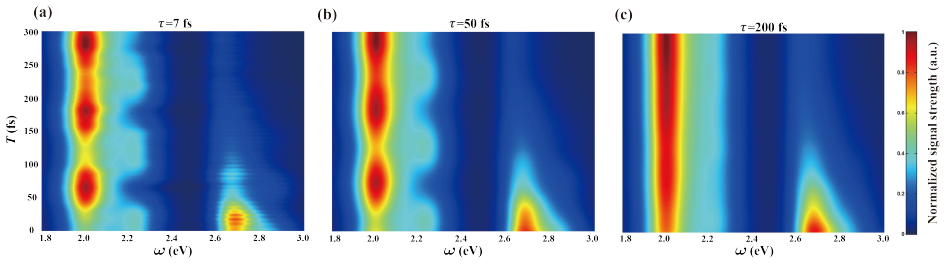
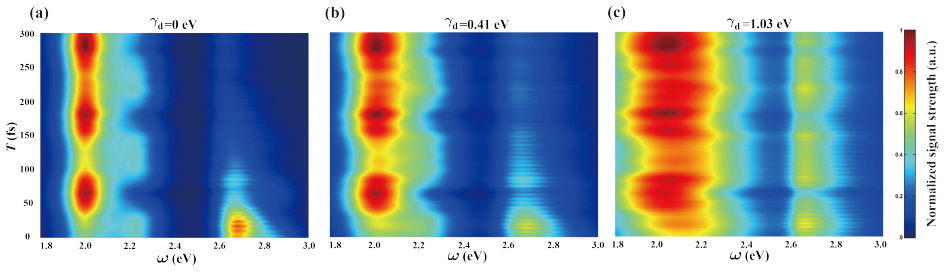
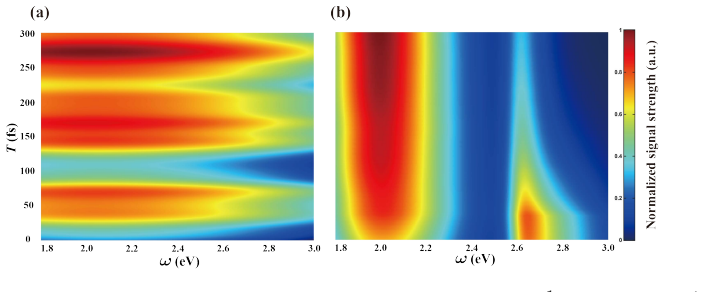
Combining a quantum description of light-molecule interactions with TD-DMRG simulations that include five vibrational modes and nonadiabatic coupling between electronic states, the study finds that tr-QGS uniquely detects electronic coherence oscillating at 0.7 eV for more than 50 fs in PBI-1 trimers as a signature of nonadiabatic coupling, which conventional time-resolved fluorescence misses due to Fourier-limited broadening, and additionally observes a direct transfer from electronic to vibrational coherence at 200 fs.
What carries the argument
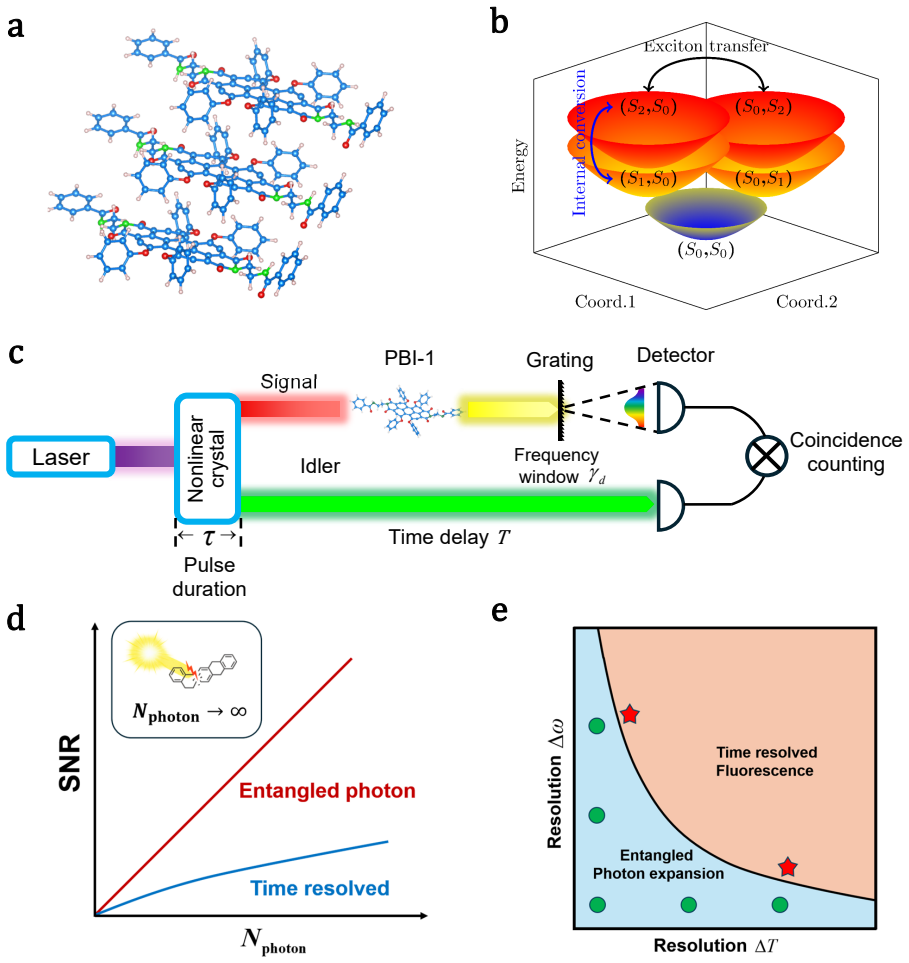
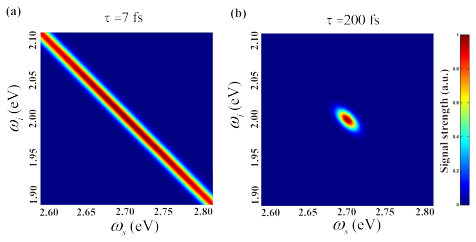
Time-resolved quantum ghost spectroscopy (tr-QGS) employing entangled photon pairs to decouple time and frequency resolutions in measurements of molecular aggregates.
If this is right
- tr-QGS provides a means to interrogate nonadiabatic dynamics in molecular aggregates with high time-energy precision.
- The technique visualizes vibronic relaxation pathways in real time through coherence transfer observations.
- Entangled photon correlations enable sensitivity below the shot-noise limit and suppress photobleaching.
- This approach applies to studying quantum coherence in light-harvesting complexes and photocatalysts.
Where Pith is reading between the lines
- Experimental implementation of tr-QGS on similar systems could confirm the simulated coherence dynamics and extend to biological complexes.
- The reported 200 fs transfer suggests that additional vibrational modes might influence longer-term dynamics if included in simulations.
- This method could be combined with other quantum sensing techniques to probe coherence in condensed phase environments.
Load-bearing premise
The TD-DMRG simulations using exactly five vibrational modes and the included nonadiabatic coupling between electronic states accurately model the coherence dynamics observable with tr-QGS, without missing modes or artifacts that would change the 0.7 eV oscillation period or 200 fs transfer time.
What would settle it
An experimental tr-QGS measurement on PBI-1 trimers showing no electronic coherence at 0.7 eV lasting beyond 50 fs or no coherence transfer at 200 fs would falsify the simulation-based predictions.
Figures
read the original abstract
Ultrafast spectroscopy of molecular systems is fundamentally constrained by the Fourier uncertainty principle: high temporal resolution smears out electronic state signatures, while high spectral resolution obscures dynamic information. Here we overcome this limitation using time-resolved quantum ghost spectroscopy (tr-QGS) with entangled photon pairs, which enables independent control of temporal and spectral scales. We apply this approach to perylene bismide (PBI-1) trimers for energy transfer,by combining a quantum description of light-molecule interaction with time-dependent density matrix renormalization group (TD-DMRG) simulations. This explicitly includes five vibrational modes and nonadiabatic coupling between electronic states. Our simulations reveal that tr-QGS uniquely captures electronic coherence oscillating at 0.7 eV for >50 fs, a signature of nonadiabatic coupling that was obscured in conventional time-resolved fluorescence due to Fourier-limited broadening. Moreover, we observe a direct transfer from electronic to vibrational coherence at 200 fs, providing real-time visualization of vibronic relaxation pathways. The entangled photon correlation enables a sensitivity below the shot-noise limit and suppresses photobleaching artifacts that plague classical measurements. These results establish tr-QGS as a transformative tool for interrogating nonadiabatic dynamics in molecular aggregates, light-harvesting complexes, and photocatalysts, offering a route to reveal quantum coherence in chemistry with unprecedented time-energy precision.
Editorial analysis
A structured set of objections, weighed in public.
Referee Report
Summary. The manuscript proposes time-resolved quantum ghost spectroscopy (tr-QGS) using entangled photon pairs to circumvent the Fourier uncertainty principle in ultrafast spectroscopy of molecular aggregates. Combining a quantum description of light-matter interactions with TD-DMRG simulations on PBI-1 trimers (incorporating exactly five vibrational modes and nonadiabatic electronic coupling), the authors claim that tr-QGS uniquely resolves electronic coherence oscillating at 0.7 eV persisting for >50 fs—a signature of nonadiabatic coupling obscured in conventional time-resolved fluorescence—and a direct transfer from electronic to vibrational coherence at 200 fs. Additional benefits cited include sub-shot-noise sensitivity and reduced photobleaching.
Significance. If the TD-DMRG results hold under more complete vibrational treatments, the work could establish a new spectroscopic tool for resolving nonadiabatic dynamics with independent time and energy resolution, offering a route to visualize vibronic relaxation pathways in aggregates and light-harvesting systems that are inaccessible to Fourier-limited methods.
major comments (1)
- [TD-DMRG simulations (abstract and methods)] The TD-DMRG simulations (described in the abstract and methods) employ exactly five vibrational modes plus nonadiabatic coupling. PBI-1 trimers possess additional Franck-Condon active modes whose omission can alter vibronic relaxation pathways, dephasing rates, and the apparent nonadiabatic signatures. If extra modes shorten the electronic coherence lifetime or shift the 200 fs transfer time, the asserted advantage of tr-QGS over conventional fluorescence would not hold for the physical system. This assumption is load-bearing for the central claim.
minor comments (1)
- [Abstract] The abstract states the coherence oscillates at 0.7 eV but does not specify the precise definition or extraction method for this energy scale from the simulated correlation functions.
Simulated Author's Rebuttal
We thank the referee for this constructive comment on the vibrational basis in our TD-DMRG simulations. We address the concern directly below.
read point-by-point responses
-
Referee: [TD-DMRG simulations (abstract and methods)] The TD-DMRG simulations (described in the abstract and methods) employ exactly five vibrational modes plus nonadiabatic coupling. PBI-1 trimers possess additional Franck-Condon active modes whose omission can alter vibronic relaxation pathways, dephasing rates, and the apparent nonadiabatic signatures. If extra modes shorten the electronic coherence lifetime or shift the 200 fs transfer time, the asserted advantage of tr-QGS over conventional fluorescence would not hold for the physical system. This assumption is load-bearing for the central claim.
Authors: We agree that limiting the simulation to five vibrational modes is a modeling choice whose consequences must be examined. These five modes were selected as the dominant Franck-Condon active vibrations with the largest Huang-Rhys factors according to prior experimental and computational studies of PBI aggregates; they capture the primary vibronic coupling relevant to the nonadiabatic dynamics under study. Nevertheless, we acknowledge that additional modes could quantitatively modify dephasing rates or the precise timing of the electronic-to-vibrational coherence transfer. The central demonstration—that tr-QGS resolves the 0.7 eV electronic coherence signature that is obscured in Fourier-limited fluorescence—remains valid within the model employed. To address the referee’s concern, we will revise the Methods section to provide explicit justification for the mode selection and add a dedicated paragraph in the Discussion that (i) states the limitation, (ii) discusses possible effects of omitted modes, and (iii) outlines how future calculations with extended vibrational bases could be performed. This revision will make the scope and robustness of the reported advantage transparent. revision: partial
Circularity Check
No circularity; claims rest on independent TD-DMRG simulations of five modes without reduction to fitted inputs or self-citations.
full rationale
The abstract presents tr-QGS results as emerging from a quantum light-matter description combined with TD-DMRG simulations that explicitly include five vibrational modes and nonadiabatic coupling. No quoted equations or statements show the reported 0.7 eV oscillation or 200 fs transfer time being defined by, fitted to, or renamed from the target observables themselves. The simulations are used to predict what tr-QGS would measure, rather than the reverse. No self-citation chains, ansatz smuggling, or uniqueness theorems are invoked in the provided text. The derivation chain therefore remains self-contained against external benchmarks.
Axiom & Free-Parameter Ledger
axioms (1)
- domain assumption TD-DMRG simulations with five vibrational modes and nonadiabatic electronic coupling faithfully represent the molecular dynamics observable via tr-QGS.
discussion (0)
Sign in with ORCID, Apple, or X to comment. Anyone can read and Pith papers without signing in.