REVIEW 5 major objections 5 minor 43 references
InfoSynth: Information-Guided Benchmark Synthesis for LLMs
T0 review · 5 major / 5 minor · reviewed 2026-08-03 · deepseek-v4-flash
Pith's one-line read InfoSynth sets out to show that benchmark novelty and diversity can be computed cheaply from embedding geometry and that optimizing those scores yields automatically generated Python coding benchmarks whose solutions and tests are correct 9
desk verdict InfoSynth is a real, mostly working synthesis pipeline, but its central novelty/diversity claim is undercut by using the same embedding geometry to select and to measure; referee it, expect major revision. read the letter →
The pith
A machine-rendered reading of the paper's core claim, the machinery that carries it, and where it could break.
The reading
What carries the argument
The load-bearing machinery is the pair of information-theoretic estimators—a k-NN KL-divergence estimator for novelty and a k-NN differential-entropy estimator for diversity—applied to sentence embeddings of problem statements after a joint nonlinear projection to 8–12 dimensions. These scores serve both as the paper's quality metric and as the selection signal for keeping or discarding generated problems. Around that core sits a genetic generation loop: LLM prompts that mutate a seed problem in three difficulty directions or cross over several problems, a k-farthest-neighbor filter that retains problems least similar to the already-selected set, an iterative code-feedback loop that runs can
What would settle it
Take a set of paraphrased copies of the seed problems (same ideas, different wording) and compute the paper's novelty score against the seeds; if the paraphrased copies score as high as genuinely new problems, the embedding-based metric is too weak to detect memorization. Alternatively, run the pipeline twice with and without k-farthest-neighbor filtering and check whether the higher-scoring dataset produces systematically lower pass rates on a held-out model that was not used in generation; if it does not, the claimed link between the scores and evaluation value fails.
Extended reading notes
Core claim
The central discovery is that benchmark-level properties can be treated as an optimization target: novelty is estimated by a k-nearest-neighbor KL-divergence estimator comparing a new dataset's embedding distribution to a seed dataset's, and diversity is estimated by a k-nearest-neighbor differential-entropy estimator on the new dataset. The paper validates these estimators by showing that known dataset relationships (topic subsets versus full sets, easy versus hard problem collections) rank as intuition predicts, then applies the same scores inside a genetic algorithm. Each generation round an LLM produces easy, medium, and hard mutations or crossover combinations of seed problems; problems
Load-bearing premise
The whole approach depends on the premise that KL divergence and differential entropy over low-dimensional projections of problem-statement embeddings measure the novelty and diversity that actually matter for evaluating LLMs—and in particular that high scores imply resistance to contamination, which the paper explicitly says it does not directly address.
Editorial extensions
If this is right
- Synthesized MBPP- and Leetcode-seeded datasets are reported to have higher novelty and diversity than their seeds on the proposed metrics.
- Hard-mutation variants make benchmarks harder: model pass rates drop by roughly 8–15 percentage points compared with the original MBPP dataset, providing a difficulty-control mechanism.
- k-farthest-neighbor filtering reliably increases novelty and diversity, but produces easier problems, exposing a novelty–diversity–difficulty tradeoff that the pipeline can steer.
- Iterative code feedback raises the fraction of passing solution–test pairs by about 20% over five iterations, with most of the gain achieved after three iterations.
- Post-processing problem statements to specify edge-case behavior improves downstream model pass rates by 5–15 percentage points.
Reading between the lines
- Not claimed by the paper, but a natural next step is to turn the novelty/diversity scores into a differentiable reward inside the generator rather than a post-hoc filter; the k-farthest-neighbor selection is a hard version of that idea.
- The metrics operate on problem-statement embeddings only, so the paper's scores cannot certify that a benchmark is contamination-free; a testable extension is to correlate these scores with probe models' accuracy drops on the synthesized problems.
- The pipeline's correctness is bounded by the generator's ability to write numerically accurate tests; the paper itself notes that problems with heavy numerical computation are filtered out, suggesting a ceiling on the problem types this approach can synthesize.
- The reported 97% correctness comes from manual verification of 100 sampled problems per dataset; an extension would be automated verification over the entire generated set, since the execution environment already exists.
Editorial analysis
A structured set of objections, weighed in public.
Referee Report
Summary. InfoSynth proposes an automatic pipeline for synthesizing Python coding benchmarks from seed datasets, guided by information-theoretic measures of novelty and diversity. The novelty metric is the KL divergence between embedding distributions, and the diversity metric is differential entropy, both estimated with k-NN estimators on UMAP projections of problem-statement embeddings. The pipeline applies mutation and crossover, k-farthest-neighbor filtering, deduplication, iterative code-execution feedback, and postprocessing. The authors report that roughly 97% of human-checked sampled problems have correct solutions/tests, and that the generated benchmarks are often more novel and diverse than their seeds, with controllable difficulty. They validate the metrics on known dataset categories and compare with GeneticInstruct and KodCode.
Significance. If the central claims are supported, InfoSynth would be a useful contribution: it offers a relatively cheap, model-free way to estimate benchmark novelty and diversity, and a self-verifying generator that produces executable Python problems with adjustable difficulty. The use of code execution for automated correctness feedback, the human verification of sampled problems, the extensive hyperparameter ablations in Appendix A, and the embedding-model invariance analysis are strengths. However, the current evidence for the headline novelty/diversity gains is weakened by the circular relationship between selection and evaluation, uncontrolled comparisons to prior methods, and limitations in the metric validation. The contribution is therefore conditional on additional evidence.
major comments (5)
- [Abstract; §5.1, Fig. 4; Table 2] The abstract claims synthesized benchmarks 'consistently exhibit higher novelty and diversity compared to their seed datasets' and 'higher difficulty compared to prior works.' This is not supported as stated. Figure 4a's own caption says MBPP-Hard has lower novelty than MBPP-Original, and Figures 4c/4d show guided variants with reduced novelty. Table 2 shows MBPP-Guided often has higher pass rates than MBPP-Original (e.g., GPT-4.1-Mini: 71.93 vs 66.04; Gemini-2.0-Flash: 71.93 vs 68.72), so difficulty is not consistently higher, and no difficulty comparison to GeneticInstruct or KodCode is provided. The claims need to be restricted to the datasets and configurations where they hold, or the wording revised to be non-absolute.
- [§4.1, §5.1, Algorithm 1, Eqs. (1)–(4)] The k-farthest-neighbor selection criterion (Algorithm 1, EvolveColony) and the novelty/diversity evaluation (Eqs. (1)–(4)) use the same underlying embedding geometry: the pipeline retains problems with lowest cosine similarity to the seed+generated set, while the reported novelty/diversity is measured as KL/entropy over UMAP projections of those same embeddings. The claimed gains are therefore at least partly by construction. The §3.2 validation only shows that the metric orders hand-picked categories (e.g., String vs. Hash Table); it does not establish that optimizing the metric returns genuinely novel tasks. An independent held-out measure (e.g., n-gram overlap with seeds, LLM-judged topic novelty, or human blind ratings) and a random-selection control with identical prompts and generation budget are needed before accepting the novelty/diversity claims.
- [§3.2.2, §5.1, Fig. 4] Differential entropy estimates are strongly affected by sample size, as the paper itself notes in §3.2.2 when it equalizes N for Figure 2. Figure 4 compares datasets of different sizes (e.g., MBPP-New filtered vs. original; Leetcode-New variants) without stating whether the same sample-size equalization was applied. If it was not, higher diversity of the generated sets may simply reflect smaller sample sizes. The authors should apply the equalization procedure to all comparisons or provide control experiments demonstrating that the reported rankings are invariant to sample size.
- [§5.7, Fig. 6] The comparison with GeneticInstruct and KodCode is not controlled. Those methods are not run under the same seed subset, generation budget, or reference distribution, and novelty is measured against Leetcode Original, which is InfoSynth's own seed, rather than the seeds of the other pipelines. This setup cannot support the conclusion that 'InfoSynth stands out as the most novel dataset.' A fair comparison should use identical seed data and equal generation budgets, or the conclusion should be limited to InfoSynth's behavior relative to its own seed.
- [§3.2.1, Eq. (3)] The KL estimator in Eq. (3) produces negative values in the subset-superset comparison in §3.2.1, which is impossible for the true KL divergence. This indicates a substantial estimator bias in exactly the type of comparison the paper later uses to evaluate generated vs. seed datasets. The statement that 'we only care about relative differences' is not sufficient, because a biased estimator can distort relative rankings when dataset densities differ substantially. The authors should validate the estimator's monotonic behavior on synthetic perturbations or use a nonnegative estimator.
minor comments (5)
- [References] References [11] and [13] are duplicates of the same paper; please deduplicate and renumber.
- [§3.1, Eq. (3)] The phrase 'we take the KL-divergence of p with q as the null hypothesis' is confusing. Equation (1) defines D_KL(q||p); the wording should be clarified to reflect the actual direction.
- [§5.1, Fig. 4] Figure 4 captions do not state the number of UMAP runs or whether confidence intervals are shown, unlike Figure 2. Please state the sampling/equalization procedure used (or that it matches Figure 2).
- [Abstract, Table 1] The 97% figure in the abstract is derived from manual verification of 100 randomly sampled problems per dataset, not from all generated problems. This should be stated explicitly to avoid overgeneralization.
- [§5.7] The text says all three pipelines use Leetcode-based seeds, but earlier sections suggest GeneticInstruct and KodCode use multiple seed datasets. Clarify the exact seed configuration used for each method in the comparison.
Circularity Check
No significant circularity: correctness and difficulty are externally verified; the novelty/diversity metric is partially aligned with the selection rule but not a definitional reduction.
full rationale
InfoSynth's main claims are: (i) generated solutions/tests are accurate ~97%, (ii) generated benchmarks are harder, and (iii) generated benchmarks are more novel/diverse. Claim (i) is supported by execution and manual verification of 100 problems per dataset (Table 1), an external check outside the embedding metrics. Claim (ii) is supported by test-taker accuracy drops (Table 2), which are independent of any embedding-distance measure. Claim (iii) is the only part entangled with the proposed metric: Section 4.1's k-farthest-neighbor filter selects generated problems by low cosine similarity to the seed+generated set, while Section 5.1 evaluates novelty/diversity with kNN-distance-based KL/entropy estimators (Eqs. 3-4) over UMAP projections of the same problem embeddings, with distances renormalized to correspond to cosine similarity. This creates a same-ruler concern: some of the reported novelty/diversity gain of guided over unguided datasets is an expected consequence of the selection heuristic, not an independent discovery. However, this is not a formal circular reduction: the selection and the estimators are not the same function (selection uses cosine similarity; metrics use KL/entropy of UMAP-projected kNN distances), unguided generation still shows gains over seeds (Figures 4a/4b), and Section 5.6 provides a separate LLM-topic-label check of diversity. The paper also explicitly disclaims directly addressing contamination-free benchmarks, and the only self-citation (AgentSynth, ref. [25]) appears in related work and is not load-bearing. Overall, no significant circularity.
Assumptions & free parameters
free parameters (6)
- kNN neighbor count k =
k=4 for KL; k/N∈[0.02,0.04] for entropy
- UMAP projection dimension d =
8–12
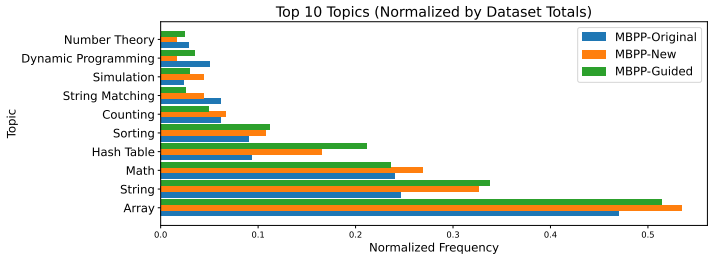
- UMAP n_neighbors / min_dist =
80 / 0.1 (30/0.1 in Fig. 4d)
- Dedup similarity threshold =
0.75 similarity, 250 permutations
- Code feedback iterations Nit =
3–5 depending on dataset
- Evolution parameters N,Nc,Bs,C,Bc =
e.g., N=1000, Nc=10, Bs=30, C=2, Bc=5
assumptions (5)
- standard math Wang et al. and Kozachenko-Leonenko kNN estimators are consistent for the embedding distributions used here
- domain assumption Cosine similarity in the projected embedding space captures semantic/reasoning similarity of coding problems
- domain assumption Code-execution self-verification of LLM-generated solution/test pairs is sufficient evidence of benchmark correctness
- domain assumption High KL novelty and high entropy diversity approximate contamination resistance
- domain assumption GPT-4o is a reliable generator/verifier for mutation, crossover, and test synthesis
Cite this review
Pith. "Pith review of InfoSynth: Information-Guided Benchmark Synthesis for LLMs." pith.science (2026). https://pith.science/paper/VHS654F5
@misc{pith2026260100575,
  author       = {Pith},
  title        = {Pith review of: InfoSynth: Information-Guided Benchmark Synthesis for LLMs},
  year         = {2026},
  howpublished = {\url{https://pith.science/paper/VHS654F5}},
  note         = {Machine review of arXiv:2601.00575}
}
read the original abstract
Large language models (LLMs) have demonstrated significant advancements in reasoning and code generation, but efficiently creating new benchmarks to evaluate these capabilities remains a challenge. Traditional benchmark creation relies on manual human effort, which is expensive and time-consuming. Furthermore, existing benchmarks often contaminate LLM training data, necessitating novel and diverse benchmarks to accurately assess their genuine capabilities. This work introduces InfoSynth, a novel framework for automatically generating and evaluating reasoning benchmarks guided by information-theoretic principles. We propose metrics based on KL-divergence and entropy to quantify benchmark novelty and diversity without relying on costly model evaluations. Building on this framework, we develop an end-to-end pipeline that synthesizes robust Python coding problems from seed datasets using genetic algorithms and iterative code feedback. Our method generates accurate test cases and solutions to new problems 97% of the time, and the synthesized benchmarks consistently exhibit higher difficulty compared to prior works. Moreover, our algorithm provides a method for controlling the novelty/diversity and difficulty of generated problems. InfoSynth offers a scalable, self-verifying pipeline for constructing high-quality, challenging coding benchmarks for LLMs. Project Page: https://ishirgarg.github.io/infosynth_web/
Figures


Figures from the paper (6 more)



Reference graph
Works this paper leans on
-
[2]
Terry Yue Zhuo, Minh Chien Vu, Jenny Chim, Han Hu, Wenhao Yu, Ratnadira Widyasari, Imam Nur Bani Yusuf, Haolan Zhan, Junda He, Indraneil Paul, Simon Brunner, Chen Gong, Thong Hoang, Armel Randy Zebaze, Xiaoheng Hong, Wen-Ding Li, Jean Kaddour, Ming Xu, Zhihan Zhang, Prateek Yadav, Naman Jain, Alex Gu, Zhoujun Cheng, Jiawei Liu, Qian Liu, Zijian Wang, Davi...
arXiv 2024
-
[3]
Nye, Maarten Bosma, Henryk Michalewski, David Dohan, Ellen Jiang, Carrie J
Jacob Austin, Augustus Odena, Maxwell I. Nye, Maarten Bosma, Henryk Michalewski, David Dohan, Ellen Jiang, Carrie J. Cai, Michael Terry, Quoc V . Le, and Charles Sutton. Program Synthesis with Large Language Models.ArXiv preprint, abs/2108.07732, 2021. URLhttps: //arxiv.org/abs/2108.07732
arXiv 2021
-
[4]
Evaluat- ing Large Language Models Trained on Code.ArXiv preprint, abs/2107.03374, 2021
Mark Chen, Jerry Tworek, Heewoo Jun, Qiming Yuan, Henrique Ponde De Oliveira Pinto, Jared Kaplan, Harri Edwards, Yuri Burda, Nicholas Joseph, Greg Brockman, et al. Evaluat- ing Large Language Models Trained on Code.ArXiv preprint, abs/2107.03374, 2021. URL https://arxiv.org/abs/2107.03374
arXiv 2021
-
[6]
Learning Code Preference via Synthetic Evolution.ArXiv preprint, abs/2410.03837, 2024
Jiawei Liu, Thanh Nguyen, Mingyue Shang, Hantian Ding, Xiaopeng Li, Yu Yu, Varun Ku- mar, and Zijian Wang. Learning Code Preference via Synthetic Evolution.ArXiv preprint, abs/2410.03837, 2024. URLhttps://arxiv.org/abs/2410.03837
arXiv 2024
-
[7]
Somshubra Majumdar, Vahid Noroozi, Sean Narenthiran, Aleksander Ficek, Jagadeesh Balam, and Boris Ginsburg. Genetic Instruct: Scaling up Synthetic Generation of Coding Instructions for Large Language Models.ArXiv preprint, abs/2407.21077, 2024. URLhttps://arxiv. org/abs/2407.21077
arXiv 2024
-
[8]
Yisen Li, Lingfeng Yang, Wenxuan Shen, Pan Zhou, Yao Wan, Weiwei Lin, and Dongping Chen. CrowdSelect: Synthetic Instruction Data Selection with Multi-LLM Wisdom.ArXiv preprint, abs/2503.01836, 2025. URLhttps://arxiv.org/abs/2503.01836
arXiv 2025
-
[9]
Yuyang Ding, Xinyu Shi, Xiaobo Liang, Juntao Li, Qiaoming Zhu, and Min Zhang. Unleashing Reasoning Capability of LLMs via Scalable Question Synthesis from Scratch.ArXiv preprint, abs/2410.18693, 2024. URLhttps://arxiv.org/abs/2410.18693. 11
arXiv 2024
-
[10]
Kaixuan Huang, Jiacheng Guo, Zihao Li, Xiang Ji, Jiawei Ge, Wenzhe Li, Yingqing Guo, Tianle Cai, Hui Yuan, Runzhe Wang, Yue Wu, Ming Yin, Shange Tang, Yangsibo Huang, Chi Jin, Xinyun Chen, Chiyuan Zhang, and Mengdi Wang. MATH-Perturb: Benchmarking LLMs’ Math Reasoning Abilities against Hard Perturbations.ArXiv preprint, abs/2502.06453, 2025. URLhttps://ar...
arXiv 2025
Show all 43 references
-
[12]
Data Contamination Quiz: A Tool to Detect and Esti- mate Contamination in Large Language Models.ArXiv preprint, abs/2311.06233, 2023
Shahriar Golchin and Mihai Surdeanu. Data Contamination Quiz: A Tool to Detect and Esti- mate Contamination in Large Language Models.ArXiv preprint, abs/2311.06233, 2023. URL https://arxiv.org/abs/2311.06233
2023 arXiv
-
[13]
Investigating data contamination in modern benchmarks for large language models
Chunyuan Deng, Yilun Zhao, Xiangru Tang, Mark Gerstein, and Arman Cohan. Investigating data contamination in modern benchmarks for large language models. In Kevin Duh, Helena Gomez, and Steven Bethard, editors,Proceedings of the 2024 Conference of the North Amer- ican Chapter ...
2024
-
[14]
A careful examination of large language model performance on grade school arithmetic
Hugh Zhang, Jeff Da, Dean Lee, Vaughn Robinson, Catherine Wu, William Song, Tiffany Zhao, Pranav Raja, Charlotte Zhuang, Dylan Slack, Qin Lyu, Sean Hendryx, Russell Ka- plan, Michele Lunati, and Summer Yue. A careful examination of large language model performance on grade sch...
2024
-
[15]
Smith, Daniel Khashabi, and Hannaneh Hajishirzi
Yizhong Wang, Yeganeh Kordi, Swaroop Mishra, Alisa Liu, Noah A. Smith, Daniel Khashabi, and Hannaneh Hajishirzi. Self-instruct: Aligning language models with self-generated in- structions. In Anna Rogers, Jordan Boyd-Graber, and Naoaki Okazaki, editors,Proceedings of the 61st ...
2023 doi
-
[16]
PromptCoT: Synthesizing Olympiad- level Problems for Mathematical Reasoning in Large Language Models.ArXiv preprint, abs/2503.02324, 2025
Xueliang Zhao, Wei Wu, Jian Guan, and Lingpeng Kong. PromptCoT: Synthesizing Olympiad- level Problems for Mathematical Reasoning in Large Language Models.ArXiv preprint, abs/2503.02324, 2025. URLhttps://arxiv.org/abs/2503.02324
2025
-
[17]
Wizardlm: Empowering large pre-trained language models to follow complex instructions
Can Xu, Qingfeng Sun, Kai Zheng, Xiubo Geng, Pu Zhao, Jiazhan Feng, Chongyang Tao, Qingwei Lin, and Daxin Jiang. Wizardlm: Empowering large pre-trained language models to follow complex instructions. InThe Twelfth International Conference on Learning Rep- resentations, ICLR 20...
2024
-
[18]
Kod- Code: A Diverse, Challenging, and Verifiable Synthetic Dataset for Coding.ArXiv preprint, abs/2503.02951, 2025
Zhangchen Xu, Yang Liu, Yueqin Yin, Mingyuan Zhou, and Radha Poovendran. Kod- Code: A Diverse, Challenging, and Verifiable Synthetic Dataset for Coding.ArXiv preprint, abs/2503.02951, 2025. URLhttps://arxiv.org/abs/2503.02951
2025 arXiv
-
[19]
DSTC: Direct Preference Learning with Only Self-generated Tests and Code to Improve Code LMs.ArXiv preprint, abs/2411.13611, 2024
Zhihan Liu, Shenao Zhang, and Zhaoran Wang. DSTC: Direct Preference Learning with Only Self-generated Tests and Code to Improve Code LMs.ArXiv preprint, abs/2411.13611, 2024. URLhttps://arxiv.org/abs/2411.13611. 12
2024 arXiv
-
[20]
RLTF: Reinforcement Learning from Unit Test Feedback.ArXiv preprint, abs/2307.04349, 2023
Jiate Liu, Yiqin Zhu, Kaiwen Xiao, Qiang Fu, Xiao Han, Wei Yang, and Deheng Ye. RLTF: Reinforcement Learning from Unit Test Feedback.ArXiv preprint, abs/2307.04349, 2023. URLhttps://arxiv.org/abs/2307.04349
2023 arXiv
-
[21]
Codet: Code generation with generated tests
Bei Chen, Fengji Zhang, Anh Nguyen, Daoguang Zan, Zeqi Lin, Jian-Guang Lou, and Weizhu Chen. Codet: Code generation with generated tests. InThe Eleventh International Conference on Learning Representations, ICLR 2023, Kigali, Rwanda, May 1-5, 2023. OpenReview.net,
2023
-
[22]
ACECODER: Acing Coder RL via Automated Test-case Synthesis.ArXiv preprint, abs/2502.01718, 2025
Huaye Zeng, Dongfu Jiang, Haozhe Wang, Ping Nie, Xiaotong Chen, and Wenhu Chen. ACECODER: Acing Coder RL via Automated Test-case Synthesis.ArXiv preprint, abs/2502.01718, 2025. URLhttps://arxiv.org/abs/2502.01718
2025 arXiv
-
[23]
AutoBencher: Towards Declarative Benchmark Construction
Xiang Lisa Li, Farzaan Kaiyom, Evan Zheran Liu, Yifan Mai, Percy Liang, and Tatsunori Hashimoto. AutoBencher: Towards Declarative Benchmark Construction. InThe Thirteenth International Conference on Learning Representations, ICLR 2025, Singapore, April 24-28,
2025
-
[24]
Truong, Yuheng Tu, Percy Liang, Bo Li, and Sanmi Koyejo
Sang T. Truong, Yuheng Tu, Percy Liang, Bo Li, and Sanmi Koyejo. Reliable and Efficient Amortized Model-based Evaluation.ArXiv preprint, abs/2503.13335, 2025. URLhttps: //arxiv.org/abs/2503.13335
2025 arXiv
-
[25]
Agentsynth: Scalable task generation for generalist computer-use agents.arXiv preprint arXiv:2506.14205, 2025
Jingxu Xie, Dylan Xu, Xuandong Zhao, and Dawn Song. Agentsynth: Scalable task generation for generalist computer-use agents.arXiv preprint arXiv:2506.14205, 2025
2025
-
[26]
TaskE- val: Assessing Difficulty of Code Generation Tasks for Large Language Models.ArXiv preprint, abs/2407.21227, 2024
Florian Tambon, Amin Nikanjam, Cyrine Zid, Foutse Khomh, and Giuliano Antoniol. TaskE- val: Assessing Difficulty of Code Generation Tasks for Large Language Models.ArXiv preprint, abs/2407.21227, 2024. URLhttps://arxiv.org/abs/2407.21227
2024
-
[27]
Proximal Policy Optimization Algorithms.ArXiv preprint, abs/1707.06347, 2017
John Schulman, Filip Wolski, Prafulla Dhariwal, Alec Radford, and Oleg Klimov. Proximal Policy Optimization Algorithms.ArXiv preprint, abs/1707.06347, 2017. URLhttps:// arxiv.org/abs/1707.06347
2017 arXiv
-
[28]
Kingma and Max Welling
Diederik P. Kingma and Max Welling. Auto-encoding variational bayes. In Yoshua Bengio and Yann LeCun, editors,2nd International Conference on Learning Representations, ICLR 2014, Banff, AB, Canada, April 14-16, 2014, Conference Track Proceedings, 2014. URL http://arxiv.org/abs...
2014 arXiv
-
[29]
Kulkarni, and Sergio Verd ´u
Qing Wang, Sanjeev R. Kulkarni, and Sergio Verd ´u. Divergence estimation for multidimen- sional densities via k-nearest-neighbor distances.IEEE Trans. Inf. Theory, 55(5):2392–2405,
-
[30]
Mpnet: Masked and permuted pre-training for language understanding
Kaitao Song, Xu Tan, Tao Qin, Jianfeng Lu, and Tie-Yan Liu. Mpnet: Masked and permuted pre-training for language understanding. In Hugo Larochelle, Marc’Aurelio Ranzato, Raia Hadsell, Maria-Florina Balcan, and Hsuan-Tien Lin, editors,Ad- vances in Neural Information Processing...
2020
-
[31]
UMAP: Uniform Manifold Approximation and Projection.J
Leland McInnes, John Healy, Nathaniel Saul, and Lukas Großberger. UMAP: Uniform Manifold Approximation and Projection.J. Open Source Softw., 3(29):861, 2018. doi: 10.21105/JOSS.00861. URLhttps://doi.org/10.21105/joss.00861
2018 doi
-
[32]
leetcode-problem-set.https://huggingface.co/datasets/kaysss/ leetcode-problem-set, 2025
kaysss. leetcode-problem-set.https://huggingface.co/datasets/kaysss/ leetcode-problem-set, 2025. Accessed: 2025-05-11
2025
-
[33]
Measuring coding challenge competence with apps.ArXiv preprint, abs/2105.09938, 2021
Dan Hendrycks, Steven Basart, Saurav Kadavath, Mantas Mazeika, Akul Arora, Ethan Guo, Collin Burns, Samir Puranik, Horace He, Dawn Song, and Jacob Steinhardt. Measuring coding challenge competence with apps.ArXiv preprint, abs/2105.09938, 2021. URLhttps:// arxiv.org/abs/2105.09938. 13
2021 arXiv
-
[34]
Codeforces Problems Dataset.https://huggingface.co/datasets/open-r1/ codeforces, 2024
open-r1. Codeforces Problems Dataset.https://huggingface.co/datasets/open-r1/ codeforces, 2024. Accessed: 2025-05-11
2024
-
[35]
Estimating mutual information
Alexander Kraskov, Harald St ¨ogbauer, and Peter Grassberger. Estimating mutual information. Physical Review E, 69(6), 2004. ISSN 1550-2376. doi: 10.1103/physreve.69.066138. URL http://dx.doi.org/10.1103/PhysRevE.69.066138
2004 doi
-
[36]
Chi, Quoc V
Jason Wei, Xuezhi Wang, Dale Schuurmans, Maarten Bosma, Brian Ichter, Fei Xia, Ed H. Chi, Quoc V . Le, and Denny Zhou. Chain-of-thought prompting elicits reasoning in large language models. In Sanmi Koyejo, S. Mohamed, A. Agarwal, Danielle Belgrave, K. Cho, and A. Oh, editors,...
2022
-
[37]
Gpt-4o system card, 2024
Aaron Hurst, Adam Lerer, Adam P Goucher, Adam Perelman, Aditya Ramesh, Aidan Clark, AJ Ostrow, Akila Welihinda, Alan Hayes, Alec Radford, et al. Gpt-4o system card, 2024. URL https://arxiv.org/abs/2410.21276
2024 arXiv
-
[38]
LeetCodeDataset: A Temporal Dataset for Robust Evaluation and Efficient Training of Code LLMs.ArXiv preprint, abs/2504.14655, 2025
Yunhui Xia, Wei Shen, Yan Wang, Jason Klein Liu, Huifeng Sun, Siyue Wu, Jian Hu, and Xiaolong Xu. LeetCodeDataset: A Temporal Dataset for Robust Evaluation and Efficient Training of Code LLMs.ArXiv preprint, abs/2504.14655, 2025. URLhttps://arxiv.org/ abs/2504.14655
2025 arXiv
-
[39]
mutation
Hirokazu Kiyomaru, Issa Sugiura, Daisuke Kawahara, and Sadao Kurohashi. A Compre- hensive Analysis of Memorization in Large Language Models. In Saad Mahamood, Minh Le Nguyen, and Daphne Ippolito, editors,Proceedings of the 17th International Natural Language Generation Confere...
2024 doi
-
[45]
The sum of the fourth power of the first 'k' odd numbers from the array
-
[46]
"" Returns the second shortest string containing all vowels, sorted alphabetically
The sum of the bitwise XOR of all pairs of numbers formed by selecting one element from the first 'k' even numbers and one element from the last 'k' elements in the array. The function should take two arguments - the array of integers and an integer 'k'. Ensure that 'k' is les...
-
[2009]
URLhttps://doi.org/10.1109/TIT.2009
doi: 10.1109/TIT.2009.2016060. URLhttps://doi.org/10.1109/TIT.2009. 2016060
2009
-
[2021]
URLhttps://arxiv.org/abs/2110.14168
-
[2023]
URLhttps://openreview.net/pdf?id=ktrw68Cmu9c
-
[2024]
URLhttps://arxiv.org/abs/2403.07974
-
[2025]
URLhttps://openreview.net/forum?id=ymt4crbbXh
OpenReview.net, 2025. URLhttps://openreview.net/forum?id=ymt4crbbXh
2025
Reviewed August 3, 2026 · model on record in the stance chip above.
Discussion (0). Continue with ORCID to comment.