REVIEW 4 major objections 6 minor 35 references
A Data-Centric Approach to Pedestrian Attribute Recognition: Synthetic Augmentation via Prompt-driven Diffusion Models
T0 review · 4 major / 6 minor · reviewed 2026-08-05 · deepseek-v4-flash
Pith's one-line read Targeted synthetic images from a diffusion model improve pedestrian attribute recognition on rare attributes and raise overall F1 on RAPv1, RAPv2, and RAPzs without changing the recognition architecture.
desk verdict Plausible data-centric idea for PAR, but the evaluation is compromised by test-set tuning and the gains shrink against an optimized baseline. read the letter →
The pith
A machine-rendered reading of the paper's core claim, the machinery that carries it, and where it could break.
The reading
What carries the argument
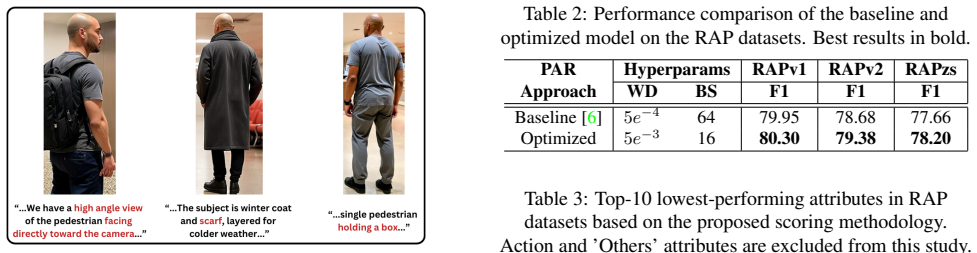
The mechanism is a three-stage data-side pipeline: (1) a qualitative scoring protocol that flags attributes with few training samples, low test F1, and large train-to-test drops; (2) a text-to-image diffusion generator using template wildcards for pose, background, view, style, and color, followed by detector-based cropping and a hand-designed degradation module to mimic surveillance-domain quality; and (3) an augmented BCE loss with label values -1, 1, and 3, where -1 masks unknown attributes and 3 down-weights prompt-derived secondary attributes. This carries the argument by making synthetic data a controllable, labeled, and smoothly integrated part of training without modifying the model
What would settle it
A direct falsifier is to replace the target attribute in the generation prompt with a random attribute while keeping the labels unchanged: if the targeted attribute's test F1 still rises, the gain comes from generic synthetic diversity rather than attribute-preserving generation, and the paper's central mechanism is not doing the work. A complementary check is to train on synthetic images only and evaluate on the real RAP test partition; if F1 on the targeted attribute stays near chance, the synthetic domain is not close enough to transfer.
Extended reading notes
Core claim
The central claim is that selectively augmenting a small number of weak attributes—here hs-BaldHead, lb-ShortSkirt, AgeLess16, ub-SuitUp, and attach-PaperBag—with synthetic images generated by a diffusion pipeline improves recognition of those attributes and also lifts overall performance beyond them. The synthetic images are generated from wildcard-and-template prompts, cropped to the pedestrian, degraded with noise, resizing, blur, and brightness/contrast adjustments to approximate security-camera quality, and labeled from the prompt structure with an uncertainty-aware scheme. An augmented binary cross-entropy loss treats the target attribute as confirmed, other prompt-derived attributes a
Load-bearing premise
The load-bearing premise is that the hand-tuned degradation applied to high-quality diffusion images makes them similar enough to real RAP security-camera frames that attribute labels derived from prompts remain a trustworthy training signal; the authors themselves note in the supplement that prompting alone could not reproduce the target image quality and required post-processing.
Editorial extensions
If this is right
- Targeted augmentation of two or three weak attributes can produce overall F1 gains competitive with standard augmentation methods such as AutoAug, MixUp, RandAug, TrivialAugment, and AugMix on the RAP datasets.
- The approach improves zero-shot attribute recognition on RAPzs, suggesting synthetic data can partially compensate for unseen pedestrian identities.
- Prompt-derived annotation with uncertainty labels removes the need for manual labeling of synthetic images, making large-scale synthetic augmentation feasible.
- Because no architectural changes are required, the pipeline can be applied on top of existing PAR models and training pipelines.
- The indirectly augmented attributes—those not targeted but labeled as 3—also benefit, indicating the modified loss spreads the synthetic signal beyond the intended attributes.
Reading between the lines
- If the degradation module is what closes the domain gap, the same pipeline could be reused for other low-quality surveillance domains by re-estimating noise, blur, and contrast parameters from target statistics; the paper only tests one airport-style domain family.
- The success of indirectly augmented attributes suggests synthetic data may act partly as a regularizer rather than purely as additional positives; a testable extension is whether weaker or even partially mismatched synthetic images still improve overall calibration.
- The RAPzs hs-BaldHead result rests on only six test images with visibly noisy labels, so a relabeled or enlarged zero-shot test set could shrink or shift the reported improvement.
- The paper lists automatic estimation of augmentation percentage as future work; one could predict an attribute's optimal augmentation level from the slope of its F1 improvement curve across augmentation percentages.
Editorial analysis
A structured set of objections, weighed in public.
Referee Report
Summary. The paper proposes a data-centric approach to Pedestrian Attribute Recognition (PAR) in which weakly recognized attributes are identified by a threshold-based scoring protocol, synthetic images are generated with a Stable Diffusion 3 pipeline and then degraded to approximate surveillance-camera quality, and synthetic samples are integrated by a modified weighted binary cross-entropy loss that uses prompt-derived labels. The method is evaluated on RAPv1, RAPv2, and RAPzs with a ResNet+MLP backbone, reporting attribute-level F1 gains for several underrepresented attributes and small overall F1 improvements. The authors also claim improved zero-shot generalization without architectural changes. The supplementary material contains detailed prompt definitions, the full ComfyUI workflow, and extensive per-attribute tables.
Significance. If the empirical claims were established, the paper would make a useful contribution: it demonstrates a practical, architecture-agnostic way to use text-to-image diffusion for data augmentation in PAR, with a transparent generation/degradation pipeline and an explicit labeling scheme for synthetic samples. The supplementary material is unusually complete: prompts, wildcard lists, generation seeds, and the exact ComfyUI node graph are documented, and code is promised on GitHub. The authors also honestly report negative results (e.g., lb-ShortSkirt augmentation hurts the targeted attribute) and discuss test-set noise. The core problem is that the evaluation protocol selects nearly all free parameters on the official test sets, so the reported gains are not established as genuine improvements over the baseline. The central methodological idea remains plausible, but the current evidence is insufficient for the paper's claims.
major comments (4)
- [Sec. 4.3, Suppl. D.1, Tables 4-6, 30-32, 35, 41, 49, 51, 53] The main empirical claim rests on selecting the noise level, augmentation weight, DA percentage, and even baseline hyperparameters using the official test partitions. There is no validation split or nested selection. Under the null hypothesis, the best cell in a multi-axis grid evaluated on the test set will look favorable by construction. With at least 3 noise levels × 4 weights × 7 DA percentages × 3 datasets, the selection bias is on the order of the reported F1 gains (e.g., Table 6 shows attribute-level gains of roughly +0.5 to +16 F1, many of which are within the spread of test-set noise). The paper therefore has not demonstrated that the improvements are due to synthetic augmentation rather than to test-set selection. Please provide a validation-based protocol, or report all evaluated configurations with test evaluation performed only once after selection.
- [Table 7 vs Table 54] The headline comparisons in Table 7 use the unoptimized Horizontal Flip baseline [6] (F1 79.95/78.68/77.66), while the proposal is built on the optimized baseline (F1 80.30/79.38/78.20, Table 2 and Table 54). Relative to the optimized baseline, the reported best overall F1 gains shrink to roughly +0.3 on RAPv1, +0.3 on RAPv2, and +0.4 on RAPzs (Table 54: best all-attributes 80.60/79.67/78.62). These differences are comparable to the 10-run standard deviations reported in Table 54 (about ±0.1), and no significance tests are provided. Please report all comparisons against the same optimized baseline, with confidence intervals or pairwise significance tests.
- [Eq. (1)-(2), Sec. 3.3] The attribution of the gains to synthetic data is confounded by the loss modification. The paper introduces a new weighted BCE with labels -1 and 3, and this loss is used only when synthetic samples are present. There is no ablation that applies the same loss and labeling scheme to real data or to a non-synthetic augmentation (e.g., duplicated real images with label 3). Thus the observed overall F1 improvements in Tables 7/54 could arise from the changed loss or label weighting rather than from the diffusion-generated images. Please add ablations isolating (i) synthetic images + original loss, (ii) original images + new loss, and (iii) synthetic images + new loss.
- [Table 35, Table 36, Sec. D.1] The RAPzs attribute-level conclusions are based on extremely small test sets. Table 36 lists only 6 hs-BaldHead test images in RAPzs, and Table 35 reports F1 moving from 37.50 to 40.00, i.e., a change of about one test image (or one prediction). Similar issues affect other rare attributes (e.g., shoes-Cloth has 25 test images in RAPzs, Table 21). The claimed improvement of underrepresented attributes in the zero-shot setting is therefore not supported by stable evidence. Please report per-image predictions, exact binomial confidence intervals, or an aggregated evaluation over multiple test splits.
minor comments (6)
- [Sec. 3.2, Figures 9/10] The main text refers to 'the positive prompt shown in Figure 9' and 'examples in Figure 10,' but these are supplementary figures. In the main paper the prompt and examples appear as Figures 2 and 3. Please renumber cross-references.
- [Eq. (2), Sec. 3.3] Equation (2) assigns weight 1 to yi,m ∈ {0,1,2}, but Section 3.3 states that 2s are avoided and mapped to 1s in the baseline. The notation should be aligned so the loss definition does not appear to support labels that the annotation scheme explicitly excludes.
- [Table 25] Typo: 'action-Pusing' should be 'action-Pushing'. A similar typo appears in Table 29 ('attachment-HandTrunk' is likely attribute 34, not 40).
- [Suppl. D.1] Typo: 'it was deceided' should be 'decided'.
- [Suppl. A.1] Typo: 'Wildcards and Template-Based Promptsstrategy' is missing a space.
- [General] The notation 'RAPZs' and 'RAPzs' is used inconsistently. Please standardize.
Circularity Check
Reported gains are selected on the official test splits: augmentation parameters and baseline hyperparameters are tuned by test F1, then the same test F1 is presented as evidence of improvement.
-
fitted input called prediction
[Sec. 4.3 'Parameter Selection for Generation' (Tables 4, 5)]
"To optimize augmentation, we selected the weakest attribute hs-BaldHead identified in the subsection 4.2, and we evaluated two key parameters on the RAP datasets: image noise level (see Sec. 3.2) and augmented weight (see Eq. 2). ... We tested three noise blending levels (25%, 50%, 75%) in Table 4, with medium noise performing best. Augmented weight, explored from 0 to 1 with four values, was optimal at 0.5 (see Table 5). These best values were used for all subsequent experiments."
The noise level and augmented weight are chosen by comparing attribute-level F1 on the RAP test splits (Tables 4 and 5). Those same test splits are then used to report the gains in Tables 6 and 7. The reported 'best' configuration is therefore the argmax of a grid search evaluated directly on the test labels, not an independent prediction. Under a null effect, the best cell of such a search is expected to look positive, so the observed improvement is partly an artifact of fitting the augmentation hyperparameters to the evaluation set.
-
fitted input called prediction
[Sec. 4.3 'Per-Attribute Performance Gains' and 'Overall Performance' (Table 6, then Table 7)]
"Table 6: Attribute-level F1-score comparison for different data augmentation (DA) percentages on the RAP datasets. Best results for each dataset and attribute are in bold. ... After optimizing augmentation per attribute, we tested simultaneous augmentation across datasets. We evaluated two models: one using 500% augmentation for all attributes and another applying each attribute's optimal augmentation level."
The 'optimal augmentation level' per attribute and dataset is selected as the bold maximum in Table 6, which is computed on the official test partitions. The final overall results in Table 7 then reuse those test-selected percentages, comparing the test-maximizing configuration against a baseline. There is no validation holdout: the augmentation fraction is fit to the very metric (test F1) that is later reported as the method's benefit. The conclusion that synthetic augmentation 'improves overall model performance' is thus partly a consequence of selecting parameters on the test set rather than an independent estimate.
full rationale
The paper contains no theoretical derivation whose conclusion equals its assumptions: the augmented loss in Eq. (1)-(2) is a standard weighted BCE and is not circular, and there is no load-bearing self-citation (the cited baseline [6] is external). However, the central empirical claim—that synthetic augmentation improves PAR—is compromised by a test-set selection protocol. Section 4.2 selects batch size and weight decay by test F1 (Table 2, Supp. Tables 8-15), Section 4.3 selects noise level, augmentation weight, and per-attribute augmentation percentages by test F1 (Tables 4-6), and Supp. D.1 does the same in extended grids. The final comparisons in Table 7 use these test-selected configurations, and the main table compares against the unoptimized Horizontal Flip baseline (79.95/78.68/77.66) rather than the paper's own optimized baseline (80.30/79.38/78.20), further inflating the apparent gain. The paper itself reports in Supp. D that lb-ShortSkirt augmentation lowers attribute F1 on every dataset, so the 'boosts underrepresented attributes' claim is not uniform. Because the reported improvements are effectively maxima over test-evaluated configurations, the validation is partially circular: the same test labels used for model selection are used as the evidence of success. A held-out validation protocol or pre-registered augmentation schedule would be needed to establish the claimed gains independently.
Assumptions & free parameters
free parameters (6)
- attribute scoring thresholds: low training <3%, high test >80%, low test <50%, small drop <15%, big drop >30% =
3%, 80%, 50%, 15%, 30%
- degradation noise blend level =
0.5 (medium noise)
- augmentation weight for label 3 =
0.5
- data augmentation percentage (DA%) =
per-attribute, from 50% to 700%; final selections use 500% or per-attribute best
- training hyperparameters: batch size, weight decay =
BS=16, WD=5e-3
- number of selected attributes to augment =
2 or 3 (hs-BaldHead, lb-ShortSkirt, AgeLess16; sometimes omit lb-ShortSkirt)
assumptions (4)
- domain assumption Stable Diffusion 3 can generate photorealistic pedestrians with specified attributes from textual prompts.
- domain assumption The RAP datasets and their train/test splits are a valid benchmark for PAR generalization, and their labels are accurate enough for the reported comparisons.
- domain assumption The degradation module (noise, blur, brightness/contrast) closes the domain gap between SD3 images and surveillance footage.
- domain assumption The baseline architecture of Jia et al. [6] is the relevant reference for comparing PAR improvements.
Cite this review
Pith. "Pith review of A Data-Centric Approach to Pedestrian Attribute Recognition: Synthetic Augmentation via Prompt-driven Diffusion Models." pith.science (2026). https://pith.science/paper/VKRBXZS7
@misc{pith2026250902099,
  author       = {Pith},
  title        = {Pith review of: A Data-Centric Approach to Pedestrian Attribute Recognition: Synthetic Augmentation via Prompt-driven Diffusion Models},
  year         = {2026},
  howpublished = {\url{https://pith.science/paper/VKRBXZS7}},
  note         = {Machine review of arXiv:2509.02099}
}
read the original abstract
Pedestrian Attribute Recognition (PAR) is a challenging task as models are required to generalize across numerous attributes in real-world data. Traditional approaches focus on complex methods, yet recognition performance is often constrained by training dataset limitations, particularly the under-representation of certain attributes. In this paper, we propose a data-centric approach to improve PAR by synthetic data augmentation guided by textual descriptions. First, we define a protocol to identify weakly recognized attributes across multiple datasets. Second, we propose a prompt-driven pipeline that leverages diffusion models to generate synthetic pedestrian images while preserving the consistency of PAR datasets. Finally, we derive a strategy to seamlessly incorporate synthetic samples into training data, which considers prompt-based annotation rules and modifies the loss function. Results on popular PAR datasets demonstrate that our approach not only boosts recognition of underrepresented attributes but also improves overall model performance beyond the targeted attributes. Notably, this approach strengthens zero-shot generalization without requiring architectural changes of the model, presenting an efficient and scalable solution to improve the recognition of attributes of pedestrians in the real world.
Figures


Figures from the paper (11 more)


Reference graph
Works this paper leans on
-
[1]
J. Jin et al., “Pedestrian attribute recognition: A new bench- mark dataset and a large language model augmented frame- work,” arXiv:2408.09720, 2024
work page Pith review arXiv 2024
-
[2]
Heterogeneous feature re-sampling for bal- anced pedestrian attribute recognition,
Y . Zhou et al., “Heterogeneous feature re-sampling for bal- anced pedestrian attribute recognition,” IEEE Trans. Pattern Analysis and Machine Intelligence, 2025
work page 2025
-
[3]
A comprehensive survey for generative data augmentation,
Y . Chen et al., “A comprehensive survey for generative data augmentation,” Neurocomputing, p. 128167, 2024
work page 2024
-
[4]
Diffusion models in vision: A sur- vey,
F.-A. Croitoru et al. , “Diffusion models in vision: A sur- vey,” IEEE Trans. Pattern Analysis and Machine Intelli- gence, vol. 45, no. 9, pp. 10 850–10 869, 2023
work page 2023
-
[5]
A richly annotated pedestrian dataset for person retrieval in real surveillance scenarios,
D. Li et al., “A richly annotated pedestrian dataset for person retrieval in real surveillance scenarios,” IEEE Trans. Image Processing, vol. 28, no. 4, pp. 1575–1590, 2018
work page 2018
-
[7]
Pedestrian attribute recognition: A survey,
X. Wang et al., “Pedestrian attribute recognition: A survey,” Pattern Recognition, vol. 121, p. 108220, 2022
work page 2022
-
[8]
N. Kirillova et al., “A visual surveillance system to observe realistic road user behavior for improved pedestrian and cy- clist safety at crossroads,” in IEEE Int. Conf. Adv. Video and Signal-based Surveillance, 2022, pp. 1–8
work page 2022
-
[9]
Discrete soft biometric attribute-based person retrieval in surveillance videos,
H. Galiyawala et al., “Discrete soft biometric attribute-based person retrieval in surveillance videos,” in IEEE Int. Conf. Adv. Video and Signal-based Surveillance, 2021, pp. 1–7
work page 2021
Show all 35 references
-
[10]
SSPNet: Scale and spatial priors guided gen- eralizable and interpretable pedestrian attribute recognition,
J. Shen et al., “SSPNet: Scale and spatial priors guided gen- eralizable and interpretable pedestrian attribute recognition,” Pattern Recognition, vol. 148, p. 110194, 2024
2024
-
[11]
Exploring attribute localization and corre- lation for pedestrian attribute recognition,
D. Weng et al., “Exploring attribute localization and corre- lation for pedestrian attribute recognition,”Neurocomputing, vol. 531, pp. 140–150, 2023
2023
-
[12]
A solution to co-occurrence bias: Attributes disentanglement via mutual information minimization for pedestrian attribute recognition,
Y . Zhou et al., “A solution to co-occurrence bias: Attributes disentanglement via mutual information minimization for pedestrian attribute recognition,” inInt. Joint Conf. Artificial Intelligence, 2023, pp. 1831–1839
2023
-
[13]
Transformer-based multi-task network for pedestrian attribute recognition,
X. Fan et al. , “Transformer-based multi-task network for pedestrian attribute recognition,” IEEE Trans. Circuits and Systems for Video Tech., vol. 34, no. 1, pp. 411–423, 2023
2023
-
[14]
Pedestrian attribute recognition at far distance,
Deng et al., “Pedestrian attribute recognition at far distance,” in ACM Int. Conf. Multimedia, 2014, pp. 789–792
2014
-
[15]
Attentive deep features for pedestrian analysis,
Liu et al., “Attentive deep features for pedestrian analysis,” in IEEE Int. Conf. on Computer Vision, 2017, pp. 350–359
2017
-
[16]
Robust clip-based detector for exposing diffu- sion model-generated images,
L. Lin et al., “Robust clip-based detector for exposing diffu- sion model-generated images,” in IEEE Int. Conf. Advanced Video and Signal-based Surveillance, 2024, pp. 1–7
2024
-
[17]
Generative adversarial models for people attribute recognition in surveillance,
M. Fabbri et al., “Generative adversarial models for people attribute recognition in surveillance,” inIEEE Int. Conf. Adv. Video and Signal-based Surveillance, 2017, pp. 1–6
2017
-
[18]
Zero-shot text-to-image generation,
A. Ramesh et al., “Zero-shot text-to-image generation,” in Int. Conf. Machine Learning, 2021, pp. 8821–8831
2021
-
[19]
High-resolution image synthesis with la- tent diffusion models,
R. Rombach et al., “High-resolution image synthesis with la- tent diffusion models,” in IEEE/CVF Conf. Computer Vision and Pattern Recognition, 2022, pp. 10 684–10 695
2022
-
[20]
The prompt report: A systematic survey of prompting techniques,
S. Schulhoff et al., “The prompt report: A systematic survey of prompting techniques,” arXiv:2406.06608, 2024
2024 arXiv
-
[21]
Dynamic prompt optimizing for text-to-image generation,
W. Mo et al., “Dynamic prompt optimizing for text-to-image generation,” in IEEE/CVF Conf. Computer Vision and Pat- tern Recognition, 2024, pp. 26 627–26 636
2024
-
[22]
An image is worth one word: Personaliz- ing text-to-image generation using textual inversion,
R. Gal et al. , “An image is worth one word: Personaliz- ing text-to-image generation using textual inversion,” in Int. Conf. Learning Represen., 2023
2023
-
[23]
Prompt-to-prompt image editing with cross attention control,
A. Hertz et al., “Prompt-to-prompt image editing with cross attention control,” in Int. Conf. Learning Represen., 2023
2023
-
[24]
Lora: Low-rank adaptation of large language models
E. J. Hu et al., “Lora: Low-rank adaptation of large language models.” in Int. Conf. Learning Represen., 2022
2022
-
[25]
Autoaugment: Learning augmentation strategies from data,
E. D. Cubuk et al., “Autoaugment: Learning augmentation strategies from data,” in IEEE/CVF Conf. Computer Vision and Pattern Recogn., 2019, pp. 113–123
2019
-
[26]
mixup: Beyond empirical risk minimiza- tion,
H. Zhang et al., “mixup: Beyond empirical risk minimiza- tion,” arXiv preprint arXiv:1710.09412, 2017
2017 arXiv
-
[27]
Practical automated data augmentation with a reduced search space,
E. Cubuk et al., “Practical automated data augmentation with a reduced search space,” in IEEE/CVF Conf. on Computer Vision and Pattern Recognition Work., 2020, pp. 702–703
2020
-
[28]
Trivialaugment: Tuning-free yet state-of-the-art data augmentation,
S. G. M ¨uller and F. Hutter, “Trivialaugment: Tuning-free yet state-of-the-art data augmentation,” in IEEE/CVF Int. Conf. on Computer Vision, 2021, pp. 774–782
2021
-
[29]
Augmix: A simple data processing method to improve robustness and uncertainty,
D. Hendrycks et al. , “Augmix: A simple data processing method to improve robustness and uncertainty,” inInt. Conf. Learning Represen., 2020. SUPPLEMENTARY MATERIAL This supplementary material offers additional details on the prompt definition of our proposal in Section A. Mor...
2020
-
[30]
Rethinking of pedestrian attribute recognition: A reliable evaluation under zero-shot pedestrian identity setting,
J. Jia et al. , “Rethinking of pedestrian attribute recognition: A reliable evaluation under zero-shot pedestrian identity setting,” arXiv:2107.03576, 2021
2021 arXiv
-
[31]
Comfyui dynamicprompts: Comfyui custom nodes for dynamic prompts,
Adieyal, “Comfyui dynamicprompts: Comfyui custom nodes for dynamic prompts,” 2024, accessed: 2024-12-18. [Online]. Available: https://github.com/adieyal/comfyui-dynamicprompts
2024
-
[32]
Comfyui-yolo-cropper: A simple comfyui node for image cropping and masking using yolov8,
tooldigital, “Comfyui-yolo-cropper: A simple comfyui node for image cropping and masking using yolov8,” 2024, accessed: 2024-12-21. [Online]. Available: https://github.com/tooldigital/ComfyUI-Yolo-Cropper
2024
-
[33]
Yolov8: A novel object detection algorithm with enhanced performance and robustness,
R. Varghese and S. M., “Yolov8: A novel object detection algorithm with enhanced performance and robustness,” in 2024 Interna- tional Conference on Advances in Data Engineering and Intelligent Computing Systems (ADICS), 2024, pp. 1–6
2024
-
[34]
Comfy-plasma: A simple plasma noise generator for comfyui,
Jordach, “Comfy-plasma: A simple plasma noise generator for comfyui,” 2024, accessed: 2024-12-21. [Online]. Available: https://github.com/Jordach/comfy-plasma
2024
-
[35]
Image resize for comfyui: A custom node providing various tools for resizing images without distorting proportions,
W. Palant, “Image resize for comfyui: A custom node providing various tools for resizing images without distorting proportions,” 2024, accessed: 2024-12-21. [Online]. Available: https://github.com/palant/image-resize-comfyui
2024
-
[42]
In terms of dataset size, this case falls between the previous two: it contains fewer base images than lb-ShortSkirt, yet more than hs-BaldHead. After filtering the generated images, a notable observation emerges: despite the prompt containing no explicit reference to pedestri...
Reviewed August 5, 2026 · model on record in the stance chip above.
Discussion (0). Continue with ORCID to comment.