REVIEW 2 major objections 4 minor 32 references
On the sharpness of bounds on the rate of growth of Lebesgue norms of the velocity in Navier-Stokes flows
T0 review · 2 major / 4 minor · reviewed 2026-07-12 · grok-4.5
Pith's one-line read A classic upper bound on how fast Navier-Stokes velocity norms can grow is sharp up to a numerical constant.
desk verdict Solid numerical evidence that the Robinson–Sadowski Lq-growth bound is saturated in the exponent by concrete local maximizers; the local-vs-global caveat is real but does not erase the result. read the letter →
The pith
A machine-rendered reading of the paper's core claim, the machinery that carries it, and where it could break.
The reading
What carries the argument
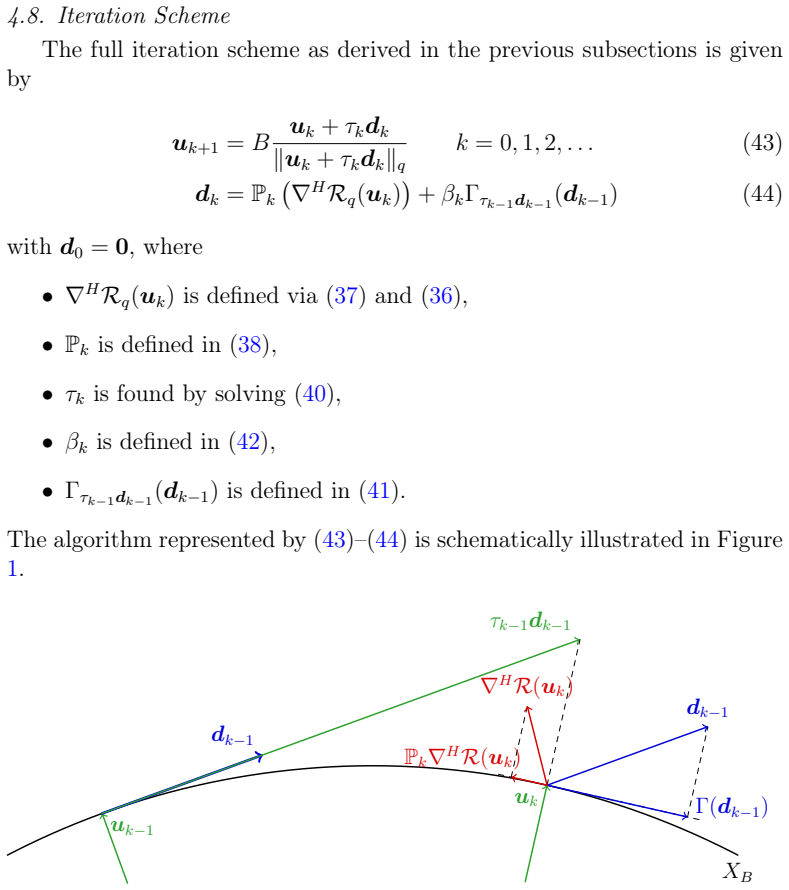
A Riemannian conjugate-gradient method on the Hilbert manifold of divergence-free, zero-mean fields with fixed Lq norm, maximising the objective functional Rq that expresses the instantaneous growth rate after elimination of pressure via the Poisson equation.
What would settle it
An independent maximisation of the same objective, started from a qualitatively different family of initial fields or run at substantially higher resolution, that produces a strictly slower growth rate whose scaling is weaker than the predicted power of the Lq norm.
Extended reading notes
Core claim
Numerical maximisers of the instantaneous rate of growth of the Lq norm of velocity, obtained for several q>3 and for norms spanning several orders of magnitude, saturate the power-law upper bound d/dt ||u||_q^q ≤ C ||u||_q^{q(q-1)/(q-3)} as the norm tends to infinity. The bound is therefore sharp up to a numerical prefactor and cannot be fundamentally improved.
Load-bearing premise
That the local maximisers found by continuing from the small-data ABC flow remain representative of the true global maximum growth rate at large norms, and are not artefacts of finite resolution or of the particular geometric operations used on the constraint manifold.
Editorial analysis
A structured set of objections, weighed in public.
Referee Report
Summary. The paper investigates the sharpness of the a priori bound (5) on the instantaneous growth rate of the L^q norm of velocity for 3D Navier-Stokes flows (q>3), which is closely tied to the Ladyzhenskaya-Prodi-Serrin conditions. An objective functional R_q(u) for (d/dt)||u||_q^q is derived (Eq. (15)), and maximizers subject to fixed ||u||_q=B, divergence-free and zero-mean constraints are sought via a Riemannian conjugate-gradient method on the Hilbert manifold X_B subset H^{3/2-1/q} (Problem 3). Branches of local maximizers are continued from the small-data ABC eigenfunction (Section 3, Algorithm 1). Numerical results for q=4,5,6,9 show that R_q(eu_B) saturates the power q(q-1)/(q-3) as B o∞ (Table 3, Figures 4–5), up to a numerical prefactor, while the q o3 limit appears ill-posed. The optimizers become increasingly localized and approach the edge of the ambient Sobolev space.
Significance. If the numerical evidence is accepted as representative, the work supplies concrete computational support that bound (5) cannot be improved in the exponent, complementing earlier variational studies of enstrophy growth (Problem 1) and completing the picture summarized in Table 1. The derivation of R_q, the small-data analysis, and the Riemannian CG formulation are clean and reusable. The observation that the same states do not simultaneously saturate the enstrophy bound, and that the q=3 problem appears ill-posed, are of independent interest for the conditional-regularity program. Strengths include transparent appendices (A–C), explicit power-law fits, and careful spectral monitoring.
major comments (2)
- The central claim that bound (5) “cannot be fundamentally improved” rests on local maximizers obtained exclusively by continuation from the ABC flow (Algorithm 1, Section 5). Problem 3 is non-convex; nothing rules out other branches (different topology or localization) that could produce a strictly larger growth rate or a higher exponent. The paper should either (i) attempt restarts from qualitatively different initial data at large B, or (ii) rephrase the claim as “sharp along the computed branches / lower bound on the true supremum.” Without this, the global-sharpness language in the abstract and Section 6 overreaches the evidence.
- Figures 4–5 and Table 3 report power-law saturation, yet the maximizers approach the edge of H^{3/2-1/q} (Fig. 2b) and become highly localized while resolution is capped at N=1024^{3}. No systematic resolution study or extrapolation of the fitted exponents eα versus N is provided. A short convergence check (e.g., recompute a large-B point at two resolutions and report the change in R_q and eα) is needed to confirm that the observed scaling is not an artifact of under-resolution or of the particular filter length ℓ=0.1.
minor comments (4)
- Table 1 and the abstract state that the bound is sharp “up to a numerical prefactor,” yet the measured prefactors eC in Table 3 are extremely small (10^{-15}–10^{-4}). A brief remark on the practical size of the constant would help readers assess how close the bound is to being saturated in absolute terms.
- Section 5.4 (q o3) reports diverging exponents with “relatively large uncertainties.” The fitting procedure and the range of B used for those fits should be stated more precisely so that the claimed divergence can be reproduced.
- Typographical slips: “formatioon” (keywords), “ealier” (Section 6), and occasional missing spaces around math operators. A light copy-edit pass would suffice.
- Figure 6 captions refer to “normalized” fields but do not specify the normalization; a short clarification would improve readability.
Circularity Check
No significant circularity: independent analytic bound is compared post-hoc to unconstrained numerical maximizers of the exact growth functional.
full rationale
The a priori bound (5) is derived independently in Appendix A via Hölder/Young/Gagliardo-Nirenberg estimates applied to the exact expression (15) for (1/q) d/dt ||u||_q^q. The optimization Problems 2/3 maximize that same exact functional R_q(u) (obtained by testing the NSE with |u|^{q-2}u and eliminating pressure) subject only to the L^q-norm constraint, divergence-free and zero-mean conditions; the bound itself is never inserted into the objective, the Riemannian CG iteration, the retraction, or the continuation from the ABC eigenfunction. After the maximizers eu_B are obtained, their achieved R_q values are simply plotted against B and fitted to a power law whose exponent is then compared with the analytic exponent q(q-1)/(q-3). Self-citations (to [7,17,14,27,32] etc.) supply only the methodological template for the Riemannian CG solver and earlier enstrophy results; none of those citations is used to justify the sharpness claim for bound (5). The observed saturation is therefore an independent numerical observation, not a tautology. Minor residual self-citation of the authors' own prior optimization framework does not load-bear the central claim, yielding a score of 1.
Assumptions & free parameters
free parameters (4)
- Sobolev filter length ℓ =
0.1
- constraint increment δB =
10^{1/8}-1
- momentum reset interval =
25
- prefactors ĒC in power-law fits =
2.9e-15 … 7.0e-4
assumptions (4)
- domain assumption Navier-Stokes equations on the unit torus with
u=1 and periodic boundary conditions
- standard math Sobolev embedding H^{3/2-1/q} o W^{1,3q/(q+1)} for q≥3
- standard math Riesz representation theorem in L^{2} and H^s allowing construction of Hilbert-Sobolev gradients from the L^{2} gradient
- ad hoc to paper Local maximizers obtained by Riemannian CG from the ABC initial guess capture the asymptotic scaling of the global supremum
Cite this review
Pith. "Pith review of On the sharpness of bounds on the rate of growth of Lebesgue norms of the velocity in Navier-Stokes flows." pith.science (2026). https://pith.science/paper/VPGM6IBV
@misc{pith2026260702739,
  author       = {Pith},
  title        = {Pith review of: On the sharpness of bounds on the rate of growth of Lebesgue norms of the velocity in Navier-Stokes flows},
  year         = {2026},
  howpublished = {\url{https://pith.science/paper/VPGM6IBV}},
  note         = {Machine review of arXiv:2607.02739}
}
abstract
In this paper we consider solutions $\boldsymbol{u}$ of the three-dimensional Navier-Stokes system and investigate sharpness of the a priori bound \begin{align*} \frac{d}{dt}\|\boldsymbol{u}\|_q^q \leq C\|\boldsymbol{u}\|_q^{q\frac{q-1}{q-3}}, \qquad q > 3. \end{align*} This bound is closely related to the Ladyzhenskaya-Prodi-Serrin conditions characterizing classical solutions of the Navier-Stokes system. Velocity fields maximizing the rate of growth $(d/dt)\|\boldsymbol{u}\|_q^q$ under certain constraints are found as solutions of a suitable optimization problem which is solved numerically using a Riemannian conjugate gradient approach. The results obtained for different $q$ and increasing values of $\|\boldsymbol{u}\|_q$ indicate that the bound is indeed sharp, up to a numerical prefactor, and therefore cannot be fundamentally improved. Additionally, the results also suggest that the rate of growth $(d/dt)\|\boldsymbol{u}\|_q^q$ diverges as $q\to 3$.
Figures


Figures from the paper (4 more)


Reference graph
Works this paper leans on
-
[1]
Optimization Algorithms on Matrix Manifolds
Absil, P.A., Mahony, R., Sepulchre, R., 2008. Optimization Algorithms on Matrix Manifolds. Princeton University Press
2008
-
[2]
Sobolev Spaces
Adams, R.A., Fournier, J.F., 2005. Sobolev Spaces. Elsevier, Amster- dam
2005
-
[3]
Sharp bounds on enstrophy growth for viscous scalar conservation laws
Albritton, D., De Nitti, N., 2023. Sharp bounds on enstrophy growth for viscous scalar conservation laws. Nonlinearity 36, 7142. doi:10.1088/ 1361-6544/ad073f
2023
-
[4]
Maximum palinstrophy amplification in the two-dimensional navier–stokes equations
Ayala, D., Doering, C.R., Simon, T.M., 2018. Maximum palinstrophy amplification in the two-dimensional navier–stokes equations. Journal of Fluid Mechanics 837, 839–857. doi:10.1017/jfm.2017.874
-
[5]
On maximum enstrophy growth in a hy- drodynamic system
Ayala, D., Protas, B., 2011. On maximum enstrophy growth in a hy- drodynamic system. Physica D: Nonlinear Phenomena 240, 1553–1563. doi:10.1016/j.physd.2011.07.003
-
[6]
Maximum palinstrophy growth in 2d in- compressible flows
Ayala, D., Protas, B., 2014. Maximum palinstrophy growth in 2d in- compressible flows. Journal of Fluid Mechanics 742, 340–367. doi:10. 1017/jfm.2013.685
2014
-
[7]
Extreme vortex states and the growth of enstrophy in three-dimensional incompressible flows
Ayala, D., Protas, B., 2017. Extreme vortex states and the growth of enstrophy in three-dimensional incompressible flows. Journal of Fluid Mechanics 818, 772–806. doi:10.1017/jfm.2017.136
-
[8]
Nonlinearity and Functional Analysis
Berger, M.S., 1977. Nonlinearity and Functional Analysis. Academic Press
1977
Show all 32 references
-
[9]
Spectral Methods
Canuto, C., Hussaini, M.Y., Quarteroni, A., Zang, T.A., 2006. Spectral Methods. Springer. doi:10.1007/978-3-540-30726-6
2006 doi
-
[10]
L3,∞-solutions of the Navier-Stokes equations and backward uniqueness
Escauriaza, L., Seregin, G.A., Sverak, V., 2003. L3,∞-solutions of the Navier-Stokes equations and backward uniqueness. Russian Mathemat- ical Surveys 58, 211–250. doi:10.1070/rm2003v058n02abeh000609
2003 doi
-
[11]
Existence and smoothness of the Navier–Stokes equation
Fefferman, C.L., 2000. Existence and smoothness of the Navier–Stokes equation. URL:https://www.claymath.org/wp-content/uploads/ 2022/06/navierstokes.pdf. 39
2000
-
[12]
Gevrey class regularity for the solutions of the navier-stokes equations
Foias, C., Temam, R., 1989. Gevrey class regularity for the solutions of the navier-stokes equations. Journal of Functional Analysis 87, 359–369. doi:10.1016/0022-1236(89)90015-3
1989 doi
-
[13]
Potentially singular behavior of the 3D Navier–Stokes equations
Hou, T., 2022. Potentially singular behavior of the 3D Navier–Stokes equations. Foundations of Computational Mathematics 23, 2251–2299. doi:10.1007/s10208-022-09578-4
2022 doi
-
[14]
Searching for singularities in navier–stokes flows based on the ladyzhenskaya–prodi–serrin conditions
Kang, D., Protas, B., 2022. Searching for singularities in navier–stokes flows based on the ladyzhenskaya–prodi–serrin conditions. Journal of Nonlinear Science 32, 1–35. doi:10.1007/s00332-022-09832-7
2022 doi
-
[15]
Maximum amplification of enstro- phy in three-dimensional Navier-Stokes flows
Kang, D., Yun, D., Protas, B., 2020. Maximum amplification of enstro- phy in three-dimensional Navier-Stokes flows. Journal of Fluid Mechan- ics 893, A22. doi:10.1017/jfm.2020.204
2020 doi
-
[16]
On the existence and unique- ness of the solution of the nonstationary problem for a viscous, incom- pressible fluid
Ladyzhenskaya, O.A., Kiselev, A.A., 1957. On the existence and unique- ness of the solution of the nonstationary problem for a viscous, incom- pressible fluid. Izvestiya Akademii Nauk SSSR. Seriya Matematich- eskaya 21, 655–680
1957
-
[17]
Limits on enstrophy growth for solutions of the three-dimensional Navier-Stokes equations
Lu, L., Doering, C.R., 2008. Limits on enstrophy growth for solutions of the three-dimensional Navier-Stokes equations. Indiana University Mathematics Journal 57, 2693–2728. doi:10.1512/iumj.2008.57.3716
2008 doi
-
[18]
Vorticity and Incompressible Flow
Majda, A.J., Bertozzi, A.L., 2002. Vorticity and Incompressible Flow. Cambridge University Press, Cambridge
2002
-
[19]
Sobolev Gradients and Differential Equations
Neuberger, J.W., 2010. Sobolev Gradients and Differential Equations. 2 ed., Springer. doi:10.1007/978-3-642-04041-2
2010 doi
-
[20]
Numerical Optimization
Nocedal, J., Wright, S.J., 1999. Numerical Optimization. Springer, New York
1999
-
[21]
NumericalOptimization
Nocedal, J., Wright, S.J., 2006. NumericalOptimization. 2ed., Springer. doi:10.1007/978-0-387-40065-5
2006 doi
-
[22]
Numerical Recipes
Press, W.H., Teukolsky, S.A., Vetterling, W.T., Flannery, B.P., 2007. Numerical Recipes. 3 ed., Cambridge University Press. 40
2007
-
[23]
Un teorema di unicità per le equazioni di navier-stokes
Prodi, G., 1959. Un teorema di unicità per le equazioni di navier-stokes. Annali di Matematica Pura ed Applicata 48, 173–182. doi:10.1007/ BF02410664
1959
-
[24]
Adjoint-based optimization of PDE systems with al- ternative gradients
Protas, B., 2008. Adjoint-based optimization of PDE systems with al- ternative gradients. Journal of Computational Physics 227, 6490–6510. doi:10.1016/j.jcp.2008.03.013
2008 doi
-
[25]
Systematic search for extreme and singular behaviour in some fundamental models of fluid mechanics
Protas, B., 2022. Systematic search for extreme and singular behaviour in some fundamental models of fluid mechanics. Philosophical Transac- tions of the Royal Society A: Mathematical, Physical and Engineering Sciences 380, 20210035. doi:10.1098/rsta.2021.0035
2022 doi
-
[26]
A computational framework for the regularization of adjoint analysis in multiscale pde systems
Protas, B., Bewley, T.R., Hagen, G., 2004. A computational framework for the regularization of adjoint analysis in multiscale pde systems. Jour- nalofComputationalPhysics195, 49–89. doi:10.1016/j.jcp.2003.08. 031
2004 doi
-
[27]
Systematic search for extreme behavior in 3D Navier- Stokes flows based on the Ladyzhenskaya-Prodi-Serrin conditions
Ramírez, E., 2025. Systematic search for extreme behavior in 3D Navier- Stokes flows based on the Ladyzhenskaya-Prodi-Serrin conditions. Ph.D. thesis. URL:http://hdl.handle.net/11375/32607
2025
-
[28]
The ladyzhenskaya-prodi-serrin condi- tions and the search for extreme behavior in 3d navier-stokes flows
Ramírez, E., Protas, B., 2026. The ladyzhenskaya-prodi-serrin condi- tions and the search for extreme behavior in 3d navier-stokes flows. arXiv:2604.13338
2026 arXiv
-
[29]
A local smoothness criterion for solutions of the 3d navier-stokes equations
Robinson, J.C., Sadowski, W., 2014. A local smoothness criterion for solutions of the 3d navier-stokes equations. Rendiconti del Seminario Matematico della Università di Padova 131, 159–178. URL:http:// www.numdam.org/item/RSMUP_2014__131__159_0/
2014
-
[30]
On the interior regularity of weak solutions of the navier-stokes equations
Serrin, J., 1962. On the interior regularity of weak solutions of the navier-stokes equations. Archive for Rational Mechanics and Analysis 9, 187–195. doi:10.1007/BF00253344
1962 doi
-
[31]
Quantitative bounds for critically bounded solutions to the navier-stokes equations.arXiv:1908.04958
Tao, T., 2020. Quantitative bounds for critically bounded solutions to the navier-stokes equations.arXiv:1908.04958
2020 arXiv
-
[32]
Systematic search for singularities in 3d euler flows
Zhao, X., Protas, B., 2023. Systematic search for singularities in 3d euler flows. Journal of Nonlinear Science 33, 1–33. doi:10.1007/ s00332-023-09977-z. 41
2023
Reviewed July 12, 2026 · model on record in the stance chip above.
Discussion (0). Continue with ORCID to comment.